Proceedings of the 2019 Conference on Empirical Methods in Natural Language Processing and the 9th International Joint Conference on Natural Language Processing, pages 1261–1266,
1261
Multi-task Learning for Natural Language Generation in Task-Oriented
Dialogue
Chenguang Zhu Michael Zeng
Microsoft Speech and Dialogue Research Group, Redmond, WA, USA {chezhu, nzeng, xdh}@microsoft.com
Xuedong Huang
Abstract
In task-oriented dialogues, Natural Language Generation (NLG) is the final and crucial step to produce user-facing system utterances. The result of NLG is directly related to the per-ceived quality and usability of a dialogue sys-tem. While most existing systems provide semantically correct responses given goals to present, they struggle to match the variation and fluency in the human language. In this paper, we propose a novel multi-task learning framework, NLG-LM, for natural language generation. In addition to generating high-quality responses conveying the required in-formation, it also explicitly targets for natu-ralness in generated responses via an uncon-ditioned language model. This can signifi-cantly improve the learning of style and vari-ation in human language. Empirical results show that this multi-task learning framework outperforms previous models across multiple datasets. For example, it improves the previ-ous best BLEU score on the E2E-NLG dataset by 2.2%, and on the Laptop dataset by 6.1%.
1 Introduction
Natural Language Generation (NLG) is the fi-nal procedure in the pipeline of task-oriented di-alogues. As the result of NLG is directly fac-ing users, its readability and informativeness have a direct impact on users’ perception of the en-tire dialogue system. On one hand, the response must contain the desired information, referred to asmeaning representation(MR), in order to pro-vide or request a user’s information. On the other hand, the system response needs to mimic the flu-ency and variation in human language to improve the user experience. To this end, there have been numerous studies on methods to generate natural responses for task-driven dialogues.
Early work primarily employ predefined rules or syntax (Cheyer and Guzzoni,2014;Langkilde
and Knight,1998). Though these frameworks can provide adequate information, their lack of nat-uralness and variation in language make the re-sponse rather rigid. Moreover, these methods usu-ally require non-trivial manual work to create tem-plates, rendering them unscalable across domains. Recently, corpus-based methods have gained considerable popularity in natural language gen-eration (Wen et al.,2015a,b;Duˇsek and Jurˇc´ıˇcek,
2016). With the increasing availability of rich di-alogue task data, corpus-based frameworks design end-to-end trainable systems. With minimum hu-man effort, these methods directly learn the pat-tern and styles of human responses from the data, while conveying the required task-specific mean-ing representation information. Furthermore, the booming of deep learning technology in natural language processing increases these models’ ca-pacity to generate sophisticated human-like re-sponses. For instance,Duˇsek and Jurˇc´ıˇcek(2016) employs sequence-to-sequence structure and at-tention mechanism to generate response tokens from the MR sequence. Wen et al.(2015b) uses a semantic control vector integrated into an LSTM to guide the response generation process. Li et al. (2015) uses maximum mutual information as objective function to generate diverse and ap-propriate responses. Wen et al. (2016) proposes data counterfeiting to reduce the complexity of transferring trained parameters across multiple do-mains. However, it still remains a challenge in task-oriented dialogue systems to generate truly natural utterance indistinguishable from a human’s response.
et al., 2015). As task-oriented dialogue datasets usually contain rich human responses, leveraging language modeling has a great potential to boost an NLG model’s capacity to mimic human lan-guage.
Due to recent successes of multi-task learning in NLP (Collobert et al., 2011;Xu et al., 2018), we propose a multi-task scheme to tackle natural lan-guage generation in task-oriented dialogues. For the NLG task, we employ a sequence-to-sequence framework. The decoder uses an attention mech-anism to carry over information from the encoder on an MR sequence. Therefore, the NLG task gen-erates response conditioned on input MR.
The primary contribution of our work is to in-corporate a language modeling task on human-generated responses as anunconditioned comple-mentary process that brings in more language-related elements, without the intervention of re-quired MR information. Furthermore, the unsu-pervised nature of language modeling means we do not need additional labelled data. Thus, under multi-task learning framework, we simultaneously train the NLG and language modeling tasks. To fa-cilitate multi-task learning, we carry out language modeling task in decoder and it partially shares pa-rameters from the NLG task.
To evaluate the effectiveness of our model, NLG-LM, we conduct evaluation on 5 task-oriented dialogue NLG tasks: E2E-NLG (Novikova et al., 2017), TV, Laptop, Hotel and the Restaurant datasets (Wen et al., 2015b,
2016). NLG-LM achieves new state-of-the-art results on all 5 datasets. For example, it outper-forms Slug (Juraska et al.,2018), the best model in E2E-NLG competition, by 2.2% in BLEU score. Ablation studies show that the introduction of language modeling task during training can improve the result by 2.4% in BLEU score on average.
2 Problem Description
In task-oriented dialogues, the natural language generation (NLG) process is to produce system utterances as natural language, given system-generated meaning representations from previous steps in the pipeline. Each MR is a slot-value pair, where the slot indicates the category of the infor-mation to convey and the value represents the con-tent. For example, (area, city south) is a mean-ing representation and the correspondmean-ing utterance
should indicate city south as area information. In addition to meaning representation,dialogue acts(DA) are given to differentiate between differ-ent types of system actions. Typical examples of dialogue acts includeinform,requestandconfirm. For a given meaning representation, the NLG pro-cess should generate different utterances for differ-ent dialogue acts. For instance, confirmdialogue act usually leads to system response starting with “Let me confirm” or “Correct me if I’m wrong”.
In task-oriented dialogues, NLG is framed as a supervised learning problem. Given training data {(di, ri, ui)}, where di is the dialogue act, ri = {(s1, v1),(s2, v2), ...,(sk, vk)} is the set of meaning representations, andui is a sample utter-ance generated by human labellers, the goal is to generate utteranceugiven a new pair of dialogue actdand meaning representationsr.
As certain types of meaning representation con-tain entities like location names and product types that are usually proper nouns, we use the delexi-calizationtechnique to replace values with a spe-cial slot token, hslot namei, during training and generation. The ultimate response is obtained via a reversallexicalizationprocess to replace slot to-kens with their corresponding values.
3 Model
3.1 The NLG task
We approach the NLG problem using the sequence-to-sequence method (Sutskever et al.,
2014). Compared with SC-LSTM (Wen et al.,
2015b), this method does not need to create ad-ditional one-hot MR vector, and can be much more easily extended across different domains with varying meaning representations.
We first concatenate dialogue actdand mean-ing representationsras a single input sequenceI
with m tokens. The output sequence O is simi-larly obtained from the given utteranceu, withn tokens. Both sequences are delexicalized. We put special sentence tokenshBOSiandhEOSiaround each sequence.
The goal is to generate output tokens one at a time, given previously predicted tokens and the in-put sequence. This can be modeled as maximizing the conditional probability distribution:
p(w1, ..., wn|I) = n Y
t=1
To do this, we employ the encoder-decoder method.
Encoder. We train a dictionaryDto map each token to a fixed-length vector of dimensiond. The input embedding sequence then goes into a layer of bidirectional RNN to produce contextualized embeddings. We use GRU (Cho et al., 2014) as the RNN unit and sum up the forward and back-ward RNN outputs. The output of the encoder is denoted by (u1, ...,um) ∈ Rdh×m, where d
h is the RNN’s output dimension andmis its input se-quence length.
Decoder. The decoder employs an RNN with an attention mechanism to generate tokens one at a time. It starts with the beginning-of-sentence to-ken and uses the final hidden state from encoder RNN as the initial hidden state. In thet-th step, we use the same dictionaryDfrom the encoder to map the t-th output token into vectorst and ap-ply dropout. Then, given the previous hidden state ht−1, the decoder first computes attention weights
over encoder outputs:
vi = [ht−1;ui]∈R2dh (2)
ei =softmax(W1vi)∈Rdh (3)
αi = ReLU(bTei)∈R (4)
Here, W1 ∈ Rdh×2dh and b ∈ Rdh are
pa-rameters. The weights {αi}mi=1 are then applied to encoder outputs to obtain the context vector c=P
1≤i≤mαiui.
The context vector c and embedded vector st are then concatenated and sent into decoder GRU with outputg∈Rdhand a new hidden stateht∈
Rdh.
To generate the next token, we reuse the dic-tionary Dwith its transposed weightsWD1. We
again integrate the context vector to fuse in con-textual information:
o=W2[g;c]∈Rd (5)
pt=WDo∈R|V| (6)
whereW2 ∈ Rd×2dh is a parametrized matrix.
ptis the probability distribution of the next token over all tokens in dictionary.
The loss function is cross entropy. Suppose the one-hot vector for the ground-truth at t-th step is
1SupposeD ∈
R|V|×d, its transposed weightsWD ∈
Rd×|V|.
yt, then the loss function for each training sample sequence pair is:
LN LG(θ) =−
n X
t=1
yTt log(pt) (7)
3.2 Coupling with Language Model
The encoder-decoder approach above incorporates the information from dialogue act and meaning representation at each step via attention. However, due to this mechanism, the generated utterance in-evitably relies to a great extent on the input se-quence, focusing less on the fluency and variation of human language, which is as important as con-veying the required information in task-oriented dialogues.
On the other hand, language modeling is typi-cally used to characterize the naturalness of words, phrases and sentences. A well-trained language model can assign natural and semantically sound utterance higher scores than rigid and unnatural sentences. In deep learning, the language model task is often solved by a recurrent neural network. However, instead of depending on an input se-quence like in Equation (1), the probability of the next token in language models only relies on pre-ceding words:
pLM(w1, ..., wn) = n Y
t=1
pLM(wt|w1, ..., wt−1)
(8) We propose that by integrating language mod-elling into the NLG process as an additional ob-jective, the generated sentences will better approx-imate the styles and variation in human response.
To do this, we add another GRU unit,GRULM, to the decoder, that has its own hidden statehLMt−1 and takes the embedded vectorst as input. The output isgLM and the new hidden state ishLMt . The probability distribution of next token in lan-guage model is:
oLM =W2[:dh]gLM ∈Rd (9)
pLMt =WDoLM ∈R|V| (10)
whereW2[:dh]are the firstdhcolumns ofW2. As we can see, the context c does not affect the probability computation for language modeling. The loss function of language model is:
LLM(θ) =− n X
t=1
… …
…
inform <name> wifi yes <price> <SOS> I found with <price> I found <name> <price> <EOS>
att att att att
GRU
Dictionary 𝒟
Transpose of 𝒟: 𝑾𝒟
Dialogue Act (DA) and Meaning representation (MR) Attention-based NLG
Language model
[image:4.595.113.491.69.296.2]I found <name> <price> <EOS>
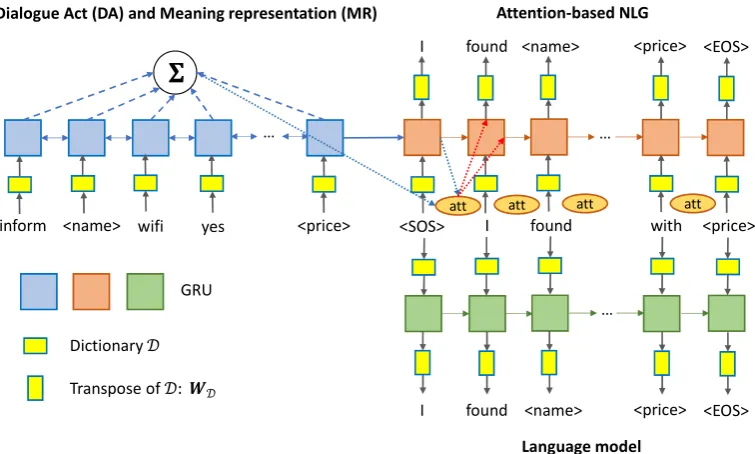
Figure 1: NLG-LM model structure. The encoder takes dialogue act (DA) and meaning representations (MR) as input. The decoder for NLG applies attention on encoder outputs, and the decoder for language modeling shares dictionary with NLG but uses a separate GRU unit.
Model E TV L H R
TGen 0.659 / / / /
Slug 0.662 0.529 0.524 / /
SCLSTM / 0.527 0.512 0.848 0.752 RALSTM / 0.541 0.525 0.898 0.779
[image:4.595.75.289.357.467.2]w/o LM 0.673 0.609 0.560 0.927 0.734 NLG-LM 0.684 0.617 0.586 0.939 0.795
Table 1: BLEU scores on E2E-NLG (E), TV, Laptop (L), Hotel (H) and Restaurant (R)testset. w/o LM is our model without language model task.
Model TGen Slug w/o LM NLG-LM
NIST 8.609 8.613 8.581 8.626
Table 2: NIST scores on E2E-NLGtestset.
Finally, we linearly combine the two loss func-tions into a single multi-task loss function:
L(θ) =LN LG(θ) +αLLM(θ) (12)
We depict our model structure in Figure 1. As shown, the dictionary D is shared between the NLG task and language modeling task.
4 Experiments
4.1 Datasets and settings
We evaluated the models on five datasets from dif-ferent domains, covering restaurant booking, hotel booking and retail. The largest dataset is from the E2E-NLG task (Novikova et al.,2017), consisting of 51.2K MR-utterance pairs in the restaurant do-main. We also use the four datasets from RNN-LG (Wen et al.,2016), including dialogue scenar-ios in TV retails, laptop retails, hotel-booking and restaurant-booking domains, with 14.1K, 26.5K, 8.7K and 8.5K samples respectively.
For fairness, we use the official evaluation scripts from E2E-NLG and RNN-LG (Wen et al.,
2016) to assess models. We use the BLEU-4 ( Pa-pineni et al., 2002) and NIST (Przybocki et al.,
2009) metrics.
E2E-NLG TV Laptop Hotel Restaurant
Dropout rate 0.4 0.2 0.2 0.3 0.3
Learning rate 0.005 0.001 0.001 0.005 0.001
Batch size 20 20 20 20 20
Dictionary dimension 100 50 50 200 50
RNN hidden size 512 128 512 256 512
Table 3: Hyperparameters of NLG-LM in experiments.
Baseline. Our baseline models include TGen (Duˇsek and Jurˇc´ıˇcek, 2016), SC-LSTM (Wen et al.,2015b), RALSTM (Tran and Nguyen,2017) and Slug (Juraska et al.,2018).
Training details.We use Adamax (Kingma and Ba, 2014) as the optimizer. We use teacher forc-ing, which means that during trainforc-ing, the decoder is always presented with the previous ground-truth token. The language modeling task is only used during training, and it uses utterances from the same batch as NLG task. The inference uses a beam search of width 10. We use the multi-task coefficientα= 0.5in all experiments. The hyper-parameters were chosen on the dev set with early stopping, as shown in Table3.
4.2 Result
We present our experimental results in Table1and
2. As shown, our model, NLG-LM, outperforms the baseline models in all 5 datasets. In E2E-NLG dataset, it achieves2.2%higher BLEU score and 0.013 higher NIST score than Slug. In TV, Laptop, Hotel and Restaurant datasets, NLG-LM greatly improves previously best result by 7.6%, 6.1%,
4.1%, and 1.6%, respectively. We also ran our model without the language modeling task as an ablation study, denoted byw/o LM. As seen, lan-guage modeling can improve the result by0.8%to
6.1%, or on average2.4%, which demonstrates the effectiveness of multi-task learning.
In the appendix, we examined some predicted samples generated from our model, which shows that the addition of the language model makes the generated responses more natural and variable.
Efficiency. We compared the training time of NLG-LM with that of w/o LM. As shown in Ta-ble 4, the additional language model only intro-duces23.6%more training time, since it does not involve expensive attention computation. There-fore, NLG-LM can offer more natural response generation with comparable efficiency.
NLG-LM w/o LM
Per-batch 618.87s 500.64s
Table 4: Running time per batch of NLG-LM and w/o LM on E2ENLG training set. The machine has an Intel Xeon CPU E5 and a Tesla v100 GPU.
5 Conclusions
In this paper, we propose a novel multi-task learn-ing method, NLG-LM. It incorporates a language model task into the response generation process as an unconditioned complementary process to boost the naturalness of generated utterances. We fit both tasks into a sequence-to-sequence struc-ture under a multi-task learning scheme. Em-pirical results show that NLG-LM significantly outperforms previous methods in 5 large-scale datasets with reasonable computational efficiency. Ablation studies show the effectiveness of using the language modeling task within a multi-task scheme.
Acknowledgement
We thank the anonymous reviewers for the insight-ful comments. We thank William Hinthorn for proof-reading our paper.
References
Adam Cheyer and Didier Guzzoni. 2014. Method and apparatus for building an intelligent automated as-sistant. US Patent 8,677,377.
Kyunghyun Cho, Bart Van Merri¨enboer, Caglar Gul-cehre, Dzmitry Bahdanau, Fethi Bougares, Holger Schwenk, and Yoshua Bengio. 2014. Learning phrase representations using rnn encoder-decoder for statistical machine translation. arXiv preprint arXiv:1406.1078.
scratch. Journal of machine learning research, 12(Aug):2493–2537.
Ondˇrej Duˇsek and Filip Jurˇc´ıˇcek. 2016. Sequence-to-sequence generation for spoken dialogue via deep syntax trees and strings. arXiv preprint arXiv:1606.05491.
Juraj Juraska, Panagiotis Karagiannis, Kevin K Bow-den, and Marilyn A Walker. 2018. A deep en-semble model with slot alignment for sequence-to-sequence natural language generation. arXiv preprint arXiv:1805.06553.
Diederik P Kingma and Jimmy Ba. 2014. Adam: A method for stochastic optimization. arXiv preprint arXiv:1412.6980.
Irene Langkilde and Kevin Knight. 1998. Gener-ation that exploits corpus-based statistical knowl-edge. In Proceedings of the 36th Annual Meet-ing of the Association for Computational LMeet-inguis- Linguis-tics and 17th International Conference on Compu-tational Linguistics-Volume 1, pages 704–710. As-sociation for Computational Linguistics.
Jiwei Li, Michel Galley, Chris Brockett, Jianfeng Gao, and Bill Dolan. 2015. A diversity-promoting objec-tive function for neural conversation models. arXiv preprint arXiv:1510.03055.
Jekaterina Novikova, Ondˇrej Duˇsek, and Verena Rieser. 2017. The e2e dataset: New challenges for end-to-end generation. arXiv preprint arXiv:1706.09254.
Kishore Papineni, Salim Roukos, Todd Ward, and Wei-Jing Zhu. 2002. Bleu: a method for automatic eval-uation of machine translation. In Proceedings of the 40th annual meeting on association for compu-tational linguistics, pages 311–318. Association for Computational Linguistics.
Mark Przybocki, Kay Peterson, S´ebastien Bronsart, and Gregory Sanders. 2009. The nist 2008 metrics for machine translation challengeoverview, method-ology, metrics, and results. Machine Translation, 23(2-3):71–103.
Brian Roark, Murat Saraclar, and Michael Collins. 2004. Corrective language modeling for large vo-cabulary asr with the perceptron algorithm. In
2004 IEEE International Conference on Acoustics, Speech, and Signal Processing, volume 1, pages I– 749. IEEE.
Alexander M Rush, Sumit Chopra, and Jason We-ston. 2015. A neural attention model for ab-stractive sentence summarization. arXiv preprint arXiv:1509.00685.
Ilya Sutskever, Oriol Vinyals, and Quoc V Le. 2014. Sequence to sequence learning with neural net-works. InAdvances in neural information process-ing systems, pages 3104–3112.
Van-Khanh Tran and Le-Minh Nguyen. 2017. Natural language generation for spoken dialogue system us-ing rnn encoder-decoder networks. arXiv preprint arXiv:1706.00139.
Tsung-Hsien Wen, Milica Gasic, Dongho Kim, Nikola Mrksic, Pei-Hao Su, David Vandyke, and Steve Young. 2015a. Stochastic language generation in dialogue using recurrent neural networks with convolutional sentence reranking. arXiv preprint arXiv:1508.01755.
Tsung-Hsien Wen, Milica Gasic, Nikola Mrksic, Lina M Rojas-Barahona, Pei-Hao Su, David Vandyke, and Steve Young. 2016. Multi-domain neural network language generation for spoken di-alogue systems.arXiv preprint arXiv:1603.01232.
Tsung-Hsien Wen, Milica Gasic, Nikola Mrksic, Pei-Hao Su, David Vandyke, and Steve Young. 2015b. Semantically conditioned lstm-based natural lan-guage generation for spoken dialogue systems.
arXiv preprint arXiv:1508.01745.