Towards an Iterative Reinforcement Approach for Simultaneous
Document Summarization and Keyword Extraction
Xiaojun Wan Jianwu Yang Jianguo Xiao
Institute of Computer Science and Technology
Peking University, Beijing 100871, China
{wanxiaojun,yangjianwu,xiaojianguo}@icst.pku.edu.cn
Abstract
Though both document summarization and keyword extraction aim to extract concise representations from documents, these two tasks have usually been investigated inde-pendently. This paper proposes a novel it-erative reinforcement approach to simulta-neously extracting summary and keywords from single document under the assump-tion that the summary and keywords of a document can be mutually boosted. The approach can naturally make full use of the reinforcement between sentences and key-words by fusing three kinds of relation-ships between sentences and words, either homogeneous or heterogeneous. Experi-mental results show the effectiveness of the proposed approach for both tasks. The cor-pus-based approach is validated to work almost as well as the knowledge-based ap-proach for computing word semantics.
1
Introduction
Text summarization is the process of creating a compressed version of a given document that de-livers the main topic of the document. Keyword extraction is the process of extracting a few salient words (or phrases) from a given text and using the words to represent the text. The two tasks are simi-lar in essence because they both aim to extract concise representations for documents. Automatic text summarization and keyword extraction have drawn much attention for a long time because they both are very important for many text applications, including document retrieval, document clustering, etc. For example, keywords of a document can be
used for document indexing and thus benefit to improve the performance of document retrieval, and document summary can help to facilitate users to browse the search results and improve users’ search experience.
Text summaries and keywords can be either query-relevant or generic. Generic summary and keyword should reflect the main topics of the document without any additional clues and prior knowledge. In this paper, we focus on generic document summarization and keyword extraction for single documents.
Document summarization and keyword extrac-tion have been widely explored in the natural lan-guage processing and information retrieval com-munities. A series of workshops and conferences on automatic text summarization (e.g. SUMMAC, DUC and NTCIR) have advanced the technology and produced a couple of experimental online sys-tems. In recent years, graph-based ranking algo-rithms have been successfully used for document summarization (Mihalcea and Tarau, 2004, 2005; ErKan and Radev, 2004) and keyword extraction (Mihalcea and Tarau, 2004). Such algorithms make use of “voting” or “recommendations” between sentences (or words) to extract sentences (or key-words). Though the two tasks essentially share much in common, most algorithms have been de-veloped particularly for either document summari-zation or keyword extraction.
Zha (2002) proposes a method for simultaneous keyphrase extraction and text summarization by using only the heterogeneous sentence-to-word relationships. Inspired by this, we aim to take into account all the three kinds of relationships among sentences and words (i.e. the homogeneous tionships between words, the homogeneous rela-tionships between sentences, and the heterogene-ous relationships between words and sentences) in
a unified framework for both document summari-zation and keyword extraction. The importance of a sentence (word) is determined by both the tance of related sentences (words) and the impor-tance of related words (sentences). The proposed approach can be considered as a generalized form of previous graph-based ranking algorithms and Zha’s work (Zha, 2002).
In this study, we propose an iterative reinforce-ment approach to realize the above idea. The pro-posed approach is evaluated on the DUC2002 dataset and the results demonstrate its effectiveness for both document summarization and keyword extraction. Both knowledge-based approach and corpus-based approach have been investigated to compute word semantics and they both perform very well.
The rest of this paper is organized as follows: Section 2 introduces related works. The details of the proposed approach are described in Section 3. Section 4 presents and discusses the evaluation results. Lastly we conclude our paper in Section 5.
2
Related Works
2.1 Document Summarization
Generally speaking, single document summariza-tion methods can be either extracsummariza-tion-based or ab-straction-based and we focus on extraction-based methods in this study.
Extraction-based methods usually assign a sali-ency score to each sentence and then rank the sen-tences in the document. The scores are usually computed based on a combination of statistical and linguistic features, including term frequency, sen-tence position, cue words, stigma words, topic sig-nature (Hovy and Lin, 1997; Lin and Hovy, 2000), etc. Machine learning methods have also been em-ployed to extract sentences, including unsupervised methods (Nomoto and Matsumoto, 2001) and su-pervised methods (Kupiec et al., 1995; Conroy and O’Leary, 2001; Amini and Gallinari, 2002; Shen et al., 2007). Other methods include maximal mar-ginal relevance (MMR) (Carbonell and Goldstein, 1998), latent semantic analysis (LSA) (Gong and Liu, 2001). In Zha (2002), the mutual reinforce-ment principle is employed to iteratively extract key phrases and sentences from a document.
Most recently, graph-based ranking methods, in-cluding TextRank ((Mihalcea and Tarau, 2004, 2005) and LexPageRank (ErKan and Radev, 2004)
have been proposed for document summarization. Similar to Kleinberg’s HITS algorithm (Kleinberg, 1999) or Google’s PageRank (Brin and Page, 1998), these methods first build a graph based on the similarity between sentences in a document and then the importance of a sentence is determined by taking into account global information on the graph recursively, rather than relying only on local sentence-specific information.
2.2 Keyword Extraction
Keyword (or keyphrase) extraction usually in-volves assigning a saliency score to each candidate keyword by considering various features. Krulwich and Burkey (1996) use heuristics to extract key-phrases from a document. The heuristics are based on syntactic clues, such as the use of italics, the presence of phrases in section headers, and the use of acronyms. Muñoz (1996) uses an unsupervised learning algorithm to discover two-word key-phrases. The algorithm is based on Adaptive Reso-nance Theory (ART) neural networks. Steier and Belew (1993) use the mutual information statistics to discover two-word keyphrases.
Supervised machine learning algorithms have been proposed to classify a candidate phrase into either keyphrase or not. GenEx (Turney, 2000) and Kea (Frank et al., 1999; Witten et al., 1999) are two typical systems, and the most important fea-tures for classifying a candidate phrase are the fre-quency and location of the phrase in the document. More linguistic knowledge (such as syntactic fea-tures) has been explored by Hulth (2003). More recently, Mihalcea and Tarau (2004) propose the TextRank model to rank keywords based on the co-occurrence links between words.
3
Iterative Reinforcement Approach
3.1 Overview
The proposed approach is intuitively based on the following assumptions:
Assumption 1: A sentence should be salient if it
is heavily linked with other salient sentences, and a word should be salient if it is heavily linked with other salient words.
Assumption 2: A sentence should be salient if it
contains many salient words, and a word should be salient if it appears in many salient sentences.
between homogeneous objects to rank objects. The second assumption is similar to HITS if words and sentences are considered as authorities and hubs respectively. In other words, the proposed ap-proach aims to fuse the ideas of PageRank and HITS in a unified framework.
In more detail, given the heterogeneous data points of sentences and words, the following three kinds of relationships are fused in the proposed approach:
SS-Relationship: It reflects the homogeneous
relationships between sentences, usually computed by their content similarity.
WW-Relationship: It reflects the homogeneous
relationships between words, usually computed by knowledge-based approach or corpus-based ap-proach.
SW-Relationship: It reflects the heterogeneous
relationships between sentences and words, usually computed as the relative importance of a word in a sentence.
[image:3.612.89.284.367.505.2]Figure 1 gives an illustration of the relationships.
Figure 1. Illustration of the Relationships
The proposed approach first builds three graphs to reflect the above relationships respectively, and then iteratively computes the saliency scores of the sentences and words based on the graphs. Finally, the algorithm converges and each sentence or word gets its saliency score. The sentences with high saliency scores are chosen into the summary, and the words with high saliency scores are combined to produce the keywords.
3.2 Graph Building
3.2.1 Sentence-to-Sentence Graph ( SS-Graph) Given the sentence collection S={si | 1IiIm} of a
document, if each sentence is considered as a node,
the sentence collection can be modeled as an undi-rected graph by generating an edge between two sentences if their content similarity exceeds 0, i.e. an undirected link between si and sj (iKj) is
con-structed and the associated weight is their content similarity. Thus, we construct an undirected graph GSS to reflect the homogeneous relationship
be-tween sentences. The content similarity bebe-tween two sentences is computed with the cosine measure. We use an adjacency matrix Uto describe GSS with
each entry corresponding to the weight of a link in the graph. U= [Uij]m×mis defined as follows:
π ◊
otherwise ,
j , if i s s
s s
U i j
j i
ij
0
r r
r r
(1)
where
s
iands
r
j are the corresponding term vec-tors of sentences si and sjrespectively. The weightassociated with term t is calculated with tft.isft,
where tft is the frequency of term tin the sentence
and isftis the inverse sentence frequency of term t,
i.e. 1+log(N/nt), where N is the total number of
sentences and nt is the number of sentences
con-taining term t in a background corpus. Note that other measures (e.g. Jaccard, Dice, Overlap, etc.) can also be explored to compute the content simi-larity between sentences, and we simply choose the cosine measure in this study.
Then U is normalized to U~ as follows to make the sum of each row equal to 1:
π
erwise , oth
U , if U U
U
m
j ij m
j ij ij
ij 0
0 ~
1
1 (2)
3.2.2 Word-to-Word Graph ( WW-Graph)
Given the word collection T={tj|1IjIn} of a
docu-ment1, the semantic similarity between any two words ti and tj can be computed using approaches
that are either knowledge-based or corpus-based (Mihalcea et al., 2006).
Knowledge-based measures of word semantic similarity try to quantify the degree to which two words are semantically related using information drawn from semantic networks. WordNet (Fell-baum, 1998) is a lexical database where each
1The stopwords defined in the Smart system have been
re-moved from the collection. sentence
word
SS
unique meaning of a word is represented by a synonym set or synset. Each synset has a gloss that defines the concept that it represents. Synsets are connected to each other through explicit semantic relations that are defined in WordNet. Many ap-proaches have been proposed to measure semantic relatedness based on WordNet. The measures vary from simple edge-counting to attempt to factor in peculiarities of the network structure by consider-ing link direction, relative path, and density, such as vector,lesk,hso, lch,wup,path,res, lin and jcn (Pedersen et al., 2004). For example, “cat” and “dog” has higher semantic similarity than “cat” and “computer”. In this study, we implement the vector measure to efficiently evaluate the similari-ties of a large number of word pairs. The vector measure (Patwardhan, 2003) creates a co– occurrence matrix from a corpus made up of the WordNet glosses. Each content word used in a WordNet gloss has an associated context vector. Each gloss is represented by a gloss vector that is the average of all the context vectors of the words found in the gloss. Relatedness between concepts is measured by finding the cosine between a pair of gloss vectors.
Corpus-based measures of word semantic simi-larity try to identify the degree of simisimi-larity be-tween words using information exclusively derived from large corpora. Such measures as mutual in-formation (Turney 2001), latent semantic analysis (Landauer et al., 1998), log-likelihood ratio (Dun-ning, 1993) have been proposed to evaluate word semantic similarity based on the co-occurrence information on a large corpus. In this study, we simply choose the mutual information to compute the semantic similarity between word ti and tjas
follows:
) ( ) (
) ( log
) (
j i
j i j
i
t p t p
,t t p N ,t
t
sim (3)
which indicates the degree of statistical depend-ence between tiand tj. Here, Nis the total number
of words in the corpus and p(ti) and p(tj) are
re-spectively the probabilities of the occurrences of ti
and tj, i.e. count(ti)/N and count(tj)/N, where
count(ti) and count(tj) are the frequencies of tiand tj.
p(ti, tj) is the probability of the co-occurrence of ti
and tjwithin a window with a predefined size k, i.e.
count(ti, tj)/N, where count(ti, tj) is the number of
the times tiand tjco-occur within the window.
Similar to the SS-Graph, we can build an undi-rected graph GWW to reflect the homogeneous
rela-tionship between words, in which each node corre-sponds to a word and the weight associated with the edge between any different word ti and tj is
computed by either the WordNet-based vector measure or the corpus-based mutual information measure. We use an adjacency matrix V to de-scribe GWW with each entry corresponding to the
weight of a link in the graph. V= [Vij]n×n, where Vij
=sim(ti, tj)if iKjand Vij=0 if i=j.
Then V is similarly normalized to V~ to make the sum of each row equal to 1.
3.2.3 Sentence-to-Word Graph ( SW-Graph) Given the sentence collection S={si | 1IiIm} and
the word collection T={tj|1IjIn } of a document,
we can build a weighted bipartite graph GSW from S
and T in the following way: if word tjappears in
sentence si, we then create an edge between siand
tj. A nonnegative weight aff(si,tj) is specified on the
edge, which is proportional to the importance of word tjin sentence si, computed as follows:
i
j j
s t
t t
t t j i
isf tf
isf tf ,t
s
aff( ) (4)
where t represents a unique term in si and tft, isft
are respectively the term frequency in the sentence and the inverse sentence frequency.
We use an adjacency (affinity) matrix W=[Wij]m×n to describe GSW with each entry Wij
corresponding to aff(si,tj). Similarly, W is
normal-ized to W~ to make the sum of each row equal to 1. In addition, we normalize the transpose of W, i.e. WT, to Wˆ to make the sum of each row in WT
equal to 1.
3.3 Reinforcement Algorithm
We use two column vectors u=[u(si)]m×1 and v =[v(tj)]n×1 to denote the saliency scores of the sen-tences and words in the specified document. The assumptions introduced in Section 3.1 can be ren-dered as follows:
j ji j
i U u s
s
u( ) ~ ( )
(5)
i ij i
j V v t
t
v( ) ~ ( )
(6)
j ji j
i W v t
s
u( ) ˆ ( )
i ij i
j
W
u
s
t
v
(
)
~
(
)
(8)
After fusing the above equations, we can obtain the following iterative forms:
n
j ji j
m
j ji j
i * U u s ) W v t
s u
1 1
) ( ˆ )
( ~ )
( (9)
m
i
i ij n
i
i ij
j * V v t ) W u s
t v
1 1
) ( ~ )
( ~ )
( (10)
And the matrix form is:
v
W
u
U
u
*
~
T)
ˆ
T (11)u
W
v
V
v
*
~
T)
~
T (12)where *and )specify the relative contributions to the final saliency scores from the homogeneous nodes and the heterogeneous nodes and we have
*+)=1. In order to guarantee the convergence of the iterative form, u and v are normalized after each iteration.
For numerical computation of the saliency scores, the initial scores of all sentences and words are set to 1 and the following two steps are alter-nated until convergence,
1. Compute and normalize the scores of sen-tences:
) (n-T )
(n-T
(n)
*
U
~
u
1)
W
ˆ
v
1u
,1
(n) (n)
(n) u / u
u
2. Compute and normalize the scores of words:
) (n-T )
(n-T
(n)
*
V
~
v
1)
W
~
u
1v
,1
(n) (n) (n) v / v
v
where u(n)and v(n)denote the vectors computed at the n-th iteration.
Usually the convergence of the iteration algo-rithm is achieved when the difference between the scores computed at two successive iterations for any sentences and words falls below a given threshold (0.0001 in this study).
4
Empirical Evaluation
4.1 Summarization Evaluation
4.1.1 Evaluation Setup
We used task 1 of DUC2002 (DUC, 2002) for evaluation. The task aimed to evaluate generic summaries with a length of approximately 100 words or less. DUC2002 provided 567 English news articles collected from TREC-9 for
single-document summarization task. The sentences in each article have been separated and the sentence information was stored into files.
In the experiments, the background corpus for using the mutual information measure to compute word semantics simply consisted of all the docu-ments from DUC2001 to DUC2005, which could be easily expanded by adding more documents. The stopwords were removed and the remaining words were converted to the basic forms based on WordNet. Then the semantic similarity values be-tween the words were computed.
We used the ROUGE (Lin and Hovy, 2003) toolkit (i.e.ROUGEeval-1.4.2 in this study) for evaluation, which has been widely adopted by DUC for automatic summarization evaluation. It measured summary quality by counting overlap-ping units such as the n-gram, word sequences and word pairs between the candidate summary and the reference summary. ROUGE toolkit reported sepa-rate scores for 1, 2, 3 and 4-gram, and also for longest common subsequence co-occurrences. Among these different scores, unigram-based ROUGE score (ROUGE-1) has been shown to agree with human judgment most (Lin and Hovy, 2003). We showed three of the ROUGE metrics in the experimental results: ROUGE-1 (unigram-based), 2 (bigram-(unigram-based), and ROUGE-W (based on weighted longest common subse-quence, weight=1.2).
In order to truncate summaries longer than the length limit, we used the “-l” option2 in the ROUGE toolkit.
4.1.2 Evaluation Results
For simplicity, the parameters in the proposed ap-proach are simply set to *=)=0.5, which means that the contributions from sentences and words are equally important. We adopt the WordNet-based vector measure (WN) and the corpus-based mutual information measure (MI) for computing the semantic similarity between words. When us-ing the mutual information measure, we heuristi-cally set the window size kto 2, 5 and 10, respec-tively.
The proposed approaches with different word similarity measures (WN and MI) are compared
2The “-l” option is very important for fair comparison. Some
with two solid baselines: SentenceRank and Mutu-alRank. SentenceRank is proposed in Mihalcea and Tarau (2004) to make use of only the sentence-to-sentence relationships to rank sentence-to-sentences, which outperforms most popular summarization methods. MutualRank is proposed in Zha (2002) to make use of only the sentence-to-word relationships to rank sentences and words. For all the summarization methods, after the sentences are ranked by their saliency scores, we can apply a variant form of the MMR algorithm to remove redundancy and choose both the salient and novel sentences to the sum-mary. Table 1 gives the comparison results of the methods before removing redundancy and Table 2 gives the comparison results of the methods after removing redundancy.
System ROUGE-1 ROUGE-2 ROUGE-W
Our Approach
(WN) 0.47100*# 0.20424*# 0.16336# Our Approach
(MI:k=2) 0.46711# 0.20195# 0.16257# Our Approach
(MI:k=5) 0.46803# 0.20259# 0.16310# Our Approach
(MI:k=10) 0.46823# 0.20301# 0.16294# SentenceRank 0.45591 0.19201 0.15789
MutualRank 0.43743 0.17986 0.15333 Table 1. Summarization Performance before
Re-moving Redundancy (w/o MMR)
System ROUGE-1 ROUGE-2 ROUGE-W
Our Approach
(WN) 0.47329*# 0.20249# 0.16352# Our Approach
(MI:k=2) 0.47281# 0.20281# 0.16373# Our Approach
(MI:k=5) 0.47282# 0.20249# 0.16343# Our Approach
(MI:k=10) 0.47223# 0.20225# 0.16308# SentenceRank 0.46261 0.19457 0.16018
MutualRank 0.43805 0.17253 0.15221 Table 2. Summarization Performance after
Remov-ing Redundancy (w/ MMR)
(*indicates that the improvement over SentenceRank is
sig-nificant and #indicates that the improvement over
Mutual-Rank is significant, both by comparing the 95% confidence intervals provided by the ROUGE package.)
Seen from Tables 1 and 2, the proposed ap-proaches always outperform the two baselines over all three metrics with different word semantic measures. Moreover, no matter whether the MMR algorithm is applied or not, almost all performance improvements over MutualRank are significant
and the ROUGE-1 performance improvements over SentenceRank are significant when using WordNet-based measure (WN). Word semantics can be naturally incorporated into the computation process, which addresses the problem that Sen-tenceRank cannot take into account word seman-tics, and thus improves the summarization per-formance. We also observe that the corpus-based measure (MI) works almost as well as the knowl-edge-based measure (WN) for computing word semantic similarity.
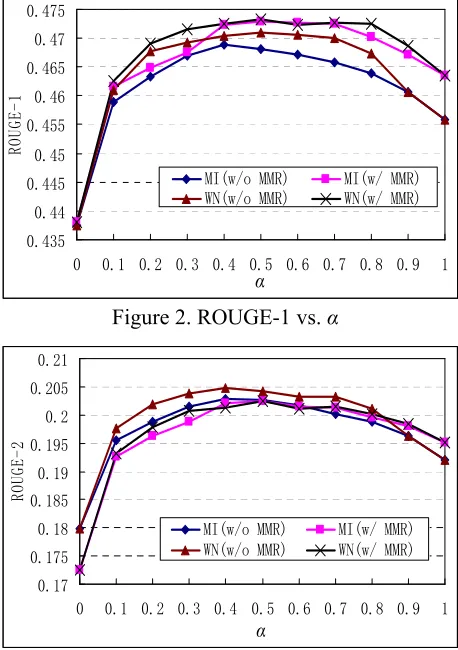
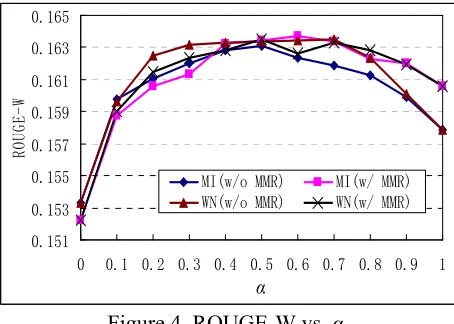
In order to better understand the relative contri-butions from the sentence nodes and the word nodes, the parameter * is varied from 0 to 1. The larger *is, the more contribution is given from the sentences through the SS-Graph, while the less contribution is given from the words through the SW-Graph. Figures 2-4 show the curves over three ROUGE scores with respect to *. Without loss of generality, we use the case of k=5 for the MI measure as an illustration. The curves are similar to Figures 2-4 when k=2 and k=10.
0.435 0.44 0.445 0.45 0.455 0.46 0.465 0.47 0.475
0 0.1 0.2 0.3 0.4 0.5 0.6 0.7 0.8 0.9 1
*
RO
UG
E-1
[image:6.612.314.543.367.692.2]MI(w/o MMR) MI(w/ MMR) WN(w/o MMR) WN(w/ MMR)
Figure 2. ROUGE-1 vs. *
0.17 0.175 0.18 0.185 0.19 0.195 0.2 0.205 0.21
0 0.1 0.2 0.3 0.4 0.5 0.6 0.7 0.8 0.9 1
*
RO
U
GE
-2
MI(w/o MMR) MI(w/ MMR) WN(w/o MMR) WN(w/ MMR)
0.151 0.153 0.155 0.157 0.159 0.161 0.163 0.165
0 0.1 0.2 0.3 0.4 0.5 0.6 0.7 0.8 0.9 1
*
RO
U
GE
-W
[image:7.612.74.301.73.235.2]MI(w/o MMR) MI(w/ MMR) WN(w/o MMR) WN(w/ MMR)
Figure 4. ROUGE-W vs. *
Seen from Figures 2-4, no matter whether the MMR algorithm is applied or not (i.e. w/o MMR or w/ MMR), the ROUGE scores based on either word semantic measure (MI or WN) achieves the peak when *is set between 0.4 and 0.6. The per-formance values decrease sharply when * is very large (near to 1) or very small (near to 0). The curves demonstrate that both the contribution from the sentences and the contribution from the words are important for ranking sentences; moreover, the contributions are almost equally important. Loss of either contribution will much deteriorate the final performance.
Similar results and observations have been ob-tained on task 1 of DUC2001 in our study and the details are omitted due to page limit.
4.2 Keyword Evaluation
4.1.1 Evaluation Setup
In this study we performed a preliminary evalua-tion of keyword extracevalua-tion. The evaluaevalua-tion was conducted on the single word level instead of the multi-word phrase (n-gram) level, in other words, we compared the automatically extracted unigrams (words) and the manually labeled unigrams (words). The reasons were that: 1) there existed partial matching between phrases and it was not trivial to define an accurate measure to evaluate phrase quality; 2) each phrase was in fact com-posed of a few words, so the keyphrases could be obtained by combining the consecutive keywords.
We used 34 documents in the first five docu-ment clusters in DUC2002 dataset (i.e. d061-d065). At most 10 salient words were manually labeled for each document to represent the document and the average number of manually assigned
key-words was 6.8. Each approach returned 10 key-words with highest saliency scores as the keywords. The extracted 10 words were compared with the manu-ally labeled keywords. The words were converted to their corresponding basic forms based on WordNet before comparison. The precision p, re-call r, F-measure (F=2pr/(p+r)) were obtained for each document and then the values were averaged over all documents for evaluation purpose.
4.1.2 Evaluation Results
Table 3 gives the comparison results. The proposed approaches are compared with two baselines: WordRank and MutualRank. WordRank is pro-posed in Mihalcea and Tarau (2004) to make use of only the co-occurrence relationships between words to rank words, which outperforms tradi-tional keyword extraction methods. The window size kfor WordRank is also set to 2, 5 and 10, re-spectively.
System Precision Recall F-measure
Our Approach
(WN) 0.413 0.504 0.454 Our Approach
(MI:k=2) 0.428 0.485 0.455 Our Approach
(MI:k=5) 0.425 0.491 0.456 Our Approach
(MI:k=10) 0.393 0.455 0.422 WordRank
(k=2) 0.373 0.412 0.392
WordRank
(k=5) 0.368 0.422 0.393
WordRank
[image:7.612.307.548.336.511.2](k=10) 0.379 0.407 0.393 MutualRank 0.355 0.397 0.375
Table 3. The Performance of Keyword Extraction Seen from the table, the proposed approaches significantly outperform the baseline approaches. Both the corpus-based measure (MI) and the knowledge-based measure (WN) perform well on the task of keyword extraction.
A running example is given below to demon-strate the results:
Document ID: D062/AP891018-0301 Labeled keywords:
insurance earthquake insurer damage california Francisco pay
Extracted keywords:
WN: insurance earthquake insurer quake california spokesman cost million wednesday damage
5
Conclusion and Future Work
In this paper we propose a novel approach to si-multaneously document summarization and key-word extraction for single documents by fusing the sentence, word-to-word, sentence-to-word relationships in a unified framework. The semantics between words computed by either cor-pus-based approach or knowledge-based approach can be incorporated into the framework in a natural way. Evaluation results demonstrate the perform-ance improvement of the proposed approach over the baselines for both tasks.
In this study, only the mutual information meas-ure and the vector measmeas-ure are employed to com-pute word semantics, and in future work many other measures mentioned earlier will be investi-gated in the framework in order to show the ro-bustness of the framework. The evaluation of key-word extraction is preliminary in this study, and we will conduct more thorough experiments to make the results more convincing. Furthermore, the proposed approach will be applied to multi-document summarization and keyword extraction, which are considered more difficult than single document summarization and keyword extraction.
Acknowledgements
This work was supported by the National Science Foundation of China (60642001).
References
M. R. Amini and P. Gallinari. 2002. The use of unlabeled data to improve supervised learning for text summarization. In Pro-ceedings of SIGIR2002, 105-112.
S. Brin and L. Page. 1998. The anatomy of a large-scale hypertex-tual Web search engine. Computer Networks and ISDN Sys-tems, 30(1–7).
J. Carbonell and J. Goldstein. 1998. The use of MMR, diversity-based reranking for reordering documents and producing summaries. In Proceedings of SIGIR-1998, 335-336.
J. M. Conroy and D. P. O’Leary. 2001. Text summarization via Hidden Markov Models. In Proceedings of SIGIR2001, 406-407.
DUC. 2002. The Document Understanding Workshop 2002. http://www-nlpir.nist.gov/projects/duc/guidelines/2002.html T. Dunning. 1993. Accurate methods for the statistics of surprise
and coincidence. Computational Linguistics 19, 61–74. G. ErKan and D. R. Radev. 2004. LexPageRank: Prestige in
multi-document text summarization. In Proceedings of EMNLP2004.
C. Fellbaum. 1998. WordNet: An Electronic Lexical Database. The MIT Press.
E. Frank, G. W. Paynter, I. H. Witten, C. Gutwin, and C. G. Nevill-Manning. 1999. Domain-specific keyphrase extraction.
Proceedings of IJCAI-99, pp. 668-673.
Y. H. Gong and X. Liu. 2001. Generic text summarization using Relevance Measure and Latent Semantic Analysis. In Proceed-ings of SIGIR2001, 19-25.
E. Hovy and C. Y. Lin. 1997. Automated text summarization in SUMMARIST. In Proceeding of ACL’1997/EACL’1997 Wor-shop on Intelligent Scalable Text Summarization.
A. Hulth. 2003. Improved automatic keyword extraction given more linguistic knowledge. In Proceedings of EMNLP2003, Japan, August.
J. M. Kleinberg. 1999. Authoritative sources in a hyperlinked environment. Journal of the ACM, 46(5):604–632.
B. Krulwich and C. Burkey. 1996. Learning user information interests through the extraction of semantically significant phrases. In AAAI 1996 Spring Symposium on Machine Learn-ing in Information Access.
J. Kupiec, J. Pedersen, and F. Chen. 1995. A.trainable document summarizer. In Proceedings of SIGIR1995, 68-73.
T. K. Landauer, P. Foltz, and D. Laham. 1998. Introduction to latent semantic analysis. Discourse Processes 25.
C. Y. Lin and E. Hovy. 2000. The automated acquisition of topic signatures for text Summarization. In Proceedings of ACL-2000, 495-501.
C.Y. Lin and E.H. Hovy. 2003. Automatic evaluation of summa-ries using n-gram co-occurrence statistics. In Proceedings of HLT-NAACL2003, Edmonton, Canada, May.
R. Mihalcea, C. Corley, and C. Strapparava. 2006. Corpus-based and knowledge-based measures of text semantic similarity. In
Proceedings of AAAI-06.
R. Mihalcea and P. Tarau. 2004. TextRank: Bringing order into texts. In Proceedings of EMNLP2004.
R. Mihalcea and P.Tarau. 2005. A language independent algo-rithm for single and multiple document summarization. In
Proceedings of IJCNLP2005.
A. Muñoz. 1996. Compound key word generation from document databases using a hierarchical clustering ART model. Intelli-gent Data Analysis, 1(1).
T. Nomoto and Y. Matsumoto. 2001. A new approach to unsuper-vised text summarization. In Proceedings of SIGIR2001, 26-34. S. Patwardhan. 2003. Incorporating dictionary and corpus
infor-mation into a context vector measure of semantic relatedness.
Master’s thesis, Univ. of Minnesota, Duluth.
T. Pedersen, S. Patwardhan, and J. Michelizzi. 2004. Word-Net::Similarity – Measuring the relatedness of concepts. In
Proceedings of AAAI-04.
D. Shen, J.-T. Sun, H. Li, Q. Yang, and Z. Chen. 2007. Document Summarization using Conditional Random Fields. In Proceed-ings of IJCAI 07.
A. M. Steier and R. K. Belew. 1993. Exporting phrases: A statisti-cal analysis of topistatisti-cal language. In Proceedings of Second Symposium on Document Analysis and Information Retrieval, pp. 179-190.
P. D. Turney. 2000. Learning algorithms for keyphrase extraction.
Information Retrieval, 2:303-336.
P. Turney. 2001. Mining the web for synonyms: PMI-IR versus LSA on TOEFL. In Proceedings of ECML-2001.
I. H. Witten, G. W. Paynter, E. Frank, C. Gutwin, and C. G. Nevill-Manning. 1999. KEA: Practical automatic keyphrase extraction. Proceedings of Digital Libraries 99 (DL'99), pp. 254-256.