Gadolinium Complexes: An Experimental Study in Rabbits
Michael A. Ibrahim, Victor M. Haughton, and James S. Hyde
PURPOSE: To measure the rate of enhancement in immature intervertebral disks in comparison
with that of mature disks after intravenous administration of gadolinium-containing contrast media.
METHODS: Four rabbits were imaged with MR for 120 minutes after the injection of gadopentetate
dimeglumine, gadoteridol, or gadodiamide. Contrast enhancement was measured in the lumbar intervertebral disks on each image. The rate and magnitude of enhancement in the immature and mature disks were compared. RESULTS: Contrast enhancement was detected in intervertebral disks with all three contrast media. Enhancement was significantly greater in immature than in mature animals. CONCLUSION: Greater enhancement in immature disks is consistent with a lower concentration of fixed negative charges in the glycosaminoglycans of the disk.
Index terms: Spine, intervertebral disks; Spine, magnetic resonance; Magnetic resonance, contrast
enhancement; Animal studies
AJNR Am J Neuroradiol16:1307–1311, June 1995
Low-molecular-weight molecules such as ox-ygen, sulfate, and gadolinium chelates diffuse into the intervertebral disk (1–5). Because the gadolinium chelates diffuse into the disk, con-trast enhancement of the disk is detected in magnetic resonance (MR) imaging if doses of contrast medium and delay between injection and imaging are sufficient (4, 5). The rate of diffusion through the disk is related to the charge on the molecule, the molecular weight, and other factors. The ionic contrast medium
gadopentetate dimeglumine diffuses more
slowly through cartilage than do the nonionic media gadoteridol and gadodiamide, presum-ably because of the fixed negative charges in cartilage that impede the diffusion of charged particles (4). Hypothetically, the composition of the disk, which is altered by maturation and degeneration, affects the diffusion of the
gado-linium chelates through the matrix. To test this hypothesis, we measured the diffusion of gado-linium chelates through immature disks and compared the rates with those in mature disks.
Methods
Four immature female New Zealand White rabbits, 2.2 to 2.3 kg in weight, underwent MR studies with three con-trast media. Each rabbit had MR with gadopentetate dime-glumine (Magnevist, Berlex Laboratories, Seacacus, NJ), gadoteridol (ProHance, Bristol-Meyer Squibb, Princeton, NJ), and gadodiamide (Omniscan, Sanofi-Winthrop, New York, NY). In each rabbit, each contrast medium was ad-ministered in a dose of 0.3 mmol/kg, with 1 week between studies and with the order or administration randomized.
For MR, animals were sedated with 2 mL of a mixture of 20 mg/mL ketamine hydrochloride (Ketaset, Aveco, Fort Dodge, Iowa) and 2 mg/mL xylazine hydrochloride (Rompun, Mobay, Shawnee, Kan) intramuscularly and supplementary doses of 0.5 mL intravenously every 40 minutes. The posterior auricular vein was cannulated with a 25-gauge needle, and 0.9% saline was administered intravenously at a rate of 40 mL/h. The rabbits were posi-tioned supine on a quadrature surface coil (10) in a 1.5-T imager. Locater images and then sagittal images through the lumbar spine were obtained with a spin-echo pulse sequence providing small fields of view (500/25/2 [repe-tition time/echo time/excitations], 6-cm field of view, 3-mm section thickness) (Jesmanowicz A, Hyde JS,
Received January 25, 1994; accepted after revision January 6, 1995. From the Biophysics Research Institute, Department of Radiology, Medical College of Wisconsin, Milwaukee.
Address reprint requests to Victor M. Haughton, MD, Department of Radiology, Medical College of Wisconsin, Doyne Clinic, 8700 W Wisconsin Ave, Milwaukee, WI 53226.
AJNR 16:1307–1311, June 1995 0195-6108/95/1606 –1307
qAmerican Society of Neuroradiology
Kneeland JB, “Pulse Sequences for Small Fields of View” [abstract], presented at the Seventh Annual Meeting of the Society of Magnetic Resonance, August 20 –26, 1988, San Francisco, Calif) and no phase wrap. The contrast medium was injected as a bolus through the venous cannula. Im-ages were repeated at 2, 10, 20, 30, 45, 60, 90, and 120 minutes and inspected for evidence of enhancement. Sig-nal intensity in the midline section in the intervertebral disks closest to the coil was measured with an elliptical cursor 2 mm2in area. Contrast enhancement was calcu-lated as the change in signal intensity from the baseline divided by the baseline signal intensity. Contrast enhance-ment, plotted as a function of time for each contrast me-dium as in a previous study (5), was compared to the plots from the previous study in which gadopentetate dimeglu-mine or gadoteridol were administered intravenously to 4 adult New Zealand white rabbits, 3.4 to 4.3 kg in weight
(5). The same experimental protocol was used in this and in the previous study, except that gadodiamide was not used. The contrast enhancement measurements in both mature and immature disks were fitted to a function:
CE(t)5K[12exp(2at)]
in which K represents an enhancement coefficient; t, the time after injection; anda, a rate constant. The values of K and a were calculated for each data set. The K and a values were averaged for mature and immature disks and contrast medium. The K andavalues were compared for the two contrast media and for the mature and immature disk.
[image:2.612.58.556.300.715.2]Differences between groups were tested for significance by means of the one-tailedttest.
Results
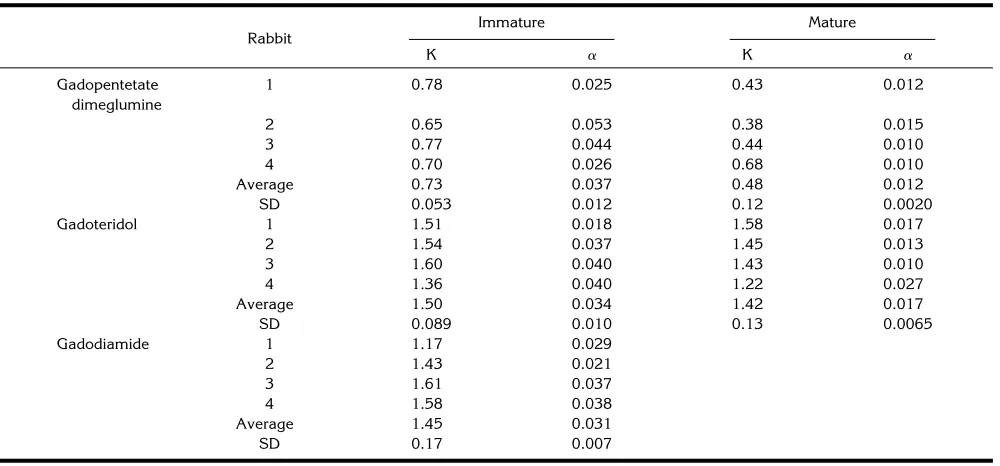
Each of the 12 MR studies was technically adequate for measuring contrast enhancement. Contrast enhancement was evident in the inter-vertebral disks in each sequence of images, usually by 20 minutes. Enhancement was con-spicuously greater with the nonionic media (gadoteridol, gadodiamide) than with the ionic medium (gadopentetate dimeglumine) (Fig 1). Contrast enhancement in the intervertebral disk in the four immature rabbits is plotted in Figure 2A, and contrast enhancement in four adult rab-bits studied similarly is plotted in Figure 2B. The contrast enhancement coefficients and rate constants for the three contrast media, together with the same constants for mature rabbits, are listed in the Table and plotted in Figure 3.
Differences between Immature and Mature Intervertebral Disks
The immature rabbit disks had greater en-hancement coefficients and rate constants than mature rabbit disks, especially when the ionic contrast medium was used. The enhancement coefficient for immature rabbits with the ionic medium was 0.73 and for mature rabbits with the same medium was 0.48. The difference was significant at the .01 level. For the nonionic media, the rate constants averaged 1.45 to 1.50 for the immature disks and 1.42 for the mature disks. The differences were not significant. The rate constant for the ionic contrast medium was 0.037 in the immature disks and 0.012 in the mature disks, and the difference was significant at the .01 level. For the nonionic media, the rate constant was 0.034 for immature disks and 0.017 for mature disks, a difference that was significant at the .02 level.
Differences between Media
The enhancement coefficients for the non-ionic media were greater than the same constants for the ionic medium in the imma-ture disks and in the maimma-ture disks. Enhance-ment coefficients were significantly greater (P,.001) for gadoteridol (average, 1.5) or for gadodiamide (average, 1.48) than for gado-pentetate dimeglumine (average, 0.73) in im-mature rabbit disks. In im-mature disks, the en-hancement coefficients (average, 1.42) also were significantly (P,.01) greater than for the
[image:3.612.315.547.101.536.2]ionic medium (average, 0.48). The rate con-stants did not differ significantly between me-dia. The rate constant for the nonionic media in immature disks was 0.03 compared with 0.04 with the ionic medium (P 5.4). In the mature disks, the rate constant was 0.02 for the non-ionic medium and 0.01 for the non-ionic medium (P 5.1).
Discussion
Contrast enhancement in the intervertebral disk can be described in terms of an enhance-ment coefficient and a rate constant. After the injection of a bolus of the gadolinium complex, enhancement in the intervertebral disk
asymp-totically approaches a plateau, which we have defined as theenhancement coefficient. The en-hancement coefficient is a measure of the max-imal enhancement reached after an injection of contrast medium. For different contrast media or different disks, the enhancement coefficient may vary. For example, the coefficient is greater for nonionic than for ionic media and greater for immature than for mature disks. In-tervertebral disk enhancement approaches the plateau at different rates, depending on the composition of the disk and of the molecule. The rate constant is a measure of the rate at which the disk increases in enhancement. The rate constants are greater in immature than in mature disks. The enhancement coefficient and the rate constant can be used to describe the enhancement of the disk. For example, the en-hancement of the disk at any time after injection is calculated from the enhancement coefficients and rate constants. The rate constants in this study were significantly greater for immature than for mature disks. The enhancement coef-ficients were significantly greater for nonionic than for ionic media.
The greater enhancement coefficients and rate constants (with ionic medium) in immature rabbit disks compared with mature rabbit disks indicate more rapid diffusion. The greater rate of enhancement may be explained by differ-ences in the end plates or by differdiffer-ences in the composition of the disk. The contact between Enhancement coefficients (K) and rate constants (a) for ionic and nonionic media in immature and mature disks
Rabbit
Immature Mature
K a K a
Gadopentetate dimeglumine
1 0.78 0.025 0.43 0.012
2 0.65 0.053 0.38 0.015
3 0.77 0.044 0.44 0.010
4 0.70 0.026 0.68 0.010
Average 0.73 0.037 0.48 0.012
SD 0.053 0.012 0.12 0.0020
Gadoteridol 1 1.51 0.018 1.58 0.017
2 1.54 0.037 1.45 0.013
3 1.60 0.040 1.43 0.010
4 1.36 0.040 1.22 0.027
Average 1.50 0.034 1.42 0.017
SD 0.089 0.010 0.13 0.0065
Gadodiamide 1 1.17 0.029
2 1.43 0.021
3 1.61 0.037
4 1.58 0.038
Average 1.45 0.031
[image:4.612.58.558.113.346.2]SD 0.17 0.007
the disk and blood vessels in the end plate is greater in immature disks than in adult disks (11, 12). The younger end plates also are more permeable (13). Maturation of the disk affects the enhancement coefficient and rate constant of gadopentetate dimeglumine differently than those of gadoteridol. This difference could be explained by an increase in the fixed negative charges in cartilage with maturation. Fixed neg-ative charges hinder the diffusion of negneg-atively charged particles more than uncharged mole-cules. Radioisotope studies support the conclu-sion that ionic particles diffuse differently than nonionic molecules (1, 3).
This study was designed as a pilot for more-extensive studies on the effect of disk compo-sition on diffusion of contrast media. A limited number of animals was therefore used. The study was terminated at 120 minutes, when en-hancement was near maximal according to un-published studies (Ibrahim MA, Mathematical and Pharmacokinetic Modelling of MRI Contrast
Agent Transport into the Intervertebral Disks,
Milwaukee: Medical College of Wisconsin; 1994, dissertation.) The composition of disks was not studied in this experiment. However, other investigators have shown that in the young rabbit disks, proteoglycan concentra-tions are changing (14).
After intravenous injection of contrast me-dium, diffusion of contrast medium into the disk can be characterized by an enhancement and rate constant. These constants may be affected by changes in the vertebral end plates or the composition of the disk. Changes in diffusion into the disk, according to one theory, is an early marker of disk degeneration. This study suggests that MR imaging with intravenous ga-dolinium chelates may be used to test this hy-pothesis.
In summary, enhancement in intervertebral disks is a function of the composition of the disk and of the contrast medium. Contrast enhance-ment diminishes as the disk matures.
Matura-tion of the disk is accompanied by a slowing of the enhancement coefficient and rate constant for enhancement. The enhancement coeffi-cients for both immature and mature disks are greater for nonionic than for ionic paramagnetic media.
References
1. Maroudas A. Nutrition and metabolism of the intervertebral disc. In: Ghosh P, ed.The Biology of the Intervertebral Disc.Boca Raton, Fla: CRC Press, 1988;II:1–38
2. Maroudas A. Biophysical chemistry of cartilaginous tissues with special reference to solute and fluid transport.Biorheology1975; 12:233–248
3. Urban JPG, Holm S, Maroudas A, Nacherson A. Nutrition of the intervertebral disc: an in vivo study of solute transport.Clin Orthop 1977;129:101–114
4. Ibrahim MA, Haughton VM, Hyde JS. Enhancement of interverte-bral disks with gadolinium complexes: comparison of an ionic and a nonionic medium in an animal model.AJNR Am J Neuroradiol 1994;15:1907–1910
5. Ibrahim MA, Jesmanowicz A, Hyde J, Estkowski J, Haughton VM. Contrast enhancement of normal intervertebral disks: time and dose.AJNR Am J Neuroradiol1994;15:419 – 423
6. Davidson EA, Small W. Metabolism in vivo of connective tissue mucopolysaccharides.Biochem Biophys Acta1963;69:445– 452 7. Souter WA, Taylor TKF. Sulphated acid mucopolysaccharide me-tabolism in the rabbit intervertebral disc.J Bone Joint Surg[Am] 1970;52B:371–384
8. Ghosh P, Taylor TKF, Braund KG. The variation of the glycosami-noglycans of the canine intervertebral disc with ageing, I: chon-drodystrophoid breed.Gerontology1977;23:87–98
9. Ghosh P, Taylor TKF, Braund KG. Variation of the glycosamin-oglycans of the intervertebral disc with ageing, II: non-chondro-dystrophoid breed.Gerontology1977;23:99 –109
10. Taylor TKF, Ghosh P, Braund KG, Sutherland JM, Sherwood A. The effects of spinal fusion on intervertebral disc composition: an experimental study.J Surg Res1976;21:91–104
11. Amato VP, Bombelli R. The normal vascular supply of the verte-bral column in the growing rabbit.J Bone Joint Surg1959;41B: 782–795
12. Hassler O. The human intervertebral disc: a microangiographic study on its vascular supply at various ages.Acta Orthop Scand 1970;40:765–772
13. Brown M, Tsaltas T. Studies on the permeability of the interver-tebral disc during skeletal maturation.Spine1976;1:240 –244 14. Buckwalter JA, Pedrini-Mille A, Pedrini V, Tudisco C.