Semantic Neural Machine Translation Using AMR
Linfeng Song,1 Daniel Gildea,1 Yue Zhang,2 Zhiguo Wang,3 and Jinsong Su4
1Department of Computer Science, University of Rochester, Rochester, NY 14627 2School of Engineering, Westlake University, China
3IBM T.J. Watson Research Center, Yorktown Heights, NY 10598 4Xiamen University, Xiamen, China
1{lsong10,gildea}@cs.rochester.edu 2[email protected]
3[email protected] 4[email protected]
Abstract
It is intuitive that semantic representations can be useful for machine translation, mainly be-cause they can help in enforcing meaning pre-servation and handling data sparsity (many sentences correspond to one meaning) of ma-chine translation models. On the other hand, little work has been done on leveraging se-mantics for neural machine translation (NMT). In this work, we study the usefulness of AMR (abstract meaning representation) on NMT. Experiments on a standard English-to-German dataset show that incorporating AMR as additional knowledge can significantly improve a strong attention-based sequence-to-sequence neural translation model.
1 Introduction
It is intuitive that semantic representations ought to be relevant to machine translation, given that the task is to produce a target language sentence with the same meaning as the source language input. Semantic representations formed the core of the earliest symbolic machine translation systems, and have been applied to statistical but non-neural systems as well.
Leveraging syntax for neural machine trans-lation (NMT) has been an active research topic (Stahlberg et al., 2016; Aharoni and Goldberg, 2017; Li et al., 2017; Chen et al., 2017; Bastings et al., 2017; Wu et al., 2017; Chen et al., 2018). On the other hand, exploring semantics for NMT has so far received relatively little attention. Recently, Marcheggiani et al. (2018) exploited semantic role labeling (SRL) for NMT, showing that the predicate–argument information
from SRL can improve the performance of an attention-based sequence-to-sequence model by alleviating the ‘‘argument switching’’ problem,1 one frequent and severe issue faced by NMT systems (Isabelle et al., 2017). Figure 1(a) shows one example of semantic role information, which only captures the relations between a predicate (gave) and its arguments (John,wife, andpresent). Other important information, such as the relation betweenJohnandwife, cannot be incorporated.
In this paper, we explore the usefulness of abstract meaning representation (AMR) (Banarescu et al., 2013) as a semantic representation for NMT. AMR is a semantic formalism that encodes the meaning of a sentence as a rooted, directed graph. Figure 1(b) shows an AMR graph, in which the nodes (such asgive-01 andJohn) rep-resent the concepts and edges (such as:ARG0and :ARG1) represent the relations between concepts they connect. Comparing with semantic roles, AMRs capture more relations, such as the rela-tion between John and wife (represented by the subgraph within dotted lines). In addition, AMRs directly capture entity relations and abstract away inflections and function words. As a result, they can serve as a source of knowledge for machine translation that is orthogonal to the textual input. Furthermore, structural information from AMR graphs can help reduce data sparsity when training data is not sufficient for large-scale training.
Recent advances in AMR parsing keep push-ing the boundary of state-of-the-art performance (Flanigan et al., 2014; Artzi et al., 2015; Pust et al., 2015; Peng et al., 2015; Flanigan et al., 2016; Buys and Blunsom, 2017; Konstas et al., 2017; Wang and Xue, 2017; Lyu and Titov, 2018;
1That is, flipping arguments corresponding to different
roles.
19
Figure 1: (a) A sentence with semantic roles annotations; (b) the corresponding AMR graph of that sentence.
Peng et al., 2018; Groschwitz et al., 2018; Guo and Lu, 2018), and have made it possible for automatically generated AMRs to benefit down-stream tasks, such as question answering (Mitra and Baral, 2015), summarization (Takase et al., 2016), and event detection (Li et al., 2015a). However, to our knowledge, no existing work has exploited AMR for enhancing NMT.
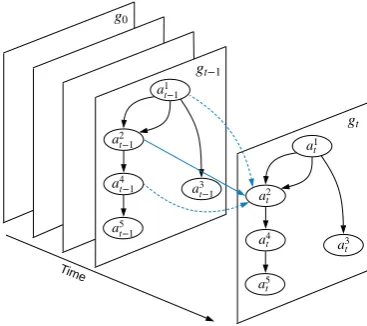
We fill in this gap, taking an attention-based sequence-to-sequence system as our baseline, which is similar to Bahdanau et al. (2015). To leverage knowledge within an AMR graph, we adopt a graph recurrent network (GRN) (Song et al., 2018; Zhang et al., 2018) as the AMR encoder. In particular, a full AMR graph is considered as a single state, with nodes in the graph being its substates. State transitions are performed on the graph recurrently, allowing substates to exchange information through edges. At each recurrent step, each node advances its current state by receiving information from the current states of its adjacent nodes. Thus, with increasing numbers of recurrent steps, each word receives information from a larger context. Figure 3 shows the recurrent tran-sition, where each node works simultaneously. Compared with other methods for encoding AMRs (Konstas et al., 2017), GRN keeps the original graph structure, and thus no information is lost (Song et al., 2018). For the decoding stage, two separate attention mechanisms are adopted in the AMR encoder and sequential encoder, respectively.
Experiments on WMT16 English-to-German data (4.17M) show that adopting AMR
signifi-cantly improves a strong attention-based sequence-to-sequence baseline (25.5 vs 23.7 BLEU). When trained with small-scale (226K) data, the im-provement increases (19.2 vs 16.0 BLEU), which shows that the structural information from AMR can alleviate data sparsity when training data are not sufficient. To our knowledge, we are the first to investigate AMR for NMT.
Our code and parallel data (training/dev/test) with automatically parsed AMRs are available at https://github.com/freesunshine0316/semantic-nmt.
2 Related Work
Most previous work on exploring semantics for statistical machine translation (SMT) studies the usefulness of predicate–argument structure from semantic role labeling (Wong and Mooney, 2006; Wu and Fung, 2009; Liu and Gildea, 2010; Baker et al., 2012). Jones et al. (2012) first convert Prolog expressions into graphical meaning representations, leveraging synchronous hyperedge replacement grammar to parse the input graphs while generating the outputs. Their graphical meaning representation is different from AMR under a strict definition, and their experimental data are limited to 880 sentences. We are the first to investigate AMR on a large-scale machine translation task.
Recently, Marcheggiani et al. (2018) investi-gated SRL on NMT. The predicate–argument structures are encoded via graph convolutional network (GCN) layers (Kipf and Welling, 2017), which are laid on top of regular BiRNN or CNN layers. Our work is in line with exploring seman-tic information, but different in exploiting AMR rather than SRL for NMT. In addition, we lever-age a GRN (Song et al., 2018; Zhang et al., 2018) for modeling AMRs rather than GCN, which is formally consistent with the RNN sentence encoder. Since there is no one-to-one correspon-dence between AMR nodes and source words, we adopt a doubly attentive LSTM decoder, which is another major difference from Marcheggiani et al. (2018).
and Transformer (Vaswani et al., 2017) on classification and sequence labeling tasks; Song et al. (2018) build a GRN for encoding AMR graphs for text generation, showing that the representation is superior compared to BiLSTM on serialized AMR. We extend Song et al. (2018) by investigating the usefulness of AMR for neu-ral machine translation. To our knowledge, we are the first to use GRN for machine translation.
In addition to GRNs and GCNs, there have been other graph neural networks, such as graph gated neural network (GGNN) (Li et al., 2015b; Beck et al., 2018). Because our main concern is to empirically investigate the effectiveness of AMR for NMT, we leave it to future work to compare GCN, GGNN, and GRN for our task.
3 Baseline: Attention-Based BiLSTM
We take the attention-based sequence-to-sequence model of Bahdanau et al. (2015) as the baseline, but use LSTM cells (Hochreiter and Schmidhuber, 1997) instead of GRU cells (Cho et al., 2014).
3.1 BiLSTM Encoder
The encoder is a bidirectional LSTM on the source side. Given a sentence, two sequences of states [←h−1,
←− h2, . . . ,
←−
hN] and [
− →
h1,
− →
h2, . . .
− →
hN] are generated for representing the input word sequence x1, x2, . . . , xN in the right-to-left and left-to-right directions, respectively, where for each wordxi,
←−
hi =LSTM(
←−
hi+1,exi)
− →
hi =LSTM(
− →
hi−1,exi)
exi is the embedding of wordxi.
3.2 Attention-Based Decoder
The decoder yields a word sequence in the target languagey1, y2, . . . , yMby calculating a sequence of hidden states s1,s2. . . ,sM recurrently. We use an attention-based LSTM decoder (Bahdanau et al., 2015), where the attention memory (H) is the concatenation of the attention vectors among all source words. Each attention vectorhi is the concatenation of the encoder states of an input token in both directions (←h−i and
− →
hi):
hi= [
←− hi;−→hi]
H = [h1;h2;. . .;hN].
N is the number of source words.
While generating the m-th word, the decoder considers four factors: (1) the attention memory
H; (2) the previous hidden state of the LSTM model sm−1; (3) the embedding of the current input (previously generated word) eym; and (4) the previous context vector ζm−1 from attention memory H. When m = 1, we initializeζ0 as a zero vector, setey1 to the embedding of sentence
start token ‘‘<s>’’, and calculates0from the last step of the encoder states via a dense layer:
s0=W1[
←−
h0;−→hN] +b1, whereW1andb1are model parameters.
For each decoding step m, the decoder feeds the concatenation of the embedding of the current input eym and the previous context vectorζm−1 into the LSTM model to update its hidden state:
sm =LSTM(sm−1,[eym;ζm−1]).
Then the attention probabilityαm,ion the attention vector hi ∈ H for the current decode step is calculated as:
m,i=v|2tanh(Whhi+Wssm+b2)
αm,i=
exp(m,i)
PN
j=1exp(m,j) .
Wh, Ws,v2, andb2 are model parameters. The new context vectorζmis calculated via
ζm= N
X
i=1
αm,ihi.
The output probability distribution over the target vocabulary at the current state is calculated by
Pvocab =softmax(V3[sm,ζm] +b3), (1)
whereV3andb3are learnable parameters.
4 Incorporating AMR
Figure 2 shows the overall architecture of our model, which adopts a BiLSTM (bottom left) and our graph recurrent network (GRN)2(bottom right) for encoding the source sentence and AMR, respectively. An attention-based LSTM decoder is used to generate the output sequence in the target language, with attention models over both the sequential encoder and the graph encoder. The
2We show the advantage of our graph encoder by
John wants to go
... ...
möchte gehen
[image:4.595.323.507.57.220.2]möchte
Figure 2: Overall architecture of our model.
attention memory for the graph encoder is from the last step of the graph state transition process, which is shown in Figure 3.
[image:4.595.74.292.59.212.2]4.1 Encoding AMR with GRN
Figure 3 shows the overall structure of our graph recurrent network for encoding AMR graphs, which follows Song et al. (2018). Formally, given an AMR graph G = (V,E), we use a hidden state vector aj to represent each node vj ∈ V. The state of the graph can thus be represented as:
g ={aj}|vj∈V.
In order to capture non-local interaction between nodes, information exchange between nodes is executed through a sequence of state transitions, leading to a sequence of states g0,g1, . . . ,gT, where gt = {ajt}|vj∈V, and T is the number of state transitions, which is a hyperparameter. The initial state g0 consists of a set of initial node statesaj0=a0, wherea0is a vector of all zeros.
A recurrent neural network is used to model the state transition process. In particular, the transi-tion fromgt−1togtconsists of a hidden state tran-sition for each node (such as from ajt−1 to ajt), as shown in Figure 3. At each state transition stept, our model conducts direct communication between a node and all nodes that are directly con-nected to the node. To avoid gradient diminishing or bursting, LSTM (Hochreiter and Schmidhuber, 1997) is adopted, where a cell cjt is taken to re-cord memory forajt. We use an input gateijt, an output gateojt, and a forget gatefjt to control in-formation flow from the inputs and to the outputajt. The inputs include representations of edges that are connected to vj, where vj can be either
Figure 3: Architecture of the graph recurrent network.
the source or the target of the edge. We define each edge as a triple (i, j, l), where i and j are indices of the source and target nodes, respec-tively, and l is the edge label. xli,j is the repre-sentation of edge(i, j, l), detailed in Section 4.1.1. The inputs forvj are grouped into incoming and outgoing edges before being summed up:
φj = X
(i,j,l)∈Ein(j)
xli,j
ˆ
φj =
X
(j,k,l)∈Eout(j)
xlj,k
whereEin(j)andEout(j)are the sets of incoming and outgoing edges ofvj, respectively.
In addition to edge inputs, our model also takes the hidden states of the incoming and outgoing neighbors of each node during a state transition. Takingvjas an example, the states of its incoming and outgoing neighbors are summed up before being passed to the cell and gate nodes:
ψj = X
(i,j,l)∈Ein(j)
ait−1
ˆ
ψj = X
(j,k,l)∈Eout(j)
akt−1.
Based on the above definitions of φj, φˆj, ψj, and ψˆj, the state transition from gt−1 to gt, as represented byajt, can be defined as:
ijt=σ(Wiφj+ ˆWiφˆj+Uiψj+ ˆUiψˆj+bi)
ojt=σ(Woφj+ ˆWoφˆj+Uoψj+ ˆUoψˆj+bo)
fjt=σ(Wfφj+ ˆWfφˆj+Ufψj+ ˆUfψˆj+bf)
ujt=σ(Wuφj+ ˆWuφˆj+Uuψj+ ˆUuψˆj+bu)
cjt=fjtctj−1+ijtujt
[image:4.595.368.464.358.421.2]whereijt,ojt, andfjtare the input, output, and for-get gates mentioned earlier. Wx, Wˆ x, Ux,Uˆx,
bx, wherex∈ {i, o, f, u}, are model parameters. With this state transition mechanism, infor-mation of each node is propagated to all its neighboring nodes after each step. So after several transition steps, each node state contains the in-formation of a large context, including its an-cestors, descendants, and siblings. For the worst case where the input graph is a chain of nodes, the maximum number of steps necessary for information from one arbitrary node to reach another is equal to the size of the graph. We experiment with different numbers of transition steps to study the effectiveness of global encoding.
4.1.1 Input Representation
The edges of an AMR graph contain labels, which represent relations between the nodes they connect, and are thus important for modeling the graphs. The representation for each edge(i, j, l) is defined as:
xli,j =W4
[el;evi]
+b4,
whereelandeiare the embeddings of edge label l and source nodevi, and W4 andb4 are model parameters.
4.2 Incorporating AMR Information with a Doubly Attentive Decoder
There is no one-to-one correspondence between AMR nodes and source words. To incorporate additional knowledge from an AMR graph, an external attention model is adopted over the base-line model. In particular, the attention mem-ory from the AMR graph is the last graph state
gT = {ajT}|vj∈V. In addition, the contextual vector based on the graph state is calculated as:
˜
m,i= ˜v|2tanh(WaaiT + ˜Wssm+ ˜b2)
˜ αm,i=
exp(˜m,i)
PN
j=1exp(˜m,j) .
Wa, W˜ s, v˜2, and ˜b2 are model parameters. The new context vector ζ˜m is calculated via
PN
i=1α˜m,iaiT. Finally,ζ˜mis incorporated into the calculation of the output probability distribution over the target vocabulary (previously defined in Equation 1):
Pvocab =softmax(V3[sm,ζm,ζ˜m] +b3). (2)
5 Training
Given a set of training instances {(X(1),Y(1)), (X(2),Y(2)), . . .}, we train our models using the cross-entropy loss over each gold-standard target sequenceY(j) =y1(j), y(j)2 , . . . , yM(j):
l=−
M
X
m=1
logp(y(j)m|y(j)m−1, . . . , y (j)
1 ,X(j);θ).
X(j) represents the inputs for the jth instance, which is a source sentence for our baseline, or a source sentence paired with an automatically parsed AMR graph for our model. θ represents the model parameters.
6 Experiments
We empirically investigate the effectiveness of AMR for English-to-German translation.
6.1 Setup
Data We use the WMT163 English-to-German dataset, which contains around 4.5 million sen-tence pairs for training. In addition, we use a sub-set of the full datasub-set (News Commentary v11 [NC-v11], containing around 243,000 sentence pairs) for development and additional experi-ments. For all experiments, we use newstest2013 and newstest2016 as the development and test sets, respectively.
To preprocess the data, the tokenizer from Moses4 is used to tokenize both the English and German sides. The training sentence pairs where either side is longer than 50 words are filtered out after tokenization. To deal with rare and compound words, byte-pair encoding (BPE)5 (Sennrich et al., 2016) is applied to both sides. In particular, 8,000 and 16,000 BPE merges are used on the News Commentary v11 subset and the full training set, respectively. On the other hand, JAMR6 (Flanigan et al., 2016) is adopted to parse the English sentences into AMRs before BPE is applied. The statistics of the training data and vocabularies after preprocessing are shown in Tables 1 and 2, respectively. For the experiments with the full training set, we used the top 40K
3http://www.statmt.org/wmt16/translation-task.html. 4http://www.statmt.org/moses/.
Dataset #Sent. #Tok. (EN) #Tok. (DE)
NC-v11 226K 6.4M 7.3M
Full 4.17M 109M 118M
[image:6.595.74.289.57.125.2]News2013 3000 84.7K 95.6K News2016 2999 88.1K 98.8K
Table 1: Statistics of the dataset. Numbers of tokens are after BPE processing.
Dataset EN-ori EN AMR DE NC-v11 79.8K 8.4K 36.6K 8.3K Full 874K 19.3K 403K 19.1K
Table 2: Sizes of vocabularies. EN-ori represents original English sentences without BPE.
of the AMR vocabulary, which covers more than 99.6% of the training set.
For our dependency-based and SRL-based base-lines (which will be introduced inBaseline Sys-tems), we choose Stanford CoreNLP Manning et al. (2014) and IBM SIRE to generate depen-dency trees and semantic roles, respectively. Since both dependency trees and semantic roles are based on the original English sentences without BPE, we used the top 100K frequent English words, which cover roughly 99.0% of the training set.
Hyperparameters We use the Adam optimizer (Kingma and Ba, 2014) with a learning rate of 0.0005. The batch size is set to 128. Between layers, we apply dropout with a probability of 0.2. The best model is picked based on the cross-entropy loss on the development set. For model hyperparameters, we set the graph state transition number to 10 according to development experiments. Each node takes information from at most six neighbors. BLEU (Papineni et al., 2002), TER (Snover et al., 2006), and Meteor (Denkowski and Lavie, 2014) are used as the metrics on cased and tokenized results.
For experiments with the NC-v11 subset, both word embedding and hidden vector sizes are set to 500, and the models are trained for at most 30 epochs. For experiments with full training set, the word embedding and hidden state sizes are set to 800, and our models are trained for at most 10 epochs. For all systems, the word embeddings are randomly initialized and updated during training.
Baseline Systems We compare our model with the following systems. Seq2seq represents our attention-based LSTM baseline (Section 3), and
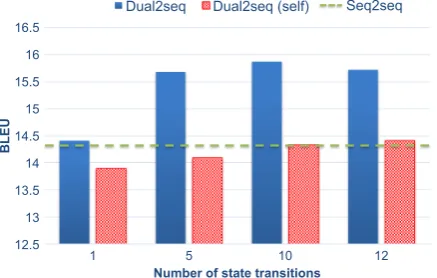
Figure 4: DEVBLEU scores against transition steps for the graph encoders. The state transition is not applicable toSeq2seq, so we draw a dashed line to represent its performance.
Dual2seq is our model, which takes both a se-quential and a graph encoder and adopts a doubly attentive decoder (Section 4). To show the merit of AMR, we further contrast our model with the following baselines, all of which adopt the same doubly attentive framework with a BiLSTM for encoding BPE-segmented source sentences: Dual2seq-LinAMR uses another BiLSTM for encoding linearized AMRs. Dual2seq-Dep and Dual2seq-SRL adopt our graph recurrent net-work to encode original source sentences with dependency and semantic role annotations, re-spectively. The three baselines are useful for contrasting different methods of encoding AMRs and for comparing AMRs with other popular structural information for NMT.
We also compare with Transformer (Vaswani et al., 2017) and OpenNMT (Klein et al., 2017), trained on the same dataset and with the same set of hyperparameters as our systems. In particular, we compare with Transformer-tf, one popular implementation7 of Transformer based on TensorFlow, and we choose OpenNMT-tf, an official release8of OpenNMT implemented with TensorFlow. For a fair comparison,OpenNMT-tf has one layer for both the encoder and the decoder, andTransformer-tf has the default configuration (N=6), but with parameters being shared among different blocks.
6.2 Development Experiments
Figure 4 shows the system performances as a function of the number of graph state transitions
[image:6.595.308.527.58.197.2]System NC-V11 FULL
[image:7.595.125.478.55.179.2]BLEU TER↓ Meteor BLEU TER↓ Meteor OpenNMT-tf 15.1 0.6902 0.3040 24.3 0.5567 0.4225 Transformer-tf 17.1 0.6647 0.3578 25.1 0.5537 0.4344 Seq2seq 16.0 0.6695 0.3379 23.7 0.5590 0.4258 Dual2seq-LinAMR 17.3 0.6530 0.3612 24.0 0.5643 0.4246 Duel2seq-SRL 17.2 0.6591 0.3644 23.8 0.5626 0.4223 Dual2seq-Dep 17.8 0.6516 0.3673 25.0 0.5538 0.4328 Dual2seq 19.2* 0.6305 0.3840 25.5* 0.5480 0.4376
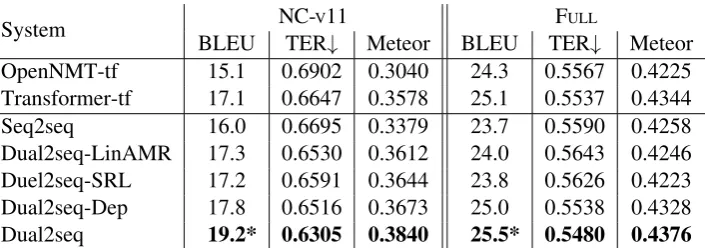
Table 3: TESTperformance.NC-v11represents training only with the NC-v11 data, whileFullmeans using the full training data. * represents significant (Koehn, 2004) result (p <0.01) overSeq2seq.↓indicates the lower the better.
on the development set.Dual2seq (self)represents our dual-attentive model, but its graph encoder encodes the source sentence, which is treated as a chain graph instead of an AMR graph. Compared with Dual2seq, Dual2seq (self) has the same number of parameters, but without semantic information from AMR. Due to hardware limitations, we do not perform an exhaustive search by evaluating every possible state transition number, but only transition numbers of 1, 5, 10, and 12.
Our Dual2seq shows consistent performance improvement by increasing the transition number both from 1 to 5 (roughly +1.3 BLEU points) and from 5 to 10 (roughly 0.2 BLEU points). The former shows greater improvement than the latter, showing that the performance starts to converge after five transition steps. Further increasing transition steps from 10 to 12 gives a slight performance drop. We set the number of state transition steps to 10 for all experiments according to these observations.
On the other hand, Dual2seq (self) shows only small improvements by increasing the state transition number, and it does not perform better than Seq2seq. Both results show that the performance gains ofDual2seq are not due to an increased number of parameters.
6.3 Main Results
Table 3 shows theTESTBLEU, TER, and Meteor scores of all systems trained on the small-scale News Commentary v11 subset or the large-scale full set. Dual2seq is consistently better than the other systems under all three metrics, showing the effectiveness of the semantic information pro-vided by AMR. Especially, Dual2seq is better than both OpenNMT-tf and Transformer-tf. The
recurrent graph state transition of Dual2seq is similar to Transformer in that it iteratively incorporates global information. The improve-ment of Dual2seq over Transformer-tf undoubt-edly comes from the use of AMRs, which provide complementary information to the textual inputs of the source language.
In terms of BLEU score, Dual2seq is signif-icantly better thanSeq2seqin both settings, which shows the effectiveness of incorporating AMR information. In particular, the improvement is much larger under the small-scale setting (+3.2 BLEU) than that under the large-scale setting (+1.7 BLEU). This is an evidence that structural and coarse-grained semantic information encoded in AMRs can be more helpful when training data are limited.
When trained on the NC-v11 subset, the gap between Seq2seq and Dual2seq under Meteor (around 5 points) is greater than that under BLEU (around 3 points). Since Meteor gives partial credit to outputs that are synonyms to the reference or share identical stems, one possible explanation is that the structural information within AMRs helps to better translate the concepts from the source language, which may be synonyms or paronyms of reference words.
AMR Anno. BLEU Automatic 16.8
Gold 17.5*
Table 4: BLEU scores ofDual2seqonThe Little Prince
data, when gold or automatic AMRs are available.
(sequential) encoder.9The gap betweenDual2seq andDual2seq-LinAMRcomes from modeling the relations between concepts, which can be helpful for deciding target word order by enhancing the relations in source sentences. We conclude that properly encoding AMRs is necessary to make them useful.
Encoding dependency trees instead of AMRs, Dual2seq-Dep shows a larger performance gap with our model (17.8 vs 19.2) on small-scale training data than on large-scale training data (25.0 vs 25.5). It is likely because AMRs are more useful on alleviating data sparsity than dependency trees, since words are lemmatized into unified concepts when parsing sentences into AMRs. For modeling long-range dependencies, AMRs have one crucial advantage over dependency trees by modeling concept-concept relations more directly. It is because AMRs drop function words; thus the distances between concepts are generally closer in AMRs than in dependency trees. Finally, Dual2seq-SRL is less effective than our model, because the annotations labeled by SRL are a subset of AMRs.
We outperform Marcheggiani et al. (2018) on the same datasets, although our systems vary in a number of respects. When trained on the NC-v11 data, they show BLEU scores of 14.9 only with their BiLSTM baseline, 16.1 using additional dependency information, 15.6 using additional semantic roles, and 15.8 taking both as additional knowledge. UsingFullas the training data, the scores become 23.3, 23.9, 24.5, and 24.9, respectively. In addition to the different seman-tic representation being used (AMR vs SRL), Marcheggiani et al. (2018) laid GCN (Kipf and Welling, 2017) layers on top of a bidirectional LSTM (BiLSTM) layer, and then concatenated layer outputs as the attention memory. GCN layers encode the semantic role information, while BiLSTM layers encode the input sentence in the source language, and the concatenated hidden
9AMRs can contain multi-word concepts, such asNew
[image:8.595.308.524.57.171.2]York City, but they are in the textual input.
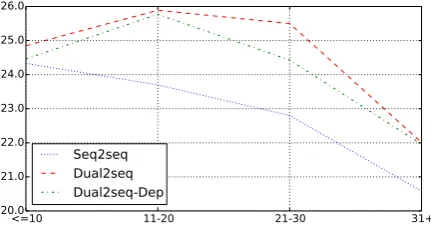
Figure 5: Test BLEU score of various sentence lengths.
states of both layers contain information from both semantic role and source sentence. For incorporating AMR, because there is no one-to-one word-to-node correspondence between a sentence and the corresponding AMR graph, we adopt separate attention models. Our BLEU scores are higher than theirs, but we cannot conclude that the advantage primarily comes from AMR.
6.4 Analysis
Influence of AMR Parsing Accuracy To ana-lyze the influence of AMR parsing on our model performance, we further evaluate on a test set where the gold AMRs for the English side are available. In particular, we choose The Little Prince corpus, which contains 1,562 sentences with gold AMR annotations.10Since there are no parallel German sentences, we take a German-versionThe Little Princenovel, and then perform manual sentence alignment. Taking the wholeThe Little Princecorpus as the test set, we measure the influence of AMR parsing accuracy by evaluating on the test set when gold or automatically parsed AMRs are available. The automatic AMRs are generated by parsing the English sentences with JAMR.
Table 4 shows the BLEU scores of our Dual2seqmodel taking gold or automatic AMRs as inputs. Not listed in Table 4,Seq2seqachieves a BLEU score of 15.6, which is 1.2 BLEU points lower than using automatic AMR information. The improvement from automatic AMR to gold AMR (+0.7 BLEU) is significant, which shows that the translation quality of our model can be further improved with an increase of AMR parsing accuracy. However, the BLEU score with gold AMR does not indicate the potentially best
AMR: (s2 / say-01 :ARG0 (p3 / person :ARG1-of (h / have-rel-role-91 :ARG0 (p / person :ARG1-of (m2 / meet-03 :ARG0 (t / they) :ARG2 15) :mod (m / mutual)) :ARG2 (f / friend)) :name (n2 / name :op1 ‘‘Carla’’ :op2 ‘‘Hairston’’)) :ARG1 (a / and :op1 (p2 / person :name (n / name :op1 ‘‘Lamb’’))) :ARG2 (s / she) :time 20)
Src: Carla Hairston said she was 15 and Lamb was 20 when they met through mutual friends .
Ref: Carla Hairston sagte , sie war 15 und Lamm war 20 , als sie sich durch gemeinsame Freunde trafen .
Dual2seq: Carla Hairston sagte , sie war 15 und Lamm war 20 , als sie sich durch gegenseitige Freunde trafen .
Seq2seq: Carla Hirston sagte , sie sei 15 und Lamb 20 , als sie durch gegenseitige Freunde trafen .
AMR: (s / say-01 :ARG0 (m / media :ARG1-of (l / local-02)) :ARG1 (c2 / come-01 :ARG1 (v / vehicle :mod (p / police)) :manner (c3 / constant) :path (a / across :op1 (r / refugee :mod (n2 / new))) :time (s2 / since :op1 (t3 / then)) :topic (t / thing :name (n / name :op1 (c / Croatian) :op2 (t2 / Tavarnik)))))
Src: Since then , according to local media , police vehicles are constantly coming across new refugees in Croatian Tavarnik .
Ref: Laut lokalen Medien treffen seitdem im kroatischen Tovarnik st¨andig Polizeifahrzeuge mit neuen Fl¨uchtlingen ein .
Dual2seq: Seither kommen die Polizeifahrzeuge nach den ¨ortlichen Medien st¨andig ¨uber neue Fl¨uchtlinge in Kroatische Tavarnik .
Seq2seq: Seitdem sind die Polizeiautos nach den lokalen Medien st¨andig neue Fl¨uchtlinge in Kroatien Tavarnik .
AMR: (b2 / breed-01 :ARG0 (p2 / person :ARG0-of (h / have-org-role-91 :ARG2 (s3 / scientist))) :ARG1 (w2 / worm) :ARG2 (s2 / system :ARG1-of (c / control-01 :ARG0 (b / burst-01 :ARG1 (w / wave :mod (s / sound))) :ARG1-of (p / possible-01)) :ARG1-of (n / nervous-01) :mod (m / modify-01 :ARG1 (g / genetics))))
Src: Scientists have bred worms with genetically modified nervous systems that can be controlled by bursts of sound waves .
Ref: Wissenschaftler haben W¨urmer mit genetisch ver¨anderten Nervensystemen gez¨uchtet , die von Ausbr¨uchen von Schallwellen gesteuert werden k¨onnen .
Dual2seq: Die Wissenschaftler haben die W¨urmer mit genetisch ver¨anderten Nervensystemen gez¨uchtet, die durch Verbrennungen von Schallwellen kontrolliert werden k¨onnen .
Seq2seq: Wissenschaftler haben sich mit genetisch modifiziertem Nervensystem gez¨uchtet , die durch Verbrennungen von Klangwellen gesteuert werden k¨onnen .
Figure 6: Sample system outputs.
performance that our model can achieve. The primary reason is that even though the test set is coupled with gold AMRs, the training set is not. Trained with automatic AMRs, our model can learn to selectively trust the AMR structure. An additional reason is the domain difference: The Little Prince data are in the literary domain while our training data are in the news domain. There can be a further performance gain if the accuracy of the automatic AMRs on the training set is improved.
Performance Based on Sentence Length We hypothesize that AMRs should be more beneficial for longer sentences: Those are likely to contain long-distance dependencies (such as discourse information and predicate–argument structures), which may not be adequately captured by linear chain RNNs but are directly encoded in AMRs. To test this, we partition the test data into four buckets by length and calculate BLEU for each of them. Figure 5 shows the performances of our model along withDual2seq-DepandSeq2seq. Our
model outperforms the Seq2seq baseline rather uniformly across all buckets, except for the first one, where they are roughly equal. This may be surprising. On the one hand, Seq2seq fails to capture some dependencies for medium-length instances; on the other hand, AMR parses are more noisy for longer sentences, which prevents us from obtaining extra improvements with AMRs.
Human Evaluation We further study the trans-lation quality of predicate–argument structures by conducting a human evaluation on 100 instances from the test set. In the evaluation, translations of bothDual2seq andSeq2seq, together with the source English sentence, the German reference, and an AMR are provided to a German-speaking annotator to decide which translation better captures the predicate–argument structures in the source sentence. To avoid annotation bias, translation results of both models are swapped for some instances, and the German annotator does not know which model each translation belongs to. The annotator either selects a ‘‘winner’’ or makes a ‘‘tie’’ decision, meaning that both results are equally good.
Out of the 100 instances, Dual2seq wins on 46, Seq2seq wins on 23, and there is a tie on the remaining 31.Dual2seq wins on almost half of the instances, about twice as often asSeq2seq wins, indicating that AMRs help in translating the predicate–argument structures on the source side.
Case Study The outputs of the baseline system (Seq2seq) and our final system (Dual2seq) are shown in Figure 6. In the first sentence, the AMR-based Dual2seq system correctly produces the reflexive pronoun sich as an argument of the verb trafen (meet), despite the distance between the words in the system output, and despite the fact that the equivalent English wordseach other do not appear in the system output. This is facilitated by the argument structure in the AMR analysis.
In the second sentence, the AMR-based Dual2seq system produces an overly literal trans-lation for the English phrasal verb come across. The Seq2seq translation, however, incorrectly states that the police vehicles are refugees. The difficulty for the Seq2seq probably derives in part from the fact thatareandcomingare separated by the wordconstantly in the input, while the main predicate is clear in the AMR representation.
In the third sentence, the Dual2seq system correctly translates the object ofbreedasworms, while the Seq2seq translation incorrectly states that the scientists breed themselves. Here the difficulty is likely the distance between the object and the verb in the German output, which causes the Seq2seq system to lose track of the correct input position to translate.
7 Conclusion
We showed that AMRs can improve neural machine translation. In particular, the structural semantic information from AMRs can be com-plementary to the source textual input by intro-ducing a higher level of information abstraction. A graph recurrent network (GRN) is leveraged to encode AMR graphs without breaking the original graph structure, and a sequential LSTM is used to encode the source input. The decoder is a doubly attentive LSTM, taking the encoding results of both the graph encoder and the sequential encoder as attention memories. Experiments on a standard benchmark showed that AMRs are helpful regardless of the sentence length and are more effective than other more popular choices, such as dependency trees and semantic roles.
Acknowledgments
We would like to thank the action editor and the anonymous reviewers for their insightful comments. We also thank Kai Song from Alibaba for suggestions on large-scale training, Parker Riley for comments on the draft, and Rochester’s CIRC for computational resources.
References
Roee Aharoni and Yoav Goldberg. 2017. Towards string-to-tree neural machine translation. In Proceedings of the 55th Annual Meeting of the Association for Computational Linguistics (ACL-17), pages 132–140.
Yoav Artzi, Kenton Lee, and Luke Zettlemoyer. 2015. Broad-coverage CCG semantic pars-ing with AMR. In Conference on Empirical Methods in Natural Language Processing (EMNLP-15), pages 1699–1710.
Dzmitry Bahdanau, Kyunghyun Cho, and Yoshua Bengio. 2015. Neural machine translation by jointly learning to align and translate. In International Conference on Learning Repre-sentations (ICLR).
Laura Banarescu, Claire Bonial, Shu Cai, Madalina Georgescu, Kira Griffitt, Ulf Hermjakob, Kevin Knight, Philipp Koehn, Martha Palmer, and Nathan Schneider. 2013. Abstract meaning representation for sembank-ing. In Proceedings of the 7th Linguistic Annotation Workshop and Interoperability with Discourse, pages 178–186.
Joost Bastings, Ivan Titov, Wilker Aziz, Diego Marcheggiani, and Khalil Simaan. 2017. Graph convolutional encoders for syntax-aware neu-ral machine translation. In Conference on Empirical Methods in Natural Language Processing (EMNLP-17), pages 1957–1967.
Daniel Beck, Gholamreza Haffari, and Trevor Cohn. 2018. Graph-to-sequence learning using gated graph neural networks. In Proceedings of the 56th Annual Meeting of the Associa-tion for ComputaAssocia-tional Linguistics (ACL-18), pages 273–283.
Jan Buys and Phil Blunsom. 2017. Robust incremental neural semantic graph parsing. In Proceedings of the 55th Annual Meeting of the Association for Computational Linguistics (ACL-17), pages 1215–1226.
Huadong Chen, Shujian Huang, David Chiang, and Jiajun Chen. 2017. Improved neural ma-chine translation with a syntax-aware encoder and decoder. InProceedings of the 55th Annual Meeting of the Association for Computational Linguistics (ACL-17), pages 1936–1945.
Kehai Chen, Rui Wang, Masao Utiyama, Eiichiro Sumita, and Tiejun Zhao. 2018. Syntax-directed attention for neural machine translation. In Proceedings of the National Conference on Artificial Intelligence (AAAI-18).
Kyunghyun Cho, Bart van Merrienboer, Caglar Gulcehre, Dzmitry Bahdanau, Fethi Bougares, Holger Schwenk, and Yoshua Bengio. 2014. Learning phrase representations using RNN encoder–decoder for statistical machine trans-lation. In Conference on Empirical Methods in Natural Language Processing (EMNLP-14), pages 1724–1734.
Michael Denkowski and Alon Lavie. 2014. Meteor universal: Language specific translation evalu-ation for any target language. In Proceedings
of the Ninth Workshop on Statistical Machine Translation, pages 376–380.
Jeffrey Flanigan, Chris Dyer, Noah A. Smith, and Jaime Carbonell. 2016. CMU at SemEval-2016 Task 8: Graph-based AMR parsing with infinite ramp loss. In Proceedings of the 10th International Workshop on Semantic Evaluation (SemEval-2016), pages 1202–1206.
Jeffrey Flanigan, Sam Thomson, Jaime Carbonell, Chris Dyer, and Noah A. Smith. 2014. A discriminative graph-based parser for the ab-stract meaning representation. In Proceedings of the 52nd Annual Meeting of the Associ-ation for ComputAssoci-ational Linguistics (ACL-14), pages 1426–1436.
Jonas Groschwitz, Matthias Lindemann, Meaghan Fowlie, Mark Johnson, and Alexander Koller. 2018. AMR dependency parsing with a typed semantic algebra. In Proceedings of the 56th Annual Meeting of the Association for Computa-tional Linguistics (ACL-18), pages 1831–1841.
Zhijiang Guo and Wei Lu. 2018. Better transition-based AMR parsing with a refined search space. InProceedings of the 56th Annual Meeting of the Association for Computational Linguistics (ACL-18), pages 1712–1722.
Sepp Hochreiter and J¨urgen Schmidhuber. 1997. Long short-term memory.Neural Computation, 9(8):1735–1780.
Pierre Isabelle, Colin Cherry, and George Foster. 2017. A challenge set approach to evaluating machine translation. In Conference on Empirical Methods in Natural Language Processing (EMNLP-17), pages 2486–2496.
Bevan Jones, Jacob Andreas, Daniel Bauer, Karl Moritz Hermann, and Kevin Knight. 2012. Semantics-based machine translation with hyperedge replacement grammars. In Proceedings of the International Conference on Computational Linguistics (COLING-12), pages 1359–1376.
Thomas N. Kipf and Max Welling. 2017. Semi-supervised classification with graph convolu-tional networks. In International Conference on Learning Representations (ICLR).
Guillaume Klein, Yoon Kim, Yuntian Deng, Jean Senellart, and Alexander M. Rush. 2017. OpenNMT: Open-Source Toolkit for Neural Machine Translation. arXiv preprint arXiv:1701.02810.
Philipp Koehn. 2004. Statistical significance tests for machine translation evaluation. In Confer-ence on Empirical Methods in Natural Lan-guage Processing (EMNLP-04), pages 388–395.
Ioannis Konstas, Srinivasan Iyer, Mark Yatskar, Yejin Choi, and Luke Zettlemoyer. 2017. Neural AMR: Sequence-to-sequence models for parsing and generation. In Proceedings of the 55th Annual Meeting of the Associa-tion for ComputaAssocia-tional Linguistics (ACL-17), pages 146–157.
Junhui Li, Deyi Xiong, Zhaopeng Tu, Muhua Zhu, Min Zhang, and Guodong Zhou. 2017. Modeling source syntax for neural machine translation. InProceedings of the 55th Annual Meeting of the Association for Computational Linguistics (ACL-17), pages 688–697.
Xiang Li, Thien Huu Nguyen, Kai Cao, and Ralph Grishman. 2015a. Improving event detection with abstract meaning representa-tion. In Proceedings of the First Workshop on Computing News Storylines, pages 11–15.
Yujia Li, Daniel Tarlow, Marc Brockschmidt, and Richard Zemel. 2015b. Gated graph sequence neural networks. arXiv preprint arXiv:1511.05493.
Ding Liu and Daniel Gildea. 2010. Semantic role features for machine translation. In Proceed-ings of the 23rd International Conference on Computational Linguistics (COLING-10), pages 716–724.
Chunchuan Lyu and Ivan Titov. 2018. AMR parsing as graph prediction with latent alignment. In Proceedings of the 56th Annual Meeting of the Association for Computational Linguistics (ACL-18), pages 397–407.
Christopher D. Manning, Mihai Surdeanu, John Bauer, Jenny Finkel, Steven J. Bethard, and David McClosky. 2014. The Stanford CoreNLP natural language processing toolkit. In Asso-ciation for Computational Linguistics (ACL) System Demonstrations, pages 55–60.
Diego Marcheggiani, Joost Bastings, and Ivan Titov. 2018. Exploiting semantics in neural machine translation with graph convolutional networks. In Proceedings of the 2018 Meeting of the North American Chapter of the Associa-tion for ComputaAssocia-tional Linguistics (NAACL-18), pages 486–492.
Arindam Mitra and Chitta Baral. 2015. Loca-tioning a question answering challenge by combining statistical methods with inductive rule learning and reasoning. In Proceedings of the National Conference on Artificial Intel-ligence (AAAI-16).
Kishore Papineni, Salim Roukos, Todd Ward, and Wei-Jing Zhu. 2002. BLEU: A method for automatic evaluation of machine translation. InProceedings of the 40th Annual Meeting of the Association for Computational Linguistics (ACL-02), pages 311–318.
Xiaochang Peng, Linfeng Song, and Daniel Gildea. 2015. A synchronous hyperedge re-placement grammar based approach for AMR parsing. InProceedings of the Nineteenth Con-ference on Computational Natural Language Learning, pages 32–41.
Xiaochang Peng, Linfeng Song, Daniel Gildea, and Giorgio Satta. 2018. Sequence-to-sequence models for cache transition systems. In Pro-ceedings of the 56th Annual Meeting of the Association for Computational Linguistics (ACL-18), pages 1842–1852.
Michael Pust, Ulf Hermjakob, Kevin Knight, Daniel Marcu, and Jonathan May. 2015. Pars-ing english into abstract meanPars-ing represen-tation using syntax-based machine translation. In Conference on Empirical Methods in Natural Language Processing (EMNLP-15), pages 1143–1154.
of the 54th Annual Meeting of the Associa-tion for ComputaAssocia-tional Linguistics (ACL-16), pages 1715–1725.
Matthew Snover, Bonnie Dorr, Richard Schwartz, Linnea Micciulla, and John Makhoul. 2006. A study of translation edit rate with tar-geted human annotation. In Proceedings of Association for Machine Translation in the Americas, pages 223–231.
Linfeng Song, Yue Zhang, Zhiguo Wang, and Daniel Gildea. 2018. A graph-to-sequence model for AMR-to-text generation. In Pro-ceedings of the 56th Annual Meeting of the Association for Computational Linguistics (ACL-18), pages 1842–1852.
Felix Stahlberg, Eva Hasler, Aurelien Waite, and Bill Byrne. 2016. Syntactically guided neural machine translation. In Proceedings of the 54th Annual Meeting of the Association for Computational Linguistics (ACL-16), pages 299–305.
Sho Takase, Jun Suzuki, Naoaki Okazaki, Tsutomu Hirao, and Masaaki Nagata. 2016. Neural headline generation on abstract meaning representation. In Conference on Empirical Methods in Natural Language Processing (EMNLP-16), pages 1054–1059.
Ashish Vaswani, Noam Shazeer, Niki Parmar, Jakob Uszkoreit, Llion Jones, Aidan N Gomez, Łukasz Kaiser, and Illia Polosukhin.
2017. Attention is all you need. In Advances in Neural Information Processing Systems, 30, pages 5998–6008.
Chuan Wang and Nianwen Xue. 2017. Getting the most out of AMR parsing. In Conference on Empirical Methods in Natural Language Processing (EMNLP-17), pages 1257–1268.
Yuk Wah Wong and Raymond Mooney. 2006. Learning for semantic parsing with statistical machine translation. InProceedings of the 2006 Meeting of the North American Chapter of the Association for Computational Linguistics (NAACL-06), pages 439–446.
Dekai Wu and Pascale Fung. 2009. Semantic roles for SMT: A hybrid two-pass model. In Proceedings of the 2009 Meeting of the North American Chapter of the Association for Computational Linguistics (NAACL-09), pages 13–16.
Shuangzhi Wu, Ming Zhou, and Dongdong Zhang. 2017. Improved neural machine trans-lation with source syntax. In Proceedings of the Twenty-Sixth International Joint Con-ference on Artificial Intelligence (IJCAI-17), pages 4179–4185.