warwick.ac.uk/lib-publications
A Thesis Submitted for the Degree of PhD at the University of Warwick
Permanent WRAP URL:
http://wrap.warwick.ac.uk/
101807/Copyright and reuse:
This thesis is made available online and is protected by original copyright.
Please scroll down to view the document itself.
Please refer to the repository record for this item for information to help you to cite it.
Our policy information is available from the repository home page.
Moving knowledge into practice: evaluating
cross cultural applicability of the Promoting
Action on Research Implementation in Health
Service (PARIHS) framework
Liz Avital BSc (Hons) MSc.
A thesis submitted for the Degree of Doctor of Philosophy
University of Warwick, Warwick Medical School,
i
Contents
1 Chapter One - Introduction ... 1
1.1 Background ... 1
1.2 Identification of the topic ... 1
1.3 Implementation of knowledge... 2
1.4 Implementation frameworks ... 2
1.4.1 Why was the PARIHS framework chosen? ... 4
1.5 Research gaps ... 4
1.6 Research questions ... 5
1.7 Thesis structure ... 5
2 Chapter Two - Literature Review ... 7
2.1 Introduction ... 7
2.2 Evidence based medicine ... 7
2.2.1 The development of Evidence Based Medicine (EBM) ... 7
2.2.2 Definition of evidence based medicine... 8
2.2.3 Implementation of evidence ... 8
2.3 Clinical practice guidelines ... 9
2.3.1 Definition and purpose ... 9
2.3.2 Guideline implementation ... 10
2.3.3 Definition of knowledge implementation ... 11
2.3.4 The challenge of knowledge implementation ... 12
2.3.5 Moving knowledge into practice ... 12
2.3.6 Implementation research ... 13
2.3.7 Summary ... 14
2.4 Theories and frameworks ... 15
2.4.1 Background ... 15
2.4.2 Identification of theories and frameworks ... 16
2.4.3 Frameworks... 16
2.4.4 Selection of frequently used models and frameworks ... 19
2.4.5 The Ottawa Model of Research Use (OMRU) ... 20
2.4.6 The Knowledge to Action (KTA) framework ... 23
2.4.7 The Stetler Model of Evidence Based Practice ... 25
ii
2.5 Further framework elements to be considered. ... 37
2.5.1 The patient ... 37
2.5.2 Culture within knowledge implementation frameworks. ... 37
2.6 Framework selection ... 40
2.6.1 The contribution of this study ... 41
2.7 Culture: the breadth and complexity ... 42
2.7.1 Introduction ... 42
2.7.2 Defining culture ... 43
2.7.3 Everyday culture ... 45
2.7.4 Cross cultural communication ... 46
2.7.5 Organisational culture ... 47
2.7.6 Knowledge transfer and culture ... 49
2.7.7 Healthcare organisational culture ... 50
2.7.8 Healthcare organisational context ... 51
2.7.9 Context and culture ... 52
2.7.10 Summary of definitions of culture ... 52
2.7.11 How culture is to be used in this study ... 53
2.8 The countries where this study is based ... 54
2.8.1 Background ... 54
2.8.2 Jordan ... 54
2.8.3 Malta ... 57
3 Chapter Three - Methodology ... 60
3.1 Introduction ... 60
3.2 The philosophy of knowledge ... 60
3.2.1 Ontology ... 61
3.2.2 Epistemology ... 61
3.3 Research paradigms ... 63
3.3.1 Introduction ... 63
3.3.2 Positivism ... 64
3.3.3 Post positivism ... 65
3.3.4 Constructivism ... 65
3.3.5 Constructivist paradigm in this study ... 66
3.4 Methodology ... 67
iii
3.4.2 Quantitative research ... 68
3.4.3 Qualitative research ... 68
3.4.4 Consideration of qualitative methodologies ... 69
3.4.5 Chosen methodology for this study ... 72
3.4.6 Rigour ... 74
3.4.7 Reflexivity ... 75
4 Chapter Four - Methods ... 77
4.1 Introduction ... 77
4.2 Focus group ... 77
4.2.1 How focus groups are used ... 78
4.2.2 Main functions of focus groups ... 78
4.2.3 Focus groups: areas for consideration ... 80
4.2.4 Application of focus groups to this study ... 81
4.2.5 Cultural awareness and focus groups ... 82
4.3 Interviewing ... 83
4.3.1 Qualitative interviewing ... 83
4.3.2 Types of qualitative interviews ... 84
4.3.3 Structured and un-structured interviews ... 85
4.3.4 Semi structured interviews ... 85
4.3.5 Application of interview to this study ... 86
4.3.6 Practical considerations ... 87
4.3.7 Non face to face interviews ... 88
4.3.8 Considerations when using semi structured interviews ... 89
4.4 Observation ... 90
4.4.1 Types of observation ... 90
4.4.2 Recording the observation ... 92
4.4.3 Practicalities of observation ... 93
4.5 Being culturally aware ... 94
4.6 Ethics ... 95
4.6.1 What are ethics? ... 95
4.6.2 Main principles of ethics ... 96
4.7 Analysis. ... 101
4.7.1 Introduction ... 101
iv
4.7.3 Thematic analysis ... 102
4.7.4 Framework analysis... 103
4.8 Summary of methods and methodology considerations ... 106
5 Chapter five - Carrying out the case study ... 107
5.1 Overview ... 107
5.2 Obtaining ethical approval and access to participants ... 108
5.2.1 Warwick University ... 108
5.2.2 Jordan ... 108
5.2.3 Malta ... 108
5.3 Sampling ... 109
5.4 Study sites ... 110
5.5 Focus group Jordan ... 110
5.5.1 Focus group questions ... 110
5.5.2 Pre-organisation of the focus group ... 111
5.5.3 Adaptation to the organisation of the focus group ... 111
5.5.4 Data capture... 112
5.5.5 Participants ... 112
5.5.6 The focus group set up ... 112
5.5.7 The focus group introduction ... 113
5.5.8 The focus group in action ... 113
5.6 Focus Group Malta ... 114
5.6.1 Focus group questions ... 114
5.6.2 Pre-organisation of the focus group ... 114
5.6.3 Data capture... 115
5.6.4 Participants ... 115
5.6.5 The focus group set up ... 115
5.6.6 The focus group introduction ... 115
5.6.7 The focus group in action ... 116
5.7 Semi structured interviews: pre and post guideline development ... 116
5.7.1 Semi structured interview questions ... 116
5.7.2 Participants ... 117
5.7.3 Organisation of interviews ... 117
5.7.4 Data capture... 118
v
5.8 Development of clinical guidance ... 119
5.8.1 Topic identification ... 119
5.8.2 Formulation of the guideline group / invitation to attend ... 120
5.8.3 Guideline development group: meeting one ... 120
5.8.4 Next steps of guidance development ... 123
5.9 Observation and reflexivity ... 124
5.10 Language used for the research. ... 124
5.11 Cultural awareness of the case study ... 124
5.12 Summary ... 125
6 Chapter Six – analysis and findings ... 126
6.1 Introduction ... 126
6.1.1 Carrying out the analysis ... 126
6.2 Analysis of focus groups ... 127
6.2.1 Understanding evidence ... 128
6.2.2 Clinical guidelines ... 130
6.2.3 The influence of context, culture and the patient ... 132
6.2.4 Facilitation ... 138
6.2.5 Barriers to the implementation of evidence based practice ... 140
6.2.6 Comparison of the two focus groups ... 142
6.2.7 Summary ... 143
6.3 Analysis of Interviews: PARIHS framework ... 144
6.3.1 Introduction ... 144
6.3.2 Evidence; what constitutes evidence and its applicability ... 145
6.3.3 Context; how where we work impacts on what we do ... 153
6.3.4 Culture – the multifaceted influence of culture ... 165
6.3.5 Facilitation and the role of implementation ... 170
6.3.6 Section Summary ... 174
6.4 Experience of developing the guideline. ... 174
6.4.1 Introduction ... 174
6.4.2 The experience of participation ... 174
6.4.3 Learning process ... 175
6.4.4 Summary ... 176
7 Chapter Seven - Discussion ... 177
vi
7.2 The PARIHS framework it’s elements and sub-elements. ... 178
7.2.1 Evidence ... 178
7.2.2 Context ... 185
7.2.3 Culture ... 188
7.2.4 Leadership ... 193
7.2.5 Resources: financial and human ... 197
7.2.6 Politics ... 202
7.2.7 Stakeholders... 203
7.2.8 Facilitation ... 204
7.2.9 Summary ... 205
7.3 Barriers ... 206
7.3.1 Introduction ... 206
7.3.2 The Patient ... 207
7.4 Patient involvement in this study ... 212
7.4.1 Recruitment of the guideline development group ... 212
7.5 Guideline development... 214
7.5.1 Topic identification ... 214
7.5.2 Clinical questions ... 214
7.5.3 Guideline development and recommendations ... 215
7.5.4 Challenges encountered in guideline development ... 218
7.6 Rigour / trustworthiness within this study ... 219
7.7 Limitations... 220
7.7.1 Language ... 220
7.7.2 Time ... 220
7.7.3 Substitution ... 222
8 Chapter Eight - Conclusion and recommendations ... 223
8.1 Overview ... 223
8.2 Key findings ... 223
8.3 Identification of original contribution to knowledge ... 226
8.3.1 The impact of this work on the PARIHS framework ... 226
8.3.2 Contextualisation of guideline development ... 227
8.4 Recommendations for policy and practice. ... 227
8.5 Recommendations for research ... 228
vii 9 Chapter Nine - |References ... 229
10 Chapter Ten - Appendices ... 245
Tables
Table 1: Representation of the original OMRU (Logan and Graham, 1998) 21 Table 2: Representation of the refined OMRU (Logan and Graham, 2010) 22 Table 3: Changes made to the sub-elements of the PARIHS framework 1998 - 2013. 33 Table 4: Consideration of culture in the four main frameworks reviewed. 38
Table 5: Summary of focus group themes 127
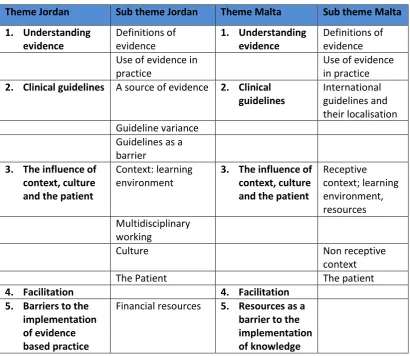
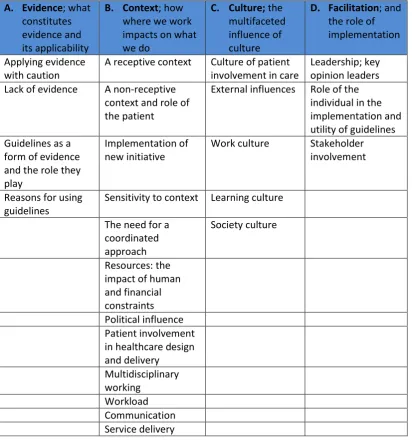
Table 6: Themes identified from the interviews 145
Table 7: Elements and sub- elements of the PARIHS framework 2008 (Kitson Alison. L et al.,
2008) 177
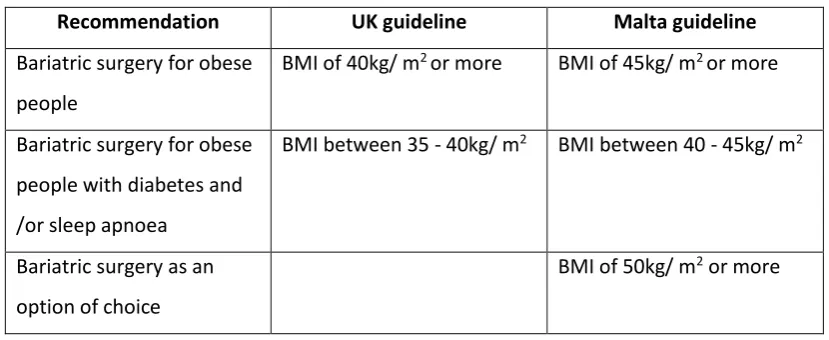
Table 8: Comparison of UK and Malta recommendations 217
Figures
viii
Acknowledgements
At a career crossroads, I decided to undertake a PhD. Subsequently, my children have
grown up for the past four years living and breathing ‘Mummy’s PhD’. They have put up
with me staying in when they have gone out, eating their sweets to keep me going when
tired, and lecturing them on perseverance, endurance and aiming high. Whilst I have now
completed this mammoth task, I can only hope that they have developed an understanding
of the effort needed in order to succeed and will be pleased to have mummy back at full
capacity. I thank them for their patience, love and moments of distraction. I also thank my
husband for creating the space for precious writing time, his tolerance, love and support,
that has enabled me to bring this project to fruition.
Particular thanks must go to:
Dr Ian Bullock for believing in me at the very beginning, mentoring and guiding me on a
professional and personal level.
Prof Kate Seers and Prof Sophie Staniszewska, my supervisors, without whose direction,
knowledge sharing, patience and understanding, I would not have succeeded. They have
been the most admirable supervisors who have made difficult times enjoyable.
Prof Kevin Davis for facilitating my quick change in direction to Malta. Prof Stephen Fava
and Prof Andrew Borg for accommodating me, allowing me to run the full study. The
healthcare professionals in Malta, who at short notice, took me in whole heartedly and
embraced the project.
The Royal College of Physicians, including the National Guideline Centre, in particular Dr
Kate Kelley, for their support, collaboration, sponsorship and flexibility to allow for a whole
new way of working.
Others I would like to thank, whose actions have been so important; the healthcare
professionals in Jordan who provided me with the beginnings of rich and valuable data, in
the most friendly and engaging environment; the friends and colleagues who have helped
me bottom out problems, find solutions and create the right academic path; my family who
have kept me going through love and encouragement; my running friends who have
provided me with endless kilometres of stress release, creativity and advice; and finally
friends and acquaintances who have listened to me, laughed with me and given me the will
ix
Declaration
This thesis is the work of Elizabeth Avital.
x
Abstract
Clinical practice guidelines are developed worldwide, at an ever increasing rate (Sandström
et al., 2015) and accessed internationally without a full understanding as to whether they
are applicable in cross cultural settings. Informed by a review of the literature which
identified a range of theories, frameworks and models to guide knowledge translation, the
Promoting Action on Research Implementation in Health Services (PARIHS) framework
(Kitson et al., 1998b), was selected as a suitable framework to explore evidence based
clinical guideline development work in a cross cultural context.
This research study was an exploration of the appropriateness and utility of the PARIHS
framework, in the cultural translation and adaptation of an evidence based clinical practice
guideline into clinical practice in the healthcare system in Malta. It also aimed to identify
challenges and barriers to successful cultural translation and implementation to inform
future cross cultural knowledge translation programs.
A case study using an embedded single case was used. Data collection consisted of two
focus groups with multidisciplinary healthcare professionals (n=11 and n=5), eighteen semi
structured interviews (n=9 pre and n=9 post) and non-participant observation of two
guideline development groups. Data was analysed both inductively and deductively using
Framework Analysis. Findings of the study indicate that the components of the PARIHS
framework of evidence, context and facilitation are useful to guide the cultural translation
and adaptation of an evidence based clinical practice guideline. In addition, a number of
challenges and barriers to successful translation and potential implementation were
identified; the influence of politics, culture and context, stakeholder involvement including
patient involvement, and resources, both human and financial.
Overall the PARIHS framework is a useful tool to guide the cultural translation and
adaptation of an evidence based clinical practice guideline. The study identified important
additions to the PARIHS framework to improve its utility: expanding the use of culture in
the PARIHS framework to include macro, meso and micro dimensions; the need for a
definition of what context means within the PARIHS framework; the inclusion of politics as
a sub element of context; the importance of resources, and acknowledging the role of the
xi
Abbreviations
Abbreviation Meaning
BSREC Biomedical and Scientific Research Ethics Committee CFIR Consolidated Framework for Implementation Research
EBM Evidence Based Medicine
EU European Union
I-PARIHS Integrated PARIHS
JUH Jordan University Hospital
KAH King Abdullah the Second University Hospital
KHCF King Hussein Cancer Foundation
KTA Knowledge to Action
MOH Ministry of Health
NCSR National Centre for Social Research
NGC National Guideline Centre
NHS National Health Service
NICE National Institute of Health and Care Excellence
OECD The Organisation for Economic Cooperation and Development
OMRU Ottawa Model of Research Use
PARIHS Promoting Action on Research Implementation in Health Services
RCP Royal College of Physicians, London
RMS Royal Medical Services, Jordan
UN United Nations
UNRWA United Nations Relief and Welfare Agency
1
1
Chapter One - Introduction
The implementation of evidence based knowledge into practice is an area of research and
practice that has been evolving over the past few decades as the production of evidence
based innovations and the need for effective implementation is ever increasing. Knowledge
implementation is a complex process, with many frameworks to guide it, yet there is a gap
looking at the cross cultural utility of such frameworks, therefore this research seeks to
evaluate this, focusing on one particular framework.
The purpose of this chapter is to outline the rationale for undertaking this study, clearly
identify the research objectives and the structure of the remaining chapters.
1.1 Background
The context for this study is provided by the National Guideline Centre (NGC) at the Royal
College of Physicians. The Royal College of Physicians (RCP), the oldest medical college in
England (founded in 1518 by a royal charter from King Henry VIII) functions not only as a
membership body which “supports physicians to fulfill their potential” through a variety of
activities, but to significantly and actively contribute to the design of healthcare systems and
the promotion of illness prevention (Royal College of Physicians, 2017c, Royal College of
Physicians, 2017b). The RCP has over 32,000 physician members worldwide, from medical
trainees to retired doctors, covering 30 different medical specialties (Royal College of
Physicians, 2017b, Royal College of Physicians, 2017d). Membership of the RCP reaches
beyond the UK with eighteen percent being global from more than 80 countries (Royal
College of Physicians, 2017a).
1.2 Identification of the topic
The NGC was established in 2009 and is commissioned by the National Institute for Health
and Care Excellence (NICE), to produce evidence based clinical practice guidelines, the aim of
which is to improve the quality of patient care within the NHS in England and Wales. The
NGC has also carried out evidence translation and utilisation in international healthcare
systems looking to standardise their use of healthcare guidelines. As this international work
progressed, the Promoting Action on Research Implementation in Health Services (PARIHS)
framework (Kitson et al., 1998b) was identified and used to underpin the evidence
translation programme. However, although the PARIHS framework was being used to guide
2 approach to considering the appropriateness and utility of cross-cultural adaptation of
guidelines and guidance there was a need to examine whether guidelines developed in one
country were transferable to other countries, and to examine whether the PARIHS
framework was appropriate in other cultural contexts. This thesis thus reviews other
frameworks to ascertain suitability and ultimately test an implementation framework for
cross cultural robustness and utility.
1.3 Implementation of knowledge
The implementation of evidence based knowledge as an area of research and practice
continues to evolve, fuelled by the fact that on an annual basis world-wide, billions of US
dollars are spent in healthcare on the generation of research and the development of
evidence based innovations which are often not implemented (Chaudoir et al., 2013). Due to
this, a gap has been identified referred to as the ‘know-do’ gap (Pablos-Mendez and
Shademani, 2006) the gap between knowledge and what occurs in practice. This ‘gap’ or lack
of utilisation of knowledge, has resulted in healthcare organisations and policy makers
seeking to find ways to ensure that clinical practice is evidence based (Seers et al., 2012) and
implementation strategies are suitable (Grimshaw et al., 2001). The intention being, by
understanding how best to implement evidence based information into health service
delivery, the aim of improving patient care can be better realised.
There are numerous theories and frameworks (discussed and outlined in Chapter 2, section
2.4), developed as a result of the drive for effective implementation of knowledge.
1.4 Implementation frameworks
Implementation frameworks are varied with some being more general and focused on the
whole service and others directed at where the service is delivered or who delivers it.
Whatever the focus of the framework, they all distil theory and practice into key components
(the number of which differ per framework) to be adhered to or considered when
implementing evidence based knowledge. Following a preliminary review of the knowledge
implementation literature, a variety of theories, models and frameworks were derived from
those that were most frequently used and identified in the literature. Within this selection,
there were some which attempt to draw together elements from supporting theories or
frameworks to create service focused frameworks for knowledge implementation including;
the General Theory of Implementation (May, 2013) which explains the implementation
3 and capacity; The Consolidated Framework for Implementation Research (Damschroder et
al., 2009), which is a construct of five domains (the intervention, inner and outer setting, the
individuals involved, the process of implementation) and is recommended to be used as an
adjunct to other theories; a conceptual framework by Ward et al (Ward et al., 2009) which
whilst they identified five common knowledge transfer processes they also identified three
types of knowledge transfer processes; linear process, cyclical process, dynamic
multidirectional process; the Diffusion of Innovations in Healthcare Organisations
(Greenhalgh et al., 2004), which identified a larger number of components to be used for
information and as motivation when considering the complexities of translating knowledge
into practice.
These frameworks consolidate aspects from other frameworks and theories in an attempt to
create frameworks for knowledge implementation. In doing so they illustrate the
multi-layered complexity that is knowledge implementation. They highlight that it is not possible to
account for all the processes involved in implementation, because they are so varied and
complex. However, they do provide ideas and raise awareness of the type of factors that
need to be taken into consideration.
A further four frameworks were reviewed; three of which focus on the context of knowledge
translation and one which looks at the individual practitioner. The four frameworks have
evolved and been refined over time and each has its own set of advantages and
disadvantages, which are outlined in Chapter 2. The Ottawa Model of Research Use (OMRU)
(Logan and Graham, 1998), is a two part model with six elements relating to implementation
factors that are overarched by three key elements of assessment, monitoring and evaluation.
The elements work together in a nonlinear fashion and it is reportedly suited to a range of
healthcare professions, researchers and policy makers. The Knowledge to Action (KTA)
framework (Graham et al., 2006) has the same intended audience as the OMRU and hence
has a wide applicability. It is a framework of two distinct phases; knowledge creation (with
four aspects of knowledge) and action (seven phase dynamic and inter-related cycle) and
accounts for the whole cycle of implementation. The Stetler Model of Evidence Based
Practice (Stetler et al., 2009b), is intended for individual healthcare practitioners or teams, as
a guide to the application of research intro practice. It is a two part model – part one consists
of five sequential phases; preparation, validation, evaluation / decision making, translation/
application, evaluation (Stetler, 2010) and part two is a more in-depth explanation of the
4 guide (Stetler, 2010). The final framework to be reviewed was the Promoting Action on
Research Implementation in Health Services (PARIHS) framework (Kitson et al., 1998b) aimed
at healthcare professionals. The PARIHS framework is a multidimensional conceptual
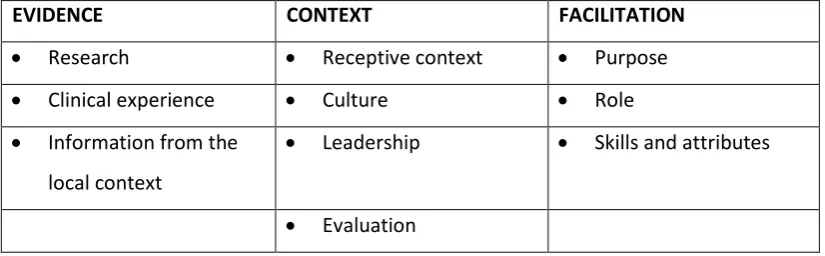
framework with three core interacting elements: evidence, context and facilitation, each of
which is broken down into sub-elements.
As in all models and frameworks, there are limitations and areas for future development.
Examples of these in regards to the afore mentioned models include; the need for further
evaluation and testing of models and adjunct instruments, further deconstruction of
segments, more details of the process itself, clarity of versions, interaction between various
elements. One limitation that applies to all is the role of the patient as this is not sufficiently
addressed in any of the frameworks reviewed.
1.4.1
Why was the PARIHS framework chosen?
The PARIHS framework was identified as being suitable for this study, primarily because of its
focus on high quality evidence, an environment that is receptive to change and skilled
facilitation (Rycroft-Malone et al., 2004a). These are all aspects that are suitable and
applicable to the knowledge translation of evidence based healthcare guidelines. The two
stage process of PARIHS; stage one (evidence and context) produces data outputs which
inform the intervention to be applied at stage two (facilitation) (Kitson Alison. L et al., 2008)
further enhanced its suitability because it works in parallel with the development of an
evidence based healthcare guideline.
1.5 Research gaps
The reviewed frameworks continue to evolve in one way or another, the more they are used
in practice and research gaps are beginning to be filled. However in regards to the PARIHS
frameworks, some gaps still exists such as the need to ascertain whether the three elements
of context, evidence and facilitation hold equal importance (Rycroft-Malone, 2010a) or even
if their relative importance differs depending on the environment in which the framework is
being used. Whilst the PARHIS framework has been used by researchers worldwide, from
Australia (Perry et al., 2011) to Vietnam (Wallin et al., 2011) it has yet to be evaluated as a
framework in a non-Western context or as a framework facilitating the development and
5 therefore not known whether the elements outlined in the framework are transferable cross
culturally.
1.6 Research questions
The aim of this research is to explore the appropriateness and utility of the PARIHS
framework in a cross cultural context. The following research questions were identified:
1. To explore the appropriateness and utility of the PARIHS framework, in the cultural
translation and adaptation of an evidence based clinical practice guideline into clinical
practice in the healthcare system in Malta1.
2. To identify the challenges and barriers to successful cultural translation and
implementation to inform future cross cultural knowledge translation programmes.
1.7 Thesis structure
The thesis is structured into the following chapters:
Chapter one, the introduction which provides a background to the research and an overview
of the chapters.
Chapter two is the literature review. This review is divided into three sections; part one
begins by charting the rise of evidence based medicine, its development and
implementation. It then progresses to explain the role of knowledge translation, making sure
to define the variations in terminology and definitions relating to knowledge
implementation. The review moves to an evaluation of a variety of knowledge
implementation theories and frameworks, concluding with the decision to use the Promoting
Action on Research Implementation in Health Services (PARIHS) for the purposes of this
research. Part two of the review is an exploration of the complexity of defining culture and
its function within healthcare in particular organisational culture and context. The chapter
continues with the identification of culture within the original knowledge implementation
frameworks reviewed. Part three is an overview of the two research settings; Jordan and
1 This study began with the Royal Jordanian Medical Services, however due to unforeseen
6 Malta. The intention of this chapter is to provide the reader with an understanding of the
country geography, demographics and healthcare provision.
Chapter three is the methodology. The chapter provides an understanding as to why a
particular methodology has been employed for the purpose of this research. A discussion
about the different philosophical paradigms by which research can be carried out is made
and concludes that the most appropriate for this study is constructivism. Qualitative case
study as a methodology is further explored illustrating its suitability to this research.
Chapter four follows by reviewing the individual methods used in this research in turn. The
methods utilised in this study are; focus group, semi structured interviews and observation.
The method of data analysis (framework analysis) selected is explored using examples from
the literature.
Chapter five is an account of the case study, how each method was used and how the data
was captured including the; focus groups, interviews, guideline development and
observation.
Chapter six presents the analysis and findings of the study in three sections. Section one is
an analysis of the two focus groups that took place in Jordan and Malta, and is a commentary
of key aspects that were recorded in the groups with a comparison of concepts between the
two study sites. Section two presents the most salient themes identified relating to the
three main elements of the PARIHS framework, identifying their function in a cross cultural
setting and providing insight into how these factors interlink with one another. The final
section is concerned with the findings of the participants’ experience of developing the
guideline and is a consideration of their view of the work undertaken.
Chapter seven, presents a discussion of the findings of the study focusing on the key themes
that emerged. Within this discussion; key themes are linked to underpinning theory;
identification is made of where further work can be carried out; original contributions to
knowledge are noted; insight into the process that was undertaken and the experience of
cross cultural translation is discussed; and limitations of the study and any methodological
issues that arose are outlined.
Chapter eight is the final chapter and concludes with the key findings, identification of
7
2
Chapter Two - Literature Review
2.1 Introduction
This chapter offers a background to the area of study. It commences by looking at the
development of evidence based medicine, the role and use of evidence in clinical practice.
An overview of the area of knowledge implementation and a definition is provided, leading
to a review on a selection of knowledge implementation theories and frameworks.
Assessment was made of the limitations of these frameworks, resulting in the selection of
the Promoting Action on Research Implementation in Health Services (PARIHS) framework
as the one most suitable for this study. Whether reference made to the role of culture in
the models and frameworks reviewed is also assessed.
The second part of the review looks at culture; the breadth and complexity of it. It begins
by an exploration of definitions of culture and considers possible definitions for this study.
The latter part of the section focuses on organisational culture, what this means in the
healthcare sphere and the relationship it has with context.
The final section of this chapter provides an overview of country characteristics and
background to the countries in which this study is situated.
2.2 Evidence based medicine
2.2.1
The development of Evidence Based Medicine (EBM)
The idea of medicine being underpinned by evidence, resulting in care that would be both
effective and efficient, was proposed by Archie Cochrane in 1972 in his seminal book
entitled ‘Effectiveness and Efficiency’ (Cochrane, 1972) . Yet the popularity and utilisation
of evidence based medicine is recognised as gaining traction in the 1990’s, as concern grew
regarding the utilisation of healthcare research outcomes into everyday practice and the
drive to create a more efficient and effective health service (Oborn et al., 2010). The term
‘evidence based medicine’ was coined by Professor Gordon Guyatt in 1990, as he changed
the title of the medical teaching program to insist that patient care should be delivered on
the basis of evidence (Smith and Rennie, 2014). Over the following years the concept was
further developed to include patient preferences and values (Smith and Rennie, 2014).
The establishment of the Cochrane Collaboration in 1993 was pivotal in furthering the
8 producing synthesised research evidence through global collaboration and promoting
evidence based clinical decision making (Cochrane, 2017b).
2.2.2
Definition of evidence based medicine
To understand evidence based medicine (EBM), it is important to define it. In the 1990’s
(Sackett et al., 1996) defined EBM with a definition which focuses on the use of evidence to
inform decision making, as it is defined as “the conscientious, explicit, and judicious use of
current best evidence in making decisions about the care of individual patients” (Sackett et
al., 1996)(p71). Building on this and as a way of addressing the medical focus of EBM a
nursing orientated definition was written to include the consideration of the expertise of
nurses; “integration of the best evidence available, nursing expertise, and the values and
preferences of the individuals, families and communities who are served”(Sigma Theta Tau
International Evidence-Based Practice Task Force, 2004)(p69). Whilst the second definition
expands on the types of evidence one may consider, the fundamental aim is the same, that
is to say, patient care, in regards to both policy and practice should be based on the best
available evidence (Pablos-Mendez and Shademani, 2006). A range of terms exist;
evidence based healthcare, evidence-based practice and evidence based nursing (DiCenso
et al., 1998), all of which focus on using the best available evidence to inform practice
(Cochrane, 2017a). An expression that has more recently been used and which has become
an expected standard of practice is evidence informed decision making (EIDM), (Yost et al.,
2015). Within this review, evidence based practice will be used as the preferred term
because it is understood to be a broader term which encompasses the multidisciplinary
nature of healthcare provision.
2.2.3
Implementation of evidence
As established, evidence based practice refers to the utilisation of evidence, to provide the
best patient care. In conjunction with this is the availability of such evidence, how it is
assessed and implemented into practice. Thus the implementation of evidence into
practice is an area of research and practice that has been evolving over the past few
decades. On an annual basis world-wide, billions of US dollars are spent in healthcare on
the generation of research and the development of evidence based innovations,
interventions and practices however, many are often not implemented (Chaudoir et al.,
2013). To facilitate the use of evidence, countries such as the UK, US and Australia have
9 Excellence, the Agency for Healthcare Research and Quality and the National Health and
Medical Research Council respectively, to produce accessible evidence e.g clinical practice
guidelines. This does not however act as a guarantee that the synthesised evidence is
implemented into practice, even though the use of evidence to guide decision making is
being driven at all levels, for healthcare practitioners and policy (Luoto et al., 2014). In the
UK efforts to integrate evidence based knowledge has primarily focused on the
development and dissemination of clinical practice guidelines, but their implementation
has been inconsistent (Grove et al., 2015) and hard to measure.
The lack of implementation referred to is not only a concern because of a waste of
resources but, it can result in inequality and unsuitability of healthcare provision as
optimum care is not provided (Graham et al., 2006) (Grimshaw et al., 2012, Grol, 2001).
Alongside the failure to provide the best care available, healthcare services are incurring
unnecessary costs whilst patients are ultimately experiencing a poorer quality of life
(Grimshaw et al., 2012). Interventions and practices that are shown to be effective in a
research environment but are not effectively translated into practice, has an impact both
on healthcare providers and patients (Damschroder et al., 2009). The challenges of
consistent knowledge implementation is something that occurs worldwide, yet the
difficulties encountered by low and middle income countries is even more extreme where
resources are scarce (Santesso and Tugwell, 2006).
For healthcare professionals to be able to make informed decisions about clinical practices,
knowledge acquisition and implementation needs to be embedded in their practice (Doran
and Sidani, 2007). However, there is such a plethora of evidence to implement, evidence
often fails to translate into practice (Damschroder et al., 2009). To address this, clinical
practice guidelines have been developed and promoted as tools for the synthesis of
evidence (Shekelle et al., 2012). The following section focuses on clinical practice
guidelines in greater detail.
2.3 Clinical practice guidelines
2.3.1
Definition and purpose
Clinical practice guidelines can be described as a distillation of evidence that is made
available to healthcare practitioners with the aim of improving patient care and safety
10 In their rawest form they can be considered as the “foundations for efforts to improve
healthcare” (Shekelle et al., 2012) (p1), the building blocks upon which change in practice
can be established and should be integral to clinical practice (Grove et al., 2015). Clinical
practice guidelines are developed worldwide at an ever increasing rate (Sandström et al.,
2015) and used nationally and internationally as a means of disseminating evidence based
practice by transforming healthcare research into practice recommendations (van der Zijpp
et al., 2016) (Lowson et al., 2015). Clinical practice based guidelines are developed to
cover a variety of health topics and service delivery to include prevention, diagnosis and
treatment. Not only are they considered to be a clinical aide but as they are the end
product of appraised research, they help overcome barriers such as time to read the excess
of clinical research papers, critical appraisal and accessibility (Grimshaw et al., 2012).
Despite the inherent focus of clinical practice guidelines being for the healthcare
professional community, they are also accessed by patients and can be regarded as helping
to empower patients to make better informed choices (Woolf et al., 1999).
In the UK, the National Institute for Health and Care Excellence (NICE) has been developing
healthcare guidance since 1999, to reduce the disparity of healthcare quality, provision and
practice (Lowson et al., 2015). Whilst clinical practice guidelines are easily accessible,
through online clearing houses or directly through guideline developers and providers such
as NICE, this does not ensure certainty that they will be implemented (Shekelle et al.,
2012), nor does it promise that they will be adhered to (van der Zijpp et al., 2016). It might
therefore be said that this method of evidence dissemination has not had the health
outcomes success as such investment should warrant (Rycroft-Malone et al., 2016).
2.3.2
Guideline implementation
A systematic meta-review by Francke (2008) evaluated factors which impacted on guideline
implementation and found that there were a number of influencing factors, including the
complexity of the guideline and the characteristics of the healthcare professionals involved
in the development (Francke et al., 2008). They concluded that for implementation to be
effective a multifaceted implementation approach was needed, and that both the
characteristics of the guideline and the professionals at whom they are targeted play
important roles in successful implementation. Moreover, in addition to these factors, it has
been repeatedly identified that for guideline implementation to be successful the context,
11 this has, needs to be recognised (Francke et al., 2008) (Davis and Taylor-Vaisey, 1997)
(Straus et al., 2013) (Sandström et al., 2015).
2.3.3
Definition of knowledge implementation
Reference has been continuously made to the implementation of guidelines, however,
comprehending what is meant by implementation is crucial to understanding the process.
Variations in terminology and definitions have increased as the area of implementation
research has expanded (Damschroder et al., 2009). Terms and definitions are often used
interchangeably such as; knowledge transfer, knowledge translation, transfer exchange,
research utilisation, quality assurance, quality improvement and innovation diffusion (Ward
et al., 2009) (Graham and Logan, 2006). Knowledge translation is a popularly used term
from the Canadian Institutes of Health Research whereby it is defined as: “a dynamic and
iterative process that includes synthesis, dissemination, exchange and ethically-sound
application of knowledge to improve the health of Canadians, provide more effective health
services and products and strengthen the healthcare system” (Canadian Institutes of Health
Research, 2017). What is illustrated by this definition is that the use of knowledge in
healthcare is an interactive process covering the whole journey starting with the formation
of new evidence and ending with it being used in practice (Sudsawad, 2007).
The World Health Organisation formulated a more globalised definition by defining
knowledge implementation as “the synthesis, exchange and application of knowledge by
relevant stakeholders to accelerate the benefits of global and local innovation in
strengthening health systems and improving people’s health” (World Health Organisation,
2017c). Grimshaw (2012) expanded the inclusion of stakeholders by recognising the variety
of stakeholders involved in the provision of care ranging from policy makers to patients
themselves as they state that knowledge translation involves “ensuring that stakeholders
are aware of and use research evidence to inform their health and healthcare decision
making” (Grimshaw et al., 2012)(p2).
What these definitions illustrate is that despite the variant names or descriptions for the
implementation and uptake of evidence based knowledge, the fundamental principle
remains the same, that is, the purpose of knowledge translation is to move ‘knowledge
into action’ (Graham and Logan, 2006). Thus the aim of the intervention is to move the
12 referring to the complex process of facilitating the use of evidence into practice in this
review, the term knowledge implementation will be used, based on the following
definition which encapsulates the multifaceted nature and challenges of knowledge
implementation; implementation may be defined as “actively and systematically
integrating information into place; identifying barriers to change, targeting effective
communication strategies to address barriers, using administrative and educational
techniques to increase effectiveness” (Bucknall and Rycroft-Malone, 2010) (P6). As the
definition of knowledge implementation has been established, the subsequent section
looks at the movement of knowledge into practice and the challenges faced.
2.3.4
The challenge of knowledge implementation
The overall aim of knowledge implementation is to improve the use of research based
knowledge in healthcare practice (Salter and Kothari, 2014). Over the past decade,
healthcare policy and practice has become increasingly focused on the use of evidence
based care to move appropriate evidence into practice as healthcare provision is not
always based on the best available evidence (Oborn et al., 2010). In parallel to the desire
to facilitate evidence into practice there is a frustration that research is undertaken and
published but not moved into the realms of policy making or practice (Grimshaw et al.,
2012) in order to improve patient care (Straus et al., 2009). This incongruence has been
termed as a ‘know-do gap’ (Pablos-Mendez and Shademani, 2006), that is, the gap
between knowledge and what occurs in practice. What is evident is that the existence of
knowledge and the action of dissemination alone are not sufficient to effectively move
knowledge into practice (Straus et al., 2009). The same difficulties associated with the
movement of knowledge into practice can be found in low, middle and high income
countries and across healthcare environments (Straus et al., 2009).
2.3.5
Moving knowledge into practice
The healthcare environment is a complex and diverse place, which is dynamic in nature,
hence it is increasingly recognised that knowledge implementation interventions need to
be sensitive to numerous aspects to ensure optimum translation such as; the identification
of possible barriers and facilitators, the identification of the intended audience, the
adaptation of information to suit the target audience (Grimshaw et al., 2012) and the
acknowledgement of context (Rycroft-Malone et al., 2012 -a) (Estabrooks et al., 2006)
13 knowledge implementation is healthcare providers, the evidence should utilise systematic
reviews as this assists in the globalisation of evidence (Grimshaw et al., 2012). Different
theories, frameworks and models each evolving from a different theoretical background
have been developed to illustrate and guide the implementation process, illustrating how
implementing evidence into practice is a multidimensional, process (Rycroft-Malone,
2010b) (May, 2013). The applicability of each model, theory or framework based on this
review have varying strengths and weaknesses, making them suitable for different
circumstances. Examples of such models, theories and frameworks are given and discussed
in detail in section 2.4 entitled Theories and Frameworks.
This ‘gap’ or lack of utilisation of knowledge, has resulted in healthcare organisations and
policy makers seeking to find ways to ensure that clinical practice is evidence based (Seers
et al., 2012). This has not only positively created an increased awareness of the
importance of appropriate implementation strategies (Grimshaw et al., 2001) but has
created a drive to reduce this gap (Grimshaw et al., 2012). In acknowledgement of this
disparity the World Health Organisation (WHO) stated that they would be instrumental in
seeking to lessen the gap and that they would support countries to do so through
advancement in knowledge translation (Pablos-Mendez and Shademani, 2006). Yet
knowledge implementation can be slow and is costly, with numerous influences such as
who is responsible for the development of the knowledge to be implemented, trust in the
people who have been involved and the culture of the receiving context, preventing
effective implementation of evidence based practice (Sandström et al., 2015).
2.3.6
Implementation research
As the drive for knowledge implementation has increased, as has a renewed focus on
knowledge implementation research. The original conceptualisation of implementation
research may be attributed to the French sociologist Gabriel Tarde in the late 1800s, who
was concerned with why society adopts some innovations but not others (Tarde, 1903).
However, recent growth in implementation research, in particular over the last 10 to 15
years, emulates from the same conceptual base and is driven by the need to identify the
challenges, barriers and facilitators associated with the implementation of evidence based
practice (Nilsen, 2015). This has occurred alongside a necessity to identify the uniqueness
of each healthcare environment and the most effective means of implementing knowledge
in different contexts (Kirk et al., 2016). Yet, more research needs to be carried out on why
14 implementation intervention that is successful in one context is infrequently equally
successful in another (Rycroft-Malone et al., 2012 -a). Furthermore, researchers have
expressed concern that the processes used to implement knowledge are not achieving the
desired effects (van der Zijpp et al., 2016), the provision of the best available care is not
being met(Grimshaw et al., 2012), nor is there assurance that the interventions undertaken
create sustainable change (Tricco et al., 2016).
2.3.7
Summary
In sum, the development of implementation strategies needs to move from an approach
which does not consider the diversity of an environment or context, to one which starts to
accommodate these influences (Rycroft-Malone, 2010a). Research indicates that
successful implementation strategies rely on a multidimensional approach, taking into
consideration the intended audience, the type of knowledge to be implemented (Straus et
al., 2009) and the barriers and facilitators to doing this (Wiltsey Stirman et al., 2012).
Implementation theory is developed as researchers and practitioners further identify the
important elements of the implementation process (May, 2013), both their individual
importance and their interaction with each other. Moreover, Nilsen (2015) (Nilsen, 2015)
argues it is the role of implementation research to explore these influences and continue
the drive to develop a theoretical base to underpin implementation strategies.
Hence it has been established that clinical knowledge, interventions and practices are not
being implemented successfully, if at all, (Chaudoir et al., 2013) for a variety of reasons.
Some reasons are better understood such as the lack of an infrastructure for knowledge
implementation, and others are less so, for example unsuccessful implementation where a
structure exists. Acknowledgement has been made of the importance of recognising
factors that aid the facilitation of knowledge implementation, with the need for further
research into the identification of what these factors are. The development of this
15
2.4 Theories and frameworks
2.4.1
Background
Within the arena of healthcare practice and policy, it is recognised that, it is imperative for
evidence based knowledge to be implemented effectively in-order to provide optimum
patient care. However, there is currently no agreement over the most efficacious way to
do this (Ward et al., 2009), how to evaluate the impact of such implementation practices
(Salter and Kothari, 2014) or an understanding of how implementation can be successful in
one arena but not another (Kirk et al., 2016). Nor is it clear which methods are the most
effective and / or in which context (Kitson Alison. L et al., 2008). Successful knowledge
implementation is multidimensional, as the definitions exampled illustrate and is reliant on
a variety of factors as previously identified. To help explain and illuminate these processes
and factors, numerous theories, frameworks and models have been developed (Nilsen,
2015) (May, 2013). In an attempt to distinguish between the different types of theories,
models and frameworks and their roles, (Nilsen, 2015) identified three purposes of use,
providing an understanding of the role that they have;
a) A guide or description as to how to translate knowledge into practice
b) A means for explaining or assisting the understanding of the multivariate factors
that influence implementation
c) An aid or structure to the evaluation of implementation
Ellen (2014) supports the notion that frameworks should be seen as guides to the activities
or processes needed to enable the transference of knowledge into practice and identifying
where the barriers and enablers are to facilitate this (Ellen et al., 2014). Whilst there needs
to be an understanding of the purpose and role of theories, models and frameworks,
consideration also needs to be made of the overriding principles one should consider prior
to the implementation of change. These have been identified and include;
acknowledgement and understanding of the complexity of the healthcare practice, the
commitment of the target group, characteristics of the intervention and the importance of
progress monitoring to identify whether change has occurred (Grol et al., 2007). The
following will expand these principles by an evaluation of a selection of models, theories
16
2.4.2
Identification of theories and frameworks
The following section looks at a cross section of different types of implementation theories
and frameworks. Selection of the following theories and frameworks was derived from
those that were most frequently used and identified in a review of the knowledge
implementation literature. The purpose of this literature review was to identify a
framework suitable to facilitate the cultural translation and adaptation of an evidence
based clinical practice guideline. In turn the utility and appropriateness of the framework
for such a purpose will be evaluated.
2.4.3
Frameworks
In response to differences in terminology and in a quest to identify specific elements of
successful implementation some overarching frameworks have been developed. They
attempt to draw together elements from supporting theories or frameworks to create all
encompassing frameworks for knowledge implementation. One such example is a General
Theory of Implementation developed by May (May, 2013) using Normalization Process
Theory as the foundations and linking it with constructs from social system theories and
cognitive psychology. From this, May (2013) identified four key elements relating to the
knowledge implementation process; capability, potential, contribution and capacity, at the
same time acknowledging .that whilst it is possible to have both a general theory and
terminology, it is not possible to account for all the processes involved in implementation
as they are so variable and complex by nature (May, 2013). In the context of healthcare,
process theory relates to how the organisation of an activity (how it should be planned and
carried out), which aims to implement change, will be effective and how the intended
audience is affected by the activity (Grol et al., 2007).
Another combined theory was developed by Damschroder et al (2009), following a
comprehensive review of existing theories, models and frameworks that aim to embed
research into practice; the Consolidated Framework for Implementation Research (CFIR)
(Damschroder et al., 2009). The review resulted in the construction of five main domains;
the intervention, inner and outer setting, the individuals involved, the process of
implementation (Damschroder et al., 2009) which can be employed at any implementation
stage (Kirk et al., 2016). The authors regard the framework as a usable guide and it is
perceived as complementing other theories, in particular process theories (Damschroder et
17 identified that although it had been applied in a variety of research studies and settings,
they concluded that in order to aid progression of implementation science the CFIR needed
to be further evaluated (Kirk et al., 2016).
A unifying conceptual model; the Diffusion of Innovations in Healthcare Organisations
(Greenhalgh et al., 2004) was developed following a literature review, across a variety of
disciplines (sociology, psychology, organisation and management, systems analysis) to
ascertain how health service innovations could be disseminated in a manner which
ensures sustainability. The model was created to be used as a stimulus to consider the
varied and multiple complexities that impact on translating knowledge into practice. The
model has nine main components, each of which has a number of detailed
sub-components, which can be applied in any order and which, the authors’ state, should not
be used rigidly (Greenhalgh et al., 2004). The components are:
The innovation itself, emphasising the need to make it relevant, accessible, simple and
compatible with the views of the intended audience.
Communication of the innovation. This can be achieved through a planned or
unplanned process (diffusion or dissemination), using a variety of communication
structures such as social networks, opinion leaders and media.
Outer context. These are the external influences, such as whether similar organisations
have done the same thing, whether there are policies that support the innovation, that
impact on the organisations ability to implement the innovation and create
sustainability.
Linkage. Ensuring that during both the design stage of the innovation and the
implementation stage that there are connections across the other components to
assist in a systems wide approach to implementation.
Implementation process. This is influenced by a variety of factors including system
readiness, leadership and management, human and financial resources. Adoption and assimilation of the innovation. This is a process within which the
intended user is active and will be influenced to adopt the innovation through a
number of influences such as the meaning the innovation has on a personal or
organisational level. Assimilation of the innovation into an organisation is a complex
18 System readiness for innovation. Whether an organisation is open to an innovation
being introduced. This is influenced by the values of the organisations, staff perception
of the current situation, time and resources.
System antecedents for innovation. The organisational context in which the innovation
is to be implemented and the influence this has on its uptake and use (Greenhalgh et
al., 2004).
As the nine components illustrate, it is very comprehensive, covering both the macro and
micro systems involved and external influences to both, resulting in the authors recognising
that it would be a challenging undertaking, to fully operationalize the framework
(Greenhalgh et al., 2004). Instead they visualise it as a model to assist in the identification
and understanding of the factors involved in the successful implementation of knowledge
into practice (Greenhalgh et al., 2004).
A further framework to outline is one that focuses on implementation research rather than
practice, created by Chaudoir et al (Chaudoir et al., 2013). They identified five factors from
existing frameworks to create a multi-level framework which comprised of the following
levels;
Structural; the context in which an organisation operates. Organisational such as leadership effectiveness and culture, Provider; any individual providing care,
Innovation, which refers to whether the innovation is regarded as being
advantageous to practice and the robustness of the evidence behind it,
Patient-level factors which focuses on the characteristics of the patient (Chaudoir
et al., 2013).
Following the identification of these levels a systematic review found 62 measures that
could be used to assess the five factors (there was not an equal number per factor). The
result was a catalogue of measures intended for use by researchers, to assist them in
appraising factors relating to implementation, e.g. organisational, provider or patient
factors (Chaudoir et al., 2013).
The four frameworks outlined so far attempt to draw together elements from supporting
theories or frameworks to create broad frameworks for knowledge implementation in
practice and in research. These examples not only indicate that a multidimensional focus
19 consideration, they also suggest that a single framework, may not be suitable for all
situations (Ward et al., 2009). The diversity in these frameworks stems from the inclusion
of different components, and they have been developed from a variety of backgrounds and
influences such as psychology, behavioural change, research utilisation and organisational
change (Ward et al., 2009) (Sudsawad, 2007). These frameworks are broad in their
application and may be considered as lacking the finer details needed to operationalise the
implementation of evidence into practice.
2.4.4
Selection of frequently used models and frameworks
Consideration of the, afore mentioned frameworks have identified the complexity of the
knowledge translation process and that there are numerous factors to be considered. To
extend the debate further and to provide an opportunity to incorporate other factors of
importance in knowledge implementation, an additional two models and two frameworks
were identified; the Ottawa Model of Research Use (OMRU) (Logan and Graham, 1998), the
Stetler Model of Evidence Based Practice (Stetler et al., 2009b), the Knowledge to Action
(KTA) framework (Graham et al., 2006) and the Promoting Action on Research
Implementation in Health Services (PARIHS) framework (Kitson et al., 1998b) . They were
primarily chosen because they are; frequently referred to and utilised in the knowledge
translation literature, internationally recognised and used, well established, tested and
evaluated (Rycroft-Malone, 2010a). These factors have particular resonance in this study
where there is a distinct focus on international usage. A framework was required in this
study to guide the development of an evidence based practice guideline, thus previous use
in a country other than that in which the model/ framework was developed, is important.
Furthermore, as this study emphasises the influence and importance of culture, the review
identifies whether the model or framework has a component or sub-component that
relates to context, culture or both.
Sudsawad (2007) categorised models and frameworks looking at their different attributes
(Sudsawad, 2007). Within this categorisation the OMRU, KTA and PARIHS were classified as
a model and frameworks whereby the attention is on the context in which knowledge is
translated and the Stetler Model as an example of a model which looks at the individual
practitioner (Sudsawad, 2007). The process of categorisation of knowledge implementation
models, theories and frameworks is continued by Nilsen (2015) who developed a further
five categories; process models, determinant frameworks, classic theories, implementation
20 Stetler Model and the OMRU are seen as process models the function of which is to guide
the process of knowledge translation, whereas the PARIHS framework is identified as a
determinant framework, the function of which is to describe the multifactorial elements
(both barriers and facilitators) that influence implementation (Nilsen, 2015). These
distinctions have been noted because they signify the differences between the models and
frameworks and indicate how one theory, model or framework does not suit all settings
(Ward et al., 2009). In turn, this supports the reasoning that it is important to know the
setting and population before choosing a framework (Estabrooks et al., 2006).
The following is a review of these four models and frameworks, identifying their key
components, limitations and usages, to determine which one would be the most suitable to
use to guide the cultural translation and adaptation of an evidence based clinical guideline
in a cross cultural environment.
2.4.5
The Ottawa Model of Research Use (OMRU)
The Ottawa Model of Research Use (OMRU), was first conceptualised in 1998 (Logan and
Graham, 1998). As with other models and in keeping with the developing field of
knowledge implementation, the model has evolved since it was originated (Graham and
Logan, 2006, Logan and Graham, 2010). The development of OMRU was twofold as it was
developed as a mechanism through which the process of knowledge translation could be
studied and as a practical model for multidisciplinary use to transfer healthcare knowledge
into practice (Hogan, 2004) for example for the implementation of evidence based
guidelines and the promotion of clinical assessment and clinical management programmes
(Sandhaus et al., 2009) (Graham and Logan, 2004). It is based on theories of change
(Graham and Logan, 2006), is regarded as a planned action model and is both descriptive
(six elements) and prescriptive (monitoring process)(Logan and Graham, 2010). The basis of
the six descriptive elements is derived from literature in areas such as physicians’
behaviour, development and implementation of guidelines and research utilisation (Logan
and Graham, 1998).
The authors were clear in explaining that, although these elements are linear in
representation, they are not unidirectional and work influencing each other (Logan and
Graham, 1998). Overarching the six key elements are what can be described as the more
fixed parts of the model, the function of which is to guide facilitators in all stages of
21 lifecycle of the project as they are there to; identify barriers and facilitators (assess);
provide direction; monitor progress and the amount of use (monitor); assess the impact of
the innovation (evaluate) (Logan and Graham, 2010) (Logan and Graham, 1998). The
identification of barriers to the implementation of research knowledge is a key component
of the model as it is through this that the selection of appropriate intervention can be
enabled (Sudsawad, 2007). This is what the OMRU was designed to do and focus on
(Santesso and Tugwell, 2006) (Graham and Logan, 2006).
The model has altered over time, with changes primarily occurring in the sub elements,
whilst the core elements have been maintained (even though their ‘titles’ have changed in
some cases). The only structural change was the re-positioning of the innovation element
from the bottom to the top of the diagram, as it was felt that in most projects, people start
with the idea for the innovation and then the other factors are formed (Logan and Graham,
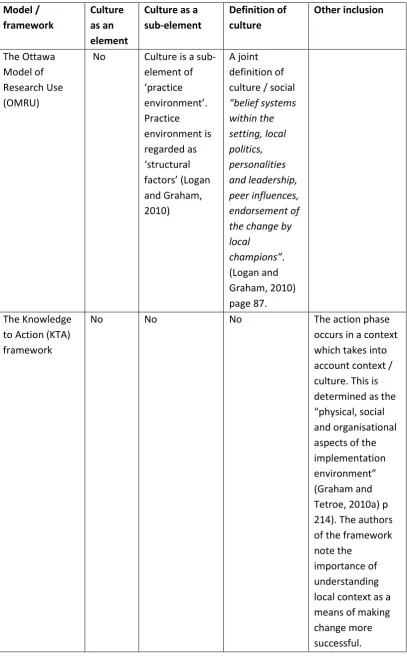
2010). As the framework evolved culture became a sub element in its own right rather
than being just part of the explanation of what constituted social factors (Logan and
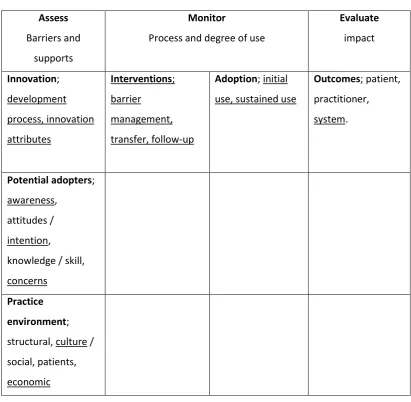
Graham, 2010). The two iterations can be seen in Tables 1 and 2 with changes identified by
[image:34.595.114.524.435.682.2]underlining.
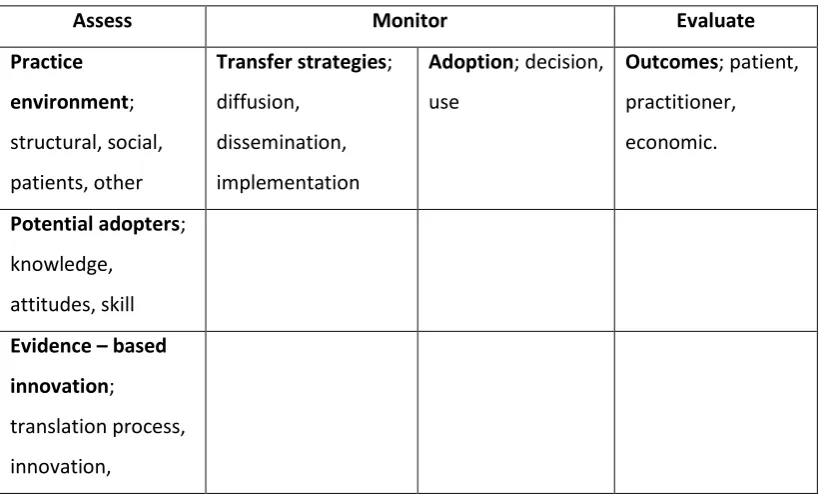
Table 1: Representation of the original OMRU (Logan and Graham, 1998)
Assess Monitor Evaluate
Practice
environment;
structural, social,
patients, other
Transfer strategies;
diffusion,
dissemination,
implementation
Adoption; decision,
use
Outcomes; patient,
practitioner,
economic.
Potential adopters;
knowledge,
attitudes, skill
Evidence – based
innovation;
translation process,