Abstract— Transforming linear business models to circular economies that obtain as much of a product’s material and value as possible is anticipated by industry and policy as a way to conciliate economic, societal and environmental interests. A key factor for this transformation is the integration of information processing, material flows and financial benefits throughout value chains. Unfortunately, this integration comes at the price of complexity in manifold facets. Opposing this systemic, holistic challenge, tools for complexity management that are currently used by companies aim at reducing complexity on a local level rather than appreciating the relevance of complexity for viable circular value networks. Through reviewing complexity in its relevance for manufacturing and value creation and the concept of a circular economy, this paper highlights the misalignment of global goals and local measures. This misalignment leads to an uncertainty on how to shift towards circularity in the industry. We conclude by proposing research to cure this knowledge-gap.
Index Terms—Complexity, Circular Economy, Closed Loop Value Chain, Management
I. INTRODUCTION
The so called circular economy is a paradigm of conducting business that appraises the role of resource efficiency and value conservation for prosperous economies and their environment. Based on the thought that value and resources inbuilt in a product get lost when this product is downgraded or landfilled, the circular economy and those who are arguing for a shift towards this paradigm aim at highlighting ways where value co-creation within value networks and the timely consideration of end-of-life options and reuse help save resources and money both for producers and customers.
In this paper, we will introduce the field of complexity management into the circular economy. In a first step, we will briefly review definitions of complexity as they are used in production and manufacturing and detail the main mechanisms of complexity management as they are described in the literature and used in manufacturing
Manuscript received March 18, 2016; revised April 06, 2016. 1 Christoph J. Velte is with the University of Bayreuth, Bayreuth, 95447 Germany (corresponding author phone: +49-921-78516-422; e-mail: [email protected]).
2 Rolf Steinhilper is with the University of Bayreuth, Bayreuth, 95447 Germany. He is professor at the Chair Manufacturing and Remanufacturing Technology and leads the Fraunhofer Project Group Process Innovation. (e.mail: [email protected])
contexts (Section II).
In Section III, we will review concepts and descriptions of the circular economy and detail them as to the elements that constitute elements of complexity definitions and drivers for complexity as identified in section II. Those drivers will be reviewed as to their role for the viability of circular economy approaches with the perspective of an integrated value chain rather than company-individual strategies.
Section IV will conclude the definitions of complexity on the one hand and the key factors of a circular economy on the other hand. A new perspective on complexity and complexity management in a production environment is opened in comparing drivers for complexity and KPIs for the circular economy and using this comparison to comment the adequacy of complexity management techniques and tools in a shift from linear to circular.
Concluding the insights from sections II – IV, section V will provide a perspective for coming research in the field of complexity management with a dedication to the circular economy to become a catalyst for an economically viable and manageable paradigm shift.
II. COMPLEXITY IN PRODUCTION AND MANUFACTURING
Complexity consists, depending on the source cited and, more importantly, on the scientific background and envisaged application of the source, of different sub-properties [1–4]. Those sub-sub-properties are e.g. variety or dynamics and will be introduced in the next section. All of those properties have in common that they are properties of systems, which, in their basic configuration and from a systemic point of view, consist of elements (items) and the connections between those elements [5]. In the following paragraph, we will comment on definitions and the properties that construct complexity, as they are proposed in the field of product and process complexity and refer to properties and constellations of items and their connections.
A. Definitions and composition of complexity
Following Schuh, there are two main ways, in which companies experience complexity: the first is, that they are too big and diverse to meaningfully connect all elements, resulting in a feeling of complexity. The second is, that the dynamic change of such a system and its development cannot be predicted due to its size and diversity [2]. Schuh talks about this referring to product complexity in companies, while it is legitimate to assume that this is true even more so when talking about value chains (i.e.
Complexity in a Circular Economy: A Need for
Rethinking Complexity Management Strategies
Internal vs. External Complexity
Items can be: Det ail Complexit y 1. Number of it ems 2. Diversit y of it ems
Dynamic Complexit y 1. Change in t ime 2. Nonlinearit y 3. Nonpredict abilit y
[image:2.595.313.537.619.763.2]Elements (Variet y) Links (Connect ivity)
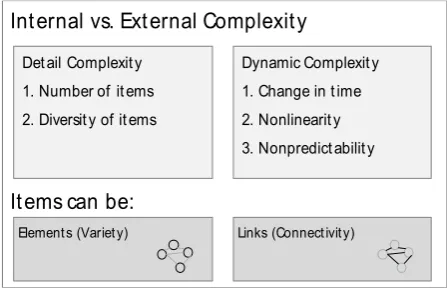
Fig. 1. Complexity definitions as adapted for this paper
production systems) in a circular economy.
Going more into detail based on this basic understanding and summing up Schuh’s thoughts, complexity can be subdivided into: (1) the number of different elements (i.e. items and connections) in a system; (2) the degree of difference between these elements; (3) the degree of change that these constellations experience relative to time (i.e. dynamics) [4].
Taking these considerations into account, Ehrlenspiel draws a line between elements and their connections. He summarizes the number of different elements and the overall degree of difference between those elements as ‘variety’, while he talks about ‘connectivity’ addressing the degree of difference of the links or relations that items have [1]. With this distinction, Ehrlenspiel is in the tradition of Casti, who talked about complexity saying that it consists of the “structure of the irreducible component subsystems” on the one hand, and the “manner in which the components are connected to form the system” on the other hand [6, p.41].
On top of those considerations, a dedicated measure for the uncertainty that is connected to those key characteristics is introduced by Zielowski, who understands ‘transparency’ as an aspect that contributes to the complexity as it is experienced [7]. Describing transparency as a system property referring to complexity pays respect to another important property of systems experienced as complex (Gell-Mann talks about effective complexity in this ‘subjective’ context [8]), which is the non-linearity and non-predictability of those systems and their behavior [9].
Beyond these generic considerations, there are many more detailed definitions of complexity from different fields of research (compare [10]), and especially towards specific aspects of those fields. Product complexity [11], project complexity [12] and supply chain complexity [13], just to mention three specific fields, are described in detail to result in quantifiable system properties such as the e.g. the number of different parts per product in terms of the product complexity[11]. From a generic point of view, these detailed descriptions all apply the number and variety of elements and connections and their unpredictability to different system boundaries and definitions.
B. Complexity of systems
Widening the understanding of complexity beyond detail considerations, the tradition of describing systems’ complexity comes from a wide range of literatures and fields of research, among those “philosophy, the physical sciences, engineering and management.” [13, p.79].
A distinction that can be made in defining complexity based on its relevance for actions as well as on the acknowledgement of interdependencies is the one resulting from defining system boundaries. Complexity, described in its properties by the definitions above, can be either system-internal or external [1, 2], with a system boundary as the border. Following this distinction, complexity consists of items that can either be directly influenced as a control variable within the system boundaries and reach, or items that cannot be influenced
and must be reacted and adapted to. Described in this way, it becomes obvious that those two types of complexity are interdependent. Internal complexity can be understood as the internal representation of the external complexity within the system boundaries, while external complexity is e.g. the input and information that has to be processed within the system boundaries [14].
Peter M. Senge, coming from a systems thinking perspective, talks about two kinds of complexity that sum up all previous thoughts from his point of view: (1) detail complexity, dealing with situations that are ‘complex’ because of the amount of details, i.e. the sheer number of variables and (2) dynamic complexity where “obvious interventions produce nonobvious consequences”, local effects differ from global effects, effects in the short run differ from effects in the long run [5, p.73].
Systemizing the mentioned differentiations, in this paper we understand complexity in its relevance for manufacturing and production systems as to be differentiated between:
(1) Internal and external complexity (2) Detail/Static and dynamic complexity (3) Variety and connectivity
An overview of these distinctions and how they include each other (where relevant) can be found in Fig. 1.
Building on this distinction, the following section will introduce the concept of a circular economy as it is promoted today by the European Commission [15, 16], independent organizations [17] and research (e.g. [18]).
III. THE CIRCULAR ECONOMY AND SYSTEMS THINKING
Large parts of the global and European economy today are significantly shaped by a principle coined ‘take-make-dispose’, describing the linear use of virgin materials and resources in a short-sighted way that considers resource supply to be endless and landfilling to be the normal end of product use. This principle of thinking has its origins in the industrial revolution and is increasingly questioned in recent years, due to increasing price volatility across the global economy and advancing depletion of resources [17], industries as well as societies feel the need for a paradigm shift.
Characterized as “regenerative by intent” [17], the circular economy aims at designing and producing products that make it easy to maintain as much of a products value as possible and giving it a next life (completely or to some of the components) through potential successive cycles of upgrading, reuse, remanufacturing and other principles that ultimately increase resource productivity [19]. In this spirit, already in 2012, the European Commission stated: “[…] the EU has no choice but to go for the transition to a resource-efficient and ultimately regenerative circular economy. Our future jobs and competitiveness […] are dependent on our ability to maximize added value, and achieve overall decoupling, through a systemic change in the use and recovery of resources in the economy.” [20]
This goes along with a shift of understanding for manufacturers. In a circular economy, caring for and following an individual product does not necessarily end with the product leaving the factory, but continues throughout its use and beyond in a systemic approach [19]. In such a system, value is maintained and only reshaped or reused as an intentional act of passing value to another user along the value chain [19]. Such a continued network of value generation and maintenance needs to be understood as a contrast to the current linear ‘take-make-dispose’ paradigm that consists of short, unconnected value chains on their own account.
The circular economy as a concept is best understood as opposed to its antipode, a linear economy. A linear economy is one that can be imagined as a chain reaching from a source of virgin raw materials via various steps of production and consumption or use to the end of the chain when a used product or material is landfilled. A linear value chain has (1) a defined beginning, (2) a defined end and (3) a predestined direction in which material, information and capital flow within this chain. A good metaphor for this principle is a river that flows from its source to its mouth, decoupled from the actual circularity that nature established through evaporation and rainfall. Each ‘element’ in this chain along the river, connected by links, only sees the product once, before handing it to the next downstream element.
Opposing this view, the idea of a circular economy as an alternative to this finite way of doing business has been around for some time [21]. The main idea of a circular economy is to transform straight value chains with dedicated beginning and end to closed loops, where resources and products circulate through being reused, recycled or refurbished and the application of other principles of value recovery (compare [17]). It builds on several schools of thought that all center around and refine ideas and concepts to prolong product lives, reuse resources and minimize or even eliminate waste through an adequate design of products, value chains and collaborations (compare among others [22–24]). Basic principles of a circular economy as they are described by the Ellen MacArthur Foundation can are compiled in Fig.
2.
Necessarily, the circular economy takes a system perspective that integrates flows of material, information and capital to be viable for each of the actors in a circular
economy as well as for the economy as a whole [19]. As such, it is driven by (1) companies that improve product design to facilitate loops in the circular economy, (2) companies developing and applying new business models leveraging the potential of the circular economy, (3) specialists for implementing reverse cycles and the logistics and technical operations necessary for product and material recovery and (4) system-wide enablers for the circular economy that promote collaboration and co-design [25, 26]. The circular economy has the ambition of “optimising systems rather than components” [27, p.22]. This system perspective, and the fact that each player must have this systems perspective and understanding to efficiently contribute to a circular economy, brings with it new possibilities granted through collaboration, but coming at the cost of a risen complexity.
Circularity opens a whole new set of possibilities for generating and capturing value, coming at the price of close interconnection of actors and systems, making the complexity to oversee grow at least to the extent that new possibilities emerge. In this paper, we appreciate the circular economy in its role as a major driver for collaboration in value creation throughout value chains and beyond single product lives that are prolonged through designing and treating products adequate for repair, reuse, refurbishment and recycling cycles. In a circular economy, those cycles are open for third players to contribute.
IV. COMPLEXITY MANAGEMENT AND THE CIRCULAR
ECONOMY
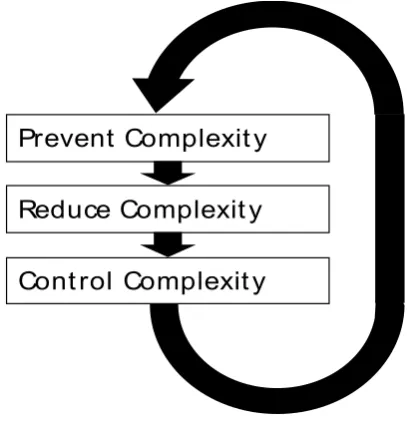
Based on the understanding of complexity collected in section II and with the understanding of major objectives and principles of the circular economy, this section will critically comment on some of the most common principles of complexity management in manufacturing and their viability for a circular economy. Following Wildemann, there are three basic principles to handle complexity throughout value generation and transfer: (1) reduction of complexity, (2) control of complexity and (3) prevention of complexity [28–30] (compare Fig. 3).
Source of mat erials
Part s manuf act urer
Product manuf act urer
Service provider
Energy recovery
Landf ill
Recycling
Remanufacturing
Reuse
Maintenance
User
Leakage Value recovery
[image:3.595.312.530.57.276.2]…
A reduction of complexity takes the state of the art of a current system and tries to identify the level of (internal) complexity that enables companies to produce products attractive for customers that at the same time keeps internal costs low [31]. It aims at reducing the factors increasing complexity on the level of production, customers and processes.
Control of complexity targets the complexity remaining after it is reduced as far as possible and tries to decrease the effects of these factors on the value chain [29].
Prevention of complexity targets the phase of product and value chain design and tries to prevent complexity in value generation and production before it can (or needs to be) reduced [29].
[image:4.595.65.269.67.280.2]But there is more to complexity than this brief overview. There is the positive side of complexity that needs to be taken into account for systems, especially when talking about the differentiation between internal and external complexity and the interdependency between those. Ashby formulated a famous law for what he called requisite variety, saying “only variety can destroy variety” [32, p.207]. In more detail, this means that in order to control a system with a certain complexity, another system with at least the same complexity is necessary [32, 33]. Applying this to an external complexity that is internally processed, this means that a certain degree of internal complexity is necessary and its amount depends on the complexity of an external system.
In this complexity, variety and connectivity (compare Fig. 1) for a circular economy is rather a key characteristic than a disturbance that needs to be reduced, controlled or prevented. Supply chains are “fast dynamic networks of interconnected firms and industries” [34, p.1] (based on [35]), where this fast, dynamic interconnection is a competitive factor. Expanding thoughts on supply chains as an integral part of the circular economy, it is furthermore important to remark that vulnerability of
supply chains in the face of turbulent and dynamic markets is worked on in building resilient value chains that mitigate risk e.g. through diversification and variety of value chain partners and flows and maintaining agility [34] to be able to react fast (and have alternatives at hand). Comparing what is described as key factors and ‘building blocks’ of a complexity that needs to be prevented, reduced and controlled (remarkably all negatively connoted adjectives) and what can be collected as a set of features that describe a circular economy (value chain), one can identify obvious misalignments. What is conducted as complexity management on a local scale with a rather short time horizon and targeted at cashing in the low hanging fruits of complexity reduction does even contradict long-term goals of a company that wants to shift towards conducting a circular economy.
Even though due to the character and objectives of this paper, the review of complexity as it is understood in manufacturing on the one hand, and the description of the circular economy on the other hand needed to be rather brief, this overview suffices to establish a connection between internal complexity management on a detail level and the complexity of a business environment in a circular economy on the other hand. The complexity of assembly and disassembly might e.g. be determined by the detail complexity of the product [36], but it corresponds directly with the supply chain complexity [36] while this complexity again corresponds to customer demands and a competitive positioning in globalized and diversified markets [29]. All these interconnections are examples of the application of Ashby’s law [32].
What is new to these considerations in the light of a circular economy is twofold. Firstly, it is the positive connotation of complexity as it comes with diversified product and material cycles involving manifold partners in new, closed loop value chains (compare Fig. 2). Secondly,
it is the difference in measuring the performance of those new models, taking the perspective of the whole chain and adding environmental and social performance, next to the economic rationale that determines corporate actions and the design of complexity management tools in a linear economy.
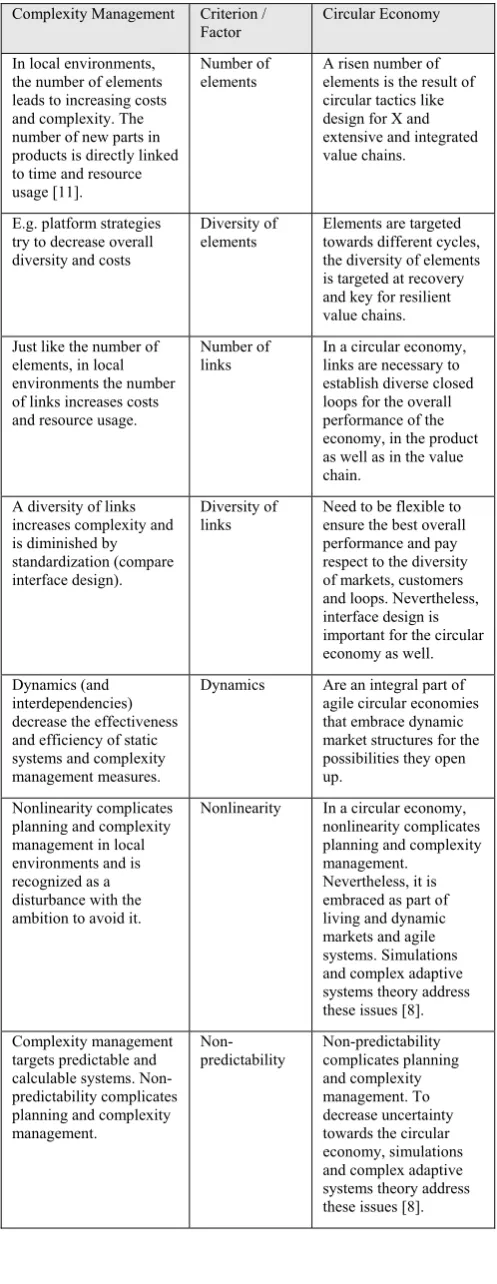
A comparison of factors as they are interpreted in complexity management and the circular economy can be found in Table I. This comparison underlines the fundamentally different roles and importance of factors as they are perceived as a risk being a complexity driver in local and short-term considerations, whereas the very same factors are key for the setup of a circular economy value chain that is capable of establishing economically, environmentally and socially viable chains of production and consumption.
Prevent Complexit y
Reduce Complexit y
Cont rol Complexit y
Table I. Criteria and Factors of Complexity from a Complexity Management and a Circular Economy Perspective
Complexity Management Criterion / Factor
Circular Economy
In local environments, the number of elements leads to increasing costs and complexity. The number of new parts in products is directly linked to time and resource usage [11].
Number of
elements A risen number of elements is the result of circular tactics like design for X and extensive and integrated value chains.
E.g. platform strategies try to decrease overall diversity and costs
Diversity of elements
Elements are targeted towards different cycles, the diversity of elements is targeted at recovery and key for resilient value chains.
Just like the number of elements, in local environments the number of links increases costs and resource usage.
Number of links
In a circular economy, links are necessary to establish diverse closed loops for the overall performance of the economy, in the product as well as in the value chain.
A diversity of links increases complexity and is diminished by standardization (compare interface design).
Diversity of
links Need to be flexible to ensure the best overall performance and pay respect to the diversity of markets, customers and loops. Nevertheless, interface design is important for the circular economy as well.
Dynamics (and interdependencies) decrease the effectiveness and efficiency of static systems and complexity management measures.
Dynamics Are an integral part of agile circular economies that embrace dynamic market structures for the possibilities they open up.
Nonlinearity complicates planning and complexity management in local environments and is recognized as a disturbance with the ambition to avoid it.
Nonlinearity In a circular economy, nonlinearity complicates planning and complexity management.
Nevertheless, it is embraced as part of living and dynamic markets and agile systems. Simulations and complex adaptive systems theory address these issues [8].
Complexity management targets predictable and calculable systems. Non-predictability complicates planning and complexity management.
Non-predictability
Non-predictability complicates planning and complexity management. To decrease uncertainty towards the circular economy, simulations and complex adaptive systems theory address these issues [8].
V. CONCLUSION AND OUTLOOK
This papers ambition was to highlight the necessity for rethinking complexity management in the face of an anticipated shift towards a circular economy. Though promoted through various channels from policy and industry, the role of complexity management is not addressed in a rigorous way from research until now. We have shown that the basic principles of complexity management as it is practiced today are conflicting with some of the key characteristics of circular value chains. A rethinking of complexity management and the role of complexity in a circular economy with closed product and material loops needs to be done. In the spirit of Ashby’s law, a first necessary step is the recapitulation of external and internal complexity drivers and their interdependencies.
On the operational level, difficulties with a sustainable shift towards a circular economy originate in the fact that planning value chains that do not end with the product being shipped to the customer bears a complexity in it far greater than established linear approaches. This includes the collection of product information during use, the development of reverse logistics systems that are economically viable and different approaches to use products, parts or materials after their return and the integration of those streams in the overall business model to generate value for successive cycles (compare Fig. 2).
One consequence of this risen complexity is the failure of established linear models, decision heuristics and other tools for complexity management to plan for the circular economy, resulting in great uncertainty and risk perceived by actors involved.
Rethinking complexity management in this light will lead to an understanding of how complexity factors interact in a circular economy, what the critical and most influential interactions are and how short- and long-term developments and dynamics change in time. Future research needs to be put in the adequate recalibration and development of new complexity management tools for all tasks and time horizons of a firm, that are as interconnected as the influences they help to control are. With such an understanding, in the future it will be possible to decrease the uncertainty that is felt by the industry towards the circular economy. Furthermore, such a new understanding of the role of complexity in a circular economy will help tap its full potential without (1) falling victim to complexities that go beyond a manageable amount on the one hand, and (2) reducing complexity to a point where it is below an amount necessary to compete and create a viable circular economy on the other hand.
REFERENCES
[1] K. Ehrlenspiel, Integrierte Produktentwicklung: Denkabläufe,
Methodeneinsatz, Zusammenarbeit, 4th ed. München: Hanser,
2009.
[2] G. Schuh, Produktkomplexität managen. München: Hanser, 2005.
[3] D. Baccarini, “The concept of project complexity — a review,”
International Journal of Project Management, vol. 14, no. 4, pp.
http://www.sciencedirect.com/science/article/pii/026378639500 0933, 1996.
[4] H. Ulrich and G. Probst, Anleitung zum ganzheitlichen Denken
und Handeln: Ein Brevier für Führungskräfte. Bern: Haupt,
1991.
[5] P. Senge, The Fifth Discipline. New York: Currency, 1994.
[6] J. L. Casti, Connectivity, complexity, and catastrophe in
large-scale systems. Chichester [England], New York: John Wiley &
Sons, 1979.
[7] C. Zielowski, Managementkonzepte aus Sicht der Organisationskultur: Auswahl, Ausgestaltung und Einführung,
1st ed. Wiesbaden: Dt. Univ.-Verl, 2006.
[8] M. Gell-Mann, “Complexity and Complex Adaptive Systems,”
in The Evolution of Human Languages.: SFI Studies in the
Sciences of Complexity, Reading, MA: Addison-Wesley, 1992,
pp. 3–18.
[9] R. Flood and E. Carson, Dealing With Complexity: An
Introduction to the Theory and Application of Systems Science.
New York: Plenum Press, 1993.
[10] J. Kim and D. Wilemon, “Sources and assessment of complexity in NPD projects,” R&D Management, vol. 33, no. 1, pp. 15–30,
2003.
[11] P. A. Murmann, “Expected development time reductions in the German mechanical engineering industry,” Journal of Product
Innovation Management, vol. 11, no. 3, pp. 236–252,
http://www.sciencedirect.com/science/article/pii/073767829490 006X, Jun. 1994.
[12] M. Tatikonda and S. Rosenthal, “Technology novelty, project complexity, and product development project execution success: a deeper look at task uncertainty in product innovation,”
Engineering Management, IEEE Transactions on, vol. 47, no. 1,
pp. 74–87, 2000.
[13] C. C. Bozarth, D. P. Warsing, B. B. Flynn, and E. J. Flynn, “The impact of supply chain complexity on manufacturing plant performance,” Journal of Operations Management, vol. 27, no.
1, pp. 78–93, 2009.
[14] J. Jost, “External and internal complexity of complex adaptive systems,” Theory in Biosciences, vol. 123, no. 1, pp. 69–88, 2004.
[15] European Commission, Closing the loop: Commission adopts ambitious new Circular Economy Package to boost
competitiveness, create jobs and generate sustainable growth.
Brussels, 2015.
[16] European Commission, “Communication from the Commission to the European Parliament, the Council, the European Economic and Social Committee and the Committee of the Regions: Closing the loop - An EU action plan for the Circular Economy,” European Commission, Brussels, Dec. 2015. [17] Ellen MacArthur Foundation and McKinsey & Company,
“Towards the circular economy: Economic and business rationale for an accelerated transition,”
[18] G. Roos and R. Agarwal, “Services Innovation in a Circular Economy,” in The handbook of service innovation, R. Agarwal, W. Selen, G. Roos, and R. Green, Eds, London: Springer, 2015, pp. 501–520.
[19] P. Lacy and J. Rutqvist, Waste to wealth: The circular economy
advantage. New York: Palgrave Macmillan, 2015.
[20] European Commission, Manifesto for a Resource Efficient
Europe. Available:
http://europa.eu/rapid/press-release_MEMO-12-989_en.htm (2016, Jan. 12).
[21] W. R. Stahel and G. Reday-Mulvey, Jobs for tomorrow: The
potential for substituting manpower for energy, 1st ed. New
York: Vantage Press, 1981.
[22] W. McDonough and M. Braungart, Cradle to cradle: Remaking
the way we make things, 1st ed. New York: North Point Press,
2002.
[23] J. M. Benyus, Biomimicry: Innovation inspired by nature. New York: Harper Perennial, 2002.
[24] R. Clift, Taking Stock of Industrial Ecology, 12016th ed. Cham: Springer International Publishing, 2016.
[25] Ellen MacArthur Foundation, Building Blocks of a Circular
Economy. Available:
http://www.ellenmacarthurfoundation.org/circular-economy/building-blocks (2016, Mar. 15).
[26] P. Planing, “Business Model Innovation in a Circular Economy Reasons for Non-Acceptance of Circular Business Models,”
Open Journal of Business Model Innovation, 2015.
[27] Ellen MacArthur Foundation (Cowes, Isle of Wight), Towards
the circular economy. Isle of Wight: Ellen MacArthur
Foundation, 2012-.
[28] H. Wildemann, Komplexitätsmanagement: In Vertrieb,
Beschaffung, Produkt, Entwicklung und Produktion, 9th ed.
München: TCW Transfer-Centrum, 2008.
[29] F. T. Piller, Mass Customization: Ein wettbewerbsstrategisches
Konzept im Informationszeitalter, 4th ed. Wiesbaden: Dt.
Univ.-Verl, 2006.
[30] K.-I. Voigt and H. Wildemann, Komplexitätsindex-Tool: Entscheidungsgrundlagen für die Produktprogrammgestaltung
bei KMU. München: TCW-Verl, 2011.
[31] P. Child, R. Diederichs, F.-H. Sanders, S. Wisniowski, and P. Cummings, “The management of complexity,” The McKinsey
Quarterly, no. 4, pp. 52–60, 1991.
[32] W. R. Ashby, An introduction to cybernetics. London, [New
York]: Methuen; Distributed by Harper & Row, 1976.
[33] A. Helferich, Software mass customization, 1st ed. Lohmar, Köln: Eul, 2010.
[34] M. Christopher and H. Peck, “Building the resilient supply chain,” The international journal of logistics management, vol.
15, no. 2, pp. 1–14, 2004.
[35] H. Håkansson and I. Snehota, “No business is an island: The network concept of business strategy,” Scandinavian Journal of
Management, vol. 5, no. 3, pp. 187–200, 1989.
![Fig. 2. The Circular Economy. Own figure based on [27]](https://thumb-us.123doks.com/thumbv2/123dok_us/432113.540916/3.595.312.530.57.276/fig-circular-economy-figure-based.webp)