Improved Dynamic Virtual Bats Algorithm for
Global Numerical Optimization
Ali Osman Topal, Yunus Emre Yildiz, and Mukremin Ozkul
Abstract—Dynamic Virtual Bats Algorithm (DVBA) is a
relatively new nature inspired optimization algorithm. DVBA, like Bat Algorithm (BA), is fundamentally inspired by bat’s hunting strategies, but it is conceptually very different from BA. In DVBA, a role based search is developed to avoid deficiencies of BA. Although the new technique outperforms BA significantly, there is still an insufficiency in DVBA regarding its exploration, when it comes to high dimensional complex optimization problems. To increase the performance of DVBA, this paper presents a novel, improved dynamic virtual bats algorithm (IDVBA) based on probabilistic selection. The perfor-mance of the proposed IDVBA was compared with DVBA and four state-of-the-art BA variants. The algorithms were tested on 30 optimization problems from CEC 2014. The experimental results demonstrated that the new search mechanism improved the performance of DVBA in terms of accuracy and robustness.
Index Terms—dynamic virtual bats algorithm, meta heuristic
algorithm, global numerical optimization.
I. INTRODUCTION
D
YNAMIC virtual bat algorithm (DVBA), by Topal and Altun [13], [14], is another meta-heuristic algorithm inspired by bats ability to manipulate frequency and wave-length of emitted sound waves. DVBA is not a classic Bat Algorithm [17] variation, it is a new simulation of the bat’s hunting strategies. In DVBA, a role-based search is devel-oped by using just two bats to improve the Bat Algorithm. Recently, DVBA has been tested on well-known test func-tions [13] and supply chain cost problem [15]. Experimental results show that, DVBA is suitable for solving most of the low dimensional problems. However, DVBA, similar to other evolutionary algorithms, has some challenging problems. For example, the convergence speed of DVBA is slower than other population-based algorithms like PSO [9], GA [5], BF [12], and BA. The convergence issue of these algorithms was resolved through the latest variants [4] [19]. Additionally, in high dimensional multimodal problems, escaping from the local optima traps becomes a difficult task for DVBA. Therefore, accelerating convergence speed and avoiding the local optima have become two of the most important issues in DVBA.To minimize the impact of this weakness, this paper pro-poses an improved solution which accelerates convergence speed and avoids the local optima trap. To achieve both goals, we introduce a new search mechanism for the ex-plorer bat. This new search mechanism improves the search performance and gives DVBA more powerful exploitation
Manuscript received July 7, 2017; revised July 28, 2017.
A.O.Topal is with the Department of Computer Engineering, Epoka University, Tirana, Albania e-mail: [email protected].
Y.E. Yildiz is with the Department of Computer Engineering, Metrapolitan University, Tirana, Albania e-mail: [email protected].
M. Ozkul is with the Department of Computer Engineering, Epoka University, Tirana, Albania e-mail: [email protected].
+ Vi : Flying direction
h11
h12
h13
h14
h44
h43
h42
h41
[image:1.595.353.505.171.269.2]Wavelength(λ)
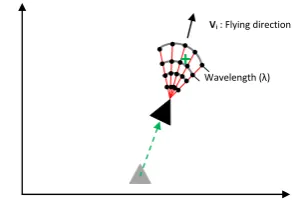
Fig. 1. Explorer bat is searching for prey with a wide search scope.
Vi: Flying direction
Wavelength (λ)
+
Fig. 2. Exploiter bat is chasing prey with a narrow search space.
capabilities. Simulations and comparisons based on several well-studied benchmarks demonstrate the effectiveness, effi-ciency, and robustness of the proposed IDVBA.
The rest of this paper is organized as follows. Section 2 summarizes DVBA. The improved DVBA algorithm is presented in Section 3. Section 4 presents simulation results on the use of IDVBA for solving CEC 2014 test functions. Finally, conclusions are drawn in Section 5.
II. DYNAMICVIRTUALBATSALGORITHM(DVBA)
When bats search out prey, they burst sound pulses with lower frequency and longer wavelengths so the sound pulses can travel farther. In this long range mode it becomes hard to detect the exact position of the prey; however, it becomes easy to search a large area. When bats detect prey, the pulses will be emitted with higher frequency and shorter wavelengths so that bats are able to update the prey location more often [1], [7]. In DVBA, two bats are used to imitate this hunting behavior. Each bat has its own role in the algorithm and during the search they exchange these roles according to their positions. These bats are referred as explorer bat and exploiter bat. The bat that is in a better position becomes the exploiter meanwhile the other becomes the explorer.
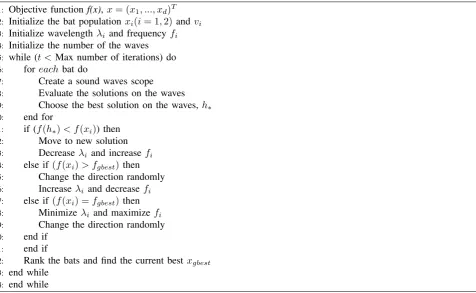
[image:1.595.342.489.315.416.2]Algorithm 1 DVBA pseudo code.fgbest is the global best solution anddis the number of dimensions. [13]
1: Objective functionf(x),x= (x1, ..., xd)T 2: Initialize the bat populationxi(i= 1,2)andvi 3: Initialize wavelengthλi and frequency fi 4: Initialize the number of the waves 5: while (t <Max number of iterations) do 6: for eachbat do
7: Create a sound waves scope 8: Evaluate the solutions on the waves 9: Choose the best solution on the waves, h∗
10: end for
11: if (f(h∗)< f(xi)) then
12: Move to new solution 13: Decreaseλi and increasefi 14: else if(f(xi)> fgbest)then 15: Change the direction randomly 16: Increaseλi and decrease fi 17: else if(f(xi) =fgbest)then 18: Minimize λi and maximizefi 19: Change the direction randomly 20: end if
21: end if
22: Rank the bats and find the current bestxgbest 23: end while
24: end while
waves in this iteration, and”+”sign represents prey. During the search, the explorer bat’s search scope gets its widest shape; the distance between the search waves and the angle between the wave vectors (red dashed arrows) get larger (see Fig. 1). On the contrary, if the bat becomes the exploiter bat, its search scope gets its narrowest shape; the distance between the search waves and the angle between the wave vectors get smaller (see Fig.2). The number of the visited solutions is same for both bats, just the distance between the solutions changes dynamically by using wavelength and frequency. The wavelength and the distance between the solutions are proportional. The frequency and the angle between the wave vectors are inversely proportional.
The algorithm determines the best solution in the bat’s search scope. If it is better than the current location (so-lution), the bat will fly to the better solution, decrease the wavelength and increase the frequency for the next iteration. These changes are targeting to increase the intensification of the search. Unless there is no better solution than the current solution in the search scope, the bat will stay on it, turn around randomly and keep scanning its nearby surrounding space. It will keep spinning in this position and expanding its search scope until it finds a better solution. The basic steps of the algorithm for minimizing an objective function f(x)
are shown in Algorithm 1.
III. PROPOSEDNOVELIMPROVEDDYNAMICVIRTUAL BATSALGORITHM(IDVBA)
A. The weakness of DVBA
In DVBA, the explorer bat’s search scope size is limited by the wavelength. This search scope might not be large enough to detect better solutions near its surrounding space. Thus, it is very likely that the explorer bat will be trapped
in a local optimum. In addition, the exploiter bat’s search scope size becomes very small during the exploitation and it moves very slowly. Therefore it might need too much time to reach the global optima. These problems in DVBA have been eradicated by introducing probabilistic selection restart techniques in IDVBA.
The concept of IDVBA is analogous to the idea behind the Micro-Particle Swarm Optimizer [6] and the Micro-Genetic Algorithm [10], where a set of restart operations are executed after the population has converged. However, IDVBA uses restart operations according to the bats’ stagnancy during the search and it doesn’t blacklist the inferior solutions as in micro-genetic algorithm.
B. Improved Dynamic Virtual Bats Algorithm (IDVBA)
To improve the search performance and give DVBA more powerful search capabilities, we introduce two probabilistic selections:R- random flying probability andC- convergence probability. If the explorer bat is stuck in large local minima, it chooses to fly away from the trap randomly with a probability R related to number of unsuccessful attempts. In addition, it chooses to fly near to the exploiter bat with a probability C related to the number of escapes attempted from the traps.Ris calculated as follows:
Rti+1=Rti[1−exp(−trialiγ)], (1)
whereγ constant and triali denotes the number of
unsuc-cessful attempts. Obviously, the higher the triali is, the
[image:2.595.55.532.66.359.2]Algorithm 2 IDVBA pseudo code. fgbest is the global best solution and d is the number of dimensions. The code we
discuss in the text is in boldface. 1: Objective functionf(x),x= (x1, ..., xd)T 2: Initialize the bat populationxi(i= 1,2)andvi
3: Initialize wavelengthλiand frequencyfi
4: Initialize the number of the waves 5: Ci=Ri= 1.0
6: while (t <Max number of iterations) do 7: foreachbat do
8: Create a sound waves scope 9: Evaluate the solutions on the waves 10: Choose the best solution on the waves,h∗
11: end for
12: iff(h∗)< f(xi)then
13: Move to new solution 14: Decreaseλi and increasefi
15: triali= 0
16: else iff(xi)> fgbest then
17: Calculate the random f lying probability Riby Eq.1
18: ifrand()¡ Rithen
19: Change the direction randomly
20: triali=triali+ 1
21: else
22: Restart the search f rom a random position
23: Reset Riand triali
24: rf lyi=rf lyi+ 1
25: Calculate the Ci by Eq.2
26: end if
27: ifrand()> Cithen
28: P roduce a new solution around the exploiter bat.
29: Reset Ciand rf lyi
30: end if
31: Increaseλiand decrease fi
32: else iff(xi) =fgbest then 33: Minimizeλi and maximizefi
34: Change the direction randomly
35: Reset rf lyiand triali
36: end if 37: end if
38: Rank the bats and find the current bestxgbest
39: end while 40: end while
(line 17 in Algorithm 2) increases. This can help the explorer bat to escape from the local optima trap rapidly. However, the explorer bat should not leave the trap without exploring the nearby surrounding space. Thus, γ should be chosen carefully.
The convergence probability C gives possibility to the explorer bat to converge with the exploiter bat, instead of exploring a random position. Thus, the exploitation speed will be increased rapidly around the best position. Time after time the explorer bat visits the exploiter bat to speed up the exploitation process then flies away randomly to keep up the exploration process. This also increases the exploitation capability of IDVBA.C is calculated as follows:
Cit+1=Cit[1−exp(−rf lyiγ)], (2)
where rf lyi denotes the number of random restarts. As
shown in Eq.(2), the convergence probability Cis inversely proportional with the number of random restarts rf lyi done
by the explorer bat. Thus, increasing random restarts will increase the probability of rand() > C that allows the explorer bat to visit the exploiter bat often (line 25-26 in Algorithm 2).
-0.2 0 0.2 0.4 0.6 0.8 1 1.2
0 5 10 15 20 25 30 35
C
onve
rg
ing
P
roba
bil
it
y
C
i
[image:3.595.315.546.503.657.2]Number of Unsuccessful Trials γ=4 γ=3 γ=2
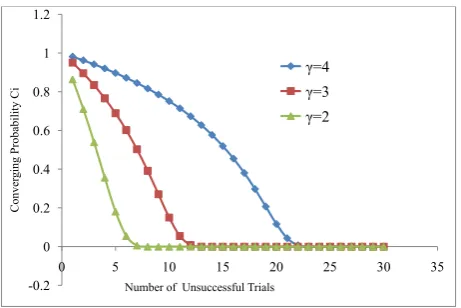
Fig. 3. Characteristics of Eq. 2C- convergence probability changes as the unsuccessful trials increases forγ= 2,3and 4.
functions we use in this work.Ris calculated with the same equation used for C Eq. 2 but with different values of γ. Therefore Fig.3 shows the characteristics of Eq.1 as well. By properly choosing the value of γ, we can prevent bats from local minima traps while allowing them to explore and exploit the nearby surrounding space without experiencing too many unnecessary random jumps. In our experiments, we set γ= 2 forR andγ= 3for C. According to all these approximations and improvements IDVBA can be given as in Algorithm 2. The differences from DVBA are shown in boldface font.
IV. EXPERIMENTS
This section presents an extensive comparisons among the performances of six algorithms. IDVBA is compared with DVBA and four state-of-the-art BA variants: Adap-tive Bat Algorithm (ABA) [16], Novel AdapAdap-tive Bat Al-gorithm (NABA) [8], Local Memory Search Bat AlAl-gorithm (LMSBA) [18], and Chaotic Local Search-based Bat Algo-rithm (CLSBA) [2].
In our experimental studies, parameter settings of the al-gorithms are same as in their original papers. The population size of the algorithms has been kept as 50.
All the algorithms are developed using Anaconda Python Distribution environment and run a PC with a 3.0 GHz CPU and 8.00 GB of RAM.
A. Test Functions
To provide a comprehensive comparison, all thirty CEC 2014 test functions are used to conduct this experiment. The descriptions of these functions are given in [11]. In CEC 2014 test suits, f1−f3 are rotated unimodal,f4−f16 are
shifted and rotated multimodal, f17 −f22 are hybrid, and
f23−f30 are composition test functions.
B. Comparison Experiments
This paper aims to test the quality of the final solution and the convergence speed at the end of a fixed number of function evaluations (FEs). According to the instructions in CEC 2014 special session we set the maximum number of FEs as 3×10⁵ and the dimensions of the problems 30-D.
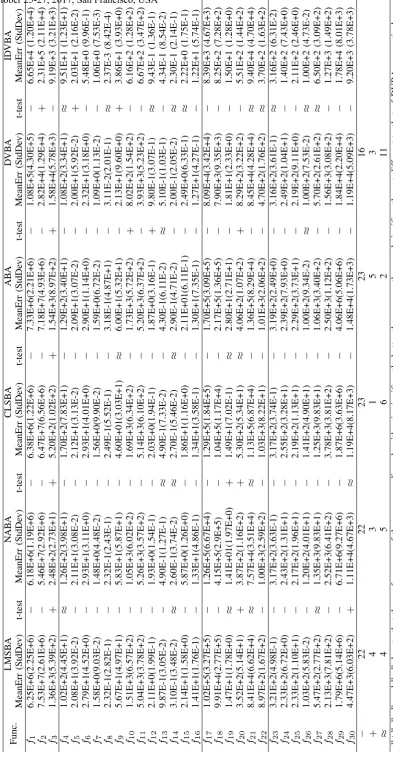
The test results are shown in Table 1 in terms of the mean error values (MeanErr) and the standard deviation (STDEV) of the results found over the 30 independent runs by each algorithm.
Furthermore, we used t-tests [3] to compare the mean error values of the results produced by the IDVBA and the other algorithms at the 0.05 level of significance. The statistical significance level of the results are shown in the Table 1. In Table 1 ‘−’ indicates that IDVBA is significantly more successful than selected one at a 0.05 level of significance by two-tailed test, ‘≈’ means the difference of means is not statistically significant and ‘+’ indicates that the other algorithm is significantly more successful than IDVBA at a 0.05 level of significance by two-tailed test.
C. Experimental Results and Discussion
The functions f1, f2, and f3 are unimodal and
non-separable plate shaped problems. From Table 1, it can be
seen that these functions are very hard to optimize and the algorithms did not show a significant success. By analyzing their t-test values, we can see that the solutions with IDVBA are significantly better than that with other algorithms, fol-lowed by NABA. For the functionf3, except DVBA, IDVBA
is outperformed by other algorithms. NABA has the best solutions in terms of mean error values, followed by CLSBA. The test functions in second group (f4 - f16) are simple
multi-modal. The t-test values show that the performance of IDVBA is significantly better than that of other five algorithms. In this group, DVBA remained the toughest competitors of IDVBA in most of the functions.
The third group (f17−f22) has six hybrid functions which
are almost same as real-world optimization problems [11]. On these functions, IDVBA exhibits better performance than other algorithms. For function f20, LMSBA, NABA, and
ABA have less mean error values than that of IDVBA. LMSBA, CLSBA, and NABA performed comparable to IDVBA onf19. In this group, LMSBA and NABA also find
competitive solutions compared with IDVBA, as their t-test values reflect.
In group four, there are eight composition functions. The composition function merges the properties of the sub-functions better and maintains continuity around the global/local optima. We can observe that, the performance of IDVBA is superior overall to that of five competitors. Only for functionf24, LMSBA performed better than IDVBA in
terms of the mean error values.
We observe that IDVBA found effective results in most cases, which implies that IDVBA by its improved search mechanism is more competent in tackling complex problems than DVBA.
Additionally, we can observe that among the BA’s variants, NABA has the best performance in terms of the mean, followed by LMSBA.
V. CONCLUSION
In order to apply DVBA to solve complex high dimen-sional problems efficiently, this paper proposes a novel improved dynamic virtual bats algorithm, namely IDVBA. The proposed algorithm employs two probabilistic selections - random flying probability R and convergence probability
C. They are used to prevent the bats from falling into the local minimum traps, accelerate the convergence speed, and increase the accuracy. Results show that we achieved our goal efficiently with the new search mechanism.
REFERENCES
[1] M. Airas. Echolocation in bats. InProceedings of spatial sound perception and reproduction. The postgrad seminar course of HUT Acoustics Laboratory, pages 1–25, 2003.
[2] C. Chandrasekar et al. An optimized approach of modified bat algorithm to record deduplication.International Journal of Computer Applications, 62(1), 2013.
[3] S. Das, A. Abraham, U. K. Chakraborty, and A. Konar. Differential evolution using a neighborhood-based mutation operator.Evolutionary Computation, IEEE Transactions on, 13(3):526–553, 2009.
[4] D. Handayani, N. Nuraini, O. Tse, R. Saragih, and J. Naiborhu. Convergence analysis of particle swarm optimization (pso) method on the with-in host dengue infection treatment model. InAIP Conference Proceedings, volume 1723, page 030013. AIP Publishing, 2016. [5] J. H. Holland.Adaptation in natural and artificial systems: an
intro-ductory analysis with applications to biology, control, and artificial intelligence. U Michigan Press, 1975.
[6] T. Huang and A. S. Mohan. Micro-particle swarm optimizer for solving high dimensional optimization problems (µpso for high dimen-sional optimization problems).Applied Mathematics and Computation, 181(2):1148–1154, 2006.
[7] L. Jakobsen and A. Surlykke. Vespertilionid bats control the width of their biosonar sound beam dynamically during prey pursuit. Pro-ceedings of the National Academy of Sciences, 107(31):13930–13935, 2010.
[8] M. W. U. Kabir, N. Sakib, S. M. R. Chowdhury, and M. S. Alam. A novel adaptive bat algorithm to control explorations and exploita-tions for continuous optimization problems. International Journal of Computer Applications, 94(13), 2014.
[9] J. Kennedy. Eberhart c., iparticle swarm optimization,”. In Pro-ceedings of IEEE International Conference on Neural Network, pages 1942Y1948–1995, 1995.
[10] M. Koppen, K. Franke, and R. Vicente-Garcia. Tiny gas for image processing applications.Computational Intelligence Magazine, IEEE, 1(2):17–26, 2006.
[11] J. Liang, B. Qu, and P. Suganthan. Problem definitions and evaluation criteria for the cec 2014 special session and competition on single objective real-parameter numerical optimization.Computational Intel-ligence Laboratory, 2013.
[12] K. M. Passino. Biomimicry of bacterial foraging for distributed optimization and control.Control Systems, IEEE, 22(3):52–67, 2002. [13] A. O. Topal and O. Altun. Dynamic virtual bats algorithm (dvba) for global numerical optimization. In Intelligent Networking and Collaborative Systems (INCoS), 2014 International Conference on, pages 320–327. IEEE, 2014.
[14] A. O. Topal and O. Altun. A novel meta-heuristic algorithm: Dynamic virtual bats algorithm.Information Sciences, 354:222–235, 2016. [15] A. O. Topal, O. Altun, and E. Terolli. Dynamic virtual bats algorithm
(dvba) for minimization of supply chain cost with embedded risk. In
Proceedings of the 2014 European Modelling Symposium, pages 58– 64. IEEE Computer Society, 2014.
[16] X. Wang, W. Wang, and Y. Wang. An adaptive bat algorithm. InIntelligent Computing Theories and Technology, pages 216–223. Springer, 2013.
[17] X.-S. Yang. A new metaheuristic bat-inspired algorithm. InNature inspired cooperative strategies for optimization (NICSO 2010), pages 65–74. Springer, 2010.