Modeling and Optimization of Electrical
Discharge Machining of SiC Parameters, Using
Neural Network and Non-dominating Sorting
Genetic Algorithm (NSGA II)
Ramezan Ali MahdaviNejad
School of mechanical Engineering, College of Engineering, University of Tehran, Tehran, Iran. Email: [email protected]
Received December 29th, 2010; revised March 28th, 2011; accepted May 18th, 2011.
ABSTRACT
Silicon Carbide (SiC) machining by traditional methods with regards to its high hardness is not possible. Electro Dis-charge Machining, among non-traditional machining methods, is used for machining of SiC. The present work is aimed to optimize the surface roughness and material removal rate of electro discharge machining of SiC parameters simul-taneously. As the output parameters are conflicting in nature, so there is no single combination of machining parame-ters, which provides the best machining performance. Artificial neural network (ANN) with back propagation algorithm is used to model the process. A multi-objective optimization method, non-dominating sorting genetic algorithm-II is used to optimize the process. Affects of three important input parameters of process viz., discharge current, pulse on time (Ton), pulse off time (Toff) on electric discharge machining of SiC are considered. Experiments have been conducted
over a wide range of considered input parameters for training and verification of the model. Testing results demon-strate that the model is suitable for predicting the response parameters. A pareto-optimal set has been predicted in this work.
Keywords: Electro Discharge Machining, Non-Dominating Sorting Algorithm, Neural Network, REFEL SiC
1. Introduction
Electrical discharge machining (EDM) is one of the most extensively used non-conventional material removal process. Its unique feature of using thermal energy to machine electrically conductive parts regardless of hard-ness has been its distinctive advantage in the manufac-ture of mould, die, automotive, aerospace and surgical component [1]. The selection of appropriate parameters for maximum material removal rate and minimum sur-face roughness during the EDM process traditionally carried out by the operator’s experience or conservative technological data provided by the EDM equipment manufacturers, which produced inconsistent machining performance.[2]
Some researchers carried out various investigations to improve the stock material removal rate and surface fin-ishing in EDM process. Proper selection of machining parameters for the best process performance is still a
challenging job.
of the network.
Pal et al. [1] used non dominating sorting genetic al-gorithm-II to optimize the process. They conducted some experiments on C40 Steel to generate input and output data for training an ANN model. Material removal rate and tool wear were two objectives to be optimized. So they predicted a pareto-optimal set for outputs.
In this study material removal rate and surface rough-ness have been considered to produce a pareto-optimal set for EDM of REFEL SiC. Some related properties of this material are shown in Table 1.
2. Experimentations
In this study, Deckel CNC Spark, ISO frequency system, with gap control system was used to carry out the ex-periments. Copper electrode was selected to drill holes in the REFEL SiC blocks. For evaluating the EDM process the MRR and surface roughness (Ra) are mentioned with input machining parameters such as pulse on time (Ton),
pulse off time (Toff), discharge current (I). Proper
selec-tion of the machining parameters can result a higher ma-terial removal rate and lower Ra. Using an orthogonal array L25 according Taguchi method decreased the
num-ber experiments effectively. Hence 25 sets of experi-ments have been conducted with five levels of each pa-rameter (current, pulse on time and off time) to collect for training of the neural network model. Moreover five sets of experiments have been for testing the trained neural network. For each experiment, a new set of tool and work-piece has been used. For normal polarity the work-piece is connected to the negative terminal and the tool is connected to the positive terminal of the source, where as for reverse polarity it is just the opposite. Ex-periment has been performed with normal polarity. The current range is 0.1 - 5 A and the pulse on time and pulse off time ranges are 21 - 1125 µs.
3. Material Removal Rate (MRR)
Material removal rate and surface roughness have been used to evaluate machining performance. Material re-moval rate (MRR) is calculated from the difference of weight of work piece before and after experiment.
SiC
MRR wi wf
t
mm3/min (1)
where, wi is the initial weight of workpiece in g; wf the
weight of workpiece after machining in g; t the machin-ing time in minutes; SiC is the density of SiC (3.1× 10⁻³ g/mm3).
4. Surface Roughness
The surface roughness Ra is the arithmetic average of
collected roughness data points and given by the sum of the absolute values of all the areas above and below the mean line (in integrally form). A mean line is found that is parallel to the general surface direction and divides the surface in such a way that the sum of the areas formed above the line is equal to the sum of the areas formed below the line. When sample points were taken, Ra is
calculated as follows:
1
1 n
a i
R
n
yi (2)where yi is the distance between the ith sample point on the
profile from the mean line, and n is the number of sample points.
5. Neural Network
Modeling of EDM with feed forward neural network is composed of two stages: training and testing of the net-work with experimental machining data. The scale of the input and output data is an important matter to consider, especially, when the operating ranges of process pa-rameters are different. The scaling or normalization en-sures that the ANN will be trained effectively. By searching in different network architectures using a MATLAB code, multilayer-perceptron (3-5-5-2) was chosen as the network architecture. The networks were trained using a back-propagation algorithm. The selected network architecture had the minimum value of the error. The error E indicates the difference between the actual and the desired output of the neural network, as follows:
21 min
az
j j
j
E
y a (3)where yj is the desired output, aj is the calculated output,
az the number of testing data. Five sets of experiments allocated to test the network’s error value. Pulse on-time, pulse off-time and the current are the inputs of neural network and material removal rate and surface roughness are the outputs of the neural network. Figure 1 shows the
Table1. Some characteristics of REFEL SiC [5].
Density
(gr/cm3) Hardness (HV) Young modulus (E) (GN/m)
Thermal expansion 1 × 10⁻⁶˚C
Thermal conductivity (k) at 100˚C (W/m·˚C)
at 1200˚C
Specific heat (J/g˚C)
Electrical resistance (Ω·cm)
Thermal shock (cal/cm·s) at 500˚C
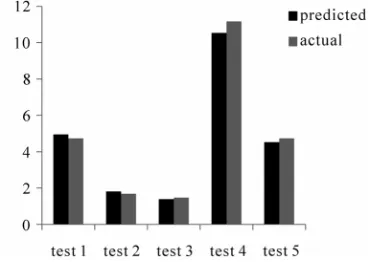
material removal rate comparison between experimental outputs and the corresponding values that are predicted by neural network. The average percentage of error for pre-dicting MRR is 6.71%.
Figure 2 shows the surface roughness comparison between experimental outputs and the corresponding values that are predicted by neural network. The average percentage of error for predicting is 5.67% in this case.
6. NSGA II
A single objective optimization algorithm provides a single optimal solution. However, most of the multi-ob-jective problems, in principle, give rise to a set of opti-mal solutions instead of a single optiopti-mal solution [1-9]. The set of solution is known as pareto-optimal solution. In the absence of any further information, none of these pareto-optimal solutions cannot be said to be better than the other. Suitability of one solution depends on a num-ber of factors including user’s choice and problem envi-ronment and etc. Hence, this demands finding the entire set of optimal solutions. In this study two objectives that we considered are MRR and Ra. It is observed that when MRR is increasing the Ra increases too. But our goals are maximizing of MRR and minimizing of Ra. A single optimal solution will not serve our purpose, as these ob-jectives are conflicting in nature. Optimization of both the output parameters requires multi-objective optimiza-tion. Genetic algorithm works with a population of feasi-ble solutions and, therefore, it can be used in multi-ob-jective optimization problems to capture a number of solutions simultaneously. NSGA-II is fast and elitist multi objective GA, proposed by Dev et al. [6]. The flow chart of NSGA-II is shown in Figure 3.
7. Discussion
The objectives in this study, which are conflicting to-gether, are MRR and surface roughness. In order to con-vert the first objective (MRR) for minimization, it is suitably modified. Two objective functions are given below:
objective 1 1 MRR and objective 2Ra (4)
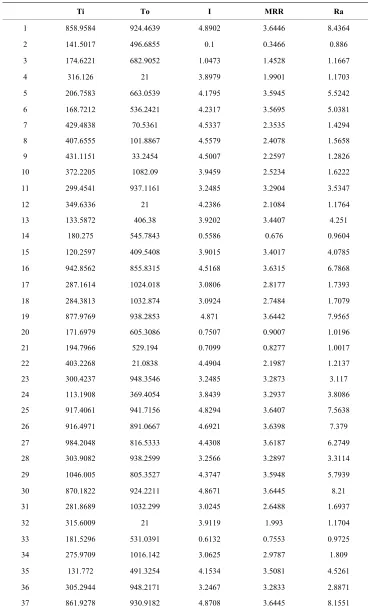
The non-dominated solution set obtained over the en-tire optimization procedure is shown in Figure 4. This shows the formation of the pareto-optimal front leading to the final set of solutions.
Since none of the solutions in the pareto-optimal front is absolutely better than any other, any one of them is an acceptable solution. The choice of one solution over the other depends on the requirement of the process engineer. If the situation or environment can permit a surface roughness rate of 3 μm to maintain the accuracy of the
[image:3.595.307.536.441.710.2]Figure 1. Comparison between experimental and neural network predicted outputs of material removal rate.
Figure 2. Comparison between experimental and neural network predicted outputs of surface roughness.
Apply tournament selection, mutation and cross over to create child population Q of size N Create random parent population P of size N
Assign a fitness equal to non-domination level Sort the population based on non-domination
Combine parent and child population (R = P + Q) of size 2N and sort based on non-domination
Chose population P, of size N based on non-domination and crowding distance operator
If Generation > max. Gen
Stop
Table 2. Optimal sets of parameters.
Ti To I MRR Ra
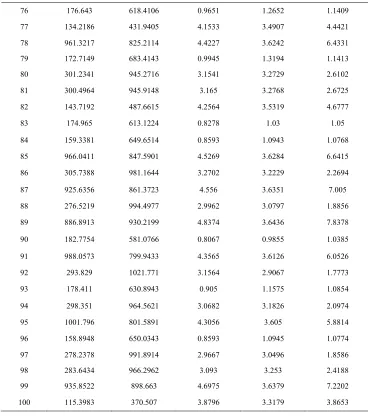
76 176.643 618.4106 0.9651 1.2652 1.1409 77 134.2186 431.9405 4.1533 3.4907 4.4421 78 961.3217 825.2114 4.4227 3.6242 6.4331 79 172.7149 683.4143 0.9945 1.3194 1.1413 80 301.2341 945.2716 3.1541 3.2729 2.6102 81 300.4964 945.9148 3.165 3.2768 2.6725 82 143.7192 487.6615 4.2564 3.5319 4.6777 83 174.965 613.1224 0.8278 1.03 1.05 84 159.3381 649.6514 0.8593 1.0943 1.0768 85 966.0411 847.5901 4.5269 3.6284 6.6415 86 305.7388 981.1644 3.2702 3.2229 2.2694 87 925.6356 861.3723 4.556 3.6351 7.005 88 276.5219 994.4977 2.9962 3.0797 1.8856 89 886.8913 930.2199 4.8374 3.6436 7.8378 90 182.7754 581.0766 0.8067 0.9855 1.0385 91 988.0573 799.9433 4.3565 3.6126 6.0526 92 293.829 1021.771 3.1564 2.9067 1.7773 93 178.411 630.8943 0.905 1.1575 1.0854 94 298.351 964.5621 3.0682 3.1826 2.0974 95 1001.796 801.5891 4.3056 3.605 5.8814 96 158.8948 650.0343 0.8593 1.0945 1.0774 97 278.2378 991.8914 2.9667 3.0496 1.8586 98 283.6434 966.2962 3.093 3.253 2.4188 99 935.8522 898.663 4.6975 3.6379 7.2202 100 115.3983 370.507 3.8796 3.3179 3.8653
product, the process engineer can chose the parameter setting according to that to obtain maximum material removal rate at the specified value of surface roughness.
From the experiments results, material removal and surface roughness are 3.58 mm3/min and 7.34 μm
respec-tively. In this case the pulse on and pulse off times and also the current settings are 850 µs, 900 µs and 5A re-spectively. For solution number 1 in Figure 1, material removal rate and Surface roughness are 3.6446 mm3/min
[image:6.595.112.480.93.513.2]and 7.2561 μm, where the pulse on and pulse off times and also current settings are 858.9584, 924.463 µs and 4.8902A, respectively. Choice of pulse on time and off time will help to achieve higher MRR with same tool wear. This indicates, values obtained from the optimiza-tion technique are in close agreement with the experi-mental values for more or less the same parameter set-tings.
8. Conclusions
81 experiments have been conducted with a wide range of current, pulse on time and pulse off time. The MRR and surface roughness have been measured for each set-ting ofpulse on time and pulse off time and current. An ANN model has been trained within the experimental data. Various ANN architectureshave been studied, and 3-5-5-2 is selected. Material removal rate and surface roughness have beenoptimized as objectives by using a multi-objective optimization method. Non-dominating sorting genetic algorithm-II and finally pareto-optimal sets of material removal rate and surface roughness are obtained. The results are shown in Table 2.
REFERENCES
[1] S. K. Pal, D. Mandal and P. Saha, “Modeling of Electrical Discharge Machining Process Using Back Propagation Neural Network and Multi-Objective Optimization Using Non-Dominating Sorting Genetic Algorithm-II,” Journal of Materials Processing Technology, Vol. 186, No. 1-3, 2007, pp. 154-162.doi:10.1016/j.jmatprotec.2006.12.030 [2] G. K. M. Rao, G. Rangajanardhaa, D. H. Rao and M. S.
Rao, “Development of Hybrid Model and Optimization of Surface Roughness in Electric Discharge Machining Us-ing Artificial Neural Networks and Genetic Algorithm,”
Journal of Materials Processing Technology, Vol. 209,
No. 3, 2009, pp. 1512-1520.
doi:10.1016/j.jmatprotec.2008.04.003
[3] K. Wang, H. L. Gelgele, Y. Wang, Q. Yuan and M. Fang, “A Hybrid Intelligent Method for Modeling the EDM Process,” International Journal of Machine Tools and Manufacture, Vol. 43, No. 10, 2003, pp. 995-999.
doi:10.1016/S0890-6955(03)00102-0
[4] J. C. Su, J. Y. Kao and Y. S. Tarng, “Optimization of the Electrical Discharge Machining Process Using a GA- Based Neural Network,” International Journal of Ad-vanced Manufacturing Technology, Vol. 24, 2004, pp. 81-90.
[5] R. Mahdavinejad, M. Tolouei-Rad and H. Sharifi Bidgoli, “Heat Transfer Analysis of EDM Process on Silicon Car-bide,” International Journal of Numerical Methods for Heat and Fluid Flow, Vol. 15, No. 5, 2005, pp. 483-502. doi:10.1108/09615530510593657
[6] K. Dev, A. Pratap, S. Agarwal and T. Meyarivan, “A Fast and Elitist Multi Objective Genetic Algorithm: NSGA-II,”
IEEE Transactions on Evolutionary Computation, Vol. 6,
No. 2, 2002, pp. 182-197.
[7] G. K. M. Rao, G. Rangajanardhaa, D. H. Rao and M. S. Rao, “Development of Hybrid Model and Optimization of Surface Roughness in Electric Discharge Machining Us-ing Artificial Neural Networks and Genetic Algorithm,”
Journal of Materials Processing Technology, Vol. 209, No. 3, 2009, pp. 1512-1520.