STANDARD MODEL PICTURE WITH 61 ELEMENTARY PARTICLES
Department of Chemistry, ETH, Zurich, Switzerland
ARTICLE INFO ABSTRACT
In 1960 Gell
Spin, Strangeness and an oblique incident charge with 3 investigated Quarks constructed in 10 Baryons. Until now the CERN scientists have found 61 elementary particles, but only 17 Fundamental particles are listed
why not use Gell
contrast to common practice
Copyright © 2018, Hermann Josef Scheuber. This is unrestricted use, distribution, and reproduction in any medium,
INTRODUCTION
If you have heard all about the fundamental particles in the standard model but have never seen how these 61 very small points could be integrated in a standard system matching all together, then you’ve come to the right place here to follow Gell-Mann, the investigator of the Quarks –
ago – but since then no other picture exists. Only in the CERN 17 Fundamental particles have been found,
box (Figure.8) the three upper quarks: up, charm and top; the three lower quarks: down, strange and bottom; the three neutrinos: Electron-neutrino, Mu-neutrino and Tau
the three electrons: Electron, and again the couple Mu Tau-electron; until now also 12 half-spin particles, which results with the five 1 spin Bosons: (W plus and W minus)charge Ray, Gluon (8 ones), Z force, Photon and Higgs in exactly 17 Fundamental particles. But as the particles with half-spin should be doubled by spin inversion (Pauli) and the quarks even tripled to get three distinguishable Quarks for the Baryons, the enlarged Standard Model will get 61 Elemental particles which until now are only known as a Lagrange formula with about 20 parameters. But as not everybody can imagine this formula, I tried to devise a picture step by step by using the free downloadable PC program GeoGebra 5 on Windows 10. All pictures shown here are ones I constructed myself with the freely accessible data for spin and charge the strangeness to
*Corresponding author: Hermann Josef Scheuber
Department of Chemistry, ETH, Zurich, Switzerland
ISSN: 0975-833X
Vol. 10, Issue,
Article History:
Received 19th August, 2018
Received in revised form
20th September, 2018
Accepted 29th October, 2018
Published online 30th November, 2018
Citation: Hermann Josef Scheuber. 2018.“Standard Model Picture with 61 Elementary Particles 75414-75420.
Key Words:
Standard Model,
QCD, 61 Elementary Particles, Particle Physics with Pictures.
RESEARCH ARTICLE
STANDARD MODEL PICTURE WITH 61 ELEMENTARY PARTICLES
*
Hermann Josef Scheuber
Department of Chemistry, ETH, Zurich, Switzerland
ABSTRACT
In 1960 Gell-Mann completed the «<Particle Zoo» with a picture simulating a 3
Spin, Strangeness and an oblique incident charge with 3 investigated Quarks constructed in 10 Baryons. Until now the CERN scientists have found 61 elementary particles, but only 17 Fundamental particles are listed in a brick box as «Standard model». But if the Quarks really exist, why not use Gell-Mann’s picture which I tried to enhance with modern media. This explains why contrast to common practice - only pictures can be seen in this publication and NO Lagran
is an open access article distributed under the Creative Commons medium, provided the original work is properly cited.
If you have heard all about the fundamental particles in the but have never seen how these 61 very small standard system matching all together, then you’ve come to the right place here to follow – even sixty years but since then no other picture exists. Only in the CERN 17 Fundamental particles have been found, building a brick box (Figure.8) the three upper quarks: up, charm and top; the lower quarks: down, strange and bottom; the three neutrino and Tau-neutrino; the three electrons: Electron, and again the couple Mu- and spin particles, which results with the five 1 spin Bosons: (W plus and W Z force, Photon and Higgs in exactly 17 Fundamental particles. But as the particles with led by spin inversion (Pauli) and the quarks even tripled to get three distinguishable Quarks for the Baryons, the enlarged Standard Model will get 61 Elemental particles which until now are only known as a Lagrange not everybody can imagine this formula, I tried to devise a picture step by step by using the free downloadable PC program GeoGebra 5 on All pictures shown here are ones I constructed myself with the freely accessible data for spin and charge and
Hermann Josef Scheuber, Department of Chemistry, ETH, Zurich, Switzerland.
get a revolving Stereo picture. But as the publicizing possibilities are limited, the pictures here are restricted to momentarily chosen stationary ones. But nevertheless, even if it looks very complicated with the 7 circle planes, to expound off a Lagrange formula take seven longer (1
brick box of the 17 Fundamental particles had to be enhanced: the half spin fermions corresponding to Pauli by Spin inverting and QCD namely 3 distinguishable Quarks i.e. analogue to 3 imaginary colors making up white: green Quark
red Quark – QCD – therefore blue Quark. The same also with the Antiquark colors: magenta
Electron Neutrino gives the Antineutrino and the Electron left spin - inversion - the right spin electron and at (Higgs) center inversion the positron. From the 8 Gluons there are 6 sitting on the horizontal Boson spin 1 and 2 o
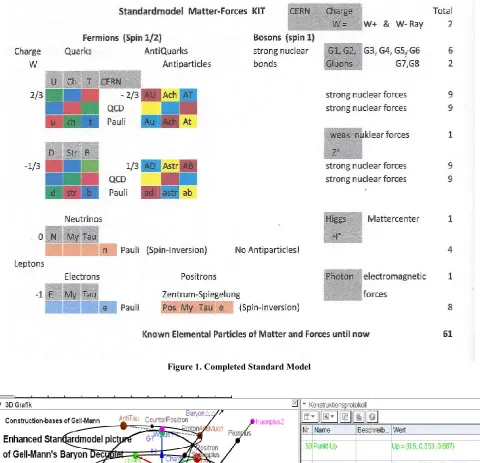
spin 1 i.e. on W-1 and W+1 respectively. The 61 particles can therefore be gotten from the following Fi
Construction of the Models with Inverted Axes and Views
Input of Data with the GeoGebra Program 5:
cleverly devised by Gell-Mann’s eightfold way the stereo system (Spin, Strangeness, Charge) with
and the modern Higgs-center Point (zero, zero, zero). So, we begin with the Spin and go to the next step: the half spin: left with the negative, left rotating i.e. the Mu
with the positive and bigger Tau a closed circle – thanks to Gell
strangeness as planar dimension and the incident oblique
International Journal of Current Research
Vol. 10, Issue, 11, pp.75414-75420, November, 2018
DOI: https://doi.org/10.24941/ijcr.32976.11.2018
Standard Model Picture with 61 Elementary Particles”, International Journal
Available online at http://www.journalcra.com
z
STANDARD MODEL PICTURE WITH 61 ELEMENTARY PARTICLES
picture simulating a 3-dimensional model: Spin, Strangeness and an oblique incident charge with 3 investigated Quarks constructed in 10 Baryons. Until now the CERN scientists have found 61 elementary particles, but only 17 in a brick box as «Standard model». But if the Quarks really exist, Mann’s picture which I tried to enhance with modern media. This explains why – in only pictures can be seen in this publication and NO Lagrange formula.
Commons Attribution License, which permits
get a revolving Stereo picture. But as the publicizing possibilities are limited, the pictures here are restricted to chosen stationary ones. But nevertheless, even if it looks very complicated with the 7 circle planes, to expound seven longer (1-5)First, the CERN brick box of the 17 Fundamental particles had to be enhanced: ons corresponding to Pauli by Spin inverting and QCD namely 3 distinguishable Quarks i.e. analogue to 3 imaginary colors making up white: green Quark – inversion – therefore blue Quark. The same also with the Antiquark colors: magenta – cyan blue – yellow. The Antineutrino and the Electron with the right spin electron and at (Higgs)-center inversion the positron. From the 8 Gluons there are 6 sitting on the horizontal Boson spin 1 and 2 ones on the vertical 1 and W+1 respectively. The 61 particles can therefore be gotten from the following Figure 1.
Construction of the Models with Inverted Axes and Views
Input of Data with the GeoGebra Program 5:The Basis,
Mann’s eightfold way the stereo Charge) with the Neutron-Baryon center Point (zero, zero, zero). So, we begin with the Spin and go to the next step: the half spin: left with the negative, left rotating i.e. the Mu-neutrino and right with the positive and bigger Tau-neutrino; both sides united in thanks to Gell-Mann, choosing the strangeness as planar dimension and the incident oblique
INTERNATIONAL JOURNAL OF CURRENT RESEARCH
Zero Spin-axis on Strangeness 0 with the Pions Pionminus and Pionplus, the Baryons with increasing charge: baryon -1, Neutron 0, Proton +1 and the baryon +2, and today finally the Higgs-particle as Zero Stereo Coordination point. (Center particle at the CERN-Detector). On the Strangeness -1there are the other 2 Kaons and the 2 Sigma-baryons. So, we can connect the 4 Kaons and the 2 Pionsto get a Meson Sextet between the strangeness axes +1 and -1 (8).We connect also, the Neutron line from the left to the right in the Neutrino half-spin circle. We get the cross points Antineutrino and the Electron Neutrino and enlarge the Sextet by the double + loaded Baryon double Delta on the strangeness axis 0 to get
the oblique incident charge +2, +1 (= Positron), zero (= Charge-center). The Electron we can get from the Positron
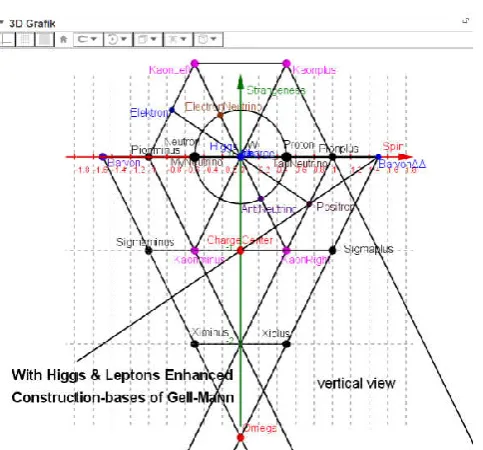
+1 by drawing the connection line through the Higgs-center. So, the Electron gets a positive strangeness. The Detail Figure 11 shows the exact construction with the same methods as Gell-Mann for the Baryon Decuplet. The Zero Charge-center lies on Strangeness -1 and the Higgs-center on Strangeness 0. We fix the Electron, the Positron and draw the strangeness lines, connected by the half-spin right and left, and connect the other corners until we get exactly Gell-Mann’s Basic construction with the Omega Baryon on Strangeness -3, containing 6 triangles with the 6 centers of gravity which we call the Quarks, namely Up and Down, Strange, and later the subsequently detected Charm, Bottom and Top.
The reason for the name Strangelies therein that the plus strangeness has changed with the minus strangeness of the Charm; therefore, we take actual the spin-inversed particles to draw the half-spin circle of the same charge. The 3 Double (one + and the other minus) triangles in green, blue and red represent the 3 mass increasing Quark families. They have been projected onto the neutral plane to show the upper (+) and lower minus charge parts better. On this neutral plane there are also the weak power Bosons Photon and Z which we connect by the Boson 1 spin circle. One charge quant below the Neutrino neutral plane there lies the Muon and the Tauon or Tau – so we had better turn the axes and get a bit of strangeness for a real stereo picture. The figure you see is that the W plus and minus ray are connected to a charge axis with the two Quark half-spin levels on + 2/3 and minus 1/3 charge level, so that we can draw the Electron half-spin circle on charge -1 because we have three -1 charged points: Electron, Muon and Tau. As the Standard Model proposes that each half spin point has its Antipoint, we get the Anti-Muon and the Anti-Tau by inverting the signs or constructively by placing reflection rays through the Higgs-zero Point. Thus, we get the Anti-Electron as Positron half-spin circle and as fourth point on both circles the spin inverted Pauli counter electron and Anti-electron respectively. Therefore, there are 4 particles connected in both half-spin circles W plus and minus, the couple Muon and Tau as well as the big Initialized Electron and the spin inverted, small initialized electron - like the Neutrino half-spin circle. As each half-spin point has its Antipoint, after marking the four center points with a white ball, we get the minus 2/3 half-spin circle with Anticharm, Antiup and Antitop and the other 1/3 Anti half-spin circle with Antistrange, Antidown and Antibottom.
but distinguishable quarks there should be another three Quarks more in the spin circle, which can be done by “Quantum Chromatic Dynamic”, abbreviated QCD. Therefore, we construct through the white bowls on the W plus and W minus-ray at 2/3 and 1/3 these colored QCD’s, because they consist of the same three colored Quarks: blue, green and red; and the antiquarks as yellow, magenta and cyan blue respectively; all three together result again in white; necessary for each existing Baryon containing these three different colored Quarks or three Antiquarks. We completed therefore the minus 2/3 counter Antiquarks with the antiquark colors and indicate the W+2/3 counter Quarks with small initialized terms charm, up and top with the Quark colors. We continue with the W minus 1/3 counter Quarks small initialized down, strange and bottom and finish with the W+1/3 counter Antiquarks: Antidown, Antistrange and Antibottom with the Antiquark colors also called “anti-green”,” anti-red”, “anti-blue”, i.e.magenta, cyan-blue and yellow respectively.
To demonstrate the two matching Quark spin-circles we connect the corresponding Quarks and see: The white balls are thespin-circle centers of the W+2/3 and 1/3 lying on the W+ ray and the spin circle centers of the W minus (1/3 and 2/3) lying on the W minus ray. On each Quark spin-level lie 9 Quarks or 9 Antiquarks. The Quarks in the Baryons are fixed by Gluons. To place the Gluons, we rotate the axis again and add the six double colored gluon Bosons (one Quark color side and the other with Antiquark color) on the 1 Spin-circle and the other two as 4 and 6 anti-coloreds as W+1 and W-1; filling out the 8 Gluon-interstices with the 9 Quarks, to keep them bonded very strongly together in the Baryonic nucleus. At the end of the 7 planes of the Standard Model we can test the precision of the picture by rotating the axes and checking the Higgs crossing lines. But finally, we can turn and rotate the whole System and look at each particle with all the possibilities of the GeoGebra program e.g. checking Electrons, Neutrinos, Quarks, Gluons, Bosons and the Algebra points given by the 3-dimensional construction, enlarging and so on. (11, 12)
Construction pictures
The Picture with Perpendicular Charge Axis (W+, Higgs,
W-) has 7 Planes: The Construction can by clicking according
(11) step by step be observed as well as printed out with the exact construction program.
It Can Be Shown That the Quarks Are Really Triangular
Points of Gravity: On Neutral plane, the 6 and 2 different
Gluons on the horizontal and vertical Boson spin 1 demonstrate the 3 families of the particle physics each one having 1 upper and 1 lower Quarks.
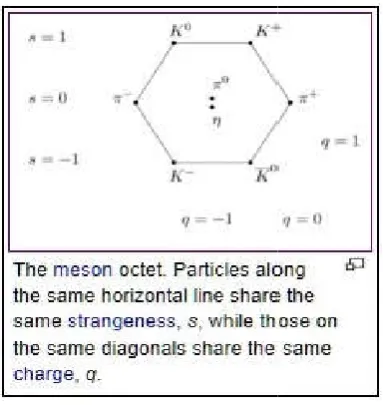
Comparison of the enhanced vertical model (Figure 6) with Gell-Mann’s meson octet and baryon Decuplet.
Discussion of Gell-Mann’s Quark models (Figure 4 and 5):
Figure 2. The Construction of the Standard Model with 61 Elementary QCD 75416 International Journal of Current Research,
Figure 1. Completed Standard Model
The Construction of the Standard Model with 61 Elementary QCD particles International Journal of Current Research, Vol. 10, Issue, 11, pp.75414-75420, November
particles
Therefore, the charge Ray Q incidents between the Kaon K+ the pion plus on the right side (q = +1 = Positron)
between the Kaon K- and the pion minus (q =
(9). In the Baryon Decuplet there are 2 Zero Points, one with strangeness 0 (for the Higgs-particle) and
strangeness -1 (for the charge-center). The Positron p (1) is indicated between the Proton and the meson Pionplus (same place as for baryon Sigma-plus. The Electron must be center-symmetrical through the Higgs-particle. So, the Stereo picture of Gell-Mann can be enhanced to a nonmathematical, visible real construction, implementing all the CERN bricks.
Showing the same construction of Figure 2,
(without visible charge): This picture (Figure 6) continues the
Baryon Decuplet as also the (6 and 2) Gluons investigated later in the same position of the axes (spin, Strangeness) without a visible stereo effect but with high symmetry.
[image:4.595.75.528.56.321.2]shows that if the Quarks are real (and even the 6 and 2 Gluons) then it is also real that only three particle families can exist! So, a great problem of particle physics should be solved.
Figure 3. Shows the (projected) Neutral plane, the horizontal and the perpendicular 1 Spin Bo son
Figure 4. Gell-Mann’s meson octet
the charge Ray Q incidents between the Kaon K+ and the pion plus on the right side (q = +1 = Positron) to the left side the pion minus (q = -1 = Electron) (6), In the Baryon Decuplet there are 2 Zero Points, one with and the other with center). The Positron position (1) is indicated between the Proton and the meson Pionplus plus. The Electron must be particle. So, the Stereo Mann can be enhanced to a nonmathematical, eal construction, implementing all the CERN bricks.
the same construction of Figure 2, but vertical
(Figure 6) continues the Baryon Decuplet as also the (6 and 2) Gluons investigated later in the same position of the axes (spin, Strangeness) without a visible stereo effect but with high symmetry. This picture the 6 and 2 Gluons) then it is also real that only three particle families can exist! So, a great problem of particle physics should be solved.
(In the proved CERN Standard model there is no place for a forth family!)
Model of the 61 Elementary Particles Without Disturbing Construction Details
Details of the Standard model Constructions:
brick box there are only the 17 Fundamental Particles.The Leptons can be symmetrically enhanced through the
particle and the Quarks through the Charge points 2/3,1/3, and -1/3,-2/3.
This picture shows that if the Quarks are real (and even the 6 and 2 Gluons) then it is also real that only three particle families can exist! So, a great problem of particl
should be solved. (In the proved CERN Standard model there is no place for a forth family!
Function: The Gravity points (1/3 / 2/3 of the Triangle Higgs High-Lines); therefore the 2/3 Charge for the upper
for the lower Triangles.
Shows the (projected) Neutral plane, the horizontal and the perpendicular 1 Spin Bo son
Mann’s meson octet Figure 5. Gell-Mann’s Baryon decuplet
CERN Standard model there is no place for a
Model of the 61 Elementary Particles Without Disturbing
Details of the Standard model Constructions: In the CERN
brick box there are only the 17 Fundamental Particles.The Leptons can be symmetrically enhanced through the Higgs-particle and the Quarks through the Charge points 2/3,1/3, and
This picture shows that if the Quarks are real (and even the 6 and 2 Gluons) then it is also real that only three particle families can exist! So, a great problem of particle physics should be solved. (In the proved CERN Standard model there is no place for a forth family! The 6 Quarks have a real Function: The Gravity points (1/3 / 2/3 of the Triangle Higgs Lines); therefore the 2/3 Charge for the upper and -1/3
Shows the (projected) Neutral plane, the horizontal and the perpendicular 1 Spin Bo son-circle for the 6 & 2 Gluons
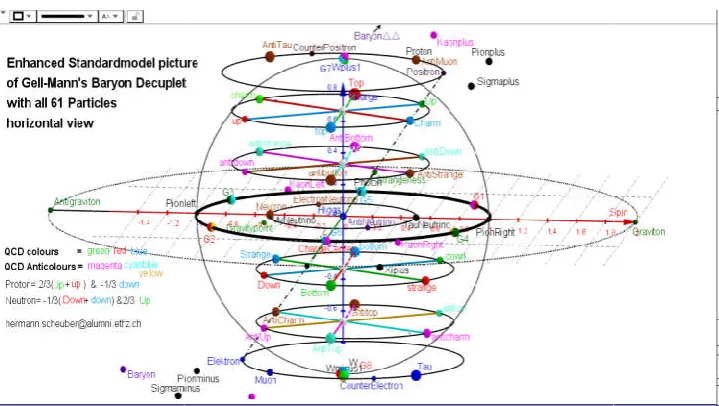
[image:4.595.311.523.352.545.2] [image:4.595.76.268.354.557.2]Figure 6. High Symmetry of the enhanced “Decuplet” with 61 Particles and Spin circles; the right side shows construction details (spin, strangeness, charge)
Figure 7. Great Model of the 61
75418 International Journal of Current Research,
High Symmetry of the enhanced “Decuplet” with 61 Particles and Spin circles; the right side shows construction details (spin, strangeness, charge)
Figure 7. Great Model of the 61 Elementary Particles with QCD sequent cross
Figure 8. Public Box of the Standard model
International Journal of Current Research, Vol. 10, Issue, 11, pp.75414-75420, November
High Symmetry of the enhanced “Decuplet” with 61 Particles and Spin circles;
[image:5.595.178.429.572.765.2]Figure 9.
Figure 10. Stereo Standard model of the CERN brick box
Figure 11. Strangeness +1, +1/2, 0,
Figure 9. The 6 Quarks as Points of Gravity
Figure 10. Stereo Standard model of the CERN brick box
DISCUSSION
All these pictures are parts of the Lagrange formula of the enhanced Standard model with the 61 elementary particles, especially for peoples without enough mathematical knowledge getting a deeper insight into the particle physics. It is an experiment to demonstrate that the Standard model can be depicted using the Gell-Mann system of matrices to show the mesons (strangeness zero) and the baryon Decuplet with the oblique charge incident. To get a real tree-dimensional stereo picture, the charge (composed of the + and minus W ray) must be put perpendicular against the horizontal spin. This will be right turning on the right side and left turning on the left side. Connected with the minus strangeness on the front side, the 4 tri-pointed charge planes of the CERN Standard model can be put on circles. As they are all half spin particles, according to Pauli they have3 electron-inverted counter particles on the same plane; and because of the baryons, 3 distinguishable particles are depicted by 3 imaginary colors in the (white) plane center. According to the (Higgs) center point symmetry, the 2 Quark planes must have 2 Antiquark planes, and the Electron plane an Antielectron = Positron plane. The result will then be 7 half spin planes. But as the zero plane cannot be doubled, this special case is shown by the fact that also the Tau-neutrino (on the right spin side) is left turning.
This demands a further investigation of the Neutrinos to complete the „Standard Model “.The upper pictures show that the later discovered particles (Quarks, Gluons and Higgs) can be fitted into the same model if both W+ and W minus rays are united with the Higgs particle in the middle, getting a charge axis. The Quantum Chromo Dynamic is achieved by putting a segment colored e.g. blue between the other both colored green and red spin inverted Quarks, crossing the middle point of that Quark plane. Without the connecting segment a white ball can be put into the center, containing all three colors; but then the missing third Quark color may be written. Only Baryons containing all three Quarks with different colors are stable. For a better overview and for purposes of verification, models without construction lines and helping points can be used, whereby all Quark circle lines must have three times 2 Quark particles with the same color and the white ball in the middle of the Quark plane. It should also be mentioned that heavier particles with greater mass have a greater diameter in the model. The Nomenclature of all the particles may not always be correct, but as each particle has its fixed place, the particle concerned can be found in each language. As Gell-Mann constructed at the bottom point of his picture with spin 2 the later discovered particle OMEGA, I enhanced the Neutral plane also with spin 2 and put there the very weak force particle, the GRAVITON and antigraviton.
Conclusion
In conclusion, I propose that the graphical system could provide a better model as an aid to memoryas well as for future research rather than a strange mathematical equation with 20 Parameter-constants (5) which is ponderous and difficult to verify investigate.
I am wondering why particle physics never published any picture after the investigation of the Higgs particle, but only showed a CERN box of independent bricks and put all the power to speculate and calculate the future SUSY super symmetry with hypothetical grey matter particles - if the immense mass of the 4 Neutrinos and perhaps even possible 4 vanished anti-matter Neutrinos is not enough. The present construction model of the 61 elementary particles shows all systematically in a real Model and not only in a brick box; thus, from each particle we can see at once2 Values: Spin 1/2 (r or l), Spin1, Spin2 and Charge (+1, +2/3, +1/3, 0, 1/3, 2/3, -1)without looking in Wikipedia e.g. ((except for the left turning Tau-neutrino); indication that the system is complete?). Of course, the stationary particle System gives only a systematic review of all 61 physical particles of the Standard Model; In the baryons e.g., there are only 3 (Anti)Quarks in Confinement with 3 Gluons. But the neighborhood of the wanted particles is conspicuous.
Acknowledgements: The author is grateful to the support
from Research Gate (10) and Wikimedia for the prepublications.
REFERENCES
(1) Mathematics sciencehttps://ned.ipac.caltech.edu/ level5/ Cottingham/frames.html
(2) CERN historyhttps://www.youtube.com/ watch? v=cfw BelQubYI
(3) brick boxhttps://en.wikipedia.org/w iki/Standard_ Model_ (mathematical_formulation)
(4) Mathematic formula 1https://www.sciencealert.com/this-is-what-the-standard-model-of-physics-actually-looks-like (5) Mathematic formula 2https://www. symmetrymagazine.org/
article/the-deconstructed-standard-model-equation
(6) Eightfold Way – Wikipediahttps:// de.wikipedia.org/ wiki/ Eightfold_Way
(7) Step by Step in video “Standardmodel picture QCD” https://www.youtube.com
(8) Strangeness – Wikipediahttps:// en.wikipedia.org/ wiki/ Strangeness
(9) Meson – Wikipedia https://de. wikipedia. org/wiki/Meson (10) Standardmodel_with_61_elementary particles_in stereo picture
https://www.researchgate.net/publication/305851350
(11) GeoGebra Link vertical construction: https://www.geogebra.org/m/zzbvbect
(12) GeoGebra Link horizontal construction: https://www.geogebra.org/m/n3beje4m
75420 International Journal of Current Research, Vol. 10, Issue, 11, pp.75414-75420, November, 2018