Does eXtreme Programming support
Collaborative Creativity?
Broderick Crawford and Claudio Le´on de la Barra, PUCV
∗Abstract—In this paper, the Agile method called eXtreme Programming (XP) is analyzed from the perspective of the creativity, in particular the cre-ative performance and structure required at the team-work level. The conclusion is that XP has characteris-tics that ensure the creative performance of the team members, but we believe that it can be fostered from a creativity perspective.
Keywords: Creativity, Software Development, Agile Methodologies, eXtreme Programming
1
Introduction
The agile principles and values have emphasized the im-portance of collaboration and interaction in the software development and, by other hand, creative work com-monly involves collaboration in some form and it can be understood as an interaction between an individual and a sociocultural context. We believe that the innovation and development of new products is an interdisciplinary issue [25], we are interested in the study of the poten-tial of new concepts and techniques to foster creativity in software engineering [8]. This paper is organised as follows: in section 2 we explain the motivation of this work fixing the relevance of Creativity in Software Devel-opment. Section 3 is about central aspects in Creativity. Section 4 gives a brief overview of XP and its phases and roles. Section 5 presents a comparison between roles in creative teams and roles in XP teams. Finally, in Section 6 we conclude the paper and give some perspectives for future research.
2
Creativity in Software Development
Software engineering is a knowledge intensive process that includes human and social factors in all phases: elic-iting requirements, design, construction, testing, imple-mentation, maintenance, and project management [14]. No worker of a development project has all the knowledge required to fulfill all activities. This underlies the need for communication, collaboration and knowledge sharing support to share domain expertise between the customer
and the development team [4].
Since human creativity is thought as the source to re-solve complex problem or create innovative products, one possibility to improve the software development process is to design a process which can stimulate the creativ-ity of the developers. There are few studies reported on the importance of creativity in software development. In management and business, researchers have done much work about creativity and obtained evidence that the employees who had appropriate creativity characteristics, worked on complex, challenging jobs, and were supervised in a supportive, noncontrolling fashion, produced more creative work. Then, according to the previous ideas the use of creativity in software development is undeniable, but requirements engineering is not recognized as a cre-ative process in all the cases [20].
In a few publications the importance of creativity has been investigated in all the phases of software develop-ment process [7, 8, 5] and mostly focused in the require-ments engineering [24, 21, 22]. Nevertheless, the use of techniques to foster creativity in requirements engineer-ing is still shortly investigated. Indeed, the importance of creative thinking is expected to increase over the next decade [19].
In [24, 23] very interesting open questions are proposed: Is inventing part of the requirements activity? It is if we want to advance. So who does the inventing? We can-not rely on the customer to know what to invent. The designer sees his task as deriving the optimal solution to the stated requirements. We can not rely on programmers because they are far away from the work of client to un-derstand what needs to be invented. Requirements ana-lysts are ideally placed to innovate. They understand the business problem, have updated knowledge of the tech-nology, will be blamed if the new product does not please the customer, and know if inventions are appropriate to the work being studied. In short, requirements analysts are the people whose skills and position allows, indeed encourages, creativity.
∗Pontificia Universidad Cat´olica de Valpara´ıso, Chile
3
Creativity
The creativity definitions are numerous [2, 17, 28], there-fore, considering the object of analysis in the present pa-per: a software development teamwork, that must re-spond to the requirements of a specific client for a par-ticular problem, a suitable definition is the one raised by Welsch [27]:
Creativity is the process of generating unique products by transformation of existing products. These products, tan-gible and intantan-gible, must be unique only to the creator, and must meet the criteria of purpose and value estab-lished by the creator.
More specifically, and from an eminently creative per-spective, it is possible to distinguish three aspects at the interior of a group developing new products: a) The pur-poses that the team tries to reach, which demand two scopes of results [6, 9, 10, 11, 12]:
• Those related to the creative result that must be original, elaborated, productive and flexible.
• Those related to the creative team, so that it reaches its goals, developing cognitive abilities and presenting an improved disposition to the change. All this in order to obtain a better creative team performance in the future.
b) The performance shown by the team in connection with the main aspects of the complex dynamics that the persons build inside a team. We describe three aspects:
• The personal conditions of the members of the team, in terms of the styles and cognitives abili-ties, the personality, their intrinsic motivation and knowledge [28, 1, 2, 6].
• The organizational conditions in which the cre-ative team is inserted, and that determines, at least partly, its functioning. These conditions, in the extent that present/display certain necessary particular characteristics - although non sufficient - for the creative performance. They emphasize in special the culture (communication, collabora-tion, trust, conflict handle, pressure and learn-ing) [28, 16, 13]; the internal structure (formaliza-tion, autonomy and evaluation of the performance) [28, 16, 13, 1]; the team available resources (time disposition) [28, 16, 2] and the physical atmosphere of work [17].
• The conditions of performance of the creative team, mainly the creative process realized, which sup-poses the set of specific phases that allow to assure the obtaining of a concrete result (creative product) [17, 26].
c) The structure of the creative team, particularly the group characteristics, such as norms, cohesiveness, size, diversity, roles, task and problem-solving approaches [28].
Of the mentioned aspects, we deepen in those referred to the structure and performance of the team for the de-velopment of new products, specially considering: the creative process and the roles surrounding this process.
3.1
The Creative Process
The creative process constitutes the central aspect of team performance, because it supposes a serie of clearly distinguishable phases that had to be realized by one or more of the team members in order to obtain a concrete creative result.
The phases - on the basis of Wallas [26] and Leonard and Swap [17] - are the following ones:
• Initial preparation: the creativity will bloom when the mental ground is deep, fertile and it has a suitable preparation. Thus, the deep and relevant knowledge, and the experience precedes the creative expression.
• Encounter: the findings corresponding to the per-ception of a problematic situation. For this situa-tion a solusitua-tion does not exist. It is a new problem.
• Final preparation: it corresponds to the under-standing and foundation of the problem. It’s the immersion in the problem and the use of knowledge and analytical abilities. It includes search for data and the detailed analysis of factors and variables.
• Generation of options: referred to produce a menu of possible alternatives. It supposes the divergent thinking. It includes, on one hand, finding princi-ples, lines or addresses, when making associations and uniting different marks of references and, on the other hand, to generate possible solutions, combi-nations and interpretations.
• Incubation: it corresponds to the required time to reflect about the elaborated alternatives, and ”to test them mentally”.
• Options Choice: it corresponds to the final evalu-ation and selection of the options. It supposes the convergent thinking.
• Persuasion: closing of the creative process and com-munication to other persons.
phases it is possible to associate feedbacks whose ”des-tiny” can be anyone of the previous phases in the men-tioned sequence.
3.2
The Creative Team
Lumsdaine and Lumsdaine [18] raise the subject of the required cognitives abilities (mindsets) for creative prob-lem resolution. Their tipology is excellent for the creative team, and the different roles to consider. These roles are the following ones:
• Detective. In charge of collecting the greatest quan-tity of information related to the problem. It has to collect data without making judgements, even when it thinks that it has already understood the problem exactly.
• Explorer. Detects what can happen in the area of the problem and its context. It thinks on its long term effects and it anticipates certain devel-opments that can affect the context (in this case, the team). The explorer perceives the problem in a broad sense.
• Artist. Creates new things, transforming the infor-mation. It must be able to break his own schemes to generate eccentric ideas, with imagination and feeling.
• Engineer. Is the one in charge of evaluating new ideas. It must make converge the ideas, in order to clarify the concepts and to obtain practical ideas that can be implemented for the resolution of prob-lems.
• Judge. Must do a hierarchy of ideas and decide which of them will be implemented (and as well, which ones must be discarded). Additionally, it must detect possible faults or inconsistences, as well as raise the corresponding solutions. Its role must be critical and impartial, having to look for the best idea, evaluating the associated risks.
• Producer. In charge of implementing the chosen ideas.
Leonard and Swap [17] have mentioned additional roles, possible to be integrated with the previous ones, because they try to make more fruitful the divergence and the convergence in the creative process:
• The provoker who takes the members of the team ”to break” habitual mental and procedural schemes to allow the mentioned divergence (in the case of the ”artist”) or even a better convergence (in the case of the ”engineer”).
• Think tank that it is invited to the team sessions to give a renewed vision of the problem-situation based on his/her experticia and experience.
• The facilitator whose function consists in helping and supporting the team work in its creative task in different stages.
• The manager who cares for the performance and specially for the results of the creative team try-ing to adjust them to the criteria and rules of the organization (use of resources, due dates).
Kelley and Littman [15], on the other hand, have raised a role tipology similar to Lumsdaine and Lumsdaine [18], being interesting that they group the roles in three cate-gories: those directed to the learning of the creative team (susceptible of corresponding with the detective, explorer, artist, provoker and think tank roles), others directed to the internal organization and success of the team (similar to the judge, facilitator and manager roles) and, finally, roles whose purpose is to construct the innovation (pos-sibly related to the role of the engineer and judge).
4
eXtreme Programming (XP)
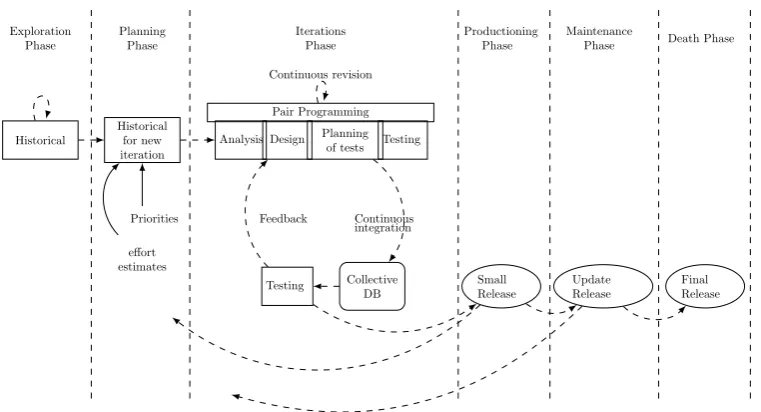
Extreme Programming is an iterative approach to soft-ware development [3], the process is shown in Figure 1. The methodology is designed to deliver the software that customer needs when it’s needed. This methodology em-phasizes team work. Managers, customers, and devel-opers are all part of a team dedicated to deliver qual-ity software. XP implements a simple, yet effective way to enable groupware style development. XP improves a software project in four essential ways; communication, simplicity, feedback, and courage.
4.1
Roles in XP
XP defines the following roles for a software development process [3]:
• Programmer. The programmer writes source code for the software system under development. This role is at the technical heart of every XP project because it is responsible for the main outcome of the project: the application system.
• Customer. The customer writes user stories, which tell the programmer what to program. ”The pro-grammer knows how to program. The customer knows what to program”.
• Tracker. The tracker keeps track of all the num-bers in a project. This role is familiar with the estimation reliability of the team. Whoever plays this role knows the facts and records of the project and should be able to tell the team whether they will finish the next iteration as planned.
• Coach. The coach is responsible for the develop-ment process as a whole. The coach notices when the team is getting ”off track” and puts it ”back on track.” To do this, the coach must have experience with XP.
• Consultant. Whenever the XP team needs ad-ditional special knowledge, they ”hire” a consul-tant who possesses this knowledge. The consulconsul-tant transfers this knowledge to the team members, en-abling them to solve the problem on their own.
• Big boss. The big boss or Manager provides the resources for the process. The big boss needs to have the general picture of the project, be familiar with the current project state, and know whether any interventions are needed to ensure the project’s success.
5
Creativity in XP
Regarding to the structure dimension of a new product development team (in particular software), it is possible to relate the roles in creativity to the roles defined in the XP methodology distinguishing: base roles, that is, those directly related to the creative processes and soft-ware development, and support roles, whose function is to support or lead the other roles for a better performance.
In relation with the structure dimension it’s important to considerate how the team can operate. In order to implement the functionality of each role, we must con-siderate two aspects: basic organizational conditions and the pertinent creative process.
5.1
Team Performance and Organizational
Conditions
The creative team performance is determined by the or-ganizational conditions in which it’s inserted [1, 17, 28, 16, 13]. Some conditions are necessary - although not sufficient - for the creative performance. We are inter-ested in explore the influence of autonomy, communi-cation, cooperation and learning, the handling of pos-sible conflicts, pressure, formalization, performance eval-uation, available resources (time) and the physical atmo-sphere of work.
The autonomyrefers to the capacity of the people and the team as a whole to act and make decisions. This as-pect is related to the following XP practices: the actual client, since it is part of the team and, in addition, has
decisional capacity delegated by its own organization; the use of metaphors, of codification standards and the ex-istence of ”right” rules really represent codes of shared thought and action, that make possible the autonomy of the team members; the small deliveries and the fact of the collective property allow that all the involved ones share official and explicit knowledge, that results in a greater independence of the members and the possibility of a minor coordination among them.
The team member’s communication, cooperation and learning are fortified since the client is present and there exist opened spaces to work together and in a pair pro-gramming mode. The work dynamics is based on a game of planning and metaphors involving all the participants from the beginning (client and equipment developer). Also, the use of codification standards, the small deliv-eries, the collective property of the code and the simple design, allow that the person has clear performance codes and rules about what is expected and acceptable (internal culture) in order to establish the required communication and cooperation.
Thehandling of possible conflicts between the client and the development team, and internally at team level is fa-vored by XP practices handling it (presence of the client, pairs programming, planning game, continuous integra-tion, tests, collective property), or to reduce it and to avoid it (small deliveries, simple design, 40 hour a week and codification standard). Cooperation and trust are associated to this issue.
Thepressure(that in creativity is appraised as favorable until certain degree, favoring the performance, and detri-mental if it exceeds this degree), is susceptible then to favor in XP through the client in situ, the programming by pairs, the planning game, the tests and continuous in-tegration. It’s possible to avoid, or at least to reduce, the pressure through the refactorization, the small deliveries, the collective property, and the fact that surpassing the 40 weekly working hours is seen like an error.
The formalization, that gives account of all those for-mal aspects (norms, procedures) defined explicitly and that are known, and even shared, by the members of the team. It’s assured in XP through planning game, metaphors, continuous integration, the collective prop-erty, the 40 hours per week and the codification stan-dards guiding the desirable conduct and performance of the team.
the products. The evaluation characteristics empower the learning processs.
Thetime dedicated has fundamental importance in XP team respecting the available resources. This aspect is strongly stressed in creativity. The pair programming and the developer multifunctional role allow to optimize the partial working-times, as well as the whole project time, ensuring a positive pressure.
The physical atmosphere of work, referred in creativity to the surroundings that favor or make difficult the cre-ative performance (including aspects like available spaces, noise, colours, ventilation, relaxation places) are assured only partially in XP through the open spaces, as a way to assure the interaction between members of the team.
5.2
Team Performance and the Process
The team performance is directly determined by the cre-ative process [17, 26]. It’s important to correlate the phases defined in XP with the phases considered in a creative process.
• The initial preparation and ”finding” defined in the creative process correspond to the exploration phase in XP, where the functionality of the proto-type and familiarization with the methodology are established.
• The final stage of preparation is equivalent with the phases of exploration and planning in XP, defining more in detail the scope and limit of the develop-ment.
• The option generation phases, incubation and elec-tion of opelec-tions defined in the creative process cor-respond to the iterations made in XP and also with the liberations of the production phase (small re-leases). In XP there is not a clear distinction of the mentioned creative phases, assuming that they occur to the interior of the team.
• The feedback phase (understanding this one as a final stage of the process, and not excluding that can have existed previous micro-feedbacks since the creative process is nonlinear) it could correspond in XP with the maintenance phase.
• The persuasion phase is related to the phase of death established in XP, constituting the close of the development project with the final liberation.
5.3
The correlation between Creative and
XP Roles
As previously mentioned in the creative process there are base and supporting roles. The base roles are directly related to the creative and software development process
and the supporting roles support or lead the base roles to a better performance. The following is the correlation between creative and XP roles:
• The detective function consisting in collecting infor-mation related to a problem is made by the client himself in XP, because this one generates the first contact with the software development team.
• The function of explorer consisting in defining com-pletely the problem is made in XP as much by the client as the manager of the team, all together they appreciate the reach of the identified problem, as well as of the possible solutions. The function of the artist consisting in transforming the informa-tion, creating new relations, and therefore generat-ing interestgenerat-ing solutions is made by the developer, that in XP methodology is in charge of the analysis, design and programming of software.
• The function of the engineer referred to clarify and to evaluate the new ideas, in terms of its feasibility is made in XP by the tester and the tracker.
• The function of the judge, understood as the defini-tive selection of the solutions to implant, is made in XP by the tracker and the client.
• The function of the producer, referred to the imple-mentation of the selected ideas (strictly speaking it is working software) is made in XP by the client in his organization, including the processes and pro-cedures that this function implies.
The supporting roles considered are:
• The provoker; creativity demands that the diver-gence as well as converdiver-gence in the solutions be maximum and complete. There is not explicit refer-ence in XP methodology about divergent thinking.
• The think tank who helps the team work ”from outside” is equivalent completely to the role of the consultant.
• The facilitator whose function is helping the team, corresponds in XP to the coach role.
• The manager whose function is to lead to the team in terms of its general efficiency and its effectiveness corresponds with XP’s big boss or manager.
6
Conclusions
Historical
Historical for new iteration
Analysis Design Planning of tests Testing
Testing Collective DB effort
estimates
Priorities Feedback Continuous integration
Small Release
Update Release
Final Release Exploration
Phase
Planning Phase
Iterations Phase
Productioning Phase
Maintenance
Phase Death Phase
[image:6.595.102.483.95.301.2]Pair Programming Continuous revision
Figure 1: Lifecycle XP Phases
The structure that the team adopts and specially the different roles that the methodology advises to define, nearly correspond with the roles at the interior of a cre-ative team. The performance that characterizes the team through certain advisable practices, from the perspective of creativity, constitutes the necessary basic conditions, although nonsufficient, in order to favor the group cre-ative performance. These conditions - called practices in XP methodology - are accompanied by concrete phases of constituent activities of an agile software development process, which is possible to correspond with the cre-ative process, which is fundamental to the crecre-ative per-formance.
In spite of the previous comments, we think that XP methodology should have a more explicit reference to:
• The provoker role that is thoroughly described in creativity as a fundamental factor to generate
in-novation. This can be explained because, in gen-eral, agile methodologies do not aim, as a central element, to generate an original software, but an effective one.
• The distinction and formalization of the creative phases to generate options incubation and option choices (that are fundamental in creativity). It is assumed that they take place in the iterative and production process. Again, XP is not focused in ”originality”, resulting that the divergence is not so fundamental in XP.
• A more direct mention to the physical atmosphere of work, that in creativity are considered as highly relevant to enhance the performance. These aspects should have a greater consideration since software development is a special case of pro-duct develop-ment.
References
[1] T. Amabile. How to kill creativity.Harvard Business Review, Sept-Oct:77–87, 1998.
[2] T. Amabile, R. Conti, H. Coon, J. Lazenby, and M. Herron. Assessing the work environment for creativity. Academy of Management Journal, 39(5):1154–1184.
[3] K. Beck. Extreme programming explained: embrace change. Addison-Wesley Longman Publishing Co., Inc., Boston, MA, USA, 2000.
[4] T. Chau, F. Maurer, and G. Melnik. Knowl-edge sharing: Agile methods vs tayloristic meth-ods. InTwelfth International Workshop on Enabling Technologies: Infrastructure for Collaborative Enter-prises, WETICE, pages 302–307, Los Alamitos, CA, USA, May 2003. IEEE Computer Society.
[5] B. Crawford and C. L. de la Barra. Enhancing creativity in agile software teams. In G. Concas, E. Damiani, M. Scotto, and G. Succi, editors, XP, volume 4536 of Lecture Notes in Computer Science, pages 161–162. Springer, 2007.
Peren-nial, New York, 1998.
[7] R. L. Glass. Software creativity. Prentice-Hall, Inc., Upper Saddle River, NJ, USA, 1995.
[8] M. Gu and X. Tong. Towards hypotheses on creativ-ity in software development. In F. Bomarius and H. Iida, editors, PROFES, volume 3009 of Lecture Notes in Computer Science, pages 47–61. Springer, 2004.
[9] J. P. Guilford.Intelligence, Creativity and Their Ed-ucational Implications. Edits Pub, 1968.
[10] R. Hallman. The necessary and sufficient condi-tions of creativity. Journal of Humanistic Psychol-ogy, 3(1), 1963. Also reprinted in J. C. Gowan et al., Creativity: Its Educational Implications. New York: John Wiley and Co., 1967.
[11] R. Hallman. Aesthetic pleasure and the creative pro-cess. Journal of Humanistic Psychology, 6(2):141– 148, 1966.
[12] R. Hallman. Techniques of creative teaching. Jour-nal of Creative Behavior, I(Sept), 1966.
[13] S. G. Isaksen, K. J. Lauer, and G. Ekvall. Situa-tional outlook questionnaire: A measure of the cli-mate for creativity and change. Psychological Re-ports, (85):665–674.
[14] M. John, F. Maurer, and B. Tessem. Human and so-cial factors of software engineering: workshop sum-mary.SIGSOFT Softw. Eng. Notes, 30(4):1–6, 2005.
[15] T. Kelley and J. Littman. The Ten Faces of Inno-vation: IDEO’s Strategies for Defeating the Devil’s Advocate and Driving Creativity Throughout Your Organization. Currency, 2005.
[16] P. Kotler and G. Armstrong. Principles of Market-ing, 10th Edition. Prentice Hall, 2003.
[17] D. A. Leonard and W. C. Swap. When Sparks Fly: Igniting Creativity in Groups. Harvard Busi-ness School Press, Boston, 1999.
[18] E. Lumsdaine and M. Lumsdaine. Creative Prob-lem Solving: Thinking Skills for a Changing World. McGraw-Hill, Inc, New York, 1995.
[19] N. Maiden and A. Gizikis. Where do requirements come from? IEEE Softw., 18(5):10–12, 2001.
[20] N. Maiden, A. Gizikis, and S. Robertson. Provoking creativity: Imagine what your requirements could be like. IEEE Software, 21(5):68–75, 2004.
[21] N. Maiden and S. Robertson. Integrating creativity into requirements processes: Experiences with an air traffic management system. In 13th IEEE Interna-tional Conference on Requirements Engineering (RE 2005), 29 August - 2 September 2005, Paris, France, pages 105–116. IEEE Computer Society, 2005.
[22] L. Mich, C. Anesi, and D. M. Berry. Applying a pragmatics-based creativity-fostering technique to requirements elicitation. Requir. Eng., 10(4):262– 275, 2005.
[23] J. Robertson. Eureka! why analysts should invent requirements. IEEE Softw., 19(4):20–22, 2002.
[24] J. Robertson. Requirements analysts must also be inventors. Software, IEEE, 22(1):48–50, 2005.
[25] H. Takeuchi and I. Nonaka. The new new product development game. Harvard Business Review, 1986.
[26] G. Wallas. The art of thought. New York: Harcourt Brace, 1926.
[27] G. Welsh. Personality and Creativity: A Study of Talented High School Students. Unpub. doctoral dis-sertation, Chapel Hill, University of North Carolina, 1967.
[28] R. W. Woodman, J. E. Sawyer, and R. W. Grif-fin. Toward a theory of organizational creativity.