Porting Statistical Parsers with Data-Defined Kernels
Ivan Titov University of Geneva 24, rue G´en´eral Dufour CH-1211 Gen`eve 4, Switzerland
James Henderson University of Edinburgh
2 Buccleuch Place
Edinburgh EH8 9LW, United Kingdom [email protected]
Abstract
Previous results have shown disappointing performance when porting a parser trained on one domain to another domain where only a small amount of data is available. We propose the use of data-defined ker-nels as a way to exploit statistics from a source domain while still specializing a parser to a target domain. A probabilistic model trained on the source domain (and possibly also the target domain) is used to define a kernel, which is then used in a large margin classifier trained only on the target domain. With a SVM classifier and a neural network probabilistic model, this method achieves improved performance over the probabilistic model alone.
1 Introduction
In recent years, significant progress has been made in the area of natural language parsing. This re-search has focused mostly on the development of statistical parsers trained on large annotated corpora, in particular the Penn Treebank WSJ corpus (Marcus et al., 1993). The best statistical parsers have shown good results on this benchmark, but these statistical parsers demonstrate far worse results when they are applied to data from a different domain (Roark and Bacchiani, 2003; Gildea, 2001; Ratnaparkhi, 1999). This is an important problem because we cannot ex-pect to have large annotated corpora available for most domains. While identifying this problem, pre-vious work has not proposed parsing methods which
are specifically designed for porting parsers. Instead they propose methods for training a standard parser with a large amount of out-of-domain data and a small amount of in-domain data.
In this paper, we propose using data-defined ker-nels and large margin methods to specifically ad-dress porting a parser to a new domain. Data-defined kernels are used to construct a new parser which ex-ploits information from a parser trained on a large out-of-domain corpus. Large margin methods are used to train this parser to optimize performance on a small in-domain corpus.
Large margin methods have demonstrated sub-stantial success in applications to many machine learning problems, because they optimize a mea-sure which is directly related to the expected test-ing performance. They achieve especially good per-formance compared to other classifiers when only a small amount of training data is available. Most of the large margin methods need the definition of a kernel. Work on kernels for natural language parsing has been mostly focused on the definition of kernels over parse trees (e.g. (Collins and Duffy, 2002)), which are chosen on the basis of domain knowledge. In (Henderson and Titov, 2005) it was proposed to apply a class of kernels derived from probabilistic models to the natural language parsing problem.
In (Henderson and Titov, 2005), the kernel is con-structed using the parameters of a trained proba-bilistic model. This type of kernel is called a data-defined kernel, because the kernel incorporates in-formation from the data used to train the probabilis-tic model. We propose to exploit this property to transfer information from a large corpus to a
tical parser for a different domain. Specifically, we propose to train a statistical parser on data including the large corpus, and to derive the kernel from this trained model. Then this derived kernel is used in a large margin classifier trained on the small amount of training data available for the target domain.
In our experiments, we consider two different scenarios for porting parsers. The first scenario is the pure porting case, which we call “transferring”. Here we only require a probabilistic model trained on the large corpus. This model is then reparameter-ized so as to extend the vocabulary to better suit the target domain. The kernel is derived from this repa-rameterized model. The second scenario is a mixture of parser training and porting, which we call “focus-ing”. Here we train a probabilistic model on both the large corpus and the target corpus. The kernel is derived from this trained model. In both scenar-ios, the kernel is used in a SVM classifier (Tsochan-taridis et al., 2004) trained on a small amount of data from the target domain. This classifier is trained to rerank the candidate parses selected by the associ-ated probabilistic model. We use the Penn Treebank Wall Street Journal corpus as the large corpus and individual sections of the Brown corpus as the tar-get corpora (Marcus et al., 1993). The probabilis-tic model is a neural network statisprobabilis-tical parser (Hen-derson, 2003), and the data-defined kernel is a TOP reranking kernel (Henderson and Titov, 2005).
With both scenarios, the resulting parser demon-strates improved accuracy on the target domain over the probabilistic model alone. In additional experi-ments, we evaluate the hypothesis that the primary issue for porting parsers between domains is differ-ences in the distributions of words in structures, and not in the distributions of the structures themselves. We partition the parameters of the probability model into those which define the distributions of words and those that only involve structural decisions, and derive separate kernels for these two subsets of pa-rameters. The former model achieves virtually iden-tical accuracy to the full model, but the later model does worse, confirming the hypothesis.
2 Data-Defined Kernels for Parsing
Previous work has shown how data-defined kernels can be applied to the parsing task (Henderson and
Titov, 2005). Given the trained parameters of a prob-abilistic model of parsing, the method defines a ker-nel over sentence-tree pairs, which is then used to rerank a list of candidate parses.
In this paper, we focus on the TOP reranking ker-nel defined in (Henderson and Titov, 2005), which are closely related to Fisher kernels. The rerank-ing task is defined as selectrerank-ing a parse tree from the list of candidate trees (y1, . . . , ys) suggested by a
probabilistic modelP(x, y|θˆ), whereθˆis a vector of model parameters learned during training the prob-abilistic model. The motivation for the TOP rerank-ing kernel is given in (Henderson and Titov, 2005), but for completeness we note that the its feature ex-tractor is given by:
φθˆ(x, yk) =
(v(x, yk,θˆ),∂v(x,yk,
ˆ
θ)
∂θ1 , . . . ,
∂v(x,yk,θˆ)
∂θl ),
(1)
where v(x, yk,θˆ) = logP(x, yk|θˆ) −
logPt6=kP(x, yt|θˆ). The first feature reflects the score given to (x, yk) by the probabilistic model (relative to the other candidates for x), and the remaining features reflect how changing the parameters of the probabilistic model would change this score for(x, yk).
The parametersθˆused in this feature extractor do not have to be exactly the same as the parameters trained in the probabilistic model. In general, we can first reparameterize the probabilistic model, pro-ducing a new model which defines exactly the same probability distribution as the old model, but with a different set of adjustable parameters. For example, we may want to freeze the values of some parame-ters (thereby removing them fromθˆ), or split some parameters into multiple cases (thereby duplicating their values inθˆ). This flexibility allows the features used in the kernel method to be different from those used in training the probabilistic model. This can be useful for computational reasons, or when the kernel method is not solving exactly the same problem as the probabilistic model was trained for.
3 Porting with Data-Defined Kernels
scenarios, transferring and focusing. Also we verify the hypothesis that addressing differences between the vocabularies of domains is more important than addressing differences between their syntactic struc-tures.
3.1 Transferring to a Different Domain
In the transferring scenario, we are given just a prob-abilistic model which has been trained on a large corpus from a source domain. The large corpus is not available during porting, and the small corpus for the target domain is not available during training of the probabilistic model. This is the case of pure parser porting, because it only requires the source domain parser, not the source domain corpus. Be-sides this theoretical significance, this scenario has the advantage that we only need to train a single probabilistic parser, thereby saving on training time and removing the need for access to the large cor-pus once this training is done. Then any number of parsers for new domains can be trained, using only the small amount of annotated data available for the new domain.
Our proposed porting method first constructs a data-defined kernel using the parameters of the trained probabilistic model. A large margin clas-sifier with this kernel is then trained to rerank the top candidate parses produced by the probabilistic model. Only the small target corpus is used during training of this classifier. The resulting parser con-sists of the original parser plus a very computation-ally cheap procedure to rerank its best parses.
Whereas training of standard large margin meth-ods, like SVMs, isn’t feasible on a large corpus, it is quite tractable to train them on a small target cor-pus.1 Also, the choice of the large margin classifier is motivated by their good generalization properties on small datasets, on which accurate probabilistic models are usually difficult to learn.
We hypothesize that differences in vocabulary across domains is one of the main difficulties with parser portability. To address this problem, we pro-pose constructing the kernel from a probabilistic model which has been reparameterized to better suit
1
In (Shen and Joshi, 2003) it was proposed to use an en-semble of SVMs trained the Wall Street Journal corpus, but we believe that the generalization performance of the resulting clas-sifier is compromised in this approach.
the target domain vocabulary. As in other lexicalized statistical parsers, the probabilistic model we use treats words which are not frequent enough in the training set as ‘unknown’ words (Henderson, 2003). Thus there are no parameters in this model which are specifically for these words. When we consider a different target domain, a substantial proportion of the words in the target domain are treated as un-known words, which makes the parser only weakly lexicalized for this domain.
To address this problem, we reparameterize the probability model so as to add specific parameters for the words which have high enough frequency in the target domain training set but are treated as unknown words by the original probabilistic model. These new parameters all have the same values as their associated unknown words, so the probability distribution specified by the model does not change. However, when a kernel is defined with this repa-rameterized model, the kernel’s feature extractor in-cludes features specific to these words, so the train-ing of a large margin classifier can exploit differ-ences between these words in the target domain. Ex-panding the vocabulary in this way is also justified for computational reasons; the speed of the proba-bilistic model we use is greatly effected by vocabu-lary size, but the large-margin method is not.
3.2 Focusing on a Subdomain
In the focusing scenario, we are given the large cor-pus from the source domain. We may also be given a parsing model, but as with other approaches to this problem we simply throw this parsing model away and train a new one on the combination of the source and target domain data. Previous work (Roark and Bacchiani, 2003) has shown that better accuracy can be achieved by finding the optimal re-weighting be-tween these two datasets, but this issue is orthogonal to our method, so we only consider equal weighting. After this training phase, we still want to optimize the parser for only the target domain.
reparameter-ization could be applied here, thereby allowing us to use a statistical parser with a smaller vocabulary, which can be more computationally efficient both during training and testing. However, we would ex-pect better accuracy of the combined system if the same large vocabulary is used both by the proba-bilistic parser and the kernel method.
3.3 Vocabulary versus Structure
It is commonly believed that differences in vo-cabulary distributions between domains effects the ported parser performance more significantly than the differences in syntactic structure distributions. We would like to test this hypothesis in our frame-work. The probabilistic model (Henderson, 2003) allows us to distinguish between those parameters responsible for the distributions of individual vocab-ulary items, and those parameters responsible for the distributions of structural decisions, as described in more details in section 4.2. We train two additional models, one which uses a kernel defined in terms of only vocabulary parameters, and one which uses a kernel defined in terms of only structure parameters. By comparing the performance of these models and the model with the combined kernel, we can draw conclusion on the relative importance of vocabulary and syntactic structures for parser portability.
4 An Application to a Neural Network Statistical Parser
Data-defined kernels can be applied to any kind of parameterized probabilistic model, but they are particularly interesting for latent variable models. Without latent variables (e.g. for PCFG models), the features of the data-defined kernel (except for the first feature) are a function of the counts used to esti-mate the model. For a PCFG, each such feature is a function of one rule’s counts, where the counts from different candidates are weighted using the probabil-ity estimates from the model. With latent variables, the meaning of the variable (not just its value) is learned from the data, and the associated features of the data-defined kernel capture this induced mean-ing. There has been much recent work on latent variable models (e.g. (Matsuzaki et al., 2005; Koo and Collins, 2005)). We choose to use an earlier neural network based probabilistic model of
pars-ing (Henderson, 2003), whose hidden units can be viewed as approximations to latent variables. This parsing model is also a good candidate for our exper-iments because it achieves state-of-the-art results on the standard Wall Street Journal (WSJ) parsing prob-lem (Henderson, 2003), and data-defined kernels de-rived from this parsing model have recently been used with the Voted Perceptron algorithm on the WSJ parsing task, achieving a significant improve-ment in accuracy over the neural network parser alone (Henderson and Titov, 2005).
4.1 The Probabilistic Model of Parsing
The probabilistic model of parsing in (Henderson, 2003) has two levels of parameterization. The first level of parameterization is in terms of a history-based generative probability model. These param-eters are estimated using a neural network, the weights of which form the second level of param-eterization. This approach allows the probability model to have an infinite number of parameters; the neural network only estimates the bounded number of parameters which are relevant to a given partial parse. We define our kernels in terms of the second level of parameterization (the network weights).
A history-based model of parsing first defines a one-to-one mapping from parse trees to sequences of parser decisions,d1,..., dm(i.e. derivations).
Hen-derson (2003) uses a form of left-corner parsing strategy, and the decisions include generating the words of the sentence (i.e. it is generative). The probability of a sequence P(d1,..., dm) is then
de-composed into the multiplication of the probabilities of each parser decision conditioned on its history of previous decisionsΠiP(di|d1,..., di−1).
4.2 Deriving the Kernel
The complete set of neural network weights isn’t used to define the kernel, but instead retion is applied to define a third level of parameteriza-tion which only includes the network’s output layer weights. As suggested in (Henderson and Titov, 2005) use of the complete set of weights doesn’t lead to any improvement of the resulting reranker and makes the reranker training more computation-ally expensive.
sec-tion 3.3), we divide the set of the parameters into vo-cabulary parameters and structural parameters. We consider the parameters used in the estimation of the probability of the next word given the history repre-sentation as vocabulary parameters, and the param-eters used in the estimation of structural decision probabilities as structural parameters. We define the kernel with structural features as using only struc-tural parameters, and the kernel with vocabulary fea-tures as using only vocabulary parameters.
5 Experimental Results
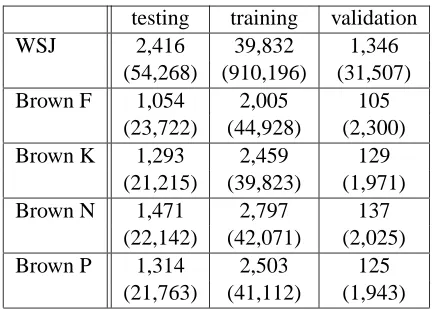
We used the Penn Treebank WSJ corpus and the Brown corpus to evaluate our approach. We used the standard division of the WSJ corpus into train-ing, validation, and testing sets. In the Brown corpus we ran separate experiments for sections F (informa-tive prose: popular lore), K (imagina(informa-tive prose: gen-eral fiction), N (imaginative prose: adventure and western fiction), and P (imaginative prose: romance and love story). These sections were selected be-cause they are sufficiently large, and bebe-cause they appeared to be maximally different from each other and from WSJ text. In each Brown corpus section, we selected every third sentence for testing. From the remaining sentences, we used 1 sentence out of 20 for the validation set, and the remainder for train-ing. The resulting datasets sizes are presented in ta-ble 1.
For the large margin classifier, we used the SVM-Struct (Tsochantaridis et al., 2004) implementation of SVM, which rescales the margin with F1
mea-sure of bracketed constituents (see (Tsochantaridis et al., 2004) for details). Linear slack penalty was employed.2
5.1 Experiments on Transferring across Domains
To evaluate the pure porting scenario (transferring), described in section 3.1, we trained the SSN pars-ing model on the WSJ corpus. For each tag, there is an unknown-word vocabulary item which is used for all those words not sufficiently frequent with that tag to be included individually in the vocabulary. In the
2
Training of the SVM takes about 3 hours on a standard desktop PC. Running the SVM is very fast, once the probabilis-tic model has finished computing the probabilities needed to select the candidate parses.
testing training validation WSJ 2,416 39,832 1,346
(54,268) (910,196) (31,507) Brown F 1,054 2,005 105
(23,722) (44,928) (2,300) Brown K 1,293 2,459 129
(21,215) (39,823) (1,971) Brown N 1,471 2,797 137
(22,142) (42,071) (2,025) Brown P 1,314 2,503 125
(21,763) (41,112) (1,943)
Table 1: Number of sentences (words) for each dataset.
vocabulary of the parser, we included the unknown-word items and the unknown-words which occurred in the training set at least 20 times. This led to the vo-cabulary of 4,215 tag-word pairs.
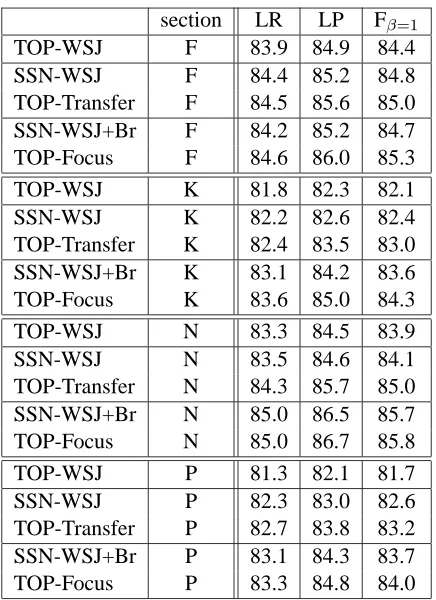
We derived the kernel from the trained model for each target section (F, K, N, P) using reparameteriza-tion discussed in secreparameteriza-tion 3.1: we included in the vo-cabulary all the words which occurred at least twice in the training set of the corresponding section. This approach led to a smaller vocabulary than that of the initial parser but specifically tied to the target do-main (3,613, 2,789, 2,820 and 2,553 tag-word pairs for sections F, K, N and P respectively). There is no sense in including the words from the WSJ which do not appear in the Brown section training set because the classifier won’t be able to learn the correspond-ing components of its decision vector. The results for the original probabilistic model (SSN-WSJ) and for the kernel method (TOP-Transfer) on the testing set of each section are presented in table 2.3
To evaluate the relative contribution of our porting technique versus the use of the TOP kernel alone, we also used this TOP kernel to train an SVM on the WSJ corpus. We trained the SVM on data from the development set and section 0, so that the size of this dataset (3,267 sentences) was about the same as for each Brown section.4 This gave us a “TOP-WSJ”
3
All our results are computed with the evalb program fol-lowing the standard criteria in (Collins, 1999).
4
[image:5.612.317.534.55.210.2]model, which we tested on each of the four Brown sections. In each case, the TOP-WSJ model did worse than the original SSN-WSJ model, as shown in table 2. This makes it clear that we are getting no improvement from simply using a TOP kernel alone or simply using more data, and all our improvement is from the proposed porting method.
5.2 Experiments on Focusing on a Subdomain
To perform the experiments on the approach sug-gested in section 3.2 (focusing), we trained the SSN parser on the WSJ training set joined with the train-ing set of the correspondtrain-ing section. We included in the vocabulary only words which appeared in the joint training set at least 20 times. Resulting vocab-ularies comprised 4,386, 4,365, 4,367 and 4,348 for sections F, K, N and P, respectively.5 Experiments were done in the same way as for the parser transfer-ring approach, but reparameterization was not per-formed. Standard measures of accuracy for the orig-inal probabilistic model (SSN-WSJ+Br) and the ker-nel method (TOP-Focus) are also shown in table 2.
For the sake of comparison, we also trained the SSN parser on only training data from one of the Brown corpus sections (section P), producing a “SSN-Brown” model. This model achieved an F1
measure of only 81.0% for the P section testing set, which is worse than all the other models and is 3% lower than our best results on this testing set (TOP-Focus). This result underlines the need to port parsers from domains in which there are large anno-tated datasets.
5.3 Experiments Comparing Vocabulary to
Structure
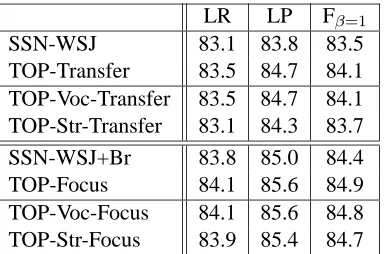
We conducted the same set of experiments with the kernel with vocabulary features (TOP-Voc-Transfer and TOP-Voc-Focus) and with the kernel with the structural features (Transfer and TOP-Str-Focus). Average results for classifiers with these kernels, as well as for the original kernel and the baseline, are presented in table 3.
5
We would expect some improvement if we used a smaller threshold on the target domain, but preliminary results suggest that this improvement would be small.
section LR LP Fβ=1
[image:6.612.317.535.54.354.2]TOP-WSJ F 83.9 84.9 84.4 SSN-WSJ F 84.4 85.2 84.8 TOP-Transfer F 84.5 85.6 85.0 SSN-WSJ+Br F 84.2 85.2 84.7 TOP-Focus F 84.6 86.0 85.3 TOP-WSJ K 81.8 82.3 82.1 SSN-WSJ K 82.2 82.6 82.4 TOP-Transfer K 82.4 83.5 83.0 SSN-WSJ+Br K 83.1 84.2 83.6 TOP-Focus K 83.6 85.0 84.3 TOP-WSJ N 83.3 84.5 83.9 SSN-WSJ N 83.5 84.6 84.1 TOP-Transfer N 84.3 85.7 85.0 SSN-WSJ+Br N 85.0 86.5 85.7 TOP-Focus N 85.0 86.7 85.8 TOP-WSJ P 81.3 82.1 81.7 SSN-WSJ P 82.3 83.0 82.6 TOP-Transfer P 82.7 83.8 83.2 SSN-WSJ+Br P 83.1 84.3 83.7 TOP-Focus P 83.3 84.8 84.0
Table 2: Percentage labeled constituent recall (LR), precision (LP), and a combination of both (Fβ=1) on
the individual test sets.
5.4 Discussion of Results
For the experiments which directly test the useful-ness of our proposed porting technique (SSN-WSJ versus TOP-Transfer), our technique demonstrated improvement for each of the Brown sections (ta-ble 2), and this improvement was significant for three out of four of the sections (K, N, and P).6This demonstrates that data-defined kernels are an effec-tive way to port parsers to a new domain.
For the experiments which combine training a new probability model with our porting technique (SSN-WSJ+Br versus TOP-Focus), our technique still demonstrated improvement over training alone. There was improvement for each of the Brown sec-tions, and this improvement was significant for two
6
We measured significance inF1 measure at the 5% level
LR LP Fβ=1
[image:7.612.90.284.56.183.2]SSN-WSJ 83.1 83.8 83.5 TOP-Transfer 83.5 84.7 84.1 TOP-Voc-Transfer 83.5 84.7 84.1 TOP-Str-Transfer 83.1 84.3 83.7 SSN-WSJ+Br 83.8 85.0 84.4 TOP-Focus 84.1 85.6 84.9 TOP-Voc-Focus 84.1 85.6 84.8 TOP-Str-Focus 83.9 85.4 84.7
Table 3: Average accuracy of the models on chapters F, K, N and P of the Brown corpus.
out of four of the sections (F and K). This demon-strates that, even when the probability model is well suited to the target domain, there is still room for improvement from using data-defined kernels to op-timize the parser specifically to the target domain without losing information about the source domain. One potential criticism of these conclusions is that the improvement could be the result of reranking with the TOP kernel, and have nothing to do with porting. The lack of an improvement in the TOP-WSJ results discussed in section 5.1 clearly shows that this cannot be the explanation. The opposite criticism is that the improvement could be the result of optimizing to the target domain alone. The poor performance of the SSN-Brown model discussed in section 5.2 makes it clear that this also cannot be the explanation. Therefore reranking with data de-fined kernels must be both effective at preserving information about the source domain and effective at specializing to the target domain.
The experiments which test the hypothesis that differences in vocabulary distributions are more im-portant than difference in syntactic structure distri-butions confirm this belief. Results for the classi-fier which uses the kernel with only vocabulary fea-tures are better than those for structural feafea-tures in each of the four sections with both the Transfer and Focus scenarios. In addition, comparing the results of Transfer with Voc-Transfer and TOP-Focus with TOP-Voc-TOP-Focus, we can see that adding structural features in TOP-Focus and TOP-Transfer leads to virtually no improvement. This suggest that differences in vocabulary distributions are the only issue we need to address, although this result could possibly also be an indication that our method did
not sufficiently exploit structural differences. In this paper we concentrate on the situation where a parser is needed for a restricted target do-main, for which only a small amount of data is avail-able. We believe that this is the task which is of greatest practical interest. For this reason we do not run experiments on the task considered in (Gildea, 2001) and (Roark and Bacchiani, 2003), where they are porting from the restricted domain of the WSJ corpus to the more varied domain of the Brown cor-pus as a whole. However, to help emphasize the success of our proposed porting method, it is rele-vant to show that even our baseline models are per-forming better than this previous work on parser portability. We trained and tested the SSN parser in their “de-focusing” scenario using the same datasets as (Roark and Bacchiani, 2003). When trained only on the WSJ data (analogously to the SSN-WSJ baseline for TOP-Transfer) it achieves results of 82.9%/83.4% LR/LP and 83.2% F1, and when
trained on data from both domains (analogously to the SSN-WSJ+Br baselines for TOP-Focus) it achieves results of 86.3%/87.6% LR/LP and 87.0%
F1. These results represent a 2.2% and 1.3%
in-crease inF1 over the best previous results,
respec-tively (see the discussion of (Roark and Bacchiani, 2003) below).
6 Related Work
Most research in the field of parsing has focused on the Wall Street Journal corpus. Several researchers have addressed the portability of these WSJ parsers to other domains, but mostly without addressing the issue of how a parser can be designed specifically for porting to another domain. Unfortunately, no di-rect empirical comparison is possible between our results and results with other parsers, because there is no standard portability benchmark to date where a small amount of data from a target domain is used.
set plus a portion of 2,000 sentences from a Brown corpus section. They achieved 80.9%/80.3% re-call/precision for section K, and 80.6%/81.3% for section N.7 Our analogous method (TOP-Focus) achieved much better accuracy (3.7% and 4.9% bet-terF1, respectively).
In addition to portability experiments with the parsing model of (Collins, 1997), (Gildea, 2001) provided a comprehensive analysis of parser porta-bility. On the basis of this analysis, a tech-nique for parameter pruning was proposed leading to a significant reduction in the model size with-out a large decrease of accuracy. Gildea (2001) only reports results on sentences of 40 or less words on all the Brown corpus sections combined, for which he reports 80.3%/81.0% recall/precision when training only on data from the WSJ corpus, and 83.9%/84.8% when training on data from the WSJ corpus and all sections of the Brown corpus.
(Roark and Bacchiani, 2003) performed experi-ments on supervised and unsupervised PCFG adap-tation to the target domain. They propose to use the statistics from a source domain to define pri-ors over weights. However, in their experiments they used only trivial sub-cases of this approach, namely, count merging and model interpolation. They achieved very good improvement over their baseline and over (Gildea, 2001), but the absolute accuracies were still relatively low (as discussed above). They report results with combined Brown data (on sentences of 100 words or less), achieving 81.3%/80.9% when training only on the WSJ cor-pus and 85.4%/85.9% with their best method using the data from both domains.
7 Conclusions
This paper proposes a novel technique for improv-ing parser portability, applyimprov-ing parse rerankimprov-ing with data-defined kernels. First a probabilistic model of parsing is trained on all the available data, including a large set of data from the source domain. This model is used to define a kernel over parse trees. Then this kernel is used in a large margin classifier
7
The sizes of Brown sections reported in (Ratnaparkhi, 1999) do not match the sizes of sections distributed in the Penn Treebank 3.0 package, so we couldn’t replicate their split. We suspect that a preliminary version of the corpus was used for their experiments.
trained on a small set of data only from the target do-main. This classifier is used to rerank the top parses produced by the probabilistic model on the target do-main. Experiments with a neural network statistical parser demonstrate that this approach leads to im-proved parser accuracy on the target domain, with-out any significant increase in computational cost.
References
Michael Collins and Nigel Duffy. 2002. New ranking algo-rithms for parsing and tagging: Kernels over discrete struc-tures and the voted perceptron. In Proc. ACL 2002 , pages 263–270, Philadelphia, PA.
Michael Collins. 1997. Three generative, lexicalized models for statistical parsing. In Proc. ACL/EACL 1997 , pages 16– 23, Somerset, New Jersey.
Michael Collins. 1999. Head-Driven Statistical Models for
Natural Language Parsing. Ph.D. thesis, University of Pennsylvania, Philadelphia, PA.
Daniel Gildea. 2001. Corpus variation and parser performance. In Proc. EMNLP 2001 , Pittsburgh, PA.
James Henderson and Ivan Titov. 2005. Data-defined kernels for parse reranking derived from probabilistic models. In
Proc. ACL 2005 , Ann Arbor, MI.
James Henderson. 2003. Inducing history representations for broad coverage statistical parsing. In Proc. NAACL/HLT
2003 , pages 103–110, Edmonton, Canada.
Terry Koo and Michael Collins. 2005. Hidden-variable models for discriminative reranking. In Proc. EMNLP 2005 , Van-couver, B.C., Canada.
Mitchell P. Marcus, Beatrice Santorini, and Mary Ann Marcinkiewicz. 1993. Building a large annotated corpus of English: The Penn Treebank. Computational Linguistics, 19(2):313–330.
Takuya Matsuzaki, Yusuke Miyao, and Jun’ichi Tsujii. 2005. Probabilistic CFG with latent annotations. In Proc. ACL
2005 , Ann Arbor, MI.
Adwait Ratnaparkhi. 1999. Learning to parse natural language with maximum entropy models. Machine Learning, 34:151– 175.
Brian Roark and Michiel Bacchiani. 2003. Supervised and unsuperised PCFG adaptation to novel domains. In Proc.
HLT/ACL 2003 , Edmionton, Canada.
Libin Shen and Aravind K. Joshi. 2003. An SVM based voting algorithm with application to parse reranking. In Proc. 7th
Conf. on Computational Natural Language Learning, pages
9–16, Edmonton, Canada.
Ioannis Tsochantaridis, Thomas Hofmann, Thorsten Joachims, and Yasemin Altun. 2004. Support vector machine learning for interdependent and structured output spaces. In Proc.
21st Int. Conf. on Machine Learning, pages 823–830, Banff,
Alberta, Canada.
Alexander Yeh. 2000. More accurate tests for the statistical significance of the result differences. In Proc. 17th Int. Conf.
on Computational Linguistics, pages 947–953, Saarbruken,