3026
GAN Driven Semi-distant Supervision for Relation Extraction
Pengshuai Li1, Xinsong Zhang1, Weijia Jia2,1∗and Hai Zhao1∗
1Dept. of CSE, Shanghai Jiao Tong University, Shanghai, China
2State Key Lab of IoT for Smart City, CIS, University of Macau, Macao, SAR China
{pengshuai.li,xszhang0320}@sjtu.edu.cn
{jia-wj,zhaohai}@cs.sjtu.edu.cn
Abstract
Distant supervision has been widely used in relation extraction tasks without hand-labeled datasets recently. However, the automati-cally constructed datasets comprise numbers of wrongly labeled negative instances due to the incompleteness of knowledge bases, which is neglected by current distant supervised methods resulting in seriously misleading in both training and testing processes. To address this issue, we propose a novel semi-distant su-pervision approach for relation extraction by constructing a small accurate dataset and prop-erly leveraging numerous instances without re-lation labels. In our approach, we construct ac-curate instances by both knowledge base and entity descriptions determined to avoid wrong negative labeling and further utilize unlabeled instances sufficiently using generative adver-sarial network (GAN) framework. Experimen-tal results on real-world datasets show that our approach can achieve significant improve-ments in distant supervised relation extraction over strong baselines.
1 Introduction
Relation extraction aims to identify relations for a pair of entities in a sentence to construct relation triples like [Steve Jobs, Founder, Apple]. It has been well studied by supervised approaches with hand-labeled data. However, supervised methods are limited to costly hand-labeled training sets and
∗
Corresponding authors: Weijia Jia, Hai Zhao, { jia-wj, zhaohai}@cs.sjtu.edu.cn. This work is supported by tional China 973 Project No. 2015CB352401; Chinese Na-tional Research Fund (NSFC) Key Project No. 61532013 and No. 61872239. 0007/2018/A1, DCT-MoST Joint-project No. 025/2015/AMJ,FDCT,SAR Macau, China, and University of Macau Grant Nos: MYRG2018-00237-RTO, CPG2019-00004-FST and SRG2018-00111-FST, National Key Research and Development Program of China (No. 2017YFB0304100), Key Projects of National Natural Sci-ence Foundation of China (U1836222 and 61733011), and Key Project of National Society Science Foundation of China (No. 15-ZDA041).
hard to be extended to large-scale relations. To break the bottleneck of hand-labeled training set, distant supervision (Mintz et al.,2009) automati-cally construct datasets with knowledge bases. It assumes that if two entities have a known rela-tion in a knowledge base, all sentences that men-tion these two entities will probably express the same relation and can be called positive instances. At the same time, it treats sentences as nega-tive instances whose entity pairs do not have a known relation in knowledge bases. Due to the strong assumption, instances are likely to be mis-labeled. To alleviate the wrong labeling prob-lem, distant supervised methods have been im-plemented with multi-instance learning and neu-ral networks (Riedel et al.,2010;Hoffmann et al.,
2011;Zeng et al., 2015; Lin et al., 2016, 2017). However, previous works focus on positive in-stances and few methods have addressed the issue of false negative instances.
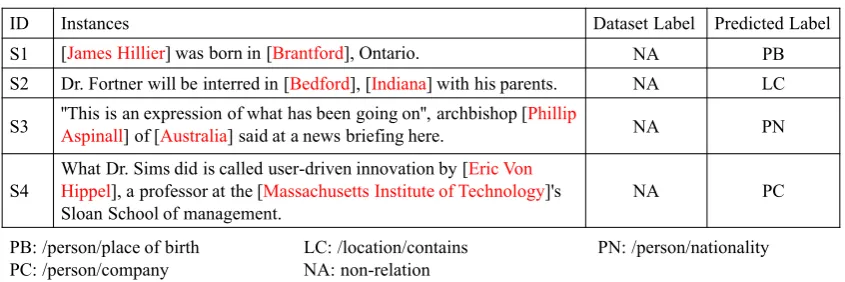
ID Instances Dataset Label Predicted Label
S1 [James Hillier] was born in [Brantford], Ontario. NA PB
S2 Dr. Fortner will be interred in [Bedford], [Indiana] with his parents. NA LC
S3 ''This is an expression of what has been going on'', archbishop [Aspinall] of [Australia] said at a news briefing here. Phillip NA PN
S4
What Dr. Sims did is called user-driven innovation by [Eric Von Hippel], a professor at the [Massachusetts Institute of Technology]'s Sloan School of management.
NA PC
PB: /person/place of birth LC: /location/contains PN: /person/nationality
[image:2.595.90.513.61.202.2]PC: /person/company NA: non-relation
Figure 1: Illustration of the false negative instances in relation extraction by distant supervision. Instances are selected from a widely used dataset NYT (Riedel et al.,2010).
The huge bias mainly comes from false negative instances in the testing set, which severely limits the upper bound of accuracy for relation extrac-tion. Therefore, handling false negative instances is a pivotal issue to improve the performance of distant supervised relation extraction.
Evaluations P@100 P@200 P@300
Automatic 76.2 73.1 67.4
Manual 96.0(+19.8) 95.5(+22.4) 91.0(+23.6)
Table 1: The Precision at top N predictions (%) of the model Lin et al.(2016) upon automatic and manual evaluations on the NYT Dataset
To alleviate the effect of false negative in-stances, there are two possible ways. One is im-proving the accuracy of the automatically labeled dataset, and the other is properly leveraging unla-beled instances which cannot be launla-beled as posi-tive or negaposi-tive. The former way is to construct an accurate dataset by filtering credible negative in-stances but limited by high annotation cost and the resulting dataset size. The latter way is to train re-lation extraction models with abundant unlabeled instances but restricted by the prerequisite of an accurate dataset used as ground truth. Therefore, we propose a novel semi-distant supervised ap-proach by integrating both ways to decrease the influence of false negative instances for better re-lation extraction.
In our approach, we additionally use entity de-scriptions together with a knowledge base to con-struct an accurate dataset. Supervised by the dataset as ground truth, to effectively exploit num-bers of unlabeled instances, we train our relation extractor using a generative adversarial network (GAN) framework. In detail, We propose a
three-player min-max game to generate proper relation representations for unlabeled instances in an ad-versarial way which minimizes the difference be-tween labeled and unlabeled data and maximizes the probability of distinguishing from each other at the same time. The experiments demonstrate that our approach is effective and outperforms the state-of-the-art work. In summary, we make the following major contributions:
• We propose a novel semi-distant supervision method for relation extraction to alleviate the influence of false negative instances.
• To the best of our knowledge, we are the first to generate valid relation representations for sentences by an adversarial algorithm. Num-bers of unlabeled instances are used to im-prove the performance of relation extraction. Moreover, our generative adversarial train-ing strategy is proved effective on an ad-ditional sentiment classification with sixteen real-world datasets.
• We construct a new accurate dataset for re-lation extraction extended from the NYT dataset. Our approach increases the area of the Precision-Recall curve from 0.39 to 0.56 over the baselines.
2 Related Work
distant supervision (Riedel et al.,2010;Hoffmann et al., 2011). Inspired by the pioneering work, a series of later studies were conducted to fur-ther improve distant supervised relation extraction with methods such as multi-instance multi-label learning (Surdeanu et al.,2012), graph model for label generation (Takamatsu et al., 2012), partial supervision (Angeli et al.,2014), matrix comple-tion with low-rank criterion (Fan et al.,2014) and modeling the neighbor consistency with Markov logic (Han and Sun,2016).
However, the performance of the methods men-tioned above strongly depends on the quality of human-designed features. With the development of neural models, relation features with seman-tic meaning can be accurately, simply and auto-matically extracted. Zeng et al.(2015) proposed the first neural relation extraction with distant su-pervision. Mnih et al. (2014), Lin et al. (2016),
Zhang et al. (2018), Han et al. (2018) and Du et al. (2018) showed that attention model could improve the accuracy of neural relation extraction. Another similar work (Ji et al., 2017) assigned better attention weights with extra data like en-tity descriptions. DSGAN (Qin et al., 2018a), a GAN-based method, was also used to recognize true positive instances from noisy datasets. To fur-ther alleviate the effect of wrong labeling problem, soft-label training algorithm (Liu et al.,2017b), re-inforcement learning methods (Feng et al.,2018;
Qin et al., 2018b) and additional side informa-tion (Vashishth et al., 2018; Wang et al., 2018) have been used. Most recently, a few methods focused on the pre-training embeddings for word tokens and relations including adversarial train-ing (Wu et al.,2017), transfer learning (Liu et al.,
2018) and relation decoder (Su et al.,2018). All the above methods mainly pay attention to positive instances. Whereas, few studies work on the quality of negative instances, which is exactly the focus of this paper. We effectively construct a reliable dataset with both entity descriptions and a knowledge base, and thus propose a novel semi-distant supervised method to extract relations pre-cisely.
3 Method
In the distant supervised relation extraction paradigm, all sentences labeled by a relation triple constitute a bag, and each sentence is called an in-stance. The relation triple is described as [head,
relation, tail], where head andtail are both en-tities. We extract relation features from labeled training bags and then predict relations for un-seen bags in the test set. This section presents our method about constructing an accurate dataset, the sentence encoder for relation representation and the semi-supervised way for relation extraction.
3.1 Dataset Construction
To reduce false negative instances, we construct a new reliable dataset extended from a widely used dataset NYT (Riedel et al., 2010) with entity de-scriptions. Entity descriptions are crawled from Wikipedia with entity name matching1. We as-sume that if an entity is relevant to another entity, its name is possibly mentioned in the description of the other entity. For example, the entity Ap-ple Inc. is mentioned in the description of Steve Jobs. To verify the assumption, we count the num-ber of all the accurate positive instances whose en-tity descriptions mention the other enen-tity name in the NYT corpora. There are 163,108 positive stences in total, in which 161,392 ones contain en-tity pairs that related to each other in their descrip-tions at least once. In other words, over 98.9% instances in positive set fitting our assumption in-dicates that most entity pairs in positive instances contain each other in their descriptions. There-fore, a former negative instance has a big chance to be credible negative if any of its entities is not mentioned in the description of the other one. Ex-cluding instances that contain entity pairs related to each other in their descriptions, we can obtain more confident negative instances. Finally, we fil-ter credible positive and negative instances from the dataset, and the other instances are unlabeled ones that cannot be labeled as positive or negative.
3.2 Sentence Encoder
3.2.1 Input Embedding
We pre-train input embeddings of word tokens in-cluding word and position embeddings. Word em-beddings are distributed representations that map each word to a vectorword∈ Rw, where the
pa-rameter w indicates the dimension of the vector. The vectors are trained in advance byword2vec
in the setting of Skip-gram (Mikolov et al.,2013). In the task of relation extraction, the relative po-sitions of input tokens are important information.
Position embeddings are defined as the combina-tion of the relative distances from the current word to head and tail. For instance, the relative dis-tances from [co-founder] to [Steve Jobs] and [Ap-ple] are respectively 3 and -6 in the sentenceSteve Jobs was the co-founder and the CEO of the Apple. We encode distances to vectors position ∈ Rp,
where p is the dimension. The position embed-dings are initialized randomly and updated in the training process. Finally, word embeddings and position embeddings are concatenated together to feed the neural model. We denote all the words in an instance as an initial vector sequenceb∗ =
{x1,· · ·, xi,· · · , xq}, wherexi ∈ Rw+p andqis
the number of words in the instanceb∗.
3.2.2 Convolutional Encoder
Steve Jobs was the co-founder of Apple Input Layer x1 x2 x3 x4 x5 x6
Embedding Layer Convolution
Layer Softmax
Layer Output Layer Y
h
Max pool Layer
...
f1
f2
fd
[image:4.595.76.283.293.515.2]f*
Figure 2: The architecture of our sentence encoder illustrating the procedure for handling one instance and predicting the relation between [Apple] and [Steve Jobs]. All forms of f are hidden states, ¯his relation representation of the sentence andY represents rela-tion labels.
Convolutional Neural Network (CNN) is a widely used structure for sentence encoder as shown in Figure 2. With the input embeddings, the convolutional layer extracts local features with a sliding window of length k over the input to-kens. In the figure, we extract local features from 3 (k = 3) adjacent word tokens with dot produc-tion between convoluproduc-tional kernels and input em-beddings. The convolutional kernels are weight vectors represented by W ∈ Rd×k(w+p) and the
number of kernels isd. In summary, the
convolu-tional operation follows the equation,
fij =Wi·[xj−1;xj;xj+1], (1)
where [x;y] denotes the vertical concatenation of x and y. fij presents j-th value of the i
-th filter, where i and j are in range [1, d] and
[1, q]respectively. Out-of-range input values such as x0 and xq+1 are taken to be zero. A
max-pooling operation selects the most important fea-tures of each fi with fi∗ = max(fij), where f∗ ∈ Rd. Furthermore, PCNN (Zeng et al.,2015)
improves the max-pooling operation with a piece-wise method whose outputs of convolutional fil-ters are divided into three segments byhead and
tail entities. Therefore, the max pooling proce-dure is performed in three segments separately.
Then, we summarize f∗ to ¯h by a non-linear function such as the hyperbolic tangent. The final feature vector¯h is fed into output layer after the softmax methodpˆ=sof tmax(Wr¯h+br), where Wr ∈ Rz×d andbr ∈ Rz are variables,pˆ∈ Rz
is the estimated probability for each class andzis the number of relations. A cost function for one instance is the negative log-likelihood of the rela-tions,
Jtruth(ˆp, y, θ) =− 1 z
z X
j=1
yjlog ˆpj, (2)
wherey ∈ Rz is the one-hot represented ground
truth andθpresents all the parameters.
3.3 Semi-distant Supervision
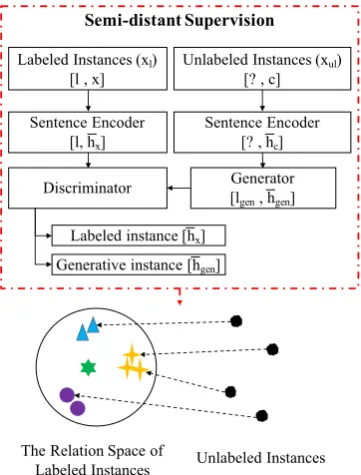
The architecture of our semi-distant supervision is shown in Figure3. To sufficiently utilize the re-constructing dataset including accurately labeled instances and unlabeled ones, we propose a gen-erative adversarial training strategy, which trans-forms unlabeled instances (xul) to labeled data
(xl) space by generating valid relation
representa-tions (xgen) and making the distribution of labeled
instances p(xl) equal to that of generative data p(xgen) in relation space2. Inspired by Goodfel-low et al.(2014), we further devise a three-player min-max game to generate valid data distribution
p(xgen)with sentence encoder, generative and
dis-criminative modules. The generative module min-imizes the difference of p(xl) and p(xgen), and
the discriminative module maximizes the proba-bility of distinguishing from each other at the same
2p(x
l)andp(xgen)represents the data distribution of
Algorithm 1GAN driven Semi-Distant Supervision algorithm
Require: discriminator D, generator G, sentence encoder S, si, sj and sk are hyper-parameters to
indicate iterator number of each module
1: Initialize the parameters ofD,G,Swith random weightsθd,θgandθs 2: fornumbers of training iterationsdo
3: forsi stepsdo
4: Sample mini-batch ofnsamples from accurate instances set presented asx 5: Sample mini-batch ofmsamples from unlabeled instances set presented asc 6: FixGandS, updateDby ascending its stochastic gradient:
7: ∇θd[
1 n
Pn
u=1logD(xu) +m1 Pmv=1log(1−D(G(cv)))] 8: end for
9: forsj stepsdo
10: Sample mini-batch ofmsamples from unlabeled instances set presented asc 11: FixDandS, updateGby descending its stochastic gradient:
12: ∇θgm1 Pmv=1log(1−D(G(cv))) 13: end for
14: forskstepsdo
15: Sample mini-batch ofnsamples from accurate instances set presented asx 16: Sample mini-batch ofmsamples from unlabeled instances set presented asc 17: FixDandG, updateSby descending its stochastic gradient:
18: ∇θs[− 1
nz Pn
u=1 Pz
j=1yljlog ˆp(yj|xu)− mz1 Pmv=1 Pz
j=1yg jlog ˆp(yj|G(cv))] 19: end for
20: end for
Semi-distant Supervision
[image:5.595.91.272.411.649.2]Labeled Instances (xl)
[l , x]
Unlabeled Instances (xul)
[? , c]
Sentence Encoder [l, hx]
Unlabeled Instances The Relation Space of
Labeled Instances
Generator [lgen, hgen]
Discriminator
Labeled instance [hx]
Generative instance [hgen]
Sentence Encoder [? , hc]
Figure 3: The architecture of GAN driven semi-distant supervision for relation extraction. ¯hxand¯hcare rela-tion representarela-tions of labeled and unlabeled instances respectively. ¯hgen is generated relation representation by the generator. l andlgen represent accurate label and generated label respectively. The symbols in rela-tion space represent labeled instances.
time. Sentence encoder is proposed as the third player, which extracts relation features from all the instances and produces a pre-trained relation representation for unlabeled instances. With the sentence encoder, we can control relation features contained in the generated representations.
Therefore, the discriminative moduleDwill try to distinguish labeled data from generative data, while the generative moduleGmakesp(xgen) ≈ p(xl). In addition, the sentence encoder S
ex-tracts relation features with all the training in-stances pall. The training procedure is a
three-player min-max game as the following equation,
min
S,G maxD V(S, D, G) =Ex∼pall[logS(x)] +Ex∼pxl[logD(x)] +Ec∼pxgen[log(1−D(G(c)))],
(3)
In generative adversarial training, the discrim-inative module is trained by maximizing the gap between labeled data and generative data with the following equation,
JD(x, c, θd) = logD(x) + log(1−D(G(c))),
θdpresents parameters for the discriminator.D(x)
andD(G(c))are defined as follows,
D(x) =σ(Wd¯hx), (5)
D(G(c)) =σ(Wd(¯hc+Wg)), (6)
whereWdandWgare variables for discriminative
and generative modules respectively. σ is the sig-moid function. The generative module is trained to make the generated relation representations more similar to real ones by the following loss function, whereθgpresents parameters.
JG(c, θg) = log(1−D(G(c))) (7)
Finally, we train our sentence encoderSby op-timizing the following loss function,
JS(x, c, θs) =− 1 z
z X
j=1
yljlog ˆp(yj|x)
−1
z z X
j=1
yg jlog ˆp(yj|G(c)),
(8)
whereyg means a one-hot vector which labels the
most possible relation for unlabeled instances gen-erated by the sentence encoder. θs represents
pa-rameters of S. The complete training procedure for generative adversarial training is shown as Al-gorithm1.
4 Experiments
The experiments are proposed to answer the fol-lowing three questions, 1) Is the proposed semi-distant supervision method effective for the task of relation extraction? 2) Is the constructed dataset credible enough? 3) Is the generative adversar-ial training helpful to relation extraction and other semi-supervised tasks?
4.1 Experimental Settings
4.1.1 Dataset
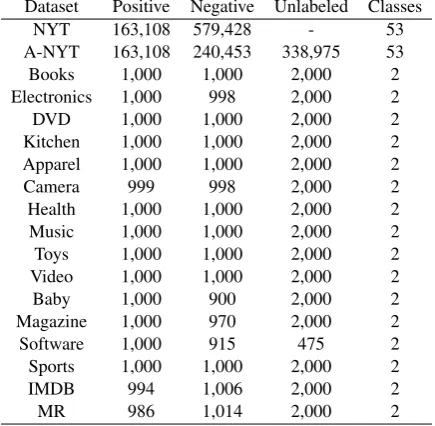
We conduct experiments on a widely used dataset NYT (Riedel et al., 2010) and its new version Accurate-NYT (A-NYT). A-NYT is a credible dataset filtered by our data construction module. We follow the previous work (Lin et al., 2016) to partition training and testing sets for NYT and A-NYT. Besides, we apply sixteen real-world datasets3 (Liu et al., 2017a) to further verify the effectiveness of our generative adversarial train-ing strategy on the task of sentiment classification. The dataset details are shown in Table2.
3The datasets are Amazon product reviews and movie re-views.
Dataset Positive Negative Unlabeled Classes
NYT 163,108 579,428 - 53
A-NYT 163,108 240,453 338,975 53
Books 1,000 1,000 2,000 2
Electronics 1,000 998 2,000 2
DVD 1,000 1,000 2,000 2
Kitchen 1,000 1,000 2,000 2
Apparel 1,000 1,000 2,000 2
Camera 999 998 2,000 2
Health 1,000 1,000 2,000 2
Music 1,000 1,000 2,000 2
Toys 1,000 1,000 2,000 2
Video 1,000 1,000 2,000 2
Baby 1,000 900 2,000 2
Magazine 1,000 970 2,000 2
Software 1,000 915 475 2
Sports 1,000 1,000 2,000 2
IMDB 994 1,006 2,000 2
[image:6.595.309.527.65.278.2]MR 986 1,014 2,000 2
Table 2: Statistics of the datasets
4.1.2 Evaluation Metrics and Baselines
On the dataset NYT and A-NYT, we evaluate our method in the classical held-out evaluation. It evaluates our models by comparing relation facts discovered from the test sentences with those in Freebase. Specifically, we report both the aggre-gate Precision-Recall (PR) curves and Precision at top N predictions (P@N) in our experiments. For the other datasets, we compute the precision of all the predictions.
We adopt the following baselines for distant su-pervised relation extraction.
Zeng et al.(2015)extracted relation features with piecewise convolutional neural network (PCNN).
Lin et al.(2016) integrated PCNN with selective attention mechanism (PCNN+ATT).
Wu et al. (2017) added adversarial noise at the level of the word embeddings (PCNN+ATT+AT).
Liu et al. (2017b) relabeled the training in-stances dynamically by the relation extractor (PCNN+ATT+SL).
Qin et al.(2018a) designed a GAN to recognize true positive samples (PCNN+DSGAN).
Liu et al.(2018) shortened the training instances with the parser tree and pre-trained word embed-dings with transfer learning, which is the latest state-of-the-art work.
4.1.3 Parameters
In our experiments, we use the word2vec in the setting of Skip-gram to train the word embeddings on NYT set. To train our model efficiently, we iterate by randomly selecting a batch from the training set until convergence and apply sentence-level attention mechanism following the previous work (Lin et al.,2016). The parameter nandm
are batch sizes for accurate and unlabeled datasets respectively. We update the gradient with adaptive moment estimation (Kingma and Ba,2015). Fur-thermore, L2 regularization and dropout ( Srivas-tava et al.,2014) are adopted to avoid overfitting. Finally, we use a grid search and cross-validation to determine the optional parameters as shown in Table 3. The hyper-parameterssi, sj andsk are
training steps for different modules of generative adversarial training. Since the other parameters have little effect on the results, we follow the set-tings as the previous work (Lin et al.,2016).
batch size (n,m) 50
si,sj,sk 2, 1, 2
filter numberd 230
kernel sizek 3
word dimensionw 50 position dimensionp 10 learning rate 0.001 dropout probability 0.5 L2 regularization strength 0.0001
Table 3: Parameter settings
4.2 Overall Performance of Semi-Distant Supervision
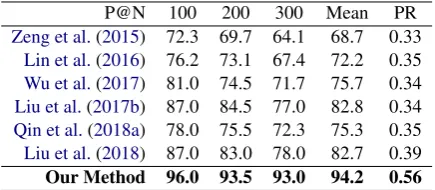
The overall performance of our method compared with baselines for distant supervised relation ex-traction is shown in Table4. We can see that our semi-distant supervised method achieves much better results than the baselines on all metrics. The huge improvement comes from both the accurate dataset and the effective training strategy which leverages unlabeled instances properly.
4.3 Effect of Dataset A-NYT
In this section, we apply two previous meth-ods Zeng et al. (2015) and Lin et al. (2016) on NYT and A-NYT. PR curves for NYT are re-ported in their papers, while PR curves for A-NYT come from our implementations of the two base-lines. NYT and A-NYT share the same positive instances, while A-NYT set has less and credi-ble negative instances. As shown in Figure 4(a),
P@N 100 200 300 Mean PR
Zeng et al.(2015) 72.3 69.7 64.1 68.7 0.33
Lin et al.(2016) 76.2 73.1 67.4 72.2 0.35
Wu et al.(2017) 81.0 74.5 71.7 75.7 0.34
Liu et al.(2017b) 87.0 84.5 77.0 82.8 0.34
Qin et al.(2018a) 78.0 75.5 72.3 75.3 0.35
Liu et al.(2018) 87.0 83.0 78.0 82.7 0.39
[image:7.595.309.527.62.157.2]Our Method 96.0 93.5 93.0 94.2 0.56
Table 4: Overall performance at P@Ns(%) and PR curve areas
methods on A-NYT always obtain better perfor-mance. The huge gap between PR curves is caused by false negative instances in NYT, which are not used for training and testing in A-NYT. To prove that results on A-NYT are according to the actual situation, we do manual evaluations at P@Ns. As shown in Table 5, the huge bias caused by false negative instances on NYT is dramatically allevi-ated on the dataset A-NYT.
Evaluations P@100 P@200 P@300 Automatic@NYT 76.2 73.1 67.4
Manual@NYT 96.0(+19.8) 95.5(+22.4) 91.0(+23.6) Automatic@A-NYT 93.0 89.5 88.0
Manual@A-NYT 96.0(+3.0) 92.5(+3.0) 90.7(+2.7)
Table 5: P@Ns(%) ofLin et al.(2016) upon automatic and manual evaluations
4.4 Effect of Generative Adversarial Training for Relation Extraction
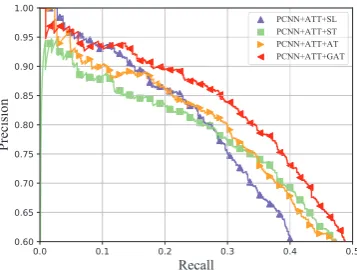
To further demonstrate the effectiveness of our training strategies, we compare Generative Adver-sarial Training (GAT) with other baselines on the partially labeled dataset A-NYT as shown in Fig-ure4(b). The figure gives the following insights, 1) PCNN+ATT+ST and PCNN+ATT+AT do not work well, which is caused by the low quality of unlabeled instances. 2) PCNN+ATT+SL works as well as our models at low recall rate because of its excellent ability to extract notable features. Un-fortunately, it falls far behind all the baselines at high recall rate, which means it tends to converge to a local optimum. 3) Our model achieves solid PR curves at all range of recall rate.
(a) PR curves of baselines on NYT and A-NYT4 (b) PR curves of our model and baselines on A-NYT with
[image:8.595.313.492.82.217.2]all the labeled and unlabeled data
Figure 4: PR curves for the comparisons (Better view in color)
deeper in the table, PCNN+ATT+SL works well at top predictions but obtains the worst PR curve. Our semi-distant supervised model with adversar-ial generations is useful for leveraging unlabeled instances properly.
P@N 100 200 300 Mean PR
Zeng et al.(2015)‡ 91.0 88.5 87.6 89.0 0.513
Lin et al.(2016)‡ 93.0 89.5 88.0 88.2 0.513
Qin et al.(2018a)‡ 90.0 91.0 88.3 89.8 0.524
Liu et al.(2018)‡ 93.0 93.5 91.3 92.6 0.503 PCNN+ATT+SL 96.0 93.0 90.6 93.2 0.466 PCNN+ATT+ST 92.0 88.0 85.3 88.4 0.519 PCNN+ATT+AT 95.0 92.0 88.6 91.9 0.526
[image:8.595.96.274.83.218.2]PCNN+ATT+GAT 96.0 93.5 93.0 94.2 0.558
Table 6: P@Ns(%) and PR curve areas on A-NYT. Methods with ‡ do not use unlabeled data. PCNN+ATT+AT is a semi-supervised extension of original method (Wu et al.(2017)) to make the unla-beled instances consistent with their predictions.
4.5 Effect of Generative Adversarial Training for Sentiment Classification
To verify the expandability of generative adver-sarial training, we conduct additional experiments on the task of sentiment classification. We im-plement our model and three baselines based on the Long Short-Term Memory (LSTM) network5. The results are shown in Table7, from which we
4Results on NYT are reported as their papers exceptWu et al.(2017) andQin et al.(2018a). Results of these two methods on NYT and all results on A-NYT are obtained by our implementations.
5Our generative adversarial training strategy is model-independent, meaning that it could be applied to other neural models.
see that, 1) Self-training obtains poor results com-pared with the basic LSTM model, which means they fail to utilize unlabeled data correctly. 2) Adversarial training improves the performance on only three of the datasets and performs poorly on others, which means they possibly rely on the quality of unlabeled data. 3) LSTM+GAT achieves better results than the baselines on most of the datasets because of generating high-quality representations for unlabeled sentences.
Dataset LSTM LSTM+ST LSTM+AT LSTM+GAT Books 79.5 75.8 80.5 80.3
Elec. 80.5 77.5 84.1 81.5 DVD 81.7 75.8 78.6 82.0 Kitchen 78.0 79.3 81.7 81.3 Apparel 83.2 83.5 84.8 85.2 Camera 85.2 84.3 86.1 86.8 Health 84.5 84.4 81.7 86.2 Music 76.7 76.0 76.0 80.3 Toys 83.2 79.8 83.7 84.8 Video 81.5 79.7 80.4 83.0 Baby 84.7 84.3 83.0 85.3 Mag. 89.2 85.3 89.0 89.5 Soft. 84.7 84.1 83.3 85.1 Sports 81.7 79.8 82.3 82.5 IMDB 81.7 78.3 82.5 82.8 MR 72.7 71.8 72.3 73.5 Mean 81.8 80.0 81.9 83.1
Table 7: Precision for the sentiment classification task
5 Conclusions
[image:8.595.309.525.437.628.2]With the dataset, the generative adversarial train-ing strategy is proposed to deal with plenty of un-labeled instances, which generates valid relation representations. Our experiments show that the proposed approach achieves significant improve-ment over previous state-of-the-art baselines.
References
Gabor Angeli, Julie Tibshirani, Jean Wu, and Christo-pher D Manning. 2014. Combining distant and partial supervision for relation extraction. In Pro-ceedings of the 2014 conference on empirical meth-ods in natural language processing (EMNLP), pages 1556–1567.
Xin Dong, Evgeniy Gabrilovich, Geremy Heitz, Wilko Horn, Ni Lao, Kevin Murphy, Thomas Strohmann, Shaohua Sun, and Wei Zhang. 2014. Knowledge vault: A web-scale approach to probabilistic knowl-edge fusion. In Proceedings of the 20th ACM SIGKDD International Conference on Knowledge Discovery and Data Mining (KDD), pages 601–610.
Jinhua Du, Jingguang Han, Andy Way, and Dadong Wan. 2018. Multi-level structured self-attentions for distantly supervised relation extraction. Proceed-ings of the 2018 Conference on Empirical Methods in Natural Language Processing (EMNLP), pages 2216–2225.
Miao Fan, Deli Zhao, Qiang Zhou, Zhiyuan Liu, Thomas Fang Zheng, and Edward Y Chang. 2014. Distant supervision for relation extraction with ma-trix completion. InProceedings of the 52nd Annual Meeting of the Association for Computational Lin-guistics (ACL), pages 839–849.
Jun Feng, Minlie Huang, Li Zhao, Yang Yang, and Xi-aoyan Zhu. 2018. Reinforcement learning for rela-tion classificarela-tion from noisy data. InProceedings of the Thirty-Second AAAI Conference on Artificial Intelligence (AAAI), pages 5779–5786.
Ian Goodfellow, Jean Pouget-Abadie, Mehdi Mirza, Bing Xu, David Warde-Farley, Sherjil Ozair, Aaron Courville, and Yoshua Bengio. 2014. Generative ad-versarial nets. In Proceedings of the 27th Interna-tional Conference on Neural Information Processing Systems, pages 2672–2680.
Xianpei Han and Le Sun. 2016. Global distant super-vision for relation extraction. InProceedings of the Thirtieth AAAI Conference on Artificial Intelligence (AAAI), pages 2950–2956.
Xu Han, Pengfei Yu, Zhiyuan Liu, Maosong Sun, and Peng Li. 2018. Hierarchical relation extraction with coarse-to-fine grained attention. In Proceedings of the 2018 Conference on Empirical Methods in Nat-ural Language Processing (EMNLP), pages 2236– 2245.
Raphael Hoffmann, Congle Zhang, Xiao Ling, Luke Zettlemoyer, and Daniel S Weld. 2011. Knowledge-based weak supervision for information extraction of overlapping relations. InProceedings of the 49th Annual Meeting of the Association for Computa-tional Linguistics (ACL), pages 541–550.
Guoliang Ji, Kang Liu, Shizhu He, and Jun Zhao. 2017. Distant supervision for relation extraction with sentence-level attention and entity descriptions. InProceedings of the Thirty-First AAAI Conference on Artificial Intelligence (AAAI), pages 3060–3066.
Diederik Kingma and Jimmy Ba. 2015. Adam: A method for stochastic optimization. InProcessings of the third International Conference for Learning Representations (ICLR).
Yankai Lin, Zhiyuan Liu, and Maosong Sun. 2017. Neural relation extraction with multi-lingual atten-tion. In Proceedings of the 55th Annual Meet-ing of the Association for Computational LMeet-inguistics (ACL), pages 34–43.
Yankai Lin, Shiqi Shen, Zhiyuan Liu, Huanbo Luan, and Maosong Sun. 2016. Neural relation extraction with selective attention over instances. In Proceed-ings of the 54th Annual Meeting of the Association for Computational Linguistics (ACL), pages 2124– 2133.
Pengfei Liu, Xipeng Qiu, and Xuanjing Huang. 2017a. Adversarial multi-task learning for text classifica-tion. In Proceedings of the 55th Annual Meet-ing of the Association for Computational LMeet-inguistics (ACL), pages 1–10.
Tianyi Liu, Xinsong Zhang, Wanhao Zhou, and Wei-jia Jia. 2018. Neural relation extraction via inner-sentence noise reduction and transfer learn-ing. In Proceedings of the 2018 Conference on Empirical Methods in Natural Language Processing (EMNLP), pages 2195–2204.
Tianyu Liu, Kexiang Wang, Baobao Chang, and Zhifang Sui. 2017b. A soft-label method for noise-tolerant distantly supervised relation extrac-tion. In Proceedings of the 2017 Conference on Empirical Methods in Natural Language Processing (EMNLP), pages 1790–1795.
Tomas Mikolov, Kai Chen, Greg Corrado, and Jef-frey Dean. 2013. Efficient estimation of word representations in vector space. arXiv preprint arXiv:1301.3781.
Volodymyr Mnih, Nicolas Heess, Alex Graves, et al. 2014. Recurrent models of visual attention. In Proceedings of the 27th International Conference on Neural Information Processing Systems, pages 2204–2212.
Pengda Qin, Weiran Xu, and William Yang Wang. 2018a. Dsgan: Generative adversarial training for distant supervision relation extraction. In Proceed-ings of the 56th Annual Meeting of the Association for Computational Linguistics (ACL), pages 496– 505.
Pengda Qin, Weiran Xu, and William Yang Wang. 2018b. Robust distant supervision relation extrac-tion via deep reinforcement learning. In Proceed-ings of the 56th Annual Meeting of the Association for Computational Linguistics (ACL), pages 2137– 2147.
Sebastian Riedel, Limin Yao, and Andrew McCallum. 2010. Modeling relations and their mentions with-out labeled text. In Joint European Conference on Machine Learning and Knowledge Discovery in Databases (ECML-PKDD), pages 148–163.
Nitish Srivastava, Geoffrey E Hinton, Alex Krizhevsky, Ilya Sutskever, and Ruslan Salakhutdinov. 2014. Dropout: a simple way to prevent neural networks from overfitting. Journal of Machine Learning Re-search, pages 1929–1958.
Sen Su, Ningning Jia, Xiang Cheng, Shuguang Zhu, and Ruiping Li. 2018. Exploring encoder-decoder model for distant supervised relation extraction. InProceedings of the Twenty-Seventh International Joint Conference on Artificial Intelligence (IJCAI), pages 4389–4395.
Mihai Surdeanu, Julie Tibshirani, Ramesh Nallapati, and Christopher D Manning. 2012. Multi-instance multi-label learning for relation extraction. In Pro-ceedings of the 2012 joint conference on empir-ical methods in natural language processing and computational natural language learning (EMNLP-CoNLL), pages 455–465.
Shingo Takamatsu, Issei Sato, and Hiroshi Nakagawa. 2012. Reducing wrong labels in distant supervi-sion for relation extraction. In Proceedings of the 50th Annual Meeting of the Association for Compu-tational Linguistics (ACL), pages 721–729.
Shikhar Vashishth, Rishabh Joshi, Sai Suman Prayaga, Chiranjib Bhattacharyya, and Partha Talukdar. 2018. Reside: Improving distantly-supervised neural rela-tion extracrela-tion using side informarela-tion. In Proceed-ings of the 2018 Conference on Empirical Methods in Natural Language Processing (EMNLP), pages 1257–1266.
Guanying Wang, Wen Zhang, Ruoxu Wang, Yalin Zhou, Xi Chen, Wei Zhang, Hai Zhu, and Hua-jun Chen. 2018. Label-free distant supervision for relation extraction via knowledge graph embed-ding. In Proceedings of the 2018 Conference on
Empirical Methods in Natural Language Processing (EMNLP), pages 2246–2255.
Yi Wu, David Bamman, and Stuart Russell. 2017. Ad-versarial training for relation extraction. In Proceed-ings of the 2017 Conference on Empirical Methods in Natural Language Processing (EMNLP), pages 1778–1783.
Daojian Zeng, Kang Liu, Yubo Chen, and Jun Zhao. 2015. Distant supervision for relation extraction via piecewise convolutional neural networks. In Pro-ceedings of the 2015 Conference on Empirical Meth-ods in Natural Language Processing (EMNLP), pages 1753–1762.
![Figure 2: The architecture of our sentence encoderillustrating the procedure for handling one instancerepresentation of the sentence andand predicting the relation between [Apple] and [SteveJobs]](https://thumb-us.123doks.com/thumbv2/123dok_us/1387452.673031/4.595.76.283.293.515/architecture-sentence-encoderillustrating-procedure-handling-instancerepresentation-predicting-stevejobs.webp)