Distant Supervision for Relation Extraction
with an Incomplete Knowledge Base
Bonan Min, Ralph Grishman, Li Wan
New York University New York, NY 10003
{min,grishman,wanli}
@cs.nyu.edu
Chang Wang, David Gondek
IBM T. J. Watson Research Center Yorktown Heights, NY 10598
{wangchan,dgondek}
@us.ibm.com
Abstract
Distant supervision, heuristically labeling a corpus using a knowledge base, has emerged as a popular choice for training relation ex-tractors. In this paper, we show that a sig-nificant number of “negative“ examples gen-erated by the labeling process are false neg-ativesbecause the knowledge base is incom-plete. Therefore the heuristic for generating negative examples has a serious flaw. Building on a state-of-the-art distantly-supervised ex-traction algorithm, we proposed an algorithm that learns from onlypositive and unlabeled labels at the pair-of-entity level. Experimental results demonstrate its advantage over existing algorithms.
1 Introduction
Relation Extraction is a well-studied problem (Miller et al., 2000; Zhou et al., 2005; Kambhatla, 2004; Min et al., 2012a). Recently, Distant Super-vision (DS) (Craven and Kumlien, 1999; Mintz et al., 2009) has emerged to be a popular choice for training relation extractors without using manually labeled data. It automatically generates training ex-amples by labeling relation mentions1in the source corpus according to whether the argument pair is listed in the target relational tables in a knowledge base (KB). This method significantly reduces human efforts for relation extraction.
The labeling heuristic has a serious flaw. Knowl-edge bases are usually highly incomplete. For
exam-1An occurrence of a pair of entities with the source sentence.
ple, 93.8% ofpersonsfrom Freebase2have noplace of birth, and 78.5% have nonationality(section 3). Previous work typically assumes that if the argument entity pair is not listed in the KB as having a re-lation, all the corresponding relation mentions are considerednegativeexamples.3 This crude assump-tion labeled many entity pairs as negativewhen in fact some of their mentions express a relation. The number of suchfalse negative matcheseven exceeds the number ofpositivepairs, by 3 to 10 times, lead-ing to a significant problem for trainlead-ing. Previous approaches (Riedel et al., 2010; Hoffmann et al., 2011; Surdeanu et al., 2012) bypassed this problem by heavily under-sampling the“negative“class.
We instead deal with a learning scenario where we only have entity-pair level labels that are either posi-tiveorunlabeled. We proposed an extension to Sur-deanu et al. (2012) that can train on this dataset. Our contribution also includes an analysis on the incom-pleteness of Freebase and thefalse negative match rate in two datasets of labeled examples generated by DS. Experimental results on a realistic and chlenging dataset demonstrate the advantage of the al-gorithm over existing solutions.
2 Related Work
Distant supervision was first proposed by Craven and Kumlien (1999) in the biomedical domain.
2Freebase is a large collaboratively-edited KB. It is available at http://www.freebase.com.
3
There are variants of labeling heuristics. For example, Sur-deanu et al. (2011) and Sun et al. (2011) use a pair< e, v > as a negative example, when it is not listed in Freebase, buteis listed with a differentv′. These assumptions are also problem-atic in cases where the relation is not functional.
Since then, it has gain popularity (Mintz et al., 2009; Bunescu and Mooney, 2007; Wu and Weld, 2007; Riedel et al., 2010; Hoffmann et al., 2011; Sur-deanu et al., 2012; Nguyen and Moschitti, 2011). To tolerate noisy labels in positive examples, Riedel et al. (2010) use Multiple Instance Learning (MIL), which assumes only at-least-one of the relation men-tions in each “bag“ of menmen-tions sharing a pair of ar-gument entities which bears a relation, indeed ex-presses the target relation. MultiR (Hoffmann et al., 2011) and Multi-Instance Multi-Label (MIML) learning (Surdeanu et al., 2012) further improve it to support multiple relations expressed by different sentences in a bag. Takamatsu et al. (2012) mod-els the probabilities of a pattern showing relations, estimated from the heuristically labeled dataset. Their algorithm removes mentions that match low-probability patterns. Sun et al. (2011) and Min et al. (2012b) also estimate the probablities of patterns showing relations, but instead use them to relabel ex-amples to their most likely classes. Their approach can correct highly-confident false negative matches.
3 Problem Definition
Distant Supervision: Given a KBD (a collection of relational tablesr(e1, e2), in whichrǫR(Ris the
set of relation labels), and< e1, e2 > is a pair of
entities that is known to have relationr) and a cor-pusC, the key idea of distant supervision is that we alignDtoC, label each bag4 of relation mentions that share argument pair < e1, e2 >with r,
other-wiseOTHER. This generates a dataset that has labels on entity-pair (bag) level. Then a relation extractor is trained with single-instance learning (by assum-ing all mentions have the same label as the bag), or Multiple-Instance Learning (by assuming at-least-one of the mentions expresses the bag-level label), or Multi-Instance Multi-Label learning (further as-suming a bag can have multiple labels) algorithms. All of these works treat theOTHERclass as exam-ples that are labeled asnegative.
The incomplete KB problem: KBs are usually incomplete because they are manually constructed, and it is not possible to cover all human knowledge
4
A bag is defined as a set of relation mentions sharing the same entity pair as relation arguments. We will use the terms bagandentity pairinterchangeably in this paper.
nor stay current. We took frequent relations, which involve an entity of type PERSON, from Freebase for analysis. We define the incompleteness∂(r)of a relationras follows:
∂(r) = |{e}|−|{e|∃e|{′,s.t.re}| (e,e′)ǫD}|
∂(r)is the percentage of all persons{e}that do not have an attributee′ (with whichr(e, e′)holds). Table 1 shows that 93.8% ofpersonshave no place of birth, and 78.5% of them have no nationality. These are must-have attributes for a person. This shows that Freebase is highly incomplete.
Freebase relation types Incompleteness /people/person/education 0.792 /people/person/employment history 0.923 /people/person/nationality* 0.785 /people/person/parents* 0.988 /people/person/place of birth* 0.938 /people/person/places lived* 0.966 Table 1: The incompleteness of Freebase (* are must-have attributes for a person).
We further investigate the rate of false negative matches, as the percentage of entity-pairs that are not listed in Freebase but one of its mentions gen-erated by DS does express a relation in the tar-get set of types. We randomly picked 200 unla-beled bags5 from each of the two datasets (Riedel
et al., 2010; Surdeanu et al., 2012) generated by DS, and we manually annotate all relation mentions in these bags. The result is shown in Table 2, along with a few examples that indicate a relation holds in the set of false negative matches (bag-level). Both datasets have around 10% false negative matches in the unlabeled set of bags. Taking into considera-tion that the number ofpositivebags andunlabeled bags are highly imbalanced (1:134 and 1:37 in the RiedelandKBPdataset respectively, before under-sampling theunlabeledclass), the number of false negative matches are 11 and 4 times the number ofpositivebags inReidelandKBPdataset, respec-tively. Such a large ratio shows false negatives do have a significant impact on the learning process.
4 A semi-supervised MIML algorithm
Our goal is to model the bag-level label noise, caused by the incomplete KB problem, in addition
5
Dataset (train-ing)
# pos-itive bags
# positive : # unlabeled
% are
false negatives
# positive : # false negative
has human assessment
Examples of false negative mentions
Riedel 4,700 1:134(BD*) 8.5% 1:11.4 no (/location/location/contains)... inBrooklyn’sWilliamsburg.
(/people/person/place lived) Cheryl Rogowski, a farmer from
Orange County...
KBP 183,062 1:37(BD*) 11.5% 1:4 yes (per:city of birth)Juan Martn Maldacena (born September 10, 1968) is a theoretical physicist born inBuenos Aires
(per:employee of)Dave Matthews, from theABC News, ...
Table 2: False negative matches on the Riedel(Riedel et al., 2010) and KBPdataset (Surdeanu et al., 2012). All numbers are on bag (pairs of entities) level. BD*are the numbers before downsampling thenegativeset to 10% and 5% inRiedelandKBPdataset, respectively.
to modeling the instance-level noise using a 3-layer MIL or MIML model (e.g., Surdeanu et al. (2012)). We propose a 4-layer model as shown in Figure 1.
[image:3.612.154.221.424.522.2]The input to the model is a list ofnbags with a vector of binary labels, either Positive (P), or Un-labled (U) for each relation r. Our model can be viewed as a semi-supervised6 framework that ex-tends a state-of-the-art Multi-Instance Multi-Label (MIML) model (Surdeanu et al., 2012). Since the input to previous MIML models are bags with per-relation binary labels of eitherPositive (P)or Neg-ative (N), we add a set of latent variablesℓ which models the true bag-level labels, to bridge the ob-served bag labelsyand the MIML layers. We con-sider this as our main contribution to the model. Our hierarchical model is shown in Figure 1.
Figure 1: Plate diagram of our model.
Leti, jbe the index in the bag and mention level, respectively. Following Surdeanu et al. (2012), we model mention-level extraction p(zr
ij|xij;wz) and multi-instance multi-label aggregation p(ℓr
i|zi;wrℓ) in the bottom 3 layers. We define:
• r is a relation label. rǫR ∪ {OT HER}, in whichOTHERdenotes no relation expressed. • yr
iǫ{P, U}: r holds for ith bag or the bag is unlabeled.
6
We use the term semi-supervised because the algorithm usesunlabeledbags but existing solutions requires bags to be labeled eitherpositiveornegative.
• ℓr
iǫ{P, N}: a hidden variable that denotes whetherrholds for theith bag.
• θis an observed constant controlling the total number of bags whose latent label ispositive. We define the following conditional probabilities:
• p(yr i|ℓri) =
1/2 ifyri =P∧ℓri =P; 1/2 ifyr
i =U∧ℓri =P;
1 ifyr
i =U∧ℓri =N;
0 otherwise;
It encodes the constraints between true bag-level labels and the entity pair labels in the KB. • p(θ|ℓ) ∼ N(
Pn i=1
P
rǫRδ(ℓri,P)
n ,1k) where δ(x, y) = 1ifx =y,0otherwise. kis a large number. θ is the fraction of the bags that are positive. It is an observed parameter that de-pends on both the source corpus and the KB used.
Similar to Surdeanu et al. (2012), we also define the following parameters and conditional probabili-ties (details are in Surdeanu et al. (2012)):
• zijǫR∪ {OT HER}: a latent variable that de-notes the relation type of thejth mention in the ith bag.
• xij is the feature representation of thejth rela-tion menrela-tion in theith bag. We use the set of features in Surdeanu et al. (2012).
• wzis the weight vector for the multi-class rela-tion menrela-tion-level classifier.
• wrℓ is the weight vector for therth binary top-level aggregation classifier (from mention la-bels to bag-level prediction). We usewℓto rep-resentwℓ1,w2ℓ, ...wℓ|R|.
• p(ℓr
i|zi;wrℓ) ∼ Bern(fℓ(wrℓ,zi)) wherefℓ is probability produced by therth top-level clas-sifier, from the mention-label level to the bag-label level.
• p(zr
is probability produced by the mention-level classifier, from the mentions to the mention-label level.7
4.1 Training
We use hard Expectation-Maximization (EM) algo-rithm for training the model. Our objective function is to maximize log-likelihood:
L(wz,wℓ) =logp(y, θ|x;wz,wℓ)
=logX
ℓ
p(y, θ, ℓ|x;wz,wℓ)
Since solving it exactly involves exploring an expo-nential assignment space forℓ, we approximate and iteratively setℓ∗ = arg
ℓmaxp(ℓ|y, θ,x;wz,wℓ) p(ℓ|y, θ,x;wz,wℓ)∝p(y, θ, ℓ|x;wz,wℓ)
=p(y, θ|ℓ,x)p(ℓ|x;wz,wℓ)
=p(y|ℓ)p(θ|ℓ)p(ℓ|x;wz,wℓ) Rewriting in log form:
logp(ℓ|y, θ,x;wz,wℓ)
=logp(y|ℓ) +logp(θ|ℓ) +logp(ℓ|x;wz,wℓ)
=
n
X
i=1 X
rǫR
logp(yri|ℓri)−k(
n
P
i=1 P
rǫR δ(ℓr
i, P)
n −θ)
2
+
n
X
i=1 X
rǫR
logp(ℓri|xi;wz,wℓ) +const
Algorithm 1Training (E-step:2-11;M-step:12-15) 1: fori= 1,2toT do
2: ℓri ←N for allyr
i =U andrǫR 3: ℓri ←P for allyr
i =P andrǫR
4: I={< i, r >|ℓr
i =N};I′ ={< i, r >|ℓri =P} 5: fork= 0,1toθn− |I′|do
6: < i′, r′ >= arg max<i,r>ǫIp(ℓri|xi;wz,wℓ) 7: ℓr′
i′ ←P;I =I\{< i′, r′>} 8: end for
9: fori= 1,2tondo
10: z∗i = arg maxzip(zi|ℓi,xi;wz,wℓ) 11: end for
12: wz∗= arg maxwz Pn
i=1 P|xi|
j=1logp(zij|xij,wz) 13: for allrǫRdo
14: wrℓ(∗)= arg maxwr ℓ
Pn
i=1p(ℓri|zi,wrℓ)
15: end for
16: end for
17: return wz,wℓ
7
All classifiers are implemented with L2-regularized logistic regression with Stanford CoreNLP package.
In the E-step, we do a greedy search (steps 5-8 in algorithm 1) in allp(ℓr
i|xi;wz,wℓ)and updateℓri until the second term is maximized. wz,wℓare the model weights learned from the previous iteration.
After fixedℓ, we seek to maximize:
logp(ℓ|xi;wz,wℓ) = n
X
i=1
logp(ℓi|xi;wz,wℓ)
=
n
X
i=1
logX
zi
p(ℓi,zi|xi;wz,wℓ)
which can be solved with an approxi-mate solution in Surdeanu et al. (2012) (step 9-11): update zi independently with:
z∗i = arg maxzip(zi|ℓi,xi;wz,wℓ). More details can be found in Surdeanu et al. (2012).
In the M-step, we retrain both of the mention-level and the aggregation mention-level classifiers.
The full EM algorithm is shown in algorithm 1.
4.2 Inference
Inference on a bagxiis trivial. For each mention: zij∗ = argzijǫR∪{OT HER}maxp(zij|xij,wz)
Followed by the aggregation (directly withwℓ): yir(∗)= argyr
iǫ{P,N}maxp(y
r
i|zi;wrℓ)
4.3 Implementation details
We implement our model on top of the MIML(Surdeanu et al., 2012) code base.8 We use the same mention-level and aggregate-level feature sets as Surdeanu et al. (2012). We adopt the same idea of using cross validation for the E and M steps to avoid overfitting. We initialize our algorithm by sampling 5% unlabeled examples as negative, in essence using 1 epoch of MIML to initialize. Empirically it performs well.
5 Experiments
Data set: We use the KBP (Ji et al., 2011) dataset9prepared and publicly released by Surdeanu et al. (2012) for our experiment since it is 1) large and realistic, 2) publicly available, 3) most im-portantly, it is the only dataset that has associated human-labeled ground truth. Any KB held-out eval-uation without manual assessment will be signif-icantly affected by KB incompleteness. In KBP
8Available at http://nlp.stanford.edu/software/mimlre.shtml 9
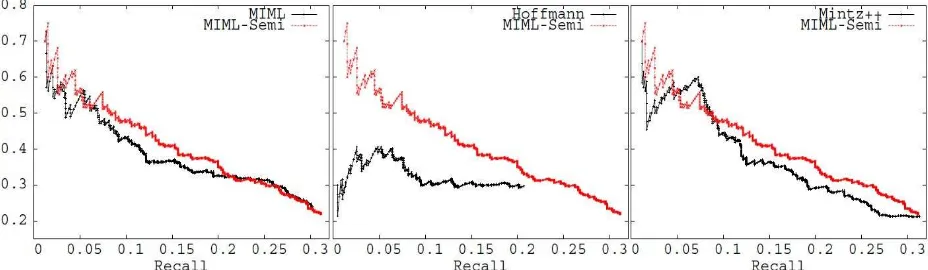
Figure 2: Performance on the KBP dataset. The figures on the left, middle and right showMIML,Hoffmann, and Mintz++compared to the sameMIML-Semicurve, respectively.MIML-Semiis shown in red curves (lighter curves in black and white) while other algorithms are shown in black curves (darker curves in black and white).
dataset, the training bags are generated by mapping Wikipedia (http://en.wikipedia.org) infoboxes (after merging similar types following the KBP 2011 task definition) into a large unlabeled corpus (consisting of 1.5M documents from the KBP source corpus and a complete snapshot of Wikipedia). The KBP shared task provided 200 query named entities with their as-sociated slot values (in total several thousand pairs). We use 40 queries as development dataset (dev), and the rest (160 queries) as evaluation dataset. We set θ = 0.25 by tuning on thedev set and use it in the experiments. For a fair comparison, we follow Sur-deanu et al. (2012) and begin by downsampling the “negative“ class to 5%. We also set T=8 and use the following noisy-or (forith bag) of mention-level probability to rank predicted types (r) of pairs and plot the precision-recall curves for all experiments.
P robi(r) = 1−
Y
j
(1−p(zij =r|xij;wz))
Evaluation: We compare our algorithm ( MIML-semi) to three algorithms: 1) MIML (Surdeanu et al., 2012), the Multiple-Instance Multiple Label al-gorithm which labels the bags directly with the KB (y = ℓ). 2) MultiR (denoted asHoffmann) (Hoff-mann et al., 2011), a Multiple-Instance algorithm that supports overlapping relations. It also imposes y = ℓ. 3)Mintz++ (Surdeanu et al., 2012), a vari-ant of the single-instance learning algorithm (section 3). The first two are stat-of-the-art Multi-Instance Multi-Label algorithms. Mintz++is a strong base-line (Surdeanu et al., 2012) and an improved ver-sion of Mintz et al. (2009). Figure 2 shows that our algorithm consistently outperforms all three
al-gorithms at almost all recall levels (with the excep-tion of a very small region in the PR-curve). This demonstrates that by treating unla-beled data set dif-ferently and leveraging the missing positive bags, MIML-semiis able to learn a more accurate model for extraction. Although the proposed solution is a specific algorithm, we believe the idea of treating unlabeled data differently can be incorporated into any of these algorithms that only use unlabeled data as negative examples.
6 Conclusion
We show that the distant-supervision labeling pro-cess generates a significant number of false nega-tives because the knowledge base is incomplete. We proposed an algorithm that learns from only positive and unlabeled bags. Experimental results demon-strate its advantage over existing algorithms.
Acknowledgments
References
Razvan Bunescu and Raymond Mooney. 2007. Learning to extract relations from the web using minimal super-vision. InProceedings of the 45th Annual Meeting of the Association for Computational Linguistics. Mark Craven and Johan Kumlien. 1999. Constructing
bi-ological knowledge bases by extracting information from text sources. InProceedings of the Seventh Inter-national Conference on Intelligent Systems for Molec-ular Biology.
Raphael Hoffmann, Congle Zhang, Xiao Ling, Luke Zettlemoyer, and Daniel S. Weld. 2011. Knowledge-based weak supervision for information extraction of overlapping relations. In Proceedings of the Annual Meeting of the Association for Computational Linguis-tics.
Heng Ji, Ralph Grishman, and Hoa T. Dang. 2011. Overview of the TAC 2011 knowledge base popula-tion track. InProceedings of the Text Analytics Con-ference.
Jing Jiang and ChengXiang Zhai. 2007. A systematic ex-ploration of the feature space for relation extraction. In Proceedings of HLT-NAACL-2007.
Nanda Kambhatla. 2004. Combining lexical, syntactic, and semantic features with maximum entropy mod-els for information extraction. InProceedings of ACL-2004.
Scott Miller, Heidi Fox, Lance Ramshaw, and Ralph Weischedel. 2000. A novel use of statistical parsing to extract information from text. In Proceedings of NAACL-2000.
Bonan Min, Shuming Shi, Ralph Grishman and Chin-Yew Lin. 2012a. Ensemble Semantics for Large-scale Unsupervised Relation Extraction. In Proceedings of EMNLP-CoNLL 2012.
Bonan Min, Xiang Li, Ralph Grishman and Ang Sun. 2012b. New York University 2012 System for KBP Slot Filling. InProceedings of the Text Analysis Con-ference (TAC)2012.
Mike Mintz, Steven Bills, Rion Snow, and Daniel Juraf-sky. 2009. Distant supervision for relation extraction without labeled data. InProceedings of the 47th An-nual Meeting of the Association for Computational Linguistics.
Truc Vien T. Nguyen and Alessandro Moschitti. 2011. End-to-end relation extraction using distant supervi-sion from external semantic repositories. In Proceed-ings of the 49th Annual Meeting of the Association for Computational Linguistics: Human Language Tech-nologies.
Sebastian Riedel, Limin Yao, and Andrew McCallum. 2010. Modeling relations and their mentions without
labeled text. InProceedings of the European Confer-ence on Machine Learning and Knowledge Discovery in Databases (ECML PKDD 10).
Ang Sun, Ralph Grishman, Wei Xu, and Bonan Min. 2011. New York University 2011 system for KBP slot filling. In Proceedings of the Text Analytics Confer-ence.
Mihai Surdeanu, Sonal Gupta, John Bauer, David Mc-Closky, Angel X. Chang, Valentin I. Spitkovsky, and Christopher D. Manning. 2011. Stanfords distantly-supervised slot-filling system. In Proceedings of the Text Analytics Conference.
Mihai Surdeanu, Julie Tibshirani, Ramesh Nallapati, Christopher D. Manning. 2012. instance Multi-label Learning for Relation Extraction. In Proceed-ings of the 2012 Conference on Empirical Methods in Natural Language Processing and Natural Language Learning.
TAC KBP 2011 task definition. 2011. http://nlp
.cs.qc.cuny.edu/kbp/2011/KBP2011 TaskDefinition.pdf Shingo Takamatsu, Issei Sato, Hiroshi Nakagawa. 2012.
Reducing Wrong Labels in Distant Supervision for Re-lation Extraction. InProceedings of 50th Annual Meet-ing of the Association for Computational LMeet-inguistics. Fei Wu and Daniel S. Weld. 2007. Autonomously
seman-tifying wikipedia. InProceedings of the International Conference on Information and Knowledge Manage-ment (CIKM-2007).