Proceedings of the 50th Annual Meeting of the Association for Computational Linguistics, pages 72–77,
Using an SVM Ensemble System for Improved Tamil Dependency Parsing
Nathan Green, Loganathan Ramasamy and Zdenˇek ˇZabokrtsk´y Charles University in Prague
Institute of Formal and Applied Linguistics Faculty of Mathematics and Physics
Prague, Czech Republic
{green,ramasamy,zabokrtsky}@ufal.mff.cuni.cz
Abstract
Dependency parsing has been shown to im-prove NLP systems in certain languages and in many cases helps achieve state of the art re-sults in NLP applications, in particular appli-cations for free word order languages. Mor-phologically rich languages are often short on training data or require much higher amounts of training data due to the increased size of their lexicon. This paper examines a new approach for addressing morphologically rich languages with little training data to start. Using Tamil as our test language, we cre-ate 9 dependency parse models with a lim-ited amount of training data. Using these models we train an SVM classifier using only the model agreements as features. We use this SVM classifier on an edge by edge deci-sion to form an ensemble parse tree. Using only model agreements as features allows this method to remain language independent and applicable to a wide range of morphologically rich languages.
We show a statistically significant 5.44% improvement over the average dependency model and a statistically significant 0.52% im-provement over the best individual system.
1 Introduction
Dependency parsing has made many advancements in recent years. A prime reason for the quick ad-vancement has been the CoNLL shared task compe-titions, which gave the community a common train-ing/testing framework along with many open source systems. These systems have, for certain languages,
achieved high accuracy ranging from on average from approximately 60% to 80% (Buchholz and Marsi, 2006). The range of scores are more of-ten language dependent rather than system depen-dent, as some languages contain more morpholog-ical complexities. While some of these languages are morphologically rich, we would like to addition-ally address dependency parsing methods that may help under-resourced languages as well, which often overlaps with morphologically rich languages. For this reason, we have chosen to do the experiments in this paper using the Tamil Treebank (Ramasamy and ˇZabokrtsk´y, 2012).
Tamil belongs to Dravidian family of languages and is mainly spoken in southern India and also in parts of Sri Lanka, Malaysia and Singapore. Tamil is agglutinative and has a rich set of morphologi-cal suffixes. Tamil has nouns and verbs as two ma-jor word classes, and hundreds of word forms can be produced by the application of concatenative and derivational morphology. Tamil’s rich morphology makes the language free word order except that it is strictlyhead final.
are an appropriate direction for lesser resourced lan-guages, often a large portion of morphologically rich languages. Ensemble methods are robust as data sizes grow, since the classifier can easily be re-trained with additional data and the ensemble model chooses the best model on an edge by edge basis. This cost is substantially less than retraining multi-ple dependency models.
2 Related Work
Ensemble learning (Dietterich, 2000) has been used for a variety of machine learning tasks and recently has been applied to dependency parsing in various ways and with different levels of success. (Surdeanu and Manning, 2010; Haffari et al., 2011) showed a successful combination of parse trees through a linear combination of trees with various weight-ing formulations. Parser combination with depen-dency trees have been examined in terms of accu-racy (Sagae and Lavie, 2006; Sagae and Tsujii, 2007; Zeman and ˇZabokrtsk´y, 2005; Søgaard and Rishøj, 2010). (Sagae and Lavie, 2006; Green and
ˇ
Zabokrtsk´y, 2012) differ in part since their method guarantees a tree while our system can, in some sit-uations, produce a forest. POS tags were used in parser combination in (Hall et al., 2007) for combin-ing a set of Malt Parser models with an SVM clas-sifier with success, however we believe our work is novel in its use of an SVM classifier solely on model agreements. Other methods of parse combinations have shown to be successful such as using one parser to generate features for another parser. This was shown in (Nivre and McDonald, 2008; Martins et al., 2008), in which Malt Parser was used as a fea-ture to MST Parser.
Few attempts were reported in the literature on the development of a treebank for Tamil. Our exper-iments are based on the openly available treebank (TamilTB) (Ramasamy and ˇZabokrtsk´y, 2012). De-velopment of TamilTB is still in progress and the ini-tial results for TamilTB appeared in (Ramasamy and
ˇ
[image:2.612.344.509.73.296.2]Zabokrtsk´y, 2011). Previous parsing experiments in Tamil were done using a rule based approach which utilized morphological tagging and identification of clause boundaries to parse the sentences. The results were also reported for Malt Parser and MST parser.
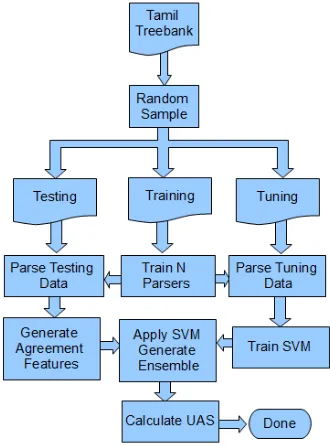
Figure 1: Process Flow for one run of our SVM Ensemble system. This Process in its entirety was run 100 times for each of the 8 data set splits.
When the morphological tags were available during both training and testing, the rule based approach performed better than Malt and MST parsers. For other Indian languages, treebank development is ac-tive mainly for Hindi and Telugu. Dependency pars-ing results for them are reported in (Husain et al., 2010).
3 Methodology
3.1 Process Flow
3.2 Parsers
A dependency tree is a special case of a depen-dency graph that spawns from an artificial root, is connected, follows a single-head constraint and is acyclic. Because of this we can look at a large his-tory of work in graph theory to address finding the best spanning tree for each dependency graph. The most common form of this type of dependency pars-ing is Graph-Based parspars-ing also called arc-factored parsing and deals with the parameterization of the edge weights. The main drawback of these meth-ods is that for projective trees, the worst case sce-nario for most methods is a complexity of O(n3) (Eisner, 1996). However, for non-projective pars-ing Chu-Liu-Edmond’s algorithm has a complexity ofO(n2) (McDonald et al., 2005). The most com-mon tool for doing this is MST parser (McDonald et al., 2005). For this parser we generate two models, one projective and one non-projective to use in our ensemble system.
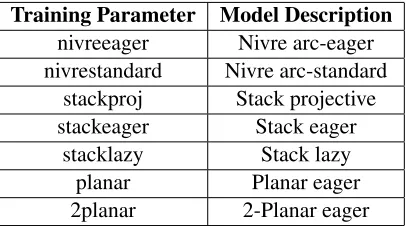
Transition-based parsing creates a dependency structure that is parameterized over the transitions. This is closely related to shift-reduce constituency parsing algorithms. The benefit of transition-based parsing is the use greedy algorithms which have a linear time complexity. However, due to the greedy algorithms, longer arc parses can cause error propa-gation across each transition (K¨ubler et al., 2009). We make use of Malt Parser (Nivre et al., 2007), which in the CoNLL shared tasks was often tied with the best performing systems. For this parser we generate 7 different models using different train-ing parameters, seen in Table 1, and use them as input into our ensemble system along with the two Graph-based models described above. Each parser has access to gold POS information as supplied by the TamilTB described in 3.4.
Dependency parsing systems are often optimized for English or other major languages. This opti-mization, along with morphological complexities, lead other languages toward lower accuracy scores in many cases. The goal here is to show that while the corpus is not the same in size or scope of most CoNLL data, a successful dependency parser can still be trained from the annotated data through model combination for morphologically rich lan-guages.
Training Parameter Model Description nivreeager Nivre arc-eager nivrestandard Nivre arc-standard
stackproj Stack projective stackeager Stack eager
[image:3.612.314.517.71.184.2]stacklazy Stack lazy planar Planar eager 2planar 2-Planar eager
Table 1: Table of the Malt Parser Parameters used during training. Each entry represents one of the parsing algo-rithms used in our experiments. For more information see http://www.maltparser.org/options.html
3.3 Ensemble SVM System
We train our SVM classifier using only model agree-ment features. Using our tuning set, for each
cor-rectly predicted dependency edge, we create
N
2
features whereN is the number of parsing models. We do this for each model which predicted the cor-rect edge in the tuning data. So for N = 3 the first feature would be a 1 if model 1 and model 2 agreed, feature 2 would be a 1 if model 1 and model 3 agreed, and so on. This feature set is novel and widely applicable to many languages since it does not use any additional linguistic tools.
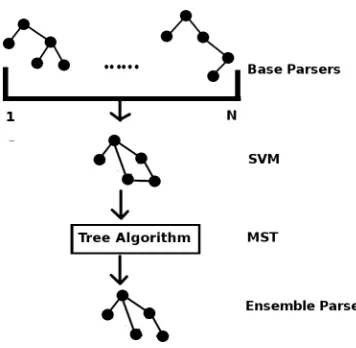
Figure 2: General flow to create an Ensemble parse tree
[image:4.612.108.266.412.509.2]3.4 Data Sets
Table 2 shows the statistics of the TamilTB Tree-bank. The last 2 rows indicate how many word types have unique tags and how many have two tags. Also, Table 2 illustrates that most of the word types can be uniquely identified with single morphological tag and only around 120 word types take more than one morphological tag.
Description Value
#Sentences 600
#Words 9581
#Word types 3583 #Tagset size 234 #Types with unique tags 3461 #Types with 2 tags 112
Table 2: TamilTB: data statistics
Since this is a relatively small treebank and in or-der to confirm that our experiments are not heavily reliant on one particular sample of data we try a va-riety of data splits. To test the effects of the train-ing, tuntrain-ing, and testing data we try 7 different data splits. The tuning data in the Section 4 use the for-mat training-tuning-testing. So 70-20-10 means we used 70% of the TamilTB for training, 20% for tun-ing the SVM classifier, and 10% for evaluation.
3.5 Evaluation
Made a standard in the CoNLL shared tasks com-petition, two standard metrics for comparing
depen-attachment score (LAS) and unlabeled attachment score (UAS). UAS studies the structure of a depen-dency tree and assesses whether the output has the correct head and dependency arcs. In addition to the structure score in UAS, LAS also measures the accu-racy of the dependency labels on each arc (Buchholz and Marsi, 2006). Since we are mainly concerned with the structure of the ensemble parse, we report only UAS scores in this paper.
To test statistical significance we use Wilcoxon paired signed-rank test. For each data split we have 100 iterations each with different sampling. Each model is compared against the same samples so a paired test is appropriate in this case. We report sta-tistical significance values for p < 0.01 andp < 0.05.
4 Results and Discussion
Data Average % Increase % Increase Split SVM UAS over Avg over Best 70-20-10 76.50% 5.13% 0.52% 60-20-20 76.36% 5.68% 0.72% 60-30-10 75.42% 5.44% 0.52% 60-10-30 75.66% 4.83% 0.10% 85-5-10 75.33% 3.10% -1.21%
90-5-5 75.42% 3.19% -1.10% 80-10-10 76.44% 4.84% 0.48%
Table 3: Average increases and decreases in UAS score for different Training-Tuning-Test samples. The average was calculated over all 9 models while the best was se-lected for each data split
Model 70-20-10 60-20-20 60-30-10 60-10-30 85-5-10 90-5-5 80-10-10
2planar * * * * * * **
mstnonproj * * * * * * **
mstproj * * * * * * **
nivreeager * * * * ** x *
nivrestandard * * ** x * * *
planar * * * * * * **
stackeager * * * x * ** *
stacklazy * * * x * ** *
[image:5.612.72.492.71.213.2]stackproj ** * * x ** ** **
Table 4: Statistical Significance Table for different Training-Tuning-Test samples. Each experiment was sampled 100 times and Wilcoxon Statistical Significance was calculated for our SVM model’s increase/decrease over each individual model.∗=p <0.01,∗ ∗p=<0.05,x=p≥0.05
the size of the tuning and training data matter more than the size of the test data given the low variance in Table 5. Since the TamilTB is relatively small when compared to other CoNLL treebanks, we ex-pect that this ratio may shift more when additional data is supplied since the amount of out of vocab-ulary, OOV, words will decrease as well. As OOV words decrease, we expect the use of additional test data to have less of an effect.
Data Splits SVM Variance 70-20-10 0.0011 60-20-20 0.0005 60-30-10 0.0010 60-10-30 0.0003 85-5-10 0.0010 90-5-5 0.0028 80-10-10 0.0010
Table 5: Variance of the UAS Scores of our Ensemble SVM System over 100 data splits
The traditional approach of using as much data as possible for training does not seem to be as effec-tive as partitioning more data for tuning an SVM. For instance the highest training percentage we use is 90% applied to training with 5% for tuning and testing each. In this case the best individual model had a UAS of 76.25% and the SVM had a UAS of 75.42%. One might think using 90% of the data would achieve a higher overall UAS than using less training data. On the contrary, we achieve a better UAS score on average using only 60%, 70%, 80%,
and 85% of the data towards training. This addi-tional data spent for tuning appears to be worth the cost.
5 Conclusion
We have shown a new SVM based ensemble parser that uses only dependency model agreement fea-tures. The ability to use only model agreements al-lows us to keep this approach language independent and applicable to a wide range of morphologically rich languages. We show a statistically significant 5.44% improvement over the average dependency model and a statistically significant 0.52% improve-ment over the best individual system.
In the future we would like to examine how our data splits’ results change as more data is added. This might be a prime use for self training. Since the tuning data size for the SVM seems most impor-tant, the UAS may be improved by only adding self training data to our tuning sets. This would have the additional benefit of eliminating the need to retrain the individual parsers, thus saving computation time. The tuning size may have a reduced effect for larger treebanks but in our experiments it is critical to the smaller treebank. Additionally, a full comparison of various ensemble parsing error distributions will be needed.
6 Acknowledgments
[image:5.612.72.217.411.525.2]References
Sabine Buchholz and Erwin Marsi. 2006. CoNLL-X shared task on multilingual dependency parsing. In Proceedings of the Tenth Conference on Compu-tational Natural Language Learning, CoNLL-X ’06, pages 149–164, Stroudsburg, PA, USA. Association for Computational Linguistics.
Thomas G. Dietterich. 2000. Ensemble methods in ma-chine learning. In Proceedings of the First Interna-tional Workshop on Multiple Classifier Systems, MCS ’00, pages 1–15, London, UK. Springer-Verlag. Jason Eisner. 1996. Three new probabilistic models
for dependency parsing: An exploration. In Proceed-ings of the 16th International Conference on Com-putational Linguistics (COLING-96), pages 340–345, Copenhagen, August.
Nathan Green and Zdenˇek ˇZabokrtsk´y. 2012. Hybrid Combination of Constituency and Dependency Trees into an Ensemble Dependency Parser. InProceedings of the Workshop on Innovative Hybrid Approaches to the Processing of Textual Data, pages 19–26, Avignon, France, April. Association for Computational Linguis-tics.
Gholamreza Haffari, Marzieh Razavi, and Anoop Sarkar. 2011. An ensemble model that combines syntactic and semantic clustering for discriminative dependency parsing. In Proceedings of the 49th Annual Meet-ing of the Association for Computational LMeet-inguistics: Human Language Technologies, pages 710–714, Port-land, Oregon, USA, June. Association for Computa-tional Linguistics.
Johan Hall, Jens Nilsson, Joakim Nivre, G¨ulsen Eryigit, Be´ata Megyesi, Mattias Nilsson, and Markus Saers. 2007. Single Malt or Blended? A Study in Mul-tilingual Parser Optimization. InProceedings of the CoNLL Shared Task Session of EMNLP-CoNLL 2007, pages 933–939.
Samar Husain, Prashanth Mannem, Bharat Ram Ambati, and Phani Gadde. 2010. The icon-2010 tools contest on indian language dependency parsing. In Proceed-ings of ICON-2010 Tools Contest on Indian Language Dependency Parsing, pages 1–8.
Sandra K¨ubler, Ryan McDonald, and Joakim Nivre. 2009. Dependency parsing. Synthesis lectures on hu-man language technologies. Morgan & Claypool, US. Andr´e F. T. Martins, Dipanjan Das, Noah A. Smith, and
Eric P. Xing. 2008. Stacking dependency parsers. InProceedings of the Conference on Empirical Meth-ods in Natural Language Processing, EMNLP ’08, pages 157–166, Stroudsburg, PA, USA. Association for Computational Linguistics.
Ryan McDonald, Fernando Pereira, Kiril Ribarov, and Jan Hajic. 2005. Non-projective dependency
pars-Human Language Technology Conference and Confer-ence on Empirical Methods in Natural Language Pro-cessing, pages 523–530, Vancouver, British Columbia, Canada, October. Association for Computational Lin-guistics.
Joakim Nivre and Ryan McDonald. 2008. Integrating graph-based and transition-based dependency parsers. In Proceedings of ACL-08: HLT, pages 950–958, Columbus, Ohio, June. Association for Computational Linguistics.
Joakim Nivre, Johan Hall, Jens Nilsson, Atanas Chanev, Gulsen Eryigit, Sandra K¨ubler, Svetoslav Marinov, and Erwin Marsi. 2007. MaltParser: A language-independent system for data-driven dependency pars-ing.Natural Language Engineering, 13(2):95–135. Loganathan Ramasamy and Zdenˇek ˇZabokrtsk´y. 2011.
Tamil dependency parsing: results using rule based and corpus based approaches. In Proceedings of the 12th international conference on Computational lin-guistics and intelligent text processing - Volume Part I, CICLing’11, pages 82–95, Berlin, Heidelberg. Loganathan Ramasamy and Zdenˇek ˇZabokrtsk´y. 2012.
Prague dependency style treebank for Tamil. In Pro-ceedings of LREC 2012, ˙Istanbul, Turkey.
Kenji Sagae and Alon Lavie. 2006. Parser combina-tion by reparsing. InProceedings of the Human Lan-guage Technology Conference of the NAACL, Com-panion Volume: Short Papers, pages 129–132, New York City, USA, June. Association for Computational Linguistics.
Kenji Sagae and Jun’ichi Tsujii. 2007. Dependency pars-ing and domain adaptation with LR models and parser ensembles. InProceedings of the CoNLL Shared Task Session of EMNLP-CoNLL 2007, pages 1044–1050, Prague, Czech Republic, June. Association for Com-putational Linguistics.
Anders Søgaard and Christian Rishøj. 2010. Semi-supervised dependency parsing using generalized tri-training. In Proceedings of the 23rd International Conference on Computational Linguistics (Coling 2010), pages 1065–1073, Beijing, China, August. Mihai Surdeanu and Christopher D. Manning. 2010.
En-semble models for dependency parsing: cheap and good? In HLT: The 2010 Annual Conference of the North American Chapter of the Association for Computational Linguistics, HLT ’10, pages 649–652, Stroudsburg, PA, USA. Association for Computational Linguistics.