Machine Learning Comprehension
Grammars for Ten Languages
Patrick Suppes*
Stanford UniversityLin Liang*
Stanford UniversityMichael B6ttner*
Stanford UniversityComprehension grammars for a sample of ten languages (English, Dutch, German, French, Spanish, Catalan, Russian, Chinese, Korean, and Japanese) were derived by machine learning from corpora of about 400 sentences. Key concepts in our learning theory are: probabilistic association of words and meanings, grammatical and semantical form generalization, grammar computations, congruence of meaning, and dynamical assignment of denotational value to a word.
1. I n t r o d u c t i o n
Our approach to machine learning of language combines psychological, linguistic, and logical concepts. We believe that the five central features of our approach--probabilistic association of words and meanings, grammatical and semantical form generalization, grammar computations, congruence of meaning, and dynamical assignment of deno- tational value to a word--are either new, or are new in their present combination. An overview of these concepts and related ones is given in Section 2.1. Two prior papers describing this approach, first presented at two conferences in 1991, are Suppes, Liang, and B6ttner (1992) and Suppes, B6ttner, and Liang (1995).
Using the theory embodying the concepts just listed, we report on our machine learning program of corpora from ten natural languages. Following our earlier work, we use a robotic framework. The computer program based on the theory learns a natural language from examples, which are commands occurring in mechanical as- sembly tasks (e.g., Go to the screw, Pick up a nut, Put the black screw into the round hole). A major improvement here, in comparison to Suppes, B(Sttner, and Liang (1995), is that the association relation is generalized from a unique correspondence between words and the program's internal representation of their meaning to a many-to-one relation, which permits different words to be associated to the same internal representation. This change is particularly important for the purpose of capturing case variation in word forms in inflecting languages such as Russian or German.
The robotic framework and the associated corpora we test our program on are certainly restricted, although we have implemented our learning program on Robot- world, a standard robot used in academic settings for development purposes. In the present paper, however, we have deliberately formulated the general learning axioms of our theory so they do not depend on the robotic framework. The axioms are meant to apply to many kinds of systematic language use, more or less in the sense of sub- languages, (see Kittredge and Lehrberger [1982]). We are already deep into our next
Computational Linguistics Volume 22, Number 3
area of application, machine understanding of physics word problems, and we have not needed to change the general formulation of our theory to accommodate this quite different problem of language learning.
In this paper, we first describe our theory of machine learning of natural lan- guage (Section 2), and then describe the corpora in ten languages that we u s e d for experimental purposes (Section 3). The languages are: English, Dutch, German, French, Spanish, Catalan, Russian, Chinese, Korean, Japanese. In Section 4 we describe some empirical results, especially the comprehension grammars generated from learning the languages. Finally, in Section 5 we discuss related work and the most pressing unsolved problems.
2. Theory
The theory that underlies our learning program is given in terms of a system of axioms. We begin with a general formulation, which is then made more special and technical for the robotic framework of this paper.
Any learning program that is given the counterpart of the command Get the black
screw in French Prends une vis noire, Russian Voz'mi chjornuj vint, or Japanese Kuroi
nejikugi o tore finds itself confronted with at least the following problems: (i) to learn
the meanings of words, (ii) to learn a grammar from a training set for each utterance to be comprehended, and (iii) to learn the semantic structure of each utterance. Our theoretical solution to these problems will become clear in what follows.
2.1 Central Concepts of the Theory
We give here an informal characterization of the key concepts used in our theory.
Association. This is the key learning concept. We use the classical concept of association
to establish the connection between unknown words in a language and their meaning. The principle of association goes back at least to Aristotle, and certainly was used extensively by eighteenth-century philosophers like H u m e long before psychology had become an experimental science. The fundamental role of association as a basis for conditioning is thoroughly recognized in modern neuroscience and is essential to the experimental study of the neuronal activity of a variety of animals. For similar reasons, its role is just as central to the learning theory of neural networks, now rapidly developing in many different directions.
We have not made explicit use of neural networks, but have worked out our theory of language learning at a higher level of abstraction. In our judgment, the difficulties we face need to be solved before a more detailed theory is developed. The choice of some level of abstraction is inevitable in all work of the present kind--a fact not always appreciated by interested bystander. Whatever the level of abstraction, there is one general issue about association that must be faced: is association probabilis- tic or deterministic? For us, the forming of associations is probabilistic rather than deterministic, which is a reflection of the complexity of the underlying process.
Suppes, Bottner, and Liang Machine Learning Comprehension Grammars
Working memory. The learning program has a short-term working memory for process- ing the command it is presented. The memory holds its content for the time period of a single trial. The first group of learning axioms describes the association computations that take place in working memory during the course of a trial.
Long-term memory. This memory also can change from trial to trial, but it stores asso- ciations and grammatical forms that remain unchanged when they are correct for the application being considered. The w a y the state of long-term memory changes from trial to trial is described in Section 2.4.1, in the second set of learning axioms.
Generalization. A distinct principle of generalization generates grammatical forms and their associated semantic forms. The methods used combine those of context-free gram- mars and model-theoretic semantics for formal languages.
The concept of generalization is widely used in psychological theories of learning. The kind of generalization used here is restricted to the generation of grammatical forms and grammatical rules from concrete utterances. For example, the phrase the nut generalizes to the grammatical form the O, where O is the category of objects. (More elaborate examples are considered later.)
Memory trace. When a generalization of any of the several kinds we use is made, the particular word association on which it is based is stored with it in long-term memory, as the memory trace justifying the generalization.
Denotational value. When a child learning a first language, or an older person learning a second language, first encounters utterances in that new language, nondenoting words are not marked in any uniform way. There is some evidence that various prosodic features are used in English and other languages t o help the child, but in any case their denotational role must be learned.
Here a separate learning procedure is introduced to compute dynamically the de- notational value of each word, with the limit being 1 for having a denotation and 0 for being nondenoting. Denoting words such as nut refer to elements of our categories; good examples of nondenoting words are definite and indefinite articles. Intuitively, only denoting words should acquire associations to elements of the environment, in- cluding possible actions, as represented internally. Several mean learning curves for denotational value are presented in Section 4.
Congruence. By using a concept of semantic congruence inspired by geometry, we sim- plify the grammars and at the same time permit direct comparisons across languages. The intuitive idea of such congruence is simple: two strings of a natural language are congruent when they have identical representations in the internal language.
Various strong and weak senses of congruence can be used to get varying degrees of closeness of meaning. The idea is not to be caught in the search for a single concept of synonymy, just as in modern geometry we are not caught in a single concept of congruence. In affine geometry, for example, there is a weaker sense of congruence than in Euclidean geometry, but it is also easy to get a commonsense notion of congruence that is stronger than the Euclidean one, namely congruence that requires sameness of orientation. Our use of congruence of meaning in this article is restricted. In particular, we only analyze congruence of nondenoting words.
Computational Linguistics Volume 22, Number 3
grammar, in contrast, as we characterize it here, can generate a superset of utterances. The rules are required only to lead to the correct semantic interpretation of an utter- ance of the language. Robots, like very young children, can easily have the capacity to understand language before they can produce it. Although it is difficult and subtle to collect accurate and anything-like-complete data on the comprehension grammar gen- erated by very young children, the evidence is overwhelming that they comprehend much more than they can produce.
2.2 Background Assumptions
We state informally as background assumptions two essential aspects of any language learning device. First, there is the problem of how the internal representation of an utterance heard for the first time is generated by the learner. Second, at the other end of the comprehension process, so to speak, there is the problem of generating a semantic interpretation of a new utterance, but one that falls within the grammar and semantics already constructed by the learner.
In any complete theory, both of these processes require thorough formal analysis, but as will become clear, this analysis is not necessary for the framework of this article. We give only a schematic formulation here.
.
.
Association by contiguity. When a learner is presented a sentence that it cannot interpret, it associates the utterance to patterns in its contiguous environment whose internal representations may be, but are not necessarily, induced by the free or coerced actions of the learner. Comprehension-and-response axiom. If a learner is presented a sentence, then using the associations and grammatical rules stored in long-term memory, the learner attempts to construct a semantic interpretation of the sentence and respond accordingly.
2.3 Internal Language
We use Lisp for the internal language of the study reported here, but in current ongoing work of machine learning of physics word problems we take the internal language to be a language for physical equations, close to what is ordinarily used in physics. In the present study the internal language is stored in memory prior to learning and does not undergo any change during learning.
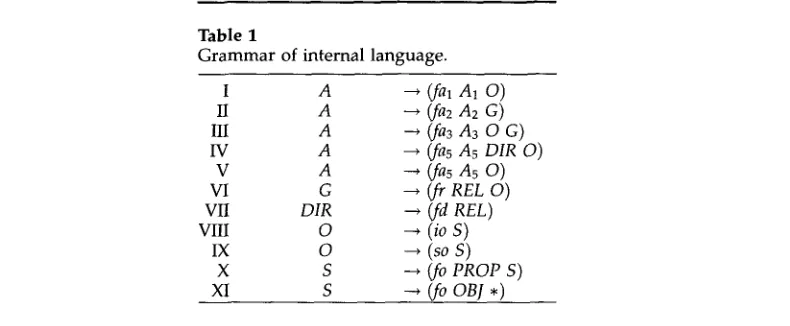
The set of expressions of the internal language is specified by the grammar in Table 1 with lexical categories A1, A2, A3, A5 (= action), REL (= relation), PROP (= property), OBJ (= object property) and phrasal categories A (= action), S (= set of objects), O (= object), G (= region), and DIR (= direction). The lexicon of our inter- nal language is given in Table 2. We refer to the elements of the lexical categories as internal symbols. The operations, such as
fal
andfa2
(read as form action), all have a straightforward procedural interpretation in a given robotic environment.Suppes, Bottner, and Liang Machine Learning Comprehension Grammars
Table 1
Grammar of internal language.
1 A
II A
III A
IV A
V A
VI G
VII DIR
VIII O
IX O
X S
XI S
- - ,
ffam A1 O)
0Ca2 A2 G) ---+ 0Ca3 A 3 0 G)
(fa5 A5 DIR O)
--* ffas A5 O)
Off REL O) --* (fd REL) --* (io S)
(so S) -~ fro PROP S)
--* (fo OBl *)
Table 2
Lexicon of internal language.
Categories
OBJ PROP REL A1 A2 A3 A5
Semantic Operations
$screw ' $1arge Sup Sget Sgo $put $pick fal (form-action)
Snut Smedium Son Splace far
$washer $small $into fa3
$ h o l e $square $above fa5
$plate $hexagonal $to fr (form-region)
Ssleeve Sround $behind fdir (form-direction)
$black io (identify-object)
$red so (select-object)
$gray fo (form-object)
The grammar of the internal language would derive the following Lisp structure for the internal representation of the action corresponding to the English command Get a screw, where the asterisk • refers to the set of objects present in a certain visual environment:
Ocal $get (so (leo $screw *))). (1)
Let 7 = 0 co $screw *). Then 7 itself is the m i n i m a l Lisp expression in (1) containing only the internal symbol $screw, and (so (fo $screw ,)) is the maximal Lisp expression in (1) containing only the internal symbol $screw. We use this distinction later.
2.4 General Learning A x i o m s
[image:5.468.41.414.44.379.2] [image:5.468.35.430.50.213.2]Computational Linguistics Volume 22, Number 3
Notation. C o n c e r n i n g notation used in the axioms, w e generally use Latin letters for
sentences or their parts, w h a t e v e r the natural language, a n d w e use G r e e k letters to refer to internal representations of sentences or their parts. Turning n o w to specific notation, the letters a, b , . . . refer to w o r d s in a sentence, a n d the Greek letters a, f l , . . . refer to internal symbols. The s y m b o l s refers to an entire sentence, a n d c o r r e s p o n d - ingly ¢ to an entire internal representation. G r a m m a t i c a l forms---either sentential or term f o r m s - - a r e d e n o t e d b y g or also g ( X ) to s h o w a category a r g u m e n t of a form; c o r r e s p o n d i n g l y the internal representations of a grammatical f o r m are d e n o t e d b y ,~ or -y(X). We violate o u r Greek-Latin letter c o n v e n t i o n in the case of semantic cate- gories or category variables X, X', Y, etc. We use the same category symbols in b o t h grammatical forms a n d their internal representations.
To insure that the p r o p e r semantic m e a n i n g is carried f r o m a natural l a n g u a g e sentence to its internal representation, or vice versa, w e i n d e x multiple occurrences of the same category in a g i v e n sentence a n d the c o r r e s p o n d i n g occurrences in its internal representation. An e x a m p l e of this i n d e x i n g is g i v e n later.
2.4.1 Axioms of Learning. The first set of axioms relates to c o m p u t a t i o n s using w o r k - ing memory.
Axiom 1.1 Probabilistic Association.
On a n y trial, let s be associated to c~, let a be in the set of w o r d s of s not associated to a n y internal s y m b o l of a, a n d let ~ be in the set of internal symbols not c u r r e n t l y associated with a n y w o r d of s. T h e n pairs (a, a) are sampled, possibly using the c u r r e n t denotational value, a n d associated, i.e. a ~ ~.
The probabilistic sampling in the case Get the screw c o u l d lead to the incorrect asso- ciations get ~,, $screw, the ,,~ $get a n d n o association for screw, for there are o n l y two symbols to be associated to in the internal representation.
Axiom 1.2 Form Generalization.
If g(g'i) "~ ")'(')'~), gl "~ 3'~, a n d "~' is derivable from X, then g(Xi) ~ "/(Xi), w h e r e i is the index of occurrence.
From the associations given after A x i o m 1.1 w e w o u l d derive the incorrect general- ization:
OBJ A1 screw ~ (fal A1 (io (fo OBJ *))). (2)
The correct one is:
A1 the OBJ ,,~ (fal (io (fo OBJ *))). (3)
Axiom 1.3 Grammar-Rule Generation. If g ~ -y a n d -y is derivable f r o m X, then X --* g.
C o r r e s p o n d i n g to A x i o m 1.3, w e n o w get the incorrect rule:
A --* OB] A1 screw.
The correct one is:
A --~ A1 the OBJ.
(4)
(s)
Axiom 1.4 Form Association.Suppes, Bottner, and Liang Machine Learning Comprehension Grammars
From (2), w e get the incorrect f o r m association:
OBJ ~ (io (fo OB l ,)). (6)
The correct o n e - - t o be learned from m o r e trials--is d e r i v e d from (3):
the OBJ ,,~ (io (fo OBJ *)). (7)
Axiom 1.5 Form Specification.
If g(Xi) "~ 3`(Xi), gl ,,~ 3`,, a n d 3" is derivable from X, then g(g;) N 3"(3"~).
As the inverse of A x i o m 1.2 using the incorrect generalization given after A x i o m 1.2, w e use 1.5 to infer:
Get the screw ~ (fal $get (io (fo $screw ,))).
Axiom 1.6 Content Deletion.
The content of working memory is deleted at the end of each trial.
All the axioms of the second set (outlined below) deal with changes in the state of long-term memory.
Axiom 2.1 Denotational Value Computation.
If at the e n d of trial n, a w o r d a in the p r e s e n t e d verbal stimulus is associated with some internal symbol or, then d(a), the denotational value of a, increases a n d if a is not so associated, d(a) decreases. Moreover, if a w o r d a does not occur on a trial, then d(a) stays the same unless the association of a to an internal symbol c~ is b r o k e n on the trial, in w h i c h case d(a) decreases.
Because this axiom is conceptually less familiar, w e give a m o r e detailed e x a m p l e later.
Axiom 2.2 Form Factorization.
If g ,-~ 3' and g' is a substring of g that is already in long-term m e m o r y and g' a n d 3'/ are derivable from X, then g and 3' are r e d u c e d to g(X) and 3`(X). Also g(X) ,,~ "y(X) is stored in long-term m e m o r y , as is the c o r r e s p o n d i n g grammatical rule g e n e r a t e d b y A x i o m 1.4.
We illustrate this axiom b y a simple example, w h i c h seems c o m p l e x because the premises take three lines, and w e h a v e two conclusions, an association, a n d the cor- r e s p o n d i n g grammatical rule. Let:
g ~ 3`: a I the OBJ ,,~ (fal A1 (io OCo OBJ ,))) g' ,-~ 3`': the OB] ,-~ (io (fo OBJ ,))
X : 0 --* the OBJ
a l O ,-~ 0Ca1 A1 O) A ~ A 1 0
Axiom 2.3 Form Filtering.
Computational Linguistics Volume 22, Number 3
In the previous example, g ~ 7 can now be removed from long-term memory, and so can A --* A1 the OBJ learned as an example of Axiom 1.3.
Axiom 2.4 Congruence Computation.
If w is a substring of g, w t is a substring of g' and they are such that
(a) g ,-~ "~ and g' ~ %
(b) g' differs from g only in the occurrence of w' in place of w,
(c) w and w' contain no words of high denotational value,
then w' ~ w and the congruence is stored in long-term memory.
Using Axiom 2.4, reduction of the number of grammatical rules for a given natural language is further achieved by using congruence of meaning (Suppes 1973, 1991). Consider the following associations of grammatical forms:
die Schraube ,,~ ( io (I:o $screw ,)) der Schraube ~ ( io (fo $screw ,)).
(8)
(9)
Association (8) and (9) differ only with respect to the article. The article in (8) is in the nominative and accusative case, the article in (9) is in the genitive and dative case. What is important here is that there is no difference in the respective internal repre- sentations. We therefore call (8) congruent with (9) and collect the differing elements into a congruence class IDA] = {die, der} where DA = definite article. This allows us to reduce the two grammatical forms (8) and (9) into one:
[DA] Schraube ~ (io (I:o $screw ,)). (10)
Notice that reduction by virtue of congruence is risky in the following way. We may lose information about the language to be learned. For instance, collapsing the gender distinction exhibited by the difference between (8) and (9) will make us incapable of distinguishing between the following sentences:
Steck die Schraube in das Loch Steck die Schraube in die Loch.
(11)
(12)
Whereas (11) is grammatical, (12) is not. As long as our focus is on comprehension grammar, a command like (12) will probably not occur, but for purposes of production, congruence in its present form should not be used.
Axiom 2.5 Formation of Memory Trace.
The first time a form generalization, grammatical rule, or congruence is formed, the word associations on which the generalization, grammatical rule, or congruence is based are stored with it in long-term memory.
Suppes, Bottner, and Liang Machine Learning Comprehension Grammars
Axiom 2.6 Deletion of Associations.
(a) W h e n a w o r d in a sentence is g i v e n a n e w association, a n y p r i o r association of that w o r d is deleted f r o m l o n g - t e r m m e m o r y .
(b) If a ,-~ c~ at the b e g i n n i n g of a trial, a a p p e a r s in the u t t e r a n c e s g i v e n on that trial b u t c~ does n o t a p p e a r in the internal r e p r e s e n t a t i o n ~ of s, t h e n the association a ,-~ a is deleted f r o m l o n g - t e r m m e m o r y .
(c) If no internal r e p r e s e n t a t i o n is g e n e r a t e d f r o m the occurrence of a sentence s, cr is t h e n g i v e n as the correct internal representation, a n d if there are several w o r d s in s associated to an internal s y m b o l c~ of cr such that the n u m b e r of occurrences of these w o r d s is g r e a t e r t h a n the n u m b e r of occurrences of c~ in or, t h e n these associations are deleted.
Axiom 2.7 Deletion of Form Association or Grammatical Rule.
If a ,-~ ~ is deleted, t h e n a n y f o r m generalization, g r a m m a t i c a l rule, or c o n g r u e n c e for w h i c h a ~ a is a m e m o r y trace is also deleted f r o m l o n g - t e r m m e m o r y .
Of the thirteen axioms, o n l y three n e e d to be m o r e specific to the s t u d y r e p o r t e d here. These three are A x i o m 1.1 Probabilistic Association, A x i o m 1.4 F o r m Association, a n d A x i o m 2.1 D e n o t a t i o n a l Value C o m p u t a t i o n s , w h i c h are g i v e n a m o r e specific technical f o r m u l a t i o n in Section 2.5. A x i o m 1.4 especially is g i v e n a m u c h m o r e detailed formulation.
2.5 Specialization of Certain Axioms and Initial Conditions Axiom 1.1' Probabilistic Association.
O n a n y trial n, let s be associated to cr in accordance w i t h B a c k g r o u n d A s s u m p t i o n 1, let A be the set of w o r d s of s n o t associated to a n y internal s y m b o l of or, let d, (a) be the c u r r e n t d e n o t a t i o n a l v a l u e of each such a in A a n d let A be the set of internal s y m b o l s n o t c u r r e n t l y associated w i t h a n y w o r d of s. T h e n
(i)
(ii)
an e l e m e n t a is u n i f o r m l y s a m p l e d w i t h o u t r e p l a c e m e n t f r o m A,
at the s a m e time, a n e l e m e n t a is s a m p l e d w i t h o u t r e p l a c e m e n t f r o m A w i t h the s a m p l i n g probability:
(iii) The s a m p l e d p a i r s are associated, i.e. a ,-~ c~.
(iv) S a m p l i n g continues until either the set A or the set A is empty.
Computational Linguistics Volume 22, Number 3
Axiom 1.4' Form Association.
Let g ,-~ 3' at a n y step of an association computation on a n y trial.
(a) If X occurs in g and (f0 X ,) occurs in % then X ~ (fo X *).
(b) If (i) w X is a substring of g with g ~ 3` such that w = a, which is a w o r d with low denotational value, or if X is preceded b y a variable, or is the first symbol of g, w = ~, the e m p t y symbol, a n d (ii) 3`' (X) is the maximal Lisp form of 3` containing the occurrence of X a n d no other occurrence of categories, then:
w X - 3 ` ' ( x ) .
(c) If (i) XlWl " " Wm-lXm is a substring of g, where the Xi, i = 1 , . . . , m are not necessarily distinct category n a m e s a n d wi are substrings, possibly empty, or w o r d s that have no association to internal symbols on the given trial, a n d (ii) 7'(X~o) . . . . , X~(m)) is the minimal Lisp form of 3` containing X.(1) . . . . , X~(m), then:
X l W 1 . . . W m _ l X m ,',, T(XTr(1 ) . . . XTc(m) ),
where 7c is a p e r m u t a t i o n of the n u m b e r s 1 . . . m.
To s h o w h o w Axiom 1.4' works, assume we have arrived at the following associ- ation of grammatical forms:
A1 the P R O P OBI ~ (fal A1 (io (fo P R O P (fo OBJ ,)))) (13)
which could be obtained as a generalization, for instance, from the c o m m a n d Get the
red screw with the w o r d s correctly associated.
From Axiom 1.4'(a), we m a y infer:
OBJ ~ OCo OBJ *). (14)
From Axiom 1.4'(b), we infer:
P R O P OBJ ~ (fo P R O P (fo OBJ ,)). (15)
From Axiom 1.4'(c), we infer:
the P R O P OBJ ,,~ (io (fo P R O P (fo OBJ *))). (16)
Using Grammar-Rule Generation (Axiom 1.3), a n d the g r a m m a r of the internal language (Table 1), we infer from (14) a n d Rule XI of Table 1:
S --, OBJ. (17)
From (15), Rule X of Table 1 a n d Form Generalization (Axiom 1.2):
PROP S ~ (/Co P R O P S), (18)
and finally from Grammar-Rule Generation (Axiom 1.3):
Suppes, Bottner, and Liang Machine Learning Comprehension Grammars
as a rule of English g r a m m a r . We also derive f r o m (16), (15) a n d the internal g r a m m a r u s i n g A x i o m 1.2:
the S ~ (io S) (20)
a n d then a g a i n b y G r a m m a r - R u l e Generation:
0 ~ the S (21)
as a rule for o u r English g r a m m a r .
Before the i n t r o d u c t i o n of the a x i o m s in Section 2.4, w e p r o m i s e d to give a n e x a m p l e of i n d e x i n g of categories to p r e s e r v e m e a n i n g . Such i n d e x i n g can be a v o i d e d for the restricted c o r p o r a here, b u t is n e e d e d for m o r e general p u r p o s e s . H e r e is an e x a m p l e f r o m o u r c o r p u s s h o w i n g h o w it works. C o n s i d e r the sentence:
Put the nut on the screw.
The correct g r a m m a t i c a l f o r m a n d associated internal r e p r e s e n t a t i o n w o u l d , w i t h in- dexing, look like this:
A3 the OBJ1 REL the OBJ2 ~ (fa 3 A3 (io (fo OBJ1 ,))Oct REL (io OCo OBJ2 , ) ) ) )
w h e r e p o s t s c r i p t n u m e r a l s are u s e d for i n d e x i n g OBJ.
A x i o m 2.1 / D e n o t a t i o n a l Value C o m p u t a t i o n s .
If at the e n d of trial n a w o r d a in the p r e s e n t e d v e r b a l s t i m u l u s is associated w i t h s o m e internal s y m b o l a of the internal r e p r e s e n t a t i o n cr of s, then:
dn+l(a ) = (1 - O)dn(a) + O,
a n d if a is n o t associated w i t h s o m e d e n o t i n g internal s y m b o l a of the internal repre- sentation:
dn+l(a) = (1 - O)dn(a).
Moreover, if a w o r d a d o e s n o t occur on trial n, then:
dn+l (a) = dn(a),
unless the association of a to an internal s y m b o l a is b r o k e n on trial n, in w h i c h case:
dn+l(a) = (1 - e)d,,(a).
To s h o w h o w the c o m p u t a t i o n of d e n o t a t i o n a l v a l u e (Axiom 2.1) w o r k s , let us consider f u r t h e r the associations g i v e n are get ,,~ $screw, the ,,~ $get. Let us f u r t h e r a s s u m e that at the e n d of this trial:
d(get) = 0.900 d(screw) = 0.950 d(the) = 0.700.
On the n e x t trial the v e r b a l c o m m a n d is:
Computational Linguistics Volume 22, Number 3
As a result, w e e n d this trial with:
get ~ Sget, nut ,,~ $nut
a n d w i t h the association of the deleted (Axiom 2.6 (a)). Using 0 = 0.03, as w e usually do, w e n o w have:
d(get) = 0.903
d(the) = 0.679.
After, let us say, three m o r e occurrences of the w i t h o u t a n y association b e i n g f o r m e d , the denotational value w o u l d be f u r t h e r r e d u c e d to 0.620. If the c o m m a n d Get the sleeve
is given a n d sleeve has not p r e v i o u s l y o c c u r r e d a n d get ,,~ $get, t h e n w e m a y see h o w
sleeve has a higher probability of b e i n g associated to $sleeve t h a n the. For u n d e r the
h y p o t h e s e s given, the sampling probabilities for the a n d sleeve w o u l d be:
d(the) 0.620
p(the) = d(the) + d(sleeve) - 0.620 + 1 - 0.383
and:
d(the) 1
p(steeve) = d(the) + d(sleeve) - 1.62~ - 0.617.
The d y n a m i c a l c o m p u t a t i o n of d e n o t a t i o n a l v a l u e continues after initial learning e v e n w h e n no mistakes are being made. As a c o n s e q u e n c e h i g h - f r e q u e n c y w o r d s such as a a n d the in English a n d ba in Chinese h a v e their d e n o t a t i o n a l values a p p r o a c h zero rather quickly, as can be seen f r o m the learning c u r v e s in Figures 1 a n d 2 in Section 4. (From a formal point, it is useful to define a w o r d as n o n d e n o t i n g if its a s y m p t o t i c denotational v a l u e is zero, or, m o r e realistically, b e l o w a certain threshold.)
This particular linear learning m o d e l w i t h two p a r a m e t e r s , dl(a), a n d 0, c o u l d easily be replaced b y m o r e elaborate alternatives.
Initial conditions. At the b e g i n n i n g of trial 1, the association relation ,-~, the c o n g r u e n c e
relation ~ a n d the set of grammatical rules is empty. Moreover, the initial d e n o t a t i o n a l value dl (a) is the same for all w o r d s a.
3. The Corpora
To test o u r system, w e a p p l i e d it to c o r p o r a of ten different languages. These languages are: English, Dutch, G e r m a n , French, Spanish, Catalan, Russian, Chinese, Korean, a n d Japanese. The size of o u r c o r p o r a v a r i e d f r o m 400 to 440 sentences. The c o r p o r a in the ten languages cover an almost identical set of internal structures. T h e y c o u l d not be m a d e c o m p l e t e l y identical for the following reason: an i n t e r n a l q a n g u a g e w o r d that was translated b y one w o r d in one language, say £, m i g h t require t w o or m o r e w o r d s ( d e p e n d i n g o n context) in a n o t h e r language £'. As a consequence, £~ m i g h t not be learnable from the same c o r p u s of 400 sentences that suffice for l a n g u a g e £. To arrive at a c o m p l e t e learning of all the words, w e therefore either a d d e d sentences as, e.g. in Spanish, or r e m o v e d sentences, as in Japanese.
The most i m p o r t a n t variation r e q u i r e m e n t o n the various c o r p o r a was that t w o w o r d s of a given language that w e r e i n t e n d e d to c o r r e s p o n d to two internal symbols m u s t not always co-occur if the correct m e a n i n g w e r e to be learned. For example,
if nimm and Schraube only occurred in the single c o m m a n d N i m m die Schraube! there
w o u l d be n o assurance that the i n t e n d e d associations Schraube ,,~ $screw a n d nimm
Suppes, Bottner, and Liang Machine Learning Comprehension Grammars
We also want to note that in the Japanese case we deleted all the sentences trans- lating $above as an internal symbol (ten sentences), because in Japanese above and on
are expressed by the same word ue.
Despite careful instruction of our translators, we are not sure whether the transla- tions sound natural in all cases and would in fact be used in a robotic working envi- ronment. To check this, however, would go far beyond what can be done by standard translation methods and requires field studies of language use in a working environ- ment. In cases of a lexical gap, we used very simple devices. For example, French has no single idiomatic word for the nonspatial meaning of the English adjective medium,
so we used the circumlocutionary phrase de taille moyenne. In some cases we avoided technical language where a single word consists of two morphemes and expresses two internal denoting symbols. As might be expected, this occurs frequently in German. For example, Rundschraube expresses the idea of round screw that is the property round
and the object screw.
In the case of Catalan, we set in advance the denotational value for a few words as different from the initial value of 1. We did so because there were m a n y nondenoting words, in our sense, and these nondenoting words uniformly co-occurred with certain action verbs, so that within our limited corpus the intuitively correct denotational value could be learned only with a probability less than one. We therefore set the initial denotational value for the words d and de at 0.05.
To obtain a successful learning performance on a corpus, it is often useful to make some modifications in the corpus. In the final tests of a theory such changes are, of course, undesirable. The changes we did make are described below.
The introduction of pick up created many problems because of the special nature of this verb and relation in English. In m a n y languages the notion of picking something up is expressed by a single action verb with no additional preposition required. This created an important problem: individual words in the corpus of a given natural language sometimes denoted more than one internal symbol. Our solution (admittedly artificial but the only really artificial solution we had to adopt), was to split such words into two parts:
French: ramasse into ra and masse
Spanish: recoge into rec and oge
Catalan: recull into re and cull
Russian: podnimi into pod and nimi
Korean: cip&ela into cip and &ela
Japanese: toriagero into tori and agero
This absence of isomorphism of the semantic categories of words across languages is not surprising, as has been observed in Bowerman (1996) and Choi and Bowerrnan (1991). What is identified as the same action and different relations in one language may be identified as different actions and the same relation in another language.
4. Empirical Results
Computational Linguistics Volume 22, Number 3
Table 3
Comprehension lexica for ten comparable corpora.
Symbols with Nondenoting More Than 1 Words W o r d s Association
English 28 2 0
Dutch 38 3 2
German 49 10 9
French 42 7 5
Spanish 40 7 6
Catalan 42 8 8
Russian 75 0 16
Chinese 33 8 0
Korean 31 4 1
Japanese 31 4 1
Lexicon.
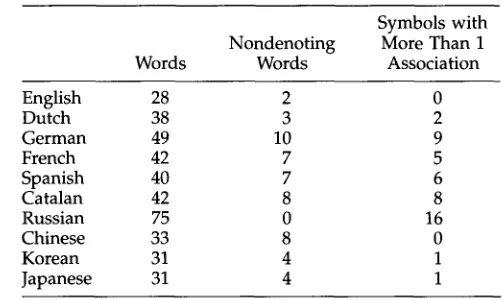
In Table 3 we specify for each natural language the number of words learned. We count as different words different inflected forms of what, according to dictionary usage, is the same word. As might be expected, Russian has the largest number of internal symbols with more than one association, just because of its rich inflectional patterns.Learning.
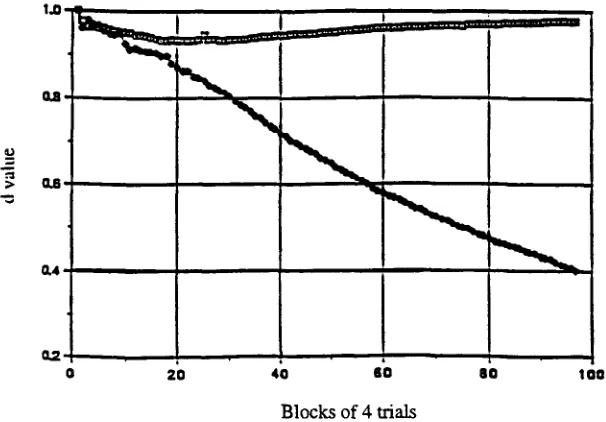
A natural question is whether or not the order of presentation of the sen- tences in the corpora was fixed in advance to facilitate learning. The answer is that the order was not fixed. For each language the sentences presented were chosen randomly without replacement from the corpus of approximately 400 sentences.Compared to most neural-net rates of learning, the learning was rapid. In each of the ten languages, one cycle through the entire corpus was sufficient to produce a comprehension grammar that was intuitively correct. In contrast, and somewhat para- doxically, even for a corpus of only 400 sentences, the standard mean learning curves, theoretically based on random sampling of sentences are computationally not feasible, as we proved in Suppes, Liang, and B6ttner (1992). In this same earlier paper, based on some very large runs--in fact, mean learning curves computed from up to 10,000 sample p a t h s - - w e conjectured that the mean learning rate for the kind of corpora we have studied is polynomically bound. The learning of the ten languages studied in this paper quite clearly supports the conjecture for our theoretical framework of learning. In Figures 1, 2, and 3 we show mean learning curves for the denotational value of words for English, Chinese and German. The averaging in this case is over the total number of denoting or nondenoting words in a given corpus. The number of nondenoting words in the three languages is 2, 8 and 10, respectively, as also shown in Table 3. As would be expected, for the three languages the rate of learning the denotational value of nondenoting words is inversely proportional to their number, an argument from pure frequency of occurrence in the corpora. This is not the whole story, as can be seen by comparing the Chinese and German mean curves, even though the number of nondenoting words is very close.
Suppes, Bottner, and Liang Machine Learning Comprehension Grammars
1.0=
0.8,
U ,
0.4
0.2
.
I
0 . 0 [ _ i I I I I I I I I I
0 2 0 4'0 60 80
Blocks of 4 trials
Figure 1
Mean denotational learning curves for English. The upper curve is for denoting words, with an asymptote of 1, and the lower curve is for nondenoting words with an asymptote of 0.
U °
0.4,.
0.0,
0 1.0.
20 4 O 60 8O I 0 0
Blocks of 4 trials
Figure 2
[image:15.468.73.375.75.287.2] [image:15.468.72.379.387.597.2]Computational Linguistics Volume 22, Number 3
\
o
U l
0 . 4
0 , 2 ~ i
o 2 0 40 6 0 8 0 I 0 0
[image:16.468.91.394.55.266.2]Blocks of 4 trials
Figure 3
Mean denotational learning curves for German.
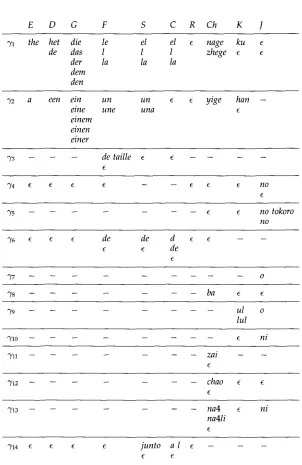
still be included in the group of languages using that rule. This has as a consequence that the grammatical rules were differentiated only by the order of occurrence of the semantic categories in the rule and not by the appearance of nondenoting words. In other words, two rules that have exactly the same semantic categories appearing in exactly the same order, independent of the appearance of nondenoting words, are treated as the same rule. (See Table 5). It is our feeling that this kind of congruence reduction is desirable in order to get a real semantic comparison of the comprehension grammars generated for different languages. The occurrence of c in Table 4 indicates that the language used the same grammatical rule as another language, but with no nondenoting word occurring.
A consequence of what has just been said is that a particular grammatical rule with congruence notation may permit an instantiation in a given language of a gram- matical form not instantiated in the corpus itself. For the purposes of comprehension as opposed to production, this does not lead to difficulties.
There are a number of descriptive remarks to be made about Table 4. Congruence class ")'1 is made up of various forms of definite articles, including in the case of Russian, and Japanese, the null word e, because these two languages do not standardly use a definite article. The same remark applies to class "Y2 for indefinite articles. In introducing classes 3'1 and 3'2 across languages we are admittedly introducing a coarse- grained but useful clustering of nondenoting words that function rather similarly in different languages. More refinements of congruence of meaning and use could lead to the division of 3'1, and also ~/2, into several smaller classes.
Suppes, Bottner, and Liang Machine Learning Comprehension Grammars
Table 4
Congruence Classes. The languages are, from left to right, English, Dutch, German, French, Spanish, Catalan, Russian, Chinese, Korean, and Japanese.
E D G F S C R C h K J
7,/1 t h e h e t d i e le el el e n a g e k u c
d e d a s I I 1 z h e g e ¢ e
d e r Ia la la
d e m d e n
"Y2 a e e n e i n u n u n ~ ~ y i g e h a n - e i n e u n e u n a
e i n e m e i n e n e i n e r
7)'3 - - - d e t a i l l e ¢ e - -
")'4 6- £ £ ~ - - - - £ ( 6. n o
£
"Y5 . . . . . e e n o t o k o r o
n o
76 e ¢ e d e d e d e e
e e d e
"Y7 . . . . . . 0
'78 . . . . . b a e e
"r9 . . . . . u l o
l u l
"/1o . . . . . ~ n i
"y3~ . . . . . . . z a i - -
(
"Y12 . . . c h a o e e
"~3 . . . . . . . n a 4 ¢ n i
n a 4 l i
"Y14 e ¢ ~ c j u n t o a l e - - -
ff ff
Given that Chinese is not an inflected language, as G e r m a n is, the n u m b e r of n o n d e n o t i n g words in Table 4 is large. We cannot discuss in detail all of these particles. The particle b a occurs before n o u n phrases describing direct objects of actions. The
[image:17.468.76.378.111.576.2]Computational Linguistics Volume 22, Number 3
the grammar for Chinese given in Table 5 has the following two rules:
[%] o
c
and:
G---* REL [76] 0
But to put zai before a relation word is not correct Chinese. This superset causes no problem for comprehension, and the correct instances are when ¢ is used rather than
zai. Remarks very similar to those for zai apply to chao. The difference in their use
reflects a semantic distinction we do not need for comprehension but would need for production. The particle zai is used mainly in connection with relations of position such as on and under. In contrast chao is used in connection with the direction of motion.
Rules. An overview of the resulting grammars for the ten languages is given in Table 5.
In the first column we list the production rules in the order of internal-language production rules (cf. Table 1). In the next columns we list the languages in the following order: English, Dutch, German, French, Spanish, Catalan, Russian, Chinese, Korean, Japanese. To each internal production rule corresponds in general a set of language specific rules. In the case of Rules VII and XI the set is a unit set for the obvious reason that no variation can arise in our limited internal language. Clearly in a more general setting, in the case of Rule VII, for example, relations could have modifying properties.
The most important contrast between the Indo-European and Asian languages is that in the Indo-European languages the imperative verb expressing action is usually at the beginning of an utterance, but in the Asian languages it is usually in final position. See, for example, the two rules derived from Rule II. The first is for the seven Indo-European languages and the second for the three Asian languages. Similar remarks hold for the three rules derived from Rule III.
This well-known contrast between the two groups of languages leads to a more systematic question about the rules given in Table 5. Does the set of rules correspond- ing to each rule of the internal language exhaust the possible permutations of the order of the semantic categories? Surprisingly the answer is affirmative except for the set generated by Rule III, which has only three members rather than six.
However, reflecting only on the three languages controlled as native speakers by the authors of this article, we can give simple examples within the vocabulary and conceptual framework of our various corpora exhibiting two of the missing permuta- tions:
A3 G O
E: Put near the washer a screw.
G: Leg neben die Scheibe eine Schraube.
G A3 O
E: Near the washer put a
G: Neben die Scheibe leg eine
Ch: Zai nage dianquan fujin fang yige
s c r e w .
Suppes, Bottner, and Liang Machine Learning Comprehension Grammars
Table 5
Comprehension grammars for ten comparable corpora.
Production Rules E D G F S C R Ch K J
I A ~ A I + O + + + + + + +
a ---+ [')'8] q- O q- [~'9] q- A1 + + +
II A ---* A2 Jr
[3'14] "~ G
+ + + + + + +A ~ [712] q- G Jr [3`13] q- A2 + + +
III A --+ A3 + O + G + + + + + + +
A ~ [78] + O + A3 + [3'11] -}- G +
A --. O + [79] q- G ~- [710] + A3 + q-
I V A -+ As + DIR + O +
A "--~ As + O + DIR +
A --+ DIR + O + A5 +
a ~ [3`8] q- O 4- [3`9] 4- As + DIR + +
A ---* DIR + A5 + O + + + +
A ~ O + [3"7] + D I R + A 5 +
V A - - - ~ A 5 + O + + + + + +
A -~ o + [77] + As +
VI G - - ~ R E L + [ % ] + O + + + + + + + +
G --. O + [v5] + REL + + +
VII DIR---. REL + + + + + + + + + +
VIII 0 - - . [ 7 2 ] + S + + + + + + + + + +
o -~ [3`~] + s +
I X 0 - - . [ 7 1 ] + S + + + + + + + + + +
O --+ [77] + S +
X S ~ P R O P + [ 3 ' 4 ] + S + + + + + + + +
S --+ S + [3"3] + P R O P + + +
X I S -* OBJ + + + + + + + + + +
For the third m i s s i n g p e r m u t a t i o n , w e o b t a i n e d f r o m o u r K o r e a n i n f o r m a n t the fol- l o w i n g e x a m p l e :
K:
G O A3
k u nasapati y e p h e y (han) nasa-lul nohala.
the w a s h e r n e a r (one) screw p u t
[image:19.468.59.398.92.457.2] [image:19.468.80.322.542.578.2]Computational Linguistics Volume 22, Number 3
taken from Suppes, B6ttner, and Liang (1995), is:
A --* A4 [einen] S D [der] PROP ist.
An instance of this rule is:
Heb eine Mutter hoch, die nicht grofl ist.
5. Related Work and U n s o l v e d Problems
By far the most extensive research on language learning has been on children's learning of their first language. Rather extensive theoretical treatments are to be found in Wexler and Culicover (1980) and in Pinker (1984, 1989). Some of this work is related to ours, but not in a central way in terms of the details of theoretical ideas. For example, Wexler and Culicover assume the learner already has a deep context-free grammar of the language in question, and learning is centered on the learning of transformations. In contrast, we begin with no grammar of the language to be learned. We make no detailed claims of the relevance of our work to children's learning, but connections undoubtedly exist at a certain level.
In the past decade or so there has been a relatively small number of articles or books on machine learning of natural language. Langley and Carbonell (1987) provide an excellent overview of research up to the date of their publication. Compared to other research in this area, ours is more semantically than syntactically driven. This semantic commitment is also evident in the recent work of Feldman et al. (1990, 1994) and Siskind (1990, 1992, 1994), which is also the work closest to our own. Feldman et al. (1990) describe in direct and simple terms their original idea. First, the learn- ing system is presented pairs of pictures and true natural language statements about the pictures. Second, the system is to learn the language well enough to determine whether or not a new sentence is true of the accompanying picture. Feldman et al.'s (to appear) approach to language learning separates the learning of the grammar from the learning of the lexical concepts. The grammar is learned by use of Bayesian in- ference over a set of possible grammars and model merging. Siskind's original work (1992), his dissertation, was in the context of naive physics, but focused also on the algorithms children may use in learning language. This work is continued in Siskind (1994), but with any assumption of prior language knowledge eliminated. The con- centration is on lexical acquisition via possible internal representations of meaning. Although Siskind (1994) concentrates entirely on lexical meaning, his seven-step pro- cedure, which constitutes a learning algorithm, bears resemblance at the top level but not in detail to our procedure. Siskind (1991) has a concept that is certainly different but similar in certain respects to our concept of denotational value equal to 0 in the limit for nondenoting words. His ideas are, however, not probabilistic, and he does not present any learning curves. He does offer in his concept of temperature (1994) a treatment of homonymy, which we do not.
In spite of our considering ten languages, the present test of our theory must be regarded as very preliminary in character. The theory needs to be extended to solve a variety of pressing unsolved problems. We restrict ourselves to four problems, but it is a mark of the still-primitive character of theoretical developments in this area, ours and others, that any informed reader can quickly double or triple this list. In our view, large scale experimentation is premature for the kind of theory we are developing until more conceptual problems are solved:
Suppes, Bottner, and Liang Machine Learning Comprehension Grammars
artificial uses of natural language are usually saturated with uses of anaphora. Physics w o r d p r o b l e m s are a g o o d example.
• L e a r n i n g t e m p o r a l features. The o r d i n a r y use of language m a r k s t e m p o r a l sequences of events in a rich variety of ways. M u c h systematic discourse in science a n d t e c h n o l o g y requires continual time and tense distinctions that m u s t be learned.
• L e a r n i n g m u l t i p l e m e a n i n g s . Troublesome examples already exist in robotic use, e.g., screw as b o t h a n o u n and a verb in English. M u c h m o r e exotic are the m a n y m e a n i n g s of washer in English: ring of metal (our robotic case), a m a c h i n e for washing, a raccoon, a n d so forth.
• Learning concepts as well as words. It can well be claimed that concepts should be learned, not just w o r d s that stand for them. At present o u r t h e o r y offers n o t h i n g in this respect, a l t h o u g h w e h a v e b e g u n some systematic w o r k involving multivariate n e t w o r k m o d e l s (Suppes and Liang, to appear).
Serious applications of o u r t h e o r y m u s t await serious progress on these and other problems.
Acknowledgments
We would like to thank our informants for providing us with linguistic data: Paul Meyer (Dutch), Michael Donio (French), Lydia Sanchez (Spanish), David Casacuberta (Spanish and Catalan), Irene Hayrapetian (Russian), Atsushi Sekino (Japanese), Hye-won Choi, and Yookyung Kim (Korean). Detailed criticisms by several anonymous referees have led us to reorganize the presentation and clarify the exposition.
References
Bowerman, Melissa. 1996. The origin of children's spatial semantic categories: Cognitive vs. linguistic determinants. In Rethinking Linguistic Relativity, edited by John J. Gumperz and Stephen C. Levinson, editors, pages 145-176. Cambridge University Press.
Choi, Soonja, and Melissa Bowerman. 1991. Learning to express motion events in English and Korean: The influence of language-specific lexicalization patterns. Cognition 41: 83-121.
Feldman, Jerome A., George Lakoff, Andreas Stolcke, and Susan Hollbach Weber. 1990. Miniature Language Acquisition: A touchstone for Cognitive Science. In Proceedings of the 12th Annual Conference of the Cognitive Science Society, pages 686-693. MIT, Cambridge, MA. Feldman, Jerome A., George Lakoff, David
Bailey, Srini Narayanan, Terry Regier, and Andreas Stolcke. To appear. L0--The First Four Years. AI Review.
Kittredge, Richard and John Lehrberger. 1982. Sublanguage. Studies of Language in Restricted Semantic Domains. De Gruyter. Langley, Pat and Jaime G. Carbonell. 1987.
Language Acquisition and Machine Learning. In Mechanisms of Language Acquisition, edited by Brian MacWhinney, editor, pages 115-155. Erlbaum.
Pinker, Steven. 1984. Language Learnability and Language Development. Harvard University Press.
Pinker, Steven. 1989. Learnability and Cognition. MIT Press.
Siskind, Jeffrey Mark. 1990. Acquiring core meanings of words, represented as Kackendoff-style conceptual structures, from correlated streams of linguistic and non-linguistic input. In Proceedings of the 28th Annual Meeting of the Association for Computational Linguistics, pages 143-156, Pittsburgh, PA.
Siskind, Jeffrey Mark. 1991. Dispelling myths about Language Bootstrapping. AAAI Spring Symposium Workshop on Machine Learning of Natural Language and Ontology.
Siskind, Jeffrey Mark. 1992. Naive Physics, Event Perception, Lexical Semantics, and Language Acquisition. Ph.D. dissertation, M.I.T.
Computational Linguistics Volume 22, Number 3
National Conference on Arti~'cial Intelligence, AAAI-94, Vol. I, pages 760-766.
Suppes, Patrick. 1973. Congruence of meaning. In Proceedings and Addresses of the American Philosophical Association 46: 21-38.
Suppes, Patrick. 1991. Language for Humans and Robots. Blackwell.
Suppes, Patrick, Michael Bfittner, and Lin Liang. 1995. Comprehension grammars generated from machine learning of natural languages. Machine Learning 19(2): 133-152. (Published in preliminary form in Proceedings of the Eighth Amsterdam Colloquium, December 17-20, 1991, Paul Dekker and Martin Stokhof, editors, pages 93-112. Institute for Logic, Language and Computation, University
of Amsterdam, 1992.)
Suppes, Patrick and Lin Liang. To appear. Concept Learning Rates and Transfer Performance of Several Multivariate Neural Network Models. In Progress in Mathematical Psychology, Cornelia
Dowling, Fred Roberts, and Peter Theuns, editors.
Suppes, Patrick, Lin Liang, and Michael Bfittner. 1992. Complexity issues in robotic machine learning of natural language. In Modeling Complexity Phenomena, Lui Lam and Vladimir Naroditsky, editors, pages 102-127. Springer.