UParse: the Edinburgh system for the CoNLL 2017 UD shared task
Clara Vania, Xingxing Zhang, and Adam Lopez
Institute for Language, Cognition and Computation School of Informatics
University of Edinburgh
{c.vania, x.zhang}@ed.ac.uk, [email protected]
Abstract
This paper presents our submissions for the CoNLL 2017 UD Shared Task. Our parser, called UParse, is based on a neural network graph-based dependency parser. The parser uses features from a bidirec-tional LSTM to produce a distribution over possible heads for each word in the sen-tence. To allow transfer learning for low-resource treebanks and surprise languages, we train several multilingual models for related languages, grouped by their genus and language families. Out of 33 partici-pants, our system achieves rank 9th in the main results, with 75.49 UAS and 68.87 LAS F-1 scores (average across 81 tree-banks).
1 Introduction
Dependency parsing aims to automatically ex-tract dependencies between words in a sentence, in the form of tree structure. These dependen-cies define the grammatical structure of the sen-tence, which makes it beneficial for many natural language applications, such as question answer-ing (Cui et al., 2005), machine translation ( Car-reras and Collins, 2009), and information extrac-tion (Angeli et al.,2015). The most common ap-proaches for dependency parsing are transition-based (Nivre et al., 2006) or graph-based ( Mc-Donald et al., 2005). Recent works also apply neural network approaches for dependency pars-ing (Chen and Manning,2014;Dyer et al.,2015;
Kiperwasser and Goldberg, 2016; Zhang et al.,
2017), particularly for learning rich feature repre-sentations that improve parser accuracy.
To train a high-quality parser, one typically needs a large treebank, annotated with some lin-guistic information, such as part of speech (POS)
tags, lemmas, and morphological features. How-ever, human annotations are expensive. As a re-sult, most of the work has been focused on few languages, such as English, Czech, or Chinese.
The Universal Dependencies (UD; Nivre et al.
(2016)) is an initiative to develop consistent tree-bank annotations across many languages. It pro-vides an opportunity to perform model transfer – using model trained on high-resource languages to parse low-resource languages, allowing the de-velopment of treebanks for many more languages. Several works (McDonald et al., 2011; Zhang and Barzilay, 2015; Duong et al., 2015a,b; Guo et al.,2015,2016) have shown that this technique can help improve accuracy for low-resource lan-guages, and in fact recent work of Ammar et al.
(2016) demonstrated that it is possible to train a single multilingual model that works well both in low-resource and high-resource settings.
The CoNLL 2017 UD Shared Task (Zeman et al.,2017) uses Universal Dependencies version 2.0 (Nivre et al., 2017), with training data con-sists of 64 treebanks from 45 languages. Some of the challenges are the truly low-resource treebanks (e.g., Kazakh and Uyghur with only 30 and 100 training sentences, respectively), small treebanks without development data (e.g., Irish, French-ParTUT, Galician-TreeGal, Ukrainian), and the surprise languages and treebanks needed to be parse during test phase.
To address these challenges, we designed our system for the shared task to use both monolingual and multilingual models. In particular:
• We train one monolingual model per high-resource treebank in the training set.
• For low-resource treebanks, we train several multilingual models, each for related lan-guages grouped by their genus and language families.
• For surprise languages, we train several delexalized parsers using treebanks that are closest to the surprise languages in terms of language family.
Our parsing model uses pretrained word vectors, gold universal POS tags (UPOS), and gold mor-phological analysis (XFEATS, if available). For the multilingual models, we also use language ID and replace pre-trained word vectors with multi-lingual word vectors. For the delexicalized mod-els, we remove the word vectors from our feature set because we want to use the model for other languages which use different vocabularies.
We submitted three systems, which are de-scribed in Section 5. The final ranking of the shared task brings our parser to the ninth place, with average UAS and LAS, 75.49 and 68.87, re-spectively. On the surprise languages, our system reaches the 6th rank, with 39.17 LAS.
2 System Description
Our system, called UParse, is a combination of monolingual, multilingual, and delexicalized models. In this section, we describe our parsing model which extends DENSE, the neural network graph-based parser ofZhang et al.(2017).
2.1 DENSE Parser
DENSE (Dependency NeuralSelection) is a neu-ral graph-based parser which generates depen-dency tree by predicting the heads of each word in a sentence. Given an input sentence of length N1, the parser first producesN hhead, dependenti dependency arcs by greedily selecting the most likely head word. If the predicted dependency arcs do not result a (projective) tree structure, a maxi-mum spanning tree algorithm will be used to ad-just the output to a (projective) tree. In the follow-ing, we will describe the DENSE parser in details. Token Representations. In the first step, the parser computes the representation of each word in the sentence. The objective is to encode both local (lexical meaning and POS tag) and global information (word position and context). To do this, the parser uses a bidirectional LSTM (bi-LSTMs), which have shown to be effective in cap-turing long-term dependencies. More formally, let
1As the convention in dependency parsing, we add a
dummyROOT token to the sentence. Therefore, the result-ing length of the sentence will beN+ 1.
S = (w0, w1, . . . , wN) be the input sentence of length N, where w0 denotes the artificial ROOT
token. Each input token wi is represented byxi, which is a concatenation of its word and POS tag embeddings,e(wi)ande(ti), respectively.
xi = [e(wi);e(ti)] (1)
These representations are the input to a bi-LSTM, which produces a sentence-specific representation of tokenwicomputed by concatenating the hidden states of a forward and a backward LSTM:
ai= [hfi;hbi] (2)
wherehfi andhb
i denotes the hidden states of the forward and backward LSTMs.
Head Predictions. For each token wi, the parser computes the probability of wj being the head as:
Phead(wj|wi, S) = ΣNexp(g(aj,ai)) k=0exp(g(ak,ai))
(3)
where ai andaj are the word representations of wi and wj, respectively. Function g is a neural network with a single layer which computes the associative score between the two words:
g(aj,ai) =vTa ·tanh(Ua·aj +Wa·ai) (4)
Note that, this step is similar to the neural atten-tion mechanism in the sequence-to-sequence mod-els (Bahdanau et al.,2015). The model is trained to minimize the negative log likelihood of the gold standardhhead, dependentiarcs of all the training sentences. At test time, the parser greedily choose the most probable head for each word in the sen-tence.
Adjusting Tree Outputs. In many cases, the individual predictions form a tree. However, if this is not the case, a maximum spanning tree (MST) algorithm is used to constrain the set of predic-tions to form a tree. DENSE can use two algo-rithms: Chu-Liu-Edmonds (Chu and Liu, 1965;
Edmonds, 1967) algorithm to generating non-projective trees; and the Eisner algorithm (Eisner,
Model Word Multi- UPOS XFEATS LID Word
MONO X X X
MULTI X X X X
DELEX X X
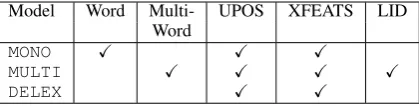
Table 1: Feature set used for each type of model in UParse. Multi-Word denotes the multilingual word embeddings. XFEATS feature is only used if the annotation is available in the training data.
Label Predictions. After obtaining the unla-beled dependency trees, the parser needs to predict labels. To do this, a two-layer rectifier network (Glorot et al., 2011) is used. More formally, to predict the arc label betweenwiandwj, the clas-sifier takes as input the concatenation of the local (Eq. 1) and global (Eq. 2) vector representations of both words,[ai;aj;xi;xj]and predicts a valid dependency label.
Zhang et al. (2017) presents more detailed ac-count of the parsing model.
2.2 UParse
Next, we describe UParse, the extended version of DENSE which we use for the UD shared task. As mentioned in Section 1, UParse is a combination of monolingual, multilingual, UDPipe baseline, and delexicalized models. In general, the key dif-ference between DENSE and UParse is in the type of features used for training. UParse uses richer linguistic features, namely word embeddings, uni-versal POS tag (UPOS), morphological analysis (XFEATS), and language ID (LID). This design is mostly inspired by the work of Ammar et al.
(2016) and Straka et al. (2016) for monolingual and multilingual parsing models. Each feature is represented by its vector representations and we concatenate them together to represent each in-put token which will be fed into the bi-LSTMs. Specifically, we modify Eq.1to
xi = [e(wi);e(ti);e(mi);e(lidi)] (5)
wheree(mi) ande(lidi)denotes the embeddings of XFEATS and language ID, respectively.2 Dur-ing trainDur-ing our system uses gold annotations (to-kenization, UPOS, and XFEATS) provided in the data. At test time, it uses predicted annotations produced by UDPipe (Straka et al.,2016).
Table 1 shows different feature set used in each type of model in the UParse. We employ
2We treat XFEATS as an atomic symbol.
the original DENSE architecture for the mono-lingual models in UParse, with an additional fea-ture (XFEATS, if available). For the multilingual models, we replace the standard word embeddings with multilingual word embeddings (Section2.3). This is important since we need to project word vectors of different languages to the same vector space. We also use language ID as a feature, to inform the parser about the language of the sen-tence it is currently parsing. This allows the model to learn not only transferable dependency features across languages, but also the language-specific features.
2.3 Multilingual Word Embeddings
FollowingAmmar et al.(2016), we adapt the ro-bust projection approach of Guo et al. (2016) to build our multilingual word embeddings. The idea is to train word embeddings of a source language and project them to obtain word embeddings for the target languages. For the shared task, we use English pre-trained word vectors trained on the Wikipedia data (Bojanowski et al., 2016) as our source embeddings. Next, we use OPUS data (Tiedemann, 2012,2009) to build alignment dic-tionaries for languages that have parallel text with English. Specifically, we use parallel corpora of Europarl, Global Voices, Wikipedia, and hrWaC (for Croatian).
To build the alignment dictionaries, we use
fast align toolkit (Dyer et al., 2013). We then compute vector for each target word using the weighted average of its aligned English word em-beddings, weighted by the alignment probabilities. A limitation of this approach is that it creates em-beddings for target words that appear in the par-allel data. Thus, the final step of this approach also compute embeddings for other target words not aligned with the source words by averaging the embeddings of all aligned target words within an edit distance of 1. The token level embeddings are shared across languages.
3 Preliminary Experiments
Prior to our participation in the shared task, we ran a number of preliminary experiments that in-formed the design of the final system. Our shared task submission is based on these results.
[image:3.595.77.287.62.115.2]Type Model de en esLanguagesfr it pt sv Average
MONO UDPipe 82.9 87.5 87.1 84.5 90.2 87.2 86.2 86.5 UParse 86.8 88.7 89.2 87.1 91.4 88.0 88.2 88.5
[image:4.595.119.479.61.133.2]MULTI UParse 85.9 87.4 88.3 87.6 91.8 89.0 88.8 88.4
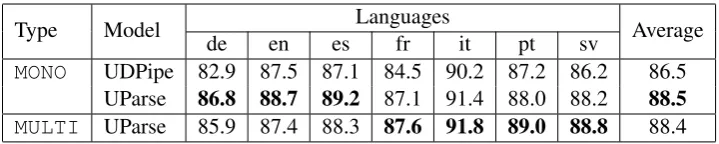
Table 2: UAS results for monolingual and multilingual model of UParse on the Universal Dependencies version 1.2.
Type Model de en esLanguagesfr it pt sv Average
MONO UDPipe 78.6 85.0 84.5 81.0 88.1 84.7 83.2 83.6 UParse 80.4 85.5 85.5 83.1 88.9 84.2 82.7 84.3
MULTI MALOPA 78.9 85.4 84.3 82.4 89.1 86.2 84.5 84.4
[image:4.595.112.485.176.260.2]UParse 77.9 85.1 84.3 81.9 89.0 86.5 81.1 83.7
Table 3: LAS results for monolingual and multilingual model of UParse on the Universal Dependencies version 1.2. MALOPA is the multilingual parser ofAmmar et al.(2016).
work of Ammar et al. (2016). To compare our results, we use the same datasets from Univer-sal Dependencies version 1.2 (Nivre et al.,2015), for seven languages: English, French, German, Italian, Spanish, Swedish, and Portuguese. The training data for the first five languages consists of more than 10K training sentences, while for Portuguese and Swedish, there are 8.8K and 4.3K training sentences, respectively. For simplicity, we also follow their experimental setup for training optimization (more detail is reported in Section4). In addition, we also compare our parser perfor-mance for the monolingual models with UDPipe parser.
Table 2 and 3 present the performance of our parser compared to UDPipe (monolingual) and MALOPA (multilingual) parsers. In terms of UAS, our multilingual model achieves the best scores, except for English, German, and French. The results for LAS are slightly different. We found that for languages where we have more than 10K training sentences, our monolingual model outperforms the other models, with an exception on Italian. For the smaller treebanks, although we see UAS improvements for Portuguese and Swedish when we use multilingual model, we only obtain LAS improvement on Portuguese. We be-lieve that these mixed results are due to poor accu-racy of our label classifier, since the UAS results demonstrate that the parser itself is quite effective in predicting the dependency arcs.
4 Experiments
This section describes the experimental design, training, and also our submissions to the shared task. After looking at the results of our prelimi-nary experiments, we decided to train both mono-lingual and multimono-lingual parsers, evaluate them on the shared task development data and choose the best settings for our submissions.
4.1 Language Groups
To build the multilingual models, we first group the treebanks such that treebanks of related lan-guages will be trained in a single model. We use genus and language family information taken from the World Atlas of Language Structures(WALS;
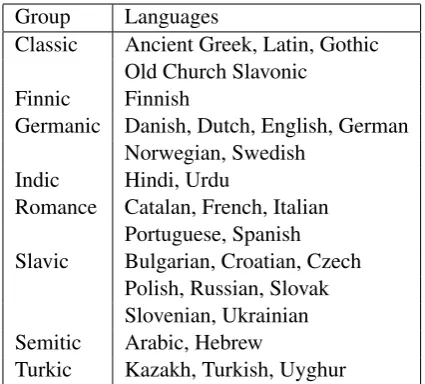
Dryer and Haspelmath (2013)) to group the lan-guages. For each treebank in which the language is not related to any other treebanks, it will be in a singleton group, hence the same as a monolin-gual model. For classic languages like Ancient Greek, Latin, Gothic, and Old Church Slavonic, we group them to the same group, instead of using the WALS information. Table 4 shows the lan-guage groups used in UParse.
4.2 Training
Group Languages
Classic Ancient Greek, Latin, Gothic Old Church Slavonic
Finnic Finnish
Germanic Danish, Dutch, English, German Norwegian, Swedish
Indic Hindi, Urdu
Romance Catalan, French, Italian Portuguese, Spanish Slavic Bulgarian, Croatian, Czech
Polish, Russian, Slovak Slovenian, Ukrainian Semitic Arabic, Hebrew
[image:5.595.75.288.61.253.2]Turkic Kazakh, Turkish, Uyghur
Table 4: Language groups used for building UP-arse multilingual models. Finish language has two treebanks, we group them together in the same group.
word embeddings fromBojanowski et al. (2016) and OPUS parallel data (Tiedemann,2012,2009). Unless we explicitly mention in the description, we follow the same training configurations as de-scribed inZhang et al.(2017). We use two-layer bi-LSTMs with 150 hidden units, and set embed-ding size for {words, UPOS, XFEATS, LID} to
{300, 30, 40, 10}, respectively. The word bedding size matches that of the pre-trained em-beddings. We did not use the Czech-CLLT or any ParTUT treebanks for training since they contain many long sentences (the longest sentence in the Czech-CLLT treebank consists of 534 words). At test time, we parse these treebanks using the mod-els trained on the same language. We trained our models on an Nvidia GPU card; training a mono-lingual model takes 1-2 hours, while training a multilingual model takes 4-5 hours.
Word embeddings. For monolingual training, we initialize the embeddings with the pre-trained ones and keep them fixed during training. For the multilingual models, we first create multilingual word embeddings as described in Section2.3, us-ing OPUS parallel data and English as the source language. Unlike Ammar et al. (2016) and Guo et al. (2016), we also share representations for words which are used by more than one language. For example, ifsystemappears in the English and German data, we only use a single vector to repre-sent it. Of course, this means we allow param-eter sharing across words with the same forms,
but different meanings. But on the other hand, it also enables named entities and loanwords to have the same representation across languages. We ini-tialize the embeddings with the multilingual word embeddings and update them during training.3 For all models, embeddings for words with no pre-trained representation are initialized uniformly at random in the range [-0.1, 0.1].
Optimization for multilingual training. For multilingual training, we follow Ammar et al.
(2016) when updating the parameters. Specifi-cally, we use mini-batch updates in which we uni-formly sampled (without replacement) the same number of sentences for each treebank, until all sentences in the smallest treebank are used. In other words, each epoch will useN×Lsentences, whereNis the number of sentences in the smallest treebank andLis the number of languages. 4.3 Truly Low-Resource Treebanks
There are some challenges when training the truly low-resource treebanks, i.e., treebanks with less than 2K sentences, with no other treebanks from the same language available. For example, Viet-namese treebank only has 1400 sentences with no related languages in terms of genus and language family. Ideally, we want to apply multilingual learning for these treebanks since we do not have enough examples to train them using monolingual models. Moreover, languages like Kazakh and Uyghur have 100 training sentences or fewer and no development data, which makes it difficult to do multilingual training as described above. Our initial experiments show that multilingual learning helps improve accuracy of the truly low-resource treebanks (with less than 1K training sentences), but degrades accuracy of the high-resource tree-banks. This is because using our training set up, each epoch will only consists of small number of sentences per language. Irish is particularly chal-lenging, with only 566 training sentences, no de-velopment data, and no related languages. Our training strategy for these particular cases are as follows:
Estonian and Hungarian. These languages are belong to the Uralic language family. Since Finnish has two treebanks with large training data, we train two more multilingual models for each, using additional Finnish treebanks.
3We did not fix the embeddings since in our preliminary
We do not use a single model to train both Estonian and Hungarian since Estonian has more training sentences than Hungarian.
Greek. We train a multilingual model for Greek, using training data from Ancient Greek and Greek treebanks.4
Irish. Since this language does not have any re-lated languages, we use delexicalized model of Czech. We chose Czech since the language has the largest treebank.
Kazakh and Uyghur. For the two languages, since the training data are very small, we use a single delexicalized model of Turkish. We only use Turkish data during training, but in-clude both Kazakh and Uyghur training data in the development set.
4.4 Surprise Languages and Treebanks For the surprise languages, since we do not have any training data, we train delexicalized models on related languages. In particular, we use delexi-calized Russian for Buryat, Persian for Kurmanji, Finnic for North Sami, and Czech for Upper Sor-bian. Note that the delexicalized models of Rus-sian, Finnic, and Czech use all the treebanks of the language, thus allowing transfer learning between different treebanks of the same language. For example, to train a delexicalized model of Rus-sian, we use both UD Russian and UD Russian-SynTagRus treebanks.
For the surprise treebanks from known lan-guages, we simply use a parser trained on other treebanks in that language.
5 Results and Analysis
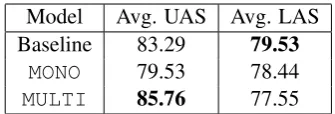
5.1 Initial Results on Development Data During the training phase, we evaluated the perfor-mance of our monolingual and multilingual sys-tems using the official development data. Since we use gold annotations (tokenization, UPOS, and XFEATS) as our features, we compare our perfor-mance with UDPipe baseline which also use gold annotations. Table5shows the average UAS and LAS of the monolingual and multilingual systems. Similar to our preliminary results, we see improve-ments on UAS for the multilingual model, but with
4This specific model is slightly different, one might
as-sume that Ancient Greek and Modern Greek are highly re-lated.
Model Avg. UAS Avg. LAS Baseline 83.29 79.53
MONO 79.53 78.44
[image:6.595.332.500.61.118.2]MULTI 85.76 77.55
Table 5: Average UAS and LAS of the monolin-gual versus multilinmonolin-gual models. The baseline is UDPipe with gold annotations.
LAS lower than the monolingual or even the UD-Pipe system. When we look at the results for in-dividual treebanks, we found that our models are especially achieved lower LAS than the baseline system on the smaller treebanks.
5.2 Submission
The UD shared task employs TIRA (Potthast et al.,
2014) to evaluate all systems. When we deployed our system on the TIRA virtual machine, we en-countered two problems which break the evalua-tion script. First, our system sometimes produces multiple roots in the prediction, which the script rejects. To address this, we post-processed the predicted tree by taking the first prediction as the root, and connect other roots to the first root with a clausal component label, ccomp.5 The second problem occurs when the test data has sentence longer than the maximum sentence length in the training data.6 Because we had limited time to ad-dress this, we used the following algorithm: Let nbe the maximum length of sentence allowed by the parsing model. For each sentences with length k, wherek > n:
1. Parse the firstnwords in the sentence. 2. For the restk−nwords, connect each word
with the previous word, and label the arc be-tween them using a heuristic label (DIST), or a random label (RAND). We simply take the most frequent label between the head POS and the dependent POS in the training data forDIST.
We decided to use the combination of monolin-gual, multilinmonolin-gual, UDPipe (only for the primary system,UP-1), and delexicalized models for our primary system. For each treebank, we pick the
5We choose this label based from our observation on the
multiple roots prediction. Most of the time, our parser pre-dicts multiple roots if the sentences are too long and contain multiple clauses.
6In the current training setup, the maximum sentence
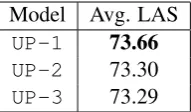
Model Avg. LAS
UP-1 73.66
UP-2 73.30
[image:7.595.134.230.62.118.2]UP-3 73.29
Table 6: Macro-averaged LAS F1 score on devel-opment data.
Treebank name Model
Estonian* Finnic-Estonian Gothic Classic
Hungarian* Finnic-Hungarian Irish* DEL-Czech Kazakh* DEL-Turkic Old Church Slavonic* Classic Slovak* Slavic Swedish Germanic Swedish-LinES Germanic Uyghur* DEL-Turkic Buryat DEL-Russian Kurmanji DEL-Persian North Sami DEL-Finnic Upper Sorbian DEL-Czech
Table 7: List of treebanks which use multilingual or delexicalized models in UParse. (*) denotes treebanks which use UDPipe models in UP-1. The bottom part of the table shows the models used to parse surprise languages.
best model based on its performance on the devel-opment data. We use UDPipe models for 24 tree-banks in which we achieved lower performance than the baseline on the development data (de-noted by (*) in Table9). UP-2andUP-3do not use any UDPipe models. Table7lists all treebanks which use multilingual or delexicalized models for parsing. Our final submission consists of three dif-ferent systems:
1. UP-1: UParse +DIST+ UDPipe 2. UP-2: UParse +DIST
3. UP-3: UParse +RAND
Table6shows the macro-averaged LAS F1 scores for all the systems.
5.3 Results on Test Data
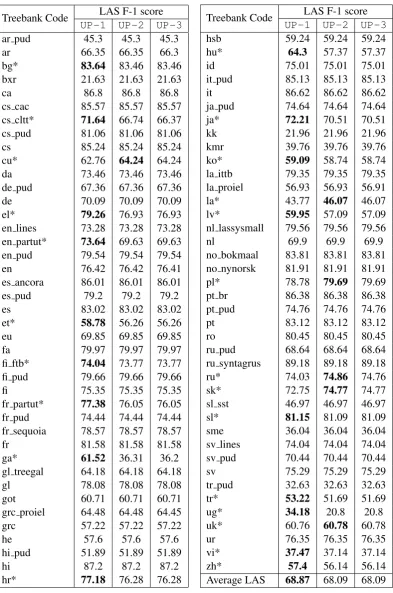
Table 8 shows the results of our primary system of LAS, UAS, and CLAS (Nivre and Fang,2017). The more detailed results for each treebank and system is given in Table9. Similar to the results
[image:7.595.379.454.62.120.2]Metric Score LAS 68.87 UAS 75.49 CLAS 63.55
Table 8: LAS, UAS, and CLAS results of our pri-mary system,UP-1.
on development data (Table6),UP-1achieves the best macro-average F1 score out of the three sys-tems. The results of UP-2 and UP-3 are quite similar, which is not surprising since there are only a few long sentences in the test data.
We further observe the performance of the UD-Pipe baseline model versus UParse models, by comparing the performance ofUP-1andUP-2on the 24 treebanks (treebanks with (*) in Table 9). Based on the results, our system achieves lower LAS-F1 scores on 16 treebanks, which are either treebanks with small training data or treebanks with long sentences, for which we did not train any model. For the other six treebanks, our sys-tem achieves higher LAS-F1 scores than the UD-Pipe baseline system, with 4 treebanks predicted using the multilingual models.
Our system is deployed on the TIRA virtual machine, which is a quad-core CPU with 16GB RAM. It took 2 hours and 43 minutes for our pri-mary system to parse the official test data.
6 Conclusion and Future Work
We described UParse, our system for the CoNLL UD Shared Task 2017. Our observation from the overall results suggested that our parsing model outperforms the UDPipe baseline model, except in cases when there is little training data avail-able. Our approach to perform multilingual learn-ing by transferrlearn-ing models from high-resource to low-resource treebank seems to be quite effective in predicting the dependency arcs, but less for the label predictions. However, we observed some im-provements for a number of treebanks when we use a multilingual model trained using treebanks from related languages.
In the light of these results, some possible di-rections for the future work include improving the label predictions of the parsing model and explor-ing the possibilities to use character-level mod-els, as they have shown to be effective for parsing morphologically rich languages (Ballesteros et al.,
[image:7.595.81.284.160.370.2]Treebank Code UP-1 UP-2 UP-3LAS F-1 score ar pud 45.3 45.3 45.3 ar 66.35 66.35 66.3
bg* 83.64 83.46 83.46
bxr 21.63 21.63 21.63 ca 86.8 86.8 86.8 cs cac 85.57 85.57 85.57 cs cltt* 71.64 66.74 66.37 cs pud 81.06 81.06 81.06 cs 85.24 85.24 85.24 cu* 62.76 64.24 64.24 da 73.46 73.46 73.46 de pud 67.36 67.36 67.36 de 70.09 70.09 70.09
el* 79.26 76.93 76.93
en lines 73.28 73.28 73.28 en partut* 73.64 69.63 69.63 en pud 79.54 79.54 79.54 en 76.42 76.42 76.41 es ancora 86.01 86.01 86.01 es pud 79.2 79.2 79.2 es 83.02 83.02 83.02
et* 58.78 56.26 56.26
eu 69.85 69.85 69.85 fa 79.97 79.97 79.97 fi ftb* 74.04 73.77 73.77 fi pud 79.66 79.66 79.66 fi 75.35 75.35 75.35 fr partut* 77.38 76.05 76.05 fr pud 74.44 74.44 74.44 fr sequoia 78.57 78.57 78.57 fr 81.58 81.58 81.58
ga* 61.52 36.31 36.2
gl treegal 64.18 64.18 64.18 gl 78.08 78.08 78.08 got 60.71 60.71 60.71 grc proiel 64.48 64.48 64.45 grc 57.22 57.22 57.22 he 57.6 57.6 57.6 hi pud 51.89 51.89 51.89 hi 87.2 87.2 87.2
hr* 77.18 76.28 76.28
Treebank Code UP-1 UP-2 UP-3LAS F-1 score hsb 59.24 59.24 59.24 hu* 64.3 57.37 57.37 id 75.01 75.01 75.01 it pud 85.13 85.13 85.13 it 86.62 86.62 86.62 ja pud 74.64 74.64 74.64
ja* 72.21 70.51 70.51
kk 21.96 21.96 21.96 kmr 39.76 39.76 39.76
ko* 59.09 58.74 58.74
la ittb 79.35 79.35 79.35 la proiel 56.93 56.93 56.91 la* 43.77 46.07 46.07
lv* 59.95 57.09 57.09
nl lassysmall 79.56 79.56 79.56 nl 69.9 69.9 69.9 no bokmaal 83.81 83.81 83.81 no nynorsk 81.91 81.91 81.91 pl* 78.78 79.69 79.69 pt br 86.38 86.38 86.38 pt pud 74.76 74.76 74.76 pt 83.12 83.12 83.12 ro 80.45 80.45 80.45 ru pud 68.64 68.64 68.64 ru syntagrus 89.18 89.18 89.18 ru* 74.03 74.86 74.76 sk* 72.75 74.77 74.77 sl sst 46.97 46.97 46.97
sl* 81.15 81.09 81.09
sme 36.04 36.04 36.04 sv lines 74.04 74.04 74.04 sv pud 70.44 70.44 70.44 sv 75.29 75.29 75.29 tr pud 32.63 32.63 32.63
tr* 53.22 51.69 51.69
ug* 34.18 20.8 20.8
uk* 60.76 60.78 60.78 ur 76.35 76.35 76.35
vi* 37.47 37.14 37.14
[image:8.595.104.498.99.693.2]zh* 57.4 56.14 56.14 Average LAS 68.87 68.09 68.09
both morphological analysis and also sub-word unit representation (characters, character n-grams, or morphemes) and investigate whether these fea-tures are transferable across languages with simi-lar typology.
Acknowledgments
We would like to thank Sameer Bansal, Jianpeng Cheng, Jonathan Mallinson, and the anonymous reviewers for the helpful feedbacks. Clara Vania is supported by the Indonesian Endowment Fund for Education (LPDP), the Centre for Doctoral Train-ing in Data Science, funded by the UK EPSRC (grant EP/L016427/1), and the University of Ed-inburgh.
References
Waleed Ammar, George Mulcaire, Miguel Balles-teros, Chris Dyer, and Noah Smith. 2016. Many languages, one parser. Transactions of the As-sociation for Computational Linguistics 4:431– 444. https://www.transacl.org/ojs/index.php/tacl /article/view/892.
Gabor Angeli, Melvin Jose Johnson Premkumar, and Christopher D. Manning. 2015. Leverag-ing lLeverag-inguistic structure for open domain informa-tion extracinforma-tion. In Proceedings of the 53rd An-nual Meeting of the Association for Computa-tional Linguistics and the 7th InternaComputa-tional Joint Conference on Natural Language Processing (Vol-ume 1: Long Papers). Association for Computa-tional Linguistics, Beijing, China, pages 344–354.
http://www.aclweb.org/anthology/P15-1034. Dzmitry Bahdanau, Kyunghyun Cho, and Yoshua
Ben-gio. 2015. Neural machine translation by jointly learning to align and translate. Proceedings of the 3rd International Conference on Learning Repre-sentations.
Miguel Ballesteros, Chris Dyer, and Noah A. Smith. 2015. Improved transition-based parsing by model-ing characters instead of words with lstms. In Pro-ceedings of the 2015 Conference on Empirical Meth-ods in Natural Language Processing. Association for Computational Linguistics, Lisbon, Portugal, pages 349–359. http://aclweb.org/anthology/D15-1041.
Piotr Bojanowski, Edouard Grave, Armand Joulin, and Tomas Mikolov. 2016. Enriching word vec-tors with subword information. arXiv preprint arXiv:1607.04606.
Xavier Carreras and Michael Collins. 2009. Non-projective parsing for statistical machine trans-lation. In Proceedings of the 2009 Conference on Empirical Methods in Natural Language
Processing: Volume 1 - Volume 1. Associa-tion for ComputaAssocia-tional Linguistics, Strouds-burg, PA, USA, EMNLP ’09, pages 200–209.
http://dl.acm.org/citation.cfm?id=1699510.1699537.
Danqi Chen and Christopher Manning. 2014. A fast and accurate dependency parser using neural networks. In Proceedings of the 2014 Confer-ence on Empirical Methods in Natural Language Processing (EMNLP). Association for Computa-tional Linguistics, Doha, Qatar, pages 740–750.
http://www.aclweb.org/anthology/D14-1082.
Y. J. Chu and T. H. Liu. 1965. On the shortest arbores-cence of a directed graph. Science Sinica14.
Hang Cui, Renxu Sun, Keya Li, Min-Yen Kan, and Tat-Seng Chua. 2005. Question answer-ing passage retrieval usanswer-ing dependency relations. In Proceedings of the 28th Annual International ACM SIGIR Conference on Research and De-velopment in Information Retrieval. ACM, New York, NY, USA, SIGIR ’05, pages 400–407.
https://doi.org/10.1145/1076034.1076103.
Matthew S. Dryer and Martin Haspelmath, editors. 2013. WALS Online. Max Planck Institute for Evo-lutionary Anthropology, Leipzig. http://wals.info/.
Long Duong, Trevor Cohn, Steven Bird, and Paul Cook. 2015a. Low resource dependency pars-ing: Cross-lingual parameter sharing in a neu-ral network parser. In Proceedings of the 53rd Annual Meeting of the Association for Computa-tional Linguistics and the 7th InternaComputa-tional Joint Conference on Natural Language Processing (Vol-ume 2: Short Papers). Association for Computa-tional Linguistics, Beijing, China, pages 845–850.
http://www.aclweb.org/anthology/P15-2139.
Long Duong, Trevor Cohn, Steven Bird, and Paul Cook. 2015b. A neural network model for low-resource universal dependency parsing. In Proceed-ings of the 2015 Conference on Empirical Methods in Natural Language Processing. Association for Computational Linguistics, Lisbon, Portugal, pages 339–348. http://aclweb.org/anthology/D15-1040.
Chris Dyer, Miguel Ballesteros, Wang Ling, Austin Matthews, and Noah A. Smith. 2015. Transition-based dependency parsing with stack long short-term memory. In Proceedings of the 53rd An-nual Meeting of the Association for Computa-tional Linguistics and the 7th InternaComputa-tional Joint Conference on Natural Language Processing (Vol-ume 1: Long Papers). Association for Computa-tional Linguistics, Beijing, China, pages 334–343.
http://www.aclweb.org/anthology/P15-1033.
Language Technologies. Association for Computa-tional Linguistics, Atlanta, Georgia, pages 644–648.
http://www.aclweb.org/anthology/N13-1073. Jack Edmonds. 1967. Optimum branchings. Journal
of Research of the National Bureau of Standards B 71(4):233–240.
Jason Eisner. 1996. Efficient normal-form pars-ing for combinatory categorial grammar. In Proceedings of the 34th Annual Meeting of the Association for Computational Linguis-tics. Association for Computational Linguistics, Santa Cruz, California, USA, pages 79–86.
https://doi.org/10.3115/981863.981874.
Xavier Glorot, Antoine Bordes, and Yoshua Bengio. 2011. Deep sparse rectifier neural networks. In In-ternational Conference on Artificial Intelligence and Statistics. Cadiz, Spain, pages 315–323.
Jiang Guo, Wanxiang Che, David Yarowsky, Haifeng Wang, and Ting Liu. 2015. Cross-lingual de-pendency parsing based on distributed representa-tions. In Proceedings of the 53rd Annual Meet-ing of the Association for Computational Lin-guistics and the 7th International Joint Confer-ence on Natural Language Processing (Volume 1: Long Papers). Association for Computational Linguistics, Beijing, China, pages 1234–1244.
http://www.aclweb.org/anthology/P15-1119. Jiang Guo, Wanxiang Che, David Yarowsky, Haifeng
Wang, and Ting Liu. 2016. A representa-tion learning framework for multi-source transfer parsing. https://www.aaai.org/ocs/index.php/AAAI /AAAI16/paper/view/12236.
Eliyahu Kiperwasser and Yoav Goldberg. 2016. Sim-ple and accurate dependency parsing using bidirec-tional lstm feature representations. Transactions of the Association for Computational Linguistics 4:313–327. https://transacl.org/ojs/index.php/tacl /article/view/885.
Ryan McDonald, Koby Crammer, and Fernando Pereira. 2005. Online large-margin training of de-pendency parsers. In Proceedings of the 43rd Annual Meeting of the Association for Computa-tional Linguistics (ACL’05). Association for Com-putational Linguistics, Ann Arbor, Michigan, pages 91–98. https://doi.org/10.3115/1219840.1219852. Ryan McDonald, Slav Petrov, and Keith Hall. 2011.
Multi-source transfer of delexicalized dependency parsers. In Proceedings of the 2011 Confer-ence on Empirical Methods in Natural Language Processing. Association for Computational Lin-guistics, Edinburgh, Scotland, UK., pages 62–72.
http://www.aclweb.org/anthology/D11-1006.
Joakim Nivre, ˇZeljko Agi´c, Maria Jesus Aranzabe, Masayuki Asahara, Aitziber Atutxa, Miguel Balles-teros, John Bauer, Kepa Bengoetxea, Riyaz Ah-mad Bhat, Cristina Bosco, Sam Bowman, Giuseppe
G. A. Celano, Miriam Connor, Marie-Catherine de Marneffe, Arantza Diaz de Ilarraza, Kaja Do-brovoljc, Timothy Dozat, Tomaˇz Erjavec, Rich´ard Farkas, Jennifer Foster, Daniel Galbraith, Filip Gin-ter, Iakes Goenaga, Koldo Gojenola, Yoav Gold-berg, Berta Gonzales, Bruno Guillaume, Jan Hajiˇc, Dag Haug, Radu Ion, Elena Irimia, Anders Jo-hannsen, Hiroshi Kanayama, Jenna Kanerva, Simon Krek, Veronika Laippala, Alessandro Lenci, Nikola Ljubeˇsi´c, Teresa Lynn, Christopher Manning, Ctlina Mrnduc, David Mareˇcek, H´ector Mart´ınez Alonso, Jan Maˇsek, Yuji Matsumoto, Ryan McDonald, Anna Missil¨a, Verginica Mititelu, Yusuke Miyao, Simonetta Montemagni, Shunsuke Mori, Hanna Nurmi, Petya Osenova, Lilja Øvrelid, Elena Pascual, Marco Passarotti, Cenel-Augusto Perez, Slav Petrov, Jussi Piitulainen, Barbara Plank, Martin Popel, Prokopis Prokopidis, Sampo Pyysalo, Loganathan Ramasamy, Rudolf Rosa, Shadi Saleh, Sebastian Schuster, Wolfgang Seeker, Mojgan Seraji, Natalia Silveira, Maria Simi, Radu Simionescu, Katalin Simk´o, Kiril Simov, Aaron Smith, Jan ˇStˇep´anek, Alane Suhr, Zsolt Sz´ant´o, Takaaki Tanaka, Reut Tsarfaty, Sumire Uematsu, Larraitz Uria, Viktor Varga, Veronika Vincze, Zdenˇek ˇZabokrtsk´y, Daniel Zeman, and Hanzhi Zhu. 2015. Universal depen-dencies 1.2LINDAT/CLARIN digital library at In-stitute of Formal and Applied Linguistics, Charles University in Prague. http://hdl.handle.net/11234/1-1548.
Joakim Nivre, Marie-Catherine de Marneffe, Filip Gin-ter, Yoav Goldberg, Jan Hajiˇc, Christopher Man-ning, Ryan McDonald, Slav Petrov, Sampo Pyysalo, Natalia Silveira, Reut Tsarfaty, and Daniel Zeman. 2016. Universal Dependencies v1: A multilingual treebank collection. InProceedings of the 10th In-ternational Conference on Language Resources and Evaluation (LREC 2016). European Language Re-sources Association, Portoro, Slovenia, pages 1659– 1666.
Joakim Nivre and Chiao-Ting Fang. 2017. Univer-sal dependency evaluation. In Proceedings of the NoDaLiDa 2017 Workshop on Universal Dependen-cies (UDW 2017). pages 86–95.
Joakim Nivre, Johan Hall, Jens Nilsson, G¨uls¸en Eryiˇgit, and Svetoslav Marinov. 2006. Labeled pseudo-projective dependency parsing with support vector machines. In Proceedings of the Tenth Conference on Computational Natural Language Learning (CoNLL-X). Association for Computa-tional Linguistics, New York City, pages 221–225.
http://www.aclweb.org/anthology/W/W06/W06-2933.
Martin Potthast, Tim Gollub, Francisco Rangel, Paolo Rosso, Efstathios Stamatatos, and Benno Stein. 2014. Improving the reproducibility of PAN’s shared tasks: Plagiarism detection, author iden-tification, and author profiling. In Evangelos Kanoulas, Mihai Lupu, Paul Clough, Mark Sander-son, Mark Hall, Allan Hanbury, and Elaine Toms, editors, Information Access Evaluation meets Mul-tilinguality, Multimodality, and Visualization. 5th International Conference of the CLEF Initiative (CLEF 14). Springer, Berlin Heidelberg New York, pages 268–299. https://doi.org/10.1007/978-3-319-11382-1 22.
Milan Straka, Jan Hajiˇc, and Jana Strakov´a. 2016. UD-Pipe: trainable pipeline for processing CoNLL-U files performing tokenization, morphological anal-ysis, POS tagging and parsing. In Proceedings of the 10th International Conference on Language Resources and Evaluation (LREC 2016). European Language Resources Association, Portoro, Slovenia.
J¨org Tiedemann. 2009. News from OPUS - A collec-tion of multilingual parallel corpora with tools and interfaces. In N. Nicolov, K. Bontcheva, G. An-gelova, and R. Mitkov, editors, Recent Advances in Natural Language Processing, John Benjamins, Amsterdam/Philadelphia, Borovets, Bulgaria, vol-ume V, pages 237–248.
J¨org Tiedemann. 2012. Parallel data, tools and in-terfaces in opus. In Nicoletta Calzolari (Con-ference Chair), Khalid Choukri, Thierry Declerck, Mehmet Ugur Dogan, Bente Maegaard, Joseph Mariani, Jan Odijk, and Stelios Piperidis, edi-tors, Proceedings of the Eight International Con-ference on Language Resources and Evaluation (LREC’12). European Language Resources Associ-ation (ELRA), Istanbul, Turkey.
Daniel Zeman, Martin Popel, Milan Straka, Jan Hajiˇc, Joakim Nivre, Filip Ginter, Juhani Luotolahti, Sampo Pyysalo, Slav Petrov, Martin Potthast, Fran-cis Tyers, Elena Badmaeva, Memduh G¨okırmak, Anna Nedoluzhko, Silvie Cinkov´a, Jan Hajiˇc jr., Jaroslava Hlav´aˇcov´a, V´aclava Kettnerov´a, Zdeˇnka Ureˇsov´a, Jenna Kanerva, Stina Ojala, Anna Mis-sil¨a, Christopher Manning, Sebastian Schuster, Siva Reddy, Dima Taji, Nizar Habash, Herman Leung, Marie-Catherine de Marneffe, Manuela Sanguinetti, Maria Simi, Hiroshi Kanayama, Valeria de Paiva, Kira Droganova, Hˇector Mart´ınez Alonso, Hans Uszkoreit, Vivien Macketanz, Aljoscha Burchardt, Kim Harris, Katrin Marheinecke, Georg Rehm, Tolga Kayadelen, Mohammed Attia, Ali Elkahky, Zhuoran Yu, Emily Pitler, Saran Lertpradit, Michael Mandl, Jesse Kirchner, Hector Fernandez Alcalde, Jana Strnadova, Esha Banerjee, Ruli Manurung, An-tonio Stella, Atsuko Shimada, Sookyoung Kwak, Gustavo Mendonc¸a, Tatiana Lando, Rattima Nitis-aroj, and Josie Li. 2017. CoNLL 2017 Shared Task: Multilingual Parsing from Raw Text to Universal Dependencies. InProceedings of the CoNLL 2017 Shared Task: Multilingual Parsing from Raw Text to
Universal Dependencies. Association for Computa-tional Linguistics.
Xingxing Zhang, Jianpeng Cheng, and Mirella Lapata. 2017. Dependency parsing as head selection. In Proceedings of the 15th Conference of the European Chapter of the Association for Computational Lin-guistics: Volume 1, Long Papers. Association for Computational Linguistics, Valencia, Spain, pages 665–676. http://www.aclweb.org/anthology/E17-1063.
Yuan Zhang and Regina Barzilay. 2015. Hier-archical low-rank tensors for multilingual trans-fer parsing. In Proceedings of the 2015 Con-ference on Empirical Methods in Natural Lan-guage Processing. Association for Computational Linguistics, Lisbon, Portugal, pages 1857–1867.