Attention-based Recurrent Convolutional Neural
Network for Automatic Essay Scoring
Fei Dong and Yue Zhang∗and Jie Yang Singapore University of Technology and Design
{fei dong, jie yang}@mymail.sutd.edu.sg
Abstract
Neural network models have recently been applied to the task of automatic essay scor-ing, giving promising results. Existing work used recurrent neural networks and convolutional neural networks to model input essays, giving grades based on a sin-gle vector representation of the essay. On the other hand, the relative advantages of RNNs and CNNs have not been compared. In addition, different parts of the essay can contribute differently for scoring, which is not captured by existing models. We ad-dress these issues by building a hierarchi-cal sentence-document model to represent essays, using the attention mechanism to automatically decide the relative weights of words and sentences. Results show that our model outperforms the previous state-of-the-art methods, demonstrating the ef-fectiveness of the attention mechanism.
1 Introduction
Automatic essay scoring (AES) is the task of au-tomatically assigning grades to student essays. It can be highly challenging, requiring not only knowledge on spelling and grammars, but also on semantics, discourse and pragmatics. Tradi-tional models use sparse features such as bag-of-words, part-of-speech tags, grammar complex-ity measures, word error rates and essay lengths, which can suffer from the drawbacks of time-consuming feature engineering and data sparsity.
Recently, neural network models have been used for AES (Alikaniotis et al.,2016;Dong and Zhang, 2016; Taghipour and Ng, 2016), giving better results compared to statistical models with handcrafted features. In particular, distributed word representations are used for the input, and
∗Corresponding author.
a neural network model is employed to combine word information, resulting in a single dense vec-tor form of the whole essay. A score is given based on a non-linear neural layer on the representa-tion. Without handcrafted features, neural network models have been shown to be more robust than statistical models across different domains (Dong and Zhang,2016).
Both recurrent neural networks (Williams and Zipser,1989;Mikolov et al., 2010) and convolu-tional neural networks (LeCun et al., 1998;Kim,
2014) have been used for modelling input es-says. In particular, Alikaniotis et al. (2016) and Taghipour and Ng (2016) use a single-layer LSTM (Hochreiter and Schmidhuber,1997) over the word sequence to model the essay, andDong and Zhang (2016) use a two-level hierarchical CNN structure to model sentences and documents separately. It has been commonly understood that CNNs can capture local ngram information effec-tively, while LSTMs are strong in modelling long history. No previous work has compared the ef-fectiveness of LSTMs and CNNs under the same settings for AES. To better understand the con-trast, we adopt the two-layer structure ofDong and Zhang(2016), comparing CNNs and LSTMs for modelling sentences and documents.
Not all sentences contribute equally to the scor-ing of a given essay, and not all words contribute equally within a sentence. We adopt the neural attention model (Xu et al., 2015; Luong et al.,
2015) to automatically calculate weights for con-volution features of CNNs and hidden state val-ues of LSTMs, which has been used for obtain-ing the most pertinent information for machine translation (Luong et al.,2015), sentiment analy-sis (Shin et al.,2016;Wang et al.,2016;Liu and Zhang,2017) and other tasks. In our case, the at-tention mechanism can intuitively select sentences and grams that are more aligned with the props or obviously incorrect. To our knowledge, no prior
work has investigated the effectiveness of atten-tion models for AES.
Results show that CNN is relatively more ef-fective for modelling sentences, and LSTMs are relatively more effective for modelling documents. This is likely because local ngram information are more relevant to the scoring of sentence structures, and global information is more relevant for scoring document level coherence. In addition, attention gives significantly more accurate results. Our fi-nal model achieves the best result reported on the ASAP1 test set. We release our code athttps:
//github.com/feidong1991/aes.
2 Automatic Essay Scoring 2.1 Task
The task of AES is usually treated as a super-vised learning problem, typical models of which can be divided into three categories: classification, regression and preference ranking. In the classi-fication scenario, scores are divided into several categories, each score or score range is regarded as one class and the ordinary classification mod-els are employed such as Naive Bayes (NB) and SVMs (Larkey, 1998; Rudner and Liang, 2002). In the regression scenario, each score is treated as continous values for the essay and regression mod-els are considered, like linear regression, Bayesian linear ridge regression (Attali and Burstein,2004;
Phandi et al.,2015). In the preference ranking sce-nario, AES task is considered as a ranking problem in which pair-wise ranking and list-wise ranking are employed (Yannakoudakis et al., 2011;Chen and He,2013;Cummins et al.,2016). The former considers the ranking between each pair of essays, while the latter considers the absolute ranking of each essay in the whole set.
Formally, an AES model is trained to minimize the difference between its automatically output scores and human given scores on a set of train-ing data:
minXN
i=1
f(y∗i, yi),
s.t.yi =g(ti), i= 1,2, ..., N
(1)
whereN is the total number of essays in the train-ing set, y∗
i and yi are the golden score assigned
by human raters and prediction score made by the
1https://www.kaggle.com/c/asap-aes/data
AES system of i-th essay in the set respectively,
ti is feature representation of i-th essay, f is the
metric function between golden score and predic-tion score, such as mean square error and mean absolute error, andgis the mapping function from featureti to scoreyi.
2.2 Evaluation Metric
Many measurement metrics have be adopted to as-sess the quality of AES systems, including Pear-son’s correlation, Spearman’s ranking correlation, Kendall’s Tau and kappa, especially quadratic weighted kappa (QWK). We follow the Auto-mated Student Assessment Prize (ASAP) compe-tition official criteria which takes QWK as evalu-ation metric, which is also adopted as evaluevalu-ation metric in (Dong and Zhang,2016;Taghipour and Ng,2016;Phandi et al.,2015).
Kappa measures inter-raters agreement on the qualitive items, here inter-raters refer to AES system and human rater. QWK is modified from kappa which takes quadratic weights. The quadratic weight matrix in QWK is defined as:
Wi,j = (i−j)
2
(R−1)2, (2)
whereiandjare the reference rating (assigned by a human rater) and the system rating (assigned by an AES system), respectively, andRis the number of possible ratings.
An observed score matrixO is calculated such thatOi,jrefers to the number of essays that receive
a ratingiby the human rater and a ratingjby the AES system. An expected score matrixE is cal-culated as the outer product of histogram vectors of the two (reference and system) ratings. The ma-trixEneeds to be normalized such that the sum of elements inEand the sum of elements inO keep the same. Finally, given the three matricesW,O
andE, the QWK value is calculated according to Equation3:
κ= 1−
P
Wi,jOi,j
P
Wi,jEi,j (3)
We evaluate our model using QWK as the metric, and perform one-tailedt-test to determine the sig-nificance of improvements.
3 Model
Figure 1: Sentence representation using ConvNet and attention pooling
(2016) who consider essay script as being com-posed of sentence sequences rather than word se-quences. Different from their model, our neu-ral model learns text representation with LSTMs, which could model the coherence and corefer-ence among sequcorefer-ences of sentcorefer-ences (i.e. captur-ing more global information compared to CNNs). Besides, attention pooling is both used on words and sentences, which aims to capture more rele-vant words and sentences that contribute to the fi-nal quality of essays.
We investiage two types of word represen-tations, one being character-based embedding, which utilizes a convolutinal layer to learn word representations from raw characters, and the other being word embedding.
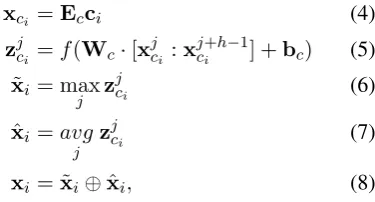
Characters For character-based word represen-tation, we employ a convolutional layer over char-acters in each word, followed by max-pooling and average-pooling layers. The concatenation of max-pooling and average-pooling forms the final word representation for each word.
Let c1
i,c2i, ...,cmi be one-hot representation of
characters that make up the wordwi, we have the
following word representation forwi using
make-up characters:
xci =Ecci (4)
zjci =f(Wc·[xjci :xjc+i h−1] +bc) (5) ˜
xi = maxj zjci (6)
ˆ
xi =avg j z
j
ci (7)
xi = ˜xi⊕xˆi, (8)
whereEcis the embedding matrix,xci is the em-bedding vector for ci, zjci is the feature map for
j-th character ini-th wordwi after convolutional
layer, Wc, bc are the weights matrix and bias
vector respectively, h specifies the window size in the convolutional layer andf is the activation
Figure 2: Document (Text) representation using LSTM and attention pooling
function, here hyperbolic tangent function tanh
is used. x˜i andxˆi are max-pooling and
average-pooling vectors overzjci, and the final word wi’s representation xi is the concatenation of x˜i and
ˆ
xi.
Words Given a sentence of words sequence
w1,w2, ...,wn, an lookup layer map eachwiinto
a dense vectorxi, i= 1,2, ..., n.
xi =Ewi, i= 1,2, ..., n (9)
where wi is one-hot representation of the i-th
word in the sentence,Eis the embedding matrix,
xiis the embedding vector ofi-th word.
3.1 Sentence Representation
After obtaining the word representations xi, i =
1,2, ..., n, we employ a convolutional layer on each sentence:
zi =f(Wz·[xji :xji+hw−1] +bz), (10)
whereWz,bzare weight matrix and bias vector,
respectively, hw is the window size in the
convo-lutional layer andzi is the result feature
represen-tation.
Above the convolutional layer, attention pool-ing is employed to acquire a sentence representa-tion. The structure of a sentence representation is depicted in Figure1. The details of convolutional and attention pooling layers are defined in the fol-lowing equations.
mi =tanh(Wm·zi+bm) (11)
ui = e
wu·mi P
ewu·mj (12)
s=Xuizi, (13)
whereWm,wu are weight matrix and vector,
re-spectively, bm is the bias vector, mi and ui are
[image:3.595.102.290.578.679.2]for i-th word. s is the final sentence representa-tion, which is the weighted sum of all the word vectors.
3.2 Text Representation
A recurrent layer is used to compose a docu-ment (text) representation similar to the models of
Alikaniotis et al. (2016) and Taghipour and Ng
(2016). The main difference is that both earlier work treat the essay script as a sequence of words rathter than a sequence of sentences. Alikaniotis et al. (2016) use score-specific word embeddings as word features and take the last hidden state of LSTM as text representation. Taghipour and Ng
(2016) take the average value over all the hidden states of LSTM as text representation. In contrast to the previous LSTM models, we use LSTM to learn from sentence sequences and attention pool-ing on the hidden states of LSTM to obtain the contribution of each sentence to the final quality of essays. The structure of a text representation using LSTM is depicted in Figure2.
Long short-term memory units are the modi-fied recurrent units which are proposed to han-dle the problem of vanishing gradients effec-tively (Hochreiter and Schmidhuber, 1997; Pas-canu et al.,2013). LSTMs use gates to control in-formation flow, preserving or forgetting informa-tion for each cell units. In order to control infor-mation flow when processing a vector sequence, an input gate, a forget gate and an output gate are employed to decide the passing of information at each time step. Assuming that an essay script con-sists of T sentences, s1, s2, ..., sT with st being
the feature representation oft-th wordst, we have
LSTM cell units addressed in the following equa-tions:
it=σ(Wi·st+Ui·ht−1+bi)
ft=σ(Wf ·st+Uf ·ht−1+bf)
˜
ct=tanh(Wc·st+Uc·ht−1+bc)
ct=it◦˜ct+ft◦ct−1
ot=σ(Wo·st+Uo·ht−1+bo)
ht=ot◦tanh(ct),
(14)
wherestandhtare the input sentence and output
sentence vectors at timet, respectively. Wi,Wf
,Wc,Wo,Ui,Uf,Uc, andUoare weight
matri-ces andbi,bf ,bc, andbo are bias vectors. The
symbol◦denotes element-wise multiplication and
σrepresents the sigmoid function.
After obtaining the intermediate hidden states of LSTMh1,h2, ...,hT, we use another attention
pooling layer over the sentences to learn the final text representation. The attention pooling helps to acuquire the weights of sentences’ contribution to final quality of the text. The attention pooling over sentences is addressed as:
ai =tanh(Wa·hi+ba) (15)
αi = e
wα·ai P
ewα·aj (16)
o=Xαihi, (17)
whereWa, wα are weight matrix and vector
re-spectively,bais the bias vector,aiis attention
vec-tor fori-th sentence, andαiis the attention weight
ofi-th sentence. ois the final text representation, which is the weighted sum of all the sentence vec-tors.
Finally, one linear layer with sigmoid function applied on the text representation to get the final score as described in Equation18.
y=sigmoid(wyo+by) (18)
wherewy,byare weight vector and bias vector,y
is the final score of the essay. 4 Training
Objective We use mean square error (MSE) loss, which is also used in previous models. MSE is widely used in regression tasks, which mea-sures the average value of square error between gold standard scoresy∗
i and prediction scores yi
assigned by the AES system among all the essays. Given N essays, we calculate MSE according to Equation19.
mse(y, y∗) = 1
N
N
X
i=1
(yi−yi∗)2 (19)
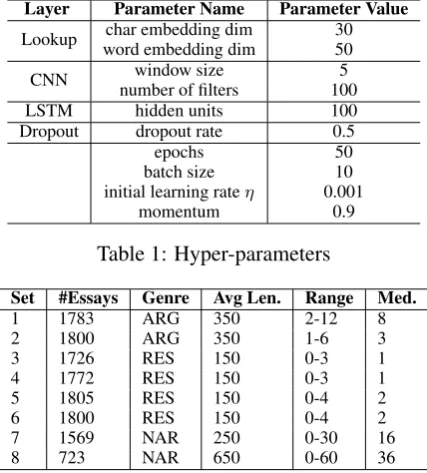
The model is trained on a fixed number of epochs and evaluated on the development set at ev-ery epoch. We set the batch size to 10 and the best model is selected on the performance of quadratic weighted kappa on the development set. The de-tails of model hyper-parameters are listed in Table
1.
Layer Parameter Name Parameter Value
Lookup word embedding dimchar embedding dim 3050 CNN number of filterswindow size 1005
LSTM hidden units 100
Dropout dropout rate 0.5
epochs 50
batch size 10
initial learning rateη 0.001
[image:5.595.74.288.63.300.2]momentum 0.9
Table 1: Hyper-parameters
Set #Essays Genre Avg Len. Range Med.
1 1783 ARG 350 2-12 8
2 1800 ARG 350 1-6 3
3 1726 RES 150 0-3 1
4 1772 RES 150 0-3 1
5 1805 RES 150 0-4 2
6 1800 RES 150 0-4 2
7 1569 NAR 250 0-30 16
8 723 NAR 650 0-60 36
Table 2: Statistics of the ASAP dataset; Range refers to score range and Med. refers to median scores. For genre, ARG specifiesargumentative essays, RES meansresponseessays and NAR de-notesnarrativeessays.
Word Embeddings We take the Stanford’s pub-licly available GloVe 50-dimensional embed-dings2 as word pretrained embeddings, which are
trained on 6 billion words from Wikipedia and web text (Pennington et al., 2014). During the training process, word embeddings are fine-tuned. Optimization We use RMSprop (Dauphin et al.,
2015) as our optimizer to train the whole model. The initial learning rateη is set to 0.001 and mo-mentum is set to 0.9. Dropout regularization is used to avoid overfitting and drop rate is 0.5. 5 Experiments
5.1 Setup
Data The ASAP dataset is used as evaluation data of our AES system. The ASAP dataset con-sists of 8 different prompts of genres as listed in Table2.
There are no released labeled test data from the ASAP competition, thus we separate test set and development set from the training set. The partition exactly follows the setting used by
Taghipour and Ng (2016), which adopts 5-fold cross-validation, in each fold, 60% of the data is used as our training set, 20% as the development
2http://nlp.stanford.edu/projects/glove/
set, and 20% as the test set. The data is tok-enized with NLTK3 tokenizer. All the words are
converted to lowercase and the scores are scaled to the range [0, 1]. During evaluation phase, the scaled scores are rescaled to original integer scores, which are used to calculate evaluation met-ric QWK values. The vocabulary size of the data is set to 4000, by following Taghipour and Ng
(2016), selecting the most 4000 frequent words in the training data and treating all other words as un-known words.
Baseline models We take LSTM with Mean-over-Time Pooling (LSTM-MoT) (Taghipour and Ng, 2016) and hierarchical CNN (CNN-CNN-MoT) (Dong and Zhang,2016) as our baselines. The former takes the essay script as a sequence of words, which is text-level model and the latter re-gards the script as a sequence of sentences, which is sentence-level model.
LSTM-MoT uses one layer of LSTM over the word sequences, and takes the average pooling over all time-step states as the final text representa-tion, which is called Mean-over-Time (MoT) pool-ing (Taghipour and Ng,2016). A linear layer with sigmoid function follows the MoT layer to predict the score of an essay script.
CNN-CNN-MoT uses two layers of CNN, in which one layer operates over each sentence to ob-tain representation for each sentence and the other CNN is stacked above, followed by mean-over-time pooling to get the final text representation.
LSTM-MoT is the current state-of-the-art neu-ral model on the text-level and CNN-CNN-MoT is a state-of-the-art model on the sentence-level. Be-sides, LSTM-LSTM-MoT and LSTM-CNN-MoT are adopted as another two baseline models. The former model takes LSTMs to represent both sen-tences and texts, and the latter uses CNN repre-senting sentences and LSTM reprerepre-senting texts. Both models use MoT pooling and are sentence-level models. We compare our model (LSTM-CNN-attent) with the baseline models to study CNN representing sentences and LSTM represent-ing texts.
5.2 Results
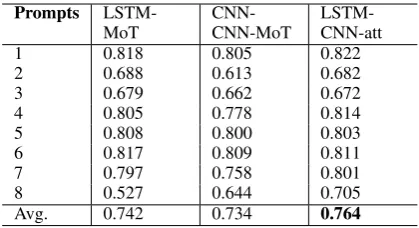
The results are listed in Table 3. Our model LSTM-CNN-attent outperforms the base-line model CNN-CNN-MoT by 3.0%, LSTM-MoT by 2.2% on average quadratic weighted
Prompts
LSTM-MoT CNN-CNN-MoT LSTM-CNN-att
1 0.818 0.805 0.822
2 0.688 0.613 0.682
3 0.679 0.662 0.672
4 0.805 0.778 0.814
5 0.808 0.800 0.803
6 0.817 0.809 0.811
7 0.797 0.758 0.801
8 0.527 0.644 0.705
[image:6.595.76.286.61.175.2]Avg. 0.742 0.734 0.764
Table 3: Comparison of quadratic weighted kappa between different models on the test data.
LSTM-CNN-attent Average QWK
char 0.738
word 0.764
[image:6.595.307.527.62.207.2]word + char 0.761
Table 4: Comparison of quadratic weight kappa using different features on the test data.
kappa. The results are statistically significant with
p < 0.05 by one-tailed t-test. Even compared with the ensemble model used byTaghipour and Ng(2016), which ensembles 10 instances of CNN and LSTM of different initializations, our model still achieves 0.3% improvement on QWK.
5.3 Analysis
We perform several development experiments to verify the effectiveness of sentence-document model and text representation with LSTM and at-tention pooling.
Characters and Words We explore a convo-lutional layer to learn word representation from char-based CNN to replace word embeddings. In Table 4, we compare the performance of using character embeddings, word embeddings and con-catenation of two embeddings. Empirical results show that with only character embedding features, the performance of our model outperforms CNN-CNN-MoT, and is close to LSTM-MoT. How-ever, there is still a big gap between character embedding and word embedding models, which could come from the fact that we use pretrained word embeddings, which helps improve the per-formance. When both the word and character em-beddings are used, the performance does not im-prove. One possible explanation is that the ASAP dataset is rather small given the model parameters, which has a potential for overfitting if both words and characters are used.
Model Model Type Pooling Avg
QWK
LSTM-MoT document-level MoT 0.742 LSTM-attent document-level attention 0.731
CNN-CNN-MoT sentence-level MoT 0.734
LSTM-LSTM-MoT sentence-level MoT 0.758
LSTM-CNN-MoT sentence-level MoT 0.759
LSTM-LSTM-attent sentence-level attention 0.762
LSTM-CNN-attent sentence-level attention 0.764 Table 5: Comparison between different model types and pooling methods on the test data (only word embeddings used).
Granularity The previous model LSTM-MoT tackles the AES task by treating each essay script as a sequence of words, which makes an es-say an extra long sequence. The word num-ber of one essay usually exceeds several hun-dreds, which makes it difficult to directly use LSTM to learn text representation if only last hidden state is used. It has been verified by
Taghipour and Ng(2016) that LSTM with Mean-over-Time pooling outperforms LSTM with only last state. Though MoT pooling could alleviate this problem by considering all the states infor-mation, the model is still built on text-level rather than sentence-level. Both LSTM-CNN-MoT and LSTM-LSTM-MoT are sentence-document mod-els. The former explores CNN for sentence rep-resentation and LSTM for text reprep-resentation, and the latter use both LSTMs for sentence and text representation with MoT pooling. In Table 5, LSTM-CNN-MoT and LSTM-LSTM-MoT obtain large improvements compared to LSTM-MoT, es-pecially for prompt 8 essays, of which the aver-age script length is the biggest. This shows that sentence-document model tends to be more effec-tive for long essays.
[image:6.595.110.255.220.265.2]text representation, and mean-over-time pooling is also used after CNN and LSTM. Compared with CNN-CNN-MoT in Table 5, LSTM-CNN-MoT gives a big improvement. We believe that on text representation layer, LSTMs can learn more global information, such as sentence coherence, while CNNs learn more local features, such as n-grams and bag-of-words. LSTM-LSTM-MoT out-performs CNN-CNN-MoT and gets slightly worse than LSTM-CNN-MoT, which also shows that LSTM is relatively more effective for modeling the documents.
Mean-over-Time vs Attention pooling We
compare the two pooling methods adopted in our model, namely mean-over-time pooling and at-tention pooling in Table 5. The pooling layers are used after both CNN and LSTM layer to get sentence representation and text representation re-spectively. We find that by attending over words and sentences, we achieve the best performance, which demonstrates that attention pooling helps find the key words and sentences that contribute to judging quality of essays. In contrast to MoT, each word and sentence will be treated equally, which violates human raters’ assessing process. Since our model is based on the sentence-level rather than the text-level, we can exert attention pooling to focus on pertinent words and sentences. Note that attention can be weakened when used for an extra long sequence, such as the scenario in the text-level model.Taghipour and Ng(2016) tried to attend over words on their one-layer LSTM model, but failed to beat the baseline model that employs mean-over-time pooling, because of that text-level model contains a quite long sequence of words, which may weaken the effect of attention. On the contrary, sentence-level model contains relatively short sequences of words, which makes attention more effective.
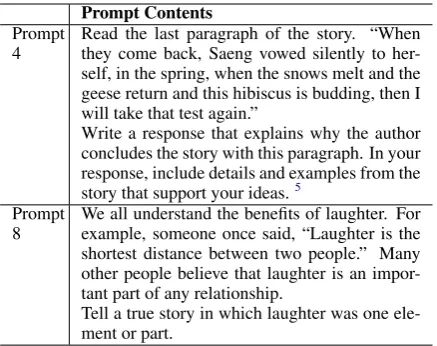
In Table 6, we briefly show two prompts from the AES data, namely Prompt 4 and Prompt 8. Prompt 4 asks for a response based on the last paragraph of a given story and Prompt 8 requires a true story about laughter. Prompt 4 has few num-ber of sentences compared with Prompt 8. For convenience, we take Prompt 4 essays as our ex-amples to analyze the attention mechanism on sen-tences, and Prompt 8 essays to analyze the atten-tion mechanism on words n-grams. In Table7, we list all five sentences in order that make up of one response essay from test set in Prompt 4. Each
Prompt Contents
Prompt
4 Read the last paragraph of the story. “Whenthey come back, Saeng vowed silently to her-self, in the spring, when the snows melt and the geese return and this hibiscus is budding, then I will take that test again.”
Write a response that explains why the author concludes the story with this paragraph. In your response, include details and examples from the story that support your ideas.5
Prompt
8 We all understand the benefits of laughter. Forexample, someone once said, “Laughter is the shortest distance between two people.” Many other people believe that laughter is an impor-tant part of any relationship.
[image:7.595.308.527.61.234.2]Tell a true story in which laughter was one ele-ment or part.
Table 6: Contents of Prompt 4 and Prompt 8
sentence is associated with its attention weight as shown in the table. The 4-th sentence has the biggest attention weight among the five sentence, then followed by the5-th sentence. Intuitively, we know the 4-th and 5-th sentence can give strong supporting ideas to illustrate why the author con-cludes the story with the last paragraph. There-fore, it proves that our attention mechanism on sentences captures the key sentences to represent essays indeed.
In Table 8, we list three example sentences in one essay from the prompt 8 test data. The essay is written by students given the prompt described in the Table6. The highlighted words are the 5-grams4that have the highest attention score. It can
be easily seen that the highlighted 5-grams are the most relevant to the prompt, which demonstrates our attention-pooling takes an effect on learning sentence representation.
6 Related Work
The first AES system dates back to 1960s (Page,
1968,1994) when Project Essay Grade (PEG) was developed. Following that, IntelliMetric 2, Intelli-gent Essay Assessor (IEA) (Landauer et al.,1998;
Foltz et al., 1999) have come out. IEA uses La-tent Semantic Analysis (LSA) to calculate the se-mantic similarity between texts and assigns a score to test text based on the score of the training text which is most similar to the given test text. Other commercial system, like e-rater system (Attali and 4Since we use a window size of 5 in CNN layer, the
at-tention pooling after CNN layer is attending over 5-grams features.
5As Prompt 4 contains a long story in the prompt
No. Sentences Attention weights
1 there was a specific reason as to why
the author concluded the story with that quote .
0.17568
2 the author wanted to show how the plant
gave saeng a new sense of determina-tion .
0.20358
3 saeng previously was upset and tearing the plant apart .
0.19651
4 but it seemed that she realized how the
plant was able to bud to the<unk>and survive .
0.21264
5
so she now was determined to<unk>
the<unk>as well and retake the test she failed .
[image:8.595.72.293.60.256.2]0.21159
Table 7: Attention weights of sentences coming from one student essay in Prompt 4 (The darkness of blue indicates the relative magnitude of atten-tion weights.
Prompt 8
Example 1 when i was a young boy i used to laugh at anything i could , but as a kid who did n’t ?
Example 2 as i got older and grew more , i developed a great sense of humor that to my advan-tage made me a young people<unk>. Example 3 i grew more and more <unk> a
stronger , more confident sense of humor .
Table 8: Examples of attention pooling over n-grams features in Prompt 8 (The first row specifies the prompt given by the essay designer).
Burstein,2004), has been deployed in the English language test, such as Test of English as a Foreign Language (TOEFL) and Graduate Record Exam-ination (GRE). Step-wise linear regression is em-ployed in the e-rater systems along with grammat-ical errors, lexgrammat-ical complexity as handcrafted fea-tures.
In the research literature, Larkey (1998) uses Naive Bayes model and takes AES as a classi-fication model. Rudner and Liang (2002) ex-plore multinomial Bernoulli Naive Bayes models to classify texts into several categories of text qual-ity based on content and style features.Chen et al.
(2010) formulates the AES task into a weakly su-pervised framework and employ a voting algo-rithm.
Other recent work formulate the task as a pref-erence ranking problem (Yannakoudakis et al.,
2011;Phandi et al., 2015). Yannakoudakis et al.
(2011) formulate AES as a pairwise ranking prob-lem by ranking the order of pair essays based on their quality. Features consist of word n-grams, deep linguistic features, including grammatical complexity, POS n-grams and parsing trees fea-tures. Chen and He(2013) formulate AES into a list-wise ranking problem by considering the or-der relation among the whole essays. Features contain syntactical features, grammar and fluency features as well as content and prompt-specific features. Phandi et al. (2015) use correlated Bayesian Linear Ridge Regression focusing on domain-adaptation tasks. All these previous meth-ods are traditional discrete models using hand-crafted discrete features.
Recently, Alikaniotis et al. (2016) employ a long short-term memory model to learn features for essay scoring task automatically without any predefined feature templates. It leverages score-specific word embeddings (SSWEs) for word rep-resentations, and takes the last hidden states of a two-layer bidirectional LSTM for essay represen-tations. Taghipour and Ng (2016) also adopt a LSTM model for AES, but use ordinary word em-bedding and take the average pooling value of all the hidden states of LSTM layer as the essay repre-sentations. Dong and Zhang(2016) develop a hi-erarchical CNN model for regression on AES task by processing texts into sentences and using two layers CNN on both sentence-level and text-level to get the final text representation. Our work con-tributes to the research literature by systematically investigating CNN and LSTM on sentence-level and text-level modeling, and the effectiveness of attention network on automatically selecting more relevant ngrams and sentences for the task.
Our work is also inline with recent work on building hierarchical sentence-document level representations of documents. Li et al. (2015) build a hierarchical LSTM auto-encoder for doc-uments. Yang et al. (2016) build hierarchi-cal LSTM models with attention for document and Tang et al. (2015) use a hierarchical Gated RNN for sentiment classification. Ren and Zhang
[image:8.595.73.291.332.444.2]7 Conclusion
We investigated a recurrent convolutional neural network to learn text representation and grade es-says automatically. Our model treated input eses-says as sentence-document hierarchies, and employed attention pooling to find the pertinent words and sentences. Empirical results on ASAP essay data show that our model outperforms state-of-art neu-ral models for automatic essay scoring task, giving the best performance. Future work explores the advantage of neural models on cross-domain AES task.
Acknowledgments
We thank the anonymous reviewers for their in-sightful comments. Yue Zhang is the correspond-ing author.
References
Dimitrios Alikaniotis, Helen Yannakoudakis, and Marek Rei. 2016. Automatic text scoring using neu-ral networks. arXiv preprint arXiv:1606.04289. Yigal Attali and Jill Burstein. 2004. Automated essay
scoring with e-raterR v. 2.0. ETS Research Report Series2004(2):i–21.
Hongbo Chen and Ben He. 2013. Automated essay scoring by maximizing human-machine agreement. InEMNLP. pages 1741–1752.
Yen-Yu Chen, Chien-Liang Liu, Chia-Hoang Lee, Tao-Hsing Chang, et al. 2010. An unsupervised auto-mated essay scoring system. IEEE Intelligent sys-tems25(5):61–67.
Ronan Cummins, Meng Zhang, and Ted Briscoe. 2016. Constrained multi-task learning for automated essay scoring. Association for Computational Linguistics. Yann Dauphin, Harm de Vries, and Yoshua Bengio. 2015. Equilibrated adaptive learning rates for non-convex optimization. InAdvances in Neural Infor-mation Processing Systems. pages 1504–1512. Fei Dong and Yue Zhang. 2016. Automatic
fea-tures for essay scoring an empirical study. In
Proceedings of the 2016 Conference on Empir-ical Methods in Natural Language Processing, pages 968974,. Association for Computational Linguistics, Austin, Texas, pages 1072–1077.
https://www.aclweb.org/anthology/D/D16/D16-1115.pdf.
Peter W Foltz, Darrell Laham, and Thomas K Lan-dauer. 1999. Automated essay scoring: Applica-tions to educational technology. Inproceedings of EdMedia. volume 99, pages 40–64.
Sepp Hochreiter and J¨urgen Schmidhuber. 1997. Long short-term memory. Neural computation
9(8):1735–1780.
Yoon Kim. 2014. Convolutional neural net-works for sentence classification. arXiv preprint arXiv:1408.5882.
Thomas K Landauer, Peter W Foltz, and Darrell La-ham. 1998. An introduction to latent semantic anal-ysis. Discourse processes25(2-3):259–284. Leah S Larkey. 1998. Automatic essay grading using
text categorization techniques. InProceedings of the 21st annual international ACM SIGIR conference on Research and development in information retrieval. ACM, pages 90–95.
Yann LeCun, L´eon Bottou, Yoshua Bengio, and Patrick Haffner. 1998. Gradient-based learning applied to document recognition. Proceedings of the IEEE
86(11):2278–2324.
Jiwei Li, Minh-Thang Luong, and Dan Jurafsky. 2015. A hierarchical neural autoencoder for paragraphs and documents.arXiv preprint arXiv:1506.01057. Jiangming Liu and Yue Zhang. 2017. Attention
mod-eling for targeted sentiment. EACL 2017page 572. Minh-Thang Luong, Hieu Pham, and Christopher D
Manning. 2015. Effective approaches to attention-based neural machine translation. arXiv preprint arXiv:1508.04025.
Tomas Mikolov, Martin Karafi´at, Lukas Burget, Jan Cernock`y, and Sanjeev Khudanpur. 2010. Recur-rent neural network based language model. In Inter-speech. volume 2, page 3.
Ellis B Page. 1968. The use of the computer in ana-lyzing student essays. International review of edu-cation14(2):210–225.
Ellis Batten Page. 1994. Computer grading of student prose, using modern concepts and software. The Journal of experimental education62(2):127–142. Razvan Pascanu, Tomas Mikolov, and Yoshua Bengio.
2013. On the difficulty of training recurrent neural networks. ICML (3)28:1310–1318.
Jeffrey Pennington, Richard Socher, and Christopher D Manning. 2014. Glove: Global vectors for word representation. InEMNLP. volume 14, pages 1532– 1543.
Peter Phandi, Kian Ming A Chai, and Hwee Tou Ng. 2015. Flexible domain adaptation for automated es-say scoring using correlated linear regression . Yafeng Ren and Yue Zhang. 2016. Deceptive
Lawrence M Rudner and Tahung Liang. 2002. Au-tomated essay scoring using bayes’ theorem. The Journal of Technology, Learning and Assessment
1(2).
Bonggun Shin, Timothy Lee, and Jinho D Choi. 2016. Lexicon integrated cnn models with at-tention for sentiment analysis. arXiv preprint arXiv:1610.06272.
Kaveh Taghipour and Hwee Tou Ng. 2016. A neural approach to automated essay scor-ing. In Proceedings of the 2016 Conference on Empirical Methods in Natural Language Processing, EMNLP 2016, Austin, Texas, USA, November 1-4, 2016. pages 1882–1891.
http://aclweb.org/anthology/D/D16/D16-1193.pdf. Duyu Tang, Bing Qin, and Ting Liu. 2015. Document
modeling with gated recurrent neural network for sentiment classification. In EMNLP. pages 1422– 1432.
Yequan Wang, Minlie Huang, Li Zhao, and Xiaoyan Zhu. 2016. Attention-based lstm for aspect-level sentiment classification. In EMNLP. pages 606– 615.
Ronald J Williams and David Zipser. 1989. A learn-ing algorithm for continually runnlearn-ing fully recurrent neural networks. Neural computation1(2):270–280. Kelvin Xu, Jimmy Ba, Ryan Kiros, Kyunghyun Cho, Aaron C Courville, Ruslan Salakhutdinov, Richard S Zemel, and Yoshua Bengio. 2015. Show, attend and tell: Neural image caption generation with visual at-tention. InICML. volume 14, pages 77–81.
Zichao Yang, Diyi Yang, Chris Dyer, Xiaodong He, Alex Smola, and Eduard Hovy. 2016. Hierarchical attention networks for document classification. In
Proceedings of NAACL-HLT. pages 1480–1489. Helen Yannakoudakis, Ted Briscoe, and Ben Medlock.