https://www.scirp.org/journal/am ISSN Online: 2152-7393 ISSN Print: 2152-7385
DOI: 10.4236/am.2019.1012072 Dec. 23, 2019 1039 Applied Mathematics
Generalized Fourier Transform Method for
Solving Nonlinear Anomalous Diffusion
Equations
Jie Yao
1*, Cameron L. Williams
2, Fazle Hussain
1, Donald J. Kouri
2,3*1Department of Mechanical Engineering, Texas Tech University, Lubbock, TX, USA
2Department of Mathematics, University of Houston, Houston, TX, USA
3Departments of Mechanical Engineering and Physics, University of Houston, Houston, TX, USA
Abstract
The solution of a nonlinear diffusion equation is numerically investigated using the generalized Fourier transform method. This equation includes frac-tal dimensions and power-law dependence on the radial variable and on the diffusion function. The generalized Fourier transform approach is the exten-sion of the Fourier transform method used for the normal diffuexten-sion equation. The feasibility of the approach is validated by comparing the numerical result with the exact solution for a point-source. The merit of the numerical method is that it provides a way to calculate anomalous diffusion with an arbitrary in-itial condition.
Keywords
Generalized Fourier Transform, Anomalous Diffusion, Nonlinear
1. Introduction
In the last few decades, anomalous diffusion has been extensively studied in a variety of physical applications, such as turbulent diffusion [1], surface growth [2], transport of fluid in porous media [2], hydraulics problems [3], etc. The dif-fusion is usually characterized by the time dependence of mean-square dis-placement (MSD) viz., 2
r ∝tσ. The MSD grows linearly with time (
σ
=1) for the normal diffusion case, and nonlinearly with time for the anomalous dif-fusion. The process is called sub-diffusion for 0< <σ
1 and super-diffusion for1
σ
> . The standard normal diffusion described by the Gaussian distribution can be obtained from the usual Fokker-Planck equation with a constant diffu-How to cite this paper: Yao, J., Williams,C.L., Hussain, F. and Kouri, D.J. (2019) Generalized Fourier Transform Method for Solving Nonlinear Anomalous Diffusion Equations. Applied Mathematics, 10, 1039- 1047.
https://doi.org/10.4236/am.2019.1012072
Received: November 18, 2019 Accepted: December 20, 2019 Published: December 23, 2019
Copyright © 2019 by author(s) and Scientific Research Publishing Inc. This work is licensed under the Creative Commons Attribution International License (CC BY 4.0).
DOI: 10.4236/am.2019.1012072 1040 Applied Mathematics sion coefficient and zero drift [4]. Extensions of the conventional Fokker-Planck equation have been used to study anomalous diffusion. For example, anomalous diffusion can be obtained by the usual Fokker-Planck equation, but with a varia-ble diffusion coefficient [5] [6]. It can also be achieved by incorporating nonli-near terms in the diffusion term, or external forces [7] [8] [9] [10]. In some ap-proaches, fractional equations have been employed to analyze anomalous diffu-sion and related phenomena [11] [12] [13] [14] [15].
In this paper, we study the generalized nonlinear diffusion equation including a fractal dimension d and a diffusion coefficient which depends on the radial va-riable and the diffusion function
ρ
[16] [17] [18]1 0 1
1
, d
d
K r
t r r r
θ ν
ρ − − ρ
−
∂ = ∂ ∂
∂ ∂ ∂ (1) with the initial and boundary conditions
(
r t,0)
0( )
r ,ρ =ρ (2)
( )
,t 0,ρ ∞ = (3)
where r is the radial coordinate, and
θ
and ν are real parameters. When the diffusion coefficient is a function of r only, it is a generalization of the diffusion equation for fractal geometry [19]. It is the traditional nonlinear diffusion equa-tion when the diffusion coefficient depends onρ
only [20] [21]. Analytical solutions of Equation (1) with a point source have been reported in [16] [17], where an ansatz forρ
is proposed as a general stretched Gaussian function. In [18], the same analytic solutions were also obtained by using Lie group symme-try analysis.Motivated by the research on generalized nonlinear diffusion, we propose here a numerical method for solving Equation (1) using a generalized Fourier transform. The generalized Fourier transform (also called the Φn transform) is a new family of integral transforms developed by Willams et al. [22] [23]. These transforms share all the properties of the Fourier transform; hence can be employed to perform more general frequency and time-frequency analysis [24] [25].
In Section 2, a brief introduction of the generalized Fourier transform is pro-vided. The procedure of using the generalized Fourier transform for solving the generalized nonlinear diffusion equation is discussed in 3.1 and 3.2. The method is validated by comparison between analytical and numerical results. Then, some numerical results for a non-Delta function initial condition are given in 3.3. Conclusions are drawn in 4.
2. Generalized Fourier Transform
The generalized Fourier transform Φn is defined as
( )
( ) ( )
d ,nf k
ϕ
n kx f x xΦ =
∫
(4)
DOI: 10.4236/am.2019.1012072 1041 Applied Mathematics
( )
1 21 1 2 1 , 2 n n n n c J n η
η η −
− +
=
(5) and
( )
( )
1 21 1 2 1 sgn , 2 n n n n s J n η
η η η −
−
=
(6) where Jν
( )
η is the cylindrical Bessel function, and n is the transform order,i.e., n=1, 2,.
The Fourier transform is the special case with n=1. The Φn trans-form shares many properties of the Fourier transtrans-form. Here we focus on two properties which will be used later. It is well-known that the Fourier transform preserves the functional form of a Gaussian; particularly,
[ ]
g1 =g1 if( )
(
2)
1 exp 2
g x = −x . For the generalized Fourier transform, we have Φngn =gn,
if
( )
2 2 e n x n ng x = − .
In addition, the generalized Fourier transform also has the following deriva-tive property:
2 2 2
.
n n
n x f k nf
x x
− −
∂ ∂
Φ = Φ
∂ ∂
(7)
In [22], the Φn transform is developed for integer order case. However, it can be easily extended to the non-integer case; see [22] for additional discussion of the properties of the Φn transform.
3. Solving the Generalized Diffusion Equation
with Generalized Fourier Transform
It is well known that the Fourier transform can be used to find the solution for the standard diffusion equation [26]. Motivated by this idea, here we explore employing the generalized Fourier transform for solving the generalized nonli-near diffusion equation.
3.1. The O’Shaugnessy-Procaccia Anomalous Diffusion Equation
on Fractals
Let us first consider the generalization of the diffusion equation for fractal geo-metry, where the diffusion coefficient is a function of r only (i.e.
ν
=1) [19]. Equation (1) can be reduced to( )
0 1( )
1 ,
, .
d d
r t K
r r t
t r r r
θ ρ ρ − − − ∂ = ∂ ∂
∂ ∂ ∂ (8)
In order to perform the Φn transform, we apply the following scaling rela-tionship
( )
d 1( )
,d dr r r − ∂ ∂ ⋅ = ⋅
∂ ∂ (9)
DOI: 10.4236/am.2019.1012072 1042 Applied Mathematics
( )
2( )
0 ,
, , d
r t
K r r t
t r r
λ
ρ
ρ
−
∂ = ∂ ∂
∂ ∂ ∂
(10)
where 2
0 0
K =K d , r=rd, and
λ
= +2θ
.By applying the Φn transform to both sides and employing the derivative identity (Equation (7)), we obtain the diffusion equation in the wavenumber domain
0 ,
d K k t
λ
ρ ρ
∂ = − ∂
(11)
with ρ= Φnρ.
Equation (11) can be exactly solved as
( )
00
, e K k dt .
k t λ
ρ = − ρ
(12)
The solution to Equation (8) is then obtained by applying the inverse Φn transform to ρ
( )
k t, .We validate the Φn transform method by comparing the numerical results with the analytical solution or a point source at the origin (i.e. ρ
(
r t, 0)
=δ( )
r ),which is given as [19]
( )
(
)
2 20 0
1
, exp .
d
a
r r t
d d K t K t
λ λ
λ ρ
λ λ λ
= −
[image:4.595.235.516.471.685.2]Γ (13)
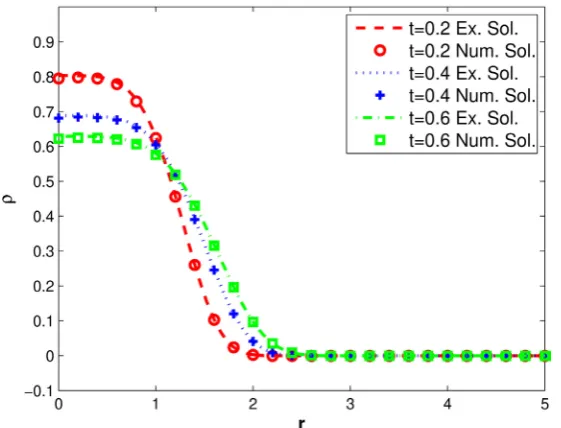
Figure 1 shows the analytical and the numerical solution for K0=1,
D
=
1
, andθ
=2.5 at different times. According to the classification discussed in [16], this example is a subdiffusion case with θ >D(
1−ν)
. From Figure 1, it can be seen that the numerical solution is in good agreement with the analytical solu-tion. In addition, we observe the short tail behaviours of the solution ρ( )
r t, .Figure 1. Comparison between exact (line) and numerical (symbols) solutions with
0 1
DOI: 10.4236/am.2019.1012072 1043 Applied Mathematics
3.2. Generalized Nonlinear Equation
Now we consider the generalized nonlinear diffusion equation with
ν
≠1. For the point source (or Dirac delta initial condition), Equation (1) was analytically solved using a generalized stretched Gaussian function approach in [16]:( )
1(
1) ( )
1 1( )( )
, if 1(
1) ( )
0; ,0, otherwise.
q
q t r Z t q t r
r t
λ λ
β β
ρ
−
− − − − ≥
=
Here q= −2
ν
, and β( )
t and Z t( )
are functions given in Equation (12) in [16]. The same solution is derived in [17] using Lie group symmetry method.In order to solve the generalized nonlinear diffusion equation numerically, we follow the procedure in 3.1, transforming the spatial domain equation to the wavenumber domain using the Φn transform. Instead of Equation (11), the wavenumber domain diffusion equation becomes
0 ,
d K k t
λ ν
ρ ρ
∂ = − ∂
(14)
with n
( )
ν ν
ρ = Φ ρ .
Due to the presence of nonlinearity term in the right hand side of Equation (13) (i.e. ρν), an analytical solution in the form of Equation (12) is difficult to
be obtained. However, Equation (13) can be numerically solved by employing certain types of time-stepping discretization methods for the time derivative. Here, the simple forward Euler finite difference scheme is employed for time discretization with ∆ =t 0.01 s. An equally spaced mesh with Nr =1001 is used over the domain r=
[
0, 30]
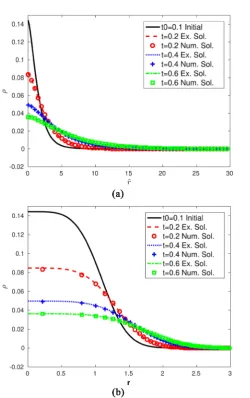
. The comparisons between the exact [16] [17] and numerical solution for the point source (Dirac delta function δ( )
r ) initial condition in scaled (r
) and original (r) coordinates are shown in Figure 2(a)and Figure 2(b), respectively. The parameters used here are K0=1, D=3, 2.5
θ
= , andν
=0.8. Note that to avoid performing a Φn transform for the fractional order of Dirac delta function (as the definition of δν is also anon-going research topic [27] [28], we use ρa
(
r t, 0 =0.1)
as the initial condition forour numerical simulation. Again, good agreement between the numerical and analytical solutions can be observed.
3.3. Generalized Diffusion for Arbitrary Initial Condition
The merit of the numerical approach using the generalized Fourier transform is that it provides a way for solving the generalized diffusion equation with arbi-trary initial condition. In Figure 3, we present the numerical solution of the ge-neralized diffusion equation for K0=1, D=1 and θ =2.5 with the Gaussian initial condition
( )
20 0
0 0 0
1
, exp ,
4 4
r r t
K t t
ρ = −
π (14)
where t0=0.1.
DOI: 10.4236/am.2019.1012072 1044 Applied Mathematics
Figure 2. Comparison between exact (line) and numerical (symbols) solutions in (a) scaled coordinate and (b) original coordinate with K0=1, D=3, θ =2.5 and ν =0.8.
[image:6.595.262.488.501.677.2]DOI: 10.4236/am.2019.1012072 1045 Applied Mathematics Gaussian shape as in the point source case (Figure 1). In [29], it was analytically shown that the normal diffusion equation, when initialized with a generalized Gaussian distribution will asymptotically approach its final solution, i.e. a Gaus-sian distribution. Here, we present a numerical example of what amounts to the “generalized central limit’’ behaviour in which the diffusion process will finally transform the arbitrary initial distribution to the corresponding generalized Gaussian distribution [30] [31]. A rigorous proof of the existence of the attractor of the generalized Gaussian diffusion has been done [24]] for linear diffusion. This is a consequence of the negative semi-definite spectrum of the usual Lapla-cian. However, as mentioned in [31], the diffusion procedure, initialized with different distribution, may take very long time to reach its asymptotic behaviour. In addition, by comparing with the solution for normal diffusion with the same initial condition, the sub-diffusion process clearly exhibits the short tail behaviour.
4. Conclusion
In this paper, a numerical method for solving the generalized nonlinear diffu-sion equation has been presented and validated. The method is based on the ge-neralized Fourier transform and has been validated by comparing the numerical solution with analytical solution for the point source. The presented method may serve as a useful tool to study a variety of systems involving the anomalous diffusion. Currently, no fast transform algorithm has yet been developed for the
n
Φ transform. This issue will be investigated in future study.
Acknowledgements
Discussions with Bernhard G. Bodmann are appreciated. Partial support for this work was provided by resources of the uHPC cluster managed by the University of Houston under NSF Award Number 1531814.
Conflicts of Interest
The authors declare no conflicts of interest regarding the publication of this pa-per.
References
[1] Gavrilov, V., Klepikova, N. and Rodean, H. (1995) Trial of a Nonlinear Diffusion Equation as a Model of Turbulent Diffusion. Atmospheric Environment, 29, 2317-2322.
https://doi.org/10.1016/1352-2310(95)00148-R
[2] Spohn, H. (1993) Surface Dynamics below the Roughening Transition. Journal de Physique I, 3, 69-81.https://doi.org/10.1051/jp1:1993117
[3] Daly, E. and Porporato, A. (2004) Similarity Solutions of Nonlinear Diffusion Prob-lems Related to Mathematical Hydraulics and the Fokker-Planck Equation. Physical Review E, 70, Article ID: 056303.https://doi.org/10.1103/PhysRevE.70.056303
[4] Risken, H. (1984) Fokker-Planck Equation. In: The Fokker-Planck Equation, Springer, Berlin, 63-95.https://doi.org/10.1007/978-3-642-96807-5_4
DOI: 10.4236/am.2019.1012072 1046 Applied Mathematics Diffusion Coefficients. Physical Review E, 72, Article ID: 020101.
[6] Fa, K.S. (2011) Solution of Fokker-Planck Equation for a Broad Class of Drift and Diffusion Coefficients. Physical Review E, 84, Article ID: 012102.
[7] Bologna, M., Tsallis, C. and Grigolini, P. (2000) Anomalous Diffusion Associated with Nonlinear Fractional Derivative Fokker-Planck-Like Equation: Exact Time- Dependent Solutions. Physical Review E, 62, 2213.
https://doi.org/10.1103/PhysRevE.62.2213
[8] Assis Jr., P., da Silva, P., da Silva, L., Lenzi, E. and Lenzi, M. (2006) Nonlinear Diffu-sion Equation and Nonlinear External Force: Exact Solution. Journal of Mathemat-ical Physics, 47, Article ID: 103302.https://doi.org/10.1063/1.2354334
[9] Lenzi, E., Lenzi, M., Gimenez, T. and da Silva, L. (2010) Some Results for an N-Dimensional Nonlinear Diffusion Equation with Radial Symmetry. Journal of Engineering Mathematics, 67, 233-240.https://doi.org/10.1007/s10665-009-9351-6
[10] Zola, R., Lenzi, M., Evangelista, L., Lenzi, E., Lucena, L. and da Silva, L. (2008) Exact Solutions for a Diffusion Equation with a Nonlinear External Force. Physics Letters A, 372, 2359-2363.https://doi.org/10.1016/j.physleta.2007.12.007
[11] Metzler, R. and Klafter, J. (2000) The Random Walk’s Guide to Anomalous Diffu-sion: A Fractional Dynamics Approach. Physics Reports, 339, 1-77.
https://doi.org/10.1016/S0370-1573(00)00070-3
[12] Sokolov, I.M., Klafter, J. and Blumen, A. (2002) Fractional Kinetics. Physics Today, 55, 48.https://doi.org/10.1063/1.1535007
[13] Tsallis, C. and Lenzi, E. (2002) Anomalous Diffusion: Nonlinear Fractional Fokk-er-Planck Equation. Chemical Physics, 284, 341-347.
https://doi.org/10.1016/S0301-0104(02)00557-8
[14] Liu, F., Anh, V. and Turner, I. (2004) Numerical Solution of the Space Fractional Fokker-Planck Equation. Journal of Computational and Applied Mathematics, 166, 209-219.https://doi.org/10.1016/j.cam.2003.09.028
[15] Tateishi, A.A., Ribeiro, H.V. and Lenzi, E.K. (2017) The Role of Fractional Time-Derivative Operators on Anomalous Diffusion. Frontiers in Physics, 5, 52.
https://doi.org/10.3389/fphy.2017.00052
[16] Malacarne, L., Mendes, R., Pedron, I. and Lenzi, E. (2001) Nonlinear Equation for Anomalous Diffusion: Unified Power-Law and Stretched Exponential Exact Solu-tion. Physical Review E, 63, Article ID: 030101.
https://doi.org/10.1103/PhysRevE.63.030101
[17] Pedron, I.T., Mendes, R., Malacarne, L.C. and Lenzi, E.K. (2002) Nonlinear Ano-malous Diffusion Equation and Fractal Dimension: Exact Generalized Gaussian Solution. Physical Review E, 65, Article ID: 041108.
https://doi.org/10.1103/PhysRevE.65.041108
[18] Abraham-Shrauner, B. (2005) Lie Symmetry Solutions for Anomalous Diffusion. Journal of Physics A: Mathematical and General, 38, 2547.
https://doi.org/10.1088/0305-4470/38/12/001
[19] O’Shaughnessy, B. and Procaccia, I. (1985) Analytical Solutions for Diffusion on Fractal Objects. Physical Review Letters, 54, 455-458.
https://doi.org/10.1103/PhysRevLett.54.455
[20] Crank, J. (1979) The Mathematics of Diffusion. Oxford University Press, Oxford. [21] Bluman, G. and Kumei, S. (1980) On the Remarkable Nonlinear Diffusion Equation
DOI: 10.4236/am.2019.1012072 1047 Applied Mathematics [22] Williams, C.L., Bodmann, B.G. and Kouri, D.J. (2017) Fourier and Beyond: Inva-riance Properties of a Family of Integral Transforms. Journal of Fourier Analysis and Applications, 23, 660-678.https://doi.org/10.1007/s00041-016-9482-x
[23] Williams, C.L. (2017) From Generalized Fourier Transforms to Coupled Super-symmetry. PhD Thesis, University of Houston, Houston.
[24] Kouri, D., Pandya, N., Williams, C.L., Bodmann, B.G. and Yao, J. (2018) Point Transformations and Relationships among Linear Anomalous Diffusion, Normal Diffusion and the Central Limit Theorem. Applied Mathematics, 9, 178-197.
https://doi.org/10.4236/am.2018.92013
[25] Kouri, D.J., Zhang, M.M. and Zhang, D.S. (2017) On a New Nonlinear Image Fil-tering Technique. 11th International Conference on Signal Processing and Com-munication Systems, Gold Coast, Australia, 13-15 December 2017, 1-5.
[26] Haberman, R. (1983) Elementary Applied Partial Differential Equations. Vol. 987, Prentice Hall, Englewood Cliffs.
[27] Li, C. (2016) The Powers of the Dirac Delta Function by Caputo Fraction Deriva-tives. Journal of Fractional Calculus and Applications, 7, 12.
[28] Jarad, F., Adjabi, Y., Baleanu, D. and Abdeljawad, T. (2018) On Defining the Dis-tributions δr and (δ’)r by Conformable Derivatives. Advances in Difference Equa-tions, 2018, Article No. 407.https://doi.org/10.1186/s13662-018-1865-7
[29] Anteneodo, C., Dias, J. and Mendes, R. (2006) Long-Time Behavior of Spreading Solutions of Schrödinger and Diffusion Equations. Physical Review E, 73, Article ID: 051105.https://doi.org/10.1103/PhysRevE.73.051105
[30] Toscani, G. (2005) A Central Limit Theorem for Solutions of the Porous Medium Equation. Journal of Evolution Equations, 5, 185-203.
https://doi.org/10.1007/s00028-005-0183-1