,~
A
POWERFUL.
IDEAIN
TERMINALS
We've put the whole ASCII set in lights. LSi's new powerhouse, the ADM-2 video display terminal has all 128 characters, including upper and lower case letters. Now you can ec perform text editing and pick up every character needed for line control procedures. TI" 12" CRT also features a 1920 character display in the 24 line format.A shortcut to the numbers game. Our special numeric pad is set up like a calculator and includes period, comma, minus, tab, and retum keys for concen-trated power. Your controller will love its operation. Its price, too.
~t1
~jo Editing like you've never seen befAre,
Safe at any speed. ADM-2 has the power to transmit at any 0
eight rates, up to 9600 baud. You can send data by line or page, send the cursor coordinate, defined mes-sage or funcfton sequence. And you can tie into a line printer for even more peripheral power.
Our monumental advance In power. Sixteen funcfton keys give Eleven separate cursor control keys and ten edit keys speed data you instant access to the special commands you specify. This editing by page, line, or single character, then get you home fast. pre-programming system provides one-key implementafton of Addiftonal funcftonal control keys have equally broad capabilities, programs, forms or instrucftons ... with power to grow! Set up and eight CRT status displays provide instant feedback on a 32 commands now and change them anytime in the future wide variety of information to keep all that power on target. to alter format, answer questions'/,'"',',,,',i' , mo, d,i,fy s U b - r o u t i n e s , @
or Whatever. Let your
//,;;1
1 ~lSI·
imaginafton-and ,./"'11,,
'1
''-''
.l9
your quest for ",,/"'" ' \ " " , LEAR SIEGLER INC ELECTRONIC INSTRUMENTATION DIVISION
~,:r~
'('
\1'" ' ..
DATA PRODUCTStr'l
Pick up your keys to power. The second. '!I
generafton, 119-key American Dream Machine is now a reality. It has the power, capacity, and flexibility you t ~ need. It lets you add options liket polling and addressing
when-L
;;..'
ever you're ready. We can, k'
interface with practically " anything in asynchronous dataequipment. and our low price drops rapidly on quantity orders.
Grab all the power you can handle. Call (714) 774-1010 or write for informafton. Lear Siegler, Inc., Electronic Instrumentation Division, 714 N. Brookhurst.
Teachers sho .
d
be dedicated;
not cOlllputers.
Dedication in a schoolteacher is admirable.
Dedication in a computer can be expensive.
Because single-purpose computers, since they only do one kind of job, usually end
up costing you time and money. On staff, space and overhead.
Xerox has a better way.
Xerox Multi-Use Computing Systems. A blend of computer technology, control
systems and software that can handle
all
your requirements. Concurrently.
For the classroom, Xerox provides computer-aided instruction, student drill and
practice, a broad spectrum of student problem solving applications (including computer
science and simulation studies.)
For the administrative side, Xerox provides ACES. Administrative Classroom
Education System. The most complete school administrative program around. ACES
keeps the business end of education functioning- handles financial reporting by budget,
stores inventory, personnel and payroll records, test and mark reporting, accounts
payable, pupil attendance - anything!
In short, we're dedicated, too. Our systems can do more for more people. And at
less cost. Let us tell you how.
Call
(800) 421-6882.
In California,
(213) 679-4511,
ext.
950.
Or write Xerox
Cor-poration, Dept.
15-08,701
S. Aviation Blvd., EI Segundo, California
90245.
XEROX® is a trademark of XEROX CORPORATION.
XEROX
When.
you
receive your actual printout sample from. aStatos~~ElIEl¢"t. r.o ... st.a.t ... i.C .... pr.i.n.t ... e.r .... '. p ... '.o .. t ... t.e.r .. , ... c .. o.'.m.p. are it to an. yt ...• hin.g ...•.... e ...•.... I.S ... e ... 0 . n .... ·th. e ...•.•...•..• m ... a ... f ..•... k ....•...•..•. e ... , •...
t
•... ·.
YouJILseethe big difference.It's extraordinary;.The blacks are blacker, the whites, whiter. The StC\tosBi-Scan™writing head does
it
Improved image density and regibilitygivey()ut'r0 and one-half times better contrast than oon-ventionaleguiprnenLAnd. better ·than· anything ·else. on.' the market.All Jour models of the Statos 33 reproduce both alphanumerics al'ldgraphics. Fast and accurately. An~we have
()n~line.interfaces plus powerful softwaretosup~
port<mosl minicomputers. For larger computers, off-line mag tape systems and software are offered; Not only does Statos give. you the finest hard cppy in the business, but you also gel the only
f.r~El.on:site.instaHation service. Uncrating,set-up, check-out,. and user instruction.
Make us prove
it.
Write foroutput samples andqe~pfiptiveliterature ... Varian 'Data 'Machines, ··'611
iJ<:lnsEln\iVay, Palo Alto, California 94303. Or call
(.415)493+4000, Ext. 6250.
CIRCLE 82 ON READER CARD
~varian
CATAMATIlaN®
NOVEMBER, 1974
volume 20 number 11
This issue 120,844 copies
structuring a dp department
There are right ways and wrong ways to organize the staff in a data processing department, and to select the equipment and facilities. Like a machine, the department can be tuned for peak efficiency and operating economy.
46 Organizing the
Data Processing Function
THOMAS R. GILDERSLEEVE
51 Designing for Minimum Downtime
LARS PERSSON
67 Which Departments Use the Computer Best?
CHARLES WALDO. The controllers say no one does.
72 A Socratic Dialogue
DENNIS P. GELLER. Structured Programming has been around longer than we realized.
79 GM's Parts Ordering System
DAVID A. BARR. Do its 30-plus computer centers make it the world's biggest teleprocessing system?
85 Who Needs a Computer?
H. LAWRENCE ABBOTT. Certainly not all the people who have them.
departments
Calendar 9 People 11 Look Ahead 17
Letters 23 Source Data 29
News in Perspective
99
Hardware 133 Software & Services 151
Advertisers' Index 162 Forum 167
LV ()vember, 1974
55 Facilities Planning
DAVID A. REISMAN
60 Getting More
From Your Computer
NATHAN HOD and JOHN G. BURCH, JR.
93 International Conference on Computer Communication
PAUL ARMER. International telecommunication ex-perts are trying to get nations to communicate with each other.
99 News in Perspective
SOFTWARE . . . . • • • 99 WALL STREET . . . • . 102 VOTE COUNTING . • . 106 RETAILING . . . • . 111
167 The Forum
PRIVACY . . . • • 112 PERIPHERALS . • • . . 118 INTERNATIONAL ••• 120 BENCHMARKS . . • • . 128
Dp management comes under fire for not rotating people; and Codasyl's COBOL committee comes under fire for just about everything.
about the cover
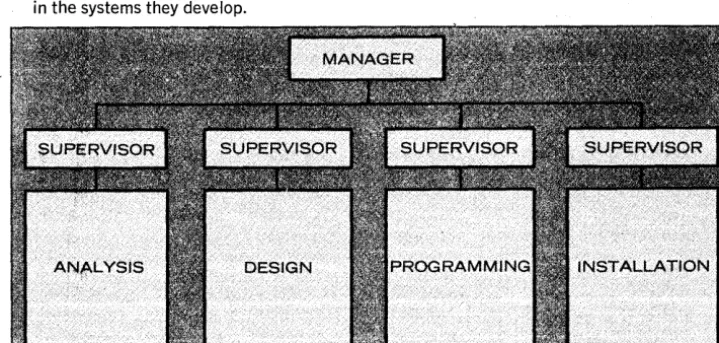
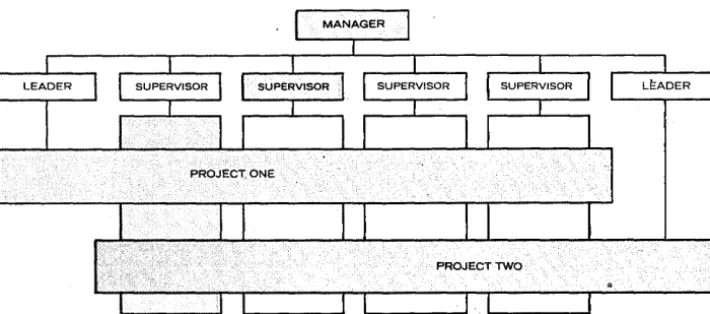
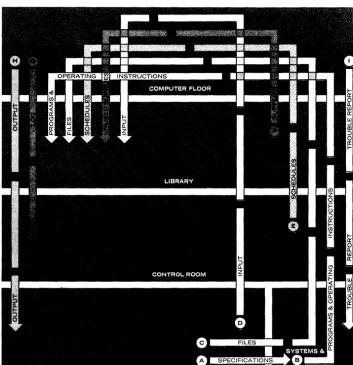
The data processing function
cannot be effective in an amo/phous
structure. It's elements and their relationships
must be rigidly defined. Design is by Barbara Benson.
Accelerate RJE Compiles
$99/Month Leases MPA's OS, DOS
&
VS Program Editor
~
STOP TRANSMITTING PROGRAMS!
Send only changes. Store programs
.. ,
on DASD at the computer site.
,
~
Make more progress on every
;
.~
-
!'~'\.
shot with The Sorcerer's COpy
~ ,\\\I\','I,I"'t'l - •~- ~f;i'
"
)I,~", ~1'4and stnng replacement features.
.!
.,~,!
CONTROL REMOTE ACCESS
_':
~Password prevents
unauthor-;r ,>"~ , ' I , '.\i>-~ '"
1'-'~i!,Ili~I,;tI:,\ ',I''\~\ r(\ _
ized updates. Source programs
,~
~~
on DASD are less prone to
scram bling and loss; easy to
backup with a system utility.
NO OPERATION HASSLES
Simple JCL. No special operator procedures.
DOS version runs in 14K, OS in less than 40K.
Standard free-format control cards. Uses
system, not special libraries.
$4000
Purchase
$99 Month-to-month
The Sorcerer
TM4
Write or call for more information or a thirty day trial.
'ro~~. t~~~A!!'~8~i!!fes
• The Sorcerer
• Anyplace II
• Catalr
CIRCLE 100 ON READER CARD
When they talk about data base management systems, experts say,
IIADABAS
is IT!-actually better than advertised!1I
ADABAS
ADABAS, the lIideal" data base management system, has over a three-year proven reliable operation record with a variety of data bases and applica-tions.
A recent release of ADA BAS provides a substantial improvement in effi-ciency with no changes in existing applications. A natural language query capability called ADASCRIPT is now available to complement normaillhost" system usage~ ADABAS is the unique cost effective solution for a large num-ber of data bases. .
With a day's training, people can use ADA BAS effectively. With a week's training, a computer center luser staff understands all the major facets of
ADABAS and can take full advantage of its power.
ADABAS can convert your files at a rate of approximately 250,000 rec-ords per cpu hour (370/155). Existing programs are converted in hours. New applications are developed at a fraction of the cost and time previously experienced. Disk space is reduced-even with the DBMS overhead.
The price ($120,000) is small when you really understand the benefits and savings.
World-wide sales passed 50 during 1973. Users range from a company with 300 employees and a 370/145 to large cities, banks, and insurance companies with very powerful computing capacity. Users include those
~witching from IMS, TOTAL, and S2000 to ADABAS.
WRITE:
scftwcre"
C9
Reston International Center 11800 Sunrise Valley Drive Reston, Virginia 22091 U.S.A.
Telephone: (703) 620-9577 Attn: John Maguire
61 Darmstadt Hilpertstrasse 20
West Germany Telephone: 6151-82747
Attn: Peter Schnell CIRCLE 80 ON READER CARD
CRTRMRTICN~
EDITORIAL STAFF Editor
Articles Editor International Editor European Editor Communications Editor Industry Editor Products Editor Source Data Editor Calendar Editor News Editor Bureau Managers,
San Francisco Los Angeles Washington, D.C. New York New England Correspondents Minneapolis Southwest Europe Australia Editorial Advisor Technical Advisor Contributing Editors
EDITORIAL OFFICES
John L. Kirkley Richard A. McLaughlin Angeline Pantages Nancy Foy Phil Hirsch W. David Gardner Michael William Cashman Daniel P. Schlosky Gloria Tidstrand Tom McCusker Edward K. Yasaki Edith D. Myers Phil Hirsch Angeline Pantages W. David Gardner James K. Johnson Robert F. Alexander Pearce Wright Frederick A. Bland Robert L. Patrick Lowell Amdahl Paul Armer, Howard Bromberg, Philip H. Dorn, Louis B. Marienthal, Ray W. Sanders, Milton R. Wessel, F. G. Withington Headquarters: 1801 S. La Cienega Blvd., Los An-geles, CA 90035. Phone (213) 559-5111. Eastern: 35 Mason St., Greenwich, CT 06830, (203) 661-5400. Lakeside Office Park, 599 North Avenue, Wakefield, Mass. 01880, (617) 246-2121, 9805 Singleton Dr., Bethesda, MD 20034, (301) 530-7271. Southwestern: 2711 Cedar Springs, 'Dallas, TX 75201, (214) 744-0161. Western: 2680 Bayshore Frontage Rd., Suite 401, Mountain View, CA 94043, (415) 965-8222. Foreign: 14 Ashburn Place, Lon-don, S.W.7; 373-3745; 64/90 Blues Point Rd., Mc-Mahons Point, NSW 2060, Australia.
GRAPHIC DESIGN & PRODUCTION Art & Production
Director Cleve Marie Boutell Advertising
Production Manager Marilee Pitman Production Assistant Alberta R. Martin CIRCULATION
35 Mason Street, Greenwich, CT 06830 Circulation Manager Suzanne A. Ryan Marketing Research
Director Douglas De Carlo Publisher James M. Morris Circulation audited
by Business Publications Audit
Member
American. Business Press, Inc.
DATAMATION Is
pub-\+_\
lished monthly on or!If!' about the first day of every month by Tech-nical Publishing Company, 1301 South Grove Ave., Barrington, Illinois 60010; Arthur L. Rice, Jr., Chairman of the Board; James B. Tafel, President; Gardner F. Landon, Executive Vice President. Executive, Circulation and Advertising offices, 35 Mason Street, Greenwich, CT 06830, (203) 661-5400. Editorial offices, 1801 S. La Cienega Blvd., Los Angeles, CA 90035. Published at Chicago, III. DATAMATION is circulated without charge by name and title to certain qualified individuals who are employed by companies involved with automatic information handling equipment. Avail-able to others by subscription at the rate of $18 annually in the U.S. and Canada. Reduced rate for qualified students. Foreign subscriptions are available for £ 12.50 or for the equivalent of $30 U.S. in most West European currencies. Sole agent for all subscriptions outside the U.S.A. and Canada is J. B. Tratsart, Ltd. 154 A Greenford Road, Harrow, Middlesex HA13QT, England. No subscription agency is authorized by us to solicit or take orders for subscriptions. Controlled circu-lation paid at Columbus, OH and Form 3579 to be sent to Technical Publishing Company, P.O. Box 2000, Greenwich, CT 06830. © Copyright 1974, Technical Publishing Company. ® "Datamation" registered trademark of Technical Publishing Com-pany. Microfilm copies of DJ..TAMATION may be obtained from University Microfilms, A Xerox Cgm-pany, 300 No. Zeeb Road, Ann Arbor, Michigan 48106. Printed by Beslow Associates, Inc.
DEC,when
6
When Varian runs
a
bench-mark, it becomes a milestone.
As you can see from these latest
figures comparing the
per-formance of our V-741h with
others.
It makes the competition's
claims about their superior
performance just that. Claims.
All these tests-and
more-were run within the
last 90 days. On the latest
operating systems and
compilers. And the saine
FORTRAN benchmark
pro-How does our
V-74
1h
deliver so much more
bealen Ihelll all.
Typical FORTRAN execution times (microseconds)
V74Y2
PDP-
Nova
Mod
H.P.
11/45
800
Comp
II
2100
A=B+C
7
33
58
19
51
(double) A=B+C
10
82
61
29
98
A=B
4
14
35
7
13
Do Loop
4t
22
10
11
17
. A(I,J)=B
22
63
39
28
46
A==Sin(B)
100
251
266
197
1583
speed than other systems?
firmware enhancements.
The VORTEX operating
Especially DEC, Data General,
system, for one thing. Aug-
Mod Camp and H.P.
mented by the firmware
And we have the reports
FORTRAN accelerator and
to prove it. For your copy call
our new Floating Point
your nearest Varian Data
Processor, no one can argue
Machines office.
with the fact that it's the fastest,
Varian Data Machines
most powerful, most sophisti-
2722 Michelson Drive, Irvine,
cated FORTRAN IV processor
California 92664.
~in the business.
No one beats the V-74
1h's
@
The mini killers
synergistic combination
varian data machines
of hardware, software and
Todays Graphics.
Becauseyou
can't wait for
tomorrow's solutions.
T~ktronix' Graphic Terminal Family is steps ahead of however
, else you're now using your , computer data.
Providing the most efficient utiliza-tion of that data. Faster than printout. More efficient than mere hard copy. Making analyzing extremely profit-able. Giving you the
answers now, when you need them. Pictured is our 4014-1 Graphic Display Ter-minal, the biggest 19-inch, flicker-free display in the busi-ness. Priced at $9,995. Also, our·
4010 Graphic Display Terminal. An 11-inch version of the same power-ful Graphics tool, at $4195. Both giving you your ideas in pictures. Team either of these with our 461 0 Hard Copy Unit at $4295, and you've got a copy to refer to, add to,
change, and then work with some more. Then there's our Flexible Disc Memory from $3695 for user- . controlled storage, off-line or aux-iliary. Add our Graphic Tablets from $2995 for fast, freehand digitizing, and your Graphics capacity is greater still.
But there's more to our Graphics than just low cost, more than
advanced problem solving. There's more peripherals,
more strong software support, more
advantages. Call your area Tektronix Applications Engineer for all the information.
Or write us, today. Tektronix, Inc.
Information Display Division P. O. Box 500
Beaverton, Oregon 97077
,I)I
TEKTRDNIX®
calendar
N_OVEMBER
Fourth Annual Conference, Association of Computer Pro-grammers and Analysts (ACPA), Nov. 20-22, Washington, D.C. This year's theme, "Y ou, Your Computer, and Your J?b,". will stres~ the practical use of computers in working
situat~ons. TOPICS scheduled include micro programming overVIew, new standard COBOL for minicomputers, career development, and privacy. Fee for full conference, lunches and banquet: $103, members; $115, non-members. Con-tact: E. Lawrence Doyle, ACPA 4 Chairman, National Insti-tutes of Health, Bldg. 1, Room 212, Bethesda, Md., 20014,
(301) 496-4602.
-JANUARY
National Microfilm Association Mid-Winter Meeting, Jan. 15-17, Atlanta. More than 500 men and women active in the micrographics profession are expected to attend the meeting. The theme -is "Micrographics-Technology for Today and Tomorrow," which will pervade sessions on state-of-the-art trends, application tutorials, advanced' system re-ports, and current events. The formal meeting will be pre-~eded on Jan. 14 by a seminar on the basics of micrograph-ICS; fee $50. One of the highlights of the regular meeting will be a.n analysis .of micrograRhic technology in Europe, in-cludmg a look mto the Soviet Union, by a representative of Rank Xerox, Ltd., England. Fee: $70 members; $85 non-members. Contact: Conference Director, National Micro-film Assoc., 8728 Colesville Road, Silver Spring, Md. 20910
(301) 587-8444. '
Winter Conference, Assn. for Development of
Computer-Base~ Instructional Systems, .lan. 28-30, Charleston, S.C. Sharmg of r.esearch findings, educational strategies, and course matenals will highlight this meeting, sponsored by ADCIS and hosted by the College of Dental Medicine
Med-i~al
Univ. of South Carolina. In addition, the Health Educa-tIon Netwo~k Users and'the Systems Implementation groups of ADCIS wIll sponsor pre-conference sessions on Jan. 27. Fees are $15, members; $20, non-members. Contact: Dr. Karen A. Duncan, Office of Computer Resources College of Dental Medicine, 80 Barre St., Charleston S.C. 29401(803) 792-3211. "
FEBRUARY
COMPCON 75 SPRING, 10th IEEE Computer Societv
Inte.~atio_~al
Conference, Feb. 25-27, San Francisco.Re~
ogmzmg this as .an era of widespread service by computers and related deVIces to the general public, the society has chosen as its theme "Computer Technology to Reach the People." Papers will be presented on applications, special eqUIpment and products, system components and devices, a?d ~rograms and software. About 800 computer technolo-gIStS m hard:vare; sof~ware, and applications are expected to attend. RegIstratIOn IS $60 ($50 advance), members; $75 ($65 ad~anc~), non-members, and $15, students. A sepa-rate regIstratIOn of $50 is required for the micro/ mini tutorial on Feb. 24, a full-day session covering topics relatedNovember, 1974
to the conference theme. Contact: Lowell D. Amdahl Compata, Inc., 6150 Canoga Ave., Woodland Hills, Cal it: 91364, (213) 884-5400.
16th Annual Winter Convention on Aerospace and Elec-tronic Syste~s (WINCON '75), Feb. 5-7, Los -Angeles. )'heme of thIS year's meeting, ,"Command and Control and ~omm~mications," for defense and non-defense applica-tIons, IS expected to attract approximately 500 military, government and industry leaders. The conference is co-sponsored by the AES society and the Los Angeles Council, IEEE. The three days of classified and unclassified sessions will be geared to exchange information that can help trans-fer the military state-of-the-art into the public sector, for example "law and order, and public safety" fields. Contact: Art Slotkin, WIN CON, P.O. Box 3356, Santa Monica Calif.
90403. '
Third Computer-Aided Design and Computer-Aided Manu-fact~ring C~nference and Exposition, Feb. 10-13, Chicago. Th.e. ImpreSSIve theme of "increased productivity and profit-abIlIty through the marriage of CAD and CAM" is expected to draw more than 1,000 industrialists, manufacturing executives and engineers responsible for computer-based equipment, systems and software used in industrial applica-tions to the conference. For senior industrial management and government officials, there will be sessions such as "CAD/CAM and Economic Needs" and "CAD/CAM-Labor, Money & Management," while users/ designers will attend more esoteric meetings, including three workshops: "CAD/CAM Systems," "Practical Applications," "User Experiences," and "Future Trends of CAD/ CAM in the '80s." Fee: $235 to members of the Society of Manufactur-ing Engineers and associated societies; $265 to non-mem-bers. Contact: Society of Manufacturing Engineers, Public Relations Dept., 20501 Ford Road, Dearborn, Mich., 48128, (313) 271-1500.
lfederal Data Processing Expositio~, Feb. 11-12, Washing-ton, D.C. Since this event is being billed as "the first annual data processing trade show to be held in the nation's capi-tol," projected attendance figures are meaningless-but the sponsors are hoping for two to three thousand users, mostly from the Federal Government, to attend. In addition to an equipment exhibition, there will be a number of application oriented workshops and seminars. The pr~ce is right for attendees-free! Contact: Robert E. Harar, Federal DP Expo c/o Instrumentation Fair, 5012 Herzel Place, Belts-ville, Md., 20705, (301) 937-7177.
Computers in Laboratory Medicin{' Symposium. Feb. 15-16, San Francisco. Approximately 500 medical personnel will explore computer applications in clinical and anatomic pathology and nuclear medicine under the sponsorship of U. of Calif. Extension, Berkeley. Attention will be given to new directions in laboratory computerization, the use of desktop computers, systems currently available and trends in these actively developing adjuncts to laboratory and nu-~
clear medicine. Fee: $125. Contact: Julie Hall or Nathan W. Cohen, U. of Calif. Extension, Berkeley, Calif. 94720, (415) 642-1061.
people
A SOMETIMES
"WHIRLING
DERVISH"
Two years ago, A. G. W. Biddle, Jr. was fishing in Oregon, happily retired from his former seven-day-a-week job at his private consulting firm.
The phone rang and it was his old friend Dan L. McGurk, former head of Xerox Data Systems, wanting to know if Biddle would come out of early retirement. McGurk was heading up a new organization called the Com-puter Industry Assn. (CIA), and he
A. G. W. BIDDLE, JR. A growth strategist
thought "Jack" Biddle would be just the man to be its executive director.
"I was' intrigued," recalls Biddle. "Back in 1960, I recommended to Bendix that they get out of the com-mercial data processing business be-cause I felt it was just about impossible to compete with IBM. In more than a decade, things hadn't changed, so that's why McGurk's offer interested me."
While McGurk got the CIA rolling, he has gradually slipped into the back-ground, and Biddle is now the driving force behind an organization that has become a surprisingly effective voice in the industry in just over two years.
While Biddle and the CIA are often accused of possessing a knee-jerk ani-mosity toward IBM, Biddle views him-self as more of a "growth strategist" than anything else and, while he con-cedes that the CIA has done its share of bad-mouthing IBM - although with
November, 1974
what. Biddle maintains has been good cause-he thinks that the CIA'S focus has been subtly shifting recently.
In short, then, is there a future for the CIA beyond the various IBM
anti-trust cases?
Biddle sees the organization serving as a voice for the industry. "We're not afraid to take controversial positions," says Biddle. "But I think our voice is balanced."
He points out that the CIA'S some 40 members represent a balanced cross section of the industry-a half dozen oem's, three data entry firms, five soft-ware houses, a minicomputer company, and just about everything else from memory manufacturers to plotter makers.
Biddle has had an extensive back-ground in the computer industry, pri-marily as a consultant to computer manufacturers. Although the West Point graduate got some hands-on ex-perience with some of the pioneering computers, and has since done some computer modeling, he does not view himself as a computer professional. He also has an extensive communications background from his military service days.
He stresses the idea that his experi-ence in growth strategy and in long-range strategy all come into play in his CIA position.
It might be added that Biddle is rap-idly becoming something of a fixture at
Congressional hearings and govern-mental regulatory hearings, pounding away on this issue or that issue-all of import to the computer industry. His critics say he is simply attacking
IBM-or lately AT&T-but his suppIBM-orters say there is a common thread to all Bid-dle's CIA positions. He is a die-hard proponent of what he calls the free enterprise system, maintaining that a business should be allowed to succeed or fail on its merits and not be suscep-tible to outside influences.
His associates have been awed at Biddle's range of expertise, and one associate says the normally hard-driv-ing Biddle becomes a "whirlhard-driv-ing der-vish" while preparing himself for, say, a paper he will deliver in Washington. The CIA has been making a pitch to users which has thus far been less than successful, but Biddle is committed to pursuing the user until he brings in user representation to the CIA. The or-. ganization has set aside $50,000 to
stimulate the establishment of a user group but, thus far, there have qeen no serious takers.
And what does IBM think of the CIA?
Armonk doesn't comment on such things, but there are indications that
IBM looks upon Biddle and the CIA as public enemy number one.
For instance; when Control Data signed its antitrust settlement with IBM
last year, IBM stipulated that CDC not
be permitted to join the CIA. "We think that's a compliment," says Biddle.
THREE YEARS IN ENGLAND
He's a chemical engineer. He's a lawyer. He sells computers and his market is the world.
He's Louis B. Perillo, International Director, Data Systems, for Xerox Corp. He enjoys selling computers on an international scale. Perillo returned last April to the EI Segundo, Calif. headquarters of Xerox's computer op-eration after three years as managing director, data systems, for Rank Xer-ox, a U.K. corporation 51 % owned by Xerox Corp. and 49 % owned by the British Rank Organization. Rank ox, says Perillo, handles 90% of Xer-ox's products and accounts for close to 50% of the corporation's revenues and profits. Its marketing area is the entire Eastern hemisphere.
Perillo went to Rank Xerox in 1971 "to try to get a computer operation going." Prior to that time, the British company had not handled the comput-er line Xcomput-erox acquired with Scientific Data Systems (SDS) in May of 1969~
In the three years Perillo was with Rank, its computer business grew at
the rate of 30% a year. It now ac-counts for some 30% of all Xerox's computer busine'ss, and Perillo predicts this share will go to 50% within five years. "The growth rate is greater there
LOUIS B. PERILLO " ... a pretty good peddler"
people
(Rank's market area) than here. They're four to five years behind us in reaching the saturation point for high technology products."
At the time of the sos/Xerox merg-er, Perillo was sos's vice president, marketing. After the merger he be-came vp/ international for Xerox Data Systems. sos had been doing some business internationally. It had a branch office in England, a licensing agreement with predecessor companies of France's Compagnie Internationale pour l' Informatique (cn) for manu-facture of Sigma 2's and 7's, and a licensing agreement with Japan's Mit-subishi which manufactures and sells Sigma 5's and 7's under the Me1com label. Perillo said Xerox is still getting royalties on Sigmas cn has out on ren-tal and doesn't market 2's or 7's in any of cn's marketing areas except Ger-many, where "we bought back our rights in 1971."
From 50 people acquired when it assimilated with the sos English branch office, the Rank Xerox com-puter effort has grown to 350 people.
Perillo enjoyed his three years in En'gland. "The summers are beautiful. The flowers are beautifu1." Via inex-pensive "packaged holidays" available there, he and his wife were able to "see many places we never would have seen." The Perillos lived in the country town of Moor Park, 15 miles north-west of London.
The genial, Italian-born Perillo re-members the dim days of England's energy crisis and blackouts. "At first it was random," he recalls. "You never knew when the lights were going to go out. And it was cold." Then came the three-day work week, which meant three days of normal power. "On the other days we worked but we only had power for typewriters, no lights, no heat."
While living in England, Perillo vis-ited his native Bellosguardo, Italy, which he left at the age of three. "Bellosguardo," he says, "means beau-tiful view. It's wrong."
Perillo grew up in Cleveland, where he became a chemical engineer (Case Institute of Technology), a lawyer (Cleveland Marshall Law School), and got interested in computers. He was working in engineering construction for Arthur G. McKee & Co. in the mid
IN NEW POSTS
'50s when the IBM 650 came out. His alma mater, Case Tech, got the first 650 and Perillo saw a use for it in his firm's design work. "We rented time on Case Tech's 650 for $1,000 a month and then we got our own." He later pioneered a similar effort for the Ralph M. Parsons Co. in Los Angeles, which he joined in 1957.
He finally put it all
together-engi-neering, law, his interest in computers -in 1959 when he joined TRW as manager of contracts and proposals for a process control operation. It was at TRW that he met Dan McGurk, who subsequently lured him to sos in 1965. At the time he made this switch he was director of marketing for TRW'S com-puter operation. "I guess Dan thought I was a pretty good peddler."
ALL ABOUT TIME-SHARING
Cutthroat competition and the eco-nomic crunch of the early '70s thinned the ranks of the then-glamorous time-sharing business; but R. Clifton Young thinks about 50 companies are still around. He and Hillel Segal would like to help customers make better use of them.
Late this summer they formed a non-profit association, the Assn. of Computer Time-Sharing Users (ACT-su) to "evaluate, compare, and im-prove the services offered by the time-sharing industry," and by this month hoped to have signed up at least 100 users at $20 a person (out of the 10,-000 persons Young estimates use time-sharing services in the U.S.) .
With that number they think they'll
VENDORS WELCOME:
R. Clifton Young (left) and Hillel Segal will invite vendors to join time-sharing users group.
I
be able right away to launch a number of surveys. They think the surveys will help users learn more about pricing, services, program packages, downtime, quality of technical support, educa-tional materials, and other characteris-tics of the vendors with which they do business. "It's taken me several years to get a comfortable overview of time-sharing services," says Segal, who is a financial analyst with the Hertz Corp.'s Rent a Car division and a user of time-sharing for financial modeling and some accounting work. "The associa-tion will help members achieve this a lot faster."
Complaints most often cited by us-ers are over the pricing schemes of time-sharing services. "They don't tell us how many dollars you spend in a day," says Young, who is manager of strategic planning at Borg-Warner Chemicals in Parkersburg, W. Va. Us-ers signing off a terminal usually get from the vendor a log-off message list-ing the connect time and usage of cpu units and storage. He'd like to have this translated into actual dollars, recalling a recent case where a customer was billed $20,000 for a two-month project for which the vendor bid less than $5,000.
The association won't be used "as a club to hold over vendors," says Young, who also is opening member-ship to vendors of time-sharing ser-vices. (The group is accepting mem-bership applications at 210 Fifth Ave:, New York, N.Y. 10010.)
Young and Segal have had broad experience with computers as users and as developers of applications. While at the B. F. Goodrich Company in Akron as manager of corporate modeling, Young created "Case-sIM," a programming language for non-pro-grammer planners to use in creating financial models and case study simula-tions. His interest in the business dates to 1951, when he sold Friden comput-ers and studied business administration at Rutgers Univ. Segal left MCI Com-munications to, do financial modeling at Hertz in New York.
Both are convinced that the com-puter - via time-sharing - has only scratched the surface as a tool for managing large enterprises, and they see a bright future for the industry in that function. However, they agree that the industry is not recession-proof. Right or wrong, in a cost crunch re-search is the first thing that is cut and the economists are the first to go. It's this kind of "blue sky" activity that most makes use of time-sharing services. D
JAMES P. CAMPBELL and CARL D. CARMAN were elected vice presidents of Data General Corp . . . .
NOR-MAN HELLER was appointed director of development at
Nixdorf Computer AG's Costa Mesa, Calif. facility ... ED-GAR L. MOORE was named to the new position of Litton Industries' Datalog Div.
November,
1974$51,238
per month
rental
$48,406
per month
lease
ITEL squeezes more out of your computer
dollar than 18M.
Now you can get a whole computer
system from tTEL for less than what IBM charges for just a
central processing unit.
The numbers speak for themselves: For $51,238 a
month, IBM rents you a single 370/158 CPU (includes two
ex-tra shifts). But for $48,406, ITEL leases you that same 370 CPU
with ITEL Monolithic Memory, 24 tTEL disk drives plus their
controllers, as well as 24tTEL tape drives with their controllers.
To put it another way, if you were to rent a comparable
system from IBM, it would cost you $81,846 a month. Almost
double our price.
Furthermore, we'll lease any kind of 370 computer
package at proportional savings. And we'll make sure that all
terms and provisions are custom-tailored to meet your exact
financial objectives.
At tTEL, we couldn't have acquired over half a billion
dollars in IBM computer leasing
experi-ence without doing more for your money.
:ITEL
Your financial alternative.
~
One Embarcadero Center, San Francisco, California 94111, Phone: (415) 983-0000You've already gained speed and
efficiency in some of your procedures
by using microfilm. There's even
more dramatic progress available to
handle customer inquiries. For example:
A major retailer failed to find the
needed records once out of every five
calls. Now all the records are on film and'
virtually anyone can be displayed on a
screen at the touch of a button.
A telephone company was laboring to
answer more than
2,000
customer
ques-tions every day. The answers are now on
film and are handled
ten
times faster
than before.
'
More than just lookups: A bank is
using the same basic method to keep
track of daily transactions. Having the
records on film produced a saving of
$50,000
in the first year.
To make this kind of progress in your
business takes your determination to
seek better answers. The sooner you ask.
us, the sooner we can help. Just write on
your letterhead to W O. Fullerton,
Eastman Kodak Company, Dept. DP4874,
Rochester, New York
14650.
Or call
BOO-447-4700.
In
Illinois,
ca1IBOO-322-4400.
What you're saving now with microfIlm
is only the beginning.
: '.1 • I ~ • ; t; I
If
you
think
all premillD1
com uter tapes are alike
tea closer look at
BASF 2000/A.D.
Because all premium computer tapes are 100% certified and meet industry standards, you might think they're all • equal. They aren't. The important
differ-ence is the margin by which a manu-facturer's standards exceed industry standards. It's this extra margin that allows no margin for errors. Let's look at a few superior points of BASF
20001
AD. computer tape:Debris-free edges
Rough edges and debris on tapes are the resul,t of inferior slitting, which causes the coating to overhang the base. The projecting edges become detached by tape guides and drive rollers. The result: loss of head-to-tape contact ... and errors. BASF has eliminated these problems with an exclusive double-cut slitting technique that keeps our tape edges perfectly debris-free.
BRAND A BRAND B
Straight edges
Another hassle, even with premium tapes, is edge waviness. This causes intermittent reading and writing errors. Dynamic conditions during tape transport can occasionally compensate for the waviness, so it's a tough job to track down. Again, our double-cut slitting tech-nique keeps
20001
AD. edges absolutely straight and symmetrical.Uniform width
Uniform tape width is essential, in order to avoid dynamic skew errors. According to industry standards, a width tolerance of ±.002" is acceptable. We peg our
20001
AD. standard at±.001". It's a small detail, but it could eliminate a few 3:00 a.m. debugging sessions.Superior coating
We've developed a new "hotter oxide"
BRAND C BASF
coating ... a higher energy oxide that produces an output consistently higher than that of the National Bureau of Standards reference tape. Then we apply this oxide with a unique coating techniquE that provides a more even dispersion of oxide particles in the binder. For any bi' density, including 6250 B.P.I.,
2000/AD.
gives you more reliable writing and read-ing ... better bit-to-bit uniformity ... fewer drop-ins and drop-outs. And virtually no permanent errors.
Hard surface
Head wear is inevitable, but it shouldn't be excessive. That's why we developed a finishing operation that gives
20001
AD. a harder, smoother surface than anyone else's. It's a lot kinder to your tape head, and keeps your main-tenance time to a minimum.And
in
conclusion
2000/ AD. costs no more than other premium tapes. You're already paying for" BASF quality ... you might as well have it. For the whole story of how
20001
AD. stacks up against the competition, write to BASF Systems, Crosby Drive,::C~:01r:~~:::~~1::R~'~--'l
~
LOOK
AHEAD
IBM, JUSTICE DIGGING IN AS RUMORS FLY
IBM has always been a rumor ridden company, but the stories making
the rounds now are reaching new heights of imagination.
First
there was the rumor, denied strongly by IBM, that Arab oil interests were
preparing to take over the computer colossus.
Then, as the trial date of
IBM's antitrust case with the government approached, rumors proliferated
that the firm was working out a consent decree with the Justice Dept.
That
rumor, another phony, was traced largely to a legal advisory service that
speculated the case would be settled before the announcement of the trial,
which is slated to begin after Dec. 2.
Then there was the rumor that IBM's
president, John Opel, had
move~to Washington where he was hammering out a
consent decree.
Negative again.
Opel has not been hammering out a consent
decree with the Justice Dept.
Indeed, his work activities appear to have
been normal and we understand that, in recent weeks, he's only been twice to
Washington where IBM naturally has always conducted a great deal of business.
Both sides in the case appear to be digging in for the upcoming trial.
Raymond Carlson, the lead Justice Dept. attorney, normally a quiet and
unassuming type, is said to be cocky about his case to the point that he
makes Muhammad Ali look modest.
Justice apparently will push for a breakup
of IBM.
Its economists are understood to be sticking to their guns, demanding
that each "Son of IBM" have a full range of.equipment --- low end to high
end.
Meantime, IBM has taken out a one year lease for some 50,000 sq. ft. of
office space at 100 Church St., near the federal courthouse in New York City
where the case is to be tried.
TELEX VS. IBM:
THREE BUSY JUDGES
Remember the IBM-Telex suit? The U.S. Tenth Circuit Court of Appeals
agreed nearly a year ago to expedite the decision which had favored Telex.
At this writing there was no decision nor inkling when there might be a
decision, but those looking for reasons for the slow pace should not have to
look beyond the activities of Judge William E. Doyle, one of the three judges
on the Appeals board.
Judge Doyle presided over the business plan that
integrated the Denver Public Schools and that, obviously, consumed much of
his time.
All three judges in the case have a heavy load.
Judge A. Sherman
Christensen, the federal district court judge who rendered the initial decision
in the Telex case, came out of retirement to hear the case and was unfettered
by a heavy case load.
That may explain his speedy disposition of
th~case.
CALIFORNIA" S DMV STICKING WITH UNIVAC
It's still Univac for California's Dept. of Motor Vehicles for at least
three more years.
The conversion of the DMV into the state's first
consolidated data center, the Stephen P. Teale center, was a critical
factor in a controversial procurement which stormed for more than two years
and saw IBM getting a contract largely because they guaranteed to convert
DMV by July 1. They didn't and the giant now is negotiating with the state
on its liability for the failure and the state's liability for programs
which were converted.
And Univac has a new three-year contract for a
LOOKAI-EAD
controversy about it continues. Assemblyman Mike Cullen called the
failure to incorporate DMV into Teale "a multi-million dollar ripoff" of
California taxpayers.
WHEN THE SWISS BANK BOUNCED CDC
Control Data may have lost more than the $30.2 million it charged against
third quarter earnings after losing a lucrative contract to automate
nearly everything the Union Bank of Switzerland does.
It could have lost
its credibility as a big factor in banking.
The Union Bank deal, captured
from Univac in 1970 after chairman Bill Norris went over to Switzerland to
sign the order, once involved some 150 programmers trying to come up with a
workable Transaction Oriented Operating System (TOOS) that would have been
used to automate not only the bank teller transactions, but also some 34
back office programs in which the l70-branch Swiss bank was involved.
CDC is trying to salvage part of the deal ••• as it has since early spring
when marketing president Paul Miller began making twice-monthly trips to
Switzerland. Late last month, though, no one at CDC wanted to talk
about what progress was being made.
Ironically, CDC's plight in Switzerland might make its fourth quarter
balance sheet look less than bad.
In the writeoff, it's found some
justification in giving its 26,000 computer employees five days off before
year-end without pay, and cutting the wages of salaried employees 10%.
And
there were rumors in Minneapolis that another 1,800 are to be dismissed
indefinitely between now and Christmas.
SEYMOUR CRAY OF CHIPPEWA FALLS
If you ever go to Chippewa
Falls~Wise., don't call Seymour Cray.
He's too
busy working on a very big number-crunching computer--but not for CDC, where
that company's 6000 series, 7600 system and the Star 100 were conceived.
Stories on why Cray left CDC two years ago to form his own company--Cray
Associates--are legendary.
One has it that he didn't like taking the
half-hour air flight from Chippewa Falls to attend CDC directors' meetings in
Minneapolis.
Another is that CDC decommitted itself from big computers.
The latter explanation has some credibility, considering that CDC last
month finally closed its Chippewa Falls operation, moving the 39 remaining
souls to other posts within the company.
Meanwhile, Cray--who once told a Datamation reporter, "Don't come over
here to interview me; I'd get a lot of phone calls if you wrote a story
and couldn't get any work done"--is still in Chippewa Falls and doing well.
His number-cruncher is underway and we're told he's about to enjoy an influx
of $20-40 million in venture capital.
Strange, in these times when venture capital is said to be nil.
HIGH SPEED PRINTER
A 45,000 line per minute printer is in operation at a subsidiary of the
Mead Corp. in Dayton, whooshing out individualized letters and address
labels for direct mail customers.
There were rumors the device runs at up
to 75,000 lpm, but company spokesmen deny this, although referring to the
45K lpm rate as a "cruising speed." Paper is fed web fashion, like on a
printing press, under a row of 500 ink jets, 100 jets to the inch, each
of the jets spurting drops of ink through what is called a "charger ring."
Drops that are charged hit the paper, those that are not charged are
deflected by an opposite charge away from the paper to a "catcher." All
this is done as the paper flies under the jets at rates of 500 to 600 feet
per minute (or 36K to 45K lpm).
This
$129,500*
timesharipg system
gives you better
BASIC
than
any
other
minicomputer system.
With batch at the same time.
HP's 3000 Model 100 lets you do more with BASIC than ever before. You can intermix integer, real, long precision and complex numbers. Share resources with any kind of peripheral. Call subroutines compiled in FORTRAN, COBOL, and our Systems Programming Language. In batch you get complete multi-language capability concurrently. And a file system identical to the one used from terminals.
This innovation works for a living. You do. So call us.
HP minicomputers.
They work for a living.
HEWLETTl~!]
PACKARD
Sales and service from 172 offices in 65 countries.
1501 Page Mill Road, Palo Alto, California 94304 ·Domestic USA price only. 22416
·
Introducing Eclipse.
The most expensive part of a computer isn't the computer
anymore.
It's the people who work with it.
So Data General is introducing a family of medium scale
computers that cut down on the work people have to do.
Eclipse.
You won't have to clean up the mistakes this computer
makes. Eclipse has automatic memory error correction.
You won't have to rewrite complicated instructions every
time you need them. Eclipse's microprogrammed architecture
includes a comprehensive new set of instructions so powerful
they do the work of entire subroutines.
You won't have to lose speed doing special subroutines
with software. Eclipse has a Writeable Control Storage Unit that
lets you keep them in the hardware.
-You won't have to use assembly language to make your
programs go fast. Eclipse is so fast it can run high level languages
at assem bly language speeds. (It has a bipolar memory cache
that makes semiconductor memory alot faster. Plus core and
semiconductor memory interleavini for even more speed.
And the fastest Floating Point Processor in the industry. )
And even though Eclipse is a brand new computer, you
won't have to write a lot of systems software or jury-rig your
peripherals. Eclipse is upwards compatible with the Nova line.
So all the software and peripherals we've already made can go
right to work on the Eclipse.
Write for our brochure. And see how bright an Eclipse
can be.
DataGeneral
The computer company you can understand.
f. Data General Corporation, Southboro, Massachusetts 01772, (617) 485-9100. Data Gen of Canada Ltd., Hull, Quebec, J8Y3S6, Data General Europe, 116 Rue de la Tour, Pa~is 750 16 France. Data General Australia, Melbourne (03) 82- f361 /Sydney (02) 908-1366.
letters
Privacy costs
In the Editor's Readout (Sept., p. 47), you subjected Congressional bills SB 3418 and HR 15528 to severe criticism based on the cost and expense involved in assuring that computer records are used within Constitutional allowances. I find that there were no proposals made to keep computer ·files from be-ing abused. An individual's rights are surely more important than the costs of doing business. All of us realize the great advantage of computer informa-tion versus manual record keeping, but we are also aware of the massive foul-ups that 09cur daily as the result of computer errors. When' these errors have the impact of destroying an indi-vidual's credit or having raw data fed into law enforcement files, any mea-sure of control is better than none until a suitable replacement is found.
The ball is in your court, DATAMA-TION, and with your readers. The un-scrupulous use of inaccurate compu-terized information must be halted.
F. PETER GRIFFIN
San Francisco, California We share Mr. Griffin's concern with privacy legislation; the costs, however, are only one of the issues inVOlved in the proposed privacy bills. Our edito-rial pointed out: that the poorly worded bills actually have broad loopholes through which the worst offenders of privacy, in the name of national secur-ity and law enforcement, could slip through. Though laudable in intent, these bills are inadequate to do the job intended.
IBM software
I read with interest your article in the June issue (p. 114) concerning the Amdahl-Fujitsu venture. One point which puzzles me is the legality of running IBM software on another manufacturer's machine. Does Am-dahl intend to purchase 168 software or simply to use it on his machine? If he purchases it, does this constitute unbundling of IBM systems software by virtue of their putting a price on it? Incidentally, what would be a ball-park figure for purchase of a major com-ponent such as os?
IAN CAIRNS
Arnciifje, Australia Mr. Yasaki, the author, replies:
We don't really know the legalities of what Amdahl Corp. is undertaking. Late last year, however, the company prepared a preliminary prospectus, which stated in part: "The Company
November, 1974
pians to support the following IBM sys-tem 360/370 operating syssys-tems: OS/ 360 MFT; OS/360 MVT; OS/VS1; and OS/VS2. These four operating systems provide reasonably comprehensive coverage of the competitive IBM Sys-tem 360/370 market. The Company's planned ability to support these oper-ating systems derives in large part from the fact that IBM has placed them in the public domain and imposes no restriction on their use and distribu-tion.
"The Company has completed the necessary software modifications to the IBM operating systems that it plans to support to enable them to be used with the Company's planned products . . . "
Unfortunately I don't know what
IBM might charge for something like OS MFT, but development costs are said to exceed a million dollars. Chalk up an equal expenditure for the latest, VS2 Release 2, which is a start-from-scratch replacement for OS MVT, rather than a patched up version of VS2 Release 1.
Wynne's law
You've heard of "Murphy's Law," "Jones' Law," etc.; now I give you "Wynne's Law," namely that "negative slack tends to increase."
Once a programming effort is re-ported "x" weeks behind schedule at midpoint, then you can pretty well bet
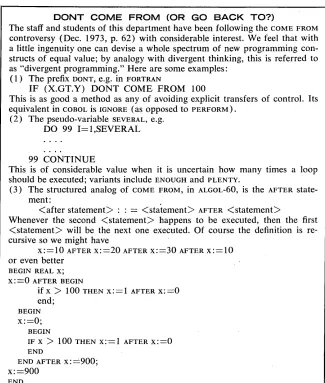
DONT COME FROM (OR GO BACK TO?)
The staff and students of this department have been following the COME FROM controversy (Dec. 1973, p. 62) with considerable interest. We feel that with a little ingenuity one can devise a whole spectrum of new programming con-structs of equal value; by analogy with divergent thinking, this is referred to as "divergent programming." Here are some examples:
(1) The prefix DONT, e.g. in FORTRAN
IF (X.GT.Y) DO NT COME FROM 100
This is as good a method as any of avoiding explicit transfers of control. Its equivalent in COBOL is IGNORE (as opposed to PERFORM).
(2) The pseudo-variable SEVERAL, e.g. DO 99 1= 1 ,SEVERAL
99 CONTINUE
This is of considerable value when it is uncertain how many times a loop should be executed; variants include ENOUGH and PLENTY.
(3) The structured analog of COME FROM, in ALGOL-60, is the AFTER state-ment:
<after statement> : : = <statement> AFTER <statement>
Whenever the second <statement> happens to be executed, then the first <statement> will be the next one executed. Of course the definition is re-cursive so we might have
x:=10 AFTER x:=20 AFTER x:=30 AFTER x:=10 or even better
BEGIN REAL x; x: =0 AFTER BEGIN
if x > 100 THEN x:=1 AFTER x:=O end;
BEGIN x:=O;
BEGIN
IF X > 100 THEN x:=1 AFTER x:=O END
END AFTER x:=900; x:=900
END
It is clear from a detailed study of these examples that the side effects of structured divergent programming have even greater potential than those of self-modifying machine code; for this reason if no other we expect such constructs to have a wide appeal to a certain section of the programming community.
P.S. On reflection, certain troublesome questions have occurred to us. Is a BRIEF CASE statement a computed GO TO, and what is the effect on it of a LOCK statement? What is NAMED UNCOMMON? And is a DURING loop exe-cuted by a During machine?
B. E. CARPENTER
Department of Computer Science Massey University Palmerston North, New Zealand
[image:25.612.242.567.219.602.2]letters
that it will be "2x" weeks or so behind schedule by completion time. What is the explanation of this phenomenon? There are at least three reasons: (1) First, no one will ever admit to the true amount of time he is behind, so every-thing else being equal, the negative slack will appear to grow larger as the delivery date approaches. (2) Second, if one is dumb enough to get behind, he is not smart enough to catch up. (3) Finally, whatever elements made a programmer late in the midpoint will probably continue to do so in a pro-portional manner over the remaining scheduled time.
You'll find this "law" somewhat more pessimistic than the guy who said "software schedules are incompress-ible"; rather, as the law states, once you're behind, the schedule tends to continue to expand. I discovered this law in 1962 while working on the Po-laris real-time program.
DONALD M. WYNNE
Hydrospace-Challenger, Inc. Rockville, Maryland
Structured programming
Mr. Tenny, in his article in the July issue (p. 110) on structured program-ming in FORTRAN, uses more or less exactly the same ideas for implementa-tion of SP in FORTRAN that I have been using for almost a year. However, I let a preprocessor do the translation from the source program, which is written in ANS FORTRAN extended with IF-THEN-ELSE, CASE-, WHlLE- and REPEAT-blocks, into ANS FORTRAN.
There are at least four advantages as compared to translating by hand from what Mr. Tenny calls IPL (Idealized Structured Programming Language) to FORTRAN.
1. The readability of the source pro-gram is increased because in itself the source program contains the high-level concepts WHILE, IF-THEN-ELSE, etc., which are closer to the human way of thinking, rather than the low-level concept GO TO. Thus there is no need for a parallel IPL-version of the com-ment cards.
2. You do not have any temptation, as Mr. Tenny puts it, to "improve" the program while translating it, simply because the translation is out of your reach. An "improvement," in this sense, very often turns out to be de-stroying the structure of the program.
3. The source code can be edited automatically by a program that in-dents the rows of the source program according to its block depth.
4. When modifying a program you do not have to bother with "non-con-sistent" labels, if for example, you would like to insert a WHILE-block within another WHILE-block, etc.
The only disadvantage that might be claimed against this procedure is that the cost for compiling will be increased because of the preprocessor. This is true, of course, for one compilation. But experience has shown that the number of compilations is significantly reduced and thus the total cost consid-erably decreased. So the alleged disvantage actually turns into a fifth ad-vantage to which all managers are sen-sitive: better economy.
LARS MOSSBERG
Technical and Scientific Data Processing Volvo Flygmotor AB Trollhiittan, Sweden
DATAMATION welcomes cor-respondence about the compu-ter industry. Please double-space your letter when you write to 1801 S. La Cienega Blvd., Los Angeles, CA 90035.
Suddenly, a small plotter with speed
24
The first real breakthrough in 12-inch incremental plotters in 15 years.
The Zeta Model 1200. As much as 21/2 times faster than other small plotters - with sharply improved line quality.
With operating speeds up to 3000 increments per second at 2.5 mils (1500 at 5.0), the Model 1200 delivers 7.5 inches per second (10.5 diagonal). The standard Was
3 inches.
What's more, the Model 1200 is compatible . with existing interfaces and software. Unit cost is low. Attractive OEM discounts are available. If you like fast-moving plots, call or write Zeta Research, Inc., 1043 Stuart Street, Lafayette, Cali-fornia 94549, 415-284-5200.
t
Zeta Research
CIRCLE 76 ON READER CARD
Now ... mainframe architecture
in
a
remote communications processor!
COPE@t600by
HARRIS·
The COPE 1600 is all new, from its mainframe architecture and
communications-oriented design to its built-in capacity for growth. This enables you to start with a basic RBT and expand as your volume and applications increase. All in all, COPE 1600 is your best way to achieve cost-effective communications!
What do we mean by cost effective? Read on. The minimum COPE 1600 system is a high-performance RBT in the COPE tradition. Then through expansion you can operate, 16 asynchronous circuits concurrent with
HASP Imultileaving at 9600 bps with no
degradation. Asynchronous speeds are
available from 75 to 9600 bps. The 1600 will also operate up to 4 synchronous communications interfaces from 2000 to 50Kbps.
Wondering about operational flexibility? Compare these features. The 1600 incorporates a multi-task
communications operating system enabling you to control up to 16 concurrent program operations. The initial system accommodates five different emulators: HASP Imultileaving, 3780, 2780, 1004 and 200UT. These emulators can communicate
concurrently with two mainframes (of different protocols if desired). IBM SDLC hardware is built-in to accommodate· future requirements.
Want to know more about the 1600? Then consider these advantages: expandable memory from 16K to 65K in 8K byte modules. Direct memory addressing. Comprehensive repertoire of 104 instructions. Structured
programming language. Plus, there's a
full complement of peripherals, of course, including magnetic tape and disk. And' back-up support nationally by Harris' own Field Engineering Department.
That's only part of the COPE 1600 story. For more details on how you can
1) eliminate redundant system hardware, 2) reduce line costs, and 3) improve your overall network performance call your nearest Harris office. Or contact Harris Corporation, Data Communications Division, 11262 Indian Trail, Dallas, Texas 75234, (214) 241-0551.
HARRIS
COMMUNICATIONS AND INFORMAnON HANDUNG
HARRIS CORPORATION Data Communications Division
TermiNet® Printers
GE
QUALITY
is ...
101 tests
·at
the factory
... exercised, vibrated, inspected, verified, bum-in
tested, and run-in tested, TermiNet printers get 101
different tests to insure customers they're reliable,
quiet, fast and easy to operate. "Quiet room" noise
testing and life testing are other ways General Electric
. makes sure TermiNet printers meet your management's
keep
you on-line
GE SERVICE is ...
local response nationwide
... but nothing is perfect. Sometime your TermiNet
printer may malfunction. If it does, General Electric's
nationwide service is
ready. In 92 locations
(30 added
in 1974 and growing),
fully trained
and qualified
servicemen are at your call to diagnose and solve your
printer problems. Each serviceman is equipped with
his own
spare parts
kit to keep your terminals up
and running - minimum down time. GE service
is aimed at KEEPING YOU ON-LINE.
For more information on TermiNet printers and the TermiNet service center nearest you wrife TermiNet
794-14. P.O. Box 4197. Lynchburg. Virginia 24502.