Open Access
Research
Application of a hybrid wavelet feature selection method in the
design of a self-paced brain interface system
Mehrdad Fatourechi*
1, Gary E Birch
1,2,3and Rabab K Ward
1,3Address: 1Department of Electrical and Computer Engineering, University of British Columbia, Vancouver, BC V6T 1Z4, Canada, 2Neil Squire
Society, Burnaby, BC V5M 3Z3, Canada and 3Institute for Computing, Information and Cognitive Systems, Vancouver, BC V6T 1Z4, Canada
Email: Mehrdad Fatourechi* - [email protected]; Gary E Birch - [email protected]; Rabab K Ward - [email protected] * Corresponding author
Abstract
Background: Recently, successful applications of the discrete wavelet transform have been reported in brain interface (BI) systems with one or two EEG channels. For a multi-channel BI system, however, the high dimensionality of the generated wavelet features space poses a challenging problem.
Methods: In this paper, a feature selection method that effectively reduces the dimensionality of the feature space of a multi-channel, self-paced BI system is proposed. The proposed method uses a two-stage feature selection scheme to select the most suitable movement-related potential features from the feature space. The first stage employs mutual information to filter out the least discriminant features, resulting in a reduced feature space. Then a genetic algorithm is applied to the reduced feature space to further reduce its dimensionality and select the best set of features.
Results: An offline analysis of the EEG signals (18 bipolar EEG channels) of four able-bodied subjects showed that the proposed method acquires low false positive rates at a reasonably high true positive rate. The results also show that features selected from different channels varied considerably from one subject to another.
Conclusion: The proposed hybrid method effectively reduces the high dimensionality of the feature space. The variability in features among subjects indicates that a user-customized BI system needs to be developed for individual users.
Background
A successful brain interface (BI) system enables individu-als with severe motor disabilities to control objects in their environment (such as a light switch, neural prosthe-sis or computer) by using only their brain signals. Such a system measures specific features of a person's brain sig-nal that relate to his or her intent to affect control, then translates them into control signals that are used to con-trol a device [1,2].
Brain interface systems are implemented in two ways: sys-tem-paced (synchronized) or self-paced (asynchronous). In system-paced BI systems, a user can initiate a command only during certain periods specified by the system. In a self-paced BI system, users can affect the output of the BI system whenever they want, by intentionally changing their brain state. The state in which a user is intentionally attempting to control a device is called an intentional con-trol (IC) state. At other times, users are said to be in a
no-Published: 30 April 2007
Journal of NeuroEngineering and Rehabilitation 2007, 4:11 doi:10.1186/1743-0003-4-11
Received: 13 May 2006 Accepted: 30 April 2007
This article is available from: http://www.jneuroengrehab.com/content/4/1/11 © 2007 Fatourechi et al; licensee BioMed Central Ltd.
control (NC) state, where they may be idle, thinking about a problem, or performing some action other than trying to control the device[3,4]. To operate in this paradigm, BI systems should be designed to respond only when the user is in an IC state and to remain inactive when the user is in an NC state. So far, only a few BI systems (e.g. [3,5-10]) have been specifically designed and tested for paced control applications. But as recognized in [2], self-paced BI systems deserve more attention.
The discrete wavelet transform (DWT) can be used as a powerful feature extraction tool to extract time-frequency features similar in shape to that of a particular wavelet function. It therefore has an advantage over other feature extraction methods that operate in only one domain, such as the Fourier transform, or autoregressive modeling.
The DWT has been extensively applied in the analysis of event-related potential (ERP) because of its ability to effectively explore both the time and frequency informa-tion of these signals [11,12]. It has also been successfully used to generate wavelet features in BI systems. In [13], DWT was employed in the design of a system-paced BI system that used wavelet coefficients extracted from slow cortical potentials (SCPs) as well as other ERPs. This sys-tem performed better than other designs that used EEG time series and a mixed filtering method. In [14], the ener-gies of various frequency bands decomposed by a wavelet packet transform (18 frequency bands in total) were used as features in detecting different movement patterns in a self-paced BI system. These features were linearly com-bined to generate a single feature, with coefficients of the linear mapping determined by a genetic algorithm (GA). In [15], a custom-made wavelet function was employed in two different studies: the detection of P300 in a single EEG channel, and the detection of the Bereitschafts poten-tial from two EEG channels. In [16], a weighted linear combination of all available wavelet coefficients (15 in total) extracted from a single EEG channel was used to detect P300 patterns. To estimate weights for each feature in the linear combination, a neural network was employed. Finally, in [17], DWT was applied to extract the 0–4 Hz component of the EEG signal in a P300-based BI system. Based on the above encouraging results, in this study we explore applying DWT to extract movement-related potential (MRP) features for driving a self-paced BI system.
Although the above BI studies provide promising evi-dence that DWT can be employed to extract features in BI systems, two main issues still need to be addressed. First, studies that used discrete wavelet coefficients as features (rather than wavelet-filtered EEG signals), used only one or two EEG channels. In these cases, the resulting dimen-sionality of the space does not pose a serious problem,
since it is not very large. Having a BI system that uses data recorded from only one or two electrodes seems very appealing, since the setup is fast and uses less hardware/ software infrastructure. Most of the above-mentioned papers, however, achieved a relatively high degree of clas-sification error when only one or two EEG channels were used. For example, in [16], the reported error rates were relatively high (nearly 40% error). In [17], where wavelet-filtered EEG signals were used, the system did not perform well (30% misclassification). For the only self-paced BI system that has applied wavelet coefficients so far [14], false activation rates (the percentage of hits that were not true positives) varied up to 67%, however, the authors did not indicate the number of NC epochs used in their study, so critical commentary on the performance of their BI sys-tem cannot be made. The invasiveness of the recording technology of the BI system in [14] is also an important issue that needs to be considered.
The above observations strongly motivate the use of addi-tional EEG electrodes in BI systems. With signals recorded from multiple channels, we can explore spatial informa-tion, which is expected to yield improvements in classifi-cation performance.
Another issue that must be addressed when using DWT to extract features in BI systems is the feature selection proce-dure. That is, how many features should be selected and how should they be selected? In [13], all of the 64 wavelet features used for classification were extracted from only one EEG channel. In [15], because of the computational limitations affecting the classifier, only a number of top wavelet features (ranked by the amount of discriminabil-ity) were selected. None of the above-mentioned approaches yielded best results (since the feature selection process used was not necessarily optimal). Using all fea-tures does not necessarily provide the best results, because some of the less discriminant features may degrade the classifier's performance [18]. On the other hand, using only few features that have the highest rank (and filtering out the rest of features) does not necessarily lead to opti-mal classification performance, since there is no guarantee that using only top-ranked features leads to the best clas-sifier performance[19].
selected to obtain better classification performance. A mechanism for selecting the most discriminating features is thus needed.
Wrapper methods, such as GAs, use the classifier's per-formance to evaluate a particular feature vector. They pro-vide a good solution for finding the features that work well together by choosing the ones that lead to better clas-sifier performance [20]. The downside of using wrapper methods is time inefficiency. As the dimension of the search space increases, it becomes harder for a wrapper method to find a suitable subset of features that lead to a high performance.
In order to benefit from the advantages of both filter and wrapper methods, we decided to employ a hybrid approach. Features carrying the least discriminative infor-mation about the output classes were filtered out first. Then a wrapper method was applied to the reduced fea-ture space to find the feafea-tures that work well together, i.e., the combination that leads to the best classification per-formance. We used mutual information (MI) in the filter-ing stage. Mutual information is a powerful tool for ranking features based on the amount of discriminative information each carries [21]. We then applied a GA in a wrapper approach to select the features that lead to the best classification performance. Genetic algorithms are heuristic methods that can effectively sample large search spaces [22]. They are implemented based on the princi-ples of evolutionary biology, and evolve over many gener-ations. By mimicking this process, GAs are able to evolve solutions to real-world problems. They have been shown to be useful tools in automatically customizing many practical systems [22,23].
We used a support vector machine (SVM) to classify the selected features into one of two classes: no control (NC) or intentional control (IC). The results of this study show that applying the proposed approach to the offline data collected from four able-bodied subjects yields low false positive (FP) rates at a reasonably high true positive (TP) rate. We also examine the spatial distribution of the selected features. We show that this distribution varies considerably from one subject to another. This finding shows the importance of user customization of BI sys-tems.
Data collection
People with severe motor disabilities cannot physically execute certain movements such as a finger flexion, but they are usually able to attempt it. Several studies have shown that recordings of brain signals obtained from attempted and real movements for able-bodied subjects bear many similarities [14,24-29]. Based on these studies, both attempted and executed movements have been
shown to activate similar cortical areas and to generate similar movement patterns. This evidence enables us to base our analysis on the data of able-bodied subjects, who actually execute the particular movement. It is then possi-ble to detect the occurrence of the control command by analyzing signals such as electro-myographic (EMG) sig-nal or the output of an actual switch. Such sigsig-nals can be used to label the brain signals and to evaluate the per-formance of a BI. The data analysis of individuals with motor disabilities was thus left to future studies.
The data of four (three male and one female) able-bodied subjects were used in this study. All subjects were right-handed and between 31 and 56 years old. They had all signed consent forms prior to participation in the experi-ment.
Subjects were positioned 150 cm in front of a computer monitor. The EEG signals were recorded from 13 monop-olar electrodes positioned over the subjects' supplemen-tary motor area and primary motor cortex (according to the International 10–20 System at F1, Fz, F2, FC3, FC1, FCz, FC2, FC4, C3, C1, Cz, C2 and C4 locations).
Electro-oculo-graphic (EOG) activity was measured as the potential dif-ference between two electrodes, placed at the corner of and below the right eye. An ocular artifact was considered present when the difference between the EOG electrodes exceeded ± 25 µV. All signals were sampled at 128 Hz and referenced to ear electrodes (see [30] for details of the data recording). The recorded signals were then saved on the computer and converted to bipolar EEG signals by calcu-lating the difference between the adjacent EEG channels. This procedure was used since it has been shown that bipolar electrodes generate more discriminating features than do monopolar electrodes [3]. This conversion gener-ated the following 18 bipolar EEG channels: F1-FC1, F1-Fz, F2-Fz, F2-FC2, FC3-FC1, FC3-C3, FC1-FCz, FC1-C1, FCz-FC2, C1-Cz, C2-C4, FC2-FC4, FC4-C4, FC2-C2, FCz-Cz, C3-C1, Cz -C2 and Fz-FCz.
The data were collected from subjects as they performed the following guided task. At each interval, a white, 2 cm diameter circle was displayed on the subject's monitor for 1/4 second, prompting the subject to attempt a move-ment. In response to this cue, the subject had to perform a right index finger flexion one second after the cue appeared. The 1-second delay was used to avoid visual evoked potential (VEP) effects caused by the cue (see [31] for more details). For each subject, 80 IC epochs were col-lected on average every day over a period of 5 days.
movement onset and ends at tfinish seconds after it. There were limitations in choosing the total length of (tstart + t fin-ish). If the length of (tstart + tfinish) increases, more artifacts
may be present in an IC epoch. As a result, the number of training epochs that are artifact-free based on the criterion used to reject ocular artifacts will be reduced. If the length of (tstart + tfinish) is too short, a poor exploration of potential
features results. Since a simple finger flexion MRP usually starts about 1.5 seconds before the movement and returns back to the normal baseline around 1 second after the movement [32], the data obtained from 1.5 seconds before to 1.0 second after the movement onset were ana-lyzed (i.e., tstart = 1.5 seconds and tfinish = 1.0 second).
The NC epochs were selected as follows. A window of width (tstart + tfinish) seconds was considered (tstart = 1.5 sec-onds and tfinish = 1.0 second). To extract NC epochs, the window was shifted over each EEG signal recorded during NC sessions by a step of 16 samples (0.1250 sec). Wavelet coefficients were extracted for each epoch that did not contain artifacts.
Method
The overall structure of the proposed scheme is shown in Figure 1. EEG signals were checked for the presence of EOG artifacts. The contaminated epochs were rejected, as explained in the "Data Collection" Section.
The continuous wavelet transform (CWT) is defined as the convolution of the signal x(t) with the wavelet functions
ψa,b(t) where ψa,b(t) is the dilated and shifted version of
the wavelet function ψ(t) and is defined as follows:
where a and b are the scale and translation parameters, respectively. The CWT maps a signal of one independent variable t into a function of two independent variables a,
b. This procedure is redundant and not efficient for algo-rithmic implementations. Therefore, it is more practical to define the wavelet transform at a discrete scale a and a dis-crete time b by choosing the set of parameters (this
trans-form is called a discrete wavelet transtrans-form, or DWT), such that
aj = 2-j, b
j,k = 2-j·k (j, k are integers) (2)
The contracted versions of the wavelet function will match the high-frequency components of the original signal and the dilated versions will match the low-frequency oscilla-tions. Then by correlating the original signal with the wavelet functions of different sizes, the details of the sig-nal at different scales are obtained. The resulting correla-tion features can be arranged in a hierarchical scheme called multi-resolution decomposition [33]. Multi-resolu-tion decomposiMulti-resolu-tion separates the signal into "details" at different frequency bands and a coarser representation of the signal called an "approximation".
For our study, the rbio3.3 wavelet from the B-spline family was chosen as the wavelet function because it has some similarities with the shape of the classic bipolar MRP pat-tern. Using a 5-level decomposition method resulted in wavelet coefficients corresponding to the following fre-quency bands (the sampling frefre-quency was 128 Hz): [32-64], [16-32], [8-16], [4-8], [2-4], and [0–2] Hz.
Based on the previous findings in [3], which showed that MRP features are mostly located in the frequency range below 4 Hz, only the lowest frequency bands (i.e., 0–2 Hz and 2–4 Hz) were considered for further analysis of MRPs. Even with this reduced feature space, the resulting feature space dimension (Nfeatures), which is the product of the number of electrodes (Nelectrodes) and the number of wave-let features per EEG signal (Nwavelet). That is, Nfeatures = N elec-trodes × Nwavelet remained very high. Thus, a feature selection
procedure had to be used that could select thefeatures that lead to optimal classification performance. This proce-dure should specify the selected EEG channels as well as the features selected per channel.
We devised a hybrid feature selection algorithm to meet these requirements. Mutual Information (MI) was employed in the filtering stage and a GA was then used to select the optimal set of features.
Although MI has been used elsewhere to filter out the less informative features [21,34], it is not usually successful at
ψa b t a ψ
t b
a
, ( )= ⋅ ( − ) (1)
The overall structure of the proposed method Figure 1
finding features that lead to optimal classification per-formance. This is because when there are more than three feature dimensions, the calculation of MI is computation-ally demanding, and impossible for large feature spaces (since the calculation of MI requires the joint probability of features in a high dimension) [21,34]. Thus, MI was only used in our algorithm to discard the least informative features based on the amount of information that each feature carries regarding the output classes.
The MI between the input feature vector X and the output classes Y was calculated as follows:
I(X, Y) = H(Y) - H(Y|X) (3) Where
In these formulae, I represents the mutual information between X and Y, where X = {xi}, (i = 1,2,3,..., N) and Y = {yj}, (j = 1,2,3,..., M), N is the number of input states and
M is the number of outputs states (M = N = 2, since the input and output can only take two values: IC and NC),
P(xi) is the probability of occurrence of an input state xi,
P(yj) is the probability of the output class yj when the
input is unknown, and P(yj|xi) is the probability of the output class yj when the input state xi is known.
For each subject, the wavelet coefficient (feature) values corresponding to all the training set data were calculated. Then, using histograms with 10 bins each, the probability function of each feature was estimated and its mutual information with each of the output classes was calcu-lated. The values of MI were calculated for all Nfeatures fea-tures and then ranked in descending order. The top L
features were then selected. In this study, we arbitrarily chose L = 50 to avoid having a feature space with a very high dimension.
After reducing the dimension of the feature space, a GA was used to select a subset of m features from the top L fea-tures. To represent each possible combination of features, a binary chromosome of length L was defined. The bit i of the binary chromosome specified whether or not the fea-ture i was selected by the GA. A value of "1" indicated the
presence of feature i and a value of "0" indicated its absence in a chromosome.
An important decision in the design of a GA is the defini-tion of a proper fitness funcdefini-tion. In the proposed design, a suitable fitness function should consider at least three objectives: maximizing the TP rate, minimizing the FP rate and minimizing the number of features selected by the hybrid feature selection procedure.
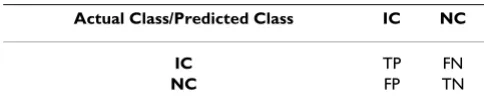
The classification performance of a 2-state, self-paced BI system is usually determined by a confusion matrix, as shown in Table 1. In Table 1, the FP rate is the percentage of instances for which an NC epoch is misclassified as an IC epoch, the true negative (TN) rate is the percentage of NC epochs being correctly classified, the true positive (TP) rate is the percentage of IC epochs being correctly classi-fied and the false negative (FN) rate is the percentage of misclassifying an IC epoch as an NC epoch. The fitness function should summarize this confusion matrix. For a 2-state self-paced BI system, we have
FN(%) = 100(%) - TP(%) (7)
and
TN(%) = 100(%) - FP(%) (8) Based on equations (7) and (8), only TP and FP rates need to be included in the fitness function. One example of a
fitness function is a function that maximizes the
ratio. In this paper, the following objective function was used:
where Z is a chromosome and f is the fitness function. This fitness function gives a higher fitness level to
chromo-somes that generate a higher ratio. We also postulated
that TP rates below 20% were too low for the successful operation of a self-paced BI system (since they correspond to detection of less than one IC out of every five IC states,
H P yj P y
j M
j
( )Y = − ( ) log⋅ ( ) =
∑
1
2 (4)
H P xi P yj xi P yj xi
j M i
N
( | )Y X = − ( )⋅ ( | ) log⋅ ( | ) = =
∑
∑
2 1 1 (5)P yj P xi P yj xi
i N ( )= ( )⋅ ( | ) =
∑
1 (6) TP FP f Z TP TP ZFP Z TP
( ) , % ( ) ( ), % = < ≥ 0 20 20 (9) TP FP
Table 1: The confusion matrix for a 2-state self-paced BI system.
Actual Class/Predicted Class IC NC
IC TP FN
which may lead to user frustration, even though the FP rates might be very low). Such chromosomes were consid-ered "unfit" and were assigned a "0" fitness value.
Next, a lexicographic approach was applied for multi-objective optimization of the GA population [23]. Very briefly, in this approach, the objectives were ranked according to the priorities assigned to them prior to opti-mization. The objective with the highest priority was used first for comparing the members of the population. In our
case, the average of over the validation sets was first
selected as the objective function with the highest priority. The chromosomes were then ranked in a single-objective fashion. Any ties were resolved by comparing the relevant chromosomes again with respect to objectives that were assigned lower priority. The other three objectives were chosen as (1) the average of FP rate over the validation sets, (2) the average of TP rate over the validation set, and (3) the number of features, resulting in four objectives per chromosome in the GA population. The 2nd and 3rd
objec-tives were ordered such that for two chromosomes with
the same ratio, the one with the lower FP rate was
considered to be the fit chromosome.
The remaining operators of the GA were tournament-based selection (tournament size = 3), uniform crossover and uniform mutation. The sizes of the initial population and the population in the next generations were chosen as 100 and 50, respectively. We used random initialization to initialize the GA. Elitism was used to keep the best per-forming chromosome of each population in the subse-quent populations.
The number of evaluations was set to 2000. If the
improvement in the ratio of the best solution was
found to be less than 1% for more than 10 consecutive generations, the algorithm was terminated. Because of the computational load, tuning the GA parameter values (such as the mutation and crossover rates) was not per-formed.
A support vector machine (SVM) that uses kernel-based learning was chosen to classify each chromosome in the GA population. In kernel-based learning, all of the bene-ficial properties of linear classification methods, such as simplicity, are maintained, however, the overall classifica-tion is nonlinear in the input space, since the feature and input spaces are nonlinearly related [35]. Another reason
for selecting an SVM as a classifier is that SVMs not only minimize the empirical risk (training error), they also minimize the confidence error (test error) [36]. We used the LIBSVM software[37], which has also been used in other BI papers [38,39].
The evaluation process was as follows. For each subject, IC and NC epochs were randomized and divided into train-ing, validation and test sets. The training set was used to train the classifier, and the validation set was used to select the best set of features. The configuration yielding the best results on the validation set in the multi-objective sense mentioned above was selected, and the performance of the system calculated on the test set was reported. We used a five-fold nested cross-validation for evaluating the per-formance of the system. For each outer cross-validation set, 20% of the data were used for testing and the rest were used for training and model selection (selection of opti-mal subset of features). In order to select the models, the datasets were further divided into five folds. For each fold, 80% of the data were used for training the classifier and 20% were used for model selection.
To deal with the problem of unbalanced training sets (there were at least 20 times more NC epochs than IC epochs), the size of the NC training feature set was reduced to be the same as the size of the training IC fea-ture sets. This was done by randomly selecting epochs from the NC training set.
Results
In this section, we present our offline analysis of the data of the four subjects described in the "Data Collection" Section. We performed a search on the classifier's param-eters during the model selection. Our findings showed that a 5th degree polynomial kernel function performed
better than other kernel functions studied (linear, polyno-mial with a degree other than 5 (3, 4, 6 and 7) and RBF kernel).
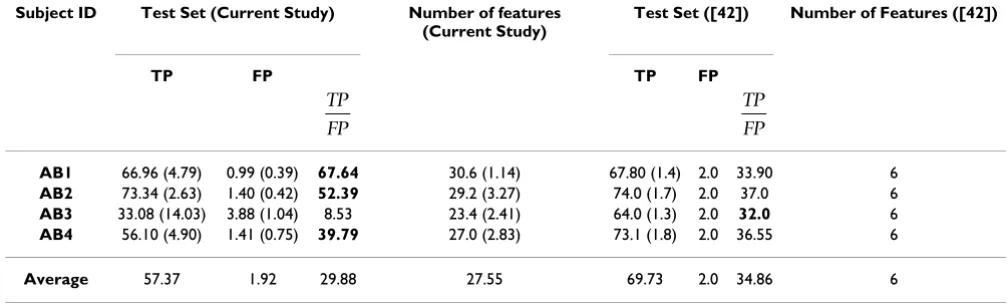
Since a five-fold nested cross-validation was used for the performance evaluation, the results were averaged over five runs of the outer validation sets. The columns 1 to 5 of Table 2 show the subject identification number, the average TP rate on the test sets, the average FP rate on the
test sets, the average ratio and the average number of
features selected by the hybrid feature selection process. The numbers in parentheses are the standard deviations. As Table 2 shows, low FP rates for three of the four sub-jects (subsub-jects AB1, AB2 and AB4) were achieved for a rel-atively high TP rate. For subject AB3, the TP results on the
TP FP
TP FP
TP FP
test sets were low (although the FP rates remained less than 4%).
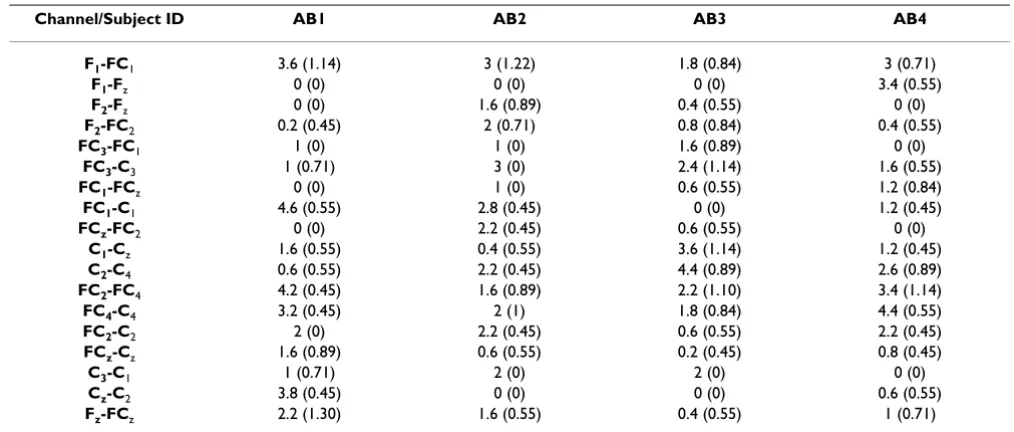
Next, the spatial distributions of the selected features were examined. The average number of selected features per channel is shown in Table 3. The numbers in parentheses show the standard deviation over five runs of outer cross-validation. Figures 2 to 5 show the number of selected fea-tures per channel for all subjects after applying the hybrid selection method (averaged over the number of cross-val-idation sets). The low standard deviation obtained for all cases shows the robustness of the proposed method over different runs of the algorithm.
Discussion and conclusions
Discrete wavelet transform (DWT) is a useful feature extraction tool since it explores the time as well as the fre-quency information of the signal. Although DWT has been employed to some degree of success in a number of synchronized BI systems, there remain some limitations in its application to self-paced BI systems (in terms of the large size of the feature space).
Brain interface systems that use DWT features have mostly employed only one or two channels (perhaps due to the large dimensionality of the feature space or to limitations imposed by the experimental protocol). To simultane-ously explore the wavelet coefficients (features) of BIs with more channels (so as to explore the spatial informa-tion) and to avoid the problems associated with the resultant large feature space, a two-stage (hybrid) feature selection algorithm is proposed. The first stage uses mutual information (MI) to discard the least informative features. In the second stage, a genetic algorithm (GA) selects those remaining features that lead to better system performance in the sense of meeting multiple objectives.
In our study, the features selected per channel varied con-siderably from one subject to another, as shown in Figures 2 to 5. For example, for subject AB1, more features were selected from channels FC1-C1, F1-FC1, Fz-FCz, FC4-C4,
FC2-FC4 and Cz-C2, while for subject AB4, more features were selected from channels FC4-C4, FC2-FC4, F1-Fz, C2-C4, F1-FC1, and FC2-C2. These results support the hypothesis that proper channel selection for every subject is necessary to obtain superior performance.
Another finding from Figures 2 to 5 is that the relevant features for each subject were unique. These findings are in contrast to an earlier study done by our group that empirically determined six pairs of electrodes for all sub-jects (channels F1-FC1, F2-FC2, FC1-C1, FC2-C2, FCz-Cz, and Fz-FCz) [3]. Our findings in this regard are not surprising. The evidence from the literature supports the hypothesis that there is a significant amount of intersubject variabil-ity in terms of generating MRP patterns [40]. The literature also shows that the selected features are not necessarily located in the standard frequency bands or on specific scalp locations, and that the set of selected features differs from subject to subject [41]. These studies support the notion that a customized BI system should be designed for each subject.
Table 3 shows that for each subject, a number of bipolar channels were not selected by the feature selection process (such as channel F1-Fz for subjects AB1, AB2 and AB3, and channel FC3-FC1 for subject AB4). These results indicate that these channels can be eliminated from the analysis in future studies. Moreover, Table 3 and Figures 2 to 5 show that the degree of contribution to the classification per-formance varies from one channel to another. These results indicate that a channel elimination methodology could be incorporated into the proposed method to
fur-Table 2: Comparison of the average TP, average FP rates, average and the average number of features.
Subject ID Test Set (Current Study) Number of features (Current Study)
Test Set ([42]) Number of Features ([42])
TP FP TP FP
AB1 66.96 (4.79) 0.99 (0.39) 67.64 30.6 (1.14) 67.80 (1.4) 2.0 33.90 6
AB2 73.34 (2.63) 1.40 (0.42) 52.39 29.2 (3.27) 74.0 (1.7) 2.0 37.0 6
AB3 33.08 (14.03) 3.88 (1.04) 8.53 23.4 (2.41) 64.0 (1.3) 2.0 32.0 6
AB4 56.10 (4.90) 1.41 (0.75) 39.79 27.0 (2.83) 73.1 (1.8) 2.0 36.55 6
Average 57.37 1.92 29.88 27.55 69.73 2.0 34.86 6 TP
FP
TP FP
Spatial distribution of the average number of selected features for Subject AB1 Figure 2
Spatial distribution of the average number of selected features for Subject AB1.
Table 3: The average number of selected features per channel after applying the hybrid feature selection algorithm.
Channel/Subject ID AB1 AB2 AB3 AB4
F1-FC1 3.6 (1.14) 3 (1.22) 1.8 (0.84) 3 (0.71)
F1-Fz 0 (0) 0 (0) 0 (0) 3.4 (0.55)
F2-Fz 0 (0) 1.6 (0.89) 0.4 (0.55) 0 (0)
F2-FC2 0.2 (0.45) 2 (0.71) 0.8 (0.84) 0.4 (0.55)
FC3-FC1 1 (0) 1 (0) 1.6 (0.89) 0 (0)
FC3-C3 1 (0.71) 3 (0) 2.4 (1.14) 1.6 (0.55)
FC1-FCz 0 (0) 1 (0) 0.6 (0.55) 1.2 (0.84)
FC1-C1 4.6 (0.55) 2.8 (0.45) 0 (0) 1.2 (0.45)
FCz-FC2 0 (0) 2.2 (0.45) 0.6 (0.55) 0 (0)
C1-Cz 1.6 (0.55) 0.4 (0.55) 3.6 (1.14) 1.2 (0.45)
C2-C4 0.6 (0.55) 2.2 (0.45) 4.4 (0.89) 2.6 (0.89)
FC2-FC4 4.2 (0.45) 1.6 (0.89) 2.2 (1.10) 3.4 (1.14)
FC4-C4 3.2 (0.45) 2 (1) 1.8 (0.84) 4.4 (0.55)
FC2-C2 2 (0) 2.2 (0.45) 0.6 (0.55) 2.2 (0.45)
FCz-Cz 1.6 (0.89) 0.6 (0.55) 0.2 (0.45) 0.8 (0.45)
C3-C1 1 (0.71) 2 (0) 2 (0) 0 (0)
Cz-C2 3.8 (0.45) 0 (0) 0 (0) 0.6 (0.55)
ther decrease the number of channels used for the opera-tion of the system. This approach would rank the channels according to the number of selected features. It would then repeatedly eliminate the channel with the lowest contribution to fitness until the performance drops below a certain threshold (recursive elimination of chan-nels). Systematic elimination of channels can lead to a faster setup of the system as well as decreased computa-tional time. This could be part of future research works aimed at moving towards a more practical system.
It should be mentioned that it is difficult to directly com-pare the results of our study with other BI studies. This is because the number of subjects, the type of subject (whether or not subjects are able-bodied), the experimen-tal protocols, the evaluation protocol and the neurologi-cal phenomenon differ from one study to another. In addition, the number of available EEG epochs, as well as the degree of training subjects receive before participating in a BI experiment, vary among studies.
We can, however, compare our current results with the lat-est design of a state-of-the-art self-paced BI system called
the low frequency-asynchronous switch design (the LF-ASD) [42]. Both studies use the same subjects, the same experimental protocol, the same EEG data and the same evaluation protocol.
The LF-ASD (originally reported in [3] and later modified as reported in [42]) uses a feature extractor with a shape similar to a wavelet function, and extracts features from six bipolar EEG channels. The Karhunen-Loève Transform (KLT) is used to reduce the 6-dimensional feature space produced by the feature generator to a 2-dimensional space. A 1-NN classifier is used as the feature classifier. A moving average and a debounce algorithm are employed to improve the performance of the system by reducing the number of false activations. The parameter values of the system were estimated by an expert (for details, see [3,30,42]). The latest performance results of the LF-ASD [42], applied to the data of subjects AB1 to AB4 are pre-sented in columns 6 to 9 of Table 2. As can be seen from the table, our proposed system has resulted in an
Spatial distribution of the average number of selected features for Subject AB2 Figure 3
increased ratio for all subjects (with the exception of
subject AB3). Specifically, the ratio increased from
33.90 to 67.74 for subject AB1 (a relative improvement of 99.5%), from 37 to 52.39 for subject AB2 (a relative improvement of 41.6%), and from 36.55 to 39.79 for sub-ject AB4 (a relative improvement of 8.9%). These results show that our proposed approach improved the perform-ance of most subjects compared with the latest design of
the LF-ASD. The degree of improvements in the ratio,
however, is not statistically significant (p > 0.05), so tests on the data of more subjects are needed to further sub-stantiate this improvement. Note that the improved per-formance was achieved at the expense of using more features (please see columns 5 and 9 in Table 2).
The relatively poor results obtained for subject AB3 may be partly related to our choice of wavelet function. Note that the wavelet function chosen for this study was based on the similarities between the chosen wavelet function
and a typical bipolar MRP ensemble average pattern. However, there is substantial inter-subject variability in the shape of MRPs, especially in single trials [42]. It is expected that by analyzing a more diverse family of wave-let functions, a different wavewave-let function might be chosen for each subject that would produce superior results.
As mentioned in "Methods" Section, we designated the number of features chosen by the MI to be L = 50. Fewer features would have sped up the process of feature selec-tion at the second stage, but might have resulted in a lower fitness value. To test this possibility, we compared the fitness of the best subset of features (see Table 2) with that of all features for subject AB1 (see Figure 6). In this figure, the black line shows the fitness of the best configu-ration (calculated from Table 2). The blue line shows the fitness of the classifier as a function of the number of top features. We began by training and testing the classifier using only the feature with the highest MI score, and then calculated the fitness. Then we added features one at a time (according to their MI scores) and trained and tested the classifier using the new set of features. This process was repeated until we reached L = 50. Although the fitness
TP FP
TP FP
TP FP
Spatial distribution of the average number of selected features for Subject AB3 Figure 4
of the classifier increased as more features were added, it stayed well below the optimal value achieved by the GA. These results indicate that a lower L (especially when only limited top features are used for training the classifier) does not necessarily lead to better performance.
A useful area to explore is the automation of the classifier. Currently, the feature selection procedure is automated but the selection of other parameter valuea, such as those of the classifier, is carried out through cross-validation. Incorporating these parameters into the automation proc-ess would relieve the designer from the tiresome procproc-ess of selecting the classifier's parameter values, while poten-tially yielding better classification results. Expanding the current results to continuous signals and ultimately online testing are also worthwhile topics for future work.
These results should be considered as preliminary results in the development of a self-paced brain interface system with a low FP rate. Our future work will also include test-ing of the proposed system on a larger pool of subjects to further investigate its usability.
Abbreviations
Abbreviation Complete Name
AB Able-bodied
BI brain interface
CWT continuous wavelet transform
DWT discrete wavelet transform
EEG Electroencephalography
EMG Electromyography
EOG Electrooculography
ERP event-related potential
FN false negative
FP false positive
Spatial distribution of the average number of selected features for Subject AB4 Figure 5
GA genetic algorithm
IC intentional control
MI mutual information
MRP movement-related potentials
NC no control
SCP slow cortical potentials
SVM support vector machine
TN true negative
TP true positive
WT wavelet transform
Authors' contributions
MF proposed the method, carried out the data analysis and drafted the manuscript. GEB and RKW critically revised the proposed scheme, and were involved in draft-ing the manuscript. All authors read and approved the final manuscript.
Acknowledgements
This work was supported in part by NSERC under Grant 90278-06 and CIHR under Grant MOP-72711. This research has been enabled by the use of WestGrid computing resources, which are funded in part by the Canada Foundation for Innovation, Alberta Innovation and Science, BC Advanced Education, and the participating research institutions. The authors would like to thank Mr. Craig Wilson for his valuable comments on this paper.
References
1. Vaughan TM: Brain-computer interface technology: A review of the second international meeting. IEEE Trans Neural Syst Rehabil Eng 2003, 11:94-109.
2. Wolpaw JR, Birbaumer N, McFarland DJ, Pfurtscheller G, Vaughan TM: Brain-computer interfaces for communication and con-trol. Clin Neurophysiol 2002, 113:767-791.
3. Mason SG, Birch GE: A brain-controlled switch for asynchro-nous control applications. IEEE Trans Biomed Eng 2000, 47:1297-1307.
4. Mason SG, Birch GE: Temporal control paradigms for direct brain interfaces – rethinking the definition of asynchronous and synchronous. Proc of HCI Int Conf Las Vegas, USA 2005. 5. Birch GE, Lawrence PD, Hare RD: Single-trial processing of
event-related potentials using outlier information. IEEE Trans Biomed Eng 1993, 40:59-73.
6. Levine SP, Huggins JE, BeMent SL, Kushwaha RK, Schuh LA, Rohde MM, Passaro EA, Ross DA, Elisevich KV, Smith BJ: A direct brain interface based on event-related potentials. IEEE Trans Rehabil Eng 2000, 8:180-185.
7. Millan Jdel R, Mourino J: Asynchronous BCI and local neural classifiers: An overview of the adaptive brain interface project. IEEE Trans Neural Syst Rehabil Eng 2003, 11:159-161. 8. Scherer R, Muller GR, Neuper C, Graimann B, Pfurtscheller G: An
asynchronously controlled EEG-based virtual keyboard: Improvement of the spelling rate. IEEE Trans Biomed Eng 2004, 51:979-984.
9. Yom-Tov E, Inbar GF: Detection of movement-related poten-tials from the electro-encephalogram for possible use in a brain-computer interface. Med Biol Eng Comput 2003, 41:85-93. 10. Townsend G, Graimann B, Pfurtscheller G: Continuous EEG
clas-sification during motor imagery – simulation of an asynchro-nous BCI. IEEE Trans Neural Syst Rehabil Eng 2004, 12:258-265. 11. Demiralp T, Yordanova J, Kolev V, Ademoglu A, Devrim M, Samar VJ:
Time-frequency analysis of single-sweep event-related potentials by means of fast wavelet transform. Brain Lang 1999, 66:129-145.
12. Samar VJ, Bopardikar A, Rao R, Swartz K: Wavelet analysis of neu-roelectric waveforms: A conceptual tutorial. Brain Lang 1999, 66:7-60.
13. Hinterberger T, Kubler A, Kaiser J, Neumann N, Birbaumer N: A brain-computer interface (BCI) for the locked-in: Compari-son of different EEG classifications for the thought transla-tion device. Electroencephalogr Clin Neurophysiol 2003, 114:416-425. 14. Graimann B, Huggins JE, Levine SP, Pfurtscheller G: Toward a direct brain interface based on human subdural recordings and wavelet-packet analysis. IEEE Trans Biomed Eng 2004, 51:954-962. 15. Glassman EL: A wavelet-like filter based on neuron action potentials for analysis of human scalp electroencephalo-graphs. IEEE Trans Biomed Eng 2005, 52:1851-1862.
16. Fukuda S, Tatsumi D, Tsujimoto H, Inokuchi S: Studies of input speed of word inputting system using event-related poten-tial. Proc 20th Int Conf IEEE Engineering in Medicine and Biology Society Hong Kong, China 1998, 3:1458-1460.
17. Jansen BH, Allam A, Kota P, Lachance K, Osho A, Sundaresan K: An exploratory study of factors affecting single trial P300 detec-tion. IEEE Tran Biomed Eng 2004, 51:975-978.
18. Ding CH: Unsupervised feature selection via two-way order-ing in gene expression analysis. Bioinformatics 2003, 19:1259-1266.
19. Talavera L: An evaluation of filter and wrapper methods for feature selection in categorical clustering. Proc 6th Int Symp on Intelligent Data Analysis(IDA05) Madrid, Spain 2005, 3646:440-451. 20. Kohavi R, John GH: Wrappers for feature subset selection. Artif
Intell 1997, 97:273-324.
21. Battiti R: Using mutual information for selecting features in supervised neural net learning. IEEE Trans on Neural Networks 1994, 5:537-550.
22. Goldberg DE: Genetic Algorithms in Search, Optimization and Machine Learning Reading, MA: Addison-Wesley Publishing Company; 1989. 23. Back T, Fogel DB, Michalewicz T: Evolutionary Computation Bristol and
Philadelphia: Institute of Physics Publishing; 2000.
24. Beisteiner R, Hollinger P, Lindinger G, Lang W, Berthoz A: Mental representations of movements. brain potentials associated with imagination of hand movements. Electroencephalogr Clin Neurophysiol 1995, 96:183-193.
Comparison of the fitness of the best chromosome vs. other subset of features
Figure 6
Publish with BioMed Central and every scientist can read your work free of charge
"BioMed Central will be the most significant development for disseminating the results of biomedical researc h in our lifetime."
Sir Paul Nurse, Cancer Research UK
Your research papers will be:
available free of charge to the entire biomedical community
peer reviewed and published immediately upon acceptance
cited in PubMed and archived on PubMed Central
yours — you keep the copyright
Submit your manuscript here:
http://www.biomedcentral.com/info/publishing_adv.asp
BioMedcentral 25. Chatrian GE, Petersen MC, Lazarte JA: The blocking of the
rolan-dic wicket rhythm and some central changes related to movement. Electroencephalogr Clin Neurophysiol Suppl 1959, 11:497-510.
26. Pfurtscheller G, Neuper C: Motor imagery activates primary sensorimotor area in humans. Neurosci Lett 1997, 239:65-68. 27. Pfurtscheller G, Neuper C, Flotzinger D, Pregenzer M: EEG-based
discrimination between imagination of right and left hand movement. Electroencephalogr Clin Neurophysiol 1997, 103:642-651. 28. Porro CA, Francescato MP, Cettolo V, Diamond ME, Baraldi P, Zuiani C, Bazzocchi M, Di Prampero PE: Primary motor and sensory cortex activation during motor performance and motor imagery: A functional magnetic resonance imaging study. J Neurosci 1996, 16:7688-7698.
29. Cunnington R, Iansek R, Bradshaw JL, Phillips JG: Movement-related potentials associated with movement preparation and motor imagery. Exp Brain Res 1996, 111:429-436.
30. Borisoff JF, Mason SG, Bashashati A, Birch GE: Brain-computer interface design for asynchronous control applications: Improvements to the LF-ASD asynchronous brain switch. IEEE Trans Biomed Eng 2004, 51:985-992.
31. Birch GE, Bozorgzadeh Z, Mason SG: Initial on-line evaluations of the LF-ASD brain-computer interface with able-bodied and spinal-cord subjects using imagined voluntary motor poten-tials. IEEE Trans Neural Syst Rehabil Eng 2002, 10:219-224. 32. Babiloni C, Carducci F, Cincotti F, Rossini PM, Neuper C,
Pfurtschel-ler G, Babiloni F: Human movement-related potentials vs desynchronization of EEG alpha rhythm: A high-resolution EEG study. Neuroimage 1999, 10:658-665.
33. Mallat SG: Multifrequency channel decompositions of images and wavelet models. IEEE Trans Acoustics, Speech, and Signal Processing 1989, 37:2091-2106.
34. Kwak N, Chong-Ho Choi: Input feature selection for classifica-tion problems. IEEE Trans Neural Networks 2002, 13:143-159. 35. Muller KR, Anderson CW, Birch GE: Linear and nonlinear
meth-ods for brain-computer interfaces. IEEE Trans on Neural Syst and Rehab Eng 2003, 11:165-169.
36. Yoon H, Yang K, Shahabi C: Feature subset selection and fea-ture ranking for multivariate time series. IEEE Trans Knowledge and Data Eng 2005, 17:1186-1198.
37. Chang C, Lin C: LIBSVM: A Library for Support Vector Machines 2001 [http://www.csie.ntu.edu.tw/~cjlin/libsvm].
38. Kaper M, Meinicke P, Grossekathoefer U, Lingner T, Ritter H: BCI competition 2003 – data set IIb: Support vector machines for the P300 speller paradigm. IEEE Trans Biomed Eng 2004, 51:1073-1076.
39. Kaper M, Ritter H: Generalizing to new subjects in brain-com-puter interfacing. Proc 26th IEEE EMBS Annual Int Conf (EMBC'04) San Francisco, USA 2004, 2:4363-4366.
40. Evidente VG, Caviness JN, Jamieson B, Weaver A, Joshi N: Intersub-ject variability and intrasubIntersub-ject reproducibility of the bere-itschaftspotential. Mov Disord 1999, 14:313-319.
41. Millan J, Franze M, Mourino J, Cincotti F, Babiloni F: Relevant EEG features for the classification of spontaneous motor-related tasks. Biol Cybern 2002, 86:89-95.