Available Online at www.ijpret.com 989
INTERNATIONAL JOURNAL OF PURE AND
APPLIED RESEARCH IN ENGINEERING AND
TECHNOLOGY
A PATH FOR HORIZING YOUR INNOVATIVE WORK
EFFECTIVE CONTAIN BASED IMAGE RETRIEVAL METHOD USING COLOR, TEXTURE
AND SHAPE FEATURES.
SHWETA R. WARGHAT, PROF. R. N. KHOBRAGADE, DR. V. M. THAKARE
PG Dept. of Computer Science, SGBAU Amravati, 444601.
Accepted Date: 15/03/2016; Published Date: 01/05/2016
\
Abstract: Content-based image retrieval (CBIR) is a technique in which images are extracted
directly based on their visual descriptor such as color, texture, and shape. An image has several types of features, every features have different effect on image retrieval. How to retrieve these features properly to get satisfying retrieval results is a one of the challenge in CBIR. Therefore in this paper we have used different methods for each feature which will help to retrieve accurate image from database. In this paper Fuzzy histogram linking technique, Texture statistical features and Canny edge detection algorithm are used to retrieve color, texture and shape features. The proposed method provides higher performance in terms of accuracy and efficiency.
Keywords: CBIR, Fuzzy histogram linking technique, Texture statistical features, Canny edge
detection algorithm, SAD
Corresponding Author: MS. SHWETA R. WARGHAT Access Online On:
www.ijpret.com
How to Cite This Article:
Shweta R. Warghat, IJPRET, 2016; Volume 4 (9): 989-996
Available Online at www.ijpret.com 990 INTRODUCTION
Social networks have become popular due to its photo sharing application. People are interested to explore contents that contain images. Since internet has become a part of life of people and they are interested in uploading images in it. Hence with the exponentially growing photos and large-scale content-based face image retrieval is facilitating technology for many emerging applications. Content-Based Image Retrieval (CBIR) is used to retrieve similar images from a large database for a given input query image. A large number of diverse methods have been proposed for CBIR using low level image content like color, texture and shape. Hence there is a need to train these features with different weights to achieve good results. Thus, in this paper different methods are used to retrieve each features i.e. color, texture and shape.
To retrieve images a user gives an image as input called query image. This query image may be an example image or any type of image. Then the query features are extracted and the similarities between the query image and the database images are calculated and retrieval is performed. Measuring the similarity is defined based on characteristics of color, texture and shape. CBIR is done by comparing the value of the distance to the query image in the image database.
Available Online at www.ijpret.com 991
similarity search or image hashing [4]. The geometrical constraints of the trace transform can be optimized to efficiently represent the information contained in the original images.
In this paper feature extraction method based on low level features like color, texture and shape for CBIR is proposed. In which the feature are extracted effectively by using fuzzy histogram linking technique, texture statistical features and canny edge detection algorithm. Pre-processing will reduce the time of extraction and also helps to improve the quality of images. This method will provide high accuracy and efficiency.
II. LITERATURE REVIEW:
Sr. No. References Evaluation Approach
1 Igor G. Olaizola, Member, IEEE, Marco
Quartulli , (2014)
It presents Color image context
categorization method i.e. DITEC which is based on the trace transform.
2 Xaro Benavent, Ana Garcia-Serrano,
Ruben Granados, Joan Benavent, and Esther de Ves (2013)
This proposed Multimedia Information Retrieval Based on Late Semantic Fusion Approaches.
3 A Haris Rangkuti1, Rizal Broer Bahaweres,
Agus Harjoko, (2012)
This proposed Image retrieval batik motif based on the similarity of shape and texture characteristics.
4 Khin Hninn Phyu, Andrea Kutics, Akihiko
Nakagawa,(2012)
It presents Self-adaptive Feature
Extraction Scheme for Mobile Image Retrieval of Flowers.
5 Fazal-e-Malik, Baharum Baharudin ,
(2011)
This proposed CBIR algorithm which is based on texture statistical features.
III. PREVIOUS WORKDONE:
Available Online at www.ijpret.com 992
Color Layout Descriptor (CLD) and the Curvature Scale Space (CSS) shape-based descriptor. This proposed system aims to enhance retrieval precision of CBIR-based systems by employing a CSS based self-adaptive feature extraction scheme for a mobile image retrieval system called MOSIR. Igor G. Olaizola et.al [2] have proposed trace transform based method for color image domain identification. The DITEC method provides highly discriminant features for context categorization purposes that can be encoded as considerably short feature vectors. This method is mostly suitable for semantic context classification, especially for those cases where the lack of prior knowledge does not allow the effective use of specific local features CBIR algorithm which is based on texture statistical features is proposed by Haris Rangkuti et.al [3]. The retrieval of the similar images using proposed algorithm from the database is based on the statistical texture features. This is quick and accurate algorithm for content-based image retrieval (CBIR). The RGB color image is converted into the grayscale image to reduce the computation speed and increase efficiency but this algorithm reduces the computation speed. Khin Hninn et.al [4] proposed batik image retrieval based on similarity of shape and texture characteristics to produce effectiveness in obtaining motif similarities are more relevant to the image. This method improves the ability to image recognition motif batik and also gives accuracy and time efficiency. A region-based method fit for the content-based retrieval of product images is proposed by Fazal-e-Malik et.al [5]. The method focuses on two key issues are fast extraction of the main region, in which the product locates, as well as efficient shape and color features extraction. The fuzzy histogram linking technique is applied to extract color feature. RHFMs and Fuzzy Color Histogram features are extracted and multi-feature queries are applied.
IV. EXISTING METHODOLOGY:
Available Online at www.ijpret.com 993
main region and efficient shape and color features extraction. The extraction serves two basic purposes eliminate the interference of background Color and discard interferential information in non-product region unconnected with the main object region.
V. ANYLASIS AND DISCUSSIONS:
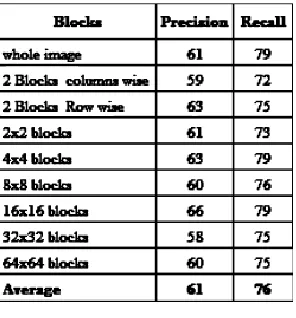
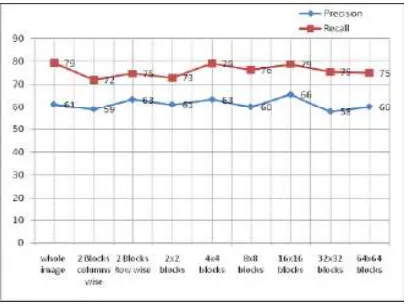
A fast and efficient approach to extract the region of main object (ROI) is proposed in paper[2] and based on the ROI, RHFMs and Fuzzy Color Histogram features are extracted and multi-feature queries are applied. Also a new flexible measure for practical retrieval results analysis is defined in this paper. Experimental results show that the proposed region-based method can contribute to the accuracy of product image retrieval. In paper[5] statistical texture moments mean standard deviation, skew, kurtosis, energy, entropy and smoothness are used to retrieve image. Image is divided into different block sizes for example 8*8 and 16*16. For each block the probability distribution of intensity levels is calculated and then is used to compute all seven statistical texture features. Total seven features are calculated for all block methods. The average precision of our algorithm for all block methods is 61 and recall is 76 as shown in Table I. This approach is not only efficient in computations but also gives good results in terms of precision and recall. Figure1 shows the comparison of average precision and recall for different block sizes. 4*4 and 16*16 block size methods got good results in terms of precision and recall measurements.
Available Online at www.ijpret.com 994 Figure 1. Comparison of average precision and recall for different block sizes. VI. PROPOSED METHODOLOGY:
There are many theory regarding CBIR, researchers have discovered different methods to retrieve the images from database effectively. In this paper we have proposed a new method to retrieve an images from database effectively. Figure 1 shows the proposed method with a several steps as follows:
1] Pre-processing: Pre-processing an image is used to improve image quality. The query image and the images from the database are pre-processed and output is given to the next step. It helps to improve the quality of images and focus the main region of the image which will generate the better result.
2] Feature Extraction: In features extraction step image features are computed by using different methods. These features are stored in database. This paper considering the main three features color, texture and shape for these features different methods are used.
I) Color Feature extraction: The color histograms can represent the color of the products more precisely. Product images in similar color with the query image can be given preferentially. The fuzzy histogram linking technique is applied to extract color feature[2]. The color information is a 24-bin fuzzy linking histogram which is extracted in HSV color space. The image is separated into a preset number of blocks. Next, the values of H, S and V of every block are calculated and used as the inputs of the two fuzzy linking systems. The output values are added to the 24-bin fuzzy linking histogram. At last, the part of White color bin added up from background is deducted from total White color bin as follows:
Available Online at www.ijpret.com 995
Where kw is the White color component while kw ' is the suppressed White color component. PNbg is the pixel number of the background and PNpb is the pixel number of each block in the main object image.
II) Texture feature extraction: The texture feature extracts by using statistical texture moments[5]. Statistical histogram texture moments are mean, standard deviation, entropy, energy, skewness and kurtosis. The statistical texture features are calculated by using the intensity level distribution in each block of image. It starts with conversion of RGB image into grayscale. After that grayscale image is divided into blocks. Each block provides the probability distribution of intensity levels which is used in computation of textures features. These features describe the properties of the intensity level distribution in image. After the calculation of these texture features, feature vector is constructed which is stored in database.
III) Shape feature extraction: First, the canny edge operator[2][3] is applied to detect edges of objects in an image. The edges will not be kept unless its intensity is less than 60 and its intensity among the 30% of all extracted edges. Then the extracted edge image is smoothed with Gaussian filter and dilated with a 3 × 3 rectangular structuring element. These can ensure the product is in a connected domain. After this, binarization is performed to reduce noise with threshold 50 (the pixels with grayscale value less than 50 are set to 0). The maximum connected domain in the resulting edge image are detected and generates the mask image. Finally the main region image is extracted from the original image using the image mask. Like this shape is extracted.
3] Similarity Measurement: In the similarity measurement step, the features of the user query image are also computed in same manner and compared with features of images in database to retrieve relevant images. Features from database are compared with feature vector of query image for similarity and retrieval of relevant images. The Sum-of-Absolute Difference (SAD) [5] is used to calculate the difference between the query image feature vector and database image feature vectors for the similarity. Let Fq is a query feature vector and Fp database feature vector then the distance is calculated by equation
Available Online at www.ijpret.com 996
Fig 2: Proposed method CONCLUSION:
In this paper the low level features of CBIR are extracted from images by using different algorithms and methods to retrieve the relevant image from database. A fast and efficient approach is proposed to extract image by using fuzzy histogram linking technique, texture statistical features, canny edge detection algorithm. The extracted features are used for the similarity measurement to retrieve relevant images. Sum-of-Absolute Difference (SAD) is used to measure the similarity. The proposed CBIR methods provide higher performance in terms of efficiency and accuracy.
REFERENCES:
1. Igor G. Olaizola, Member, IEEE, Marco Quartulli, Member, IEEE, Julián Flórez, Member, IEEE, and Basilio Sierra, Member, IEEE, “Trace Transform Based Method for Color Image Domain Identification” IEEE TRANSACTIONS ON MULTIMEDIA, VOL. 16, NO. 3, 689-685, APRIL 2014. 2. Xaro Benavent, Ana Garcia-Serrano, Ruben Granados, Joan Benavent, and Esther de Ves, “Multimedia Information Retrieval Based on Late Semantic Fusion Approaches: Experiments on a Wikipedia Image Collection” IEEE TRANSACTIONS ON MULTIMEDIA, VOL. 15, NO. 8, DECEMBER 2013.
3. A Haris Rangkuti, Rizal Broer Bahaweres , Agus Harjoko, “Batik Image Retrieval Based on Similarity of Shape and Texture Characteristics” ICACSIS , 267- 273, 2012.
4. Khin Hninn Phyu, Andrea Kutics, Akihiko Nakagawa, “Self-adaptive Feature Extraction Scheme for Mobile Image Retrieval of Flowers” IEEE , 366-373 , August 2012.
5. Fazal-e-Malik, Baharum Baharudin, “Efficient Image Retrieval Based on Texture Features” IEEE , July, 2011.
Query image
Similarity measurement Feature extraction
Feature extraction
Database image
Image retrieved Preprocessing
Preprocessing
Color
Shape
Color Texture
eee