5808
DEVELOPMENT AND VALIDATION OF RP-LC-UV METHOD FOR
DETERMINATION OF URSODEOXYCHOLIC ACID IN DRUG SUBSTANCE AND DRUG PRODUCT
Anil Kumar T*, Kausal Kishore Chandrul
Department of Pharmacy, Shri Venkateswara University, Gajraula, Uttar Pradesh, India
*Corresponding author E-mail:[email protected]
ARTICLE INFO ABSTRACT
Key Words
Colchicine, HPLC, Validation
The present work is undertaken with an aim to develop and validate an accurate, precise and rapid method for the estimation of Ursodeoxycholic Acid in tablet and bulk form. The method is simple, accurate and sensitive. The separation was achieved on high pressure liquid chromatography shimadzu HPLC LC-2010with UV detector, a Reverse Phase C-18 Column (25 cm x 4.6 mm) i.e., particle size 5 µm) was used The HPLC system was equipped with the software LC solutions. Flow Rate: 1.0 ml/min Injection Volume: 50µl, Run Time: 10 min, coloum temp: 40oC. The method was validated for specificity, precision, linearity, range, accuracy and robustness. The recovery range for Ursodeoxycholic acid is in the range of 99.94–100.0% and the method can be successfully applied for the routine analysis of the drug substance.
INTRODUCTION
The genus Colchicum belongs to the colchicaceae family. Molecular formula of colchicine is C22H25NO6 (Fig. 1) with IUPAC name N-[(7S) - 1, 2, 3, 10-tetramethoxy-9-oxo- 5, 6, 7, 9- tetrahydrobenzo [a] heptalen- 7-yl] acetamide and molecular weight is 399.44 g/mol.
Fig. 1: Colchicine
It is a highly poisonous alkaloid containing various species of colchicum. COLC is the main alkaloid obtained from the bulb and seeds of colchicum. It is used in human and veterinary medicine. The medicinal value of colchicum is due, to the presence of (-)-colchicine, the main alkaloid, which was isolated from all species of colchicum. It is widely used in breeding studies and as drug to treat gout but is also valuable for other diseases such as familial Mediterranean fever, primary biliary cirrhosis and breast cancer Generic COLC is available in tablets. (-)- Colchicine, is a phenylethylisoquinoline derived alkaloid, and it is a poisonous, lipid-soluble alkaloid
An Elsevier Indexed Journal ISSN-2230-7346
5809
with a unique 7-memberd aromatic tropolone ring Several analytical methods for the determination of COLC in pharmaceutical preparations, in biological fluids and in plant extracts have been described The aim of the present study is to develop an accurate and reliable method for the quantification of COLC in tablets using HPLC.
2.0 EXPERIMENTAL:
2.1Reagents: O-Phosphoric acid:AR
grade, Methanol: HPLC grade, Acetonitrile: HPLC grade
KH2PO4AR grade, Water: HPLC or equivalent grade
2.2Standards and Samples: Colchicine, Colchicine Tablets
2.3Reagent preparation:
2.3.1 Preparation of 0.5% ortho phosphoric acid: Dilute 1.6 ml of phosphoric acid into 50 volumetric flask and dilute with water
2.3.2 Preparation of phosphate buffer: Weigh and transfer about 7.2gm of potassium dihydrogen ortho phosphate 1000 mL water sonicate to dissolve the salt and adjust the pH to 5.0 with 0.5% ortho phosphoric acid.
2.3.3Preparation of mobile phase: Mix 550mL of buffer and 450mL of acetonitrile. Filter and degas.
2.3.4 Preparation of diluent/blank: Use mobile phase as a diluent.
2.4Chromatographic conditions: Column : Waters symmetry 5µ C18, 25cm×4.6mm. Detector : 254 nm
Flow rate : 1.0 mL/ minute
Injection volume : 20 µL
Column oven temperature : 400C Sampler temperature : 250C Run time : 12 minutes
2.5Preparation of Standard solution: Weigh accurately and transfer 25mg of Colchicine working standard into a 250 mL volumetric flask. Add 100mL of diluent and sonicate to dissolve. Dilute to volume with diluent and mix.
2.6. Preparation of Sample solution: Weigh accurately and transfer powder equivalent to 50mg of Colchicineinto a 500 mL volumetric flask. Add 250mL of diluent and sonicate for 20 minutes with intermediate shaking then cool to room temperature and dilute to volume with diluent and mix then filter the solution by using Nylon filter.
3.0 METHOD VALIDATION: The method was validated according to the ICH guidelines for the validation of analytical procedures. The parameters which were used to validate the method of analysis were linearity, range, specificity, accuracy, precision and recovery, solution stability.
System suitability: To verify that analytical system is working properly and can give accurate and precise results, the system suitability parameters are to be set.
3.2 Specificity: Specificity is the ability of analytical method to assess unequivocally the analyte in the presence of component that may be expected to be present, such as impurities,degradation products and matrix components. Performed the specificity parameter of the method by injecting Blank (Diluent), placebo, standard preparation and sample preparation into the HPLC system. Record the retention times of Blank (Diluent), placebo, standard preparation and sample preparation. 3.2.1 Specificity by degradation studies:
Force Degradation of
5810
or throughout the shelf life, any degradation product if found should not interfere with the main peak of Colchicine. In addition, the forced degradation study will help to identify the type of degradation pathway (whether oxidative, alkali hydrolysis, acid hydrolysis, water hydrolysis and dry heat) for each of the degradants.
3.2.2 Sample preparation: Weighed and transferred 50mgequivalent of sample powder into a 500 mL volumetric flask, added about 200mL of diluent, sonicated to dissolve for 20 minutes with intermittent shaking, cooled the sample solution to room temperature, diluted to volume with diluent and mixed well then filter the solution by using Nylon filter. .
3.2.3 Placebo preparation: Weighed and transferred 50mgequivalent of placebopowder into a 500 mL volumetric flask, added about 200mL of diluent, sonicated to dissolve for 20 minutes with intermittent shaking, cooled the sample solution to room temperature, diluted to volume with diluent and mixed well then filter the solution by using Nylon filter. 3.2.4 Acid stressed sample preparation (1.0 N HCL): Weighed and transferred 50mg equivalent of sample powder into a 500 mL volumetric flask, added 5 mL of 1.0 N HCL kept on water bath at 800C for 30 hours. Neutralized with 5mL of 1.0N NaOH. Added about 200 mL of diluent, sonicated to dissolve for 20 minutes with intermittent shaking, cooled the sample solution to room temperature, diluted to volume with diluent and mixed well then filter the solution by using Nylon filter. 3.2.5 Alkali stressed sample preparation (1.0N NaOH): Weighed and transferred 50mg equivalent of sample powder into a 500 mL volumetric flask, added 5 mL of
1.0N NaOHkept on water bath at 800C for 30 hours. Neutralized with 5 mL of 1.0 N HCl Added about 200 mL of diluent, sonicated to dissolve for 20 minutes with intermittent shaking, cooled the sample solution to room temperature, diluted to volume with diluent and mixed well then filter the solution by using Nylon filter. 3.2.6 Peroxide stressed sample preparation (3.0% v/v H2O2): Weighed
and transferred 50mg equivalent of sample powder into a 500 mL volumetric flask, added 5 mL of 3.0% v/v H2O2kept on water bath at 800C for 30 hours. Added about 200 mL of diluent, sonicated to dissolve for 20 minutes with intermittent shaking, cooled the sample solution to room temperature, diluted to volume with diluent and mixed well then filter the solution by using Nylon filter.
5811
3.3 PRECISION: The precision of an analytical method is the degree of agreement among individual test result when the method is applied repeatedly to multiple sampling of homogeneous sample. The precision of analytical method is usually expressed as the standard deviation or relative standard deviation (coefficient of variation) of series of measurements.
3.3.1 System precision: The system precision is checked by using standard chemical substance to ensure that the analytical system is working properly. The retention time and area of six determination should be measured and calculate relative standard deviation. Injected Blank, Standard preparation six times into the chromatograph. Record the chromatograph. Calculate the relative standard deviation.
3.3.2 Method precision: In method precision, a homogenous sample of a single batch should be analyzed six times. This indicates whether a method is giving consistent results of a single batch. Analyzed the sample of ColchicineTablets10mg six times of a same batch as per analytical procedure. Calculated the % Assay of Colchicines with respect to standard preparation. 3.3.3 Intermediate precision:
The intermediate precision was carried out to ensure that the analytical results will remain unaffected with change in instrument, analyst, column and day. Repeated the method precision set by different analyst by using different instrument and different column on different day at different location.
3.4 Accuracy: The accuracy of an analytical method is the closeness of test results obtained by that method to the true value. Performed accuracy in different
levels, at each level in triplicate Colchicine at 50%, 100%, and 150%. Analysed these samples in triplicate for each level and calculated the % recovery.
3.5 Linearity:
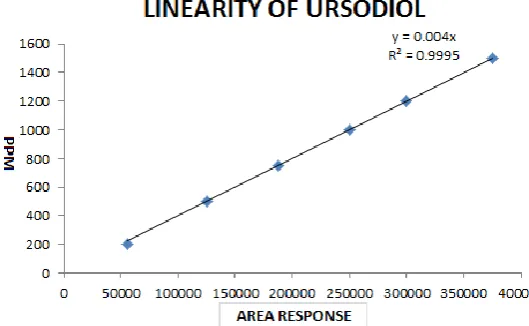
The linearity of an analytical method is its ability to elicit test results that are directly, or by a well-defined mathematical transformation, proportional to the concentration of analyte in samples within a given range. Performed the linearity using Colchicine standard in the range of 50% to 150% concentration. 3.6 Range: The range of analytical method is the interval between the upper and lower levels of analyte that has been demonstrated with a suitability and linearity.
3.7 Robustness: The robustness of an analytical method is a measure of its capacity to remain unaffected by small but deliberate variations in method parameters and provides an indication of its reliability during normal usage.
3.7.1Robustness parameters: Change in column temperature ±50C
Change in flow rate ±0.2 mL/min Change in organic phase ±5%
3.8 ADDITIONAL PARAMETERS: 3.8.1 Filter compatibility studies: 3.8.1.1 Sample preparation:
Weighed and transferred 50mg equivalent of sample powder into a 500 mL volumetric flask, added about 200 mL of diluent, sonicated to dissolve for 20 minutes with intermittent shaking, cooled the sample solution to room temperature, diluted to volume with diluent and mixed well. Centrifuged a portion of this mixture at 4000 rpm for 5 minutes.
5812
Figure 1: Linearity graph of Ursodeoxycholic acid standard
Table 1: Results of Accuracy (%Recovery) Sl.No Levels Mg added Mg
Recovered
% recovery Mean % % RSD
1 50% 50.12 50.13 100.02 99.94 0.03
2 50.49 50.42 99.86
3 50.35 50.32 99.94
1 100% 100.25 100.22 99.97 100.00 0.01
2 100.19 100.29 100.09
3 100.89 100.82 99.93
1 150% 150.78 150.56 99.98 99.99 0.04
2 150.10 150.12 100.01
3 150.46 150.42 99.97
Table 2: Results of Method precision and Intermediate precision results:
Parameter sample % Assay of Ursodiol
Method precision
1 99.1
2 99.9
3 100.5
4 98.9
5 99.7
6 98.7
Intermediate precision
1 100.2
2 98.5
3 98.9
4 100.7
5 99.8
6 99.6
Mean of 12 determinations 99.5
5813
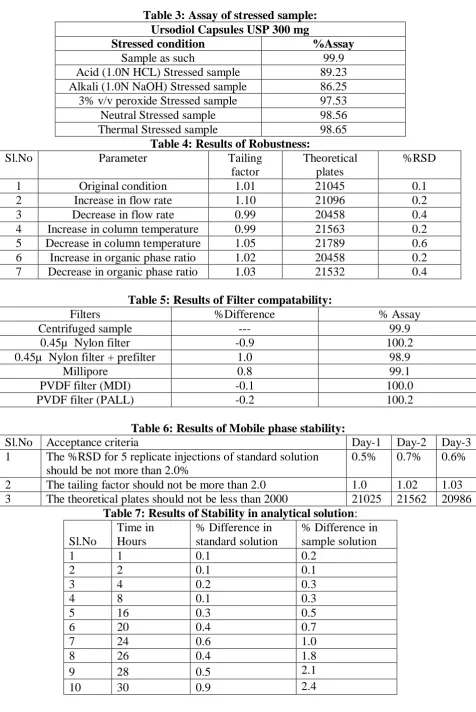
Table 3: Assay of stressed sample: Ursodiol Capsules USP 300 mg
Stressed condition %Assay
Sample as such 99.9
Acid (1.0N HCL) Stressed sample 89.23 Alkali (1.0N NaOH) Stressed sample 86.25 3% v/v peroxide Stressed sample 97.53 Neutral Stressed sample 98.56
Thermal Stressed sample 98.65
Table 4: Results of Robustness:
Sl.No Parameter Tailing
factor
Theoretical plates
%RSD
1 Original condition 1.01 21045 0.1
2 Increase in flow rate 1.10 21096 0.2
3 Decrease in flow rate 0.99 20458 0.4
4 Increase in column temperature 0.99 21563 0.2 5 Decrease in column temperature 1.05 21789 0.6 6 Increase in organic phase ratio 1.02 20458 0.2 7 Decrease in organic phase ratio 1.03 21532 0.4
Table 5: Results of Filter compatability:
Filters %Difference % Assay
Centrifuged sample --- 99.9
0.45µ Nylon filter -0.9 100.2
0.45µ Nylon filter + prefilter 1.0 98.9
Millipore 0.8 99.1
PVDF filter (MDI) -0.1 100.0
PVDF filter (PALL) -0.2 100.2
Table 6: Results of Mobile phase stability:
Sl.No Acceptance criteria Day-1 Day-2 Day-3
1 The %RSD for 5 replicate injections of standard solution should be not more than 2.0%
0.5% 0.7% 0.6%
2 The tailing factor should not be more than 2.0 1.0 1.02 1.03 3 The theoretical plates should not be less than 2000 21025 21562 20986
Table 7: Results of Stability in analytical solution:
Sl.No
Time in Hours
% Difference in standard solution
% Difference in sample solution
1 1 0.1 0.2
2 2 0.1 0.1
3 4 0.2 0.3
4 8 0.1 0.3
5 16 0.3 0.5
6 20 0.4 0.7
7 24 0.6 1.0
8 26 0.4 1.8
9 28 0.5 2.1
5814
Sonicated to dissolve for 20 minutes with intermittent shaking, cooled the sample solution to room temperature, diluted to volume with diluent and mixed well. Centrifuged a portion of this mixture at 4000 rpm for 5 minutes.
3.8.1.3 Centrifuged sample and placebo: Centrifuged sample and placebo preparation at 4000 rpm for 5 minutes.Collected the supernatant sample and placebo preparation in separate test tubes.
3.8.1.4 Sample and placebo filtered through 0.45µm Nylon filter: Filtered sample and placebo centrifuged solution through 0.45µm Nylon filter. Collected the sample and placebo preparation in separate vials.
3.8.1.5Sample and placebo filtered through Nylon + pre filter: Filtered sample and placebo centrifuged solution through Nylon + pre filter. Collected the sample and placebo preparation in separate vials.
3.8.1.6 Sample and placebo filtered through Millipore filter: Filtered sample and placebo centrifuged solution through Millipore filter. Collected the sample and placebo preparation in separate vials.
3.8.1.7 Sample and placebo filtered through PVDF filter (MDI): Filtered sample and placebo centrifuged solution through PVDF filter (MDI). Collected the sample and placebo preparation in separate vials.
3.8.1.8 Sample and placebo filtered through PVDF filter (PALL): Filtered sample and placebo centrifuged solution through PVDF filter (PALL). Collected the sample and placebo preparation in separate vials.
3.9 Stability in analytical solution: Evaluated the stability in analytical
solution by injecting the standard solution and sample solution at regular interval. 4.0 Mobile phase stability: Evaluated the stability of mobile phase by injecting the standard preparation in conjunctive days and checked the system suitability parameters.
RESULTS AND DISCUSSION:
The chromatographic conditions were optimized and separation was performed on a Waters symmetry 5µ C18, 25cm×4.6mm column using a mobile phase consisting 550mL of phosphate buffer and 450mL of acetonitrile. The proposed mobile phase composition allowed suitable retention time of colchicine and achieved good selectivity towards interference from the excipients of the formulation. Under the chromatographic conditions described, colchicine was eluted about 6.0 min. Good baselines and well-shaped peak can be observed. Calibration curve was constructed using standard colchicine solutions in the range of 50-150 % of test concentration. The linearity of the calibration curve was validated by high value of correlation coefficient (r2 = 1.0). CONCLUSION
The proposed new HPLC method described in this paper provides a simple, convenient and reproducible approach for the identification and quantification of UDCA in bulk, and pharmaceutical formulations with good presentation. Analytical results are specific, accurate and precise values. In short, the developed method is simple, sensitive, easy and efficient having small chromatographic time and can be used for routine analysis. REFERENCES:
5815
gallstone type when selecting patients for medical treatment. Gut, 16: 359-364.
2. Bouchier, I.A., 1980. The medical treatment of gallstones.Annu Rev Med, 31: 59-77.
3. Dowling, R.H.,
1983.Cholelithiasis: medical treatment. ClinGastroenterol, 12: 125-178.
4. Von Bergmann, K., M. Epple-Gutsfeld and O. Leiss, 1984.Differences in the effects of chenodeoxycholic and ursodeoxycholic acid on biliary lipid secretion and bile acid synthesis in patients with gallstones. Gastroenterology, 87: 136-143.
5. Hofmann, 1994. Pharmacology of ursodeoxycholic acid, an enterohepatic drug. Sc and J. Gastroenterol Suppl, 204: 1-15. 6. Hagey LR, Crombie DL, Espinosa
E, Carey MC, Igmi H, Hofman AF. Ursodeoxycholic Acid in the Urside: biliary bile acids of bear, pandas, and related carnivores 7. British Pharmacopeia 2012.
8. HPLC determination of Ursodeoxycholic acid after solid phase extraction of blood serumand detection – oriented dervatization by Nobilis M, Pour M, Kunes J, Kopecký J.