151
A Fast Name Lookup Method in NDN Based on Hash Coding
Mr. Shuaibo Feng,Assoc. Prof. Mingchuan Zhang,Assoc. Prof. Ruijuan Zheng
School of Engineering and Information Technology
Information Engineering College, Henan University of Science and Technology
Luoyang, Henan Province, China
Abstract—In order to improve the storage
efficiency and query rate of the name set in NDN
network, an efficient name query mechanism
based on the element hash encoding is proposed.
Firstly, it compressed name set by constructing the
element hash value tree of the name set through
the incremental hash function. Secondly, the quick
name searching is realized through the transition
array. Finally, the incremental update mechanism
is designed to meet the frequent modify, insert and
delete of NDN name. Through experimental
analysis can know that the name compression
ratio reach to 50% and the query efficiency
increase 10%.
Keywords — longest name prefix matching,named
data network, name component coding, name
lookup.
1. INTRODUCTION
With the increase of information and the expansion of
internet application type, the traditional TCP/IP
network can't meet the needs of the current users on
the network. In recent years, Named data network
(NDN) has become the mainly trend in the future
Internet. Compared to the traditional IP network,
NDN is more concerned about the content, rather than
“where” the information is located [1] and it uses the
naming of hierarchical structure to replace the
traditional IP address [2]. NDN retrieves date based
on the name of message, and the route is matched by
the longest prefix of the name. Compared with the
fixed length IP address, NDN name length does not
have upper limit, and the total number of NDN names
is much larger than the total number of IP addresses
in the network. Therefore, NDN based forwarding
table will consume more space than IP address
forwarding table. In addition, the NDN name is
composed of a number of variable length strings and
separators, which increase the complexity of the name
lookup. So, in the NDN network, how to realize the
efficient storage and quick search of the information
name has been widely concerned. The literature [3],
[4] use bloom filter to filter the name, the names that
have the same number elements are divided into the
same name sets. Compared to the hash table, bloom
filter has advantages of low storage overhead. But the
bloom filter has a very small false alarm rate, which
will affect the correctness of the query results. Bloom
filter can't meet the rapid query for a large number of
data. Yuan et al, proposed a name lookup algorithms
based on hash function, using the name as a keyword
to the query. The algorithm is difficult to deal with
the high speed search of massive data [5]. Literature
[6] proposed a multi-step alignment and transfer array
to represent the character tree and search, using the
GPU parallel processing ability to speed up the
search. Although the speed of the search is
accelerated, it is limited by the size of the actual
memory. When the number of entries that are inserted
152
literature [7], [8], the flat name is used to replace the
IP, but the flat name can’t meet the requirements of
the name aggregation. Literature [9] proposed an
efficient scalable name search algorithm, which
compresses the space of strings by the encoding, and
through the status of the array to achieve a fast
search, updated operations, but it can still improve the
encoding way to further compress the string. 2012
Wang et al proposed a name for the component
coding scheme [10], through the code distribution
mechanism to achieve high efficiency encoding, this
scheme improves speed of the prefix matching, but
still has the space to be improved in component
storage and accelerates the rate of the name lookup.
Literature [11], [12] compression storage space by
encoding the name, and using the state transition
array to quickly find the name list, but its encoding
can be further improved. Literature [13] according to
the description of the prefix information in the
forwarding table to search, and use the hash table to
speed up the name update and query rate, although
accelerated the name query speed, but the false
positive of hash function still affect the correctness of
the query. Literature [14] proposed a full name is
recognized as a encoding, but it need a new protocol
to change encoding table between routers. In this
paper, a mechanism of component hash encoding
(CHE) that based on the vertical degree of the name
tree structure will be proposed. The NDN name is
layered with a split operator. At each level, the hash
sequence is obtained by using the incremental hash
function, and the corresponding state transition array
(STA) is constructed to realize the fast searching and
updating for the information name.
2. ELEMENT HASH CODING
In this paper, encoding all children nodes of one
father’s node by using the n element syntax recursive
incremental hash function H (h, s). Assuming a node
Nj, which child node set is N = (n1, n2, …ni-1, ni ), so
a continuous n meta hash sequence can be generated
by a hash function. That is to say, in all child nodes of
Nj, the hash value of the first i node is calculated
based on the hash value of the first i-1node. The hash
value of the first child node is calculated based on the
hash value of the father node. Assuming the hash
value of node Njis hj, you can get the hash encoding
of all the child nodes in set N. As shown in (1):
The hash value of the root node is h0=H(0,scheme),
scheme represents the format of the NDN name. As
shown in the fig.1, according to above the encoding
way we can construct a hash value tree (name
component hash tree, NCHT) for the following
named collection In Fig.1, the NCHT is composed of
14 elements, representing the 9 data names in Fig.1.
Edges that connect a node to its different child nodes
formed an encoding collection, known as the
original encoding collection. Edge represents the
hash value of the child node. For example, “sina” and “yahoo” are children of node 2, edge h2.1
represents the hash value of the node “sina”, edge
h2.2 represents the hash value of the node “yahoo”.
Therefore, h2.1=H (h0.2, sina), h2.2=H (h2.1, yahoo)
can be obtained by the incremental hash function.
The encoding hash value of the component is
determined by the component itself and before a
component encoding. Therefore, for many of the
original encoding collection we can use a parallel
153
/org/yahoo/game/wow
Name Pointer /cn/google
/cn/google/maps /cn/google/news /cn/soso /cn/yahoo/uk /org/sina /org/sina/play /org/yahoo/videos
Level-3 0
2
5 3
1
8
4
9
h0,1
cn org
A
6 7
B C D
E
google soso yohoo sina yahoo
maps news uk play videos game
wow
h1,2
Level-1
Level-2
Level-4
Level-5
h0
h0,2
h1,1 h1,3 h2,1 h2,2
h3,1 h3,2 h5,1 h6,1 h7,1
hD,1
h7,2
Fig.1. Hash Sequences of Elements
For example, in Level-2 contains two components
"cn" and "org", were labeled as node 1 and node 2.
Child nodes are {Google, soso, yahoo} and {sina,
yahoo}, which are encoded as {h1, 1, h1, 2, h1, 3} and
{h2, 1, h2, 2}. So, the {h1,1, h1,2, h1,3} and {h2,1, h2,2} can
be encoded by a parallel manner. We can find that
the same component “yahoo” in two different original
encoding collections was encoded as different hash
values.
3. STATE TRANSITION ARRAY
In this paper, we construct NCHT and achieve the
longest prefix matching by using two state transition
arrays (Base Array, Transition Array). In this paper,
for the first i entries in the array A are recorded as A:i.
3.1. Base Array
The structure of the Base Array is a hexadecimal
array; each entry of Base Array is 4 bytes. The first
two bytes represent the number of the transition array,
which indicates that this element belongs to this
transition array. Bits in the back of the Base Array are
indicating where the information is stored in the
Transition Array. In NCHT, the node number starts
from 0. That is, the root node number is 0.
Accordingly, the element number of the Base Array is
also starting from 0. For example: Base: i (i=0,1,2...
n) represents the state information of the node i in
NCHT. As shown in fig.2, Base:6 is 0X00030007.
So, 0003 represents that the state information of the
sixth node in NCHT are stored in Transition 3. And
the below bits of Base:6 is a 0007, which represents
its information is stored in the seventh entries of the
Transition3, and could be expressed as Transition 3:7.
3.2. Transition Array
Transition Array will be set up in each level of the
NCHT. And each transition array in different level
has a different size. The nodes in each level are stored
by the serial number of the state nodes. One transition
array is consisted by many segments. Each segment
represent one node in the layer. As shown in Fig.2,
the first layer of NCHT has only one nodes (the root
node), so the Transition1 has only one segment. The
length of the segment is not fixed, which is
determined by the number of children in the segment.
Each segment contains two entries, respectively is an
indicator and a status symbol. Each entry takes 8
bytes. The first four bytes in the indicator record the
number of status symbols in this segment (the total
number of child nodes that the node has). The next
four bytes represent the entry pointer. If there is no
state in the FIB, PIT, or CS, the entry value is 0. The
first value of the state symbol indicates the hash value
of the child node. The second value represents the
storage location of the child node in the Base Array.
All status symbols in one segment constitute a state
list for this segment, be recorded as Lists (s is the
number of nodes that are represented by this
154
its entry has two numbers. 2 indicates that the node
has 2 child nodes. 1 indicates that the state node is
stored in the first entry of FIB; Transiton1:2 is a status
symbol, h0.1 represents the hash value of the first child
node that belong to the root node. 1 represents the
number of the child node in the Base Array.
3.3. Query Process
In Fig.2, given a query name “/org/sina”, and its corresponding to the hash encoding is“/h0, 0/h0, 2/h2, 1”.
Query process as follows:
1) The query process starts from Base:0, Base:0 is
the root node of NCHT.
2) Base:0=0X00010001 represent the state
information of the root node is stored in
Transition1:1
3) Transition1:1 is an indicator, the first four bytes
indicates that the root node has two child nodes.
That is, node 0 has two status symbols. The hash
encoding of the “org” is h0,2, which matches the
first four bytes of the two status symbol. Find it
matches Transition1:3. The last four bytes of
Transition1:3 are 2, which correspond to the
second elements in the base array Base:2.
4) Base:2=0X00020005, Iterative process to make
the hash encoding “/h0,0/h0,2/h2,1” is fully
matched. Transition3:7 is an indicator of the node
“sina”. So far, all components of the name has
been matched, no need to turn to the next node to
continue the query. Because the last four byte of
the Transition3:7 is 6, the pointer points to the
sixth entries in the FIB, complete the query.
4. ARRAY GENERATION ALGORITHM
The process of query and insert in the array is shown
in algorithm 1. The “name” expresses that the name
of input, C1, C2…Cj…Ci expresses the name is
divided into i component elements by Decompose
(name). LookupLevelj (Cj) indicate the hash value
query of the element Cj in the J-th layer array. “S”
represents that the state of the current query operation
in the transition array T. “S” has three values, “0”
indicates that the corresponding hash value is not
found in the transition array. “1” indicates that the
corresponding hash value is found in the transition
array, and the hash value belongs to the states list that
are relative to the query node. Due to the limitations
of the hash function, there is a situation that may
occur in the same transition array, which is hash value
of the element Ckin the other state list is the same as
the hash value of the query element Cj. In view of this
situation, when the “S” value is 2, it is shown that the
same hash value is matched in the corresponding
transition array, but the hash value that has been
found does not belong to the current state list.
Input “name” is decomposed by the function
Decompose (name). The function LookupLevelj (Cj) is
used to query the encoding of the elements. The query
results can be obtained by the hash value of the
element hj and the value of the current query state S.
If S=1, then the query state is transferred to the next
155
0001 0002 0002 0003 0003 0003 0003 0003 0004 0004 0004 0004 0004 0004 0005 0001 0001 0005 0001 0004 0005 0007 0009 0001 0002 0003 0004 0007 0008 0001
Name
/cn/google
/cn/google/maps
/cn/google/news
/cn/soso
/cn/yahoo/uk
/org/sina
/org/sina/play
/org/yahoo/videos
/org/yahoo/game/wow
Hash coding
h0,0,h0,1,h1,1
h0,0,h0,1,h1,1,h3,1
h0,0,h0,1,h1,1,h3,2
h0,0,h0,1,h1,2
h0,0,h0,1,h1,3,h5,1
h0,0,h0,2,h2,1
h0,0,h0,2,h2,1,h6,1
h0,0,h0,2,h2,2,h7,1
h0,0,h0,2,h2,2,h7,2,hD,1
Pointer
L2 0
2
5 3
1
8
4
9 A
6 7
B C D
E L1
L3
L4
L5
0 9 2 1 1 2
0 1 4 0 10
1 6
2
0 12 13 11
3 0 3 4
2 5 0 6 7 2
0 1 2
Base Array:
L1
L2
L3
L4
L5
0 0 0 2 3 5
0 0 1
7 8 0 14
Entry number: 0 1 2 3 4 5 6 7 8 9 10 11 12 13 14
Transition1:
Transition2:
Transition3:
Transition4:
Transition5:
h0,0
h0,1 h0,2
h1,1 h1,2 h1,3 h2,1 h2,2
h3,1 h3,2 h5,1 h6,1 h7,1 h7,2
hD,1
h0,1 h0,2
h1,1 h1,2h1,3 h2,1h2,2
h3,1h3,2 h5,1 h6,1 h7,1h7,2
hD,1
indicator
status symbol
Free entry
segment
〔 Lists 〕
Fig.2.State Transition Array
If S=0 or S=2, indicates that Cj is a new element in
this state list, then the hash value will be inserted into
the corresponding state list through the function
AddH(hj,Cj), and create a new state entry in the state
array T through AddT(T,S,Hj), while the state S value
becomes 1 The construction of NCHT is achieved by
algorithm 2. The delete operation can be realized by
amending the entries of the indicator and status
symbol. For the node information update operation, it
can also be realized by modifying the corresponding
state array directly.
5. EXPERIMENT AND PERFORMANCE
ANALYSIS
In this section, The memory cost and the query time
performance are measured on a PC with an Intel Core
4 Duo CPU of 8GHz and DDR3 SDRAM of 16
156
Data from DOMZ [20], CWR [21], Chinaz [22] and
ALEXA [23] are used as the input data in experiment.
Basic data information is shown in table (1).
5.1. Storage Complexity
For an element hash value tree T, the storage space of
T is determined by the size of the node and the
element edge.
Table (1)Number of domains with different components’ numbe
The total number of nodes can be expressed as node
(T) = edge (T) +1. The space size of the element hash
value tree can be obtained. As in:
In (2), αrepresents the space consumed by each node,
β represents the space consumed by each hash value.
For the original NCHT (element hash value tree is set
up without using the state transition array), each node
has at least one pointer to the hash list, a pointer to
the forwarding table, and a position number. A hash
edge that contains a hash value of a node, a pointer to
the next child node, and a number of hash edge list. A
pointer consumes 4Byte space, a number consumes
4Byte space, a hash value also consumes 4Byte space.
Therefore, α =12, β=12. By the above equation can be
the original NCHT will consume 24 × nodes (NCHT)
- 12 spaces. In this paper, we construct the NCHT by
two state transition arrays. Each node is represented
by an element in Base Array and an indicator in the
transition array, a hash edge occupies a status symbol
in the transition array. One element in the Base Array
consumes 4Byte storage space, one indicator
consumes 8Byte storage space, an indicator consumes
8Byte storage space, a status symbol also consumes
8Byte storage space. Therefore, α =12, β=8. By the
above equation, the total storage overhead of the
nodes tree NCHT is 24nodes NCHT( ) 8 . So the
use of state conversion array to build the NCHT than
the original NCHT space is reduced by
1 20 nodes NCHT( ) 8 24nodes NCHT( ) 12 16.7% .
Table (2) shows that the compression of effect on the
four domain names.
Table (2) Compression ratio of hash sequence
Total components represent the total number of nodes
in the tree. Hash chain represents the bits of the
element tree after the hash encoding. Tree size
represents the bits of the element tree before the hash
encoding. Compression ratio is 1 - HashChain/
TreeSize. The compression rate in table (2) shows
that the method is relatively stable for each data set,
157
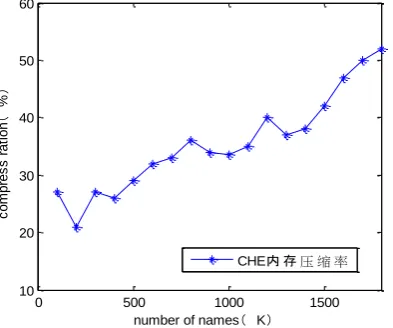
compression rate of hash encoding on the name set,
every time we get the 100K name set from DOMZ to
carry out the experiment. From fig.3, we can find that
with the increase of the name set, the compression
efficiency of the element hash encoding is also
increased. Fig.4 shows that the rise of the CHE
storage overhead is slower than NCT, and indicates
that the CHE is quite effective in both large and small
sets.
Fig.3.The compression ratio of names in DOMZ
5.2. Query Time Optimization
This paper, through the calculation the average query
time of the name set by CHE to prove the
optimization effect of CHE on name query. First,
input a 200K name set, record query time. Then take
this as the foundation, add 200K name set each time,
record the time respectively. Calculate the average
time of name query at Last. Fig.5 shows the average
time of the different domain sets when the number of
names is not the same. Analysis shows that different
sets of experimental results are different. But, with
the increase of the name collection, the query rate
tends to be stable. In table (3), we compare the query
time between CHE and NCT. Combined with fig.5
we can find that the average search time of CHE is
more stable than that of NCT for any data set.
Fig.4.the memory overhead with the change of the
name’s number in DOMZ
Fig.5.The average query time of different domain sets
with the change of name number
Table (3) query time Comparison within NCT & CHE
It can be found that the average search time of CHE is
2500 ~ 4650 CPU cycles (CPU frequency is 2.8GHz),
which is equal to the time of 904ns ~ 1054ns.
Comparison shows that CHE can be faster for the
longest prefix matching than NCT, the query rate
increased by about 10% compared to NCT. 0 500 1000 1500
10 20 30 40 50 60
number of names( K)
c o m p re s s r a ti o n ( % )
CHE内 存压 缩 率
0 500 1000 1500 2000
0 200 400 600 800 1000
Number of names(K)
m e m o ry (M B ) NCT CHE
0 500 1000 1500 0 1000 2000 3000 4000 5000
number of names(K)
158
6. CONCLUSION
In order to solve the problem of name storage and
name query in NDN network, this paper proposes a
new method based on hash coding. In this method,
the element hash value tree is constructed by using
the incremental hash function to realize the
compression of the information name. The fast query
and update of the information name is realized
through the state transition array. The simulation
results show that the method has good performance.
In order to further improve the efficiency of the name
storage, how to effectively use the free entries in the
Basic Array and the Transition Array will be the
focus of the next step.
REFERENCE
[1] Ekambaram V, SivalingamI K M, “Interest
flooding reduction in Content Centric
Networks”, High Performance Switching and
Routing, 2013 IEEE 14th International
Conference on, pp. 205-210, 2013.
[2] Jacobson V, Smetters D K, “Networking named
content”,Proceedings of the 5th international
conference on Emerging networking experiments
and technologies, pp: 1-12, 2009.
[3] Wang Y, Pan T, MI Z, “Name Filter: Achieving
fast name lookup with low memory cost via
applying two-stage bloom filters”, INFOCOM,
2013 Proceedings IEEE, pp. 95-99, 2013.
[4] Quan W, Xu C, Vasilakos A, “TB2F:
Tree-bitmap and bloom-filter for a scalable and
efficient name lookup in content-centric
networking”, Networking Conference, pp. 1-9,
2014.
[5] Yuan H, Song T, Crowley P, “Scalable NDN
forwarding: Concepts, issues and principles”,
Computer Communications and Networks, 2012
21st International Conference on, pp. 1-9, 2012.
[6] Wang Y, Zu Y, “Wire Speed Name Lookup: A
GPU-based Approach”, NSDI, pp. 199-212,
2013.
[7] Wang Y, He K, Dai H, “Scalable name lookup in
NDN using effective name component
encoding”, Distributed Computing Systems,
2012 IEEE 32nd International Conference on,
pp.688-697,2012.
[8] Singla A, Godfrey P, Fall K, “Scalable routing on
flat names”, Proceedings of the 6th International
Conference, 2010.
[9] Jain S, Chen Y, Zhang Z L, “Viro: A scalable,
robust and namespace independent virtual id
routing for future networks”, INFOCOM, 2011
Proceedings IEEE, pp.2381-2389, 2011.
[8] Wang Y, Dai H, Zhang T, “GPU-accelerated
name lookup with component encoding”,
Computer Networks, vol-57(16),
pp.3165-3177,2013.
[9] Zhou Z, Song T, Jia Y, “high-performance url
lookup engine for url filtering systems”, 2010
IEEE International Conference on, pp.1-5, 2010.
[10] Michel B S, Nikoloudakis K, Reiher P, “URL
forwarding and compression in adaptive web
caching”, Nineteenth Annual Joint Conference of
the IEEE Computer and Communications
Societies. Proceedings, pp. 670-678.
[11] Wang Y, Xu B, Tai D, “Fast name lookup for
Named Data Networking”, Quality of Service
(IWQoS), 2014 IEEE 22nd International
Symposium of, pp.198-207, 2014.
[12] Yu Y, Gu D, “The resource efficient forwarding
in the content centric network”, Springer Berlin
Heidelberg, pp.66-77, 2011.
[13] http://www.chinarank.org.cn.
[14] http://www.alexa.corn.
[15] http://www.dnloz.ore.
159
AUTHOR’S PROFILE
(1) Shuaibo Feng – Shuaibo
Feng was born in Henan
Province, PRC in August 1987.
He studied in Henan University
of Science and Technology
from 2013 to now. His majored
research area is The next generation of internet.
(2)Mingchuan Zhang –
Mingchuan Zhang was born in
Henan Province, PRC in May
1977. He studied in Beijing
University of Posts and
Telecommunications (Beijing,
PRC) from Mar 2011 to Mar 2014, majored in
computer application and earned a Doctor of
Engineering Degree in three years’ time. He works as
an Associate Professor in Henan University of
Science and Technology from Mar. 2005 to now. His
research interests include ad hoc network, Internet of
Things, cognitive network and future Internet
technology.
(3)Ruijuan Zheng- Ruijuan
Zheng was born in Henan
Province, PRC in Mar 1980. She
studied in Harbin Engineering
University Technology (Harbin,
PRC) from Mar 2005 to Mar 2008, majored in
computer application and earned a Doctor of
Engineering Degree in three year’s time. She works
as an Associate Professor in Henan University of
Science and Technology from Mar 2008 to now. Her
research interests include bio-inspired networks,
Internet of Things, future Internet and computer