Http://www.ijetmr.com©International Journal of Engineering Technologies and Management Research [281]
FLOWER POLLINATION AND GENETIC ALGORITHM BASED
OPTIMIZATION FOR NODE DEPLOYMENT IN WIRELESS SENSOR
NETWORKS
Kapil Keswani*1, Dr. Anand Bhaskar2
*1, 2Department of ECE, Sir Padampat Singhania University, Udaipur, India
Abstract:
Wireless sensor network (WSN) most popular area of research where lots of work done in this field. Energy efficiency is one of the most focusing areas because life time of network is most common issue. In the WSN, the node placement is very essential part for the proper communication between the sensor nodes and base station (BS). For better communication nodes should be aware about their own or neighbor node’s location. Better optimization of resources and performance improvement are the main concern for the WSN. Optimal techniques should be utilized to place the nodes at the best possible locations for achieving the desired goal. For node placement, flower pollination optimization and genetic algorithm are useful to generate better result. BS is responsible for the communication of nodes with each other and it should be reachable to nodes. For this Region of Interest (RoI) is helpful to choose the best location. Placement of BS in the middle is suitable place for the static nodes deployment and there should be other strategy for the dynamic environment. Nodes should be connected to each other for the transmission of data from the source to BS properly. From the MATLAB simulation, it has been shown that the proposed methodology improves the network performance in terms of dead nodes, energy remaining and various packets sent to BS.
Keywords: WSN, Flower Pollination Optimization, Genetic Algorithm and Region of Interest.
Cite This Article: Kapil Keswani, and Dr. Anand Bhaskar. (2018). “FLOWER POLLINATION AND GENETIC ALGORITHM BASED OPTIMIZATION FOR NODE DEPLOYMENT IN WIRELESS SENSOR NETWORKS.” International Journal of Engineering Technologies and Management Research, 5(2:SE), 281-293. DOI: 10.29121/ijetmr.v5.i2.2018.658.
1. Introduction
Http://www.ijetmr.com©International Journal of Engineering Technologies and Management Research [282] routing decisions. ORP takes benefit of the physical communication layer, dynamically selecting the next node based on availability and other instantaneous network conditions [10]. Therefore, the achievement of an ORP is determined by the selection metrics for the subsequent node [5]. This paper extends the idea of ECORP introduced in [9], proposing an Energy Conscious ORP (ECORP). The previous energy conserving protocol ensures that self-powered nodes with less energy available have time to recharge, which is accomplished by the introduction of a delay into the network’s throughput. An alternative protocol is proposed which still ensures that self-powered nodes with less energy have time to recharge, without the introduction of a network delay.
2. Application of WSN
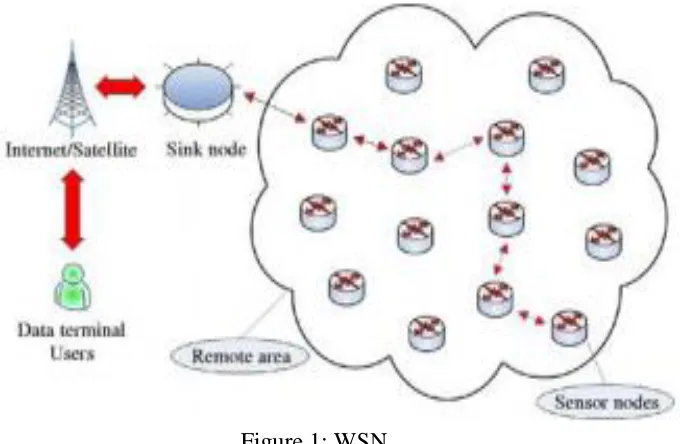
WSN can monitor different physical values: temperature, humidity, light, pressure, and noise, object motion (detection, and tracking), size, objects weight, etc. The sensors additionally have the ability to transmit and forward sensing information to the base station (BS). Maximum modern WSNs are bi-directional, enabling two-manner communiqué that may gather sensing information from sensors to the BS, in addition, to disseminate instructions from the BS to end sensors.
Figure 1: WSN
Http://www.ijetmr.com©International Journal of Engineering Technologies and Management Research [283]
Acoustic Detection: It’s the science of the usage of noise to determine the route and distance of something. Location may be carried out passively or actively and may take place in liquids and gases. The active location includes the creation of sound in series produces an echo that is the studying to determine the locality of the object in question. Passive acoustic locality entails the sound detection through the object being detected, that is the studying to determine the locality of the object in query.
Seismic Detection: Seismic waves created through means of vibrating or explosions mange sources are the main approach of underground examination. Controlled-source seismology has been utilized to anticlines and map salt domes and another geologic trap in petroleum-errors and big-buried massive meteor craters. Seismometers are sensors that feel and data the indication of the Earth occur from elastic signal. Seismometers may be placed at the Earth's surface in boreholes.
Medical Monitoring: The medical applications may be of kinds: implanted and wearable. Wearable system is utilized on the body surface of a people. The implant medical devices are those which can be added internal the human body. Body-area networks therefore formed can collect data from implanted and wearable medical devices approximately individual's health, energy expenditure and fitness.
Figure 2: WSN in medical applications
Figure-2 illustrates the role of WSN in medical applications. In this there is indoor observing within outdoor monitoring which is done with the help of mobile stations and BS. The information from the BS is sent to the IP Network which acts as a gateway from the monitoring side to the help side. Later accept the information about the patient with the aid of IP Network, medical help is given to the patient.
Http://www.ijetmr.com©International Journal of Engineering Technologies and Management Research [284] sure the toughness of surveillance task. The system agrees in a collection of cooperating sensor tool to discover and find the locations of moving vehicles in an stealthy way [8].
3. Routing Challenges and Design Issues in WSNs
Despite the numerous usages of WSNs, these networks have many limitations, e.g., restricted bandwidth of the wirelessly links connecting sensor nodes (SNs). A main scheme aims of WSNs is to perform data communiqué while annoying to prolong the lifetime of the network and prevent connectivity degradation with the aid of employing aggressive energy management approach. The strategy of routing protocols in WSNs is encouraged through various challenging reason. These factors ought to be control earlier efficient communiqué can be complete in WSNs. In the subsequent, we review certain of the routing challenges and design problems that affect routing procedure in WSNs.
Node placement/deployment: Node placement is usages dependent and affects the performance of the routing protocol in WSNs. The placement can be either randomized or deterministic. In deterministic placement, the sensors are manually deployed and the information is routed via pre-determined routes. However, in random node placement, the SNs are scattered randomly made an infrastructure in an ad hoc manner. If the consequent distribution of nodes isn't always uniform, optimal clustering will become essential to allow connectivity and enable energy efficient network operation. Inter-sensor communiqué is generally inside short transmission range because of bandwidth and energy restrictions. Therefore, its most probable that a path will consist of many wirelessly hops.
Energy consumption without losing accuracy: SNs can utilize up their restricted supply of energy execute computations and transmitting data in a wirelessly surroundings. As such, energy saving kind of communiqué and computation are important. SNs lifetime illustrates a robust dependence on the lifetime of battery [6]. All nodes plays a dual role as an information source and data router in a multi-hop WSN. The malfunctioning of a few SNs because of power failure can motive enormous topological alterations and might need reorganization of the network and rerouting of packets.
Scalability: Various SNs placed within the sensing region can be on the order of hundreds or hundreds, or more. Any routing design should to be able to work with these huge SNs. In addition, sensor network routing protocols should to be scalable sufficient to reply to event in the surroundings. Until an event arises, most of the sensors can remain in the sleeping state, with data from the few remaining sensors presenting a coarse quality.
Coverage: Every SNs obtains some view of the surroundings in WSNs. A given sensor’s view of the atmosphere is limited both in range and in accuracy; it can only cover a restricted physical region of the atmosphere. Hence, region coverage is also an vital scheme parameter in WSNs.
Http://www.ijetmr.com©International Journal of Engineering Technologies and Management Research [285] energy efficiency and information transfer optimization in several routing protocols. Signal processing approach also can be exploited for DA. In this example, it's mention called data fusion wherein a node is capable of producing a more accurate output signal via the use of some approach together with beam forming to mixture the incoming signal and decreasing the noise in these signal.
Quality of Service: In some applications, data must be delivered within some period of time from the moment it's far sensed; in any other case, the data may be unworkable. So bounded latency for information transfer is each other situation for time-constrained application. However, in many applications, conservation of energy, that's immediately related to network lifetime, is considered relatively more significant than the quality of information transmits. As the energy gets depleted, the network may be needed to reduce the quality of the results in sequence to reduce the energy dissipation in the nodes and hence lengthen the entire network lifetime. Therefore, energy-aware routing protocols are essential to capture this necessity [4].
4. Literature Survey
Abdul Shikalgar Isaq (2015) et. al present that deterministic approach. It takes into consideration of various elements including current energy of SNs, percentage of nodes that not had been elected as Cluster Heads (CHs) in each round because of area cause. The define protocol is simulated and the outcome illustrate an enormous reduction in network energy consumption as compared to LEACH and other algorithms [1]. In this paper author apply LEACH protocol which is work on CH election approach but if all nodes busy for select and detect path then energy of nodes consume and life time of network decrease.
Jamin Benazir Salma (2015) et. al present that, in this paper, they define in a WSN, a non-cooperative, dynamic and extensive game model for routing. We treat each SNs as a player who has a strategy to choose from in sequence to find the route that meets certain objective functions. A multi-hop routing is achieved simultaneously among multiple destinations and multiple source nodes considering about signal-to-noise-interference ratio (SINR) due to the constraint. The goal to be completed by every of the participant in the game is to lessen the (i) energy consumption and (ii) postpone in routing toward to the sink nodes. The players select their techniques independently and selfishly to optimize the energy and delay in routing via the optimal routing path this is guided by means of SINR values. An experimental analysis on the SINR values manifests the effect of sound and integrity in communiqué with varying network circumstances. With various node density, they observe the performance of our define routing game in terms of network lifetime and packet reception ratio (PRR). The efficiency of the dynamic routing game in its sizeable regime is also highlighted and the self-imposed Nash equilibrium is ascertained [7]. In this approach if node becomes selfish than data transmission will be stop and network become idle.
Http://www.ijetmr.com©International Journal of Engineering Technologies and Management Research [286] outcome show that the define algorithm achieves improve accuracy than the MCL and SA-MCL algorithms. Furthermore, it also exhibits highest efficiency in the sampling step [2].
Bouachir Ons (2016) et. al present that an ORP and data dissemination protocol for energy harvesting WSN (EH-WSN) depend on cross-layer constructs that allow across the layers synchronization and coordination among the routing protocol and the application layer service. The OMNET++ based extensive simulation of this protocol showed promising results in terms of meeting application requirements of handling urgent traffic and delay tolerant traffic seamlessly and ensuring energy usage efficiency [3].
Zheng Wei (2014) et. al present that, this paper presents an intelligent method for modeling Routing in WSN. A unique routing protocol depends on Artificial Bee Colony algorithm is presented in this paper for resolving delay-energy trade-off issue. In the define method every food source represents a feasible and possible candidate path amid each original and destination node. The positions of food source are changed via some artificial bees within the populace with a view to discovering the location of food source. The food source with the highest nectar value seems to be a solution which is evaluated through the fitness function. Obtained simulation outcome illustrates that the proposed protocol can acquire better trade-off amid energy and routing delay. [12].
Liaqat M. (2014) et. al present to control energy hole issue unsatisfactory clustering buildings have been define for the goal of stability network. Energy hole avoidance remains as a challenging problem. Hexagons are an ideal form for uniform random placement of nodes in WSN, due to the fact clusters regions are faultlessly separated through the hexagons. In addition, normal hexagons have biggest coverage region and covers networks area without overlapping. In this paper, we design easy but powerful scheme HEX for dividing network region into hexagonal cluster/ cellular where sensors are distributed uniformly throughout cell and presented the idea of physical clustering. Our outcome illustrates that define method yields the network stability period, lifetime and throughput via saving typical power consumption of a cluster. Also, confidence interval and packets dropped across the link is also considered utilizing uniform random model [10].
5. Proposed Work
In proposed work firstly concern over nodes deployment and after that data forwarding using energy efficient technique.
ROI (Region of Interest)
The coverage in WSN defined as the total area covered by a set of SNs placed in the ROI. This region is considered as m × n grids, every grid point size was equal to 1 and denoted as G(x, y). Here we used ROI for the placement of BS at the best location. This method is very suitable to place BS in the network. It calculates the position which has nodes in the surrounding region.
Genetic algorithm (GA)
Http://www.ijetmr.com©International Journal of Engineering Technologies and Management Research [287] data for getting the better results and here we used for the generation of population of that particular sensor area. So that we can deploy that in the optimal position for the further processing.
Node deployment/placement
The deployment of SNs in WSN is to detect the topology of the deployment nodes or detect the coordinates of the SNs within the -dimensional plane. The most vital issues for WSN are how improving the performances and optimizing the resources. Thus, an optimal placement approaches essentials to be considered to achieve the desired goal. Here our aim is to detect an optimal deployment schema that maximum the coverage region without dropping network connectivity.
Flower Pollination
The reproduction in plant life occurs via union of the gametes. The pollen grains produced by means of male gametes and ovules borne with the aid of female gametes are produced by other elements and it's essential that the pollen needs to be transmitted to the stigma for the union. This procedure of transmits and deposition of pollen grains from anther to the flower stigma is pollination. The procedure of pollination is mostly facilitated with the aid of an agent. The pollination is a outcome of fertilization and its ought to in agriculture to harvests fruits and seeds [2]. There are two kinds of pollination:
Self-Pollination: When the pollen from a pollinates of flower the similar flowers or flower of the similar plant, the procedure is known as self-pollination. It arises when a flower includes each the woman and the male gametes.
Cross Pollination: Its arise when pollen grains are moved to a flower from every other plant. The procedure of cross-pollination occurs with the aid of biotic or abiotic agent’s e.g. Birds, snails, bats, insects and another animal as pollinators. Abiotic pollination is a procedure in which the pollination occurs without involvement of outside agents. Only about 10% of plants fall in this category. The manner of pollination which needs external pollinators is mention to as Biotic Pollination to move the pollen from the anther to the stigma. Insects play the most vital role as the pollinators. Insect Pollination happens in plants with colored petals and robust odour which are attract for butterflies beetles, wasps, Honeybees, ants, and moths. The insects are attracted to flowers because of the obtainability of nectar, and while insect visit at the flower, the pollen grains stick to the body. When the insect visits every other flower, the pollen is transferred to stigma facilitating pollination. The pollination is likewise facilitated via vertebrates like bats and birds. Flowers pollinated via bats normally have white colored petals and sturdy odour. The birds generally pollinate flowers with pink petals and without odour.
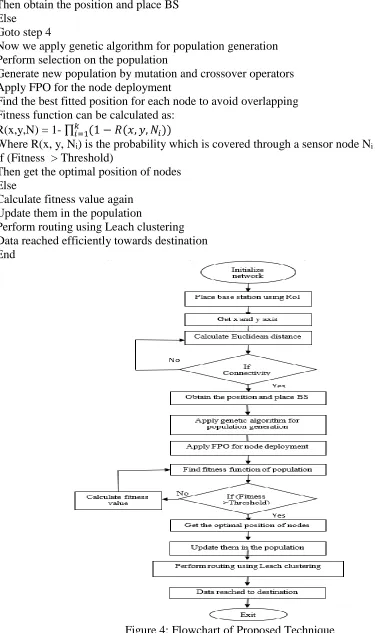
Proposed Algorithm: Create initial population
Place base station at best position using RoI
We consider the x and y axis for the base station deployment Calculate Euclidean distance with each node
Http://www.ijetmr.com©International Journal of Engineering Technologies and Management Research [288] Then obtain the position and place BS
Else
Goto step 4
Now we apply genetic algorithm for population generation Perform selection on the population
Generate new population by mutation and crossover operators Apply FPO for the node deployment
Find the best fitted position for each node to avoid overlapping Fitness function can be calculated as:
R(x,y,N) = 1- ∏𝑘𝑖=1(1 − 𝑅(𝑥, 𝑦, 𝑁𝑖))
Where R(x, y, Ni) is the probability which is covered through a sensor node Ni at (x,y) If (Fitness > Threshold)
Then get the optimal position of nodes Else
Calculate fitness value again Update them in the population
Perform routing using Leach clustering Data reached efficiently towards destination End
Http://www.ijetmr.com©International Journal of Engineering Technologies and Management Research [289]
6. Result Analysis
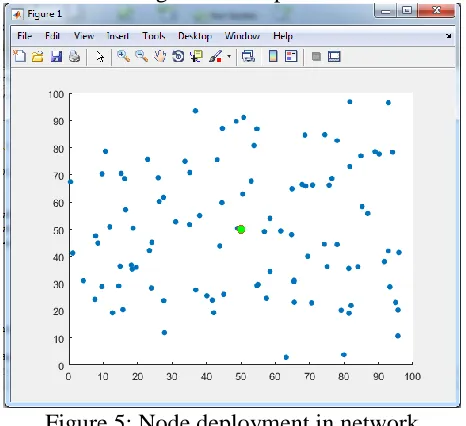
The proposed work is simulated in MATLAB 2013 to show the node deployment in the WSN. There are 100 nodes and BS in which RoI used for the BS. The parameter define the area, initial energy, transmission energy, receiving energy, size of packet and number of SNs utilized in analysis of WSN. There are total 3000 iterations performed in the
Deployment using Flower Pollination Algorithm Outputs:
Figure 5: Node deployment in network
In the graph below, it is shown that the total number of packets sent to BS which is initially 10 (minimum) at iteration 1 and 63112 (maximum) at iteration 3000.
Http://www.ijetmr.com©International Journal of Engineering Technologies and Management Research [290] Energy of node is significant term for the better communication among the nodes. At initial iteration, each node has 50J for the entire process and it decrease with the time. In the last iteration the total remaining energy of the network is 0.9650J approx.
Figure 7: Energy of nodes
The number of dead nodes increases after 1596 iterations then it reach to 91 till last iteration. So it can be seen that 91 nodes dead from the total number of nodes.
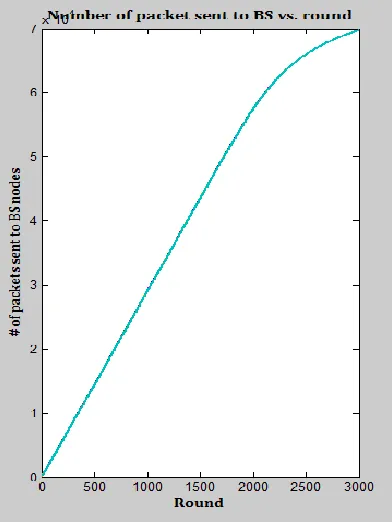
Http://www.ijetmr.com©International Journal of Engineering Technologies and Management Research [291] Deployment using Flower Pollination and Genetic Algorithm Outputs:
Figure 9: Node deployment in network
In the graph below, it is shown that the total number of packets sent to BS which is initially 10 (minimum) at iteration 1 and 69745 (maximum) at iteration 3000.
Figure 10: Number of packet sent to BS
Http://www.ijetmr.com©International Journal of Engineering Technologies and Management Research [292] Figure 11: Energy of nodes
The number of dead nodes increases after 1623 iterations then it reach to 80 till last iteration. So it can be seen that 80 nodes dead from the total number of nodes.
Http://www.ijetmr.com©International Journal of Engineering Technologies and Management Research [293]
7. Conclusion
Wirelessly sensor network is a very interesting area of research where energy efficiency is a very concerning area because SNs have limited energy resource. There are lots of works done in this field our objective of research is first deploy the nodes in accurate position so that we get accurate node location. If we aware about node location, then in this condition we can apply better routing in network and save the energy and the life time of nodes. Since each node has a limited energy and uses it in sensing, processing, gathering and transmitting the data, therefore the main issue in WSN is to utilize the energy of SNs carefully to enhance the lifetime of the network.
References
[1] Abdul Shikalgar Isaq, Dixit M.R, “Energy optimized data routing in wireless Sensor Network”,978-1-4799-7678-2/15©2015 IEEE.
[2] Bochem Arne, Yuan Yali, Hogrefe Dieter, “Tri-MCL: Synergistic Localization for Mobile Ad-hoc and Wireless Sensor Networks”, © 2016, Arne Bochem. Under license to IEEE.333 DOI 10.1109/LCN.2016.61.
[3] Bouachir Ons, Mnaouer Adel Ben, Touati Farid, Cresciniy Damiano, “Opportunistic Routing and Data Dissemination Protocol for Energy Harvesting Wireless Sensor Networks”, 978-1-5090-2914-3/16©2016 IEEE.
[4] Fang Zhen, Zhao Zhan, et al., “Localization in Wireless Sensor Networks with Known Coordinate Database,” EURASIP Journal on Wireless Communications and Networking, Volume 2010, Article ID 901283, 2010.
[5] H.R. Roopashree, Kanavalli Dr. Anita, “STREE: A Secured Tree based Routing with Energy Efficiency in Wireless Sensor Network”, 978-1-4799-7623-2/15/ 2015 IEEE.
[6] Heinzelman W., Chandrakasan A. and Balakrishnan H., "Energy-Efficient Communication Protocol for Wireless Mi- crosensor Networks," Proceedings of the 33rd Hawaii International Conference on System Sciences (HICSS '00), January
[7] Jamin Benazir Salma Mainak, Chatterjee, Samanta Tuhina, “Extensive Game Model for Concurrent Routing in Wireless Sensor Network”, 978-1-4673-7910-6/15©20 15 IEEE.
[8] Khera Sonam, Mehla Dr. Neelam, Kaur Dr. Navdeep, “Applications and Challenges in Wireless Sensor Networks”, DOI 10.17148/IJARCCE.2016.5694.
[9] Kulik J., Heinzelman W., and Balakrishnan H., "Negotiation-based protocols for disseminating information in wireless sensor networks", Wireless Networks, vol. 8, no. 2/3, Mar. May 2002, pp. 169- 185.
[10] Liaqat M., Javaid N., Akbar M., Khan Z. A., Ali L., Hafizah S., Ghani A., “HEX Clustering Protocol for Routing in Wireless Sensor Network”, 1550-445X/14 © 2014 IEEE.
[11] Mezouary Ridouane El, Houmz Abdellah, Jalil Jamila, Koutbi Mohammed El, “PRoPHET-RAIP5: A New Approach to Secure Routing in Wireless Sensor Networks”, 978-1-4673-8224-3/15/ 2015 IEEE.
[12] Zheng Wei Di, Luo, “Routing in wireless sensor network using Artificial Bee Colony algorithm”, 978-1-4799-7091-9/14 © 2014 IEEE.
*Corresponding author.