IPA
International Journal of Psychology Vol. 10, No. 1, Winter & Spring 2016
PP. 34-51
Iranian Psychological
Association
The Impact of Social-Cognitive Categorization
of Others on Implicit and Explicit Empathy
Javad Hatami, PhD Department of Psychology &
Educational Sciences University of Tehran
Pegah Nejat* Department of Psychology &
Educational Sciences Shahid Beheshti University
Azadeh Karamali
Department of Psychology & Educational Sciences University of Tehran
in-group-out-group dimension had a more noticeable impact on empathy, particularly those kinds of empathy more dependent on the evolutionarily ancient systems of the brain.
Keywords: empathy, group membership, implicit assessment, morality
The study of individuals’ reactions when observing pain in others is of great value to empathy researchers. Although pain is commonly considered as a personal and internal experience inaccessible to others, empirical findings suggest that during observation or imagination of pain in others, the experience of pain can be simulated in the observer’s brain as a result of the activation of a neural network called the “Pain Matrix” (Apkarin, Bushnell, Treede, & Zubieta, 2005). In addition, observation of pain in others is considered as one of the main motivators of empathic and prosaically behaviors. Conversely, lack of empathy for others’ pain may lead to violence, aggression, abuse, and interpersonal or intergroup problems (Batson & Ahmad, 2009). Therefore, identifying factors with possible influence on empathy is a noteworthy issue for social psychologists. Several behavioral, cognitive and neurological studies have been conducted to identify the underlying mechanisms and moderators of empathy (e.g., Avenanti, Minio-Paluello, Bufalari, & Aglioti, 2009; Cheng, Lin, Liu, Hsu, Lim, Hung, & Decety, 2007; de Vignemont & Singer, 2006; Preston & de Waal, 2002). The social-cognitive categorization of the person in pain, including the kind of relationship between the observer and the person being observed (Cikara, Bruneau, & Saxe, 2011; Harris & Fiske, 2009; Singer, Seymour, O’Doherty, Stephan, Dolan, & Frith, 2006), is amongst these factors and forms the concern of the present study.
involves dividing people into good, neutral and bad categories based on the degree to which their behavior is perceived as moral versus immoral (Singer et al., 2006). Those who violate ethical principles evoke “disgust” in others (Haidt, Rozin, McCauley, &Imada, 1997) and are even viewed as inferior to human being (Opotow, 1990). Likewise, laboratory findings suggest that attributing a moral or immoral act to an anonymous individual is sufficient to form an accordingly positive or negative relationship with him/her (Singer, Seymour, O’Doherty, Kaube, Dolan, & Frith, 2004).
aggressive than interpersonal ones (Meier & Hinsz, 2004). Shortage or absence of empathy toward out-group members is more notably pronounced in situations where intergroup competition exists. In these situations, despite the presumed role of interpersonal morality in preventing people from hurting each other, violence becomes acceptable due to the support it provides to the in-group (Cohen, Montoya, & Insko, 2006). This has been observed even in experimentally formed groups. For instance, children who were randomly assigned to either the red or the blue team developed more empathy with members of their own group (Masten, Gillen-O’Neel, & Brown, 2010). Moreover, individuals’ implicit attitudes toward out-group members has been shown to moderate their empathic responses. Avenanti, Sirigu, and Aglioti (2010) found that participants’ implicit racial bias correlates negatively with their responses to the experience of pain by an out-group member.
person simultaneously on the two dimensions of group membership (out-group vs. in-group) and perceived morality (guilty vs. innocent) according to the information presented in the story. Group membership is defined on the basis of nationality. As a result, the Iranian story character is considered an in-group member by Iranian participants, whereas the Saudi Arabian character counts as an out-group member. Similar scenarios have been used in previous studies to elicit empathic responses (e.g., Bruneau, Pluta, & Saxe, 2012).
Inspired by neurological findings (Blair, 2005), empathy is taken to be composed of motor, affective and cognitive components. Motor empathy involves the bodily simulation of pain in the observer’s mind, mainly caused by facial expressions, vocalizations and postures of the person in pain (Hatfield, Cacioppo, & Rapson, 1994). Closely related to the concept of theory of mind, cognitive empathy refers to the human being’s ability to form a representation of others’ mental states, and cognitively identify suffering of the other (Blair, 2005). Affective empathy entails the ability to feel the same emotions as another individual. The parts of neural system activated during this kind of empathy overlap with the ones active when the individual him/herself experiences something unpleasant (Singer et al., 2004). By separating components of empathy, the influence of social-cognitive categorization on them can be studied and contrasted.
Banaji, 1995), and can thus provide new insight if their results are compared against those obtained using more direct methods. By ‘explicit’ empathy in this study we mean the kind of empathy assessed using explicit questions, generally considered as a direct method of assessment.
In summary, the present study aims to examine the effect of social-cognitive categorization of a victim, including his group membership and perceived morality, on implicit, motor, affective and cognitive empathies felt toward him. Based on previous findings on these two dimensions, we hypothesize that empathy should be highest with those in-group members also perceived as morally innocent, whereas out-group members judged as morally guilty are to receive the least empathy. The degree of empathy with the remaining two victims, i.e. the guilty in-group and the innocent out-group member, is expected to be in between the two extreme cases just specified.
Method Participants
One hundred and four female students at the psychology department of the University of Tehran participated in this study. All participants were born and grew up in Iran. Each participant was assigned randomly to one of the four experimental groups, each consisting of 26 individuals. The mean age of participants was 23.14 years with a standard deviation of 2.86. None of them had a history of mental disorder.
Materials
form of stories. At the end of the all four scenarios, one character was beaten by the other. In two of the scenarios, an Iranian man called “Farzad” was hit by a man of Saudi Arabian nationality named “Bashir”, whereas in the remaining two scenarios, “Bashir” was the victim of the aggressive act by
“Farzad”. Further, in half of the scenarios, the story was presented in a way that attributed the behavior of the aggressor to a wrongdoing the victim had committed earlier in the story which made him “deserve” the harsh consequence, whereas in the other half, the victim was framed as being innocent (not having formerly done any immoral act). The resulting four scenarios were: guilty Iranian, innocent Iranian, guilty Arab, and innocent Arab. Stories depicting each scenario were written in consultation with two Persian literature professionals. To assess the efficacy of each story in causing the desired categorizations, preliminary stories were pilot-tested on a group of students and subsequently revised based on the feedback received.
Implicit Empathy.Implicit Association Test (IAT; Greenwald et al., 1998) was adopted to provide an indirect measurement of empathy. The Persian version of this test (Nejat & Hatami, 2012) has shown satisfactory construct validity of the known-groups type in Nejat (2011) as well as Hatami (2011). It also had a test-retest reliability of .52 and an internal consistency of .63 (Hashemipour, Heidari, Fathabadi, & Nejat, 2012) which are close to the coefficients reported for it in foreign sources (Hofmann, Gawronski, Gschwendner, Le, & Schmitt, 2005; Nosek, Greenwald, & Banaji, 2007). The internal consistency of IAT in the current study was .73.
Implicit Association Test is composed of five practice and two test stages. The IAT used in this study assessed the degree to which respondents associated each of the two story characters with the tendency to help. More specifically, in one of the two test stages, categories “Farzad” and “help” were shown on one side of the computer screen and “Bashir” and “not help” on the other side while a set of stimuli were presented randomly in the center one by one. Each stimulus belonged to one of the four categories and stayed on the screen for 250 milliseconds. The respondent’s task was to identify the side on which the category of the stimulus was located, and answer by pressing either ‘e’ (for left) or ‘i’ (for right) on the keyboard. If the respondent selected the wrong answer, a red cross was shown below the stimulus and the test would not proceed to the next stimulus until the participant corrected her response. Reaction time is defined as the latency between stimulus offset and the respondent’s correct answer. In the second test stage, two of the categories changed places, resulting in pairing of “Farzad” with
faster than Bashir-help (Farzad-not help) stage, her empathy with Farzad is inferred to be higher than with Bashir. The order of the two main stages was counterbalanced among participants of each of the four experimental groups. The final measure of implicit empathy was calculated according to the algorithm recommended by Greenwald, Nosek, and Banaji (2003), yielding a D score for each participant. The direction of resultant scores was changed so that it would reflect the degree of empathy with the victim in each scenario.
Procedure
Each participant was randomly assigned to one of the four experimental conditions in this study (innocent Iranian, guilty Iranian, innocent Arab, and guilty Arab). She received the corresponding story and was instructed to read it carefully. Next, the participant was seated before the computer in order to complete the empathy IAT. Once finished, she responded to three questions on paper assessing cognitive, affective and motor empathies with the victim. Each participant took the tests individually.
Results
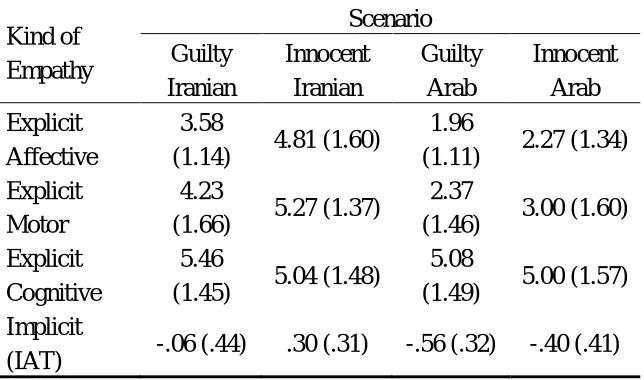
Table 1
Means (and Standard Deviations) of Empathy Scores According to Scenario
Kind of Empathy
Scenario Guilty
Iranian
Innocent Iranian
Guilty Arab
Innocent Arab Explicit
Affective
3.58
(1.14) 4.81 (1.60)
1.96
(1.11) 2.27 (1.34) Explicit
Motor
4.23
(1.66) 5.27 (1.37)
2.37
(1.46) 3.00 (1.60) Explicit
Cognitive
5.46
(1.45) 5.04 (1.48)
5.08
(1.49) 5.00 (1.57) Implicit
(IAT) -.06 (.44) .30 (.31) -.56 (.32) -.40 (.41)
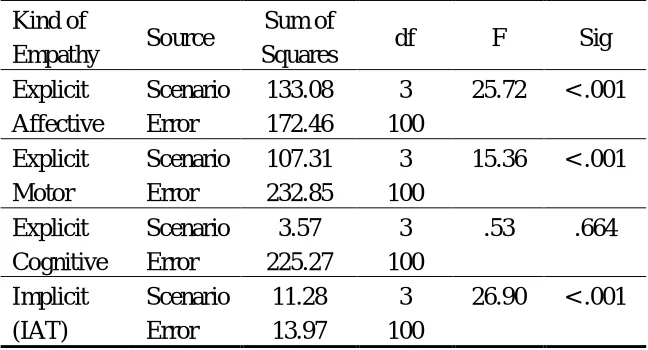
To examine the effect of social-cognitive categorization of the victim on each kind of empathy, a one-way between subjects analysis of variance (ANOVA) was conducted with scenario as the factor and empathy as the dependent variable. The assumption of homogeneity of variances was confirmed for the analyses on implicit, F (3,100)=1.39, p=.251, affective, F(3,100)= 1.08, p= .361, motor, F(3,100)= 1.02, p= .387, and cognitive, F (3,100) = .03, p = .992, empathies.
cognitive empathy reported by participants.
Table 2
Results of Analyses of Variance Comparing Empathy Scores between Four Scenarios
Kind of
Empathy Source
Sum of
Squares df F Sig
Explicit Affective
Scenario 133.08 3 25.72 < .001
Error 172.46 100
Explicit Motor
Scenario 107.31 3 15.36 < .001
Error 232.85 100
Explicit Cognitive
Scenario 3.57 3 .53 .664
Error 225.27 100
Implicit (IAT)
Scenario 11.28 3 26.90 < .001
Error 13.97 100
Post-hoc analyses using Tukey HSD test showed that innocent Iranian received the highest amount of implicit empathy among the four types of victims, PS<.01. Interestingly, participants empathized significantly more with the guilty Iranian than the innocent Arab on the implicit level, p< .01. This finding was replicated with affective, p< .01, and motor, p< .05, empathies. In addition, the guilty Iranian received less implicit, p< .01, and affective, p< .01, empathy than his innocent counterpart. However, the guilty Arab and the innocent Arab scored comparably in implicit empathy, p= .424. Similarly, affective, p= .833, and motor, p= .920, empathies were not different between the guilty Arab and the innocent Arab conditions.
found to be 3.51 times larger than the effect size of perceived morality on it, F (1,100) = 12.77, p< .01, ηp2 = .11. This ratio of effect sizes amounted to 4.80 and 6.17 in the case of affective, F (1,100) = 65.03, p<.001, ηp2 = .39; F (1,100) = 8.92, p< .01, ηp2 = .08, and motor, F (1,100) = 39.66, p< .001, ηp2 = .28; F (1,100) = 4.77, p< .05, ηp2 = .05, empathies, respectively.
Discussion
cognitive levels of empathy, group membership has a more notable effect than perceived morality. This finding was further strengthened by comparing effect sizes of the two social-cognitive factors under study.
angles of this important issue.
One general limitation of the present study, also common among many other studies conducted in the field of social psychology, is that subjects participated on a voluntary basis (rather than being selected randomly), which theoretically can confront results to validity issues. A more specific limitation is that participants were of a different gender from the two main characters depicted in scenarios. Given that the victim can also be classified as an in-group or out-group member based on gender in addition to his nationality, caution must be taken in generalizing results of this study to cases were participants and story characters are the same gender. Moreover, all participants of this research were female. Accordingly, adding participants’ gender as another factor to the study and probably alternating it with respect to the victim’s gender would be a fruitful future direction. A similar limitation can be conceived regarding group membership of the aggressor and the victim. In the current study, the two story characters belonged to opposite nationalities (i.e., Iranian vs. Saudi Arabian) in all four scenarios. Future studies are invited to examine empathy in situations where the aggressor and the victim are members of the same group, i.e. they are both perceived as members of an in-group or an out-group by participants.
References
Apkarian, A. V., Bushnell, M. C., Treede, R. D., & Zubieta, J. K. (2005).Human brain mechanisms of pain perception and regulation in health and disease.European Journal of Pain, 9, 463-484.
Neuroscience, 8, 955-960.
Avenanti, A., Minio-Paluello, I., Bufalari, I., & Aglioti, S. M. (2009). The pain of a model in the personality of an onlooker: influence of state-reactivity and personality traits on embodied empathy for pain. Neuroimage, 44, 275-283. Avenanti, A., Sirigu, A., & Aglioti, S. M. (2010). Racial bias
reduces empathic sensorimotor resonance with other–race pain. Current Biology, 20, 1018-1020.
Batson, C. D., & Ahmad, N. Y. (2009). Using empathy to improve intergroup attitudes and relations.Social Issues and Policy Review, 3, 141-177.
Batson, C. D., Sager, K., Garst, E., Kang, M., Rubchinsky, K., & Dawson, K. (1997). Is empathy-induced helping due to self–other merging? Journal of Personality & Social Psychology, 73, 495-509.
Blair, R. J. (2005). Responding to the emotions of others: dissociating forms of empathy through the study of typical and psychiatric populations.Consciousness and Cognition, 14, 698-718.
Brown, L. M., Bradley, M. M., & Lang, P. J. (2006).Affective reactions to pictures of in-group and out-group members.Biological Psychology, 71, 303-311.
Bruneau, E. G., Pluta, A., & Saxe, R. (2012). The Role of the
‘Shared Pain’ and ‘Theory of Mind’ networks in Processing Others’ Emotional Suffering. Neuropsychologia, 50, 219-231
Cheng, Y., Lin, C. P., Liu, H. L., Hsu, Y. Y., Lim, K. E., Hung, D., & Decety, J. (2007). Expertise modulates the perception of pain in others. Current Biology, 17, 1708-1713.
Cohen, T. R., Montoya, R. M., & Insko, C. A. (2006). Group morality and intergroup relations: Cross–cultural and experimental evidence. Personality and Social Psychology Bulletin, 32, 1559-1572.
De Vignemont, F., & Singer, T. (2006). The empathic brain: how, when and why. Trends in Cognitive Sciences, 10, 435-441.
De Waal, F. B. M. (2008). Putting the altruism back into altruism: The evolution of empathy.Annual Review of Psychology, 59, 279-300.
Greenwald, A. G., & Banaji, M. R. (1995). Implicit social cognition: Attitudes, self-esteem, and stereotypes. Psychological Review, 102, 4-27.
Greenwald, A. G., McGhee, D. E., & Schwartz, J. K. L. (1998). Measuring individual differences in implicit cognition: The Implicit Association Test. Journal of Personality and Social Psychology, 74, 1464-1480.
Greenwald, A. G., Nosek, B. A., & Banaji, M. R. (2003). Understanding and using the Implicit Association Test: I. An improved scoring algorithm. Journal of Personality and Social Psychology, 85, 197-216.
Haidt, J., Rozin, P., McCauley, C., & Imada, S. (1997). Body, psyche, and culture: The relationship between disgust and morality. Psychology and Developing Societies, 9, 107-131 Harris, L. T., & Fiske, S. T. (2009). Social neuroscience
evidence for dehumanized perception.European Review of Social Psychology, 20, 192-231.
Hatami, A. J. (2011). The organization of personality from the perspective of national, religious, and modern identities.Master Thesis, Department of Psychology and Educational Sciences, Shahid Beheshti University.
Hatfield, E., Cacioppo, J. T., & Rapson, R. (1994).Emotional Contagion. New York: Cambridge University Press.
Hofmann, W., Gawronski, B., Gschwendner, T., Le, H., & Schmitt, M. (2005).A meta-analysis on the correlation between the Implicit Association Test and explicit self-report measure.Personality and Social Psychology Bulletin, 31, 1369–1385.
Kagan, J. (2000). Human morality is distinctive. Journal of
Consciousness Studies, 7, 46-48.
Marler, P. (1976). On animal aggression: The roles of strangeness and familiarity. American Psychology, 31, 239-246.
Masten, C. L., Gillen-O’Neel, C., & Brown, C. S. (2010). Children’s intergroup empathic processing: The roles of novel in- group identification, situational distress, and social anxiety. Journal of Experimental Child Psychology, 106, 115-128.
Meier, B. P., & Hinsz, V. B. (2004). A comparison of human aggression committed by groups and individuals: An interindividual-intergroup discontinuity. Journal of Experimental Social Psychology, 40, 551-559.
Nejat, P. (2011). Investigating the relations between implicit/explicit stereotype, identity constructs and behavioral indicators in Iranian students of math and humanities.Master Thesis, Department of Psychology and Educational Sciences, University of Tehran.
strategies, Advances in Cognitive Science, 53, 75-87. [Text in Persian]
Nosek, B. A., Greenwald, A. G., & Banaji, M. R. (2007). The Implicit Association Test at age 7: A methodological and conceptual review. In J. A. Bargh (Ed.), Social psychologyand the unconscious: The automaticity of highermental processes (pp. 265-292). New York, NY: Psychology Press.
Opotow, S. (1990). Moral exclusion and injustice: An introduction. Journal of Social Issues, 46, 1-20.
Preston, S.D., & de Waal, F. B. (2002). Empathy: Its ultimate and proximate bases. Behavioral and Brain Sciences, 25, 1-20.
Singer, T., Seymour, B., O’Doherty, J., Kaube, H., Dolan, R., & Frith, C. (2004). Empathy for pain involves the affective but not sensory components of pain. Science, 303, 1157- 1162. Singer, T., Seymour, B., O’Doherty, J., Stephan, K., Dolan, R.,
& Frith, C. (2006). Empathic neural responses are modulated by the perceived fairness of others. Nature, 439, 466-469.
Todorov, A., & Engell, A. D. (2008). The role of the amygdala in implicit evaluation of emotionally neutral faces. Social, Cognitive, and Affective Neuroscience, 3, 303-312.