The University of San Francisco
USF Scholarship: a digital repository @ Gleeson Library |
Geschke Center
Master's Theses Theses, Dissertations, Capstones and Projects
Spring 5-23-2015
Goal Setting, Self-help Groups, and Incentives as a
Poverty Alleviation Strategy: Evidence from Field
Experiments in Indonesia, Colombia and Ethiopia
Sherefedin K. NuriFollow this and additional works at:https://repository.usfca.edu/thes Part of theSocial and Behavioral Sciences Commons
This Thesis is brought to you for free and open access by the Theses, Dissertations, Capstones and Projects at USF Scholarship: a digital repository @ Gleeson Library | Geschke Center. It has been accepted for inclusion in Master's Theses by an authorized administrator of USF Scholarship: a digital repository @ Gleeson Library | Geschke Center. For more information, please [email protected].
Recommended Citation
Nuri, Sherefedin K., "Goal Setting, Self-help Groups, and Incentives as a Poverty Alleviation Strategy: Evidence from Field Experiments in Indonesia, Colombia and Ethiopia" (2015).Master's Theses. 148.
1
Goal Setting, Self-help Groups, and Incentives as a Poverty
Alleviation Strategy: Evidence from Field Experiments in
Indonesia, Colombia and Ethiopia
Sherefedin Nuri
Department of Economics University of San Francisco2130 Fulton St. San Francisco, CA 94117
e-mail: [email protected]
May 2015
2
I. Introduction
Billions of dollars have been spent on program interventions in developing countries, yet 1.2 billion people are still living below $1.25 per day in personal income in developing countries (World Bank, 2013). Albeit many program interventions have been implemented for good intentions to address the issue of poor populations, they tend to not eradicate poverty for many reasons. One of the reasons could be the lack of motivation by participants to make change. This is due to the fact that most program interventions focus on the needs and deficits of the low-income people, but they ignore the initiative, motivation and the capacity the poor people have to make change. Nevertheless, an organization known as the Family Independence Initiative (FII) has found consistent success in improving the socio-economic status of the poor, where for many years government programs failed to do so, by creating a structure for low-income people to maximize their own abilities, resources and social networks. Maurice Lim Miller, the founder and CEO of the FII, was awarded the MacArthur Foundation’s Genius Award in 2012 for his contribution to the success of poor working families in United States.
3 they report their progress or achieve their goals. The goal could be finding a job, opening a new business, saving, attending business training, improving kids’ grades, etc. The main purpose of the FII incentive scheme is to reward initiative and progress. Moreover, the FII encourages members of a self-help group to meet on a monthly basis to discuss obstacles they face, the progress they make to achieve their goals, and to share information and resources to help one another. Families who adopted this approach achieved substantial improvements. For example, results obtained from FII follow up study in Oakland, California showed that earning of the families increased by 27 percent and homeownership increased by 40 percent in two years (FII, 2011). Could this new approach help eradicate poverty in developing countries? If so, which component is the most effective?
4 another to make progress. The third treatment group was “incentive”. This intervention is to explore the incentive scheme components of the FII model. The participants who were assigned to this treatment set personal goals and they were not placed in a small group. They were told that they will only get incentives if they achieved their goals. The fourth treatment is “FII”. This intervention is the interaction of goal-setting, group and incentives. Subjects assigned to this treatment were placed in small peer support groups, and set personal goals. They were told that they would receive incentives only if they achieved their goals. The subjects assigned to control condition did not get any intervention. For each intervention, the outcome with regard to goal achievement and income were measured. The main purpose of this study is to test the components of Family Independence Initiative approach (FII) in developing countries.
The overall analysis of the study using three countries dataset revealed strong evidence in the findings to suggest that the FII treatment could be a powerful tool for poverty alleviation in the developing countries.
The next section presents literature review. Section III describes the experiments and the experimental design. Section IV provides the estimation strategies. Results are discussed in section V. conclusion and policy implications are presented in section VI.
II. Literature Review
5
Goal Setting
The first component of the FII model is setting a goal. FII challenges low-income people to set goals that will lift them out of a low standard of living. Lock and Lathan (2006) state that a goal is the aim of an action or task that a person consciously desires to achieve or obtain. Goal setting, then, is the process of establishing the level of performance so as to achieve a certain measurable result. Although goal setting for poverty alleviation is a new research idea for development economics, there exist a large body of literature on the power of goal setting on performance in psychology and management.
In review of studies conducted on different ranges of countries and settings over past thirty five years with close to hundred tasks over forty thousand participants, Lock and Latham (2002) noted that goal setting has been shown to increase performance. Goals can be self-elected, assigned by others and they can be set in cooperation with other participants. According to Dossett and Greenberg (1981), self-set goals result in higher performance and goal attainment as versus goals assigned by others. This makes sense because self-set goals are for the person who owns them. Furthermore, goal setting theory predicts that goal difficulty is a key issue. Specific and difficult goals if accepted lead to higher levels of performance than do easy goals (Locke and Latham, 2006). A study by Harding and Hsiaw (2014) on goal setting and energy conservation found that consumers who set realistic goals save considerable amount of energy.
6
Incentive
7
Self-help groups
The third component of the FII model is self-help groups. Anne et al. (2011) reported that a family who is willing to join the FII must recruit six to eight other families who want to make improvement in their standard of living and form self-helping groups. Studies show that Self- groups play a key role in socio-economic activities. Kalra et al. (2013) carried out a case study in India on two self-help groups engaged in agricultural activities. They noted that self-help groups have the potential to contribute to economic development by empowering its member through skills, knowledge, and social networking. Kilpatrick et al (2003) stated that self-groups where members share common values and visions and take on responsibilities within the group including leadership are important to group development. Moreover, the characteristics of group members are important for group effectiveness. For example, Huppi and Feder (1990) examined the roles of groups in rural lending and indicated that the group lending to be successful, groups have to be homogenous and jointly liable.
In conclusion, several studies have been done on goal setting, incentives and self-help groups separately, to my knowledge there is no research has examined the power of goal setting, self-help groups and incentives together as a poverty reduction strategy. This study addresses this gap by using randomized field experiments data from developing countries.
III. The Experiment
8 cycle are: Goal-setting, self-help groups, and incentives. Considering these key ingredients in to account, four interventions were examined and named as follows: Goal-setting “goal”, goal-setting and self-help-groups “groups”, goal-setting and incentives “incentives”, and goal-setting, self-help groups and incentives “FII”. Table 1 shows the basic experimental design and the interventions.
The Interventions
The “goal” intervention is common to all the treatments, it is intended to test the goal setting element of the FII model. The FII challenges participants to set goals they thought change their socio-economic status. It could be opening a new business, saving, improving kids’ school performance, attending business training etc. Similarly, in the experiments subjects assigned to the “goal” treatment were asked to set life-changing goals. The goals should measureable and provable.
The “group” intervention is aimed at to examine the peer support group component of the FII approach. A Family that is willing to adopt the FII is required self-select six to eight other families and form a small group. The importance of forming self-help group to members is to share problems and achievements, give advice one another, and strengthen social ties and friendships. Likewise, in the experiments subjects assigned to this treatment were placed in small support groups. Group members set personal goals and they are allowed to turn one another for help, inspiration, and share resources.
9 The study conducted in three different sites: Medellin, Addis Ababa and Jakarta.
Medellin, Colombia
The Municipality of Medellin is the second largest city in Colombia, with an estimated population of 2.44 million. The field experiment in Medellin was conducted by University of San Francisco (USF) students, partnered with The Bank of Opportunities (the biggest financial institution in Medellin). The participants in the experiment were low-income people who own small businesses.
The bank picked 250 clients to participate in the study from its different programs. However, 150 clients showed-up for the first orientation meeting. The researchers explained the purpose of the study to the participants to obtain their agreement, and then obtained their agreement. Participants were asked to fill out orientation surveys. This survey asked for contact details, personal information, and household and business characteristics. The experiment was a five-group design consisting of four treatment five-groups and two control five-groups. The study occurred between June and December 2012 and comprised 7 follow-up meetings once every four weeks, in six phases. In the first follow-up meeting, participants filled-out a baseline survey and subjects were randomly assigned to four treatment groups and one baseline control group. The investigators also recruited and end-line control group in order to test any bias that arose in case of diffusion of information between the treatment groups and the baseline control group.
10 pure control group they were only required to fill out the end-line survey and received the same compensation per survey as the baseline control group.
In the “goal” treatment group (n=23), all subjects set individual goals. Based on the orientation meeting and survey, the investigators were able to come up with fourteen measurable goals. These subjects were required to select one new goal from the fourteen goals every four weeks over a total of six phases. At the end of every four weeks, the information on goal attainment and sales income was collected. These Individuals received $17 per survey as compensation for filling out goal related surveys, regardless of whether they achieved their goal or not. Some of the goals subjects chose were; attend and complete at least one of workshops in marketing and sales, and save at least $ 15,000 Colombian pesos (8 USD) every week for next four weeks in a savings account etc. The goal achievement verifications for attending at least one workshop were to show registration receipt and completion of certificate. Method of verification for saving goal was to present a bank statement.
In the “group” treatment (n=29), subjects were placed in a small self-help groups. The average number per group was 15 individuals. The self-help groups met every four weeks during the follow-up meeting to discuss goals and ways to help each other. At the end of every four weeks, information on goal achievements and their performance on sales income was measured and they set new goals for the next period. The subjects in this groups were compensated $17 per survey for filling out goal related survey, regardless of whether they achieved their goal or not.
11 In the “FII” treatment (n=27), subjects set goals and they were placed in a small self-help groups. They also told they would receive monetary incentive of $19 if they achieved their goals, if not they only receive $3. At the end of every four weeks, information with regard to goal achievement and monthly sales income was measured. Then, they set another new goal for the next phase.
Addis Ababa, Ethiopia
Addis Ababa is the capital city of Ethiopia and where the African Union is based. It is also the largest city in the country, with an estimated population of 3.39 million. The field experiment in Ethiopia was conducted by USF students in collaboration with The Bureau of Labor and Social Affairs (BOLSA). The study was conducted at five different sites in Addis Ababa: ALERT, HAGER, FURNITURE, GASHA and ENDAD. These sites are the place where physically disabled people either work, meet, reside or get different kinds of trainings. The researchers talked about the research idea to all of the participants invited for orientation meetings at each sites and obtained their agreement to participate in the study. The participants in the experiment were low-income physically disabled persons.
13
Jakarta, Indonesia
Jakarta is the capital city of Indonesia. It is also the largest city in the country, with an estimated population of 10.176 million. The field experiment in Jakarta was conducted in collaboration with Child Survival Program (CSP). The CSP provides nutritional assistance to mothers and babies. In addition, CSP offers health and business related trainings to mothers. Many groups of mothers attend the programs at the CSP centers. Each group consists of 10-15 mothers. These groups were the ideal candidates to test the component of the FII approach. The CSP invited these groups to an orientation meeting. The researcher explained purpose of the study to these groups of mothers during the orientation meeting and obtained their agreement to participate in the project.
As in Colombia and in Ethiopia, the experiment was a five -group design consisting of four treatment groups and one control group. The study was conducted during the summer of 2012 and comprised five follow-up meetings once every week, in two phases. In first follow-up meeting, participants filled out baseline survey and ten of the mother groups were assigned to four treatment groups and one control group on the basis of group level randomization.
14 barber, etc. In the “group” treatment (n=31), subjects were placed in small groups. The average number per self-help group was 10-15 individuals. The groups met every week during the follow-up meeting to discuss goals and ways to help each other. After the end of the two weeks, information on goal achievements and their income was measured, and another treatment other than “group” treatment was assigned for the next two weeks. In the “incentives” treatment (n=41), subjects set individual goals, and did not form self-help groups. They were told that they would receive non-cash incentives only if they achieved their goal. At the end of the two weeks, performance on bi-weekly income and goal achievement information was collected and another treatment was assigned. In the “FII” treatment (n=45), subjects assigned to this treatment set goals, and were placed in self-help groups. Group members met and discussed every week during the follow-up sessions. They were told that they would receive non-cash incentives only if they achieved their goal. At the end of the two weeks, bi-weekly income and goal achievement data was collected, and another treatment was assigned for the next phase.
15
IV. Estimation Strategy
To evaluate the causal effects of the interventions, I specify four models. The first two models (equation (1) and equation (2)) measure the effects of treatments on goal achievement. Specifically, equation (1) estimates goal achievement for Indonesia, Ethiopia and Colombia separately whereas equation (2) estimates goal attainment for three the countries together. The last two models (equation (3) and equation (4)) measure the impacts of treatments on economic outcome variables for each country individually and the three countries jointly.
The goal achievement model for Ethiopia, Indonesia and Colombia is specified as follows;
𝑌𝑖𝑡 = 𝐵0+ 𝐵1𝑔𝑟𝑜𝑢𝑝𝑖𝑡+ 𝐵2𝑖𝑛𝑐𝑒𝑛𝑡𝑖𝑣𝑒𝑖𝑡+ 𝐵3𝐹𝐼𝐼𝑖𝑡+ 𝜃𝑋 + 𝜀𝑖𝑡 (1)
Where the dependent variable 𝑌𝑖𝑡 represents mean goal attainment. The variable goal achievement measures only two possible values: 0 (failure to achieve goal) and 1(success to achieve goal). 𝐵0
is the constant term. 𝑔𝑟𝑜𝑢𝑝𝑖𝑡 is a an indicator variable for assignment to ‘group’ treatment.
𝑖𝑛𝑐𝑒𝑛𝑡𝑖𝑣𝑒𝑖𝑡 is a dummy variable that takes a value 1 if the participant is assigned to ‘incentive’
treatment. 𝐹𝐼𝐼𝑖𝑡 is another indicator variable assigned to ‘FII’ treatment . X is a vector of controls which includes age and gender. 𝜀𝑖𝑡 is an error term.
The goal achievement model for the three countries is specified as follows
𝑌𝑖𝑡 = 𝐵0+ 𝐵1𝑔𝑟𝑜𝑢𝑝𝑖𝑡+ 𝐵2𝑖𝑛𝑐𝑒𝑛𝑡𝑖𝑣𝑒𝑖𝑡+ 𝐵3𝑓𝑖𝑖𝑖𝑡+ 𝜃𝑋 + 𝜋𝑐 + 𝜀𝑖𝑡 (2)
The variable descriptions are the same as equation (1) except that this model includes country dummies (𝜋𝑐 ). The dataset in each country treated as an average per individual instead of a panel for consistency.
16 However, I can still compare the effects of treatments on average goal achievement between treatment groups since subjects were assigned to the four treatments groups are comparable due to random assignment. Hence, the difference in probability of goal achievement between the treatment groups is the effect of the treatments.
The economic outcome model for each country specified is as follows;
𝑌𝑖𝑡 = 𝐵0 + 𝐵1𝑔𝑟𝑜𝑢𝑝𝑖𝑡+ 𝐵2𝑖𝑛𝑐𝑒𝑛𝑡𝑖𝑣𝑒𝑖𝑡+ 𝐵3𝐹𝐼𝐼𝑖𝑡+ 𝐵4𝑔𝑜𝑎𝑙𝑖𝑡+ 𝜃𝑋 + 𝜀𝑖𝑡
The dependent variable Yrepresents standardized average weekly income. 𝐵0 is the intercept term, while group, incentive, FII and goal aredummy variables representing the treatments, X is the vector of covariates which includes age, gender and baseline income,and 𝜀𝑖𝑡 is an error term.
The economic outcome model for the three countries specified as follows;
𝑌𝑖𝑡 = 𝐵0+ 𝐵1𝑔𝑟𝑜𝑢𝑝𝑖𝑡+ 𝐵2𝑖𝑛𝑐𝑒𝑛𝑡𝑖𝑣𝑒𝑖𝑡 + 𝐵3𝑓𝑖𝑖𝑖𝑡+ 𝐵4𝑔𝑜𝑎𝑙𝑖𝑡+ 𝜃𝑋 + 𝜋𝑐 + 𝜀𝑖𝑡 (4)
The variables description of this model is similar to equation (3) except that country dummies have been included in this model.
The economic outcome variables observations from each country have been standardized to make all of the economic outcome variables comparable between countries by using the following formula.
𝑌𝑖𝑗,1𝜎 =𝑌𝑖𝑗 − 𝑌̅𝑠
𝜎𝑌,𝑠 (5)
Where 𝑌𝑖𝑗,1𝜎 is the standardized value of the economic outcome variable to one standard deviation for data point i for country j, 𝑌𝑖𝑗 each data point for country j, 𝑌̅𝑠 the average of all sample
17 The main advantage of standardizing the economic outcome variables distributions is to make each country’s economic outcome variable distribution the same. When these distribution are standardized, they will have a mean zero and a standard deviation of one and the economic outcome from each country can be directly compared. However, the transformation of unscaled variable into standardized values does not change the shape of the original distribution and it does not change the location of each observation relative to the others observations in the distribution. The sign of the standardized values indicates whether the value of the outcome variable is located above the mean when it is positive, located below the mean when it is negative and equal to the mean when it is zero.
V. Results
The effects of Treatments on goal achievement
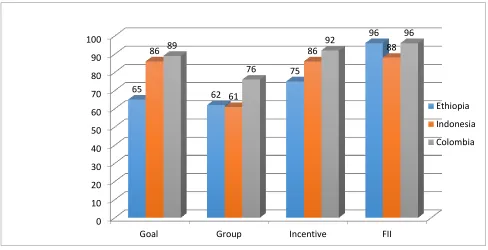
Figure1 shows the proportion of goal achievement for Indonesia, Colombia and Ethiopia under
different treatments. Only considering “goal” treatment, 86 percent of the subjects achieved their goals in Indonesia, 89 percent in Colombia and 65 percent in Ethiopia. Looking at the “incentives” treatment, 92 percent of the participants achieved their goals in Colombia, 86 percent in Indonesia and 75 in Ethiopia. Focusing on only FII treatment, the share of goal achievements are, 96 percent, 96 percent and 88 percent in Colombia, Indonesia and Ethiopia respectively. The percentage of goal achievement is the highest for “FII” treatment. The proportion of goal achievement of subjects in the group treatment is the lowest in the three countries compared to the other three treatments. The proportion of goal achievements are 76 percent, 61 percent and 62 percent in Colombia, Indonesia and Ethiopia respectively.
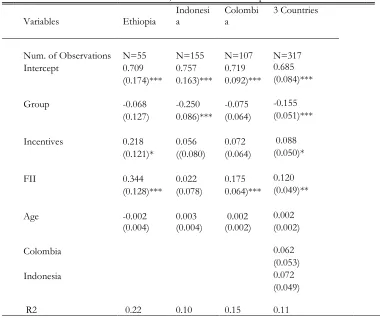
18 equation (1) and equation (2) using Ordinary Least Squares regression estimation technique. Since all the treatments are dummy variables, the “goal” treatment is used as the reference category and all of the other treatments are compared to the “goal” treatment.
The purpose of the “group” treatment is to assess the effects of self-help groups on the member’s performance for goals achievement. Studies predict that self-help groups have the advantage of empowering its members by pooling ideas, skills, and resources, and by motivating each other to achieve better results. The results obtained in this study indicated mutual support groups have the opposite impact. The coefficients of “group” treatment on goal achievement is either significant and negative or insignificant. The “group” treatment is negative and statistically insignificant in Ethiopia and Colombia, but it is statistically significant and negative in Indonesia (where all of the participants were women) at 5 percent significance level. Using the three countries data together, the coefficient of “group” treatment carries a negative sign and it is insignificant at 5 percent significance level. A possible explanation for this unexpected result is in the FII model families self-select one another to form peer support group whereas in the experiments participants were placed in the “group” treatment randomly. Therefore, there is a possibility that participants placed in the groups do not know each other well, or lack sense of belonging and a common vison.
19 estimates of “incentive “for Indonesia and Colombia are positive, but it is statistically insignificant. Overall, using the three countries dataset, the estimates of “incentive” is significant at 10 percent significance level.
The estimates of the “FII” treatment (which is the amalgamation of goal, self-help groups and incentives) are significant and positive for Colombia and Ethiopia at 1 percent significance level. However, the result for Indonesia is positive but insignificant. The result of the “FII” treatment for the three countries is significant at 10 percent significance level. The overall analysis of goal attainment using the combined dataset reveal that the “FII” treatment has the highest probability of goal achievement.
The effects of treatments on economic outcome
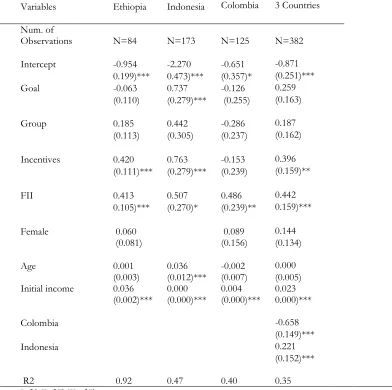
First, I will estimate the effects of the four treatments on economic outcome using each country dataset separately and then combining the countries datasets. Since I have four treatment groups and one comparison group for each country, I can evaluate the difference in impact between the treatment groups and the control group with respect to the “goal” treatment, the “group” treatment, the “incentive” treatment and the “FII” treatment because of the random assignment. The main aspect of interest is to see whether the “FII” intervention has improved the economic outcome variable. Table 3 presents the estimates of the effects of the different treatments on standardized income variables after controlling for age, gender, and baseline income and country dummies. I estimate equation (3) and equation (4) using Ordinary Least Square (OLS) regression.
20 the theory, the estimate for “goal” treatment for Indonesia shows postitive results at the 5 percent singificance level. Wheras the coeficients of “goal’ treatment for Ethiopia and Colombia are negative but insignificant. Overall, using the three countries dataset the goal treatment coficient is significant at a 10 percent singificance level.
The self-help groups can benefit each other through counseling, sharing skills and information, and giving advice. This analysis again shows surprising results for the “group” treatment. This intervention failed to have any positive and significant impact on economic outcome variable in Ethiopia, Colombia and Indonesia. Moreover, the three countries regression analysis result indicates the estimates of “group” treatment is positive but insignificant.
Result for “incentive” treatments for economic outcome are mixed. The estimates of “incentive” treatments are positive and statistically significant in Ethiopia and Indonesia at 5 percent significance level fits with prior research by (Jeffery 2009). On the other hand, there was no effect obtained for “incentive” treatment for Colombia with respect to sales income performance during the intervention.
21 In general, the “FII” treatment is the only intervention that is positive and significant for each country and the three countries as a whole.
VI. Conclusion and Policy Implication
This study uses randomized field experiments conducted in Indonesia, Colombia and Ethiopia to evaluate the efficacy of the components of the Family Independence Initiative model as a poverty alleviation strategy in developing countries. The FII encouraged the poor to utilize their own abilities and resources to break the cycle of poverty by using the power of goal setting, self-help groups and incentives. The FII has been successful in eradicating poverty.
To test the FII approach, a five-group experiment was designed in each country, and subjects were randomly assigned to one of the five groups named as follows: 1) goal-setting “goal”, 2) goal-setting and group “group”, 3) goal-setting and incentives “incentives”, 4) goal-setting, group and incentives “FII” and 5) control group. I examined the effects of the treatment on goal achievement and economic outcome.
The goal achievement estimation model did not include the control group because this group did not set any goal. The goal achievement variable takes two values: 1 if the subjects achieved their goals and 0 otherwise. The dependent variable (average goal achievement) measures the mean goal accomplishment throughout the interventions for each treatment. The “goal” dummy variable is suppressed and all other treatments are compared to it. The economic outcome models measure the impacts of treatments on economic outcome variables for each country individually and the three countries as a whole.
22 (where the treated groups consists of male and female participants), but it has a negative effect on goal achievement in Indonesia (where the treated groups consists of only female participants). Moreover, I detect no significant result for this intervention with respect to the economic performance for the countries considered for this study. The basic reason for the lack of positive impact for the “group” intervention is that subjects were placed in small support groups randomly in the experiments, as opposed to the self-select support groups approach in the FII model. As a result, there is a possibility that participants placed in the group did not know each other well, or lack a sense of belonging, trust and a common vison. Furthermore, the existing studies suggest that the self-help groups to be successful, the group members should have been self-selected and homogenous (Gomez 2005; Huppi and Feder 1990).
The result shows that the “goal” treatment has a positive and significant effect on the economic outcome variable in Indonesia, but it is statistically insignificant in Colombia and Ethiopia. The positive outcome of “goal” intervention is in line with the basic concept of the goal-setting theory of motivation and the studies that has found goal-setting alone has a power to influence motivation, goal commitment and organizational performance (Wright 2007; Ivancevich & Mcmahon 1982). The significant result for the “goal” treatment without group and incentive is encouraging because it shows that goal commitments can be motivated by the desire to reach an end result people expect for working towards achieving their goals.
24
References
Aguinaga Lezcano, P. (2013). Do Self-Help Groups Work on Achieving Economic Goals? New Evidence from a Field Experiment in Medellin, Colombia. Master's Theses.Paper 65.
Dossett, D. L., & Greenberg, C. I. (1981). Goal Setting and Performance Evaluation: An Attributional Analysis. Academy of Management Journal, 767-779.
Harding, M., & Hsiaw, A. (2014). Goal setting and energy conservation. Journal of Economic Behavior & Organization, 209–227.
Huppi, M., & Feder, G. (1990). The role of groups and credit cooperatives in rural lending. The World Bank research observer, 187-204.
Ivancevich, J. M., & Mcmahon, T. J. (1982). The Effects of Goal Setting, External Feedback, and Self-Generated Feedback on Outcome Variables: A Field Experiment. Academy of Management Journal, Vol. 25, No. 2, 359-372.
Jeffrey, S. A. (2009). Justifiability and the Motivational Power of Tangible Noncash Incentives. Human Performance , 22:143–155.
Kalra, R. K., Anilb, B., Tonts, M., & Siddique, K. H. (2013). Self-Help Groups in Indian Agriculture: A Case Study of Farmer Groups in Punjab, Northern India. Agroecology and Sustainable Food Systems, 509-530.
Kilpatrick, S. L. (2003). Effective farmer groups for defining best practices for sustainable agriculture.
Paper presented at the Australasia Pacific Extension Network, November 22, Tasmania.
Knight, D., Durham, C., & Locke, E. .. (2001). The Relationship of Team Goals, Incentives, and Efficacy to Strategic Risk, Tactical Implementation, and Performance. Academy of Management Journal , 326-388.
Latham, G. P., & .Locke, E. A. (2007). New Developmentsin and Directionsfor Goal-SettingResearch.
European Psychologist, Vol. 12(4):290–30.
Locke, E. (. (2002). Handbook of Positive Psychology. New York: Oxford University Press.
Locke, E. A., & Latham, G. P. (2006). New Directions in Goal-Setting Theory.". Current Directions in Psychological Science, 265-268.
Locke, E., & Latham, G. (1990). Work Motivation and Satisfaction: Light at the End of the Tunnel,.
Psychological Science, 240-246.
Prendergast, C. (1999). The Provision of Incentives in Firms. Journal of Economic Literature, 7-63 .
25
Shaffer, V. A., & Arkes, H. R. (2009). Preference reversals in evaluations of cash versus non-cash incentives. Journal of Economic Psychology, 859–872.
Skora, L. (2013). Incentives to Improve Economic Conditions: A Field Experiment in Medellin, Colombia.
Master's Theses. Paper 62.
Remarkable Declines in Global Poverty, But Major Challenges Remain
https://www.worldbank.org/en/news/press-release/2013/04/17/remarkable-declines-in-global-poverty-but-major-challenges-remain
26 Table 1 Experimental design and the interventions
Treatment groups Num. of participants in each
Country
Interventions
Colombia Indonesia Ethiopia Set
goals
Placed in a small groups
Received incentives
“Goal” 23 38 13
“group” 29 31 20
“incentives” 29 31 16
“FII” 27 45 13
Control 19 19 24
Figure 1 Proportion of Goal Achievement per Country for Each Treatment Group
0 10 20 30 40 50 60 70 80 90 100
Goal Group Incentive FII
27
Table 2: Impacts on Goal Achievement Dependent Variable: Mean Goal Achievement
---OLS Estimations, standard errors are in parentheses---
Variables Ethiopia Indonesia Colombia 3 Countries
Num. of Observations N=55 N=155 N=107 N=317
Intercept 0.709 0.757 0.719 0.685
(0.174)*** 0.163)*** 0.092)*** (0.084)***
Group -0.068 -0.250 -0.075 -0.155
(0.127) 0.086)*** (0.064) (0.051)***
Incentives 0.218 0.056 0.072 0.088
(0.121)* ((0.080) (0.064) (0.050)*
FII 0.344 0.022 0.175 0.120
(0.128)*** (0.078) 0.064)*** (0.049)**
Age -0.002 0.003 0.002 0.002
(0.004) (0.004) (0.002) (0.002)
Colombia 0.062
(0.053)
Indonesia 0.072
(0.049)
R2 0.22 0.10 0.15 0.11
28
Table 3: Economic Outcome
Dependent Variable: Standardized Weekly Income
---OLS Estimations, standard errors are in parenthesis---
Variables Ethiopia Indonesia Colombia 3 Countries
Num. of
Observations N=84 N=173 N=125 N=382
Intercept -0.954 -2.270 -0.651 -0.871
0.199)*** 0.473)*** (0.357)* (0.251)***
Goal -0.063 0.737 -0.126 0.259
(0.110) (0.279)*** (0.255) (0.163)
Group 0.185 0.442 -0.286 0.187
(0.113) (0.305) (0.237) (0.162)
Incentives 0.420 0.763 -0.153 0.396 (0.111)*** (0.279)*** (0.239) (0.159)**
FII 0.413 0.507 0.486 0.442
0.105)*** (0.270)* (0.239)** 0.159)***
Female 0.060 0.089 0.144
(0.081) (0.156) (0.134)
Age 0.001 0.036 -0.002 0.000
Initial income (0.003) 0.036 (0.012)*** 0.000 (0.007) 0.004 (0.005) 0.023 (0.002)*** (0.000)*** (0.000)*** 0.000)***
Colombia -0.658
(0.149)***
Indonesia 0.221
(0.152)***
R2 0.92 0.47 0.40 0.35
29