World Maritime University
The Maritime Commons: Digital Repository of the World
Maritime University
World Maritime University Dissertations
Dissertations
2000
Proposals to transform the Port of Banjul into a
transhipment and distribution centre with special
emphasis on feedering
Ismaila Malang Bojang
World Maritime UniversityFollow this and additional works at:
http://commons.wmu.se/all_dissertations
Recommended Citation
Bojang, Ismaila Malang, "Proposals to transform the Port of Banjul into a transhipment and distribution centre with special emphasis on feedering" (2000).World Maritime University Dissertations. 61.
©
WORLD MARITIME UNIVERSITY
Malmö, Sweden
PROPOSALS TO TRANSFORM THE PORT OF
BANJUL INTO A TRANSHIPMENT AND
DISTRIBUTION CENTRE: With Special
Emphasis on Feedering
By
ISMAILA MALANG BOJANG
The Gambia
A dissertation submitted to the World Maritime University in partial fulfillment of the
requirements for the award of the degree of
MASTER OF SCIENCE
in
PORT MANAGEMENT
Declaration
I certify that all the material in this dissertation that is not my work has been identified, and that no material is included for which a degree has previously been conferred on me.
The contents of this dissertation reflect my own personal views, and are not necessarily endorsed by the University.
………..(Signature)
………...(Date)
Supervised by:
Name: Dr Bernard Francou
Office: Professor, Port and Shipping Management, World Maritime University
Assessor:
Name: Dr Ma Shuo
Office: Course Professor, Port and Shipping Management World Maritime University
Co-assessor:
Name: Gary Crook
Dedication
Acknowledgement
BIS MI LAHI RAH MAN RA HIM:
IN THE NAME OF ALLAH THE BENEFICIENT, THE MOST MERCIFUL.
First of all, I wish to thank the almighty GOD for all his graces upon all of us. Secondly, my thanks goes to the Government of the Republic of the Gambia, and my employers Gambia Ports Authority especially the Managing Director Mr. I.D.K. JANGANA for giving me the opportunity to pursue the Master of Science programme in Port Management at the World Maritime University, Malmö Sweden.
I wish to express my profound gratitude and sincere appreciation to my Course Professor Dr Ma Shuo and Professor Bernard Francou, who provided me with indispensable support, guidance and dedication throughout the preparation of this dissertation.
My appreciation also goes to the entire staff of the World Maritime University who deserves commendation for their untiring and supportive attitude not only to me but also to all students and thereby making my educational life in Sweden a very pleasant one.
My special thanks to my deceased parents for their prayers and well wishes. May their souls rest in perfect peace Amen.
Abstract
The central point of this study is the development of a transshipment and distribution centre from the Gambian perspective. The strategic position of Gambia as the maritime cross road of the west African sub-region to northern Europe and south America has not been fully exploited. The Gambia vision 2020 programme has been developed against a backdrop of declining agricultural sector and the need to diversify the foreign exchange earning sources of the country and this has constituted the basis for this study.
A general view on transshipment, distribution and the underlying rationale preceded an analysis of the potential of Gambia to venture into this alternative. This led into a comparative advantage study to be undertaken by appreciating the potential of other countries likely to compete with the Gambia. The study notes that the port of Banjul has the potential for further development to include export processing zones and to serve as an operative distribution centre with connections to a buoyant regional market. On the whole, the study notes that the port of Banjul is well placed than most ports in the sub-region and therefore stands to gain from transshipment, distribution and feedering.
The study also examined the Banjul Ports Development Scheme and the current functions of the port as contributing agent in the light of vision 2020. In this connection, the basic facilities for attracting ships along with financing for port development and the cost involved were underscored. Emphasis was laid on infrastructure, auxiliary services, and the need for automation. An examination of feedering and the standard criteria for its status were thoroughly undertaken considering that feedering has not been given any significant attention as a separate component of the shipping industry in the sub-region. This aspect threw more light on the benefits that the port of Banjul will gain from feedering especially its relationship with economic co-operation.
were identified as areas worth looking into. The concluding remarks and recommendation were preceded by guidelines towards promoting the competitiveness of the port of Banjul by reviewing the scope of activities, environmental concerns and factors impinging on productivity such as port operations, training appropriate technology, the maintenance of infrastructure and marketing of the port services. The study notes that the port of Banjul does not enjoy the same infrastructure and size as its counterparts in the sub-region, but nevertheless, realistic recommendations towards an effective transshipment and distribution have been made.
TABLE OF CONTENTS
Declaration ii
Dedication iii
Acknowledgement iv
Abstract v
Table of Contents vii
Lists of Tables x
List of Figures xi
List of Abbreviations xii
1 Introduction
1.1 Background 1
1.2 The problem 2
1.3 Research Objectives 3
1.4 Research Methodology 4
2. Re-Export Trade, Transhipment and Underdeveloped ports.
2.1 The Re- export Trade 5
2.1.1 The Banjul Port 5
2.1.2 Market Reforms 6
2.1.3 Competitive costs 7
2.1.4 External Threats 8
2.1.5 The Organisation/ trend of cargo flow 10
2.2 Transhipment and Under developed ports 11
2.2.1 Transhipment and the Rationale 11
2.2.2 Gambia’s Comparative Advantages 12
2.2.3 Trend and impact of Transshipment 13
2.2.4 The volume of cargo 14
2.3. Basic Facilities for Attracting ships 18
2.3.1 Pre-requisites 18
2.3.2 Maritime Access 19
2.3.3 Services to ships at Terminal 21
2.4 Finance for port development 24
2.4.1 The main sources of fund 24
2.4.2 Port and its development cost 26
2.4.3 Investment on Expected Growth 27
3. Potential for Distribution and feedering.
3.1 Opportunity for Development. 28
3.2 Export Processing Zone (EPZ) and the port 31
3.3 Identifying a Market niche 32
3.4 Patterns and Logistics of distribution activity 32
3.4.1 Operational Aspects 32
3.4.2 Nautical Distances 34
3.4.3 Regional Market Connections 35
3.4.4 Infrastructure and auxilliary services 37
3.4.5 The need for Automation 38
3.5 Feedering 39
3.5.1 Shipping Services in the Gambia 40
3.5.2 Economic Co-operation and feedering 41
3.5.3 Standard Criteria for Transshipment status:
Hub/load centre port 42
3.5.4 Benefits of Feedering 43
4.0 Resource Management and Change.
4.1 Changing Role of ports 44
4.2 Port enlargement and spatial resource 46
4.3 Optimising the available space 47
4.4 The need for a new structure 49
5.0 Promoting the Port Competitiveness.
5.1 The scope of port activities 55
5.2 Environmental concerns and safety 56
5.3 Factors impinging on productivity 58
5.3.1 Port Operations 58
5.3.2 Training 59
5.3.3 Appropriate Technology. 60
5.4 Maintenance of the Infrastructure. 61
5.5 The scale of port services 63
6.0 Conclusion and Recommendations.
6.1 Conclusion 66
6.2 Recommendations 68
List of Tables
Table 1-1 Total Transport cost Rotterdam – West African Ports (Gate)
Table 2-1 Water depths between buoy numbers 2 and 3, access channel Banjul
Table 3-1 Sources of Funds for third Banjul port Project
Table 4-1 Nautical distances: Antwerp to the ports in the sub-region
List of Figures
List Of Abbreviations
ADB African Development Bank
ASYCUDA Automated System for Customs Data
BIVAC Bureau Veritas Inspection Valuation Assessment and
Control
CFS Container Freight Station
D Dalasi (Local currency))
DANIDA Danish International Development Agency
EDI Electronic Data Interchange
EPZ Export Processing Zone
GDP Gross Domestic Product
GPA Gambia Ports Authority
IDA International Development Association
IMDG-CODE International Maritime Dangerous Goods Code
KFW Kreditanstalt Fur Wiederaufbau
MHWNT Mean High Water Neap Tide
MHWST Mean High Water Spring Tide
MIDA Maritime Industrial Development Area
MLWST Mean Low Water Spring Tide
MW Mean Water
N.K Not Known
PDI Pre-Delivery Inspection
PMAWCA Port Management Association of West and Central Africa
SWOT Strengths Weaknesses Opportunities and Threats
3BPP Third Banjul Port Project
TEU’s Twenty-Foot Equivalent Units
CHAPTER 1
INTRODUCTION
1.1 Background
Transhipment has become commonplace in trade between the industrialised countries. For example, much of the deep-sea trade of the United Kingdom and Scandinavian countries is transhipped in major continental ports. Even between these continental ports there is a considerable feeder traffic to link each with intercontinental services on an almost continuous basis. Within continental landmasses, feeder services have to compete with overland routes, so ports linked to particularly efficient land transport services attract cargo from other ports. This has led to emergence of certain ports as load centres at which line-hauled services tend to concentrate particularly in North America.
1.2 The Problem
The Gambia lies on the West Coast of Continental Africa and Senegal borders it on all three sides except the West. It is a tiny but very significant country with a land area of 10,689 km2 and has a population of about 1.05 million.1 The country’s population
growth rate has soared from 4.1 percent in 1993 to a record of 6.04 percent in 19992
creating concern at national level.
Figure 1.1 Map of The Gambia
Source:
The economy is largely agrarian and agriculture provides employment for three quarters of the working population and contributes more than a quarter to the Gross Domestic Product (GDP). Groundnuts, rice, millet, sorghum, maize and cotton provide the bulk of crops cultivated each year with the country’s main export earnings rely heavily on groundnut cultivation. Efforts to diversify to cotton production and horticulture have not yielded any significant results. Crop failures due to the vagaries of the weather in past has led to the reduction in export earnings and a rise in import expenditure on food items thereby straining the already weak economy. It has become necessary for the Government to develop an economy recovery programme that will focus on diversifying the economy in order to ensure a sustainable development.
The strategic and geographical position of The Gambia makes for proximity to as many as six countries in West Africa. Given the limited basis of her natural resources attempts are being made to muster tremendous interest among the authorities to explore the economic implications of the natural location that could stimulate and subsequently provide the right atmosphere for international trade.
In this regard, the Government has incorporated The Gambia Ports Development scheme of an enlarged, sophisticated and highly developed port service into the ratified Vision 2020 National Development Policy aimed at making The Gambia a model country in the sub-region. This is because the port sits at the apex of all these developments and serves as a catalyst to spur and drive the process to full realisation (Jangana, 1999). The short-term focus of the programme is the Banjul Port expansion and development scheme since the Gambia economy is export oriented.
The country dubbed as the “gateway to the outside world” and the “supermarket” of the sub-region, endeavouring to attain transhipment/distribution centre status, must let its port meet the required standards and expectations of its customers if it is to compete meaningfully with other standard and developed ports. Giving the nature and trend of our economies, the standards in question here are relative to sub-regional requirements. It is also important to note that facilities can be made available in phased developments.
Unfortunately, free-flow of information and data on other port management in the sub-region are not readily available which makes it difficult for Banjul Port to effectively evaluate how its present strategy may be countered by the plans of other ports. Transhipment in West Africa is also very new and extensive studies are yet to be done on the subject to allow regular flow of information and data among competing ports.
1.3 Study Objectives
This study will focus on basic tenets of transhipment and the rationale thereof. Comparative advantages to be derived from Gambian´s geographical location will be analysed. The Banjul Ports Development Scheme and current functions of the port as an agent of economic growth in the maritime sector will be examined. A discussion of the disadvantages of the location of the ports facility (Banjul) will be made in an attempt to evaluate the economic strength and potentials compared to other competitors in the sub-region. Implications of a distribution centre will be treated with a free zone/export-processing zone in mind.
1.4 Research Methodology
such as UNCTAD Reports, books from WMU library, materials from the GPA Management Information System in the Gambia as well as information from the GPA world wide web, and information from shipping companies visited, like the Gambia Shipping Agencies, Interstate Shipping Agencies, Maersk Gambia Limited and Maritime Agencies.
Additional materials for the research was also obtained from, texts from technical seminars, news paper report on conferences, the internet, field training notes and a variety of marine periodicals, magazines and reports.
CHAPTER 2
RE-EXPORT TRADE, TRANSHIPMENT AND UNDERDEVELOPED PORTS
Re-export trade in the port of Banjul has a historical origin because of the location of the port. Until ocean going shipping became a dominant feature, it was a common sight for traders along the West Coast to converge at the port with their merchandise. These goods were in turn transported either by sea or road to the neighbouring markets in the sub-region. However, with the advent of commercial shipping re-export trade and transhipment have assumed greater dimensions with the potential of developing into an international enterprise. This chapter will examine the re-export trade with reference to the port of Banjul. The potential of the port dominating in the sub-region will be underscored by looking at the capacity of the port and competition likely to emerge from other ports. Finally transhipment and underdeveloped ports will be evaluated with the view to identifying problems associated with the port of Banjul.
2.1 The Re-Export Trade
2.1.1 The Banjul Port
This re-export trade mostly feature consumer goods such as cereal (rice), sugar, wheat flour and vegetable oil which are acutely in short supply in the sub-region3 due to
scanty rainfall leading to low agricultural output. Population explosion in these countries is also responsible for the high demand that has fuelled the re-export trade. In this trade, the Gambia stands to benefit more over its neighbours because it enjoys cost advantages in the importation of these commodities.
2.1.2 Market Reforms
Market reforms reached unprecedented heights in the mid 1980s with the implementation of free market policies in an economic recovery programme. These liberalisation reforms meant to create trade competition, include the setting up of a commercial banking system and the banning of exchange controls. Business Enterprises freely negotiated bank guarantees or letters of credit to ensure adequate supplies of goods to customers following the easing of the movement of the FOREX. A reformed liberal banking system augurs well for the indigenous business community. Due to the renewal of price controls and the restoration of confidence in the business climate, new entrants into the sector recently fleeing the hostilities in Liberia, Sierra-Leone and most recently Guinea-Bissau are encouraged to participate and effectively compete in the promotion of sub-regional trade. With the emergence of a large business community, economics of scale in overseas purchases are feasible.
Several advantages can be enjoyed from large scale or bulky purchase. There will be discount on prices and a reduction in shipping costs when larger ships are hired. An increase in the business sector may give The Gambia the capacity to adequately meet the demands of buyers, in terms of quantity and choice, within a relatively short time of order. This situation is the reverse in neighbouring states where business faces stricter regulations.
The removal of import and export licences to be replaced by an open general one for most goods permits adequate supplies of basic needs. An additional incentive was the abolition of state monopoly in the marketing of certain commodities such as rice, which was controlled and sold by The Gambia Produce Marketing Board.
In some states in our sub-region the importation of goods are monitored either by the imposition of higher tariffs to increase government revenue or even banned to protect domestic or local industries. The hiring of import and export inspection companies such, as BIVAC by some governments are also common placed. These measures may be interpreted to be impediments in international trade since the fundamental demands of the society in those countries cannot be addressed or met fully by local trading companies. The bureaucratic restriction on the free flow of goods and services raises costs and brings about unnecessary shortages.
In the Gambia however, a more liberal business environment exists because tariffs are lower with no trade restrictions. The bureaucracies with the Customs and Excise department are relatively straightforward here and it is usual for consignees to clear their cargo within 24 hours of its delivery. The filing of custom entries for domestic exports, for instance groundnut or cotton that originated from The Gambia, is a requirement not applicable to re-exports. Re-exported goods appear in customs record books once that is at the importation phase. This filing exemption for re-exports helps speed up processes for traders to respond to the needs of buyers urgently without regulatory constraints. Trade in general is facilitated if the flexibility in the system ease transactions and save valuable time. In business, time is money.
2.1.3 Competitive Costs
Because of the low custom duties, there is now high competition in the trade sector but other complementary factors cannot be easily shunned. In the maintenance of a highly productive and reliable service to port customers in relation to competing neighbouring ports, The Gambia goes all out to safeguard its cost advantage over others. Direct delivery, a system applicable to most of the goods in the re-export trade gives high productivity rates. The non-availability of adequate transportation deployed by the consignees becomes the main problem during operations. Pilferage of goods is minimal and security of cargo is of high standard. The possibility of cargo theft is presently on the decrease as more and more importers readily accept the use of containers. The share of containerised goods rises and is inversely proportional to the general cargo traffic (Annex III).
Table 1: Total transport cost Rotterdam – West African Port (gate) (US$/Teu)
Charges/Port Dakar Banjul Bissau Conakry
Pilotage Towage Port dues Quay dues Other charges Stevedoring Total Sea Freight Shore handling Duties (rice) Total 3 N.K. 120 8 0 140 271 1,500 55 4,900 6,455 13 30 8 0 125 176 1,680 45 1,500 3,225 3 N.K. 12 Q 46 350 411 2,700 150 1,500 4,350 2 N.K. 24 17 0 115 158 1,440 50 4,500 5,990
The above analysis shows changes/port cost between countries in the sub-region ranging from pilotage to import duties levied on cargo especially bulk cargo. Flowing from the analysis it can be deduced that Banjul offers the cheapest in terms of transportation cost than Guinea-Bissau, Conakry and Dakar.
2.1.4 External Threats
♦ Border Closure and its
impact:-The re-export trade has serious threats that could have crippling effects on business. Due to the fact that The Gambia is almost completely surrounded by one country – Senegal, it faces the uncomfortable challenge of compromising its economic and foreign policies for a state that repeatedly closes its borders at the slightest hitch in their diplomatic and economic relations. Of the causes for the border closures, the economic factor takes an overriding effect over political concerns.
The government of Senegal views the booming re-export trade as a threat to its domestic or home industries and in the bid to promote the sale of its domestic products closes the borders to check the flow of foreign products in Senegalese markets. The vulnerability of this trade has been tested on a number of occasions. The shortcomings of this trade reveal that total reliance on just importing and trading goods to neighbouring states will not be a prudent policy to continue in the intermediate and long term.
In 1993 and as recent as 1998 when the Casamance crises loomed large, Senegal closed its overland borders with The Gambia. Truck loads of transit goods were held up for considerable length of time at the border crossings. This unfortunate situation will no doubt totally destroy the profit margin of business.
serve as alternative means of easy transportation cannot with certainty be permanent and reliable enough. Worse still, the cost of transportation by trawlers or small boats are prohibitive.
♦ Currency
Devaluation:-Currency devaluation in recent times, especially that of the CFA Franc, which is widely used in the sub-region, will also, have an adverse effect on demand of re-exports. Devaluation naturally affects trade by lowering the purchasing power of consumers. The restriction of the convertibility of the currency on which business depends partially to pay for imports may also affect trade levels with CFA zone countries. The success of countries in the CFA zone in handling reforms after devaluation will make the ultimate impact. The reality of the system is such that even if alternatives for re-export from The Gambia are not found consumers will always revert to Banjul.
2.1.5 The Organisation/Trend of Cargo Flow
The general trend of cargo flow through the port reveals an imbalance traffic i.e. imports far outweigh exports in both volume and quality terms. Even though a substantial amount of imports are bound for neighbouring countries, none of the exports from those states are shipped through The Gambia Port to the outside world. The Gambia by and large has to endeavour to balance the import/export equation and minimise the traffic imbalance if re-exports are going to remain as re-cognisable facts of its foreign trade both within and outside the region. More interest from shipping lines is generated by more cargo for the return leg of vessels. This is greatly required in view of the fact that traditional exports from The Gambia are either stagnant or gradually reducing in Volume while imports rise on the contrary.
huge revenue from the port. The current marketing strategies are counter-productive relying mainly on buyers to make the first move.
In conclusion, it is likely that strategic economic indicators will start flashing red if trade runs out of steam. It is trade – a viable one - that spurs the economy; the failure of which renders the economy ineffective. Foreign trade being dynamic and flexible, frequent or regular appraisal of strategies to be in line with development is necessary to make up for inevitable changes. Bearing the foregoing in mind, The Gambia must diversify in the area of agricultural produce for export earnings by ridding itself of the dependence on a sole trade service.
2.2 Transhipment and Underdeveloped Ports
2.2.1 Transhipment and the Rationale
The logic underlying a transhipment strategy is that, compared with a direct service, cargo can be carried more efficiently on certain routes by transhipment at an intermediate port. Compared with a direct service by a single carrier, service with transhipment permits participation by various parties, such ads local ports and feeder operators, who can share in the benefits. However, the initiatives to organise such services come from mainline ship operators striving to improve their competitive position. The rationale therefore is that of the carriers.
Alternatively, if there is a very unbalanced trade between country A and country B, inefficient return hauls might be avoided by channelling trade in the one or both countries A and B through C. If in addition the concentration of cargo on a fewer routes can be used to increase efficiency on these routes for instances, by employing large vessels, with lower unit operating costs. This option further reduces voyage cost. These benefits are reduced, albeit the incurring of extra costs at the port of transhipment including additional vessel time but may leave sufficient balance to justify the modified services.
In the case of feedering linked services, direct services to all ports in a region may be prohibitive for the modern deep-sea vessels. The rationale of feedering would be to reduce the number of direct port calls on the long haul voyage, especially where low tonnage are involved. Inverting the reasoning with transhipment system larger vessels can be used on mainline routes. In either case, cost savings are the objective. Occasionally, other motives are involved, such as providing more frequent services at ports, which cannot sustain frequent calls from mainline vessels.
It may be noted that the choice of transhipment port is an important element in the evaluation. In one case the choice is the port with the largest base traffic, whereas in the other it would be the port closest to the mainline route. This shows that a port, which is to attract transhipment, has not only to be efficient, but also to be well situated geographically and commercially.
2.2.2 Gambian´s Comparative Advantages
The Gambia should leverage these competitive advantages by providing favourable incentives to foreign and local companies in the form of liberalised investment and trade codes and a government policy that actively supports and encourages the growth of transhipment and distribution centre in the Gambia. Furthermore, the country is well positioned to established a transhipment centre being a small country with an open economy has made the country to be an established regional trade and commercial centre with the essential economic factors to attract trade and transhipment.
The Gambia has signed the ECOWAS Trade Liberalisation Scheme, which is the key element of economic integration of the sub-region. The implementation of the Trade Liberalisation Scheme (TLS) will remove all technical barriers to trade. This will once again open the sub-regional markets to Gambian products. Furthermore, the country is a beneficiary of the Lome IV Convention with the European Community and the General Used System of Preference (GSP) with the United States provides similar preferential trade access to both the European and US markets. In contrast to many countries the Gambia offers an unlimited market access to develop countries particularly in quota-restricted sectors or trade.
2.2.3 Trend and Impact of Transhipment
Transhipment forms an integral part of maritime commerce among countries in West Africa and between the continent and the rest of the outside world. It is largely concerned with containers and gives better protection and productivity to individuals or companies involved in the transport of goods through either shipping lines, transport operators or ports.
putting in place special gridded networks centred within hub ports located strategically, like the Banjul Port, on principal trade routes. 5
The conventional system of having to call at every harbour in a given range was very expensive and hence warranted huge investments in containership. It is the desire or need to minimise unit cost and transit time that had encouraged ship owners to reinvent transhipment. Economies of scale are guaranteed when main ports or a single one is selected to be responsible for the receipt of the region’s traffic for onward transhipment to smaller ports. Usually, feeder services in the network of shipping are provided to ply the routes between the main and the small ports of the specified region.6 The main port ultimately receives the largest bulk of transhipment cargo.
Shippers in the form of reduced stable freight rate or quality service can share the cost savings from rationalised shipping services.
Finally, transhipment allows a relatively easy maritime transport service that promotes international trade.
2.3 Major Problems to cope with Transhipment
2.3.1 The Volume of Cargo
At the Banjul Port the volume of foreign cargo outweigh the domestic traffic and this does not augur w ell for the transhipment concept that aims at attracting shipping lines to ports where domestic traffic is huge. Most shipping lines are looking for viable economic transactions. The cargo throughput in Banjul is below the million tonnes mark with container cargo making 21% of the total (Annex III). This is small to attract the interest of shipping lines for transactions in transhipment. Groundnut and groundnut products which are not containerised form the leading export of The Gambia.
The introduction of cotton as a supplementary product offered some hope of containerisation but has not been doing well enough to boost exports.
The population of the country is too small to warrant large-scale imports for domestic consumption. Large-scale industrial activities that may import substantial materials are very few. The country has no mineral resources that can influence high demand and cargo traffic through the Banjul.
The weak nature of West African economies makes the region less attractive and therefore out of the world’s major trading routes with little participation in world trade. With few agricultural products and mineral resources, trade with the wider world in West Africa is relatively small. Since commodities for export are too bulky, containerisation, which facilitates transhipment through other ports, is difficult and a large amount of export is not containerised. The values of bulky exports are generally low but expensive to ship over to distant ports.
The short supply of containerised cargo from West Africa implies that exports from every country are considered as captive traffic for the national ports. Direct shipment of exports is preferable if the nature and worth of goods cannot bear the extra handling costs of transhipment.
2.3.2 Imbalance of Trade
Traffic through the port grew from 531,371 metric tonnes in 1997 to 676,374 metric tonnes in 1998, which represents an increase of 145,022 metric tonnes equivalent to 27%. Imports accounted for the larger proportion of 604,554 metric tonnes 89.3% of total cargo throughput as shown in Table 2-2 and the accompanying chart.
YEAR IMPORT EXPORT TOTAL
1997 484,430 44,942 531,372
Figure 2.1 Overall Traffic Evolution (Metric Tonnes)
Source: GPA Annual Report and Financial Statements, 1998
♦ Import: - The import traffic was dominated by the traditional commodities such as sugar 81,446 metric tonnes (13.4%), rice 77,509 metric tonnes (12.8%), Cement 121,627 metric tonnes (20.1%), Flour 31,564 metric tonnes (5.2%) and petroleum products 94,758 metric tonnes (15.6%). Break bulk, general cargo and containerised cargo (comprising manufactured goods, textiles and foodstuffs etc.) 181,165 metric tonnes (29.9%).
2.3.3 Low Containerisation Rate
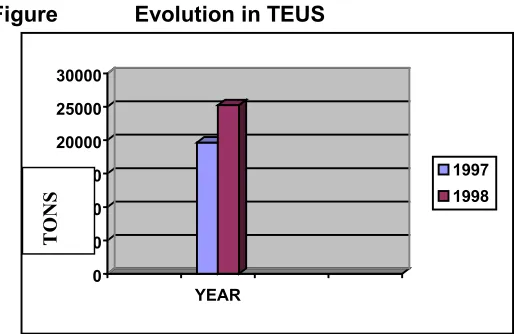
During the year 1998, container traffic experienced growth where the total Teus handled amounted to 25,240 compared to 19,649 in 1997, thus an increase of 5,591 Teus (28.4%) over the previous year.
Figure Evolution in TEUS
0 100,000 200,000 300,000 400,000 500,000 600,000 700,000
1997(Y2) 1998(Y1)
5000 10000 15000 20000 25000 30000
1997 1998
YEAR TEUS
1997 19,649
1998 25,240
TO
The share of containerised cargo in terms of total tonnage import and export handled also increased from 165,650 metric tonnes in 1997 to 218, 561 metric tonnes in 1998, equivalent to 50,911 metric tonnes (30.3%) growth.
♦ Total exports for the year 1998 accounted for 71,842 metric tonnes equivalent to 10.7% of total traffic. Commodities such as general, cargo, textiles, fish and fish products, hides and skins and other manufactured goods dominated exports. Groundnuts exports reached 29, 616 metric tonnes (41.2%) of the total export cargo.
2.3.4 Institutional Framework
A careful study reveals that transhipment is more profitable in open market or liberal economies because the regions are open to commercial competition. In West Africa, however, the economies are highly centralised and state controlled. These inherent administrative barriers prevent the handling of trade through foreign ports.
Such limiting policies are noted to be favoured by national ports without regard to cost. State control and monopoly in the production and sale of exports form the common trend. The stifling of market forces in transportation hinders inter-ports competition especially where the hinterland overlaps. Questions are being raised whether the handling of certain cargoes by national ports is as a result of efficient service there.
Naturally, Banjul is the port that serves Southern Senegal – Casamance.7 The fact that
this area is served by a port as far away as a hundred nautical miles indicates the difficulties foreign trade encounters in the region. The most economic decision to be conceived on the transhipment of cargo in this region is through the Port of Banjul.
7 There is a small port in Zinguinchor which is approximately 33 nautical miles from the sea, largest
2.4 Basic Facilities for Attracting ships
2.4.1 Prerequisites
The transhipment concept brings in fresh challenges for ports in most developing countries. There is the need therefore for a reassessment of the investment and managerial policies of the past years. Ports are expected to invest in modern trends; in technology and shipping techniques that may be thrust on them so as to adapt to changes. This process of adapting poses problems for developing countries. Most of such countries are not financially capable of either expanding their port facilities or modernising them, let alone talk of doing both. If ports in the same region view for the same transhipment traffic, as they are doing now, this unhealthy competition will only lead to over investing in ports. Sadly enough, the final decision rests with the shipping lines8, not the port authorities, who are in position to set the standard for competition
among ports to secure better trade terms for themselves. The need to invest carefully in the promotion of maritime trade in spite of these daunting challenges remains a key issue for developing countries. These port authorities must know what facilities-cum-factors draw ship owners to a specific or particular port as opposed to the others.
The authorities must also know that there are no rules that guarantee qualification for a port if they are fulfilled. There are individual differences among ports and this is important when considering the achievement of varied ports engaged in the business of transhipment. But some pre-requisites such as geographical location and proximity to region of operation, quality of site and equipment, dynamic management and last but not the least, a competitive trade atmosphere devoid of instability or civil wars. In a small number, there are pre-requisites such as sufficient domestic cargo but these can be made up for in other areas. There are ports like the port of Colombo in Sri Lanka that is doing extremely well even though the home traffic is insufficient.
8 E. BENNATHAN and E.E WALTERS, Port Pricing and Investment Policy for Developing Countries,
2.4.2 Maritime Access
Maritime Access with the requisite depth of berths at commercial ports is a basic or fundamental factor any aspiring port should posses. This deep maritime access is a facility that enables large draught ships to berth and make traffic in transhipment possible.
There are draught restrictions at the access channel between buoy numbers 2 and 3, which debars big ships. The water depths at this location at different conditions are presented in the table below:
Table 2-3: Water depths between buoy numbers 2 and 3, access channel Banjul Port
Tide Water level
MLWST MW MHWNT MHWSR
8.4 metres 9.2 metres 9.6 metres 10.0 metres
Source: Port consult A/S, Port of Banjul, July 1992, p.5-12
The approach channel at tidal conditions may be very difficult to pass by a second-generation containership with a capacity of 1,300 TEU and a minimum draught of 8.25 metres 9 that is lower than the capacity of vessels serving the West African coast. It is
also critical for vessels drawing more than 7.0 metres of water tidal conditions to enter the channel. Ports with similar restrictions to their access lose to competitors because
9 For variation in classification of containerships see E. DHONDT, Container Terminal Design, Syllabus
vessels sail on scheduled timetable. High investment in container ships by ship owners provides economies of scale10 and lower the cost per container carried.
Operational cost for these are calculated on an hourly basis and allows quick response to unfavourable market conditions.
In order to solve the approach channel problems, a study is now included in the Third Banjul Port Project (3 BPP) due for implementation. To enhance navigability of this channel, capital dredging will be carried out. However, the port authority will be burdened with the difficult task of deciding on the optimal depth required.11 The
draughts of vessels expected to ply the channel in the short and medium term will determine the depth to aim for. Plans are also conceived about the possibility of dredging way beyond the already identified restrictive zone to make access possible for future enlargement of ships’ sizes. The widening and increasing of the channel’s depth are the other alternatives.
Siltation at riverbeds or port channels is formed due to artificial and deepening may require periodic dredging maintenance to remove. Recurring expenditure that is expected will be financed by the high revenue collected from larger ships that may be attracted by the improved accessibility standard. At the moment vessels that have easy access through the approach channel are also accommodated at berth.
A standardized maritime access should make provision for the capability of the berth to accommodate the expected larger ships. The implementation of the work of expanding and dredging the quay are due to start but executing these developments before studying and improving the channel may defeat the very purpose of raising the standard of the port. The depth of 12 metres alongside will be the minimum water depth that would accommodate a third generation containership. This parameter could prove useful in the current Banjul Port expansion project. Another factor that may
10 C.K. Kim, An Innovation in Liner Shipping: The R.T.W Service as a Global strategy, in Institute of
cause technical limitations to dredge for deeper draught is the fact that the soil in the port area is soft deposits of clay, fine sand and silt. Relocation to new sites and expansion of ports with deeper approach depths12 are very common. It is widely held
that improved navigability ensures competitiveness at ports.
2.4.3 Services to Ships at Terminal
Port management anticipating container traffic should give either priority berthing or dedicated terminals on lease arrangement to ship owners. To further strengthen the policy of providing berthing, the port must provide all users with this information and endeavour to win over small ship owners who may be afraid of alienation. For containerships, high through put berths may be required when they call at port. Port users from various backgrounds strengthen the port.
Ship owners are charged for priority berthing agreements and the port reserves the right to mandate the use of the facility by other ship owners where the need arises. This is done for valid reasons and only when the facility is free at the time. On the other hand, those shipping lines with preferential berthing permit enjoy the privilege of having their vessels at definite location whenever in port.13 They can also use the equipment
on berth. Shipping lines and their stevedores are encouraged to uplift operation and a fast about turn of their ships by focusing their activities on a single terminal. Operations are more productive and time saving now that shifting from berth to berth is eliminated.
Those ship owners who may be dissatisfied with the priority-berthing permit could go in for a site lease arrangement. A single operator, whether a ship owner or its agent, may have a facility lease-out to him by the port. Irrespective of use, site availability is guaranteed at all times. There is no unnecessary waste of precious time and undue
11 R.O. Goss, Studies in Maritime Economics, P. 156
12 J.G BAUDELAIRE, Port Administration and Management PP 52-54
13 R. OP DE BEECK, Lease Arrangement in Port Areas, Syllabus Academic Course APEC 1994-1995/
delays. There is also more scope for improvement in productivity. It is however the big ports that mostly undertake lease arrangements because vessels are scheduled to on a regular routine. It is always wise for operators to invest in equipment and facilities that are sure to promote their business.
The Banjul Port has limited berths. These berths were fashioned for conventional traffic. The current GPA development project will see the quay space stretching to 627 metres excluding the Ro/Ro berth. An expanded new Banjul Wharf to 300 metres with Ro/Ro ramp at the extreme and a water depth of 11 metres will be the only facility that can reasonably accommodate third generation container vessels. Alternatively, two small ships can be at berth and on the jetty at the same time. Constraints on quay space still remain in place if we are to consider higher container traffic.
The execution of the preferential rule, which maintains a policy of giving container vessels priority to berths, at times involves moving a ship already at berth, which causes delays to the incoming ship in the process. A simulated exercise on available berths and capabilities will give a clear picture of the situation at the port if checks on the possibility of congestion due to container vessel’s traffic increase are made.
Though the port authority should promote a competitive spirit among ship owners, on equal footing, the situation becomes critical where two or more container ships vie for preferential rights to berths. There is also the risk of losing to competitors’ potential maritime traffic as ship owners may not entertain queuing, which is likely to occur. The policies of shipping lines will influence the extent to which an expanded new Banjul wharf can make available a springboard for transhipment activities.
Lighters for the discharging or loading conventional ships at anchorage should be considered where priority rule is extended to outer berths. Congestion can be eased by lighterage or alternatively “as a means to use berths ships”.14 The inner berths,
which lacks both the required length and water depth for large ships have enough capacities for lighters. Lighterage is costly because it involves double handling. It has a tremendous effect on developing capabilities in underdeveloped ports if it is less costly. Ports use it as a short-term measure while working out permanent solutions to address the queuing problems.
The availability of equipment to expedite operations and essential berths greatly reduces a vessel’s stay in port. In contrast to conventional cargo type of the past, the types of equipment required in a transhipment environment should be highly standardised and effective. Port’s handling equipment designed for unit loads are in demand to cope with traffic requirements as more and more cargo becomes utilized. The design of the ship can also affect the suitability and flexibility of specialised equipments like a ganty crane installed to handle a second generation container ship, cannot function effectively on a fourth generation vessel. A gantry crane, in the presence of good container traffic will make the Banjul Port have a competitive edge over other ports. Assessing the throughput level that justifies the acquisition of a shore crane has not been easy for terminal operators. There is no standard figure in the industry, arbitrary amount prevails. However, “40,000 to 60,000 containers per year and gantry is a good average”15 is generally adopted in practice.
There is no real need for a gantry to be purchased for the port of Banjul because the volume of container traffic is low. The port will still continue to depend on self-sustained ships for the time being as throughput rises. The present traffic of conventional cargo and containers has various landside equipment that seem adequate enough (Annex IV). The authority should focus attention on equipment capable of lifting heavy cargo in its policy of plant replacement as the traffic in container increases expectantly.
Equipment for abnormally weighted cargo expected in the near future is to be acquired by the Gambia Ports Authority. Mobile lifting crane for cargo in excess of 36T could be much preferred for the job. The Port Authority could purchase a well re-conditioned second hand machine if a brand new one may be too costly to acquire in the short term.
2.5 Finance for Port Development
2.5.1 The main sources of Fund
For the expansion and conversion of the existing facilities at a port, large sum of money or capital has to be invested in the project. Growth in trade volumes always necessitates such investments and innovations. But the ability to sponsor such ambitious projects from within i.e. local resources is almost impossible. Funding has to be solicited from outside or external agencies through multilateral lending agencies such as regional development banks, the World Bank or through bilateral assistance from donor countries.
Tests are carried out on the project in question for its viability in economic terms considering the macroeconomic impact on the country as a whole before multilateral aid is given. These stringent tests are standard procedures and potential recipients are expected to send forth proposals that can meet the criteria of lenders. The base on which other analyses rely in evaluating projects is a port’s traffic forecast forms. Even though less stringent form of tests, are required in case of bilateral assistance, recipients may be tied to the manufacturer or contractor of the donor country. The absence of international bidding may result in high prices and less competition. But some countries are now shedding this attitude and opening up to international bidding. Very minimal local contribution had been made to previous port developments in The Gambia. The World Bank and the African Development Bank (ADB) are the agencies which sponsor 85 percent of the estimated costs of the 3rd Banjul Port Project – 3BPP.
Table 3: Sources of Fund for Third Banjul Port Project in Dalasis ‘OOO ($)
External Local (GPA) Total
A.Civil Works
i. Jetty expansion and maintenance dredging ii Container freight station storage and
workshop
B. Marine craft
Tug boat, dredging/buoy tender and mooring launch
Consultancies
Prequalification and contract negotiation Port marketing
EPZ and teleport Computerization Channel study
Institutional development
Total estimated costs USD ($) 101,496 89,511 92,745 1,626 2,223 4,650 3,720 1,860 297,831 (30,237) 23,998 29,367 837 -54,202 (5,503) 125,949 118,878 92,745 873 1,626 2,223 4,650 3,720 1,860 352,033 (35,740)
Source: GPA Budget Proposal 1994-1995 – (Capital Budget 1994/95) (a) Exchange rates as at 13.12.94: US $ 1 = D9.85.
increase in traffic. Again, Funds were provided by the IDA followed by ADB and KFW. Infrastructural works are not the only forms of external assistance in port project here, the procurement of cargo handling equipment or floating crafts are also part of the process.
2.5.2 Port and Its Development Cost
Port planning and development has remained a de facto responsibility of Gambia Ports Authority. Before reaching firm proposals to be given to government for external aid, the authority identifies projects; prepares feasibility studies in collaboration with the relevant information and tutelage bodies. Loans for port project giving by multilateral agencies are actually given to Government, which lends to the authority the same loan. The authority repays the loan to Government in local currency. In repaying the same loan to the multilateral agencies, the government pays in foreign currency component.
Port projects and port operational expenses are not subsidised by Government. Loans are re-valued in local currency component periodically to take into account fluctuations of the Dalasi. The Port Authority is liable for any resultant losses on exchange. The government is relieved of possible subsidy when it is timed to remit repayments overseas. Obviously, Government assistance is limited to two functions; i.e. seeking external help and remitting repayments in foreign currencies. This is in sharp contrast with ports in highly industrialised countries where infrastructural development is partially funded by government.
take a long time, from identification to execution, to reach realisation. This delay can be costly; ports may lose potential traffic to rivals forever.
CHAPTER 3
POTENTIAL FOR DISTRIBUTION AND FEEDERING
3.1 Opportunities for Development
One of the most important determinants of a distribution centre is the geographical proximity to areas or vicinity to be served. Usually, Export Processing Zone (EPZ) or Free Port within a free zone is an ideal site for a distribution centre. Part of the hinterland or maritime foreland of host country with adequate communication network between the distribution centre and customers may be included in the market to be served.
Customs duties are not paid on merchandise imported in a distribution centre, nor are import taxes or provision of any form of financial security levied while they are within the trade zone. Storage and ware housing with some value added activities are provided to the goods during this period until sold and delivered outside the zone. Commercial companies engaged in the distribution operations may employ different market strategies on goods in custody. Goods may be imported purely for resale to regional markets. The temporary storage of goods to be soon released into the domestic market is another strategy. Normal import duties will be levied on goods later sold in the host country when they leave the duty-free zone.
The procedures for processing documents of prospective investors must be made easy enough. Delays in the approval process may cost the investor more and this eventually points to the inefficiency in zone management.16 All regulatory reliefs and
incentives should be simple and clear to avoid disappointing investor at a later date. Re-interpretation of incentives or relieves after investments must be avoided by the zone management. Prospective investors do rely more on practical things than paper agreements. Taking measures that win investors’ confidence in the existing system will be a competitive challenge to the host country.
Choosing a centre that is close and within the vicinity of the port makes for minimum transportation and handling costs. Theft or damage of cargo needs be checked by an internal security system at warehouses while goods are in transit to and from the port. These warehousing facilities must be adequately covered as well as an open storage space as required by port users. Standard cargo handling equipment should be available also to facilitate the smooth movement of goods. The services of these equipment should be at competitive market prices where they are provided by a third party.
3.2 Export Processing Zone (EPZ) and the Port
In order to improve the existing facilities and service to ships and cargo, the current Banjul Port Expansion programme must be fully implemented. A reliable service at the port is what will assure investors and also benefit the E.P.Z greatly. These reliable services could prove vital where a local manufacturing/assembly firm for instance has a fixed delivery schedules to overseas customers.
Strikes and industrial actions are uncommon phenomena for the past twenty years. There is no record of striking workers at the Banjul port which scare away ships to other ports. As a routine policy, dock-workers handle all kinds of ocean – going
16 J. Currie, Export Processing Zones in the 1980s: Customs Free Manufacturing, in The Economist
vessels or cargo bound to the port. Even ‘dirty’ cargo such as bulk cement is guaranteed the usual reception but with inducement allowance paid to dockers.
The standard of services at Banjul Port are competitive,17 and comparatively better
than some ports in the region. There is a boost in the number of cargo-handling equipment especially for general cargo, which helps to maintain productivity. Also to ensure that fleet availability is at high level, there should be an effective maintenance programme.
The estimated distance between Hamburg and Banjul is some 2,950 nautical miles i.e a week or more direct sailing days to or from any of the ports situated in North – Western Europe. Regular services that exist give EPZ companies faster shipment possibilities to the West European market. Similar opportunities do exist for EPZ firms selecting the sub-region for distribution purposes. The frequency and regularity with which ships call at the port will also be determined by a number of companies operating in EPZ. As more goods are exported from the EPZ, increased cargo volumes are generated which may create certain economies such as reduced freight rates.18 The port and an EPZ are indeed complementary to each other. Only an
efficient and reliable service can make the port contribute in giving EPZ companies time advantage needed to compete in delivery dates. However more traffic and revenue to the port is realised when there is an increase in the cargo volumes generated.
There is a drive to make up for the lack of sufficient domestic cargo for Banjul by an established EPZ. Maritime transport is what business firms and industries that are attracted to the zone rely on for imports of basic materials and exports of semi-finished or final products through the port. There is the benefit also of reducing the number of empty containers by reloading them with goods from the sub-region on their return leg. This is a way of offsetting the imbalance of the more imports less exports phenomenon.
17 Containerisation International, Special Advertising Supplement: “African Ports: A mixed Bag”, P.X1,
February 1993….
3.3 Identifying a Market Niche
One of the main tasks of the proposed EPZ management is to attract business that will invest in new sectors so as to give the country a diversed economic base. Attracting firms that engage in value added activities help create job opportunities for the local community and boosts the economy. As EPZs are port-related activities that require maritime transport for imports, they should be considered first. Permission should be given to import substitution industries to operate in the customs areas only and not in the zone. Supporting services to EPZ firms are also not precluded.
Giving competitive incentives to invest to commercial firms or manufacturers will give The Gambia Ports a great deal of advantages. Industrial base here is low and there is the absence of well established firms which assure prospective investors that those setting up shops are beginners starting on equal footing. The building requirements for warehousing or industries are not highly sophisticated except for specialised storage facilities.
The participation of investors in the distribution process that reaches out to countries in the region promises growth prospects particularly in good stuff commodities and building materials. The bulk of such cargo is rice, sugar, flour and cement. These are the usual re-export commodities to West African states. The EPZ can distribute products to the nearby market with huge savings in ocean freight as opposed to merchandise coming directly from abroad. It must be however borne in mind that cost is increased with extra handling.
3.4 Patterns and Logistics of Distribution Activity
3.4.1 Operational Aspects
Most distribution centres are normally located in an EPZ. If on the other hand they are sited outside, they still enjoy similar duty-free status which, enables investors to reap the benefit of economies of scale by making bigger orders.19 When goods are
imported in bulk, they yield lower or cheaper prices and correspondingly, a reduced shipping costs for cargo when larger vessels are chartered. Bulky goods can be broken down into desired units (lots) for retailing and delivery to respective destinations. The size of lots which can be repacked easily in warehouse to meet buyers demand is influenced by market conditions.
Special storage facilities are required for certain commodities. Raw meat and fresh dairy products for example require refrigerated warehouses where the recommended temperatures will be monitored from time to time. Heat or tropical condition will necessitate the freezing of these perisable products. Investors in this type of business are free to develop their own storage facilities or operate from prefabricated warehouses. Those goods requiring ageing, such as Tobacco, fall under the class of long term storage commodities. For seasonal goods that remain in demand all the year round, the function of warehousing bridges the gap between timely availability for consumption and customer needs. Non-existent time limit for keeping good in a distribution centre is another vital aspect that risks being neglected. This aspect facilitates commercial ingenuity and flexibility that gives brokers the opportunity to promote their business.
The ideal geographical position of the Banjul Port provides better proximity and accessibility to markets in the sub-region. Commercial firms doing business in finished or consumer goods can ensure timely response to the needs of buyers than overseas suppliers if only they can situate bonded warehouses in the country. This is noticed in the established free zones.
“Another factor that has accelerated the success of the free zone is the rapidity of delivery of merchanidise”.20
19 A.E. BRANCH, Elements of Port Operation and Management P.113
3.4.2 Nautical Distances
Table 4A: Antwerp to ports in the Sub-region
Destination Nautical Miles
Banjul Dakar Bissau Conakry
2667 2579 2823 3018
Table 4B: Banjul to ports in sub-region
Destination Nautical miles
Dakar Bissau Conakry
93 200 364
Sources: CMB Transport West Africa Services, p.54
Ware housing firms can possibly explore the prospects of sea-air cargoes to serve remote provincial towns and distant hinterlands like Mali. Sea-air cargoes may involve highly valued goods brought in by sea and flown out by air. The aim of this type of distribution is the mixed benefits of economic sea freight rates and the speed of air delivery, over the overall air freighting. The sea-air cargo prospect does circumvent border restriction imposed on transit goods transported by trucks over land. This is a promising sector especially for prospective investors because it provides economies of sale as imports of huge quantities are feasible. As usual, the merchandise are broken down, repackaged and labelled for proper delivery.
3.4.3 Regional Market Connections
The lack of adequate and quality land transport network in West Africa is the major constraint on distribution of cargo from the Port of Banjul to customers in the region. The road network development between sub-regional countries is largely uncoordinated. In some countries there is very little or no attention given to adequate road connection from the port to the hinterland. This neglect is making haulage of goods by trucks almost impossible in some area. Serious considerations must be apportioned to the acquisition of a good road link with the hinterland if the port should maintain its share of the market “and must provide this service more cheaply or efficiently than other ports”.21
The Banjul port is linked to the interior on the southern part of the country (South Bank) by a relatively good road. This road ends at Basse,22 the largest commercial centre in
the provinces. Feeder roads and the highway beyond Basse are laterite, gravel or muddy tracks that are impassable by trucks throughout the rainy season of every year. This main road which connects the port and the hinterland is basically used by large overland-carriers and truckers involved in the re-export trade in the sub-region. The
21 S. NETTLE, Port Operations and Shipping: A Guide to Ports and Related Aspects of the Shipping
Industry, P.6
poor road network is prevented to a large extent mass haulage of basic merchandise over long distances to places where needed especially during the rainy season.
Trucks making the daunting journey across rugged frontiers in the region are not adequate in their number and the establishment of road haulier companies should be an important step in overcoming the problem of distribution. Most of the vehicles that clear cargo from the port are not capable of making long trips to the hinterland. It is not enough for the port authority to just take the initiative in soliciting action from the relevant agencies and truck owners to improve transport standards. A lot of work in road network has to be done.
The minimum requirements set for vehicles transporting containers included to be refitted with twist lock devices to guarantee safety. Well equipped container transporters is an investment that can shorten the longer delay of cargo at ports. Storage facilities and capabilities are stretched to breaking points if cargo stays longer in the port. Since any documentation with customs will not be needed, the transfer time to and from distribution centre should speed up.
Distribution to neighbouring countries by overland carriers may prove risky and difficult judging from their attitudes of frequent border closure and other unnecessary limitations. There are no closer economic ties or bilateral agreements covering transit goods, so there is the fear of the Banjul Port Authority losing their transhipment and distribution activities. There is also the threat of some bigger neighbouring port wanting to undermine and neutralise Banjul by imposing administrative restrictions instead of restrictions dealing with operation efficiency. The requirements to have customs escort for goods in transit is a popular weapon used against the re-export trade.
service covering neighbouring countries. The port is capable of providing suitable vessels for this task. It can be a joint-venture undertaking with participation from the private sector. The authority should desist from the operation once they realise that the private sector interests are well motivated.
3.4.4 Infrastructure and Auxiliary Services
The need for proper temporal and permanent storage facility in the port has become glaring as huge quantities of goods are unloaded. The requisite handling of equipment necessary to facilitate easy and fast movement of cargo should also be provided. The infrastructure of an EPZ/distribution centre includes the security of the designated area where facilities are located through fencing. The physical separation of the zone from the rest of the country but linked definitely to its life line which is the port is required. This separation makes customs and other relevant agencies to monitor and police the area to prevent illicit release of goods in the local market.
There is no consistent and reliable electric power supply in the country. There are disruptions especially during peak periods resulting in load shedding. Periodic maintenance of electric plant engines also cause disruptions. This is due to the lack of spare capacity. It is now been considered a proper thing to do if power generation for the proposed EPZ is separated from the natural grid to avoid disruption in service. The telecommunications services are of competitive standards. There is also a guaranteed support service because some international banks now have offices in Banjul.
Some specialised equipment such as bagging machines or unloading installations to cope with high volume imports.
The possibility of building specialised storage facilities known as silos should be considered carefully by the authority. This will alleviate the problem of congestion. For instance GPA lacks storage facilities for the cargo of a local company involved in bulk importation of cement for bagging and marketing domestically. The cement is discharged directly to specialised tanker trucks that go back and forth from the company’s own facility situated 12 km from the port. Valuable time is wasted when unloading. At times the system causes delays when shifting are necessary to make the quay available to other vessels.23
Operations will be speeded up as goods are directly discharged to silos. It will also make the limited space available to other vessels.
3.4.5 The Need for Automation
In this age of information and technology, the maritime industry is not left behind. The flow of information and document is becoming increasingly important. The administrative bureaucracy and numerous transactions relating to ship, cargo, port and other interested parties have become too complex to be done manually. Computers on the other hand possess the capability to connect with several others and co-ordinate their operations better and faster. It is interesting to note that lighting fast business transactions now take place in cyber-space ie computers. The interested parties can exchange information in a ‘paperless’ environment on timely basis through an EDI system. The operators now have the opportunity to manage available resources to the optimum level through the monitoring of cargo or container movement.
23 A similar operation takes place for the discharge of heavy fuel oil imported by the local power
The installation of an integrated system that will include a data base system covering all port activities at Banjul will be a great advantage over regional rivals. Banjul is in fact one of the two ports chosen by PMAWCA to conduct a pilot study for computerisation in West Africa. A successful implementation of the port computerisation project will enhance the support services to the centre of distribution. The department of Customs and Excise is implementing the project called ASYCUDA to which the port can link for information after installing its own system. Computerising the administrative procedures of customs, a major player in port activities, is a giant step towards development.
3.5 Feedering
In the West African region feedering does not seem to have received significant attention as a separate component of the shipping industry. The regularly operating shipping services for the movement of foods and capital in the region has been largely in respect of the Traditional Seaborne trade between the coastal nations of the region and their trading partners in Western Europe and America.
In view of the increasing efforts and programmes towards closer economic integration of the region, the trade liberalisation in the Economic Community of West African States (ECOWAS) is very likely to generate pressure for the recognition of the need for this aspect of maritime transportation. Gambia with a short coastline therefore ought to make feedering its focal point for bulk and general cargoes. The necessity to analysis the characteristics and structure of shipping and trade in the region cannot be overlooked.
3.5.1 Shipping Services in the Gambia