Please cite this article as: R. Rostamani, S. S. Ashraf Talesh, A Dimensionless Parameter Approach based on Singular Value Decomposition and Evolutionary Algorithm for Prediction of Carbamazepine Particles Size, International Journal of Engineering (IJE), TRANSACTIONS C: Aspects Vol. 30, No. 3, (March 2017) 330-337
International Journal of Engineering
J o u r n a l H o m e p a g e : w w w . i j e . i rA Dimensionless Parameter Approach based on Singular Value Decomposition and
Evolutionary Algorithm for Prediction of Carbamazepine Particles Size
R. Rostamani, S. S. Ashraf Talesh*
Department of Chemical Engineering, Faculty of Engineering, University of Guilan, Rasht, Iran
P A P E R I N F O
Paper history: Received 11 July 2016
Received in revised form 04 February 2017 Accepted 09 February 2017
Keywords:
Confined Liquid Impinging Jet Singular Value Decomposition Genetic Algorithms
Nano-drugs
A B S T R A C T
The particle size control of drug is one of the most important factors affecting the efficiency of the nano-drug production in confined liquid impinging jets. In the present research, for this investigation the confined liquid impinging jet was used to produce nanoparticles of Carbamazepine. The effects of several parameters such as concentration, solution and anti-solvent flow rate and solvent type were investigated. So far no analytical and acceptable model has been provided to predict the Carbamazepine particle size in confined liquid impinging jets. In this study the variables affecting the size of the particle became dimensionless using the dimensional analysis then by solving the equation with singular value decomposition method, a simple dimensionless relation was obtained for this process. Moreover, using the genetic algorithm the coefficients of dimensionless parameters were optimally extracted to minimize the error between the model and the laboratory outputs. The determination coefficient of the equation obtained by singular value decomposition method and the improved equation using genetic algorithm were obtained as 0.5291 and 0.5697, respectively. For such a complex experimental system, the accuracy of the obtained equations in spite of their simplicity is acceptable. The obtained results were compared with the results of the neural network model. The results showed that despite the higher precision of the obtained relations by the neural network, the relations obtained by singular value decomposition can be used as a simple method using the dimensionless parameters with acceptable acuracy to predict the particle size in confined liquid impinging jets.
doi: 10.5829/idosi.ije.2017.30.03c.01
1. INTRODUCTION1
Poor drug solubility is one of the major problems that limits the development of highly potent pharmaceutics. Low solubility of the drug leads to low oral bioavailability and erratic absorption which is closely related with class II drugs of the biopharmaceutical classification system (BCS). In general, the limiting step for the absorption of drugs in this class is the dissolving speed which is impressed by the low solubility. Although drugs have high permeability, low solubility results in a low concentration gradient between the gut and the blood which limits the drug delivery and oral absorption. Therefore one of the most challenging problems in drug development is to improve the
1*Corresponding Author’s Email:
[email protected] (S. S. Ashraf Talesh)
supercritical fluid technology, spray-freezing/ evaporation in liquid and anti-solvent sedimentation technology [7, 8]. Among the various methods for reducing the particle size, the anti-solvent precipitation process is a simple and efficient method for producing nano-sized particles by introducing an organic solution containing a drug substance into an anti-solvent (e.g. water). The main advantage of precipitation method is using inexpensive and simple equipment. One of the main limitations of this method is selecting a solvent that dissolves the drug but is not miscible with anti-solvent [9-11]. The confined liquid impinging jets (CLIJ) were used in order to produce sub-micron and nano-sized particles using an anti-solvent precipitation liquid. The method involves mixing two reactive fluid flows in a confined mixing chamber, without using any external mechanical mixing. CLIJ previously has been used for the deposition of pharmaceutical compounds [12-14]. In most of the earlier investigations, the particle size of drugs was usually evaluated by several parameters. In this research, Carbamazepine concentration, solvent type (S) and antisolvent (AS), the volume ratio and the order of addition of solvent–anti-solvent mixing are some of these parameters [2, 15]. Carbamazepine as a poorly soluble drug has been considered in different aspects by researchers. Carbamazepine is a type of anti epileplic drug, white to off-white powder, an anti-convulsant and specific analgesic for trigeminal neuralgia. Its chemical name and chemical formula are 5H-dibenz azepine-5-carboxamide and C15H12N2O, respectively [16]. Wang et al. conducted production and characterization of Carbamazepine nanocrystals using electro-spray method for continuous pharmaceutical production [17]. Also, Sotelo et al. investigated the adsorption modeling of Carbamazepine in fixed bed columns [18]. It should be noted that our searches showed that so far no studies have been done on particle size modeling of Carbamazepine.
In this research, modeling and prediction of particle size of Carbamazepine was considered for the first time. In this way, firstly the variables that affect the size of Carbamazepine nanoparticles became dimensionless by the method of dimensional analysis. Then, using singular value decomposition (SVD) method the coefficients of the equation were obtained in a manner that minimized the error between experimental data and model output. Also, genetic algorithm was used to optimally find the coefficients of this equation and improve its accuracy. The comparison of the two models indicated the priority of the model of genetic algorithm.
2. MATERIALS AND METHODS
2. 1. Materials Carbamazepine was prepared by the Arastou pharmaceutical company. 99% pure
methanol was purchased from Merck, Germany. In all experiments deionized distilled water was used as an anti-solvent.
2. 2. Preparation of Carbamazepine
Nanoparticles In order to reduce the particle size of the drug to produce micro and nano particles in the impinging jet reactor, the solution containing the drug must be prepared. For preparation of the solutions, an accurate mass of the Carbamazepine drug was applied into volumetric flasks to achieve specific concentrations of Carbamazepine. All experiments were done at 298.1 K. All weighting was carried out with an AND electronic analytical balance (model EK-610i) with an accuracy of ±0.001 g. The solutions were progressively added using a burette with accuracy of ±0.1 ml. The temperature of all containers was controlled by a water jacket maintained with an accuracy of within ±0.1 K that was checked with a digital thermometer (Lutron TM-917). All the experiments were repeated at least two times. The digital peristaltic pumps (Zistco model P466) with accuracy of ±0.1 ml/min were used for pumping solvent and anti-solvent in this process which were set very intently at presented volumetric flow rates. Each solution was individually placed on a magnetic stirrer and gently stirred until a homogeneous solution was obtained. Each of pump was set based on the desired discharge intently. Both pumps were turned on concurrently and after the desired flow was achieved, the timer was enabled and the container containing a certain amount of anti-solvent was placed in the outlet path of the reactor. After passing the required time, the pumps were turned off. Precipitation was a major step in the present experiment, because by reducing the driving force, high saturation prevented the excessive growth of the particles. For this purpose the deionized water which was used as anti-solvent was applied. Then the precipitation container was placed on the magnetic stirrer and stirred at 1200 rpm to make the smooth and stable product. The schematic of the experimental set up of this study is represented in Figure1. The solution concentration (CBZ mg/l), flow rate (ml/min) and anti-solvent flow rate (mL/min) were set up to examine the effects of particle size.
2. 3. Particle Size Measurement Morphology and size of the particles was observed through SEM photomicrograph (JEOL, JSM-6701, Japan). The prepared samples were coated on gold using a BAL-TEC|SCD 005 sputtering coater and applying 1kV voltage for 5 min. It should be noted that the ImageJ software (image processing program) was used for the reported particle size (yEXP) in Table 1.
Figure 1. Schematic representation of the experimental setup in this research
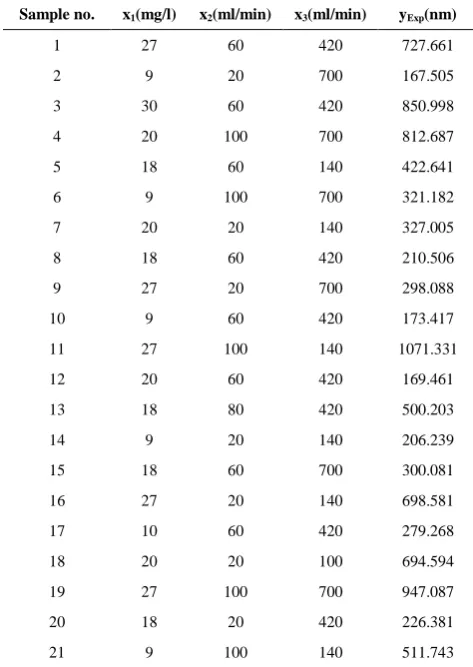
TABLE 1. CLIJ experimental conditions: Carbamazepine concentrations (x1), the solution flow rate (x2), anti-solvent
flow rate (x3) and the observed Carbamazepine particle size in
methanol (yExp)
Sample no. x1(mg/l) x2(ml/min) x3(ml/min) yExp(nm)
1 27 60 420 727.661
2 9 20 700 167.505
3 30 60 420 850.998 4 20 100 700 812.687 5 18 60 140 422.641 6 9 100 700 321.182 7 20 20 140 327.005 8 18 60 420 210.506 9 27 20 700 298.088 10 9 60 420 173.417 11 27 100 140 1071.331 12 20 60 420 169.461 13 18 80 420 500.203 14 9 20 140 206.239 15 18 60 700 300.081 16 27 20 140 698.581 17 10 60 420 279.268 18 20 20 100 694.594 19 27 100 700 947.087 20 18 20 420 226.381 21 9 100 140 511.743
By this software at least ten positions in every SEM image were marked for particle size determination. Then mean of these readings was calculated and reported in the Table 1 as yEXP. The uncertainty in the mean particle size was estimated to be ±0.001. The range of effective parameters in CLIJ experimental and
observed particle size of Carbamazepine in methanol are presented in Table 1. In Figure 2, the SEM micrographs related to unprocessed Carbamazepine and processed Carbam-azepine (Table 1, row 17) are shown as a sample. From mentioned Figure, it can be found that the processed particles have more uniform and narrower size distribution than the initial drug. As can be seen in this Figure, the initial Carbamazepine consisted of irregular shape particles. In contrast, the prepared particles via precipitation process exhibited needle-like morphology and uniform particle size and distribution compared to unprocessed Carbamazepine [19].
3. MODELING PARTICLE CARBAMAZEPINE SIZE USING SVD AND GENETIC ALGORITHM
3. 1. Dimensional Analysis Variables or physical quantities in any system can be presented as dimensionless groups. Although each group can appear different but the number of these groups are unique and depends on the number and nature of the system variables [20]. By detecting and classifying the dimensionless groups using a method called dimensional analysis each phenomenon can be formulated as a relationship between a set of dimensionless groups. Dimensional analysis using a compression method leads to remove the complexity and reduces the number of dependent and complex variables in a complicated process.
According to Buckingham π theorem, if a process depends on (m) variables, the classifiable independent dimensionless groups (k), must be equal to or less than (m-j) [21]. Where, j is the number of main dimensions (mass (M), length (L), time (T)) required for dimensional expression of variables. The formation of additional groups (more than m-j), leads to the formation of dependent groups that can be created among other groups through arithmetic operations. In this paper, the method of dimensional analysis due to the governing complications of the process was employed to find a simple model between input-output of this complex process.
3. 2. Singular Value Decomposition (SVD) Generally the goal of modeling is to find a mathematical function by which it is possible to approximately predict and characterize the behavior of a real system. So for M samples of these Multi-Input Single-Output couple data the following relation must apply:
1, 2, 3,
1, 2, ,i i i i in
y f x x x x i M (1)
Now for each input determined vector:
1, 2, 3,
i xi xi xi xin
X (2)
It is possible to predict the output values.
1, 2, 3,
1, 2, ,ˆ
ˆi i i i in
y f x x x x i M (3)
System identification and function determination should be done in a way that the squared difference between the actual and expected output would be minimal.
21 2 3
1
ˆ , , , Min
M
i i i in i
i
f x x x x y
(4)In modeling, the dimensionless parameters are formed using real physical variables of the system. The relationship between the dimensionless parameters is established by the function:
0 ˆ 1 , 2 , 3 , , 1 ˆ i f i i i ki i ,2, ,M
(5)
So the function is defined by the following equation [22, 23]:
21 2 3 0
1
, , ,
ˆ ˆ Min
M
i i i ki i
i
f
(6)3. 3. SVD Application in Predicting the Size of the Carbamazepine Nanoparticle Based on the experimental investigation and analyzing the factors influencing the size of Carbamazepine nanoparticle, the dependent and effective parameters on the particle size (yexp) were considered as x1, x2 and x3 where, Carbamazepine concentration (mg/ml), solution flow
rate (ml/min), and anti-solvent flow rate (ml/min), respectively:
1, 2, 3
exp
y f x x x (7)
Regarding original size of the variables and the implementation of dimensional homogeneity law, three dimensionless groups were obtained according to the following equations:
0 0
Π yExp
y
(8)
1 1
Π Ce
x
(9)
1 1
Π Ce
x
(10)
where, the constant parameters, y0 and Ce are primary
particle size and equilibrium concentration of Carbamazepine, respectively. Therefore, Equation (7) can be considered as follows:
0 1 2
0
Π yExp f Π ,Π
y
(11)
In order to extract the model we consider the following function:
0 1 2
Π C Π Π (12)
In the above equation the unknown coefficients c, β and
α were defined in a way that the least square error (Equation (6)) is satisfied. By taking the natural logarithm of both sides of (Equation (12)) we have:
Π0
Π1
Π2Ln Ln Ln (13)
where: lnC
Thus it is necessary to solve a system of linear algebraic equations involving K = 3 unknown and M equations (M the number of input and output couple data or the number of experimental tests).
11 12 10
21 22 20
1 2 0
.. ..
M M M
(14)
where:
ln , 1, 2, , 1, 2,3
ij ij i M j
(15)
3 3 1 1
M M
A X Y (16)
where: T
X
,
Y 10 20M0T,
11 12
21 22
1 2
1 1
. . . . . . 1 M M A
Solving Equation (16) is subjected to the calculation of non-square matrix inverse. Therefore, to calculate the pseudo-inverse matrix A, the singular value decomposition method (SVD) has been used.
In SVD method the abnormal matrix is decomposed into the product of a column orthogonal matrix, a diagonal matrix with positive or zero elements and transpose of an orthogonal matrix as: (K is the number of independent groups and M is the number of samples tested).
T
AUWV (17)
The goal is to select the optimal vector of coefficients in Equation (16) which involves finding the modified inverse diagonal matrix. Therefore, the reverse diagonal
elements equal to zero or near zero
j
1 0 w
are
equaled to zero. Then the optimized coefficient vector is obtained by the following equation [24, 25]:
T
j
1 X V diag U Y
w
(18)
To obtain a simple model for prediction of Carbamazepine particle size, the data in Table 1 were used. The data became dimensionless being placed in Equations (8)-(10), then Equation (14) was formed according to Equations (11)-(13) by taking their logarithms. By solving this system according to Equation (19), C 0.0822, 0.7845and 1.1045
were obtained. The Carbamazepine nanoparticle size can be presented as follows:
1.1045 0.7845
2
0 1 3
0.0822
Exp e
y C x
y x x
(19)
Here in order to improve the coefficients obtained the genetic algorithm was used to determine the coefficients of Equation (9) to minimize the squared error (Equation (6)). For this purpose the initial population size was set on 90 and the generation was adjusted to 150. The coefficients using a genetic algorithm are obtained as Equation (20). So the equation is as follows:
0.8801 0.6802
2
0 1 3
0.0943
Exp e
y C x
y x x
(20)
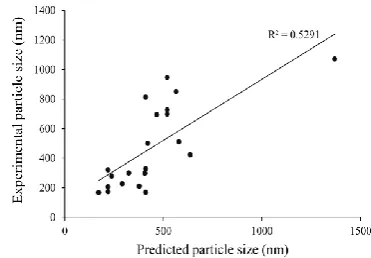
In Figures 3 and 4 the comparison between the experimental results and the results of the models
obtained by the SVD method and improved SVD by genetic algorithms can be observed. As can be seen from these Figures, the value of R2 for the equations obtained by the method SVD and improved SVD by genetic algorithm were obtained equal to 0.5291 and 0.5697, respectively. Both models have a very simple structure and using these models it is possible to assess the parameters influencing the process. Since in these equations the relative flow rate power of the solution (x2) to the anti-solvent flow rate is positive then increasing this ratio leads to increased particle size of the drug substance. Also since the exponent of this term is very close to 1, as a result for a constant concentration of Carbamazepine (x1), the relation between the ratio of the solution flow rate to the anti-solvent flow rate (x2/x3) is almost linear.
Also it is obvious from these equations that the exponent of (x1) is positive so, the value of this parameter has a direct effect on the particle size. Therefore its increase leads to increased size of the particles. In both of these equations the exponent of the first dimensionless parameter is smaller than the exponent of the second dimensionless parameter.
Figure 3. The experimental values based on the predicted size of the Carbamazepine nanoparticles by SVD method in methanol
In the other words, the parameters x2 and x3 are more important than x1. For evaluation of the performance and overfitting investigation of achieved improved SVD model in this study, 200 samples (in the range of parameters change in Table 1) was generated and applied in the improved SVD (Equation (20)). As can be seen in Figure 5, results of this model, in spite of high simplicity, has acceptable distribution in prediction of particle size of Carbamazepine, which is very good evidence for applicability of the obtained model.
4. PARTICLE SIZE MODELING USING THE GMDH-TYPE NEURAL NETWORK
In this section, the GMDH-type-NN was developed to model and predict the particles size of Carbamazepine at different operating conditions. Also for GMDH model, methanol solution flow rate, solvent flow rate, and anti-solvent flow rate were considered as inputs of neural networks and particle size obtained from each experiment was chosen as the single output. However, in order to demonstrate the prediction ability of the evolved GMDH-type neural networks, the data were divided into two different sets, namely, training and testing sets. The training set, which consisted of 80% of inputs-output data pairs, was used for training the neural network models and the testing set consisted of 20% of unforeseen inputs-output data. Samples during the training process, were merely used for testing to show the prediction ability of such evolved GMDH-type neural network models during the training process.
The developed GMDH-type-NNs were successfully used to obtain a model for the modeling of particle size of Carbamazepine in different solvent systems.
The optimal structure of the developed two hidden layer GMDH-type-NNs are shown in Figure 6 corresponding to the genome representations of ‘‘abbbabac” for the methanol solution of Carbamazepinein which a, b, c and d stand for Carbamazepine concentration, solvent flow rate, anti-solvent flow rate and type of solvent, respectively.
Figure 5. The generated random sample by improved-SVD model based on Equation (20)
Figure 6. Developed structure of GMDH-type-NN model
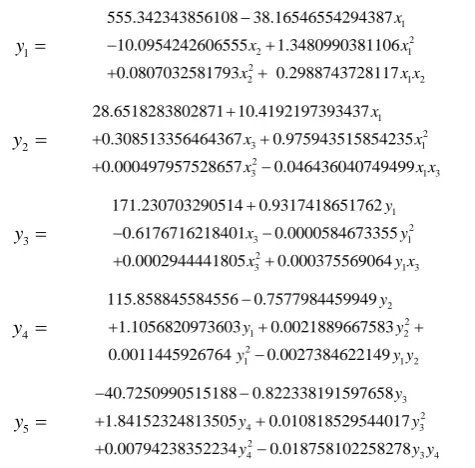
It can be seen from Figure 6, all input variables were used in modeling of this process. In the other words, the GMDH-type-NNs provide an automated selection of essential input variables, and build polynomial equations to model the particle size of Carbamazepine in different solvent systems. The polynomial equations of each GMDH-type neural network of Figure 6, are given in Table 2.
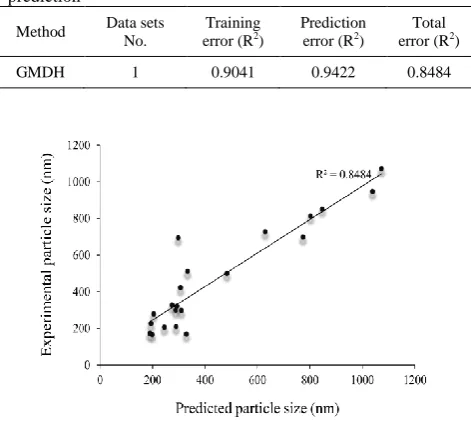
The training, prediction and total errors GMHD-type neural network are presented in Table 3.
As can be seen, the resulting equation from GMHD has a very complex structure compared to the SVD model. Figure 7 presents the comparison between experimental results and ANN model that has the correlation coefficient equal to 0.8484. It should be emphasized, however, that the neural network model has higher accuracy than SVD model, but due to high structural complexity it is not possible to analyze the impact of the parameters on the output.
TABLE 2. Polynomial equations of the GMDH model for the prediction of Carbamazepine particle size
1
y
1 2
2 1
2
2 1 2
555.342343856108 38.16546554294387 10.0954242606555 1.3480990381106 0.0807032581793 0.2988743728117
x
x x
x x x
2
y
1 2
3 1
2
3 1 3
28.6518283802871 10.4192197393437 0.308513356464367 0.975943515854235 0.000497957528657 0.046436040749499
x
x x
x x x
3
y
1 2
3 1
2
3 1 3
171.230703290514 0.9317418651762 0.6176716218401 0.0000584673355 0.0002944441805 0.000375569064
y
x y
x y x
4
y
2 2
1 2
2
1 1 2
115.858845584556 0.7577984459949 1.1056820973603 0.0021889667583 0.0011445926764 0.0027384622149
y
y y
y y y
5
y
3 2
4 3
2
4 3 4
40.7250990515188 0.822338191597658 1.84152324813505 0.010818529544017 0.00794238352234 0.018758102258278
y
y y
y y y
TABLE 3. Network properties and errors of training and prediction
Method Data sets No.
Training error (R2)
Prediction error (R2)
Total error (R2)
GMDH 1 0.9041 0.9422 0.8484
Figure 7. Experimental value based on the predicted value of CBZ nanoparticle using neural networks GMDH in methanol
Using the equation obtained by SVD and GA method the impact of the parameters can be investigated due to the simple structure.
5. CONCLUSIONS
In this study, dimensionless approach has been developed to predict the particle size of Carbamazepine based on achieved experimental data from confined liquid impinging jets. In this way, a combination of SVD and SVD-GAs has been used to derive the unknown parameters of proposed model. The effective
parameters on Carbamazepine size included
Carbamazepine concentration, solution flow rate, anti-solvent flow rate and methanol as the anti-solvent. The results showed that the developed relation by the dimensional analysis method, despite having a simple structure, had an acceptable accuracy. Then using the GMDH neural network an equation was obtained to predict the Carbamazepine particle size with a complex structure and high accuracy. Since no mathematical model to predict the Carbamazepine nano-drug particle size has been provided so far, the obtained equation using the dimensional analysis can be applied to predict the Carbamazepine particle size.
6. REFERENCES
1. Lipinski, C.A., "Drug-like properties and the causes of poor solubility and poor permeability", Journal of Pharmacological and Toxicological Methods, Vol. 44, No. 1, (2000), 235-249.
2. Douroumis, D. and Fahr, A., "Nano-and micro-particulate formulations of poorly water-soluble drugs by using a novel optimized technique", European Journal of Pharmaceutics and Biopharmaceutics, Vol. 63, No. 2, (2006), 173-175.
3. Thorat, A.A. and Dalvi, S.V., "Liquid antisolvent precipitation and stabilization of nanoparticles of poorly water soluble drugs in aqueous suspensions: Recent developments and future perspective", Chemical Engineering Journal, Vol. 181, (2012), 1-34.
4. Wang, J.-X., Zhang, Q.-X., Zhou, Y., Shao, L. and Chen, J.-F., "Microfluidic synthesis of amorphous cefuroxime axetil nanoparticles with size-dependent and enhanced dissolution rate", Chemical Engineering Journal, Vol. 162, No. 2, (2010), 844-851.
5. Patravale, V. and Kulkarni, R., "Nanosuspensions: A promising drug delivery strategy", Journal of Pharmacy and Pharmacology, Vol. 56, No. 7, (2004), 827-840.
6. Keck, C.M. and Muller, R.H., "Drug nanocrystals of poorly soluble drugs produced by high pressure homogenisation", European Journal of Pharmaceutics and Biopharmaceutics, Vol. 62, No. 1, (2006), 3-16.
7. D'addio, S.M. and Prud'homme, R.K., "Controlling drug nanoparticle formation by rapid precipitation", Advanced Drug Delivery Reviews, Vol. 63, No. 6, (2011), 417-426.
8. Chan, H.-K. and Kwok, P.C.L., "Production methods for nanodrug particles using the bottom-up approach", Advanced Drug Delivery Reviews, Vol. 63, No. 6, (2011), 406-416. 9. Dong, Y., Ng, W.K., Shen, S., Kim, S. and Tan, R.B.,
"Preparation and characterization of spironolactone nanoparticles by antisolvent precipitation", International Journal of Pharmaceutics, Vol. 375, No. 1, (2009), 84-88. 10. Beck, C., Dalvi, S.V. and Dave, R.N., "Controlled liquid
antisolvent precipitation using a rapid mixing device", Chemical Engineering Science, Vol. 65, No. 21, (2010), 5669-5675. 11. Luo, Y.-H., Wu, G.-G. and Sun, B.-W., "Antisolvent
crystallization of biapenem: Estimation of growth and nucleation kinetics", Journal of Chemical & Engineering Data, Vol. 58, No. 3, (2013), 588-597.
12. Chiou, H., Chan, H.-K., Heng, D., Prud’homme, R.K. and Raper, J.A., "A novel production method for inhalable cyclosporine a powders by confined liquid impinging jet precipitation", Journal of Aerosol Science, Vol. 39, No. 6, (2008), 500-509.
13. Johnson, B.K. and Prud'homme, R.K., "Chemical processing and micromixing in confined impinging jets", AIChE Journal, Vol. 49, No. 9, (2003), 2264-2282.
14. Wang, X., Gillian, J.M. and Kirwan, D.J., "Quasi-emulsion precipitation of pharmaceuticals. 1. Conditions for formation and crystal nucleation and growth behavior", Crystal Growth & Design, Vol. 6, No. 10, (2006), 2214-2227.
15. Park, M.-W. and Yeo, S.-D., "Antisolvent crystallization of carbamazepine from organic solutions", Chemical Engineering Research and Design, Vol. 90, No. 12, (2012), 2202-2208. 16. Appavoo, I.A., Hu, J., Huang, Y., Li, S.F.Y. and Ong, S.L.,
"Response surface modeling of carbamazepine (cbz) removal by graphene-p25 nanocomposites/uva process using central composite design", Water Research, Vol. 57, (2014), 270-279. 17. Wang, M., Rutledge, G.C., Myerson, A.S. and Trout, B.L.,
"Production and characterization of carbamazepine nanocrystals by electrospraying for continuous pharmaceutical manufacturing", Journal of Pharmaceutical Sciences, Vol. 101, No. 3, (2012), 1178-1188.
19. Shadmobaraki, F. and Ashraf Talesh, S.S., "Experimental study of effective parameters in production of carbamazepine nanoparticles", Iranian Journal of Chemistry and Chemical Engineering (IJCCE), Vol. 34, No. 3, (2015), 1-9.
20. Mirmomeni, M. and Lucas, C., "Model based method for determining the minimum embedding dimension from solar activity chaotic time series", International Journal of Engineering Transactions A Basics, Vol. 21, No. 1, (2008), 31-40.
21. Sonin, A., "the physical basis of dimensional analysis", (2001),
http://me. mit. edu/people/sonin/html.
22. Langhaar, H.L., "Dimensional analysis and theory of models, Wiley New York, Vol. 2, (1951).
23. Bagheri, A., Nariman-Zadeh, N., Siavash, A. and Khoobkar, A., "Research note gmdh type neural networks and their application to the identification of the inverse kinematic equations of robotic manipulators", International Journal of Engineering, Vol. 18, No. 2, (2005), 135.
24. Golub, G. and Kahan, W., "Calculating the singular values and pseudo-inverse of a matrix", Journal of the Society for Industrial and Applied Mathematics, Series B: Numerical Analysis, Vol. 2, No. 2, (1965), 205-224.
25. Kasana, G., Singh, K. and Bhatia, S.S., "Singular value decomposition based steganography technique for jpeg2000 compressed images", International Journal of Engineering-Transactions C: Aspects, Vol. 28, No. 12, (2015), 1720-1728.
A Dimensionless Parameter Approach based on Singular Value Decomposition and
Evolutionary Algorithm for Prediction of Carbamazepine Particles Size
R. Rostamani, S. S. Ashraf Talesh
Department of Chemical Engineering, Faculty of Engineering, University of Guilan, Rasht, Iran
P A P E R I N F O
Paper history: Received 11 July 2016
Received in revised form 04 February 2017 Accepted 09 February 2017
Keywords:
Confined Liquid Impinging Jet Singular Value Decomposition Genetic Algorithms
Nano-drugs
ديكچ ه
دودحم عیام یاهتجرد وراد ونان دیلوت یهدزاب رد هک تسا ییاهروتکاف نیرتمهم زا یکی ییوراد هدام تارذ هزادنا لرتنک ییوراد هدام تارذ ونان دیلوت تهج هدش دودحم عیام یاهتج ،رضاح قیقحت رد اتسار نیا رد .تسا راذگ ریثات هدش هدافتسا دروم نیپزامابراک .تفرگ رارق
عون و للاح دض و للاح یمجح یبد ،تظلغ هلمج زا فلتخم یاهرتماراپ ریثات
عیام یاهتج رد نیپزامابراک تارذ هزادنا ینیبشیپ یارب لوبق لباق و یلیلحت لدم چیه نونکات .تسا هدش یسررب للاح اب هرذ هزادنا رد رثوم یاهرییغتم هعلاطم نیا رد .تسا هدشن هئارا هدش دودحم سپس و هدش دعب یب یداعبا زیلانآ هدافتسا
رب هولاع .دمآ تسدب دنیارف نیا یارب ،هداس دعب یب هطبار کی ،درفنم رادقم هیزجت شور زا هدافتسا اب هلداعم لح طسوت سدب یهاگشیامزآ جیاتن و لدم نیب اطخ یزاس لقادح اب دعب یب یاهرتماراپ بیارض متیروگلا کیتنژ زا هدافتسا اب ،نیا ت
بیترتب متیروگلا کیتنژ زا هدافتسا اب هتفای دوبهب هلداعم و درفنم رادقم هیزجت شور یارب هلداعم یگتسبمه بیرض .دندمآ ریداقم 5291 / 0 و 5697 / 0 لوبق لباق اهنآ یگداس هجوت اب هدمآ تسدب تلاداعم تقد ،هدیچیپ متسیس نیا یارب .دمآ تسدب
م جیاتن اب هدمآ تسدب جیاتن .دشاب یم زا هلصاح طباور رتلااب تقد دوجو اب داد ناشن جیاتن .دیدرگ هسیاقم یبصع هکبش لد
تقد اب ،دعب یب یاهرتماراپ زا هدافتسا اب هداس شور کی ناونعب درفنم ریداقم هیزجت شور زا هلصاح طباور ،یبصع هکبش دروم هدش دودحم عیام یاهتج رد تارذ هزادنا ینیبشیپ رد دناوت یم لوبق لباق .دریگ رارق هدافتسا