Vol. 48, No. 2, Fall 2016, pp. 93-99
Please cite this article using:
Kuhestani, A., Mohammadi, A., and Emadi, M. J., 2016. “Performance Study of Untrusted Relay Network Utilizing Cooperative Jammer”. Amirkabir International Journal of Electrical and Electronics Engineering, 48(2), pp. 93–99.
DOI: 10.22060/eej.2016.820
URL: http://eej.aut.ac.ir/article_820.html
*Corresponding Author, Email: [email protected]
Performance Study of Untrusted Relay Network Utilizing
Cooperative Jammer
A. Kuhestani1, A. Mohammadi2,*, M. J. Emadi3
1- Ph.D. Student, Electrical Engineering Department, Amirkabir University of Technology 2- Professor, Electrical Engineering Department, Amirkabir University of Technology 3- Assistant Professor, Electrical Engineering Department, Amirkabir University of Technology
(Received 30 September 2015, Accepted 23 January 2016)
In this paper, the problem of secure transmission in two-hop amplify-and-forward (AF) systems with an untrusted relay is investigated. To prevent the untrusted relay from intercepting the source message and to achieve positive secrecy rate, the destination-based cooperative jamming (DBCJ) technique is used. In this method, the destination sends an intended jamming signal to the relay. This jamming signal helps protect the source message from being captured reliably at the untrusted relay, while the destination cancels itself the intended jamming signal. The optimal power allocation (OPA) technique is considered for the presented system. It is observed that the objective function is a quasi-concave function at high signal-to-noise-ratio (SNR) regimes. Based on this OPA technique, we study the ergodic secrecy rate (ESR) and the secrecy outage probability (SOP) of the system when the source and relay are equipped with a single antenna while the destination is equipped with large-scale antenna arrays (LSA). Using the achieved closed-form expressions, one can evaluate the performance of the secure system easily and fast
and also, they provide significant insights into the system design. Finally, simulation results indicate the
accuracy of the derived expressions.
KEYWORDS:
Physical Layer Security, Untrusted Relay, Optimal Power Allocation, Uplink Transmission
1- Introduction
Cooperative relaying is an effective method for power reduction, coverage extension and throughput enhancement in wireless communications [1]. Recently, with the advance of wireless information-theoretic security at the physical layer, a new dimension for designing relaying strategies has
emerged. In specific, from a perspective of physical
layer security (PLS) which eliminates the requirement of complex higher-layer secrecy techniques, such as encryption and cryptographic key management [2], a relay can be friendly and may help keep the message from being eavesdropped by malicious users [2]. This perfect secure transmission is done by degrading the received signal-to-noise ratio (SNR) at the eavesdropper nodes [3].
While most of the recent works assume that the relay nodes are trustworthy and the eavesdropper is an external node, in this paper, we consider an amplify-and-forward (AF) cooperative network with an untrusted relay. This system model may correspond to several scenarios in practice. For instance, in a public network, an untrusted relay may be used without the same security clearance [4]. In these networks, the relays required for connectivity may be untrusted. Also, in a government intelligence network or the
network of a financial institution, the relay may have
a lower security permission than the source and the destination. In both of these examples, although the relay is a cooperating node, the transmitted information
must be kept secret from it. The first proposed strategy
to achieve a positive secrecy rate was the destination-based cooperative jamming (DBCJ) [5,6], in which CJ is performed at the destination for the
source-destination communication at the first phase and then
the destination perfectly cancels the jamming signal via self-interference cancelation at the second phase. Recently, some literature have been investigated the performance of the DBCJ technique for the untrusted relay networks [4-9]. In [4,7], the authors investigated a relay network where the source can potentially utilize an untrusted non-regenerative relay
to augment its direct transmission of a confidential
message to the destination. A lower bound for the ergodic secrecy rate (ESR) of an untrusted relay network without optimal power allocation (OPA) and under the assumption of single-antenna nodes was evaluated in [8]. Furthermore, an upper bound with OPA is presented in [9]. In this paper, different from aforementioned works, we study the performance of
the DBCJ of the two-hop AF untrusted relay network under OPA strategy and when the source and relay nodes are equipped with a single antenna while the base station (destination) is equipped with multiple antennas. The ESR is evaluated as the metric of secrecy at high signal-to-noise ratio (SNR) regime
and we shall find a closed-form solution for it.
Motivated by the recent works on large-scale antenna systems [10], we also derive closed-form expressions for the ESR and secrecy outage probability (SOP).
The remainder of this paper is organized as follows. Section II describes our system model, whereas, in section III, the optimal power allocation problem is presented. In sections IV and V, the ESR and SOP of the optimized network are evaluated, respectively. In section VI, we provide numerical results and show that the OPA scheme provides the better ESR and SOP than EPA scheme. Finally, section V presents our concluding remarks.
2- System model
We consider a two-hop CJ wireless network which consists of one source, one destination, and one untrusted AF relay. The destination is equipped with
Nd antennas, while the other nodes are equipped with a single antenna. Each node operates in a half-duplex mode. There is not a direct link between the source and relay, and thus the relay performs as an intermediate node to establish the communication link between the source and destination. A time-division-multiple-access based protocol is assumed. The message transmission is divided into two phases, i.e., the broadcast phase and the relaying phase. Against the
conventional relaying protocol [1] is inefficient in the
perspective of secure communication, therefore we used the proposed protocol, in the proposed protocol,
during the first phase, while the source transmits the
information signal, and the destination transmits the jamming signal. During the second phase, the relay sends the scaled version of the received signals to the destination. The maximum-ratio transmission (MRT) beamformer and maximum-ratio combining (MRC) are applied at the destination to maximize the received SNR at the relay and at the destination, respectively.
The complex Gaussian channel vector from the source to the relay and the relay to the destination are denoted by hsr~CN(0,μsr) and hrd~CN(0,μrdINd),
respectively. All the channel coefficients remain
nodes are perfectly synchronized and the channels satisfy the reciprocity theorem. The additive white noise nm (m∈{r,d}) at each receiver is represented by a zero-mean complex Gaussian variable with variance
N0. The total transmit power of each phase is limited by P. Furthermore, γsr=ρ|hsr| 2 and γ
rd=ρ||hrd|| 2, where
ρ=P/N0 is the transmit SNR of the system. Moreover, the average SNRs per branch are γ̅sr=ρμsr and γ̅rd=ρμrd.
In the first phase or broadcast phase, the
source transmits its message with power λP, and
simultaneously, the destination emits artificial noise
with power (1-λ) P, where λ∈(0,1) is the power allocation factor. Thus, the signal-to-interference and-noise-ratio (SINR) at the relay is expressed as [9]
(1) In the second phase or relaying phase, the relay sends the scaled version of the received signals from both the source and destination, so that the power constraint P is maintained. Finally, since the destination knows its own signal or the jamming signal, it subtracts that signal and then decodes the source information from the reminder signal. Therefore, the SINR at the destination can be calculated as:
(2)
3- Optimal power allocation problem
The instantaneous secrecy rate is evaluated by [2]
(3) where [x]+=max{0,x}. For the conventional scheme
which is a standard AF relaying protocol [1], Cs=0. This fact is found by considering the inequality
xy/ (x+y)≤min{x,y}≤x [11]. However, for the proposed system, the result is different. If we consider λ=0 in (1) and (2), one can obtain Cs=0. Since in this paper, we want to allocate the power optimally to the source and destination, therefore Cs≥0. Thus, the instantaneous
secrecy rate (3) is changed to
(4) In order to maximize the instantaneous secrecy
rate, we should find the OPA factor which is denoted
by λ*. With regard to (4), λ* is the solution of the
following constrained optimization problem
(5) where ϕ(λ)=(1+γD)/ (1+γR). In this study, we first
perform the analysis at high-SNR regime and then, for large Nd. The high-SNR analysis is beneficial in
the analytical approach. Because we will observe that the function ϕ(λ) is a quasiconcave function, and its optimal solution in the feasible set (0<λ<1) is simple and easy to handle for further analysis. For large Nd, we can say that while a secure transmission is maintained, the received SNR at the destination is increased and therefore, the instantaneous secrecy rate is increased. Moreover, the recent researches show that exploiting large scale-antenna arrays at the base stations present advantageous and therefore in the next generation, the base stations are equipped with large scale antenna arrays [10].
(6) where v=γsr/γrd.
Theorem 1: At the high-SNR regime, the function ϕ(λ) is a quasiconcave function of λ in the feasible set and its maximum can be expressed in general form as
(7)
and in special case of ν<<1, it is λ*=1-(ν/2)½.
Proof: See paper [9].
4- Ergodic secrecy rate
In this section, we investigate the ESR of the proposed secure transmission scheme when OPA
technique is applied. The ESR is defined as [2]
(8) To evaluate the average of Cs, we first get the
conditional probability of a random variable and then we take an average over that random variable [12], thus the ESR can be reformulated as
(9)
(10) In the following, we investigate the ESR of the proposed system at the high-SNR regime and for LSA and VLSA.
4- 1- High SNR analysis
It is straightforward to evaluate the ESR at high-SNR. To this end, by inserting (7) into (6) and using (10) and MAPLE software, we obtain a compact expression for the ESR as
(11)
where C≈0.577 is the Euler’s constant (Eq. (8.365) in
[14]). In the above numerical expression, by increasing
Nd, the function in the integral is considerably around
zero. As we know, for x→0, ln(1+x)≈ln(x), therefore ln{1+3x+2[2(x+x2)]½}≈2(2x)½. By using Eq. (ET I
310(21)) in [14], the expression (11) is changed to the the following closed-form solution
(12) where B(x,y) is the Beta function (part 8.38 in [14]).
4- 2- Large-scale antenna arrays In this case, ν=|hsr| 2/‖h
rd‖ 2<<1, and thus according
to theorem 1, λ*=1-(v/2)½. Therefore, one can obtain
(13)
Using (13) and following the same approach in the ESR of part 1, the ESR can be written as
(14)
where E1(x) is the exponential integral function [14]. Since γ̅rdand Nd are large numbers, thus the dominant values of the function in the above integral are around zero. Therefore ln(1+(2v)½)≈(2v)½.
Using Eq. (EH I 205) in [14] the ESR can be approximated as the following compact form
(15)
where 2F1 (a,b;c,d) denotes the incomplete Beta function (part 8.39 in [14]).
4- 3- Very large-scale antenna arrays
For very large antenna arrays, ν→0, the ESR is
reduced to a simple closed-form expression as
(16)
5- Secrecy outage probability
Inserting (13) the SOP definition, the SOP is
given by
(17)
where ζ=2x(2-2Rx +2-2R -1)-2 and Γ(•,•) denotes the complementary incomplete Gamma function. We
used these facts that we first get the conditional
probability of a random variable and then we took an average of that random variable, also the fact that γrd is a chi-square random variable with 2Nd degrees of freedom and its CDF is deterministic [12], also the fact that γsr has the exponential pdf. Hence, for large
(18) where the CDF of γsr is Fγsr(x)=1-exp(-x/γ̅sr ).
6- Numerical results
In this section, we present some numerical results to verify the ESR and SOP of the proposed secure transmission scheme by Monte-Carlo simulations. We consider OPA and equal power allocation (EPA) (λ=0.5) as well as the case without DBCJ (λ=1). We set μsr=μrd=5. Moreover, we consider Nd=64 for VLSA and Nd=16 for LSA.
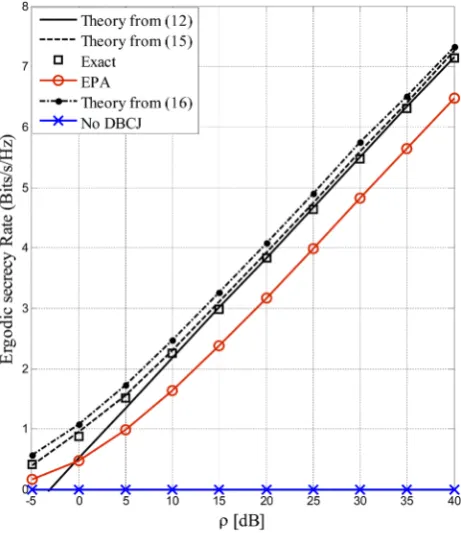
Fig. 1 shows the ESR for VLSA. It shows that: - The curve obtained from (12) is in precise agreement with Monte-Carlo simulation at high SNR regime.
- Our large system analysis in (15) well approximates the ESR at all SNRs.
- For a specific ESR, the OPA is more power efficient than the other power allocation strategies.
For example, for 3 bits/s/Hz, the OPA saves the power about 3.5 dB.
- Without using the DBCJ method, the secure transmission rate is always zero.
We have also provided Fig. 2 to show the accuracy of the evaluated expressions for a smaller number of antenna arrays.
Fig. 3 displays the SOP of the secrecy rate for three power allocation methods. We consider the outage threshold of the secrecy rate as R=1 [bpcu].
As can be seen in this figure:
Fig. 1. The ESR versus transmit SNR for VLSA Nd=64. The power of channel gains are set to μsr=μrd=5.
Fig. 2. The ESR versus transmit SNR for VLSA Nd=16. The power of channel gains are set to μsr=μrd=5.
- For large Nd=16, the achieved expressions (17) and (18) are in precise agreement with Monte-Carlo simulations for ρ>20 dB or equivalently Pout<0.002.
- The OPA offers better SOP than the EPA. For example, at the target SOP Pout=0.01, this gap is about 5 dB, which presents the efficiency of the proposed
OPA.
- As mentioned before, without using the DBCJ method, the system is always in an outage.
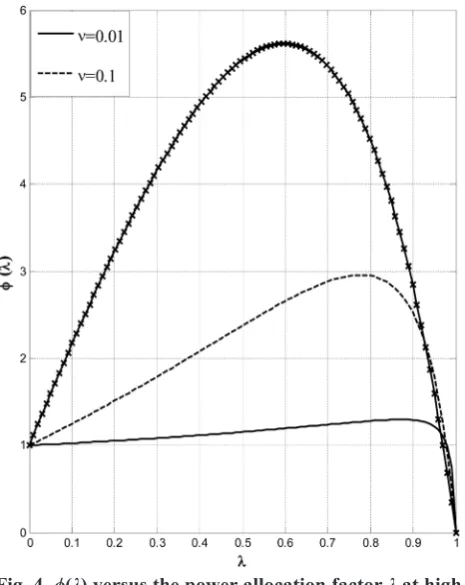
Finally, we prepare Fig. 4 to show that φ(λ) is a quasiconcave function [13] of λ at high γrd=50. As cen be seen, by increasing ν, λ* decreases, i.e., most of
the power is dedicated to the source. Furthermore, by decreasing ν, λ* increases. This means that most of the
power is dedicated to the destination.
7- Conclusion
We investigated secure communication in a two-hop wireless relaying network with an untrusted relay. To prevent the relay from intercepting the source message, the DBCJ was proposed. The optimal power allocation (OPA) technique is considered for the system. Based on the OPA, we evaluated the ESR and SOP for the case that the destination is equipped with multiple antenna arrays while the other nodes are equipped with a single antenna. The closed-form
Fig. 4. ϕ(λ) versus the power allocation factor λ at high
γrd= 50
expressions were presented for the case. Numerical results showed that the achieved expressions are in proper agreement with Montecarlo simulations.
Moreover, the proposed OPA significantly improves the power efficiency in comparison with EPA
technique.
8- References
[1] Laneman, J. N.; Tse, D. N. C. and Wornell, G. W.; “Cooperative Diversity in Wireless Networks:
Efficient Protocols and Outage Behavior,” IEEE Trans. Inf. Theory, Vol. 50, No. 12, pp. 3062–3080, 2004.
[2] Bloch, M.; Barros, J.; Rodriques, M. R. D. and McLaughlin, S. W.; “Wireless Information-Theoretic Security,” IEEE Trans. Inf. Theory, Vol. 54, No. 6, pp. 2515–2534, 2008.
[3] Wyner, A. D.; “The Wire-Tap Channel,” Bell Syst. Tech. J., Vol. 54, No. 8, pp. 1355–1387, 1975.
[4] Huang, J.; Mukherjee, A. and Swindlehurst, A. L.; “Secure Communication via an Untrusted Non-Regenerative Relay in Fading Channels,” IEEE Trans. Signal Process., Vol. 61, No. 10, pp. 2536– 2550, 2013.
[5] He, X. and Yener, A.; “Two-Hop Secure Communication Using an Untrusted Relay: A Case for Cooperative Jamming,” in Proc. IEEE Globecom, New Orleans, LA, p. 15, 2008.
[6] He, X. and Yener, A.; “Two-Hop Secure Communication Using an Untrusted Relay,”
EURASIP J. Wireless Commun. Netw., p. 13, 2009. [7] Huang, J.; Mukherjee, A. and Swindlehurst, A. L.; “Outage Performance for Amplify and Forward Channels with an Unauthenticated Relay,” in Proc. IEEE Int. Commun. Conf., pp. 893–897, 2012. [8] Sun, L.; Zhang, T.; Li, Y. and Niu, H.; “Performance Study of Two-Hop Amplify and Forward Systems with Untrustworthy Relay Nodes,” IEEE Trans. Veh. Technol., Vol. 61, No. 8, pp. 3801–3807, 2012. [9] Wang, J.; Elkashlan, M.; Huang, J.; Tran, N. H. and Duong, T. Q.; “Secure Transmission with Optimal Power Allocation in Untrusted Relay Networks,”
IEEE Wireless Commun. Lett., Vol. 3, No. 3, pp. 289– 292, 2014.
Linear Precoding in MISO Broadcast Channels with
Confidential Messages,” IEEE J. Sel. Areas Commun., Vol. 31, No. 9, pp. 1660–1671, 2013.
[11] Anghel, P. A. and Kaveh, M.; “Exact Symbol Error Probability of a Cooperative Network in a Rayleigh-Fading Environment,” IEEE Trans. Wireless Commun., Vol. 3, No. 5, pp. 1416–1421, 2004. [12] Papoulis, A.; “Probability, Random Variables,
and Stochastic Processes,” McGraw-Hill, New York, 1984.