Farideh Bastani1, Hamid Haghani2, Parisa Goodarzi1*
1. Department of Geriatric Nursing, School of Nursing & Midwifery, Iran University of Medical Sciences, Tehran, Iran. 2. Department of Biostatistics, School of Public Health, Iran University of Medical Sciences, Tehran, Iran.
* Corresponding Author: Parisa Goodarzi, MSc.
Address: Department of Geriatric Nursing, School of Nursing & Midwifery, Iran University of Medical Sciences, Tehran, Iran. Tel: +98 (912) 6183196
E-mail: [email protected]
Age–Friendly Cities Features From the Elderly’s
Per-spectives Underscoring “Community Support and Health
Services”
Background: The 21st century is characterized by two challenges; 1) Urbanized population, 2) Ageing population. In this regard, the Iranian old population ages over 60 years is expected to grow rapidly. Improving the elderly's quality of life is one of the challenges for policymakers and achieving this goal is accessible by designing accurate plans. In this way, WHO has initiated a global project to define “age- friendly cities.” This study aims to evaluate the criteria of age– friendly cities from the elderly’s perspectives.
Methods: This cross-sectional study employed interview technique on 400 older adults selected by stratified sampling method. The samples attended four community health centers. Demographic information of participants was collected and the abbreviated mental test, along with age-friendly cities checklist were administered, too. Data was analyzed by descriptive and inferential statistics using SPSS 20 (P<0.05).
Results: In this study, 53% of participants were female and 47% were male. The majority of participants (56.8%) were in the age range of 60-70 years. Most participants (59.8%) passed elementary and high school. The mean score of “community support and health services,” from participants' perspectives was 26.82, which was lower than the mean score of the tool (42). The variables of "housekeeping" and the average of "outdoor spending time" (1-3 h) had the highest relationship with the elderly’s perspectives on “community support and treatment-health services.”
Conclusion: Based on the results, welfare-cultural planning according to the older adults' perspectives and a creative collaboration among health policymakers and other organizations involved in ageing issues must be emphasized to empower the criteria of age-friendly cities.
A B S T R A C T
Keywords:
friendly city, Age-friendly community, Ageing
Article info: Received: 01 Dec. 2015 Accepted: 01 Apr. 2016
Citation: Bastani, F, Haghani, H & Goodarzi, P 2016, 'Age–Friendly Cities Features From the Elderly’s Perspectives Underscoring “Community Support and Health Services”', Journal of Client-Centered Nursing Care, vol. 2, no. 2, pp. 103-114. https://doi.org/10.32598/jccnc.2.2.103
:
: https://doi.org/10.32598/jccnc.2.2.103
1. Background
oday the world is faced with major chal -lenges of increasing urbanization and ag -ing. According to the statistics, the number of people over 60 years will increase from 12% in 2015 to 22% about two billion in 2050 (UNDESA 2013). Although a definite number has not been determined for old age, the United Nations has accepted chronological age of 60 years and more as the old age (WHO 2015a).
According to the 2011 population and housing census re -sults released by the Statistics Center, Iran’s population is 75149669 that 7.5% of the figure belongs to the old people (Statistical Center of Iran 2011). Currently, Iran old age population is about 8000000 (Secretariat National Council of the Elderly, 2016). With increase in old population, the number of old people is also increasing in urban areas and so WHO referred to the world as a growing city. The majority of Iran’s population (71.4%) are living in cities, too (Statistical Center of Iran 2011).
In this regard, countries with aging populations need to take the necessary precautions to meet this demographic change and provide favorable conditions for “ageing in place” (a situation which old people, in addition to be-ing active and interactbe-ing with the community, have easy access to all services needed) (Lowen et al. 2015). On the other hand, one of the main concerns of governments and policy makers in health sector, is the promotion of health in the community. Unfortunately, so far, there has been little attention to the social dimension of health in the studies conducted on the health of the old people. The social health of an individual depends on his or her inter -action with the community and surrounding environment
(Alidoust et al. 2014). However, paying attention to all aspects of health is essential and satisfying social needs (such as housing, nutrition, and employment) of individu-als in a society which include the old people is as impor -tant as physical and mental health and lead to the promo -tion of their general health and significant reduc-tion of the costs associated with health care (Nguyen et al. 2015).
Moreover in a rapidly aging world, taking policies to promote the elderly's quality of lives and maintaining their performances and independence must be placed un-der the priorities of the authorities. Currently the Amer-ica health system has focused its best on the promotion of the health-related quality of lives of the elderly people with chronic diseases and various disabilities. Obvious -ly, these efforts requires attention to all aspects of life quality, including its social aspect.
Today, the ever-expansion of cities, changes in lives of city dwellers, and prominent decrease in family gather -ings has led to a lonely sensation in the elderly. In this regard, many old people live alone and some of them due to chronic diseases and limited mobility are prone to se -clusion and then prominent decrease in the quality of life (as a key and valuable index in determining health status of people). In 2005, the concept of “age-friendly city” has been introduced by WHO for the first time as a strategic plan to deal with the challenge of aging population follow -ing the increase in urbanization. Because the challenges facing the old community almost are similar all over the world, they need flexible environment and in accordance with changes made by aging to adjust properly with these changes (Steels 2015).
Fortunately, the process of its creation is rapidly progress-ing around the world (Dellamora et al. 2015). The main re -sults of the “aged-friendly city” project is explaining its 8 key components by which the situation of a city or commu -nity can be evaluated in terms of the above components. The main components of age-friendly city raised by WHO are as follows: urban open spaces and buildings, transportation, housing, respect and social interactions, social participation, information and communication, employment opportunities and civic participation, community support and healthcare services (WHO 2013a;Plouffe & Kalache 2010).
Studies have shown that from the perspective of the old people, the parameters of services, family physicians, pharmacies, libraries, shopping and restaurants have high priorities (Lowen et al. 2015). Also, the results of a study in America with the purpose of determining the priority components of age-friendly city from the per-spective of urban experts and specialists in caring for the old people showed that both groups gave the highest priority to two components of “community support and healthcare services” and “respect and social inclusion” (Ruza et al. 2015). By joining Tehran to the age-friendly society (Tehran. C.O, 2015), appropriate opportunity has been created for professionals in health and ageing areas to use their expertise to conduct research and study in this field toward achieving age-friendly community.
friendly city with the focus on factors associated with the health care field (such as neighborhood support component and healthcare services).
In a study conducted in Mashhad, Iran with the purpose of evaluating the outdoor spaces and transportation in the city based on age-friendly indexes, the evaluation of cities has been much emphasized from the perspective of old people as the major clients (Kharazmi, 2014). Therefore, the present study aimed to evaluate the index of "community support and health services" from the perspective of the old people and determining the relation between old people views with their individual characteristics.
2. Materials and Methods
This research is a cross-sectional descriptive study and the study population included 60 years old or older peo-ple, living in district 2 of Tehran who were registered on urban healthcare centers of Ghods, Sa’adat Abad, Shahid Kazemiyan, and Farahzad. The second district of Tehran municipality was selected because the office of WHO in Kobe, Japan evaluated and then chose Tehran as one of the qualified cities for assessment and localization of age-friendly indexes and execution of this project has been started in district 2 of Tehran. The sampling method was stratified and proportional. The researcher at first found that average daily admissions to each center and then calculated the sample size with respect to admis -sions to each center by the following formula:
In Kharazmi et al. study, sample size was estimated as 384 according to Cochran’s formula (Kharazmi et al. 2014).
In this study and with regard to research purposes, the sample size was calculated with %95 confidence interval and precision value "d" and insertion into the following formula:
The required sample size was calculated as 400. It is to be noted that according to Kharazmi et al. 2014study, the value of σ was determined as 1 and the sample size was calculated by this formula:
n value was calculated as 400 and the share of each health center are as follows: Ghods, 73(18.3%); Saadat Abad, 111(27.8%); Shahid Kazemiyan, 116(29%); and Farahzad, 100(25%). After introducing the research and ensuring participants of the confidentiality of their infor-mation and also obtaining their written consent forms, the study samples were chosen. Inclusion criteria comprised being 60 years or older and having no cognitive impair -ment. In case of having a history of acute or chronic men-tal and cognitive disorders, participants were excluded from the study. Then, they were divided into 4 age groups of 60–70, 71–80, 81–90, and more than 90 years of age.
Completing the questionnaires has been done through self-filling by literate participants and through interview with illiterate participants. After designing the procedure, it was approved in Ethics Committee of the Iran University of Medical Sciences. Data were collected anonymously and all subjects were assured that the data collected are used only for the research purposes. At the end, after pro -viding the necessary explanations, written informed con -sent forms were obtained from all participants.
In order not to disrupt in tasks of the personnel working in healthcare centers, coordination was done with authorities of all 4 healthcare centers and a suitable room was selected in each center to complete the questionnaire in a peaceful and appropriate environment. The necessary explanations have been provided on how to respond to questions and it took them 20 to 30 minutes to respond the questions. In the next step, Abbreviated Mental Test (AMT) were in their possession. People who scored at least 7 in the AMT have met the inclusion criteria. This study was conducted from September 2015 to March 2016.
To collect data in this study, Abbreviated Mental Test (AMT), demographic questionnaire, and the checklist of Essential Features of Age-Friendly Cities (standardized by the World Health Organization) have been used. Be -low each of the questionnaires are explained briefly.
Abbreviated Mental Test (AMT)
A shortened version of the cognitive test has been extracted for the first time by Hodkinson with 10 ques-tions of 37-quesques-tions test by Roth-Hopkinson; the score of which had good correlation with brain pathological diseases in autopsy (Hodkinson 1972). Hodkinson dis -criminative test items of above mentioned test which had the best discrimination power for the shortened cognitive test. Then, Hodkinson and Qureshi (1974) in a study determined its sensitivity and specificity. The validity and reliability of the test have been confirmed
The sample size
calculated for the study
Total daily admissions
to 4 centers
The sample size of each center Daily admissions
to each center
× =
n= (0.1)22×12 n= (z
2 1-a/2×ϭ2)
in Iran by Bakhtiyari et al. (2014). Furthermore, it has an acceptable internal reliability (Cronbach α coefficient of 0.76) and a good face validity. This scale consists of items scored from 1 to 10 which an old person should be able to obtain a minimum score of 7 out of 10. Due to its shortness and repeatability, being independent from literacy and little association with culture and language, it seems to be an acceptable test (Bakhtiyari et al. 2014).
Demographic questionnaire
Demographic questionnaire has been designed accord-ing to the study purposes and review of the literature and questions of the researcher. It included questions about age, sex, marital status, occupation, education, health in-surance, driving, and the use of mobility aids.
Evaluation checklist of essential features of age-friendly cities
This checklist contains 8 components that in the pres-ent study the componpres-ent of “community support and healthcare services” has been selected. This component contains 14 items. Items are scored based on Likert-type Scale (1: totally disagree; 2: somewhat disagree; 3: I do not know; 4: somewhat agree; 5: totally agree). The total score ranges between 14 and 70 and scoring has been done based on the average scores of the samples (WHO 2011a;WHO 2009a). This is WHO’s standard checklist and its validity and reliability have been approved. How -ever, in this study we attempted to validate (translation and retranslation) and recheck its validity and reliability.
In order to determine the content validity, the checklist was given to 10 members of the Faculty of Nursing and Midwifery of Iran University of Medical Sciences as the expert panel to ask their comments and proposed amend -ments. After obtaining their comments, final reforms were performed. In order to confirm the reliability and validity of the instrument, 20 old people were selected (independent from study subjects) and questionnaires were given to them twice within interval of two weeks and after its completion, assessment of the reliability or internal consistency has been obtained through calcu-lating the Cronbach α (0.755). For pretest and posttest reproducibility, its correlation coefficient (r=0.989) was calculated. It can be concluded that instrument has nec-essary reliability.
Data were analyzed using descriptive statistical meth-ods (frequency, percentage, mean and standard devia-tion) and to determine the significance, inferential sta-tistics (Chi-square, t-test, ANOVA, and regression tests)
were used. In this study, P≤0.05 was considered signifi-cant. To analyze the data, SPSS 20 was used.
3. Results
In this research, a total of 400 men and women aged ≥60 years were studied. They were referring to urban healthcare centers (located in the second municipality dis-trict) affiliated to Tehran Northwest Healthcare Center under the supervision of Iran University of Medical Sci-ences and Healthcare Services. Table 1 shows the demo -graphic characteristics of the participants. Of them, 53% were females and 47% were males. Maximum number of participants were in the age group of 60 to 70 years (56.8%) and the lowest number were in the age group of 81 to 90 years (5.8%).
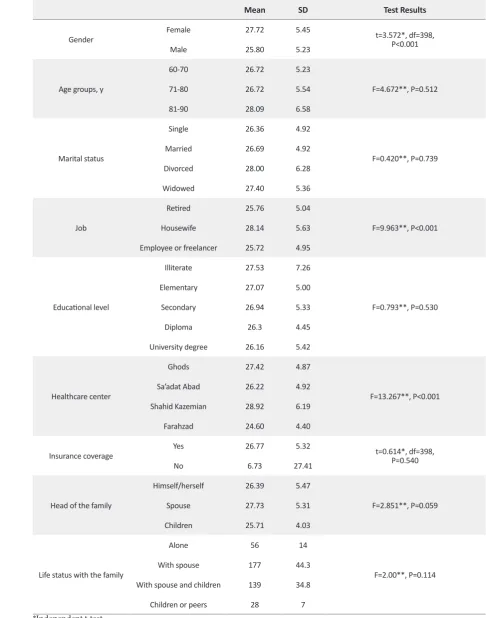
The majority of old people participating in the study (79%) were married and a small percentage of them (1.3%) had been separated from their wives. Most par-ticipants had education level under diploma (59.8%) and of these 18% were illiterate. There was a statistically significant difference between literacy among old people in the healthcare centers (P<0.001). Also, 49.2% of old subjects were retired (males and females), 44.5% were housewives (only women) and 6.2% of them had occu-pation (employee or self-employed). There was a statisti-cally significant difference (P=0.023) among 4 healthcare centers in terms of participants’ jobs. Most working old people were in the Ghods Healthcare Center (11%) and the least were in the Farahzad Healthcare Center (4%). Table 2 shows that the average scores for “community support and healthcare services” in old people was 26.82 and it was lower than the median score which was 42.
In Table 1. Demographic information of study participants.
Characteristics (Variable) No. %
Gender Female 212 53
Male 188 47
Age groups, y
60-70 227 56.8
71-80 150 37.5
81-90 23 5.8
Marital status
Single 11 2.8
Married 316 79
Divorced 5 1.3
Widowed 68 17
Job
Retired 197 49.2
Housewife 178 44.5
Employee or freelancer 25 6.2
Education level
Illiterate 72 18
Elementary 119 29.8
Secondary 48 12
Diploma 111 27.8
University degree 50 12.5
Insurance coverage Yes 371 92.8
No 29 7.2
Head of the family
Himself/herself 262 65.5
Spouse 131 32.8
Children 7 1.8
Life status with the family
Alone 56 14
With spouse 177 44.3
With spouse and children 139 34.8
With children or peers 28 7
Driving ability Yes 127 31.8
No 273 68.3
Using walking aid Yes 12 3
No 388 97
Average time spending outdoor
Less than 1 hour 106 26.5
1 to 3 hours 232 58
More than 3 hours 62 15.5
Table 2. Numerical indices of studied old people’s attitude towards the component of “community support and healthcare services” according to demographic information.
Mean SD Test Results
Gender Female 27.72 5.45 t=3.572*, df=398,P<0.001
Male 25.80 5.23
Age groups, y
60-70 26.72 5.23
F=4.672**, P=0.512
71-80 26.72 5.54
81-90 28.09 6.58
Marital status
Single 26.36 4.92
F=0.420**, P=0.739
Married 26.69 4.92
Divorced 28.00 6.28
Widowed 27.40 5.36
Job
Retired 25.76 5.04
F=9.963**, P<0.001 Housewife 28.14 5.63
Employee or freelancer 25.72 4.95
Educational level
Illiterate 27.53 7.26
F=0.793**, P=0.530 Elementary 27.07 5.00
Secondary 26.94 5.33
Diploma 26.3 4.45
University degree 26.16 5.42
Healthcare center
Ghods 27.42 4.87
F=13.267**, P<0.001 Sa’adat Abad 26.22 4.92
Shahid Kazemian 28.92 6.19
Farahzad 24.60 4.40
Insurance coverage Yes 26.77 5.32 t=0.614*, df=398,P=0.540
No 6.73 27.41
Head of the family
Himself/herself 26.39 5.47
F=2.851**, P=0.059
Spouse 27.73 5.31
Children 25.71 4.03
Life status with the family
Alone 56 14
F=2.00**, P=0.114
With spouse 177 44.3
With spouse and children 139 34.8
Children or peers 28 7
*Independent t-test. **Variance analysis.
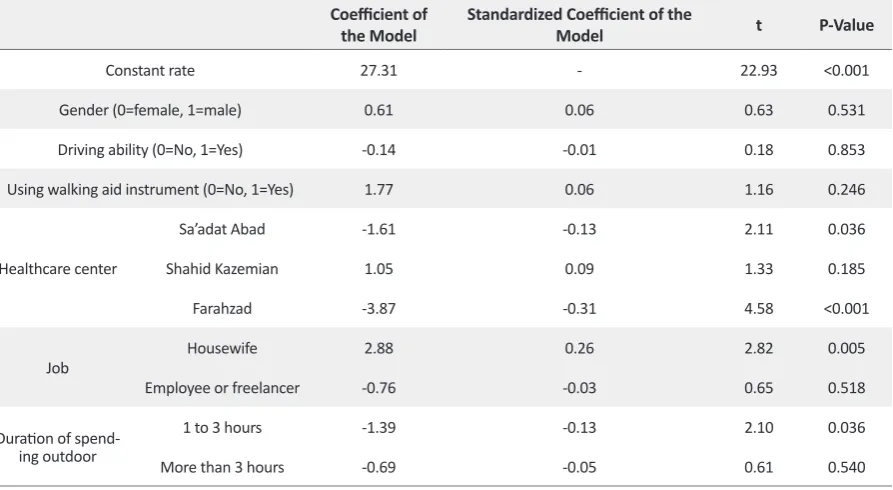
other words, housewives compared to retired (refer-ence group) people, while all other conditions remain constant, gained higher scores with respect to the model factor (2.88). Also, those who stayed 1-3 hours out-side, compared to the reference people who spend less than 1 hour, while all other conditions remain constant, gained lower scores with respect to the model factor (-1.39). Furthermore, the results of Table 3 shows that mean scores of "community supports and healthcare services" index is higher in women compared to men (P<0.001) and mean scores of this index was higher in those who were driving (compared to those who were not) (P=0.023). Finally, the mean score of this index was higher in those who used walking aids tools compared to those who did not (P=0.034)..
4. Discussion
In this study, 400 old people who were referring to 4 healthcare centers affiliated to the Northwest Health Center, located in the Second District of Tehran Mu-nicipality were interviewed. Based on the results of this study, the mean score of the index “community support and healthcare services,” from the perspective of the old people was 26.82, which was less than the median score of the instrument. This index or criterion is not in a desired status from the perspective of old people. The highest mean score in this index (3.26) was related to the sixth item i.e. “the behavior of the officials and personnel
of service centers towards old people, along with respect and special attention.” And the lowest mean score (1.04) was related to the tenth item i.e. “there’s a free service of home care which includes services related to health, personal care, and home cleaning” (Table 2).
Unfortunately, other items had low mean scores and for this reason and according to the results of this study it seems necessary that with regard to the index of “com-munity support and healthcare services” to standard-ize equipment provided to old people and establishing homecare centers with low costs and tailoring them to their needs. Furthermore, the authorities should provide healthcare-based services, perform screening at a rea-sonable cost and based on needs, issues, and common diseases of old age, present medical training tips on pre -vention of diseases, create a suitable platform to offer voluntary services and provide structured and targeted training for health care staffs. In the current study, most participants (59.8%) had under diploma education.
This issue was effective on the amount and quality of the elderly's information about the study indexes, their answers to questions of the questionnaire, and their in-teraction with the researcher. Studies have shown that the education level of the old people and their ability to use new technologies like computer has positive effects on their active and continuous communication with their children and society. On the other hand, the low-literate Table 3. Results of regression analysis related to old people’s attitude towards the component of “community support and healthcare services”.
Coefficient of
the Model Standardized Coefficient of the Model t P-Value
Constant rate 27.31 - 22.93 <0.001
Gender (0=female, 1=male) 0.61 0.06 0.63 0.531
Driving ability (0=No, 1=Yes) -0.14 -0.01 0.18 0.853
Using walking aid instrument (0=No, 1=Yes) 1.77 0.06 1.16 0.246
Healthcare center
Sa’adat Abad -1.61 -0.13 2.11 0.036
Shahid Kazemian 1.05 0.09 1.33 0.185
Farahzad -3.87 -0.31 4.58 <0.001
Job Housewife 2.88 0.26 2.82 0.005
Employee or freelancer -0.76 -0.03 0.65 0.518
Duration of spend-ing outdoor
1 to 3 hours -1.39 -0.13 2.10 0.036
More than 3 hours -0.69 -0.05 0.61 0.540
old people with inability to use new technologies get un -willingly separated from society.
In the study by other researchers, the importance of health and healthcare services was stressed and the impor-tance of referring to family physician or pharmacies from the perspective of the old people was emphasized. In this regard, the findings of some researchers led to the inclu-sion of key services such as hospitals, family physicians, and care facilities for the old people in age-friendly city assessment indicators in Australia (Lowen et al. 2015). In addition, a review article on age-friendly cities around the world found that provision of health and social services (with good quality) is considered a fundamental require-ment in the developrequire-ment of societies and providing well-being for old people (Fitzgerald & Caro 2014).
Most study participants (93%) were residing at their homes and this is considered a strong point for the men-tioned old people. House is one of the key components of age-friendly city and an important factor for enjoying an age-friendly community. Although, having a wholly-owned property largely provides the security condition for the elderly, it is not enough for the elderly's welfare and convenience. For example in this research, several houses were observed that did not possess living standards with respect to physical construction or primary security and health facilities for the elderly, and they might be regarded merely as temporary shelters.
Also, Sadeghi and colleagues emphasized the impor-tance of housing on their research about age-friendly city. In their study, which was conducted with the participation of the elderly and their family caregivers in four health-care centers of Tabriz, general questions about three domains of outer space, transportation, and housing, according to the World Health Organization checklist, were presented. The older people participating in this study stressed on the wholly-owned housing for the elderly, keeping their secu-rity, and resolving the problems of living in apartments.
Findings of this study showed most participants were unemployed and 6.2% of them had jobs (employee or self-employed). Most working old people were related to the Ghods center and the least number to the Farahzad center. Perhaps according to the results of studies con-ducted on the importance of work in health promotion, this is a threat to interact and the relationship between the old people in Tehran with community and their health status. Similarly, a Japanese researcher studied the ef-fects of working and working hours on health status of Japanese old men. The results of this study show a significant and positive impact of working hours of old
people on their health status and based on this research, less work can be a factor for low health status of old people. Apparently on the one hand, working leads to increased income and more security and subsequently spending more money on health and medical affairs and on the other hand, it improves the health status of the old people (Kajitani 2011).
Results of a study in Canada show that social participa-tion and activities of old people are closely related to their health and well-being and there was a positive correlation between social participation and perceived health, lack of loneliness, and life satisfaction (Gilmour 2012). Research has also shown that social participation has protective ef -fects on the symptoms of depression in working women and men. In addition, those who have the key role in their organization have reported better mental health (Takagi et al. 2013). In this study, one of the reasons for low score of "community supports and healthcare services" index from the perspectives of old people may be related to their unemployment (97% retired or jobless).
According to the results of this study (Table 3), the mean score of “community support and healthcare ser-vices” criterion was higher in women (27.72) than men (25.80), and the difference was statistically significant (P<0.001), although some old people participating in the study (especially the old people in Shahid Kazem-ian Center) were couples, and accordingly had the same healthcare, sanitary and economic status. However, the median score for this study component was higher in women than men. Furthermore in this study, there was no statistically significant relationship between age vari-able and attitudes of old people towards the component of “community support and healthcare services”.
In this regard, the results were consistent with Telatar study. This study was conducted on 2269 old people in Sinop, Turkey with the purpose of assessing the level of their satisfaction of the healthcare services. Then, it was concluded that with increasing age of the old people, their satisfaction from healthcare services reduced (Te-latar et al. 2015). In the present study, there was a statisti-cally significant difference between age variable and at-titude of old people towards the component “community support and healthcare services” (P<0.001).
-ciety and the social activities, has shown that having a job acts as an encouraging factor for the old people to interact with the young. However, in that study, having a job had no significant effect on the participation of the old people in society and social activities (Kadoya 2013).
Table 3 shows the numerical indexes of old people’s views towards the “community support and healthcare services” criterion in terms of their daily activities. In a recent study, there was statistically significant differ-ence between variables of using mobility aids (P=0.034), driving ability (P=0.023), and the mean time spending outdoor (P=0.007) with old people’s view towards the “community support and healthcare services” criterion. In accordance with the Scheffe test results (Table 3), the mean score of “community support and healthcare ser-vices” index in the old people who were not driving was higher than those who were driving (P=0.023). Similarly, the mean scores of the study component in people who used mobility aids was higher than those who did not use these mobility aids (P=0.034). Scheffe test showed sig-nificant differences between the median score of service provision for those with less than an hour outdoor spend -ing with two other groups in such a way that the median score for those with less than an hour spending outside the house was higher than two other groups (on the order of 1-3 hours and more than 3 hours) (P=0.007).
In this study, driving ability of old people has been also concerned as one of the factors for their social activities and interaction with the community and the results of this study showed that only 31.8% of old people partici-pating in the study were able to drive and the majority of these people who do not drive either have no driving license or have some other problems (disability, visual impairment, etc.). The results in Table 3 showed that the median score of the component “community support and healthcare services” from the perspective of old people who drive (25.91) and the old people who do not drive (27.24) and the difference between the two groups was statistically significant (P=0.023). On the other hand, the study results of Kadoya (2013) with the purpose of iden-tifying limitations of the participation of the old people in society and social activities, have shown that the mo -bility of old people was influential on their participation in society and their interaction with the young. Also, old people who are able to drive have a significant difference compared to those who are unable to drive with regard to participate in social activities (Kadoya 2013).
Also, the current study results showed that most old peo-ple (68.2%) did not drive and also there was a significant difference among studied healthcare centers (P=0.001), so
that the greatest number of old people who were driving were those referring to Sa’adat Abad and Ghods Health-care Centers. Given that most old people who had diplo-ma and higher than diplodiplo-ma were related to the mentioned centers, perhaps there was a relationship between the level of education and the ability to drive and subsequently the extent of their participation in the community and active interaction with other groups of the society.
On the one hand, results of a study on deaths resulting from road accidents in the Iranian aged people in the years 2006 to 2008 revealed that in these years, 12029 deaths happened in traffic accidents among people aged over 60 years. Of these, 19.2% of the dead were drivers, 56.9% pedestrians, and 23.2% passengers. On the other hand, 64.3% of deaths per year was related to the illiterate old people and 31.8% of deaths in each year were related to the literate old people (Ghadir zadeh et al. 2012).
Considering the importance of activities such as driv-ing and its positive impact on people’s participation in society and at the same time, potential risks arising from them for the old people (old people who were drivers and pedestrians), it is necessary to take measures to se-cure passages, to install traffic signs according to the conditions of the old people, and to execute medical ex -aminations (vision, hearing, checking the status of the persons in terms of the absence of dementia, etc.) for the old people to prevent accidents annually.
With regard to the use of assisting tools, the results in Table 3 showed that the mean scores of the study crite-rion in people who used mobility aids was higher than those who did not use these tools (P=0.034). In this regard, results of a study in Iran has shown that social participation in old people with different mobility levels was different and old people who have different mobility aids and the ability to move more showed higher level of social participation (Ayoubi Avaz et al. 2015).
During the interviews, almost all old people who re-ferred to the Farahzad healthcare center complained about the ruggedness of the passages, alleys, and sidewalks in the area and mentioned them as the main reasons for their inactivity and staying home. This result is not consistent with the results of Rebeiro et al. (2013) study on the re-lationship between social-environmental features of the location of old people and the number of “Leisure-Time Physical Activity” or LTPA. Findings of Ribeiro study showed that characteristics of living place has no relation-ship with physical activity (Rebeiro et al. 2013).
However, the results of a study based on group discus-sions with the purpose of surrounding area of the old peo -ple showed that the design of the surrounding space of the elderly had an important role on their physical activities. In such a way that even some of them changed their place of residence due to heavy traffic or lack of easy access to shopping centers. This research, has only considered the physical aspects of old people places and among its limitations are investigating just a small area of the city.
In the study, the mean score of the study index, " com-munity supports and healthcare services" from the per -spective of the study was not in a suitable condition and was lower than the median score of the criterion. Therefore, the necessity of welfare-cultural planning ac-cording to the older adults' perspectives and in the line of strengthening criteria of the age-friendly city in the community is felt and a creative collaboration among health policymakers and specialists in urban areas and representatives of the elderly (including the members of the retired clubs and so on) is necessary.
The current study is of quantitative study. In a quantita-tive study, the researcher after collecting numerical data, observing samples, and the presenting them, start to quan-titatively analyze them. On the whole, the findings of a quantitative research are more precise, but shallower than the findings of a qualitative research. On the other hand, in a qualitative research, collecting information is the result of social interaction and helps the researcher to obtain analyt -ic, perceptive, and categorized descriptions. In general, the results of a qualitative research is richer and more holistic. Therefore, it is suggested that future studies be conducted as a combination of quantitative and qualitative studies.
Acknowledgments
We especially thank deputies of the health depart -ments of Iran University of Medical Sciences, Tehran northwest health center, as well as Ghods, Saadat Abad
(Evin), Shahid Kazemiyan, and Farahzad Healthcare centers who helped us to conduct this study.
Conflict of Interest
The authors declared no conflict of interests.
References
Alidoust, S, Holden, G & Bosman, CJ 2014, ‘Urban environment and social health of the old: a critical discussion on physical, social, and policy environments’, Athens Journal of Health, vol. 1, pp. 169-80.
Ayoubi Avaz, K, Pravaneh, S, Ali Akbari, A, Miller, W, Reza Sol-tani, P & Ghahari, S 2015, ‘[Comparison of social participation level between older adults with assistive mobility devices and those without the devices (Persian)]’, Iranian Journal of Ageing, vol. 10, no. 3, pp. 166-73.
Bakhtiyari, F, Foroughan, M, Fakhrzadeh, H, Nazari, N, Najafi, B, Alizadeh, M et al 2014, ‘[Validation of the Persian version of Abbreviated Mental Test (AMT) in old residents of Kahrizak Charity Foundation (Persian)]’, Iranian Journal of Diabetes and Metabolism, vol. 13, no. 6, pp. 487-94.
Dadkhah, A 2007, ‘[Review of aged rendered services in USA and Japan and guidelines for Iran Ageing strategic plan (Per-sian)]’, Iranian Journal of Ageing, vol. 2, no. 3, pp. 166-76.
Dellamora, MC, Zecevic, AA, Baxter, D, Cramp, A, Fitzsim-mons, D & Kloseck, M 2015, ‘Review of assessment tools for baseline and follow-up measurement of age-friendliness’, Ageing International, vol. 40, no. 2, pp. 149-64. doi: 10.1007/ s12126-014-9218-7
Fitzgerald, KG & Caro, FG 2014, ‘An overview of age-friendly cities and communities around the world’, Journal of Aging & Social Policy, vol. 26, no. 1-2, pp. 1-18.
Ghadir Zadeh, MR, Fadayevatan, R, Akbari Kamrani, AA, Da-vatgaran, K, Hashemi Nazari, SS, & Mirtorabi, SD 2012, ‘Road accident mortality rate of the Iranian Old from 2006 to 2008 (Persian)]’, Iranian Journal of Ageing, vol. 7, no. 1, pp. 49-56.
Gilmour, H 2012, ‘Social participation and the health and well-being of Canadian seniors’, Health Reports, vol. 23, no. 4, pp. 23-32. PMID: 23356042
Hodkinson, H 1972, ‘Evaluation of a mental test score for assess-ment of assess-mental impairassess-ment in the elderly’, Journal of Age and ageing, vol. 1, no. 4, pp. 233-238. doi: 10.1093/ageing/1.4.233
Kadoya, Y 2013, ‘Toward an aged-friendly city: the constraints preventing the old ‘s participation in community programs in Akita city’, Working with Old People, vol. 17, pp. 101-108. doi: 10.1108/wwop-05-2013-0012
Kajitani, S 2011, ‘Working in old age and health outcomes in Ja-pan’, Japan and the World Economy, vol. 23, no. 3, pp. 153-162. doi: 10.1016/j.japwor.2011.06.001
age-friendly cities indicators’, Paper Presented at The 6th National
Conference on Urban Planning and Management with Em-phasis on the Elements of Slamic City, 12 & 13 November 2016, Iran, Mashhad.
Lowen, T, Davern, MT, Mavoa, S & Brasher, K 2015, ‘Age-friendly cities and communities: access to services for old people’, Australian Planner, vol. 52, no. 4, 255-65. doi: 10.1080/07293682.2015.1047874
Moradi, S, Fekrazad, H, Taher Mousavi, M & Arshi, M 2011, ‘[The study of relationship between social participation and quality of life of old people who are member of senior associa-tion of Tehran city in 2011 (Persian)]’, Iranian Journal of Ageing, vol. 7, no. 4, pp. 41-46.
Nguyen, OK, Chan, CV, Makam, A, Stieglitz, H & Amarasin-gham, R 2015, ‘Envisioning a social-health information ex-change as a platform to support a patient-centered medical neighborhood: a feasibility study’, Journal of General Internal Medicine, vol. 30, no. 1, pp. 60-67. doi: 10.1007/s11606-014-2969-8
Plouffe, L & Kalache, A 2010, ‘Towards global age-friendly cit-ies: determining urban features that promote active aging’, Journal of Urban Health, vol. 87, no. 5, pp. 733-39. doi: 10.1007/ s11524-010-9466-0
Ribeiro, AI, Mitchell, R, Carvalho, MS & De Pina, MDF 2013, ‘Physical activity-friendly neighbourhood among older adults from a medium size urban setting in Southern Europe’, Pre-ventive Medicine, vol. 57, no. 5, pp. 664-670. doi: 10.1016/j. ypmed.2013.08.033
Ruza, J, Kim, JI, Leung, I, Kam, C & Ng, SYM 2015, ‘Sustainable, age-friendly cities: An evaluation framework and case study application on Palo Alto, California’, Sustainable Cities and Soci-ety, vol. 14, pp. 390-96. doi: 10.1016/j.scs.2014.05.013
Statistical Center of Iran 2011, National population and housing Census 2011 (1390): Selected Findings, Statistical Center of Iran, Tehran, Viewed 18 October 2015, http://www.amar.org.ir
Steels, S 2015, ‘Key characteristics of age-friendly cities and com-munities: A review‘, Cities, vol. 47, pp. 45-52. doi: 10.1016/j. cities.2015.02.004
Takagi, D, Kondo, K & Kawachi, I 2013, ‘Social participation and mental health: moderating effects of gender, social role and rurality’, BMC Public Health, vol. 13, no. 1, pp. 1. doi: 10.1186/1471-2458-13-701
Tehran Municipality 2015, Age-Friendly City, viewed 29 October 2015, http://www.region2.tehran.ir.default. aspx?tabid=274&ArticleId=47704
Telatar, G, Üner, S, Özcebe, H, Bicer, B, & Sari, Ö 2015, ‘Defining the satisfaction from healthcare services among old in Sinop, Turkey, 2014’, The European Journal of Public Health, vol. 25, no. 3. doi: 10.1093/eurpub/ckv175.039
The United Department of Economic and Social affairs 2015, World Populations prospects, UN, New York.
The United Department of Economic and Social affairs 2013, World population ageing, UN, New York.
WHO 2009a, The World Health Organisation: Global Age-Friendly Cities, Guide and Checklist, A review of their use by local govern-ment, World Health Organization, Geneva, viewed 15 August
2015, http://www.mav.asn.au/policy-services/social-com-munity/ageing-disability/ageing/Documents
WHO 2009b, WHO global network of age-friendly cities, World Health Organization, Geneva, Viewed 10 September 2015, http://www.who.int.entity.ageing.projects.age-friendly-cit-ies-network.en
WHO 2011a, Global age-friendly cities: a guide 2007, World Health Organization, Geneva, Viewed 22 August 2015, http://www. who.int.ageing.publications
WHO 2013a, WHO global network of age-friendly cities and commu-nities, World Health Organization, Geneva, Viewed 22 August 2015, http://www.who.int.ageing.projects.age_friendly_cit-ies_network.en