76
A modified variable physical properties model, for analyzing nanofluids flow and
heat transfer over nonlinearly stretching sheet
Pooria Akbarzadeh*
School of Mechanical Engineering, Shahrood University of Technology
Received 16 July 2015; revised 11 December 2016; accepted 11 January 2017; available online 10 June 2017
ABSTRACT: In this paper, the problem of laminar nanofluid flow which results from the nonlinear stretching of a flat sheet is investigated numerically. In this paper, a modified variable physical properties model for analyzing nanofluids flow and heat transfer is introduced. In this model, the effective viscosity, density, and thermal conductivity of the solid-liquid mixture (nanofluids) which are commonly utilized in the homogenous single-phase model, are locally combined with the prevalent single-phase model. A numerical similarity solution is considered which depends on the local Prandtl number, local Brownian motion number, local Lewis number, and local thermophoresis number. The results are compared to the prevalent single-phase model. This comparison depicts that the prevalent single-phase model has a considerable deviation for predicting the behavior of nanofluids flow especially in dimensionless temperature and nanoparticle volume fraction. In addition the effect of the governing parameters such as Prandtl number, the Brownian motion number, the thermophoresis parameter, the Lewis number, and etc. on the velocity, temperature, and volume fraction distribution and the dimensionless heat and mass transfer rates are examined.
KEYWORDS: Nanofluid; Nonlinear stretching sheet; Similarity solution; Modified variable physical properties model
INTRODUCTION
Improvement in heat transfer characteristics, has an important role in increasing the efficiency of many physical and engineering processes such as cooling of electronic components, bearings heat removal, heat exchangers, cooling of strips or filaments, and to name but a few. One way to enhance the heat transfer characteristics of the original (base) fluid, is the use of nanofluids. Nanofluids are a new class of fluids that contain bases fluid and nanometer-sized particles (such as Cu, Ag, CuO, Al2O3,
TiO2 and etc. as metallic or metallic oxide particles or
MWNTs as metallic nanotubes). One of the possible mechanisms for an outstanding increase in the thermal performance of nanofluids is the Brownian motions of these nanoparticles inside the fluids [1-4]. Till now, there have been published several papers in the field of thermal characteristics of nanofluids flow such as Refs. [1-9] and to name but a few.As mentioned above, one of the application of heat transfer in industries is cooling of continuous strips or filaments by drawing them through a motionless fluid (for example materials manufactured by extrusion, glass-fiber and paper production). In these cases, the final product of desired characteristics depends on the rate of cooling in the process and the process of stretching [10]. In order to predict the heat transfer characteristics of such process, it is required to simulate the boundary layer behaviour of fluid flow over the stretching surface (strips or filaments). After the preliminary works of Sakiadis [11-13] in thesubject of
*Corresponding Author Email: [email protected]
Tel.: +989122022776; Note. This manuscript was submitted on July 16, 2015; approved on December 11, 2016; published online June 10, 2017.
Boundary Layer Flow (BLF) behaviour over a continuous moving surface (with constant velocity), the BLF happened by a stretching surface has stirred up the attention of many researchers. Crane [14] obtained the exact temperature distribution of the steady BLF of a viscous fluid caused by stretching a flat sheet with a linear velocity. He dealt with the isothermal sheet. The heat and mass transfer on a stretching plate with blowing or suction was examined by Gupta and Gupta [15]. They handled the isothermal moving plate and found the temperature and concentration distributions. The same problem was studied by Dutta et al. [16] in which the sheet was subjected to a uniform heat flux without blowing or suction. Chen and Char [17] extended the work of Gupta and Gupta [15] in the case of prescribed stretching sheet temperature and heat flux. The problem of nonlinear stretching sheet for different cases of boundary conditions has also been studied by different researchers. In 2001, Vajravelu [18] examined the boundary layer behavior and thermal characteristics of flow over a nonlinear stretching sheet without considering the viscous dissipation terms. In 2006, Vajravelu and Cannon [19] presented the existence results of the nonlinearly stretching boundary problem. Then Cortell [20] in 2007 studied flow and heat transfer on a nonlinear stretching sheet for two different types of thermal boundary conditions, i.e. prescribed and constant surface temperature. Prasad et al. [21] presented a numerical solution for the steady mixed convection magneto-hydrodynamics flow of an electrically conducting viscous fluid over a stretching sheet with variable fluid properties.
P. Akbarzadeh
77 Nomenclature
velocity component along
, positive constants coordinate measured along the surface
D Brownian diffusion coefficient coordinate measured normal to the surface
D thermophoretic diffusion coefficient Subscripts
specific heat capacity base fluid
thermal conductivity nanofluid
Le Lewis number nanoparticles
, nonlinear stretching parameters wall surface
Nb Brownian motion number ∞ far away from the stretching sheet
Nt thermophoresis parameter Greek Symbols
Nu Nusselt number thermal diffusivity
Pr Prandtl number nanoparticle volume fraction
Re local Reynolds number density
Sh local Shervood number kinematic viscosity
surface mass flux similarity parameter
surface heat flux dimensionless temperature
temperature of the fluid dimensionless nanoparticle volume fraction
velocity component along
Postelnicu and Pop [22] examined the steady two-dimensional laminar BLF of a power-law fluid past a permeable non-linear stretching wedge. Recently, Vajravelu et al. [23] analyzed magneto-hydrodynamics flow and heat transfer of a power-law fluid over an unsteady stretching sheet.
One way to improve the heat transfer characteristics of flow past a stretching sheet, is the use of nanofluids. Bachok et al. [24] studied BLF of nanofluids over a continuous moving surface (with constant velocity). Khan and Pop [25] investigated the temperature distribution of the steady BLF of nanofluids caused by stretching a flat sheet with a linear velocity. They handled the isothermal sheet. Gorder et al. [26] presented the similarity solution for the nano-BLFs over a linearly stretching sheet, in which on the surface sheet, the velocity slip was assumed to be proportional to the local shear stress. Hassani et al. [27] obtained an analytical solution for BLF of a nanofluid past a linearly stretching sheet using homotopy analysis method (HAM). Rana and Bhargava [10] studied numerically the flow and heat transfer of a nanofluid over a nonlinearly stretching sheet. Nadeem et al. [28] analyzed the flow of three-dimensional water-based nanofluid over an exponentially stretching sheet. Das [29] investigated the problem of BLF of a nanofluid over a non-linear permeable stretching sheet at predestined surface temperature in the presence of partial slip.
The numerical works presented in many papers show that, in order to investigate the heat transfer enhancement by nanoparticles (or generally small solid particles) suspended in a fluid, two main approaches have been adopted by researchers. The first approach is the two-phase model, which consider both the fluid and the solid phases role in the heat transfer process. The second one is the single-phase model in which both phases are in thermal and hydrodynamic equilibrium state (this approach is simpler
M a i B t t p i p c f t e n a v d MATHEMA The steady stretching shee
= , w
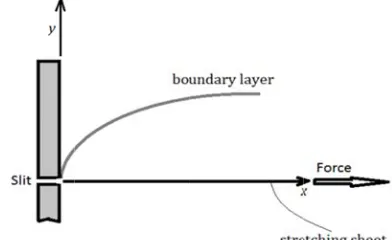
stretching par along the stre stretching the is the coordina Because of th the vertical ve this problem, prescribed surf is a positive parameter in t condition and from the stretc the following embody the c nanoparticles c
Fig. 1. Physical
+ = 0
+
+ =
( )
( ) D
+
here, and axis respective volume fractio
D is the therm is the specif diffusivity, i
ATICAL MO two-dimension et is considered where is a p
rameter and etching surface
sheet, the flow ate measured n he impermeabil elocity of fluid the stretchin face temperatu e constant, the prescribed is the tem ching sheet. Ac four governi continuity, mo concentration,
model of BLF of a coordin
0
=
= +
+D
= D +
are the veloc ely, is the tem on, D is the B mophoretic dif fic heat capaci
s the kinematic ODEL
nal BLF of a d with the non positive constan
is the coor e, as shown i w takes place at normal to the st lity characteris d on the surfa
ng surface is
ure = +
is the surf surface tempe mperature of th ccording to Re
ing boundary omentum, therm
respectively:
a nanofluid past a nate system
D
city componen mperature, is Brownian diffu ffusion coeffici
ity, = /( c viscosity, and
nanofluid pas linear velocity nt, is nonline rdinate measur
in Figure 1. t 0, where tretching surfa stic of the she ace is = 0. s maintained
, where face temperatu
erature bounda he fluid far aw fs. [31] and [3 layer equatio mal energy, a
stretching sheet an
nts along and s the nanoparti usion coefficie ient, is densi
) is the therm d is the therm
78 st a y of ear red By e ace. eet, In at ure ary way 2], ons and nd (1) (2) (3) (4) -cle ent, ity, mal mal conduc and nan Single-and he parame equatio ( ) ( ) = = wher bounda
( , 0 ( , 0 ( , ∞
( , ∞
wher at the s sheet, r transfor = = − ( ) = ( ) (where the BLF three or + 1 Pr( ) Nb( + where, F( ) Nb( Nt( ) Pr( ) 1 −
tivity. The sub noparticles, re Phase Model ( eat transfer is eters , , ons can be repla
= 1 − +
=
(1 − ) . 1
= + 2 −
+ 2 +
re, the subscr ary conditions f
0) = ( ) =
0) = ( ) =
∞) = 0, ( , ∞ ∞) =
re, and stretching surf respectively. B rmations: , = − + = ( − ) (⁄ = ( − )⁄
e, = ( +
F governing e rdinary differen
F(φ) −
) + −
) + Nt(
Le +Nt
Nb
= (1 − ) .
) = Nb 1 − ) = Nt 1 −
) = ⁄ =
+ ( ) (⁄
bscripts and espectively. In
(MSPM) for an s introduced.
, and aced by the fol
( )
( )
1
1 − + ⁄
2 −
+ −
ript refers for the problem
, ( , 0)
+ , (
∞) = 0, ( , ∞)
are the nanop face and far aw By considering
( ), − 1
+ 1 ′
( − ),
( − )
+ 1) (2 )⁄ an
equations (1) to ntial equations
2
+ 1 ′ =
2
+ 1 +
) = 0
= 0
1 − + ⁄
+ ( ) ⁄
+ ( ) (⁄
Pr ⁄⁄
( )
d refer to the n this study, a
nalyzing nanof For this ma of the above llowing relation
to the base f m are given by:
= ( ) = 0
( , 0) =
) = ,
particle volum way from the the following
nd = (
o (4) are trans s as follows:
0 ⁄ ( ) ) ⁄ ⁄ nanofluid Modified fluids flow anner, the governing ns [33]: (5) fluid. The : (6) me fraction stretching similarity (7)
( + 1) 2⁄
sformed to
(8)
P. Akbarzadeh
79
and, Pr = ⁄ is the Prandtl number, =
( ) D ( − ) ( ) is the Brownian motion
number, Nt = ( ) D ( − ) ( ) is the
thermophoresis parameter, and Le = ⁄D is the Lewis number. It is clear that,
Nb = ( ) ( − ) Le( ) (10)
According to equations (6), equations (8) are solved subject to the following boundary conditions:
(0) = 1.0, (0) = 1.0, (0) = 1.0, (0) = 0
′(∞) = 0, (∞) = 0, (∞) = 0 (11)
By defining the local Reynolds number via Re =
( ) / = , the surface heat flux via
= ( ⁄ ) , the surface mass flux via =
D ( ⁄ ) , the local Nusselt number via Nu =
( − )
⁄ and the local Shervood number via
Sh = ⁄[D ( − )], the following relation can be obtained:
Nu Re / = − ( + 1) 2⁄ (0)
Sh Re / = − ( + 1) 2⁄ (0)
(12)
where, / and ℎ / are defined as
dimensionless heat and mass transfer rates, respectively. Without loss of generality, one can assume that the nanoparticle volume fraction far away from the stretching sheet is zero or = 0. In this paper the fluid is a water based nanofluid containing different type of nanoparticles: copper (Cu), alumina (Al2O3), titanium dioxide (TiO2). The
thermophysical properties of the fluid and nanoparticles are given in Table 1 [33]. As the thermophysical properties of Al2O3 and TiO2 are approximately the same, the simulation
of Cu and Al2O3 are only presented in result sections.
Table 1
Thermophysical properties of fluid and nanoparticles.
Properties Fluid phase (water)
[J/kgK] 4179 385 765 686.2
[kg/m ] 997.1 8933 3970 4250
[W/mK] 0.613 400 40 8.95
[m /s] 1.005 × 10 - - -
Pr 6.83 - - -
⁄ - 8.959 3.981 4.262
( ) ( )⁄ - 0.825 0.729 0.700
⁄ - 652.53 65.25 14.60
NUMERICAL ALGORITHM
The procedure of numerical calculation (computer program) of the non-linear differential equations(8-10)with
boundary conditions (11) is as follows:
(i) Specify input data ⁄ , ( ) ( )⁄ , ⁄ , Pr ,
Nb, Nt, Le, and
(ii) Set an initial guess for ( ) or ( ) (iii) Calculate F( ), Nb( ), Nt( ), and Pr( ) (iv) Solve the 1st relation of equation (8) to obtain ( ) (v) Solve the 2nd relation of equation (8) to obtain ( ) (vi) Solve the 3rd relation of equation (8) to update ( ) or
( )
(vii)Check the error between the updated ( ) and the guessed one.
(viii)If the maximum error ≤ 10 then the procedure is finished. If the maximum error > 10 the go to step (iii)
It should be noted that, for step (ii), by considering the assumption = 0, the initial guess can be ( ) =
( )⁄ = (1 − ) (1 −⁄ ) as an example,
where is the maximum value of in the numerical calculation.
CODE VALIDATION
According to many references such as Ref. [25], [29], and etc., it is evident that the MSPM is reduced to the Prevalent Single-Phase Model (PSPM) by considering the relations: F( ) = 1.0, Nb( ) = Nb, Nt( ) = Nt, and
Pr( ) = Pr. In order to check the validity of the present
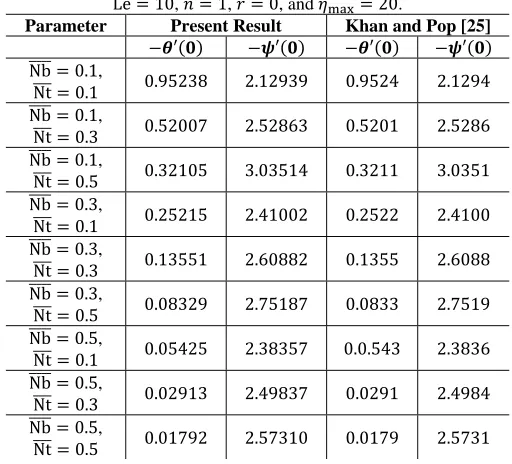
code (computer program), Equations (8-10) subject to the boundary conditions (11) are solved numerically for some values of the governing parameters of the prevalent single-phase model. The results for the reduced Nusselt number,
− ′(0), and the reduced Sherwood number, − ′(0), are
compared with those obtained by Khan and Pop [25] in Table 2.
Table 2
Comparison of results for − ′(0) and − ′(0) when Pr = 10,
Le = 10, = 1, = 0, and = 20.
Parameter Present Result Khan and Pop [25]
− ′( ) − ′( ) − ′( ) − ′( )
Nb = 0.1,
Nt = 0.1 0.95238 2.12939 0.9524 2.1294
Nb = 0.1,
Nt = 0.3 0.52007 2.52863 0.5201 2.5286
Nb = 0.1,
Nt = 0.5 0.32105 3.03514 0.3211 3.0351
Nb = 0.3,
Nt = 0.1 0.25215 2.41002 0.2522 2.4100
Nb = 0.3,
Nt = 0.3 0.13551 2.60882 0.1355 2.6088
Nb = 0.3,
Nt = 0.5 0.08329 2.75187 0.0833 2.7519
Nb = 0.5,
Nt = 0.1 0.05425 2.38357 0.0.543 2.3836
Nb = 0.5,
Nt = 0.3 0.02913 2.49837 0.0291 2.4984
Nb = 0.5,
80 In this simulation the default values of the parameters are considered as Pr = 10, Le = 10, = 1, = 0, and
= 20. It can be seen from Table 2 that the present results are in very good agreement with those reported by Khan and Pop [25]. Therefore, it is clear that the results obtained in this study are accurate.
RESULTS AND DISCUSSION
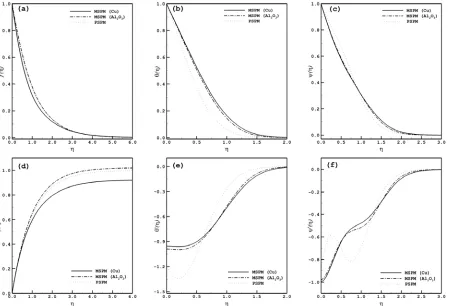
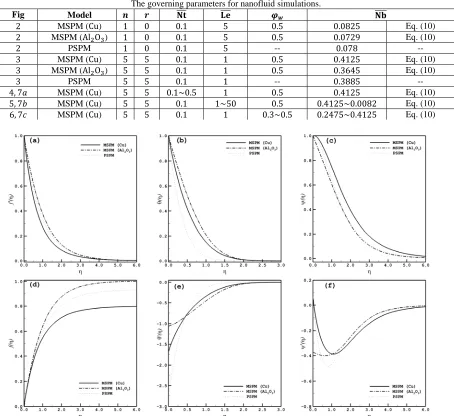
In order to get a clear understanding of the present problem, the numerical results for dimensionless velocity, temperature, nanoparticle concentration, and etc. are demonstrated in this section. Figures 2(a-f) and Figures 3(a-f) illustrate the effects of the two different nanoparticles (Cu and Al O ) on the dimensionless profiles for both MSPM and PSPM. The governing parameters for these simulations are given in Table 3.
In order to have a reasonable judgment between the results of PSPM and MSPM, the value of Brownian motion
number (Nb) for the PSPM is considered as the average of
Nb for Cu and Al O . The presented results in Figures 2 and 3 show that the temperature profiles converge quickly than the stream function profiles for both PSPM and MSPM. However, it is clear from the figures that the PSPM has a considerable deviation for predicting the behavior of nanofluids flow especially in dimensionless temperature ( ) and nanoparticle volume fraction ( ). From the results it is evident that, this inaccuracy is intensified when the sheet is stretched nonlinearly (see Fig. 3). Discussion about the PSPM and its effect on the results of the stretching sheet problem has been reported recently in many studies such as Refs. [25], [27], [29], and to name but a few. Therefore, the next simulations in this paper concentrate on the MSPM. As the boundary layer behavior and thermal characteristics of the both nanoparticles flow are approximately the same, the following results and discussion are focused only on
Cu-water nanofluid flow and the MSPM.
Fig. 2. Effect of the MSPM and PSPM on the dimensionless profiles ( , , , , , ) for Cu and Al O-water nanofluids, = 1, and = 0 Plots of the dimensionless variables ′( ), ( )
and ( ) for Cu-water nanofluids with the governing
parameters given in Table 3, are illustrated in Figures 4 through 7. Based on Figure (4a), the function ′( ) changes very little with Nt changes.
However, Figures (4b) and (4c) show that as thermophoretic parameter (Nt) increases, the temperature and the volume fraction function (as well as the boundary
layer thickness for both items) increase for the specified conditions. This is because that, positive Nt indicates a hot surface ( > ).
P. Akbarzadeh
81 Table 3
The governing parameters for nanofluid simulations.
Fig Model
2 MSPM (Cu) 1 0 0.1 5 0.5 0.0825 Eq. (10)
2 MSPM (Al O ) 1 0 0.1 5 0.5 0.0729 Eq. (10)
2 PSPM 1 0 0.1 5 -- 0.078 --
3 MSPM (Cu) 5 5 0.1 1 0.5 0.4125 Eq. (10)
3 MSPM (Al O ) 5 5 0.1 1 0.5 0.3645 Eq. (10)
3 PSPM 5 5 0.1 1 -- 0.3885 --
4, 7 MSPM (Cu) 5 5 0.1~0.5 1 0.5 0.4125 Eq. (10)
5, 7 MSPM (Cu) 5 5 0.1 1~50 0.5 0.4125~0.0082 Eq. (10)
6, 7 MSPM (Cu) 5 5 0.1 1 0.3~0.5 0.2475~0.4125 Eq. (10)
Fig. 3. Effect of the MSPM and PSPM on the dimensionless profiles ( , , , , , ) for Cu and Al O -water nanofluids, = 5, and = 5
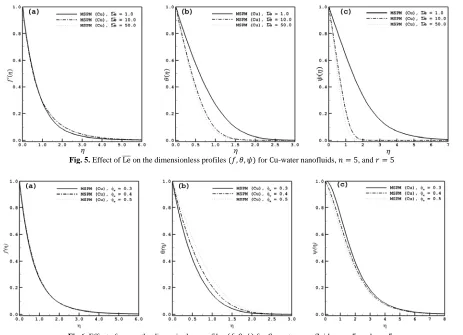
82 Figure 5 demonstrates the effect of Lewis number (Le) on the velocity, temperature, and volume fraction distribution for selected values of Nt and . One can see from Figure(5a) thatLe number has not a major effect on the velocity profile. However, it is remarked from Figs. 5b and 5c that the temperature and the volume fraction decrease with the increase in Lewis number. Lewis number is used to describe fluid flows where there is simultaneous heat and mass transfer and it presents the ratio of thermal diffusivity to mass diffusivity (Brownian diffusion coefficient, D ).
Therefore, the role of mass diffusion on heat transfer weakens with increasing Lewis number (or decreasing D ). Figure 6 represents the effect of the nanoparticle volume fraction at the stretching surface ( ) on the velocity, temperature, and volume fraction distribution. It is evident from Figures (6b) that the temperature increases with the increase in . This behavior is because of the positive role of nanoparticle volume fraction near the surface on the heat transfer enhancement. In addition, according to Figures (6a) and (6c), it is clear that has a little influence on the velocity and volume fraction profiles.
Fig. 5. Effect of Le on the dimensionless profiles ( , , ) for Cu-water nanofluids, = 5, and = 5
Fig.6. Effect of on the dimensionless profiles ( , , ) for Cu-water nanofluids, = 5, and = 5. The last results are belong to the effect of Nt, Le, and
on the dimensionless heat and mass transfer rates. These results are plotted in Figure 7. Figure (7a) illustrates that heat and mass transfer rates decrease with the increase in
Nt. This is due to the fact that by increasing the thermophoresis parameter, the temperature and nanoparticles concentration increase near the solid surface as seen in Figures 4(b-c). However, based on Figure 7b,
P. Akbarzadeh
83
Fig.7. Effect of Nt, Le, and on the dimensionless heat and mass transfer rates for = 5 and = 5
CONCLUSION
The benchmark problem of boundary layer nanofluid flow over a nonlinear stretching sheet is examined numerically. In this study, a modified variable physical properties model for analyzing nanofluids flow and heat transfer is initiated. In this modified model, the effective density and viscosity of nanofluids and the effective thermal conductivity of the solid-liquid mixture which are prevalently utilized in the effective single-phase model (as constant values), are incorporated locally with the governing equations (as no-constant values). A similarity solution is proposed which depends on the local Prandtl number, local Brownian motion number, local Lewis number, and local thermophoresis number. The results for
Cu and Al O nanoparticles are compared to the prevalent single-phase model. This comparison shows that the prevalent single-phase model has a noticeable deviation for predicting the behavior of nanofluids flow especially in dimensionless temperature and nanoparticle volume fraction. In addition, the effect of the important governing parameters on the velocity, temperature, and volume fraction distribution and the heat and mass transfer rates are presented.
ACKNOWLEDGEMENTS
The author would like to acknowledge the Shahrood University of Technology, which supported this project.
REFERENCES
[1] Hamad MA, Ferdows M. Similarity solutions to viscous flow and heat transfer of nanofluid over nonlinearly stretching sheet. Applied Mathematics and Mechanics. 2012 Jul 1;33(7):923-30.
[2] Choi SU, Zhang ZG, Yu W, Lockwood FE, Grulke EA. Anomalous thermal conductivity enhancement in nanotube suspensions. Applied physics letters. 2001 Oct 1;79(14):2252-4.
[3] Aminossadati SM, Ghasemi B. Natural convection cooling of a localised heat source at the bottom of a nanofluid-filled enclosure. European Journal of Mechanics-B/Fluids. 2009 Oct 31;28(5):630-40. [4] Xie H, Lee H, Youn W, Choi M. Nanofluids con-
taining multiwalled carbon nanotubes and their enhanced thermal conductivities. Journal of Applied physics. 2003 Oct 15;94(8):4967-71.
[5] Chol SU. Enhancing thermal conductivity of fluids with nanoparticles. ASME-Publications-Fed. 1995 Nov 12;231:99-106.
[6] Abu-Nada E, Chamkha AJ. Mixed convection flow in a lid-driven inclined square enclosure filled with a nanofluid. European Journal of Mechanics-B/Fluids. 2010 Dec 31;29(6):472-82.
[7] Sheikhzadeh GA, Arefmanesh A, Kheirkhah MH, Abdollahi R. Natural convection of Cu–water nanofluid in a cavity with partially active side walls. European Journal of Mechanics-B/Fluids. 2011 Apr 30;30(2):166-76.
[8] Hassan H. Heat transfer of Cu–water nanofluid in an enclosure with a heat sink and discrete heat source. European Journal of Mechanics-B/Fluids. 2014 Jun 30;45:72-83.
84
[10] Rana P, Bhargava R. Flow and heat transfer of ananofluid over a nonlinearly stretching sheet: a numerical study. Communications in Nonlinear Science and Numerical Simulation. 2012 Jan 31;17(1):212-26.
[11] Yusoff NH, Uddin MJ, Ismail AI. Combined simil -arity-numerical solutions of MHD boundary layer slip flow of non-Newtonian power-law nanofluids over a radiating moving plate. Sains Malaysiana. 2014 Jan 1;43(1):151-9.
[12] Abel S, Prasad KV,Mahaboob A.Buoyancy force and thermal radiation effects in MHD boundary layer visco-elastic fluid flow over continuously moving stretching surface. International Journal of Thermal Sciences. 2005 May 1;44(5):465-76.
[13] Virto SL, Gamez-Montero PJ. Thin liquid film entrainment by moving solids. Journal of Advanced Mechanical Design, Systems, and Manufacturing. 2015;9(3):JAMDSM0024-.
[14] Crane LJ. Flow past a stretching plate. Kurze Mitteilungen - Brief Reports - Communications breves. 1970; 21: 645-647.
[15] Gupta PS, Gupta AS. Heat and mass transfer on a stretching sheet with suction or blowing. The Canadian Journal of Chemical Engineering. 1977 Dec 1;55(6):744-6.
[16] Dutta BK, Roy P, Gupta AS. Temperature field in fl-ow over a stretching sheet with uniform heat flux. International Communications in Heat and Mass Transfer. 1985 Jan 1;12(1):89-94.
[17] Char MI. Heat transfer of a continuous, stretching surface with suction or blowing. Journal of Mathematical Analysis and Applications. 1988 Nov 1;135(2):568-80.
[18] Vajravelu K. Viscous flow over a nonlinearly str-etching sheet. Applied mathematics and computation. 2001 Dec 15;124(3):281-8.
[19] Vajravelu K, Cannon JR. Fluid flow over a nonlinear-ly stretching sheet. Applied Mathematics and Computation. 2006 Oct 1;181(1):609-18.
[20] Cortell R. Viscous flow and heat transfer over a nonlinearly stretching sheet. Applied Mathematics and Computation. 2007 Jan 15;184(2):864-73. [21] Prasad KV, Vajravelu K, Datti PS. Mixed convection
heat transfer over a non-linear stretching surface with variable fluid properties. International Journal of non-linear Mechanics. 2010 Apr 30;45(3):320-30. [22] Postelnicu A, Pop I. Falkner–Skan boundary layer
flow of a power-law fluid past a stretching wedge. Applied Mathematics and Computation. 2011 Jan 1;217(9):4359-68.
[23] Vajravelu K, Prasad KV, Datti PS, Raju BT. MHD flow and heat transfer of an Ostwald–de Waele fluid over an unsteady stretching surface. Ain Shams Engineering Journal. 2014 Mar 31;5(1):157-67. [24] Bachok N, Ishak A, Pop I. Boundary-layer flow of
nanofluids over a moving surface in a flowing fluid.
International Journal of Thermal Sciences. 2010 Sep 30;49(9):1663-8.
[25] Khan WA, Pop I. Boundary-layer flow of a nanofluid past a stretching sheet. International journal of heat and mass transfer. 2010 May 31;53(11):2477-83. [26] Van Gorder RA, Sweet E, Vajravelu K. Nano bou
-ndary layers over stretching surfaces. Communications in Nonlinear Science and Numerical Simulation. 2010 Jun 30;15(6):1494-500. [27] Hassani M , Tabar MM, Nemati H, Domairry G, Noo
-ri F. An analytical solution for boundary layer flow of a nanofluid past a stretching sheet. International Journal of Thermal Sciences. 2011 Nov 30;50(11):2256-63.
[28] Nadeem S, Haq RU, Khan ZH . Heat transfer analysis of water-based nanofluid over an exponentially stretching sheet. Alexandria Engineering Journal. 2014 Mar 31;53(1):219-24.
[29] Das K. Nanofluid flow over a non-linear permeable stretching sheet with partial slip. Journal of the Egyptian Mathematical Society. 2015 Jul 31;23(2):451-6.
[30] Khanafer K, Vafai K, Lightstone M. Buoyancy - dri-ven heat transfer enhancement in a two-dimensional enclosure utilizing nanofluids. International journal of heat and mass transfer. 2003 Sep 30;46(19):3639-53.
[31] Buongiorno J. Convective transport in nanofluids. Journal of Heat Transfer. 2006 Mar 1;128(3):240-50.
[32] Kuznetsov AV, Nield DA. Natural convective boun-dary-layer flow of a nanofluid past a vertical plate. International Journal of Thermal Sciences. 2010 Feb 28;49(2):243-7.
[33] Oztop HF, Abu-Nada E. Numerical study of natural convection in partially heated rectangular enclosures filled with nanofluids. International journal of heat and fluid flow. 2008 Oct 31;29(5):1326-36.