261 International Journal of Transportation Engineering, Vol. 5/ No. 3/ Winter 2018
Application of Particle Swarm Optimization and Genetic
Algorithm Techniques to Solve Bi-level Congestion Pricing
Problems
Yasamin Ghane1, Mehdi Fallah Tafti2, Ali Mostafaeipour3
Received: 05. 02. 2017 Accepted: 12. 06. 2017
Abstract
The solutions used to solve bi-level congestion pricing problems are usually based on heuristic network optimization methods which may not be able to find the best solution for these type of problems. The application of meta-heuristic methods can be seen as viable alternative solutions but so far, it has not received enough attention by researchers in this field. Therefore, the objective of this research was to compare the performance of two meta-heuristic algorithms namely, Genetic Algorithm (GA) and Particle Swarm Optimization (PSO), with each other and also with a conventional heuristic method in terms of degree of optimization, computation time and the level of imposed tolls. Hence, a bi-level congestion pricing problem formulation, for simultaneous optimization of toll locations and toll levels on a road network, using these two meta-heuristic methods, was developed. In the upper level of this bi-level problem, the objective was to maximize the variation in the Net Social Surplus (NSS) and in the lower level, the Frank-Wolfe user equilibrium method was used to assign traffic flow to the road network. PSO and GA techniques were used separately to determine the optimal toll locations and levels for a Sioux Falls network. The numerical results obtained for this network showed that GA and PSO demonstrated an almost similar performance in terms of variation in the NSS. However, the PSO technique showed 45% shorter run time and 24% lower mean toll level and consequently, a better overall performance than GA technique. Nevertheless, the number and location of toll links determined by these two methods were identical. Both algorithms also demonstrated a much better overall performance in comparison with a conventional heuristic algorithm. The results indicates the capability and superiority of these methods as viable solutions for application in congestion pricing problems.
Keywords: Congestion Pricing; Optimal Toll Location; Optimal Toll Level; Particle Swarm Optimization; Genetic Algorithm
Corresponding author E-mail: [email protected]
Application of Particle Swarm Optimization and Genetic Algorithm Techniques to Solve…
International Journal of Transportation Engineering, 262 Vol. 5/ No. 3/ Winter 2018
1.
Introduction
Many cities worldwide are facing issues such as traffic congestion, lack of adequate parking spaces, and increased fuel consumption and air pollution in long traffic jams. These issues are jeopardizing the physical and mental health of residents in these cities. Regulation of traffic flow to prevent traffic jams in downtown areas is long regarded as one of the major strategies in urban transportation management. One of the solutions proposed in this regard is the congestion pricing, which is basically a demand-oriented strategy developed as a substitute for traditional supply-oriented solutions. In demand-oriented solutions, traffic load on the network is controlled through reducing the demand for travel by private cars instead of constructing new highways or widening the existing roads (i.e. increasing the supply). In this context, congestion pricing concerns tolling the private cars when travelling within the congested areas during the busy hours of a day.
The general principle of congestion pricing is to charge private car users for their role in traffic congestion and heavy burden they impose to the society as a result, e.g. increased delays, emissions, noise, and traffic accidents. When setting the toll level, it is very important to evaluate the drivers' willingness to pay for using their own private vehicles [Mirbaha et al, 2013]. It should be remembered that a too low toll level may not meet the original objective of controlling the demand, and a too high toll level may result in public discontent and excessive pressure on the public transportation system. Congestion pricing was first introduced in Singapore in 1975. Later on, this solution was implemented in other major cities such as Bergen (1986), Oslo (1990), Trondheim (1991), London (2003) and Stockholm (2007). Most of the current congestion pricing systems, toll the cars and heavy goods vehicles seeking entry to the priced area (usually the downtown areas) during certain hours [Hensher, 2012]. Congestion pricing methods are divided into two categories namely, first best pricing methods and second best pricing methods. In
developing these methods, the effectiveness of a pricing scheme is usually evaluated using appropriate criteria such as travel time and social surplus. In the first best pricing methods, users are charged for passing through any link of the road network. The improvement of social surplus through a first-best solution is an upper bound to the improvement that can be achieved by any second best pricing scheme. Nevertheless, there has been less attention to the first best pricing methods which can be attributed to their inflexibility to impose any restriction on the pricing scheme, their technological and implementation limitations, their high operating costs and their low public acceptance [Yang and Zhang, 2003; Yang and Huang, 2005]. In contrast, the second best pricing methods are usually favored as they would allow to impose a number of restrictions on the congestion pricing scheme, e.g. only a limited number of predetermined toll levels are used, only a subset of network links are tolled, only a limited range of toll levels are used or only a closed cordon area of the network is tolled. These methods would also allow to implement a combination of such restrictions [Ekstrom, 2008].
Therefore, the majority of previous studies on the optimal congestion pricing schemes have concentrated on the second best pricing methods and especially on the schemes with pre-specified toll locations. In these studies, toll locations are already established and the remaining issue has been to solve the toll level setting problem [Yang and Huang, 2005; Yang and Lam, 1996; Verhoef et al, 1996; Marchand, 1968; Liu and McDonald, 1999; Lindsey, and Verhoef, 2001; Verhoef, 2002]. The toll collection costs has also been disregarded in these studies. However, in real terms, there are costs associated with the setting up and the operation of toll collection systems. Incorporating these costs into the optimization framework allows us to not only maximize the social surplus, but also the difference between this surplus and toll collection costs (i.e. net social surplus).
Yasamin Ghane, Mehdi Fallah Tafti, Ali Mostafaeipour
263 International Journal of Transportation Engineering, Vol. 5/ No. 3/ Winter 2018 determine the optimal locations of toll
collection links and their corresponding toll levels.
The simultaneous optimization of combined toll location and toll level setting problem has only been considered in a few studies. In these studies, conventional network optimization methods based on iterative or trial and error methods have usually been used [Shepherd and Sumalee, 2004; Ekstrom, 2008; Ekstrom, 2014]. For instance, the heuristic method proposed by [Ekstrom, 2008] was based on repeated solutions of an approximation to the combined toll location and level setting problem, with the objective to maximize net social surplus. Such approximation procedure requires examining numerous combinations of toll links even for small networks. At the end, these methods may only identify a local optimum which may not correspond to the best solution. [Ekstrom, 2008] observed that his proposed approximation approach may suggest unnecessary toll locations and the results can further be improved by their elimination. Hence, it is required to adopt a more effective method to examine possible link combinations and to identify a local or global optimum value for the objective function. This task can be performed more efficiently through the application of meta-heuristic methods such as Genetic Algorithm (GA) or Particle Swarm Optimization (PSO) techniques. As these techniques rely on the nature-inspired mechanisms to identify desired choices, it can be assumed they may yield solutions much closer to the global optimum. A number of studies have already used GA technique to solve toll network design problems using second-best pricing approach[Yang and Zhang, 2003; Shepherd and Sumalee, 2004; Cree et al, 1998]. But in these studies, GA has mainly been used either to locate the toll links or to set the toll level, and never for simultaneous optimization of both.
More recently, [Fan, 2016] proposed a bi-level GA-based solution for the simultaneous optimization of tolling locations and toll levels in a multi-class network. The objective function for the upper level problem was set to minimize the travel time of the entire system and the
lower problem was considered as a traditional user equilibrium problem. Two GA methods were used for solving this problem, one by defining separate chromosome structures for toll location and toll level setting, and another by defining a single chromosome structure for both. Assuming homogeneity of the road users, these two solution methods were then implemented on the Sioux Falls road network and their performance was compared. The results indicated that the solution based on a single chromosome structure performed more effectively than the other.
In recent years, PSO technique has also successfully been used to solve various bi-level problems in other fields [Zhao and Gu, 2006; Kuoa and Huang, 2009; Ma and Wang, 2013; Zhong et al, 2016; Zaman et al, 2017]. PSO enjoys a lot of advantages, such as memory utilization, cooperation and information sharing between particles, high convergence rate, high flexibility in terms of avoiding local optima, ease of design and implementation.
Reviewing the literature dedicated to this subject shows that the methods previously proposed to solve bi-level congestion pricing problem have rarely been based on a simultaneous toll location/level optimization approach. Most of these methods have been based on conventional network optimization heuristics methods and have rarely used meta-heuristic methods such as GA for this purpose. Furthermore, no previous study was identified in which PSO method has been used for this purpose. Therefore, the objective of this research was to compare the performance of two meta-heuristic methods namely, GA and PSO, with each other and also with a conventional heuristic method in terms of degree of optimization, computation time and the level of imposed tolls.
2.
Formulation
of
Bi-level
Problem
The following notations are used in order to present the model formulation.
Application of Particle Swarm Optimization and Genetic Algorithm Techniques to Solve…
International Journal of Transportation Engineering, 264 Vol. 5/ No. 3/ Winter 2018
a = link
i = Origin-Destination (O-D) pair A = set of links such that a ∈ A I = set of O-D pairs such that i ∈ I
Data/parameters:
qi = travel demand between O-Dpair i q = travel demand vector
ca ()= average travel cost on link a
p = each route on traffic network corresponding to an O-D
fp = traffic flow on route p Di−1(q
i) = Inverse travel demand function of
O-Dpair i given qi
Ti = total travel demand between O-Dpair i Ai = car demand between O-Dpair i in the no-toll scenario
Ki = public transportation demand between O-Dpair i in the no-toll scenario
α = scale parameter for Gumbel probability distribution
δpa = a dummy that takes on the value of 1 if route p traverses link a, and 0 otherwise πi = the cost of traveling by car between O-D
pair i
πi0 = the car travel cost in O-D pair i ∈ I in the
no-toll scenario w = integral variable Decision Variables:
τa = toll level on link a
va = traffic flow on link a v = link flow vector
In order to solve the bi-level problem under consideration, it is initially required to solve the lower level problem through using an appropriate traffic assignment method, e.g. Frank Wolfe’s user equilibrium algorithm to determine traffic loads on each network link. The outputs from the lower level problem is then used to solve the upper level problem as an optimization problem through which the tolled links and their corresponding toll levels are determined. On this basis, the following steps were defined and then coded in the MATLAB software accordingly.
1. The first step was to solve the lower level problem, i.e. traffic assignment or the network loading. Using the Multi-Nominal Logit (MNL) for splitting public and private transportation modes, the combination of user equilibrium problem and mode choice problem can be expressed as Equation (1).
min
q,v G(q, v) = ∑ ∫
c
a(w +va
0 a∈A
τ
a)dw − ∑ [πi∈I i0qi+qαilnAi(TKiiq−qi i)+ Tiαln(
Ti
Ti−qi)] (1)
Subject to:
∑ fp = qi,
p∈Πi
∀i ∈ I
fp ≥ 0, ∀i ∈ I, ∀p ∈ Πi
qi ≥ 0, ∀i ∈ I
va= ∑ ∑ fpδpa p∈Πi
i∈I
, ∀a ∈ A
Yasamin Ghane, Mehdi Fallah Tafti, Ali Mostafaeipour
265 International Journal of Transportation Engineering, Vol. 5/ No. 3/ Winter 2018 drivers is also considered. This equation was
solved using the link-based Frank-Wolfe method which is one of the first and still commonly used methods to solve user equilibrium traffic assignment problem [Frank and Wolfe, 1956; Sheffi, 1984].
By solving this equation, the optimal traffic flow rate (va ) and the optimal demand (qa) for
any link of the road network (i.e. link a) were determined, and the Net Social Surplus (NSS) for the no-toll scenario (NSS°) was calculated using equations provided in step (5).
2. The outputs of trip assignment model were used as inputs of GA and PSO algorithms. In this step, the optimal toll locations and levels were determined by GA and PSO algorithms using the objective function given in Equation (2).
max
τ∈χ F(v(τ), π̂(τ), τ) = 1
α∑ Tiln [
Ai Tie
α(πi0−π̂i)+ i∈I
Ki
Ti] + ∑a∈Ava(τ)τa− ∑a∈ACasign(τa)
(2)
Where Ca is the cost of toll collection on link a; π̂i and πi0 are the minimum cost of travel by private car users between each O-D pair in toll and no-toll scenarios, respectively. The third part of Equation (2) represents the toll operation cost. Function sign(τa) takes on the value of 1 if link a is tolled, and 0 otherwise.
Travel cost was estimated using quadratic cost Equation (3).
ca(va) = Ta(1 + 0.15 (va
Ka)
4
) (3)
Where Ta is the free flow travel cost on link a; Ka is the maximum capacity of link a.
3. The toll vector was updated using the results of GA and PSO algorithms. The user equilibrium problem was re-solved and then traffic flow rate and traffic demand on each link was updated. The outputs were used to re-solve the upper level problem again and this process was repeated in successive iterations until the termination condition is met.
4. Links with positive toll level were considered as tolled links and their toll rate was reported as
optimal toll level.
5. Improvement in NSS was calculated through the following steps.
Social surplus was calculated from Equation (4).
SS = CS + R (4)
Where R denotes the total toll revenue, which is obtained by Equation (5).
R = ∑a∈Aτava (5)
Net user benefit which refers to consumer surplus was defined as the difference between user benefit from user cost as expressed in Equation (6).
CS = UB − UC (6)
In the above equation, the user benefit is calculated from Equation (7) [Verhoef, 2002]. 𝑈𝐵 = ∑ ∫ 𝐷𝑞𝑖 𝑖−1(𝑤)
0 𝑑𝑤
𝑖∈𝐼 (7)
User costs refers to total cost of travel in the network, which consists of link costs plus the O-D pairs costs, which was obtained from Equation (8).
UC = ∑a∈Aĉa(va)va= ∑i∈Iπ̂iqi (8)
As mentioned earlier, when the toll level setting problem is solved, it is common to ignore the operator cost and set the objective on the maximization of social surplus. But when the combination of toll locations and toll levels are simultaneously considered in these optimization problems, it is essential to incorporate the operator cost into the formulations as it would affect the number and location of tolled links [Ekstrom, 2008]. NSS can then be calculated using Equation (9). NSS = SS − OC (9)
Application of Particle Swarm Optimization and Genetic Algorithm Techniques to Solve…
International Journal of Transportation Engineering, 266 Vol. 5/ No. 3/ Winter 2018
OC = ∑a∈AλaCa (10)
Where Ca is the toll collection cost on link a; λa takes on the value of 1 if link a is tolled, and 0 otherwise.
Instead of social surplus, its variation or Delta Social Surplus (∆SS), can also be used. ∆SS can then be calculated from Equation (11).
∆SS = ∆CS + ∆R (11)
In this case, the objective will be to
maximize
the
Delta
Net
Social
Surplus(∆NSS).
∆NSS can be calculatedfrom Equation (12).
∆NSS = ∆SS − OC (12)
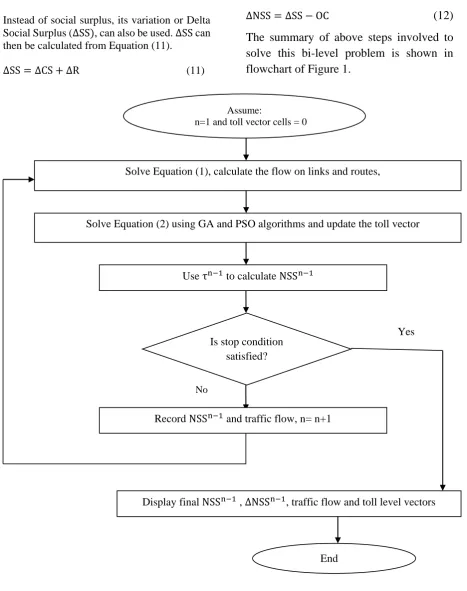
The summary of above steps involved to
solve this bi-level problem is shown in
flowchart of Figure 1.
Figure 1. Summary of steps involved to solve the bi-level problem Solve Equation (1), calculate the flow on links and routes,
Solve Equation (2) using GA and PSO algorithms and update the toll vector
Use τn−1 to calculate NSSn−1
Is stop condition satisfied?
Assume:
n=1 and toll vector cells = 0
Record NSSn−1 and traffic flow, n= n+1
Yes
Display final NSSn−1 , ∆NSSn−1, traffic flow and toll level vectors
End
Yasamin Ghane, Mehdi Fallah Tafti, Ali Mostafaeipour
267 International Journal of Transportation Engineering, Vol. 5/ No. 3/ Winter 2018
3.
Application of the Proposed
Methodology and Results
In this section, first the Sioux Falls traffic network used to examine the performance of methods under consideration is outlined. Then, two meta-heuristic methods namely, PSO and GA algorithms, and also a heuristic method proposed by [Ekstrom, 2008] that were used for the simultaneous optimization of tolling locations and toll levels are described. Finally the results obtained from the application of these methods are presented.
3.1
Traffic Network Model
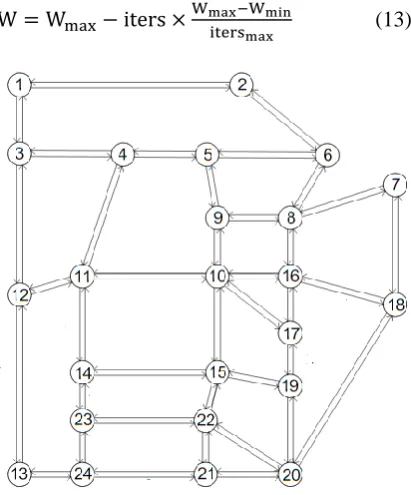
The traffic network used in this study to evaluate and demonstrate the performance of meta-heuristic methods is the Sioux Falls network. First introduced by [LeBlanc, 1975], this network has 24 nodes, 528 O-D pairs and 76 links. This network has been extensively used to demonstrate and evaluate solution methods proposed to resolve different network problems. [Ekstrom, 2008] and [Fan, 2016] in their studies used the same network parameters and the O-D matrix values as they were originally used by [LeBlanc, 1975]. In order to use the results of their studies to evaluate and compare the performance of GA and PSO algorithms proposed in this study, the same values were used in this study as well. In general, this network has a 24-hour traffic data, but similar to the [Ekstrom, 2008] studies, only the morning rush hour data was used and it was assumed to be one tenth of total daily traffic volume. Sioux Falls network is illustrated in Figure 2.
3.2.
Application of PSO Algorithm to
Solve the Upper Level Problem
Before using PSO algorithm, it was required to determine its parameters. For this purpose, the acceleration coefficients C1 and C2 were considered to be 2 and particle velocity was assumed to be random. The initial inertia weight, w, was assumed to be between 0.4 and 0.9. Similar to the study carried out by [Ekstrom, 2008], the lower and upper bounds of toll levels were considered to be 0 and 20
Swedish Krona (SEK) respectively. Each SEK is equivalent to 0.12 US dollar and 3650 IR Rials. In each iteration, W was updated using Equation (13).
W = Wmax− iters ×Wmax−Wmin
itersmax (13)
Figure 2. Sioux Falls traffic network Where 𝑖𝑡𝑒𝑟𝑠 is the current iteration number, Wmax is the maximum inertia weight of particles, Wmin is the minimum inertia weight of particles, and 𝑖𝑡𝑒𝑟𝑠𝑚𝑎𝑥 is the maximum
number of iterations.
The developed PSO algorithm was run on the Sioux Falls network. To facilitate the comparison of algorithm results with the results of heuristic method used by [Ekstrom, 2008], the cost of toll collection on all tolled links of the network was considered to be a constant rate of 1500 SEK/hour and Value of Time (VOT) was considered to be 1 SEK/minute. All values obtained from the algorithm are in SEK. Also, scale parameter of Gumbel distribution was assumed to be 0.5.
Application of Particle Swarm Optimization and Genetic Algorithm Techniques to Solve…
International Journal of Transportation Engineering, 268 Vol. 5/ No. 3/ Winter 2018
results. For example, NSS values obtained during 30 iterations of PSO and 30 iterations of Frank-Wolfe algorithm are shown in Figure 3. In this figure, the curve labeled BEST represents the optimal solution of PSO algorithm and the curve labeled MEAN represents the mean value of solutions obtained from all particles in the search space.
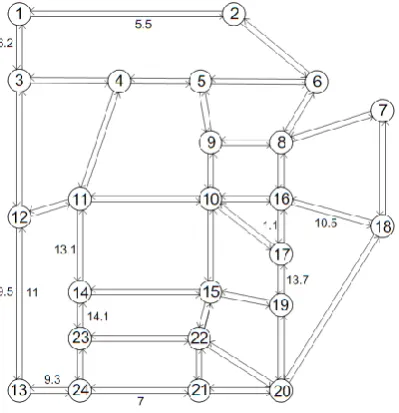
Figure 3. NSS values obtained during 30 iterations of PSO and Frank-Wolfe algorithms. Finally selected tolled links and their corresponding toll levels obtained from PSO algorithm for Sioux Falls network are shown in Figure 4.
Figure 4. Finally selected tolled links and their corresponding toll levels (in SEK) obtained from
PSO algorithm
3.2
Application of GA Algorithm to Solve
the Upper Level Problem
Similar to the PSO algorithm, it was initially required to set the parameters of GA algorithm. Some of the adopted procedures and parameter settings were based on the findings of a similar research carried out by [Fan, 2016]. For instance, in the GA based solution procedure, a single chromosome structure was applied for both toll locations and their corresponding toll levels, i.e. the population was initialized after the chromosomes for both toll levels and locations were combined. Furthermore, the following parameters were similarly used in this research: maximum number of generation, 1000; population size, 64; and mutation probability, 0.05. In both researches, Frank-Wolfe user equilibrium method was applied to solve lower-level problem. However, no limitation on the maximum tolled links was assumed in this research, whereas a maximum limit of 10 tolled link was applied by [Fan, 2016] in his research. Furthermore, the objective function for the upper level problem was set to the maximization of NSS in this research whereas, [Fan, 2016] used the minimization of total system travel time as the upper level objective function.
In the GA algorithm, the number of parent chromosomes was calculated using Equation (14).
nc = 2 × round (pc ×nPop
2 ) (14)
Where pc is the crossover probability and nPop is the number of chromosomes.
The developed GA was run on the Sioux Falls network. Similar to the PSO algorithm, the cost of toll collection on all tolled links of the network was considered to be 1500 SEK/hour, VOT was considered to be 1 SEK/minute, and scale parameter of Gumbel distribution was assumed to be 0.5.
Using test runs and plotting the curve of NSS values against the number of iterations of GA and Frank-Wolfe algorithms, stop conditions were set to maximum 50 iterations for GA algorithm and maximum 35 iterations for
Iteration Number
NS
Yasamin Ghane, Mehdi Fallah Tafti, Ali Mostafaeipour
269 International Journal of Transportation Engineering, Vol. 5/ No. 3/ Winter 2018 Frank-Wolfe algorithm. This was due to the fact
that further iterations did not make any significant difference in the results.
Figure 5. NSS values obtained during 50 iterations of GA and 35 iterations of
Frank-Wolfe algorithm
For example, NSS values obtained during 50 iterations of GA and 35 iterations of Frank-Wolfe algorithm is illustrated in Figure 5. In this figure, the curve labeled BEST represents the optimal solution of the GA algorithm and the curve labeled MEAN represents the mean value of solutions obtained from all chromosomes.
Figure 6 shows the finally selected toll links and their corresponding toll levels obtained from GA for Sioux Falls network.
Toll levels and locations obtained with GA and PSO are given in Table 1
Figure 6. Finally selected toll links and their toll levels (in SEK) obtained from GA
Table 1. Tolled links and their toll levels
Toll level based on PSO (SEK)
Toll level based on GA (SEK)
Tolled link
5.5 7
1-2
6.2 5.2
1-3
13.1 11.9
11-14
9.5 8.1
12-13
11 17.9
13-12
1.1 8.1
16-17
10.5 20
16-18 Iteration Number
NS
Application of Particle Swarm Optimization and Genetic Algorithm Techniques to Solve…
International Journal of Transportation Engineering, 270 Vol. 5/ No. 3/ Winter 2018
13.7 17.3
19-17
14.1 12
23-14
7 17.2
24-21
9.3 13.6
13-24
Table 2. A comparison of the performance of meta-heuristic and heuristic methods
Applied algorithm
Algorithm run time (sec)
No. of tolled links
Mean toll level (SEK)
ΔNSS
Value
% relative improvement
in comparison with Ekstrom
method
PSO 11,078 11 9.2 79,953 9
GA 20,314 11
12.1
81,801 11Heuristic method [Ekstrom,
2008]
Not available 27 11.6 72,919
-Table 3. Comparison of the results of GA/PSO algorithms in this study and the GA developed by [Fan, 2016]
NSS No. of tolled
links Algorithm
run time (sec)
Meta-heuristic
algorithm
1,107,351 11
11,078
PSO
1,125,074 11
20,314
GA
1,024,412 10
Not available GA developed by [Fan,
2016]
3.3
Comparison of Performance
For the studied problem, ΔNSS values obtained
Yasamin Ghane, Mehdi Fallah Tafti, Ali Mostafaeipour
271 International Journal of Transportation Engineering, Vol. 5/ No. 3/ Winter 2018 method used by [Ekstrom, 2008] under similar
conditions was 72919.
Thus, it can be concluded that both meta-heuristic algorithms have outperformed the heuristic algorithm. A comparison of the performance of these three methods in terms of measures used for comparison namely, algorithm run time, number of tolled links, mean toll level and ΔNSS is presented in Table 2.
The results of these two meta-heuristic algorithms in comparison with the results of outperformed GA model developed by [Fan, 2016] is presented in Table 3. Note that in the study carried out by [Fan, 2016], the maximum number of toll links was intentionally limited to 10 links.
The results presented in Table 2 and Table 3 show that both GA and PSO methods, while requiring a much lower number of links than a well-known heuristic method, have resulted in higher net social surplus for the network users. These results demonstrate the superiority of GA and PSO meta-heuristic methods over conventional trial and error approximation algorithms in this respect.
As indicated in Table 3, NSS values obtained from the GA method developed in this study and the one developed by [Fan, 2016] are close to each other. This similarity confirms the validity of developed GA method in this study and again demonstrates the superiority of meta-heuristic algorithms over meta-heuristic algorithms, when used to solve bi-level problems.
4.
Conclusions
In this research, a bi-level methodology was used for the simultaneous optimal determination of tolled links and their corresponding toll levels. Through an iterative process, Equation (1) based on the Frank-Wolfe user equilibrium method was used in lower level to assign traffic on a well-known traffic network namely, Sioux Falls network. In higher level, the outputs from the Frank-Wolfe algorithm (i.e. traffic flow on each link of the network) were then used as inputs to two individual meta-heuristics methods namely,
GA and PSO. This iterative process was repeated until the optimal value for the objective function (Equation 2) was reached and the final tolled links and their corresponding toll levels were identified. The results obtained from these two methods were compared with each other and also compared with the results obtained from a heuristic method used by [Ekstrom, 2008] in similar conditions. The following conclusions can be drawn from theses comparisons.
1) Both GA and PSO methods demonstrated an almost similar performance in terms of ΔNSS. This indicates that these two methods have similar capability in acquiring an optimal value for the same objective function.
2) Algorithm run time is an important parameter in such optimization problems, especially when large networks are involved. It could indicate the efficiency of applied method in solving the problem. The results presented in Table 2 and Table 3 indicate that the PSO algorithm developed in this study achieved the optimum solution in about 55% run time that was required for the GA method under similar conditions. 3) Both meta-heuristic algorithms developed
in this study selected 11 similar tolled links. Thus, in this respect, there was no difference between their performances. 4) A lower mean toll level obtained by an
algorithm may indicate an apparent better social surplus for the network users and thereby capture a better public acceptance. Therefore, one can argue that from the users’ perspective, an algorithm that provides a lower toll level has a better performance. Thus, in this respect, it can be claimed that the PSO method with mean toll level of 9.2 SEK has produced a better performance than the GA method with mean toll level of 12.1 SEK.
Application of Particle Swarm Optimization and Genetic Algorithm Techniques to Solve…
International Journal of Transportation Engineering, 272 Vol. 5/ No. 3/ Winter 2018
and to apply proposed methodology for real traffic networks.
5.
References
Cree, N. D., Maher, M. J and Paechter, B. (1998) “The continuous equilibrium optimal network design problem: a genetic approach”, Transportation Networks: Recent Methodological Advances. Pergamon, Amsterdam, pp. 163–174.
- Ekstrom, J. (2008) “Designing urban road congestion charging systems-models and heuristic solution approaches”, M.Sc. thesis, Department of Science and Technology, Linkoping University, Sweden.
- Ekstrom, J. (2014) “Finding second-best toll locations and levels by relaxing the set of first-best feasible toll vectors”, European Journal of Transport and Infrastructure Research, Vol. 14, No. 1, pp. 7-29. - Fan, W. (2016) “Optimal congestion
pricing toll design under multiclass transportation network schemes: Genetic algorithm approaches”, Journal of Case Studies on Transport Policy, Vol. 2, No. 4, pp. 78-87. - Frank, M. and Wolfe, P. (1956) “An
algorithm for quadratic programming”, Journal of Naval Research Logistics Quarterly, Vol. 3, pp. 95–110.
- Kuoa, R. J. and Huang, C. C. (2009) “Application of particle swarm optimization algorithm for solving bi-level linear programming problem”, Journal of Computers and Mathematics with Applications, Vol. 58, No. 4, pp. 678–685.
LeBlanc, L. J. (1975) “An algorithm for the discrete network design problem”, Journal of Transportation
Science, Vol. 9, No. 3, pp. 183-199. Li, Z. and Hensher, D. A (2012) “Congestion charging and car use: A review of stated preference and opinion studies and market monitoring evidence”, Journal of Transport Policy, Vol. 20, pp. 47-61.
Lindsey, R. and Verhoef, E.T. (2001) “Traffic congestion and congestion pricing”, In: D.A. Hensher and K.J. Button (Eds.) (2001) Handbook of Transport Systems and Traffic Control, Handbooks in Transport, Vol. 3, Elsevier /Pergamon, Amsterdam, pp.77–105.
Liu, L. N. and McDonald, G. (1999) “Economic efficiency of second-best congestion pricing schemes in urban highway systems”, Journal of Transportation Research Part B, Vol. 33, pp. 157–188.
Ma, W. and Wang, M. (2013) “Particle Swarm Optimization-based algorithm for bi-level joint pricing and lot-sizing decisions in a supply chain”, International Journal of Applied Artificial Intelligence, Vol. 27, No. 6, pp. 441-460.
Marchand, M. (1968) “A note on optimal tolls in an imperfect environment”, Journal of Econometrica, Vol. 36, pp. 575– 581.
Mirbaha, B., Saffarzadeh, M., Seyed Abrishami, S. E. and Prdovani, A. (2014) “Evaluating the Willingness to pay for urban congestion priced zones (case study of Tehran)”, International Journal of Transportation Engineering, Vol. 1, No. 3, pp. 199-210.
Yasamin Ghane, Mehdi Fallah Tafti, Ali Mostafaeipour
273 International Journal of Transportation Engineering, Vol. 5/ No. 3/ Winter 2018 Equilibrium analysis with
mathematical programming methods”, Prentice-Hall, New Jersey.
Shepherd, S. and Sumalee, A. (2004) “A genetic algorithm based approach to optimal toll level and locations problems”, Journal of Network Spatial Economics, Vol. 2, No. 4, pp. 161–179.
Sumalee, A. (2004) “Optimal road user charging cordon design: A heuristic optimization approach”, Journal of Computer-Aided Civil and Infrastructure Engineering Vol. 19, No. 5, pp. 377–392.
Verhoef, E.T., Nijkamp, P. and Ritveld, P. (1996) “Second-best congestion pricing: the case of an un-tolled alternative”, Journal of Urban Economics, Vol. 40, No. 3, pp. 279–302.
Verhoef, E.T. (2002) “Second-best congestion pricing in general static transportation networks with elastic demands”, Journal of Regional Science and Urban Economics, Vol. 32, No. 3, pp. 281-310.
Yang, H. and Lam, W.H.K. (1996) “Optimal road tolls under conditions of queuing and congestion”, Journal of Transportation Research Part A, Vol. 30, No. 5, pp. 319–332. Yang, H. and Zhang, X. (2003)
“Optimal toll design in second-best link-based congestion pricing”, Journal of Transportation Research Record, No. 1857, pp. 85–92. Yang, H. and Huang H. J. (2005)
“Mathematical and economic theory of road pricing”, Elsevier Science Inc, New York.
Zaman, F., Elsayed, S. M., Ray, T.
and Sarker, R. A. (2017) “Co-evolutionary approach for strategic bidding in competitive electricity markets”, Journal of Applied Soft Computing, Vol. 51, pp. 1-22. Zhao, Z. and Gu, X. (2006) “Particle
swarm optimization based algorithm for bilevel programming problems”, Proceedings of the Sixth International Conference on Intelligent Systems Design and Applications, Vol. 02, pp. 951-956. Zhong, F. Yuan, B. and Li, B.