HEAT AND MASS TRANSFER ON MHD FLUID FLOW OVER A SEMI
INFINITE FLAT PLATE WITH RADIATION ABSORPTION, HEAT
SOURCE AND DIFFUSION THERMO EFFECT
G. Dharmaiah
a*, CH. Baby Rani
b, N. Vedavathi
c, and K.S. Balamurugan
d aDepartment of Mathematics, Narasaraopeta Engineering College, Yellamanda, Narsaraopet, Andhra Pradesh, 522601, India.
b
Department of Mathematics, V. R. Siddhartha Engineering College, Kanuru, Andhra Pradesh, 520007, India.
c
Department of Mathematics, Koneru Lakshmaiah Education Foundation, Vaddeswaram, Guntur, Andhra Pradesh, 522502, India.
d
Department of Mathematics, RVR & JC College of Engineering, Chowdavaram, Guntur, Andhra Pradesh, 522019, India.
A
BSTRACTAnalytical investigation is carried out to analyze the unsteady, two-dimensional, laminar, boundary layer flow of a viscous incompressible electrically conducting and heat absorbing fluid along a semi-infinite vertical permeable moving plate in the presence of Diffusion-thermo and radiation absorption effects. The set of ordinary differential equations are solved by using perturbation technique. The effects of the various fluid flow parameters on velocity, temperature and concentration fields with in the boundary layer have been analyzed with the help of graphs. Numerical values of local skin-friction coefficient, nusselt number and Sherwood number are tabulated.
Keywords: Diffusion-thermo, Heat Absorption, Radiation Absorption, MHD, Unsteady.
*Corresponding Author. Email: [email protected]
1.
INTRODUCTION
Fluid dynamics of various fluids have many engineering and industrial applications. In particular combined heat and mass transfer from different processes with porous media has a wide range in engineering and industrial applications oil recovery, underground energy transport, geothermal reservoirs, cooling of nuclear reactors, drying of porous solids, packed-bed catalyst reactors and thermal insulation. When heat and mass transfer occur simultaneously between the fluxes, the driving potentials are of more intricate nature. An energy flux can be generated not only by temperature gradients but by composition gradients. The energy flux caused by a called Dufour or Diffusion thermo effect. Generally the thermal diffusion and the diffusion thermo effects are of smaller order magnitude than the effects prescribed by Fourier’s laws and are often neglected in heat and mass transfer processes. However, there are exceptions. Thermal-diffusion effect, for instance, has been utilized for isotope separation and in mixture between gases with very light molecular weight (Hydrogen-Helium) and of medium molecular weight (Nitrogen-air) the diffusion-thermo effect was found to be of a magnetic such that it cannot be neglected. Umamaheswar et al. (2016) studied the effects of chemical reaction, radiation absorption and thermal diffusion. Srinivasacharya et al. (2015) reported on the effects of dufour along a vertical wavy surface. Hayday et al. (1967) analyzed natural convection flow from a vertical plate with discontinuous thermal boundary conditions considering different aspects of the problem. Effects of free convection currents and mass transfer on the unsteady flow of an electrically conducting and viscous incompressible fluid around an accelerated infinite vertical porous plate subjected to variable suction in presence of a transverse magnetic field, have been studied by Hossain and Mandal (1985). The study of heat generation or absorption effects in moving fluids is important in view of several
physical problems, such as fluids undergoing exothermic or endothermic chemical reactions. Possible heat generation effects may alter the temperature distribution and consequently, the particle deposition rate in nuclear reactors, electrical chips and semi conductor wafers. Merkin (2012) has been inspected all effects with convective boundary layer flow. Raptis (1998) has been given experimental work through porous medium. Raptis and Singh (1983) have been performed all the results in an accelerated vertical plate. The interaction of buoyancy with thermal radiation has in increased greatly the last decade due to its importance in many practical applications. Thermal radiation effect is important under many isothermal and non-isothermal situations. If the entire system involving the polymer extrusion process is placed in a thermally controlled environment, then thermal radiation could be important. The knowledge of radiation heat transfer in the system can perhaps, lead to a desired product with sought characteristics. The effect of radiation on flow and heat transfer over a vertically oscillating porous flat plate embedded in porous medium with oscillating surface temperature is investigated by Kim (2000). Convection in porous media can also be applied to underground coal gasification, ground water hydrology, iron blast furnaces, wall cooled catalytic reactors, cooling of nuclear reactors, solar power collectors, energy efficient drying processes, cooling of electronic equipments and natural convection in earth’s crust. Abiodun et al. (2015) have been explained radiation absorption effect through porous materials with effect of chemical reaction and radiation absorption on the unsteady MHD natural convection flow, by considering one of the plate moves with a constant velocity in the direction of fluid flow while the other plate is stationary. Anilkumar (2011) performed to obtain the nonsimilar solution of an unsteady laminar mixed convection on a continuously moving vertical plate. Aydin and Kaya (2009) analytically explained the problems the effects of MHD mixed convection fluid about a permeable vertical flat plate applying numerical method. The mixed convective boundary layer flows over a
Frontiers in Heat and Mass Transfer
flat plate are investigated by Bhattacharyya et al. (2013). The combined effects of heat and mass transfer with chemical reaction are of great importance to engineers and scientists because of its almost universal occurrence in many branches of science and engineering, and hence received of considerable amount of attention in recent years. The study of chemical reaction with heat transfer in porous medium has important engineering applications e.g., tabular reactors, oxidation of solid materials and synthesis of ceramic materials. Heat and mass transfer effects on the unsteady flow of a micropolar fluid through a porous medium bounded by a semi-infinite vertical plate in a slip-flow regime are studied taking into account a homogeneous chemical reaction of the first order numerically studied by Chaudhary and Jha (2008). Patil and Chamkha (2013) have been experimented chemical reaction effect along with porous medium. Patil et al. (2009) have been explained chemical reaction in the presence of heat generation. Sahin and Karabi (2014) numerically studied chemical reaction effect on impulsively-started vertical plate. Soundalgekar and Wavre (1997) exhibited all effects on unsteady free convection flow past an infinite plate.
Recently, Durga Prasad et al. (2015) focuses on unsteady, two-dimensional, laminar, boundary layer flow of a viscous incompressible electrically conducting fluid long a semi-infinite vertical permeable moving plate in the presence of Diffusion-thermo and radiation absorption effects. In this paper we consider unsteady simultaneous convective heat and mass transfer flow along a vertical permeable plate embedded in a fluid-saturated porous medium in the presence of mass blowing or suction, diffusion-thermo and radiation absorption effects, magnetic field effects and absorption effects. In all above investigations it is noticed however they have not considered2. In the present work,
the set of ordinary differential equations are solved by considering
2
in regular perturbation method. The effect of non-dimensional governing parameters on velocity, temperature and concentration profiles are discussed are presented through graphs. Numerical values of local skin-friction coefficient, Nusselt number and Sherwood number are tabulated.
2.
ANALYSIS OF THE FLOW OF THE PROBLEM
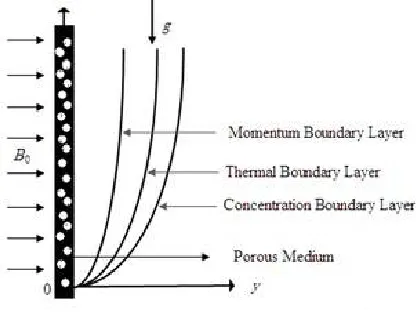
We consider unsteady two-dimensional flow of an incompressible, viscous, electrically conducting and heat-absorbing fluid past a semi-infinite vertical permeable plate embedded in a uniform porous medium which is subject to slip boundary condition at the interface of porous and fluid layers. A uniform transverse magnetic field of strength B0 is
applied in the presence of radiation and concentration buoyancy effects in the direction of y*- axis. The transversely applied magnetic field and magnetic Reynolds number are assumed to be very small so that induced magnetic field and Hall Effect are negligible.
Fig. 1 Problem Configuration
It is assumed that there is no applied voltage which implies the absence of electric field. Since the motion is two dimensional and the length of the plate is large enough so all the physical variables are independent of
*
x . The wall is maintained at constant temperature Tw and
concentration Cw, higher than the ambient temperature Tand the concentrationC, respectively. Also, it is assumed that there exists a homogeneous first-order chemical reaction with rate constant R between the diffusing species and the fluid. It is assumed that the porous medium is homogeneous and present everywhere in local thermodynamic equilibrium. Rest of properties of fluid and the porous medium are assumed to be constant. In the above assumptions the governing equations as follows:
Continuity Equation:
*
* 0
y
(1)
Momentum Equation:
2
2
* * 2 *
* 0 *
* * *
* *
1
( )
( )
T
c
B
u u p u
u g T T
t y x y
g C C u
K
(2) Energy Equation:
2 2
2 * 2
* 0 1
* * * ( ) ( ) *
m T
p p s p
Q D
T T T Q K C
T T C C
C C C C
t y y y
(3) Mass Diffusion Equation:
2
2 *
1
* * * ( )
C C C
D K C C
t y y
(4) Where x and y* *are the dimensional distances along to the plate.u and v* *are the components of dimensional velocities along
* *
x and y directions. G is the gravitational acceleration, T*is the dimensional temperature of the fluid near the plate, Tis the stream dimensional temperature, C*is the dimensional concentration, Cis the stream dimensional concentration, TandCare the thermal and concentration expansion coefficients, respectively. p*is the pressure,
p
C is the specific heat of constant pressure, B0is the magnetic field coefficient, is the viscosity of the fluid, qr* is the radiative heat flux,is the density, K is the thermal conductivity, is the density magnetic permeability of the fluid,
is the kinematic viscosity, D is the molecular diffusivity, Q0 is the dimensional heat absorption coefficient, Q1*is the coefficient of proportionality of the absorption of
the radiation and R is the chemical reaction. The fourth and fifth terms of RHS of the Eq.(2) denote the thermal and concentration buoyancy effects, respectively. The second and third term on the RHS of the Eq.(3) denote the inclusion of the effect of thermal radiation and heat absorption effects, respectively.
* * * * * *
* * *
* *
0
, ( ) , ( ) 0
(1 ), ,
n t n t
p w w w w
n t
u u T T T T e C C C C e at y
u U U e T T C C as y
Where Up,C and Tw ware the wall dimensional velocity, concentration and temperature, respectively. U,C and Tare the free stream dimensional velocity, concentration and temperature, respectively.
0
U and nare constants. It is clear from Eq.(1) that the suction velocity at the plate surface is a function of time only. Assuming that it takes the following exponential form:
* *
*
0(1 )
n t
V Ae
(6) Where A is a real positive constant,
and
A
are small less than unity, and V0 is a scale of suction velocity which has non-zero positive constant. Outside the boundary layer, Eq.(2) gives* *
2 * *
0
* * *
1 dp dU
B U U
dx dt K
(7) Introducing the non-dimensional quantities
* 2 *
* * *
0 0
0 0 0
* *
2 2 2
0
0 0 0 0 0
2 * 2
0 0 1
1
2 2 2
0 0 0
1
, , , , , , ,
( ) ( )
, , , ,
( )
, Pr , , ,
( )
,
w w
p w T w c
p T c
p w
p w p
v y v t
u v U T T C C
u v U t c
U V v U v T T C C
u gv T T gv C C
n v
n U G G
U
V U V U V
C
B v Q v Q v C C
M Q
K
V C V V T T C
v K v
Sc D V 2 * 0 2 2 0 ( ) , , ( )
m t w
u
s w
D K C C V K
D K
C K T T V
(8)
In the view of the above non-dimensional variables, the basic field of Eqs. (2)- (4) can be expressed in non-dimensional form as
2 2
(1 nt) T C ( )
u u dU u
Ae G G C N U u
t dt
(9) 2 2 1 2 2 1
(1 ) ( )
Pr Pr
nt Du C
Ae Q C
t (10) 2 2 1 (1 nt)
C C C
Ae C
t Sc
(11) Where, N M 1
K
The corresponding boundary conditions (5) in dimensionless form are
, 1 , 1 0
(1 ), 0, 0
nt nt
p
nt
u U e C e at
u U e C as
(12)
3.
NUMERICAL SOLUTIONS BY TWO TERM
PERTURBATION TECHNIQUE
Equations (9) – (11) represent a set of partial differential equations that cannot be solved in closed form. However, it can be reduced to a set of ordinary differential equations in dimensionless form that can be solved analytically. This can be done by representing the velocity, temperature and concentration as:
u = f0(η) + εe nt
f1(η) + ε 2
e2nt f2(η) + O(ε 3
) + ∙∙∙∙∙∙∙∙ (13)
θ = g0(η) + εent g1(η) + ε2e2nt g2(η) + O(ε3) + ∙∙∙∙∙∙∙∙ (14)
C = h0(η) + εe nt
h1(η) + ε 2
e2nt h2(η) + O(ε 3
) + ∙∙∙∙∙∙∙∙ (15)
Substituting (13)-(15) into Eqs.(9)-(11) and equating the coefficient of
ε0, ε1 and ε2, we get the following pairs of equations for (f0, g0, h0),
(f1, g1, h1) and (f2, g2, h2). '' '
0 0 0 T 0 C 0
f f Nf G g G h N (16)
'' ' '
1 1 ( ) 1 T 1 C 1 ( ) 0
f f Nn f G g G h Nn Af (17)
'' ' ' '
2 2 2 2 2 T 2 C 2 ( ) 1
f N f nf f G g G h Nn Af (18)
'' ' ''
0 Pr 0 Pr 0 Pr 1 0 0
g g g Q h Duh (19)
'' ' '' '
1 Pr 1 Pr( ) 1 Pr 1 1 1 Pr 0
g g n g Q h Duh Ag (20)
'' ' '' '
2 Pr 2 Pr(2 ) 2 Pr 1 2 2 Pr 1
g g n g Q h Duh Ag (21)
'' '
0 0 0 0
h Sch Sc h (22)
'' ' '
1 1 ( ) 1 0
h Sch Sc n h Ah Sc (23)
'' ' '
2 2 ( 2 ) 2 1
h Sch Sc n h Ah Sc
(24) Where the prime denotes ordinary differentiation with respect to y. The corresponding boundary conditions are
0 1 2 0 1 2
0 1 2
0 1 2 0 1
2 0 1 2
, 0, 0, 1, 1, 0,
1, 1, 0 0
1, 1, 0, 0, 0,
0, 0, 0, 0
p
f U f f g g g
h h h at
f f f g g
g h h h as
(25)
The solutions of the Equations (16) – (24) with the help of boundary conditions (25) are
6 2 1
0 4 m 3 m 2 p 1
f B e A e A e
(26)
3 6 2 1
5 4
1 5 4 10 1
2 3
1
m m m p
m m
f B e A e A e B e
B e B e
(27)
10 3 6 2
5 5
1 4 1
2 20 12 13 14
15 16 17 18 19
m m m m
m m
p m q
f q e q e q e q e
q e q e q e q e q e
(28) 2 1
0 (1 1) m 1 p
g A e A e (29)
5 1 2 4
1 9 m 6 p 7 m 8 m
g A e A e A e A e (30)
5 2 1 4
5 1
2 6 7 8 9
10 11
m m p m
q q
g q e q e q e q e
q e q e
(31) 1 0 p
h e
(32)
1 4
1 5 p (1 5) m
h A e A e (33)
1 4 1
2 4 2 3
q m p
h q e q e q e
(34) The velocity, temperature and concentration distributions can be expressed as:
6 2 1 3 6
5 10
2 1 4
3 6 2 1 5 4
5 1
4 3 2 5 4
2 2
10 1 2 3 20
12 13 14 15 16 17
18 19
( , ) ( 1) (
1 ) (
)
m m p nt m m
m m
m p m nt
m m m p m m
q q
u t B e A e A e e B e A e
A e B e B e B e e q e
q e q e q e q e q e q e
q e q e
(35) 5
2 1 1
5
2 4 2 1
5 4 1
1 1 9 6
2 2
7 8 6 7 8
9 10 11
( , ) ((1 ) ) (
) (
)
m
m p nt p
m
m m nt m p
q
m q
t A e A e e A e A e
A e A e e q e q e q e
q e q e q e
(36)
1 1 4
1 4 1
2 2
5 5
4 2 3
( , ) ( ) ( (1 ) )
( )
p nt p m nt
q m p
C t e e A e A e e
q e q e q e
The Skin-friction coefficient, the Nusselt number and the Sherwood number are important physical parameters for this type of boundary layer flow which are defined and determined as follows:
6 4 2 3 1 2 3 5 6 4
0
2 2
2 10 1 1 5 2 4 3 10 20 3 12 6 13
2 14 1 15 5 16 4 17 5 18 1 19
( ) (
) (
) nt f
nt
u
C m B m A P A e m B m A
m A P B m B m B e m q m q m q
m q p q m q m q q q q q
(38)
2 1 1 1 5 9 1 6 2 7
0 2 2
4 8 5 6 2 7 1 8 4 9 1 10 5 11
( (1 ) ) (
) ( )
nt x
nt
Nu m A p A e m A p A m A
m A e m q m q p q m q q q q q
(39)
1 1 5 4 5
0 2 2
1 4 4 2 1 3
( (1 ))
( )
nt x
nt
C
Sh p e p A m A
e q q m q p q
(40)
Where Rex V x0
is the local Reynolds number.
(37)
4.
RESULTS AND DISCUSSIONS
The unsteady simultaneous convective heat and mass transfer flow along a vertical permeable plate embedded in a fluid-saturated porous medium in the presence of mass blowing or suction, diffusion-thermo and radiation absorption effects, magnetic field effects and absorption effects is investigated by solving nonlinear ordinary differential equations using perturbation technique. It should be mentioned that in the absence of the concentration buoyancy and heat absorption effects and ɛ2 = 0, all of the flow and heat transfer solutions reported above are consistent with those reported earlier by Durga Prasad(2015).
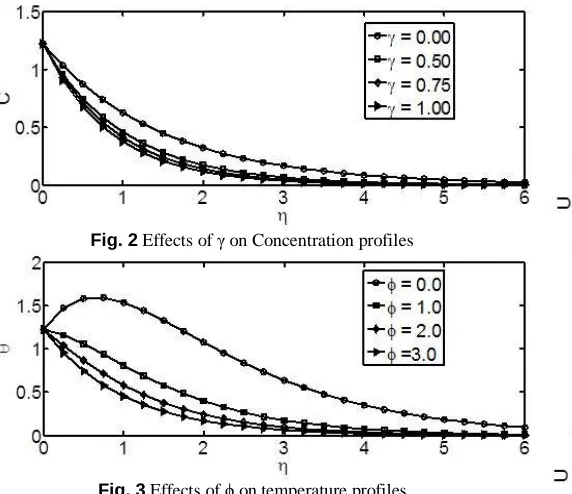
Fig. 2 Effects of γ on Concentration profiles
Fig. 3 Effects of ϕ on temperature profiles
The effects of different emerging parameters on the fluid velocity, temperature and concentration fields presented in Figs.1-12 and investigated. For numerical results we considered Sc = 0.6, ɛ = 0.2, n = 0.1, ϕ= 1, Up = 0.5, A = 0.5, t = 1, GγT= 4, GγC = 2, Q1 = 2, Du = 0.5, M = 2, K = 0.5, γ = 0.5, Pr = 0.71. These values are kept as common in
entire study except the variations in the respective figures and tables.
Fig. 4 Effects of Q1 on temperature profiles
Fig. 5 Effects of Du on temperature profiles
Fig. 6 Effects of γ on temperature profiles
Fig. 7 Effects of GrT on velocity
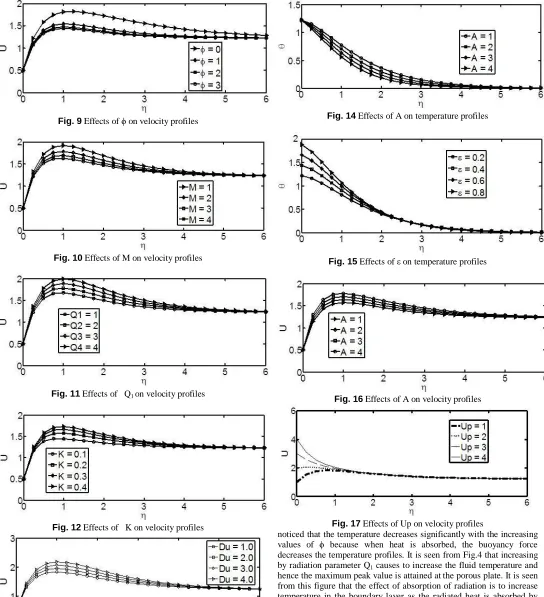
Fig. 9 Effects of ϕ on velocity profiles
Fig. 10 Effects of M on velocity profiles
Fig. 11 Effects of Q1 on velocity profiles
Fig. 12 Effects of K on velocity profiles
Fig.13 Effects of Du on velocity profiles
Fig.2 illustrate the concentration profiles for different values of
chemical reaction γ. From this figure, it is observed that the
concentration with increasing values of γ. The temperature profiles for different values of heat absorption parameter are depicted in Fig 3. It is
Fig. 14 Effects of A on temperature profiles
Fig. 15 Effects of ε on temperature profiles
Fig. 16 Effects of A on velocity profiles
Fig. 17 Effects of Up on velocity profiles
noticed that the temperature decreases significantly with the increasing values of ϕ because when heat is absorbed, the buoyancy force decreases the temperature profiles. It is seen from Fig.4 that increasing by radiation parameter Q1 causes to increase the fluid temperature and
for various values GrT and solutal buoyancyforce parameter GrC are
plotted in Figs.7 & 8. As seen from this figures that the maximum peak value is observed in the absence of buoyancy force, this is due to fact that buoyancy force enhances fluid velocity and increase the buoyancy layer thickness with increase in the values of GrT and GrC. It is also
observed that the significance of the velocity is maximum near the plate and there after it decreases and reaches to the stationary position at the other side of the plate. Fig.9 represents the decrease in fluid velocity when the heat absorption parameter ϕ is increased, it is clear that the hydro magnetic boundary layer decreases as the heat absorption effect increase also observed that in the absence of heat absorption the velocity attains maximum peak value. As expected due to the fact that when heat is absorbed the buoyancy force decreases which retard the flow rate and thereby giving rise to decrease in the velocity profiles. Fig. 10 demonstrates the effect of magnetic parameter M on the dimensionless velocity field. From this figure, it is observed that with increase in the magnetic parameter M, i.e. ratio of electromagnetic force Table 1 Numerical values of Skin-friction coefficient for various flow quantities:
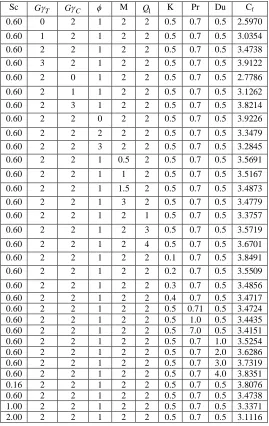
Sc T
G GC M
1
Q K Pr Du Cf
0.60 0 2 1 2 2 0.5 0.7 0.5 2.5970
0.60 1 2 1 2 2 0.5 0.7 0.5 3.0354
0.60 2 2 1 2 2 0.5 0.7 0.5 3.4738
0.60 3 2 1 2 2 0.5 0.7 0.5 3.9122
0.60 2 0 1 2 2 0.5 0.7 0.5 2.7786
0.60 2 1 1 2 2 0.5 0.7 0.5 3.1262
0.60 2 3 1 2 2 0.5 0.7 0.5 3.8214
0.60 2 2 0 2 2 0.5 0.7 0.5 3.9226
0.60 2 2 2 2 2 0.5 0.7 0.5 3.3479
0.60 2 2 3 2 2 0.5 0.7 0.5 3.2845
0.60 2 2 1 0.5 2 0.5 0.7 0.5 3.5691
0.60 2 2 1 1 2 0.5 0.7 0.5 3.5167
0.60 2 2 1 1.5 2 0.5 0.7 0.5 3.4873
0.60 2 2 1 3 2 0.5 0.7 0.5 3.4779
0.60 2 2 1 2 1 0.5 0.7 0.5 3.3757
0.60 2 2 1 2 3 0.5 0.7 0.5 3.5719
0.60 2 2 1 2 4 0.5 0.7 0.5 3.6701
0.60 2 2 1 2 2 0.1 0.7 0.5 3.8491
0.60 2 2 1 2 2 0.2 0.7 0.5 3.5509
0.60 2 2 1 2 2 0.3 0.7 0.5 3.4856
0.60 2 2 1 2 2 0.4 0.7 0.5 3.4717
0.60 2 2 1 2 2 0.5 0.71 0.5 3.4724
0.60 2 2 1 2 2 0.5 1.0 0.5 3.4435
0.60 2 2 1 2 2 0.5 7.0 0.5 3.4151
0.60 2 2 1 2 2 0.5 0.7 1.0 3.5254
0.60 2 2 1 2 2 0.5 0.7 2.0 3.6286
0.60 2 2 1 2 2 0.5 0.7 3.0 3.7319
0.60 2 2 1 2 2 0.5 0.7 4.0 3.8351
0.16 2 2 1 2 2 0.5 0.7 0.5 3.8076
0.60 2 2 1 2 2 0.5 0.7 0.5 3.4738
1.00 2 2 1 2 2 0.5 0.7 0.5 3.3371
2.00 2 2 1 2 2 0.5 0.7 0.5 3.1116
to the viscous force, the velocity field decreases. The Lorentz force is stronger corresponding to larger magnetic parameter due to which higher temperature and thicker thermal boundary layer thickness. As the values of magnetic parameter M increases, the retarding force increases and consequently the velocity decreases. Fig.11 displays the
velocity profiles for various values of radiation parameter Q1. From this
figure it is obvious that the velocity increases as Q1 increases and the
velocity starts from minimum value of zero at the surface and increases till attain the peak value. We observe in this figure that increasing the value of the absorption of the radiation parameter due to increase in the buoyancy force accelerates the flow rate. The influence of the permeability parameter K on velocity is shown in Fig. 12, as seen from this figure that maximum peak value attains for K = 0.4 and minimum peak value is observed for K = 0.1,also it is clear that the velocity increases significantly with the increasing values of K. With increase of K the velocity along the plate increases and consequently the momentum boundary layer thickness decreases. Fig.13 illustrates the effect of Dufour on velocity; from this figure an increasing Du causes a distinct rise in the velocity throughout the boundary layer. Fig. 14 & 16 deploys the profiles for temperature and velocity for A. with the increasing values of A, temperature is decreasing and velocity is increasing. Fig. 15 shows the variation of boundary-layer with the
perturbation parameter (ε). It is observed that the thermal boundary
layer thickness increases with an increase in the perturbation parameter. The effect of ɛ is to accelerate the temperature and its influence is highly dominant near the plate where as it remains uniform as we move far away from the plate. Fig.17 presents the variation of the velocity distribution across the boundary layer for different values of the plate velocity Up in the direction of the fluid flow. Although we have different initial plate velocities, the velocity increases to the constant value for given material parameters.
Table 2 Numerical values of Nusslet number for various flow quantities:
Sc Du
T
G GC Nu
0.16 1 0.5 0.5 4 2 0.333
0.60 1 0.5 0.5 4 2 -0.094
1.00 1 0.5 0.5 4 2 -0.100
0.60 0 0.5 0.5 4 2 1.384
0.60 2 0.5 0.5 4 2 -0.094
0.60 3 0.5 0.5 4 2 -0.752
0.60 1 0.5 0.5 4 2 -1.214
0.60 1 1 0.5 4 2 0.291
0.60 1 2 0.5 4 2 1.062
0.60 1 3 0.5 4 2 1.834
0.60 1 0.5 0.0 4 2 0.038
0.60 1 0.5 0.75 4 2 -0.111
0.60 1 0.5 1.0 4 2 -0.118
0.60 1 0.5 0.5 1 2 -0.094
0.60 1 0.5 0.5 2 2 -0.094
0.60 1 0.5 0.5 3 2 -0.094
0.60 1 0.5 0.5 4 0 -0.094
0.60 1 0.5 0.5 4 1 -0.094
0.60 1 0.5 0.5 4 3 -0.094
Table 1 depicts the influence of various physical parameters such as GrT, GrC, Q1, Du, ϕ, M, Pr and Sc on skin-friction coefficient. It is
influence of Sc and γ on Sherwood number. It is evident that a rise in
Schmidt number and chemical reaction parameter depreciates the mass transfer rate. Hence, chemical reaction parameter has more significant effect on Sherwood number than it does on Nusselt number. There is increase in both the heat and mass transfer rates with increase in the buoyancy ratio.
Table 3 Numerical values of Sherwood number for various flow quantities:
Sc
Sh0.16 1.0 -0.6127
0.6 1.0 -1.4428
1.0 1.0 -2.0821
2.0 1.0 -3.5600
0.60 0.0 -0.8227
0.60 0.50 -1.1974
0.60 0.75 -1.3284
5.
CONCLUSIONS
In this paper we have studied the Diffusion-thermo and radiation absorption effects on an unsteady MHD free convective heat and mass transfer flow past a semi-infinite moving plate. From the present investigation the following conclusions can be drawn.
1. There is a considerable effect of heat absorption parameter Q on the velocity.
2. It is found that on introducing the generative chemical reaction species concentration and Temperature are decreases significantly. 3. An increasing Dufour number causes a distinct rise in the temperature and velocity throughout the boundary layer.
4. The concentration decreases with an increase in the values of Sc. The velocity decelerated under the effect of magnetic parameter.
5. The rate of mass transfer reduces due to Schmidt number and chemical reaction parameter.
6. The Schmidt number quantifies the relative effectiveness of momentum and mass transport by diffusion in the hydrodynamic and concentration boundary layers. Increase in the values of γ implies
more interaction of species concentration with the momentum boundary layer and less interaction with the thermal boundary layer.
NOMENCLATURE
x*, y* dimensional distances along to the plate(m)
u*, v* components of dimensional velocities along x*, y* directions(m/s)
g gravitational acceleration(m/s2)
T* dimensional temperature of the fluid near the plate(K)
T∞ stream dimensional temperature(K) C* dimensional concentration C∞ stream dimensional concentration βT thermal expansion coefficient ΒC concentration expansion coefficient
P* pressure
Cp specific heat of constant pressure(J/kg.K) B0 magnetic field coefficient
*
r
q radiative heat flux
Ρ density
K thermal conductivity(W/mK)
σ density magnetic permeability of the fluid
υ kinematic viscosity(m2/s) D molecular diffusivity(J/kg.K)
Q0 dimensional heat absorption coefficient *
1
Q coefficient of proportionality of the absorption of the radiation
Sc Schmidt number
T dimensional time(s) M magnetic parameter(A/m) Up wall dimensional velocity Tw wall dimensional temperature
Cw wall dimensional concentration *
U free stream velocity T∞ free stream temperature C∞ free stream concentration Greek Symbols
μ viscosity of the fluid (kg/ms)
θ dimensionless temperature (k)
η similarity variable
ϕ heat absorption parameter
γ chemical reaction parameter
REFERENCES
Abiodun O. Ajibade, Ayuba M. Umar, 2015, “Effect of Chemical Reaction and Radiation Absorption on the Unsteady MHD Free Convection Couette Flow in a Vertical Channel Filled With Porous Materials,” Afrika Matematika, 27(1), 201-213.
http://dx.doi.org/10.1007/s13370-015-0334-7
Anilkumar, D., 2011, “Nonsimilar Solutions for Unsteady Mixed Convection from a Moving Vertical Plate,” Communications in Nonlinear Science and Numerical Simulation, 16, 3147–3157.
http://dx.doi.org/10.1016/j.cnsns.2010.11.017.
Aydin, O., and Kaya, A., 2009, “MHD Mixed Convection of a Viscous Dissipating Fluid about a Permeable Vertical Flat Plate,” Mathematical Modelling, 33, 4086–4096.
http://dx.doi.org/10.1016/j.apm.2009.02.002.
Bhattacharyya, K., Mukhopadhyay, S., and Layek, G., 2013, “Similarity Solution Of Mixed Convective Boundary Layer Slip Flow over A Vertical Plate,” Ain Shams Engineering Journal, 4, 299–305.
http://dx.doi.org/10.1016/j.asej.2012.09.003.
Chaudhary, R.C., and Jha, A.K., 2008, “Effects of Chemical Reactions on MHD Micropolar Fluid Flow Past a Vertical Plate in Slip-Flow Regime,” Applied Mathematics and Mechanics, 29(9), 1179–1194.
http://dx.doi.org/10.1007/s10483-008-0907-x.
Durga Prasad. P., Kiran kumar. R.V.M.S.S., and Varma. S.V.K., 2015, “Diffusion Thermo and Radiation Absorption Effects on Unsteady MHD Convective Flow past a Semi-Infinite Moving Plate,” Int.Adv.Engg.Res.Sci.,2(7), 59-69, ISSN: 2349-6495.
Hayday, A. A., Bowlus, D. A. and McGraw, R. A., 1967, “Free Convection from a Vertical Plate with Step Discontinuous in Surface Temperature,” Journal of Heat Transfer, 89(3), 244-249.
http://dx.doi.org/10.1115/1.3614371
Hossain, M. A. and Mandal, A. C., 1985, “Mass Transfer Effects on the Unsteady Hydromagnetic Free Convection Flow Past an Accelerated Vertical Porous Plate,” Journal of Physics D: Applied Physics, 18 (7), L63.
Kim, Y.J, 2000, “Unsteady MHD Convective Heat Transfer Past a Semi-Infinite Vertical Porous Moving Plate with Variable Suction,” Int. J. Eng.Sc., 38, 833-845.
http://dx.doi.org/10.1016/S0020-7225(99)00063-4
Merkin, J.H., 2012, “Natural Convective Boundary Layer Flow in a Heat Generating Porous Medium with a Constant Surface Heat Flux,”
European Journal of Mechanics- B/Fluids, 36, 75-81. http://dx.doi.org/10.1016/j.euromechflu.2012.04.004
Patil, P., and Chamkha, A.J., 2013, “Heat and Mass Transfer from the Mixed Convection Flow of Polar Fluid along a Plate in Porous Media with Chemical Reaction,” International Journal of Numerical Methods for Heat & Fluid Flow, 23(5), 899–926.
http://dx.doi.org/10.1108/HFF-03-2011-0060.
Patil, P., Roy, S., and Chamkha, A., 2009, “Double Diffusive Mixed Convection Flow over a Moving Vertical Plate in The Presence of Internal Heat Generation and a Chemical Reaction,” Turkish Journal of Engineering and Environmental Sciences, 33, 193–205.
http://dx.doi.org/10.3906/muh-0905-21.
Raptis, A., 1998, “Radiation and Free Convection Flow Through a Porous Medium,” Int Commun Heat Mass Transf, 25, 289–295. http://dx.doi.org/10.1016/s0735-1933(98)00016-5
Raptis, A., and Singh, A. K., 1983, “MHD Free Convection Flow Past an Accelerated Vertical Plate,” International Communications in Heat
and Mass Transfer, 10(4), 313-321.
http://dx.doi.org/10.1016/0735-1933(83)90016-7
Sahin Ahmed and Karabi Kalita, 2014, “Unsteady MHD Chemically Reacting Fluid through a Porous Medium Bounded by a Non-Isothermal Impulsively-Started Vertical Plate: A Numerical Technique,” Journal of Naval Architecture and Marine Engineering,
11(2).
http://dx.doi.org/10.3329/jname.v11i1.10269
Soundalgekar, V.M., and Wavre, P.D., 1997, “Unsteady Free Convection Flow Past an Infinite Plate with Variable Suction and Mass Transfer,” International Journal of Heat and Mass Transfer, 20(12), 1375–1380.
http://dx.doi.org/10.1016/0017-9310(77)90034-5.
Srinivasacharya, D., Mallikarjuna, B., and Bhuvanavijaya, R., 2015, “Soret and Dufour Effects on Mixed Convection along a Vertical Wavy Surface in a Porous Medium with Variable Properties,” Ain Shams Engineering Journal, 6(2), 553–564.
http://dx.doi.org/10.1016/j.asej.2014.11.007
Umamaheswar, M, Raju.M.C., and Varma,S.V.K, 2016, “MHD Convective Heat and Mass Transfer Flow of a Newtonian Fluid Past a Vertical Porous Plate with Chemical Reaction, Radiation Absorption and Thermal Diffusion,” International Journal of Engineering Research in Africa, 19, 37-56.