R E S E A R C H
Open Access
Dexmedetomidine improved renal function
in patients with severe sepsis: an
exploratory analysis of a randomized
controlled trial
Tsuyoshi Nakashima
1*, Kyohei Miyamoto
1, Nozomu Shima
1, Seiya Kato
1, Yu Kawazoe
2, Yoshinori Ohta
3,
Takeshi Morimoto
4, Hitoshi Yamamura
5and DESIRE Trial Investigators
Abstract
Background:Dexmedetomidine has been reported to improve organ dysfunction in critically ill patients. In a recent randomized controlled trial (Dexmedetomidine for Sepsis in Intensive Care Unit (ICU) Randomized Evolution [DESIRE]), we demonstrated that dexmedetomidine was associated with reduced mortality risk among patients with severe sepsis. We performed this exploratory sub-analysis to examine the mechanism underlying improved survival in patients sedated with dexmedetomidine.
Methods:The DESIRE trial compared a sedation strategy with and without dexmedetomidine among 201 mechanically
ventilated adult patients with sepsis across eight ICUs in Japan. In the present study, we included 104 patients with Acute Physiology and Chronic Health Evaluation II (APACHE II) scores of≥23 (54 in the dexmedetomidine [DEX] group and 50 in the non-dexmedetomidine [non-DEX] group). Initially, we compared the changes in the sequential organ failure assessment (SOFA) scores from the baseline within 6 days after randomization between groups. Subsequently, we evaluated the variables comprising the organ component of the SOFA score that showed relevant improvement in the initial comparison.
Results:The mean patient age was 71.0 ± 14.1 years. There was no difference in the median APACHE II score between the two groups (29 [interquartile range (IQR), 25–31] vs. 30 [IQR, 25–33];p= 0.35). The median SOFA score at the baseline was lower in the DEX group (9 [IQR, 7–11] vs. 11 [IQR, 9–13];p= 0.01). While the renal SOFA subscore at the baseline was similar for both groups, it significantly decreased in the DEX group on day 4 (p= 0.02). During the first 6 days, the urinary output was not significantly different (p= 0.09), but serum creatinine levels were significantly lower (p= 0.04) in the DEX group. The 28-day and in-hospital mortality rates were significantly lower in the DEX group (22% vs. 42%;p= 0.03, 28% vs. 52%;p= 0.01, respectively).
Conclusion:A sedation strategy with dexmedetomidine is associated with improved renal function and decrease
mortality rates among patients with severe sepsis.
Trial registration:This trial was registered on ClinicalTrials.gov (NCT01760967) on January 1, 2013.
Keywords:Dexmedetomidine, Sequential organ failure assessment score, Acute kidney injury, Septic shock,
Sedation
© The Author(s). 2019Open AccessThis article is distributed under the terms of the Creative Commons Attribution 4.0 International License (http://creativecommons.org/licenses/by/4.0/), which permits unrestricted use, distribution, and reproduction in any medium, provided you give appropriate credit to the original author(s) and the source, provide a link to the Creative Commons license, and indicate if changes were made. The Creative Commons Public Domain Dedication waiver (http://creativecommons.org/publicdomain/zero/1.0/) applies to the data made available in this article, unless otherwise stated.
* Correspondence:[email protected]
1Department of Emergency and Critical Care Medicine, Wakayama Medical
Background
Dexmedetomidine is a sedative drug that has a unique mechanism of action. It is a selective α2 -ad-renergic agonist, unlike the more common gamma-aminobutyric acid receptor agonists such as midazo-lam and propofol [1]. Previous studies suggest that dexmedetomidine prevents delirium and enables clini-cians to communicate with patients [1, 2]. Beyond its quality of improving sedation, dexmedetomidine may attenuate inflammatory reactions and protect against organ dysfunction such as acute kidney injury and liver dysfunction [3–6].
A previous randomized controlled trial reported that dexmedetomidine was associated with a reduced mortality rate among patients with sepsis [7]. More-over, a recent randomized controlled trial that en-rolled mechanically ventilated patients with sepsis, the Dexmedetomidine for Sepsis in Intensive Care Unit (ICU) Randomized Evolution (DESIRE) trial, showed that dexmedetomidine improves survival in the sub-group with more severe sepsis with an Acute Physi-ology and Chronic Health Evaluation II (APACHE II) score ≥ 23 [8]. The choice of sedative could influence even the survival outcome in patients with sepsis.
Dexmedetomidine may improve survival through the attenuation of organ dysfunction in sepsis [5, 6]. However, the mechanisms underlying improved sur-vival remain unclear and should be elucidated. This study aimed to determine which organ functions are improved using the sedation strategy with dexmedeto-midine in the subgroup of patients with severe sepsis, in whom survival benefit was observed in the DESIRE trial.
Methods Study design
This study is a post hoc subgroup analysis of the DESIRE trial [8], which was a multicenter randomized controlled trial conducted in eight ICUs in Japan. The DESIRE trial enrolled 201 patients with sepsis undergoing ventilation to assess the effects of a sedation strategy with dexmedetomidine (the DEX group) compared with that of a sedation strategy with-out dexmedetomidine (the non-DEX group). The protocol and results of the DESIRE trial have been reported elsewhere. The ethical review boards of all relevant institutions approved the study protocol, and all participants provided written informed consent prior to enrolment [8].
Patients
In this subgroup analysis, we included the seriously ill patients among the 201 randomized patients in the DE-SIRE trial. Seriously ill patients were defined as those with APACHE II scores≥23.
Outcomes
As the primary outcome, we compared the trajectory of each organ component of the sequential organ failure assessment (SOFA) score between the groups. SOFA scores were obtained at 1, 2, 4, and 6 days after randomization. Next, we additionally analyzed the trajec-tories of the organs that were significantly different between groups. We evaluated the variables comprising each organ component of the SOFA score (e.g., urinary output and serum creatinine level as the renal compo-nent, total bilirubin level as the hepatic compocompo-nent, and the Glasgow coma score as the central nervous system component).
As secondary outcomes, we analyzed in-hospital mor-tality, 28-day mormor-tality, renal replacement therapy, and ventilator-free days.
Statistical analysis
Continuous variables are presented as the mean ± stand-ard deviation or the median and interquartile range (IQR). Categorical variables are reported as frequencies and per-centages (%). Continuous variables were compared using thettest or Wilcoxon rank-sum test and categorical vari-ables using Fisher’s exact test between the DEX and non-DEX groups. A generalized linear model was used to examine the effect of dexmedetomidine on the natural logarithm of the daily urinary output and the serum cre-atinine concentration after excluding the chronic dialysis patients. All analyses were performed using JMP Pro ver-sion 13 (SAS Institute Inc., Cary, NC, USA) and SAS
version 9.4 (SAS Institute Inc., Cary, NC). Ap< 0.05 was considered statistically significant.
Results
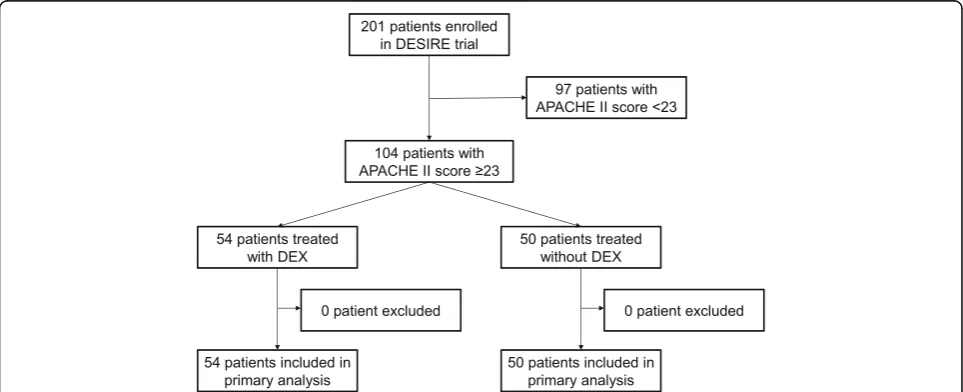
Among the 201 patients enrolled in the DESIRE trial, we focused on the 104 patients with APACHE II scores ≥ 23 in this sub-study. Of these patients, 54 patients were sedated with dexmedetomidine and 50 patients without dexmedetomidine (Fig.1).
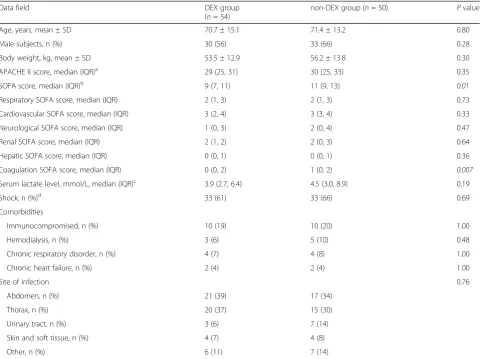
Patients’ characteristics are shown in Table 1. There were no differences in APACHE II score between the groups, but the initial total SOFA scores in the DEX group were significantly lower than those in the non-DEX group (9 (7, 11) vs. 11 (9, 13);p= 0.01). The coagulation compo-nent of the SOFA score in the DEX group was signifi-cantly lower than that in the non-DEX group at the Table 1Patient characteristics
Data field DEX group
(n= 54)
non-DEX group (n= 50) Pvalue
Age, years, mean ± SD 70.7 ± 15.1 71.4 ± 13.2 0.80
Male subjects, n (%) 30 (56) 33 (66) 0.28
Body weight, kg, mean ± SD 53.5 ± 12.9 56.2 ± 13.8 0.30
APACHE II score, median (IQR)a 29 (25, 31) 30 (25, 33) 0.35
SOFA score, median (IQR)b 9 (7, 11) 11 (9, 13) 0.01
Respiratory SOFA score, median (IQR) 2 (1, 3) 2 (1, 3) 0.73
Cardiovascular SOFA score, median (IQR) 3 (2, 4) 3 (3, 4) 0.33
Neurological SOFA score, median (IQR) 1 (0, 3) 2 (0, 4) 0.47
Renal SOFA score, median (IQR) 2 (1, 2) 2 (0, 3) 0.64
Hepatic SOFA score, median (IQR) 0 (0, 1) 0 (0, 1) 0.36
Coagulation SOFA score, median (IQR) 0 (0, 2) 1 (0, 2) 0.007
Serum lactate level, mmol/L, median (IQR)c 3.9 (2.7, 6.4) 4.5 (3.0, 8.9) 0.19
Shock, n (%)d 33 (61) 33 (66) 0.69
Comorbidities
Immunocompromised, n (%) 10 (19) 10 (20) 1.00
Hemodialysis, n (%) 3 (6) 5 (10) 0.48
Chronic respiratory disorder, n (%) 4 (7) 4 (8) 1.00
Chronic heart failure, n (%) 2 (4) 2 (4) 1.00
Site of infection 0.76
Abdomen, n (%) 21 (39) 17 (34)
Thorax, n (%) 20 (37) 15 (30)
Urinary tract, n (%) 3 (6) 7 (14)
Skin and soft tissue, n (%) 4 (7) 4 (8)
Other, n (%) 6 (11) 7 (14)
DEXdexmedetomidine,SDstandard deviation,APACHE IIacute physiology and chronic health evaluation II,SOFAsequential organ failure assessment,IQR interquartile range
a
The APACHE II score ranges from 0 to 71, with higher scores indicating severer disease.
b
The SOFA score ranges from 0 to 24, with higher scores indicating more severe disease. The SOFA score consists of six organ-subscores ranges from 0 to 4.
c
Serum lactate value was measured at randomization.
d
baseline. The daily dose of norepinephrine for patients with septic shock was not significantly different between the two groups (Additional file1: Table S1).
The types of sedatives besides dexmedetomidine are shown in Additional file 2: Table S2. The number of pa-tients with the administration of propofol in the DEX group was significantly lower than that in the non-DEX group on day 1. The number of patients with the administration of midazolam in the DEX group was significantly lower than that in the non-DEX group on days 1, 2, 3, 4, and 7.
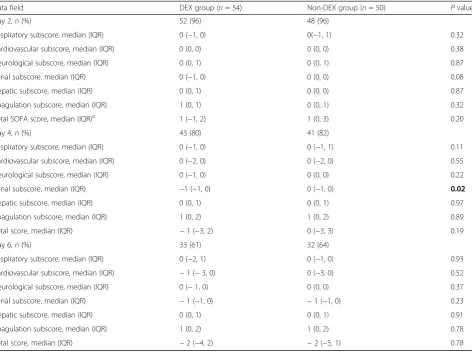
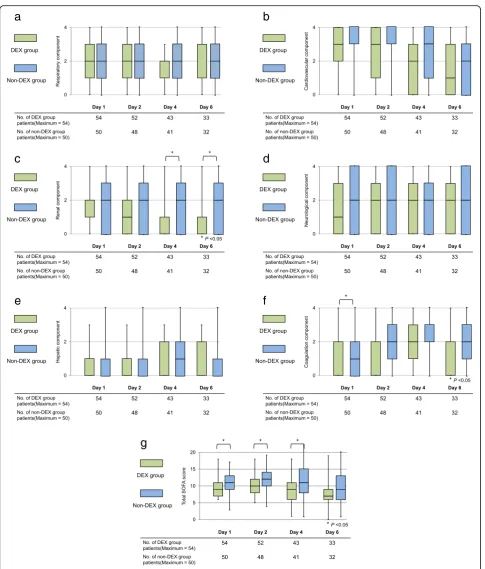
The absolute changes in the SOFA score from the baseline are shown in Table2. On day 4, the renal com-ponent of the SOFA score in the DEX group was signifi-cantly lower than that in the non-DEX group.
The renal components of the SOFA score in the DEX group were significantly lower than those in the non-DEX group on days 4 and 6 (-1(-1, 0) vs 0 (−1, 0);p= 0.02) (Fig.2).
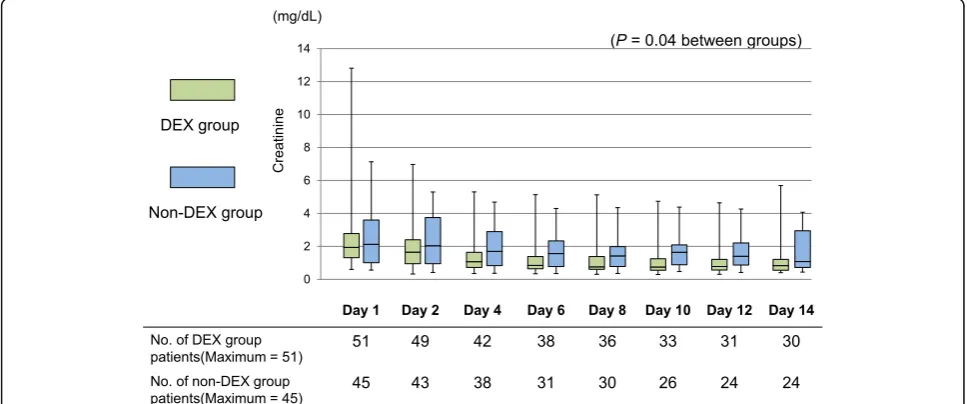
Figures3 and4 show the daily urinary output and the serum creatinine concentrations in both groups. On day 1, no significant differences in daily urinary output and
serum creatinine concentrations were observed between the groups. The daily urinary output during the first week did not differ significantly between the DEX group and the non-DEX group (p= 0.09). The serum creatin-ine concentrations during the first 2 weeks in the DEX group were significantly lower than those in the non-DEX group (p = 0.04) (Fig. 3). The number of patients with renal replacement therapy during the first week was not significantly different between the two groups (Additional file3: Table S3).
The 28-day and in-hospital mortality rates in the DEX group were significantly lower than those in the non-DEX group (22% vs. 42%; p = 0.03, 28% vs. 52%; p = 0.01, respectively) (Table3).
Discussion
In this study, we found that the sedation strategy with dexmedetomidine was associated with an improvement in the renal component of the SOFA score in severely ill patients with sepsis. Additionally, the serum creatinine Table 2The absolute change of sequential organ failure assessment score from the baseline
Data field DEX group (n= 54) Non-DEX group (n= 50) Pvalue
Day 2,n(%) 52 (96) 48 (96)
Respiratory subscore, median (IQR) 0 (−1, 0) 0(−1, 1) 0.32
Cardiovascular subscore, median (IQR) 0 (0, 0) 0 (0, 0) 0.38
Neurological subscore, median (IQR) 0 (0, 1) 0 (0, 1) 0.87
Renal subscore, median (IQR) 0 (−1, 0) 0 (0, 0) 0.08
Hepatic subscore, median (IQR) 0 (0, 1) 0 (0, 0) 0.87
Coagulation subscore, median (IQR) 1 (0, 1) 0 (0, 1) 0.32
Total SOFA score, median (IQR)a 1 (−1, 2) 1 (0, 3) 0.20
Day 4,n(%) 43 (80) 41 (82)
Respiratory subscore, median (IQR) 0 (−1, 0) 0 (−1, 1) 0.11
Cardiovascular subscore, median (IQR) 0 (−2, 0) 0 (−2, 0) 0.55
Neurological subscore, median (IQR) 0 (−1, 0) 0 (0, 0) 0.22
Renal subscore, median (IQR) −1 (−1, 0) 0 (−1, 0) 0.02
Hepatic subscore, median (IQR) 0 (0, 1) 0 (0, 1) 0.97
Coagulation subscore, median (IQR) 1 (0, 2) 1 (0, 2) 0.89
Total score, median (IQR) −1 (−3, 2) 0 (−3, 3) 0.19
Day 6,n(%) 33 (61) 32 (64)
Respiratory subscore, median (IQR) 0 (−2, 1) 0 (−1, 0) 0.93
Cardiovascular subscore, median (IQR) −1 (−3, 0) 0 (−3, 0) 0.52
Neurological subscore, median (IQR) 0 (−1, 0) 0 (0, 0) 0.37
Renal subscore, median (IQR) −1 (−1, 0) −1 (−1, 0) 0.23
Hepatic subscore, median (IQR) 0 (0, 1) 0 (0, 1) 0.91
Coagulation subscore, median (IQR) 1 (0, 2) 1 (0, 2) 0.78
Total score, median (IQR) −2 (−4, 2) −2 (−5, 1) 0.78
DEXdexmedetomidine,SOFAsequential organ failure assessment,IQRinterquartile range
a
concentrations were lower in the DEX group than those in the non-DEX group.
The present study was the sub-analysis of the DESIRE trial, which did not show improvement in mortality sta-tistically with the sedation strategy using dexmedetomi-dine in the entire cohort. However, it might have been underpowered for mortality and the sedation strategy with dexmedetomidine provided an 8% reduction in the 28-day mortality compared with no dexmedetomidine [8]. Furthermore, in the subgroup analysis that included severely ill patients (with APACHE II score ≥ 23),
dexmedetomidine was associated with an improved sur-vival rate (22% in the DEX group and 42% in the non-DEX group, p = 0.03). Therefore, we examined the mechanism underlying the improved mortality in se-verely ill patients treated with dexmedetomidine in this study.
Sepsis leads to organ dysfunction due to a systemic re-action to infection and results in a high mortality rate [9, 10]. Several studies have shown that septic acute kidney injury (AKI) is associated with a higher degree of illness severity and a higher mortality rate [11–13]. In the Fig. 3Comparison between the dexmedetomidine and non-dexmedetomidine groups regarding urinary output within a week. A generalized linear model was used to examine the effect of dexmedetomidine on the natural logarithm of the daily urinary output. DEX, dexmedetomidine
present study, dexmedetomidine was associated with an improved renal function in patients with sepsis and 28-day mortality in the DEX group was significantly lower than in the non-DEX group of patients with sepsis. How-ever, we could not clarify the relationship between renal improvement with dexmedetomidine and survival benefit.
Recent reports have shown that renal inflammation, microcirculatory dysfunction, and apoptosis occur in sepsis [14–16]. Previous animal studies reported that dexmedeto-midine prevented sepsis-induced AKI by regulating inflam-mation and apoptosis [17, 18]. Chung et al. reported that dexmedetomidine significantly reduced the levels of inflam-matory cytokines, such as tumor necrosis factor-alpha and monocyte chemotactic protein-1, and ameliorated renal dysfunction among mice in the septic AKI model [17]. Additionally, Kai et al. reported that dexmedetomidine sup-pressed the expression of sepsis-induced inflammatory fac-tors, such as tumor necrosis factor-alpha and interleukin-6, and reduced tubular apoptosis in mice [18]. Dexmedetomi-dine was also reported to reduce the level of norepinephrine in the blood, resulting in an increase in renal blood flow and urinary output [19]. The results of the present study suggest that dexmedetomidine might improve sepsis-induced AKI through the attenuation of an excessive in-flammatory response or sympathetic tone. However, we could not confirm this hypothesis because we could not evaluate the inflammatory response in the present study.
Previous randomized controlled trials reported that dexmedetomidine might attenuate renal injury during the perioperative period in patients who underwent car-diac surgery [20–22]. Zhai et al. showed that dexmedeto-midine reduced the levels of serum urea nitrogen, creatinine, and neutrophil gelatinase-associated lipocalin after cardiac valve replacement surgery under cardiopul-monary bypass [20]. However, no randomized controlled trials have reported that dexmedetomidine improves renal function among patients with sepsis. Future studies are needed to confirm our results regarding the im-provement of renal function in patients with sepsis.
Our study has several limitations. The most critical limi-tation is that this study is a post hoc subgroup analysis en-rolling with higher APACHE II score that results in the differences in baseline characteristics between groups.
Conceptually, the randomized design of this study could also balance baseline characteristics in this subgroup. Therefore, these differences between groups might occur by chance. In addition, because the sample size was not ad-equately large to conduct multivariable analyses, we did not adjust the baseline characteristics. In fact, the initial total SOFA score and coagulation SOFA score were signifi-cantly higher in the non-DEX group than those in the DEX group. More severe coagulation abnormality might increase the mortality in the non-DEX group which was re-ported in a previous study [23]. However, at least, the dif-ference of the initial coagulation SOFA score did not directly influence the evaluation of the renal component of the SOFA score, because the initial renal component of the SOFA score did not differ. Therefore, the results of our study should be interpreted as hypothesis-generating which should be confirmed through future studies. Second, our study was a post hoc analysis and applied multiple compar-isons for exploratory purposes. The difference in the renal component might be due to chance. It is necessary to evaluate our findings in further well-designed studies. Third, we could not evaluate the mechanisms in other or-gans besides those included in the SOFA score. The SOFA score was developed to provide a rough assessment of each organ dysfunction; therefore, we could not detect minor organ dysfunctions using the SOFA score. We may, there-fore, have missed identifying the mechanism underlying the improved outcome, besides renal protection. For stance, dexmedetomidine was reported to modulate in-flammation or liver dysfunction [4–6]. Fourth, we collected and analyzed the data of absolute changes in each organ component of the SOFA score only in 60% of the patients on day 6 in both groups as shown in Table2. Because the data of deceased patients were excluded and data of pa-tients discharged from ICU were missing, the number of patients’ data on day 6 decreased. Therefore, it might not be appropriate to conclude that dexmedetomidine affected organ dysfunction in the DEX group.
Conclusions
The sedative strategy with dexmedetomidine for severely ill patients with sepsis improves renal dysfunction and mortality rate. To reiterate, our study is an exploratory Table 3Secondary outcomes
Data field DEX group
(n= 54)
Non-DEX group
(n= 50) P
value
Renal replacement therapy in ICU, n (%) 27 (50) 29 (58) 0.41
Ventilator-free days, d, median (IQR) 18 (0, 23) 5 (0, 20) 0.09
28-day mortality, n (%) 12 (22) 21 (42) 0.03
Hospital mortality, n (%) 15 (28) 26 (52) 0.01
and hypothesis-generating study and our findings need to be confirmed in future studies.
Supplementary information
Supplementary informationaccompanies this paper athttps://doi.org/10. 1186/s40560-019-0415-z.
Additional file 1: Table S1.The daily dose of norepinephrine among 66 patients septic shock between two groups during the first week.
Additional file 2: Table S2.The daily usage of propofol and midazolam between two groups during the first week.
Additional file 3: Table S3.The number of patient received renal replacement therapy between two groups during the first week
Abbreviations
AKI:Acute kidney injury; APACHE: Acute Physiology and Chronic Health Evaluation; DESIRE: Dexmedetomidine for Sepsis in Intensive Care Unit Randomized Evolution; DEX: Dexmedetomidine; ICU: Intensive care unit; SOFA: Sequential organ failure assessment
Acknowledgements
The authors thank the DESIRE trial investigators for their assistance, especially Masaou Tanaka (Wakayama Medical University, Wakayama, Japan), Tomonori Yamamoto (Osaka City University, Osaka, Japan), Akihiro Fuke (Osaka City General Hospital, Osaka, Japan), Atsunori Hashimoto (Hyogo College of Medicine, Nishinomiya, Japan), Hiroyuki Koami (Saga University Hospital, Saga, Japan), Satoru Beppu (National Hospital Organization Kyoto Medical Center, Kyoto, Japan), Yoichi Katayama (Sapporo Medical University, Sapporo, Japan), and Makoto Itoh (Yamaguchi Grand Medical Center, Yamaguchi, Japan).
Our study was presented in part at the 5th SG ANZICS Asia Pacific Intensive Care Forum in Singapore, April 2018.
Authors’contributions
KM, TN, and NS designed the study and are entirely responsible for its content. TM and YO organized the data and performed the statistical analysis. YK, SK, and HY assessed the study participants for eligibility and were responsible for the quality of the study. All authors contributed and approved the final manuscript.
Funding
The original study was supported in part by a noncontractual research grant to Wakayama Medical University provided by Hospira Japan. Hospira Japan participated in part of the design of the original study; however, it had no role in the conduct of the study, collection, management, analysis, and interpretation of the data. The present subanalysis was conducted sorely by the academic investigators without any support from pharmaceutical companies.
Availability of data and materials
The datasets generated and analyzed during the current study are not publicly available because of privacy concerns and institutional policy.
Ethics approval and consent to participate
This study was a post hoc subgroup analysis of the DESIRE trial, which was a randomized controlled trial conducted among 8 ICUs in Japan. The participating institutions were Osaka City University, Osaka City General Hospital, Hyogo College of Medicine, Saga University Hospital, National Hospital Organization Kyoto Medical Center, Sapporo Medical University, Yamaguchi Grand Medical Center, and Wakayama Medical University. The ethical review boards of all relevant institutions approved the study protocol, and all participants provided written informed consent prior to enrolment.
Consent for publication Not applicable.
Competing interests
The authors declare that they have no competing interests.
Author details
1Department of Emergency and Critical Care Medicine, Wakayama Medical
University, 811-1, Kimiidera, Wakayama City, Wakayama, Japan.2Division of Emergency and Critical Care Medicine, Tohoku University Graduate School of Medicine, 1-1, Seiryo-machi, Aoba-ku, Sendai City, Japan.3Dividion of General Medicine, Department of Internal Medicine, Hyogo College of Medicine, 1-1, Mukogawa-cho, Nishinomiya City, Japan.4Department of Clinical
Epidemiology, Hyogo College of Medicine, 1-1, Mukogawa-cho, Nishinomiya City, Japan.5Osaka Prefecture Nakakawachi Critical Care and Emergency Center, 3-4-13, Nishiiwata, Higashiosaka City, Japan.
Received: 11 September 2019 Accepted: 20 November 2019
References
1. Jakob SM, Ruokonen E, Grounds RM, Saropohja T, Garratt C, Pocock SJ, Bratty JR, Takala J. Dexmedetomidine for Long-Term Sedation Investigators. Dexmedetomidine vs midazolam or propofol for sedation during prolonged mechanical ventilation: Two randomized controlled trials. JAMA. 2012;307: 1151–60.
2. Riker RR, Shehabi Y, Bokesch PM, Ceraso D, Wisemandle W, Koura F, Whitten P, Margolis BD, Byrne DW, Ely EW, Rocha MG, SEDCOM Study Group. Dexmedetomidine vs midazoram for sedation of critical ill patients: a randomized trial. JAMA. 2009;301:489–99.
3. Shi R, Tie HT. Dexmedetomidine as a promising prevention strategy for cardiac surgery-associated acute kidney injury: a meta-analysis. Crit Care. 2017;21:198.
4. Fayed NA, Sayed EI, Saleh SM, Ehsan NA, Elfert AY. Effect of
dexmedetomidine on hepatic ischemia–reperfusion injury in the setting of adult living donor liver transplantation. Clin Transpl. 2016;30:470–82. 5. Taniguchi T, Kidani Y, Kanakura H, Takemoto Y, Yamamoto K. Effects of
dexmedetomidine on mortality rate and inflammatory responses to endotoxin-induced shock in rats. Crit Care Med. 2004;32:1322–6. 6. Taniguchi T, Kurita A, Kobayashi K, Yamamoto K, Inaba H. Dose- and
time-related effects of dexmedetomidine on mortality and inflammatory responses to endotoxin-induced shock in rats. J Anesth. 2008;22:221–8. 7. Pandharipande PP, Sanders RD, Girard TD, McGrane S, Thompson JL,
Shintani AK, Herr DL, Maze M, Ely EW, MENDS investigators. Effect of dexmedetomidine versus lorazepam on outcome in patients with sepsis: an a priori-designed analysis of the MENDS randomized controlled trial. Crit Care. 2010;14:R38.
8. Kawazoe Y, Miyamoto K, Morimoto T, Yamamoto T, Fuke A, Hashimoto A, Koami H, Beppu S, Katayama Y, Itoh Y, Yamamura H, DESIRE Trial Investigators. Effect of dexmedetomidine on mortality and ventilator-free days in patients requiring mechanical ventilation with sepsis: a randomized clinical trial. JAMA. 2017;317:1321–8.
9. Shankar-Hari M, Phillips GS, Levy ML, Seymour CW, Liu VX, Deutschman CS, Angus DC, Rubenfeld GD, Singer M, Sepsis Definitions Task Force. Developing a new definition and assessing new clinical criteria for septic shock For the Third International Consensus Definitions for Sepsis and Septic Shock (Sepsis-3). JAMA. 2016;315:775–87.
10. Singer M, Deutschman CS, Seymour CW, Shankar-Hari M, Annane D, Bauer M, Bellomo R, Bernard GR, Chiche JD, Coopersmith CM, Hotchkiss RS, Levy MM, Marshall JC, Martin GS, Opal SM, Rubenfeld GD, van der Poll T, Vincent JL, Angus DC. The Third International Consensus Definitions for Sepsis and Septic Shock (Sepsis-3). JAMA. 2016;315:801–10.
11. Bagshaw SW, Shigehiko U, Bellomo R, Hiroshi M, Stanislao M, Schetz M, Tan I, Bouman C, Macedo E, Gibney N, Tolwani A, Oudemans-van Straaten HM, Ronco C, Kellum JA, BEST Kidney Investigators. Septic acute kidney injury in critically ill patients: clinical characteristics and outcomes. Clin J Am Soc Nephrol. 2007;2:431–9.
12. Shum HP, Kong HH, Chan KC, Yan WW, Chan TM. Septic acute kidney injury in critically ill patients - a single-center study on its incidence, clinical characteristics, and outcome predictors. Ren Fail. 2016;38:706–16. 13. Bagshaw SM, George C, Bellomo R, ANZICS Database Management
Committee. Early acute kidney injury and sepsis: a multicentre evaluation. Crit Care. 2008;12:R47.
14. Zarbock A, Gomez H, Kellum JA. Sepsis-induced AKI revisited:
15. Holthoff JH, Wang Z, Seely KA, Gokden N, Mayeux PR. Resveratrol improves renal microcirculation, protects the tubular epithelium, and prolongs survival in a mouse model of sepsis-induced acute kidney injury. Kidney Int. 2012;81:370–8.
16. Marcos LM, Michelle MB, Eliete B. Dexmedetomidine attenuates the microcirculatory derangements evoked by experimental sepsis. Anesthesiology. 2015;122:619–30.
17. Hsing CH, Lin CF, So E, Sun DP, Chen TC, Li CF, Yeh CH.α2-Adrenoceptor
agonist dexmedetomidine protects septic acute kidney injury through increasing BMP-7 and inhibiting HDAC2 and HDAC5. Am J Phys Renal Phys. 2012;303:1443–53.
18. Kai K, Yang G, Wang SC, Liu HT, Kong WL, Zhang X, Huang R, Qi ZD, Zheng JB, Qu JD, Liu RJ, Liu YS, Wang HL, Yu KJ. Dexmedetomidine protects against lipopolysaccharide-induced sepsis-associated acute kidney injury via anα7 nAChR-dependent pathway. Biomed Pharmacother. 2018;106:210–6. 19. Ebert TJ, Hall JE, Barney JA, Uhrich TD, Colinco MD. The effect of increasing
plasma concentrations of dexmedetomidine in humans. Anesthesiology. 2000;93:382–94.
20. Zhai M, Kang F, Han M, Huang X, Li J. The effect of dexmedetomidine on renal function in patients undergoing cardiac valve replacement under cardiopulmonary bypass: a double-blind randomized controlled trial. J Clin Anesth. 2017;40:33–8.
21. Soliman R, Hussien M. Comparison of the renoprotective effect of dexmedetomidine and dopamine in high-risk renal patients undergoing cardiac surgery: a double-blind randomized study. Ann Card Anaesth. 2017; 20:408–15.
22. Cho JS, Shim JK, Soh S, Kim MK, Kwak YL. Perioperative dexmedetomidine reduces the incidence and severity of acute kidney injury following valvular heart surgery. Kidney Int. 2016;89:693–700.
23. Minne L, Abu-Hanna A, de Jonge E. Evaluation of SOFA-based models for predicting mortality in the ICU: a systematic review. Crit Care. 2008;12:R161.
Publisher’s Note