A Comparison of Student and
Demonstrator Perceptions of
Laboratory-Based, Inquiry-Oriented Learning
Experiences
Les Kirkup, Meera Varadharajan and Michael Braun
Corresponding author: [email protected]
School of Mathematical and Physical Sciences, University of Technology Sydney, Broadway, NSW 2007, Australia
Keywords: Inquiry-oriented learning, laboratory class, student-demonstrator interactions, contingent instructors, service teaching
International Journal of Innovation in Science and Mathematics Education, 24(2), 1-13, 2016.
Abstract
Effective student-demonstrator interactions attend successful laboratory programs which engage students with the processes and products of science. We report a study on student and demonstrator experiences and perceptions of a physics laboratory program delivered to first year students in a large-enrolment subject for non-physics majors at the University of Technology Sydney. The program comprises experiments promoting learning through inquiry. Neither students nor demonstrators were completely comfortable with the open-ended nature of such experiments. Students expected instructions from demonstrators on how the experiments should be performed, and both students and demonstrators presumed the laboratory manual to offer more detailed instructions on each experiment than it provided. There was a significant and discouraging difference between student and demonstrator perceptions of a) the extent to which the skills developed in the laboratory assisted students in their future career, and b) the contribution that the experiments made to students’ understanding of physics.
Implications for practice emerging from this study include the need for academics to better communicate the reasons for an inquiry-oriented approach being adopted and clearer articulation of the expectations of student and demonstrators. Careful scaffolding of activities is necessary if students are to transition from recipe-type experiments to inquiry-oriented experiments. Aligning demonstrator professional training with the underlying philosophy of an inquiry-oriented laboratory program is not sufficient to ensure demonstrators are comfortable with that philosophy, suggesting a deeper consideration of the epistemologies influencing their actions is warranted. It is evident that the materials developed to support both students and demonstrators must undergo regular and critical review.
Introduction
Hands-on, laboratory-based activities are regarded by many science academics as essential elements of an undergraduate degree in science (Kirchner & Meester, 1988; Hofstein & Lunetta, 2004). The nature of those activities has come under scrutiny in recent years, with renewed interest in the place of inquiry-oriented experiments in the undergraduate science curriculum (Cobern, Schuster, Adams, Applegate, Skjold, Undreiu, Loving, & Gobert, 2010; Alkaher & Dolan, 2011; Rayner, Charlotte-Robb, Thompson, & Hughes, 2013).
Through inquiry-oriented experiments, students: engage with scientific questions that have no predetermined answer; develop and implement approaches to address those questions; refine
their approaches in order to enhance the quality of their data; gather evidence, and; communicate explanations and conclusions based on that evidence (adapted from Olson & Loucks-Horsley, 2000). Such experiments contrast with the recipe-type experiments that have dominated science curricula for decades (Bless, 1933; Menzie, 1970; Cheary, Gosper, Hazel, & Kirkup, 1995; Kirkup, 2015). A recent revision of the K-12 school science curriculum in Australia has resulted in greater emphasis on scientific inquiry skills (National Curriculum Board, 2009), suggesting students choosing to study science will enter university better prepared to engage in inquiry-oriented experiments, and that the undergraduate science curriculum should be ready to build on this foundation.
Those entering university to study science will likely find themselves in large enrolment subjects in which the diversity of students and the disparities in their readiness for university study has never been greater (Alauddin & Ashman, 2014). Enrolments have been rising in many Australian universities (Norton, 2013). This has occurred at a time when a greater emphasis on research has reduced the involvement of full-time academics in teaching (Lama & Joullie, 2015). One outcome of this is that the support for student learning in science laboratories falls largely, and in some instances wholly, to demonstrators (equivalent to graduate teaching assistants in North America).
Demonstrators are known to have a significant impact on the student experience in the laboratory. Rice, Thomas, and O’Toole (2009; p.65) found that, for many students, ‘demonstrators had the power to make a lab. a great or a miserable experience’. Almost three decades ago it was argued that the lack of progress in laboratory teaching was largely due to the neglect of the human dimension of the undergraduate laboratory, as embodied in student-demonstrator interactions (Pickering, 1988). Despite the importance of student-demonstrators, little has been written on their influence on the student experience in undergraduate laboratories where the experiments have an inquiry focus (Wyse, Long, & Ebert-May, 2014).
A report commissioned by the Australian Council of the Deans of Science (O’Toole, 2012) recognised the importance of the laboratory for promoting authentic, inquiry-oriented learning purposefully advocated by Australia’s Chief Scientist (Office of the Chief Scientist, 2012). The report (O’Toole, 2012; p.5) states:
The impact of the challenges posed [by inquiry-based learning] justifies investment in the development of demonstrators’ competencies, both at the individual and group level, to realise the potential of science teaching laboratories.
The laboratory may be the only place in the first year of a degree where one-on-one interactions occur between students and their instructors, further accenting the influence laboratory-based activities can have on student attitudes and experiences (French & Russell, 2002).
Background and motivation for this study
The School of Mathematical and Physical Sciences at the University of Technology Sydney (UTS) delivers a first-year physics service subject named Physical Aspects of Nature (PAN) to students enrolling in medical, biological and environmental science degrees at UTS. Total enrolment in PAN in 2014 was close to 700 students. PAN consists of, on average, 3.5 hours of lectures/tutorials each week for 12 weeks, and 2.5 hours a week of laboratory work for 9 weeks. Students work together on experiments in groups of two or three and there are typically 40 students and two demonstrators in each laboratory class. The two demonstrators
play significantly different roles in the laboratory. A principal demonstrator, who either possesses a PhD in physics or is working towards one, has primary responsibility for managing the laboratory, introducing experiments to the class, assessing the students’ laboratory-based work and assisting students throughout the laboratory session. An assistant demonstrator, who is generally a senior undergraduate or honours student with a more limited physics background than the principal demonstrator, assists students throughout the laboratory session, but has no assessment or organisational responsibilities. Both principal and assistant demonstrator attend a demonstrator training day before the start of the semester where they are advised on the philosophy underpinning the laboratory program, issues to do with each experiment, the assistance available in the laboratory, any safety matters as well as their respective roles and responsibilities. Demonstrators are also supplied with a demonstrator manual giving details of the design and philosophy of the laboratory program, how it links to the subject as a whole, and general advice on running each experiment.
Inquiry-oriented experiments, in which students engage with scientific questions that have no predetermined answer, and take on responsibility for designing an approach to addressing those questions, have been incorporated into PAN since 2001 (Kirkup, Pizzica, Waite, & Srinivasan, 2010). This is reflected in the PAN laboratory manual which advises students:
As a result of this laboratory program you will be able to actively participate in scientific activities, experiencing science as a relevant part of your life as opposed to a series of isolated events that happen in a laboratory….. you will be encouraged to think independently and creatively, and develop self confidence in your ability to tackle scientific problems.
An inquiry-oriented approach, which is adopted in this laboratory program, opens opportunities for you to obtain first-hand experiences of doing science like practicing scientists and to develop much sought-after skills to identify and define a problem, formulate a hypothesis, design an experiment, and collect, analyse and interpret data. Learning by inquiry will also allow you to relate and combine information (for example that which you will encounter during lectures) in a way that makes sense to you.
PAN laboratory manual, UTS, spring 2014
Demonstrators translate and operationalise the intentions of the designers of a laboratory program and communicate those intentions to students (French & Russell, 2002; p. 1040). Inquiry-oriented experiments in which students are given a large measure of control over how they perform an experiment present demonstrators with challenges absent when supervising recipe-type experiments. For example, demonstrators may be required to manage several groups simultaneously taking quite different approaches to carrying out an experiment (Cheary et al., 1995). While much has been written on the design of inquiry-oriented experiments (see, for example, Luckie, Maleszewski, Loznak, & Krha, 2004), less has been written on student and demonstrator views or experiences of such experiments (Wyse et al., 2014).
The research question we wished to explore through this study was: what are the students and demonstrator perceptions and experiences of the PAN laboratory program, and how do the perceptions and experiences compare? We also wished to explore how well PAN students prepare themselves for the inquiry-oriented experiments; the students’ and the demonstrators’ perceptions of the quality of teaching materials provided to support their learning, and the
extent to which students rely on the demonstrators to assist them in carrying out the experiments.
We describe the methods adopted to explore these questions, report on findings of significance, and discuss the implications of the findings for the delivery of an inquiry-oriented laboratory program, the materials to support student learning, and improvements in preparing the demonstrators to work with students carrying out inquiry-oriented experiments.
Method
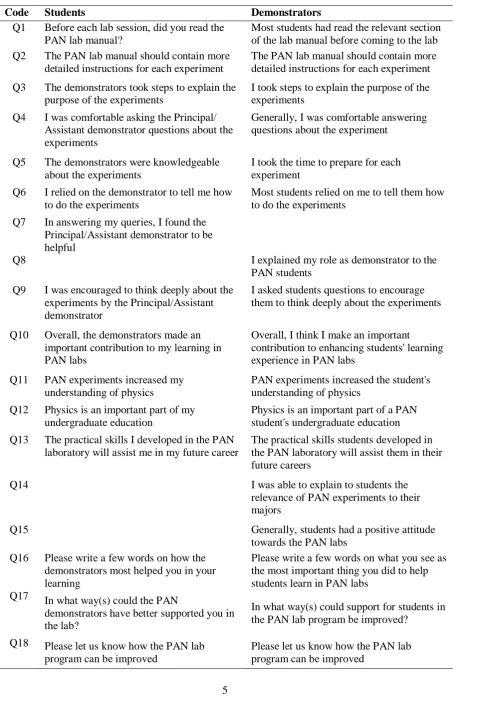
In spring semester 2014, we surveyed PAN students (N=417 representing 76 % of those enrolled) and their demonstrators (N=18 representing 82 % of all PAN demonstrators). Participants completed a survey consisting of open- and closed-ended statements and questions. The survey items were adapted from previous work (Kirkup, Pizzica, Waite, & Mears, 2011) in line with the aims and focus of this study. The student and demonstrator surveys were similar in structure and most survey items were equivalent in order to facilitate comparative analysis. Table 1 lists the survey items. The first 15 items were closed-ended and the last 3 were open-ended. Participants responded to the closed-ended items using a 5-point Likert scale, where: 1=Strongly disagree, 2 = Disagree, 3 = Neutral, 4 = Agree, and 5=Strongly agree. For item Q1, students were asked to select a frequency from Never to Always which was reported on a scale of 1 to 5.
Recognizing the different roles of the demonstrators, some items in the survey gave students the opportunity to respond separately with reference to the principal and the assistant demonstrator. The open-ended questions encouraged a short response from students on their views on the demonstrators and on how the PAN laboratory program could be improved. The closed-ended items were clustered into two groups: items 1-10 broadly canvassed the processes undertaken in or before the laboratory class whereas the remaining items dealt with outcomes.
Data analysis involved both quantitative and qualitative approaches. A two-tailed t-test was applied to test a null hypothesis that the means of samples were drawn from the same population at the 0.05 significance level (de Winter & Dodou, 2010).
Table 1: Items presented in the student and demonstrator surveys.
Code Students Demonstrators
Q1 Before each lab session, did you read the PAN lab manual?
Most students had read the relevant section of the lab manual before coming to the lab Q2 The PAN lab manual should contain more
detailed instructions for each experiment
The PAN lab manual should contain more detailed instructions for each experiment Q3 The demonstrators took steps to explain the
purpose of the experiments
I took steps to explain the purpose of the experiments
Q4 I was comfortable asking the Principal/ Assistant demonstrator questions about the experiments
Generally, I was comfortable answering questions about the experiment
Q5 The demonstrators were knowledgeable about the experiments
I took the time to prepare for each experiment
Q6 I relied on the demonstrator to tell me how to do the experiments
Most students relied on me to tell them how to do the experiments
Q7 In answering my queries, I found the Principal/Assistant demonstrator to be helpful
Q8
I explained my role as demonstrator to the PAN students
Q9 I was encouraged to think deeply about the experiments by the Principal/Assistant demonstrator
I asked students questions to encourage them to think deeply about the experiments
Q10 Overall, the demonstrators made an important contribution to my learning in PAN labs
Overall, I think I make an important contribution to enhancing students' learning experience in PAN labs
Q11 PAN experiments increased my understanding of physics
PAN experiments increased the student's understanding of physics
Q12 Physics is an important part of my undergraduate education
Physics is an important part of a PAN student's undergraduate education Q13 The practical skills I developed in the PAN
laboratory will assist me in my future career
The practical skills students developed in the PAN laboratory will assist them in their future careers
Q14
I was able to explain to students the relevance of PAN experiments to their majors
Q15
Generally, students had a positive attitude towards the PAN labs
Q16 Please write a few words on how the demonstrators most helped you in your learning
Please write a few words on what you see as the most important thing you did to help students learn in PAN labs
Q17 In what way(s) could the PAN
demonstrators have better supported you in the lab?
In what way(s) could support for students in the PAN lab program be improved?
Q18 Please let us know how the PAN lab program can be improved
Please let us know how the PAN lab program can be improved
Results and discussion
Of the 417 students and 18 demonstrators surveyed, the response rate was 100 % for the closed-ended questions and over 70 % and 80 % respectively for students and demonstrators to the open-ended items in the survey.
Table 2 provides the mean score (out of a maximum mean score of 5) and the associated standard error for each of the closed-ended survey items. Where the students were asked questions relating separately to the principal (P) and the assistant (A) demonstrator, the mean scores are specified separately. The last column in Table 2 shows the outcome of the t-testing of the null hypothesis.
Table 2: Mean score and standard error for closed-ended items in Table 1.
Item Code
Students (N=417)
Demonstrators (N=18)
Agreement (p<0.05)
Q1 3.40±0.07 3.06±0.24 N
Q2 3.91±0.05 3.88±0.19 Y
Q3 3.92±0.04 4.33±0.11 N
Q4 4.08±0.05 (P)
4.21±0.04 (A) 4.17±0.15 Y Y
Q5 4.17±0.04 4.33±0.14 Y
Q6 3.37±0.05 3.78±0.19 Y
Q7 3.96±0.05 (P) 4.02±0.05 (A)
Q8 3.89±0.14
Q9 3.58±0.05 (P)
3.56±0.05 (A) 4.22±0.13 N N
Q10 3.92±0.04 4.00±0.16 Y
Q11 3.55±0.05 4.00±0.08 N
Q12 3.13±0.05 4.33±0.14 N
Q13 3.21±0.05 4.28±0.16 N
Q14 3.67±0.19
Q15 3.44±0.23
Analysis of the open-ended questions involved a qualitative approach. A process of constant comparison for recurring words and emerging patterns (Lincoln & Guba, 1985) and open coding (Strauss & Corbin, 1990; Wiersma & Jurs, 2005) was used to categorise the data. The responses for each item were analysed, following a process of data organisation, data reduction, coding and categorisation. The results of the analysis were used to relate the open- to the closed-ended responses.
Examining the pattern of agreement between the student and demonstrator mean responses of Table 2, agreement is greatest for the process-related items (1-10). By contrast, disagreement occurs consistently for the outcome items (11-13).
With regard to the outcome items, the demonstrators as a group were more positive about the value of the laboratory class to the students than the students themselves. Demonstrators
strongly supported the proposition that students’ understanding of physics was enhanced (Q11), that the practical skills learned in the laboratory would assist the students in the future (Q13) and that physics formed an important part of a student’s education (Q12). Students’ mean responses to the same items were significantly lower, tending towards the neutral response. Only 39 % of students surveyed agreed or strongly agreed that physics was an important part of their undergraduate education (Q12) and a similar percentage (43 %) of students agreed or strongly agreed that the practical skills developed in the laboratory would help them in their future career (Q13).
Some degree of bias on the part of the demonstrators as the active agents of the laboratory program may be anticipated. Their responses might have been informed by factors possibly not known to, or appreciated by, the students. For example, the demonstrators might have a greater awareness of where and how the knowledge and skills acquired in the laboratory class would fit into a student’s later studies. Additionally, the demonstrators did not believe that students regarded the laboratories highly (Q15) with only 45 % agreeing or strongly agreeing that ‘generally, students had a positive attitude towards the PAN labs’.
With reference to the process-related questions, it is worth reiterating that the laboratory program emphasised learning through inquiry (Kirkup et al., 2010). On the scale of the inquiry continuum, much of the experimental work falls into the ’guided inquiry’’ level (Boud, Dunne, & Hegarty-Hazel, 1989; Banchi & Bell, 2008), where the research question is posed to students but neither the procedure nor the outcome are specified. This contrasts with the `verification inquiry’ or ‘recipe-type’ experiments where the procedure is specified and the outcome (for example, the value of the gravitational acceleration) is known in advance (or can be ascertained easily).
Two major issues emerged from the survey: one relates to the laboratory manual, the other to students’ dependency on the demonstrators.
Laboratory manual: expectations and experiences
Consistent with learning through inquiry, the PAN laboratory manual does not provide detailed descriptions of experimental procedures. This was seen as a deficiency. As shown in Table 2, the demonstrators and the students on average agreed that the laboratory manual ‘should contain more detailed instructions’ (Q2). This shared view was also confirmed in the open-ended responses to Q18, which sought ideas for improvements to the PAN laboratory program. Of those who responded to Q18, 20 % of the students and over 50 % of demonstrators made reference to the laboratory manual. Students remarked that “instructions (were) very unclear” and referred to “confusion and ambiguity in the manual”, while demonstrators described the manual as “vague”, causing the students to become “frustrated with the experiments”. Demonstrators suggested that, in future versions, the laboratory manual should have the instructions “clearly set out” and should specify a “clear aim for each experiment”.
Student-demonstrator agreement about shortcomings of the laboratory manual implies that neither the students nor the demonstrators were comfortable with sparsely-scripted laboratory instructions. The perception of lack of detail and clarity in the laboratory manual can also have a bearing on whether the manual was read or not before each class (response to Q1) though there is some level of disagreement between student and demonstrators, with the latter of the opinion that students did not read the manual before each class. Challenges pertaining to the laboratory manual may also have contributed to the type of help sought by students
from their demonstrators, as noted by some students in their responses “[demonstrators should] run through each experiment more thoroughly”.
Students’ dependency on demonstrators
Demonstrators’ response to Q6 (3.78 ± 0.19) suggest that they believe students rely on them to tell them how to proceed with experiments, which is indicative of students’ expectation of a direct instruction model in their interactions with the demonstrators (Boud et al., 1989). About 30 % of students who responded to the open-ended item (Q16) described the practical ways in which demonstrators helped them by outlining the steps involved in the process. Students were “assisted in simplifying the experiment”, “helped with calculations”, shown “how to set up graphs”, and instructed on “what to do with data in the end”. They relied on their demonstrators for “explaining things when stuck with experiments” and acknowledged that the demonstratorswere “helpful in explaining and demonstrating experiments”.
Requesting assistance on how to ‘set up graphs’ is not inconsistent with students engaging in inquiry, as plotting graphs is a skill demanded in both recipe-type and inquiry-oriented experiments. On the other hand, where students describe demonstrator’s assistance as “demonstrating experiments”, this is more indicative of direct intervention by the demonstrator to assist students to reach a specific endpoint characteristic of recipe-type experiments.
Demonstrators, too, noted that they helped students to complete their tasks, taught them “improvement in lab techniques”, “plotting”, “graphs”, and (the meaning of technical) “terms”. Such assistance suggests that demonstrators are adopting a direct instruction approach rather than a facilitative approach favoured when learning through inquiry (Kirkup, Johnson, Hazel, Cheary, Green, Swift, & Holliday, 1998). Most demonstrators referred to encouraging the students to “think deeply” about the experiments, “encouraging [students] to go beyond what was stated”, and were happy to “discuss the underlying physics”. Such views were as prevalent among the assistant demonstrators as among the principal demonstrators despite the former having had a typically shorter exposure to the physics discipline. The open-ended responses are consistent with the demonstrators’ response to the closed-ended item Q9 (4.22 ± 0.13), with all demonstrators but one agreeing with the statement ‘I asked students questions to encourage them to think deeply about the experiments’. The student mean score for Q9 was much less (3.56 ± 0.05 for assistants and 3.58 ± 0.05 for principal demonstrators), with just over half the respondents agreeing or strongly agreeing with the statement ‘I was encouraged to think deeply about the experiments by the (principal/assistant) demonstrator’. In response to Q16, some students appear to have accepted the proposition of deeper engagement, with 23 % commenting that demonstrators helped them “understand the reasoning behind the experiment” or acting to “challenge my methods”.
The data suggest a dichotomy between the learning model implicitly assumed by the students and that adopted by the demonstrators. The relatively low score for Q8 (3.89±0.14), which examines whether the demonstrators explained their role in the class, suggests that in many cases students were not appraised in advance of what the mode of learning and interaction with the demonstrators would be, thus contributing to the dichotomy. Students’ prior experience with experimental work at school, and in the concurrent subjects, might well have followed the verification or structured model of learning. Managing students’ expectations in an inquiry-oriented experiment emerges therefore as an important prerequisite for an effective learning experience.
The demonstrators were perceived as approachable (Q4), which is a precursor to deeper interaction with the students (Kendall & Schussler, 2012). This is also reiterated in the open ended response (Q16) where 31% of students chose to describe the attributes or qualities of their demonstrators and how this helped them in their learning. For example, students referred to the demonstrators as being “easily approachable”, “able to communicate well” and had “different ways of explaining” that “helped make the subject more comfortable”. Furthermore, both the students and the demonstrators agreed with the proposition that the latter enhanced students’ learning experience (Q10). The student response to Q4 differentiated between the principal and assistant demonstrators, with the latter being perceived to be more approachable (at the 0.05 significance level). A comparison of students’ perceptions of different categories of demonstrators is examined elsewhere (Braun & Kirkup, 2016).
Preparedness for inquiry-oriented experimentation
Depending on the nature of a particular inquiry-oriented experiment and its educational purpose, students may require a firm grasp of the principles underpinning the phenomena they are investigating particularly if they are required to reconcile and compare their experimental findings with theoretical predictions (Etkina, Karelina, Ruibal-Villsenor, Rosengrant, Jordan, & Hmelo-Silver, 2010). Background preparation of students to carry out their experiments is canvassed in Q1. The average rate with which the students admitted to have prepared for the class by reading the laboratory manual corresponded most closely to often. The demonstrators, however, tended not to rate the students’ preparation highly, as evidenced by a score of (3.06±0.24) for item Q1. In the open-ended responses to Q17, students stated they would like the demonstrators to “expand on the theoretical understanding” and provide a “clearer discussion of what the results are meant to show in relation to physics theory”. Depending on the breadth and depth of the “discussion”, this suggests that the students expect the demonstrators to cover the theoretical background to the experiments thus supplanting students’ own preparation. Almost 30 % of respondents wanted “more explanation” and “more detail” regarding the experiment and about 18 % expressed the need for “effective communication” of the laboratory’s aims by the demonstrators.
The demonstrators asserted that they prepared for each class and as a result, we conjecture, were perceived by students to be knowledgeable about the experiments, with a score for item Q5 of (4.17±0.04). Where students, with the assistance of demonstrators, better appreciate the relevance of the activity to their major area of study, this leads to deeper students’ motivation and engagement (Bruck & Towns, 2009). An ambivalent demonstrators’ response to Q14 signifies that the students were not necessarily introduced by the demonstrators to the broader context and relevance of the experiments. There may be a variety of factors responsible, including some demonstrators’ lesser familiarity with the students’ majors, the notion that this is dealt with elsewhere (for example in the prework or in lectures leading up to an experiment) and varying personal beliefs about the value of such relevance.
Differences between corresponding responses from the students and the demonstrators have parallels in the literature. Herrington and Nakhleh (2003) found that while students and teaching assistants (TAs) agreed on what made for an effective TA, there were differences. For example, with regard to TAs ‘encouraging students to ask question or express opinions’, students ranked this 17th, out of 17 characteristics, while TAs ranked this as 10th out of 17. This was attributed to students placing greater value on a demonstrator’s knowledge of the experiment as exemplified by “[the TA] explains and demonstrates theexperiment” than on a
TA’s affective domain qualities, such as “[the TA] motivates students to do their best in the lab”.
Teacher-student response differences to aspects of engagement were recently investigated by Zepke, Leach, and Butler, (2014). The differences may be ascribed to different backgrounds and, more specifically, to different epistemological approaches (Roth and Roychoudhury, 1994). In the context of a laboratory, such discrepancies were noted by Kirkup et al. (2010). The effect of the background of the demonstrators on student-demonstrator interaction has been the subject of recent investigations (Kirkup, Varadharajan, Braun, Buffler, & Lubben, 2015).
Implications for practice
The survey analysis detected a discrepancy in the learning models implicitly adopted by demonstrators and students and implicated it as a possible impediment to a more effective implementation of an inquiry-oriented model of learning in the laboratory. To assist in overcoming this discrepancy there needs to be improved management of student expectations (Bruck & Towns, 2009), as the students’ previous and concurrent experience in the laboratory can subvert the inquiry model. It falls primarily to the demonstrators, as the instructors in the laboratory, to inculcate in the students’ minds the expectations of the respective roles of students and demonstrators and their interactions demanded by the inquiry-oriented model. Effective management of student expectations should form a part of demonstrators’ professional development. The subject coordinator or convenor must also reinforce the message that the students will be given more scope and responsibility to design and carry out experiments than they are used to. Moreover, other teaching staff can assist in outlining the inquiry-oriented laboratory model in their interactions with students. The assumption that students can smoothly transition into the inquiry-oriented model is evidently not justified and better designed scaffolding should be considered. There are indications in the survey data of aspects of the laboratory where the inquiry model has not been fully embraced by the demonstrators. This points to the need for further assistance to the demonstrators in the form of tailored professional development courses, just-in-time support for each experiment as well as ongoing monitoring and feedback. Interaction between academic staff responsible for the laboratory program and the demonstrators, just prior to the laboratory session, would allow for advice to be given on how the activity links with other elements of the subject and, more broadly, with the students’ majors. Pre-laboratory consultations would also provide an opportunity to emphasise the importance of interacting with students consistent with the inquiry-oriented model, and encourage student to student, and student to demonstrator communication.
Most of the experiments in the PAN laboratory were carried out in a single session, i.e. they did not carry over more than one week. It is possible that this restricted the extent to which students took charge of their learning. For example, as students were given a modest amount of time to think about how they should proceed with their experiments this possibly led to a greater reliance in the demonstrator to guide them through the experiment, hence favouring a direct instruction approach. A comparison of student and demonstrator experiences with inquiry-oriented experiments carried out over two or more weeks, allowing time for students to take more control of their actions could form the basis of a valuable study.
This study focussed on student and demonstrator experiences and perceptions of an inquiry-oriented laboratory program in a large-enrolment physics service subject. There would be
value in carrying out a comparable study in a similar service subject which has a laboratory program dominated by recipe-type experiments to explore whether the type of experiment impacts on students perceptions of the experiment and the interactions with the demonstrators.
Conclusions
Many academics hold the conviction that inquiry-oriented activities so naturally mimic those of scientists that the experiences of students undertaking inquiry-oriented experiments will: a) be more engaging than those offered by recipe-type experiments and b) develop capacities of continuous and sustained value, irrespective of their career trajectory. This study points to a number of issues that can act to frustrate the promise of inquiry-oriented laboratory programs, including: students not being well prepared to undertake inquiry-oriented experiments, leading to a reliance on the laboratory manual and on demonstrators to direct them in their actions; the students’ view that the skills they develop in the laboratory will not assist them in their future career, and the students’ lack of belief that knowledge of physics itself is an important part of their education. This latter concern is unlikely to be addressed effectively by a laboratory program in isolation from the rest of the curriculum.
We have found significant differences between students’ and demonstrators’ perceptions of interactions in the PAN laboratory. Overall, the demonstrators appear to follow the precepts of the inquiry-oriented model of learning although there are indications that they may be uncomfortable with some of the consequences flowing from the adoption of the model. The prevailing model adopted by the students is that of direct instruction although there are indications of the recognition of deeper level engagement in their interactions with the demonstrators. The dichotomy of the adopted models has the potential to frustrate students and hamper their achievements in the class. There appear to be multiple reasons for the dichotomy including inadequately managed expectations, lack of conviction in the validity of the inquiry model and prevalence of direct instruction model in students’ prior and concurrent laboratory experience.
The surveys carried out as part of this study were not able to delve deeply into issues that impact student and demonstrator views of inquiry-oriented laboratories. An example is the effect of alignment between the background, ambitions, and views on teaching and learning of students and their demonstrators on student engagement and satisfaction. To address such issues, we need to explore in more detail demonstrators’ and students’ views about learning and teaching in the physics laboratory, and the ways these views impact on the attitudes of both groups towards inquiry-oriented laboratory experiments. A study is currently underway involving structured interviews with students and demonstrators to explore and elaborate on these issues.
Acknowledgements
The authors wish to acknowledge the staff of the Planning and Quality Unit at UTS for the compilation of survey data. Support for this paper has been provided by the Australian Government Office for Learning and Teaching. The views expressed in this paper do not necessarily reflect the views of the Australian Government Office for Learning and Teaching.
References
Alauddin, M., & Ashman, A. (2014). The changing academic environment and diversity in students’ philosophy, beliefs and attitudes in higher education. Higher Education Research & Development, 3(5), 857–870.
Alkaher, A., & Dolan, W. (2011).Instructors’ decisions that integrate inquiry teaching into undergraduate courses: how do I make this fit? International Journal for the Scholarship of Teaching and Learning, 5(2), 1-24.
Banchi, H., & Bell, R. (2008). The many levels of inquiry. Science & Children, 46, 26-29. Bless, A. A. (1933). Cook-book laboratory work. American Journal of Physics,1, 88-89.
Boud, D., Dunn, J., & Hegarty-Hazel, E. (1989) Teaching in laboratories. Milton Keynes: Open University Press).
Braun, M., & Kirkup, L. (2016). Non-physics peer demonstrators in undergraduate laboratories: a study of students' perceptions. European Journal of Physics, 35,015703.
Bruck, L. B., & Towns, M. H. (2009). Preparing students to benefit from inquiry-based activities in the chemistry laboratory: guidelines and suggestions. Journal of Chemical Education, 86 (7), 820-822. Cheary, R., Gosper, M.V., Hazel, E., & Kirkup, L. (1995). Revitalising the first-year physics laboratories at the
University of Technology, Sydney. Australia & New Zealand Physicist, 32, 119-124.
Cobern, W.W., Schuster, D., Adams, B., Applegate, B., Skjold, B., Undreiu, A., Loving, C.C., & Gobert, J.D. (2010). Experimental comparison of inquiry and direct instruction in science. Research in Science & Technological Education,28(1), 81–96.
De Winter, J. C.F. & Dodou, D. (2010). Five-Point Likert Items: t test versus Mann-Whitney-Wilcoxon
Practical Assessment, Research & Evaluation . Retrieved on January 14, 2016, from
http://pareonline.net/getvn.asp?v=15&n=11
Etkina, E., Karelina, A., Ruibal-Villasenor, M., Rosengrant, D., Jordan, R., & Hmelo-Silver, C.E. (2010). Design and reflection help students develop scientific abilities: Learning in the introductory physics laboratories. Journal of the Learning Sciences, 19, 54-98.
French, D., & Russell, C. (2002). Do graduate teaching assistants benefit from teaching inquiry-based laboratories? Bioscience, 52(11), 1036-1041.
Herrington, D.G, & Nakhleh, M. B. (2003). What defines effective chemistry laboratory instruction? Teaching assistant and student perspectives. Journal of Chemical Education, 80 (10), 1197-1205.
Hofstein, A., & Lunetta, V.N. (2004). The laboratory in science education: foundations for the twenty-first century. Science Education, 88 (1), 28-54.
Kendal, K. D., & Schussler, E. (2012). Does Instructor Type Matter? Undergraduate student perception of graduate teaching assistants and professors. CBE-Life Sciences Education, 11, 187-199.
Kirchner, P. A., & Meester, M. A. M. (1988). The laboratory in higher education: problems, premises and objectives. Higher Education, 17, 81-98.
Kirkup, L. (2015). Two decades of inquiry-oriented learning in first year undergraduate physics laboratories: an Australian Experience in P. Blessinger and J. Carfora (Eds) Inquiry Based Learning for Science, Technology, Engineering and Math (STEM) Programs. Bingley: Emerald Publishing, 41-58.
Kirkup, L., Johnson, S., Hazel, E., Cheary, R. W., Green, D. C., Swift, P., & Holliday, W. (1998). Designing a new physics laboratory programme for first year engineering students. Physics Education,33, 258-265. Kirkup, L., Pizzica, J., Waite, K., & Srinivasan, L. (2010). Realizing a framework for enhancing the laboratory
experiences of non-physics majors: From pilot to large-scale implementation. European Journal of Physics, 31, 1061-1070.
Kirkup, L., Pizzica, J., Waite, K., & Mears, A. (2011). Adaptable Resource Kit. Retrieved on July 14, 2015, from http://www.iolinscience.com.au/wp-content/uploads/2011/11/ARK_version1a.pdf.
Kirkup, L.,Varadharajan, M., Braun, M., Buffler, A., & Lubben, F. (2015). Matching the background of demonstrators' with those of their students: does it make a difference? Retrieved on July 14, 2015, from
http://www.unistars.org/papers/STARS2015/13F.pdf.
Lama, T., & Joullie, J. (2015). Casualization of academics in the Australian Higher education: Is teaching quality at risk?, Research in Higher Education, 28, 1-11.
Lincoln, Y.S., & Guba, E.G. (1985). Naturalistic Inquiry. Beverly Hills, California: Sage Publications. Luckie, D.B., Maleszewski, J.J., Loznak, S.D. & Krha, M. (2004). Infusion of collaborative inquiry throughout
a biology curriculum increases student learning: A four-year study of Teams and Streams. Advances in Physiology Education,28, 199–209.
Menzie, J. (1970). The lost arts of experimentation. American Journal of Physics, 38 (9), 1121-1127.
National Curriculum Board (2009). Shape of the Australian Curriculum: Science. Retrieved on May 7, 2015, from http://www.acara.edu.au/verve/_resources/australian_curriculum_-_science.pdf
Norton, A. (2013), Taking University Teaching Seriously. Retrieved on January 14, 2016 from
https://docs.education.gov.au/search/site/student%2520teacher%2520ratio
Office of the Chief Scientist (2012). Mathematics, Engineering & Science in the National Interest. Retrieved on July 22, 2015, from www.chiefscientist.gov.au/wp-content/uploads/Office-of-the-Chief-Scientist-MES-Report-8-May-2012.pdf.
Olson, S., & Loucks-Horsley, S. (2000). Inquiry and the National Science Education Standards: A guide for teaching and learning . Retrieved on January 14, 2016, from: http://www.nap.edu/books/0309064767/html/
O’Toole, P. (2012). Demonstrator Development: Preparing for the Learning Lab. Retrieved on May 7, 2015, from http://www.academia.edu/2239775/ Demonstrator_Development_Preparing_for_the_Learning_Lab
Pickering, M. (1988). Report on the NEACT conference ‘The chemistry lab and its future‘. Journal of Chemical Education, 65 (5), 449-450.
Rayner, G, Charleton-Robb, K., Thompson, C., & Hughes, T. (2013). Interdisciplinary collaboration to integrate inquiry-oriented learning in undergraduate science practicals. International Journal of Innovation in Science and Mathematics Education, 21(5), 1-11.
Rice, J. W., Thomas, S.M., & O’Toole, P. (2009). Tertiary Science in the 21st Century. Retrieved on May 7,
2015, from
http://www.olt.gov.au/Tertiary%20science%20education%20in%20the%2021st%20century%20-%20University%20of%20Canberra%20-%202009
Roth, W. M. & Roychoudhury, A. (1994). Physics students' epistemologies and views about knowing and learning. Journal of research in Science Teaching, 31(1), 5-30.
Strauss, A., & Corbin, J. (1990). Basics of qualitative research. Newbury Park, CA: Sage Publications. Wiersma, W., & Jurs, S. (2005). Research methods in education: An introduction. (8th edn). Boston, USA:
Pearson.
Wyse, S.A., Long, T. M., & Ebert-May, D. (2014). Teaching assistant professional development in Biology: designed for and driven by multidimensional data. CBE—Life Sciences Education,13, 212–223.
Zepke, N., Leach, L., & Butler, P. (2014). Student engagement: Students’ and teachers’ perceptions. Higher Education Research & Development, 33 (2), 386-398.