The Thirty-Third AAAI Conference on Artificial Intelligence (AAAI-19)
Title-Guided Encoding for Keyphrase Generation
Wang Chen,
1,2Yifan Gao,
1,2Jiani Zhang,
1,2Irwin King,
1,2Michael R. Lyu
1,2 1Department of Computer Science and Engineering,The Chinese University of Hong Kong, Shatin, N.T., Hong Kong 2Shenzhen Key Laboratory of Rich Media Big Data Analytics and Application, Shenzhen Research Institute, The Chinese University of Hong Kong, Shenzhen, China
{wchen, yfgao, jnzhang, king, lyu}@cse.cuhk.edu.hk
Abstract
Keyphrase generation (KG) aims to generate a set of keyphrases given a document, which is a fundamental task in natural language processing (NLP). Most previous methods solve this problem in an extractive manner, while recently, several attempts are made under the generative setting using deep neural networks. However, the state-of-the-art genera-tive methods simply treat the document title and the docu-ment main body equally, ignoring the leading role of the ti-tle to the overall document. To solve this problem, we intro-duce a new model called Title-Guided Network (TG-Net) for automatic keyphrase generation task based on the encoder-decoder architecture with two new features: (i) the title is additionally employed as a query-like input, and (ii) a title-guided encoder gathers the relevant information from the title to each word in the document. Experiments on a range of KG datasets demonstrate that our model outperforms the state-of-the-art models with a large margin, especially for documents with either very low or very high title length ratios.
Introduction
Keyphrases are short phrases that can quickly provide the main information of a given document (the terms “docu-ment”, “source text” and “context” are interchangeable in this study, and all of them represent the concatenation of the title and the main body.). Because of the succinct and accurate expression, keyphrases are widely used in informa-tion retrieval (Jones and Staveley 1999), document catego-rizing (Hulth and Megyesi 2006), opinion mining (Berend 2011), etc. Due to the huge potential value, various auto-matic keyphrase extraction and generation methods have been developed. As shown in Figure 1, the input usually con-sists of the title and the main body, and the output is a set of keyphrases.
Most typical automatic keyphrase extraction meth-ods (Witten et al. 1999; Medelyan, Frank, and Witten 2009; Mihalcea and Tarau 2004) focus on extracting present keyphrases like “relevance profiling” in Figure 1, which are the exact phrases appearing in the source text. The main ideas among them areidentifying candidate phrases first and then rankingalgorithms. However, these methods ignore the
Copyright c2019, Association for the Advancement of Artificial Intelligence (www.aaai.org). All rights reserved.
Title:Within-document retrieval: A user-centred evaluation of
relevance profiling
Main Body:We present a user-centred, task-oriented, comparative evaluation of two within-document retrievaltools. ProfileSkim computes a relevance profile for a document with respect to a query, and presents the profile as an interactive bar graph. … Relevance profilingshould prove highly beneficial for users trying to identify relevant information within long documents. …
(a) Present Keyphrases:
{within-document retrieval; relevance profiling} (b) Absent Keyphrases:
{interactive information retrieval; task-oriented evaluation; language models}
Figure 1: An example of keyphrase generation. The present keyphrases are bold and italic in the source text.
semantic meaning underlying the context content and can-not generateabsent keyphrases like “interactive informa-tion retrieval”, which do not appear in the source text.
To overcome the above drawbacks, several encoder-decoder based keyphrase generation methods have been pro-posed including CopyRNN (Meng et al. 2017) and Copy-CNN (Zhang, Fang, and Weidong 2017). First, these meth-ods treat the title and the main body equally and concate-nate them as the only source text input. Then, the encoder maps each source text word into a hidden state vector which is regarded as the contextual representation. Finally, based on these representations, the decoder generates keyphrases from a predefined vocabulary regardless of the presence or absence of the keyphrases. A serious drawback of these models is that they ignore the leading role of the title and consequently fail to sufficiently utilize the already summa-rized information in it.
“re-trieval”, “profiling”, and “evaluation”. Statistically, we study the proportion of keyphrases related to the title on the largest KG dataset and show the results in Table 1. For simplicity, we define aTitleRelatedkeyphrase as the keyphrase contain-ing at least one common non-stop-word with the title. From Table 1, we find that about 33% absent keyphrases are Ti-tleRelated. For present keyphrases, theTitleRelated percent-age is up to around 60%. By considering the fact that the length of a title is usually only 3%-6% of the corresponding source text, we can conclude that the title, indeed, contains highly summative and valuable information for generating keyphrases. Moreover, information in the title is also helpful in reflecting which part of the main body is essential, such as the part containing the same or related information with the title. For instance, in Figure 1, the point “evaluation” in the title can guide us to focus on the part “... task-oriented, comparative evaluation ...” of the main body, which is highly related to the absent keyphrase “task-oriented evaluation”.
To sufficiently leverage the title content, we introduce a new title-guided network by taking the above fact into the keyphrase generation scenario. In our model, the title is ad-ditionally treated as a query-like input in the encoding stage. First, two bi-directional Gated Recurrent Unit (GRU) (Cho et al. 2014) layers are adopted to separately encode the con-text and the title into corresponding concon-textual representa-tions. Then, an attention-based matching layer is used to gather the relevant title information for each context word according to the semantic relatedness. Since the context is the concatenation of the title and the main body, this layer implicitly contains two parts. The former part is the “title to title” self-matching, which aims to make the salient in-formation in the title more important. The latter part is the “main body to title” matching wherein the title information is employed to reflect the importance of information in the main body. Next, an extra bi-directional GRU layer is used to merge the original contextual information and the corre-sponding gathered title information into the final title-guided representation for each context word. Finally, the decoder equipped with attention and copy mechanisms utilizes the fi-nal title-guided context representation to predict keyphrases. We evaluate our model on five real-world benchmarks, which test the ability of our model to predict present and ab-sent keyphrases. Using these benchmarks, we demonstrate that our model can effectively exploit the title information and it outperforms the relevant baselines by a significant margin: for present (absent) keyphrase prediction, the im-provement gain of F1-measure at 10 (Recall at 50) score is up to 9.4% (19.1%) compared to the best baseline on the largest dataset. Besides, we probe the performance of our model and a strong baseline CopyRNN on documents with different title length ratios (i.e., the title length over the text length). Experimental results show that our model con-sistently improves the performance with large gains, espe-cially for documents with either very low or very high title length ratios.
Our main contributions consist of three parts:
• A new perspective on keyphrase generation is explored, which sufficiently employs the title to guide the keyphrase prediction process.
Keyphrase TitleRelated % Present 54,403 32,328 59.42 Absent 42,997 14,296 33.25
Table 1: The statistics ofTitleRelatedkeyphrases on the val-idation set ofKP20k.
• A novel TG-Net model is proposed, which can effectively leverage the useful information in the title.
• The overall empirical results on five real-world bench-marks show that our model outperforms the state-of-the-art models significantly on both present and absent keyphrase prediction, especially for documents with ei-ther very low or very high title length ratios.
Related Work
Automatic Keyphrase Extraction
Most of the automatic keyphrase extraction methods con-sist of two steps. Firstly, the candidate identification step obtains a set of candidate phrases such as phrases with some specific part-of-speech (POS) tags (Medelyan, Frank, and Witten 2009; Witten et al. 1999). Secondly, in the
ranking step, all the candidates are ranked based on the importance computed by either unsupervised ranking ap-proaches (Wan and Xiao 2008; Mihalcea and Tarau 2004; Florescu and Caragea 2017) or supervised machine learn-ing approaches (Medelyan, Frank, and Witten 2009; Wit-ten et al. 1999; Nguyen and Luong 2010; Florescu and Jin 2018). Finally, the top-ranked candidates are selected as the keyphrases. Besides these widely developed two-step approaches, there are also some methods using a se-quence labeling operation to extract keyphrases (Zhang et al. 2016; Luan, Ostendorf, and Hajishirzi 2017; Gollapalli, Li, and Yang 2017). But they still cannot generate absent keyphrases.
Some extraction approaches (Li et al. 2010; Liu et al. 2011) also consider the influence of the title. Li et al. (2010) proposes a graph-based ranking algorithm which initializes the importance score of title phrases as one and the others as zero and then propagates the influence of title phrases iter-atively. The biggest difference between Li et al. (2010) and our method is that our method utilizes the contextual infor-mation of the title to guide the context encoding, while their model only considers the phrase occurrence in the title. Liu et al. (2011) models keyphrase extraction process as a trans-lation operation from a document to keyphrases. The title is used as the target output to train the translator. Compared with our model, one difference is that this method still can-not handle semantic meaning of the context. The other is that our model regards the title as an extra query-like input instead of a target output.
Automatic Keyphrase Generation
task and employs a widely used encoder-decoder frame-work (Sutskever, Vinyals, and Le 2014) with attention (Bah-danau, Cho, and Bengio 2015) and copy (Gu et al. 2016) mechanisms. Based on CopyRNN, various extensions (Hai and Lu 2018; Jun et al. 2018) are recently proposed. How-ever, these recurrent neural network (RNN) based models may suffer the low-efficiency issues because of the com-putation dependency between the current time step and the preceding time steps in RNN. To overcome this short-coming, CopyCNN (Zhang, Fang, and Weidong 2017) ap-plies a convolutional neural network (CNN) based encoder-decoder model (Gehring et al. 2017). CopyCNN employs position embedding for obtaining a sense of order in the in-put sequence and adopts gated linear units (GLU) (Dauphin et al. 2017) as the non-linearity function. CopyCNN not only achieves much faster keyphrase generation speed but also outperforms CopyRNN on five real-world benchmark datasets.
Nevertheless, both CopyRNN and CopyCNN treat the ti-tle and the main body equally, which ignores the seman-tic similarity between the title and the keyphrases. Mo-tivated by the success of query-based encoding in vari-ous natural language processing tasks (Gao et al. 2018; Song, Wang, and Hamza 2017; Nema et al. 2017; Wang et al. 2017), we regard the title as an extra query-like input to guide the source context encoding. Consequently, we pro-pose a TG-Net model to explicitly explore the useful infor-mation in the title. In this paper, we focus on how to incor-porate a title-guided encoding into the RNN-based model, but it is also convenient to apply this idea to the CNN-based model in a similar way.
Problem Definition
We denote vectors with bold lowercase letters, matrices with bold uppercase letters and sets with calligraphy letters. We denoteΘas a set of parameters andWas a parameter ma-trix.
Keyphrase generation (KG) is usually formulated as fol-lows: given a context x, which is the concatenation of the title and the main body, output a set of keyphrases Y = {yi}
i=1,...,M whereM is the keyphrase number of
x. Here, the contextx= [x1, . . . , xLx]and each keyphrase
yi = [yi
1, . . . , yLiyi]are both word sequences, whereLx is
the length (i.e., the total word number) of the context and
Lyi is the length of thei-th produced keyphraseyi.
To adapt the encoder-decoder framework, M context-keyphrase pairs {(x,yi)}
i=1,...,M are usually split. Since
we additionally use the titlet = [t1, . . . , tLt]with length Lt as an extra query-like input, we split M
context-title-keyphrase triplets {(x,t,yi)}i=1,...,M instead of
context-keyphrase pairs to feed our model. For conciseness, we use (x,t,y)to represent such a triplet, whereyis one of its tar-get keyphrases.
Our Proposed Model
Title-Guided Encoder Module
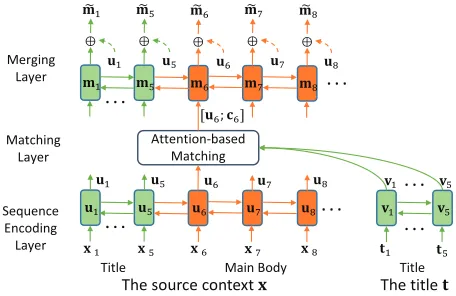
As shown in Figure 2, the title-guided encoder module con-sists of a sequence encoding layer, a matching layer, and a
!" !# !$ !% !&
'" '# '$ '% '&
Title Main Body
(" (#
Title . . .
Sequence Encoding
Layer Matching
Layer Merging
Layer
['$; +$]
The source context - The title .
'$
Attention-based Matching
/
!$
⊕
'$
/ !"
⊕
'"
/
!#
⊕
'#
/
!%
⊕
'%
/ !&
⊕
'&
'" '# '% '&
-" -# -$ -% -& ." .#
(" (#
. . .
. . .
. . .
. . . . . .
Figure 2: The title-guided encoder module. (Best viewed in color.)
merging layer. First, the sequence encoding layer reads the context input and the title input and learns their contextual representations separately. Then the matching layer gathers the relevant title information for each context word reflect-ing the important parts of the context. Finally, the mergreflect-ing layer merges the aggregated title information into each con-text word producing the final title-guided concon-text represen-tation.
Sequence Encoding Layer At first, an embedding look-up table is applied to map each word within the context and the title into a dense vector with a fixed sizede. To incor-porate the contextual information into the representation of each word, two bi-directional GRUs (Cho et al. 2014) are used to encode the context and the title respectively:
− →u
i=GRU11(xi,−→ui−1), (1) ←−u
i=GRU12(xi,←−ui+1), (2) −
→v
j=GRU21(tj,−→vj−1), (3) ←−v
j=GRU22(tj,←−vj+1), (4) wherei= 1,2, . . . , Lxandj = 1,2, . . . , Lt.xiandtj are
the de-dimensional embedding vectors of the i-th context word and thej-th title word separately.−→ui,←−ui,−→vj, and←−vj
are d/2-dimensional hidden vectors where dis the hidden dimension of the bi-directional GRUs. The concatenations
ui= [−→ui;←u−i]∈Rdandvj = [−→vj;←v−j]∈Rdare used as
the contextual vectors for thei-th context word and thej-th title word respectively.
Matching Layer The attention-based matching layer is engaged to aggregate the relevant information from the title for each word within the context. The aggregation operation
ci=attn(ui,[v1,v2, . . . ,vLt];W1)is as follows:
ci=
Lt
X
j=1
αi,jvj, (5)
αi,j= exp(si,j)/ Lt
X
k=1
exp(si,k), (6)
whereci ∈Rdis the aggregated information vector for the i-th word ofx.αi,j(si,j) is the normalized (unnormalized) attention score betweenuiandvj.
Here, the matching layer is implicitly composed of two parts because the context is a concatenation of the title and the main body. The first part is the “title to title” self-matching part, wherein each title word attends the whole ti-tle itself and gathers the relevant titi-tle information. This part is used to strengthen the important information in the title itself, which is essential to capture the core information be-cause the title already contains much highly summative in-formation. The other part is the “main body to title” match-ing part wherein each main body word also aggregates the relevant title information based on semantic relatedness. In this part, the title information is employed to reflect the im-portance of information in the main body based on the fact that the highly title-related information in the main body should contain core information. Through these two parts, this matching layer can utilize the title information much more sufficiently than any of the previous sequence to se-quence methods.
Merging Layer Finally, the original contextual vectorui
and the aggregated information vectorciare used as the
in-puts to another information merging layer: −
→
mi=GRU31([ui;ci],−→mi−1), (8)
←−
mi=GRU32([ui;ci],←m−i+1), (9)
e
mi=λui+ (1−λ)[→−mi;←m−i], (10)
where[ui;ci]∈R2d,−→mi ∈Rd/2,←m−i ∈Rd/2,[−→mi,←m−i]∈ Rd, andmei ∈R
d. Theu
i in Eq. (10) is a residual
connec-tion, andλ ∈ (0,1) is the corresponding hyperparameter. Eventually, we obtain the title-guided contextual represen-tation of the context (i.e.,[me1,me2, . . . ,meLx]), which is
re-garded as a memory bank for the later decoding process.
Decoder Module
After encoding the context into the title-guided repre-sentation, we engage an attention-based decoder (Luong, Pham, and Manning 2015) incorporating with copy mech-anism (See, Liu, and Manning 2017) to produce keyphrases. Only one foward GRU is used in this module:
ht=GRU4([et−1; ˜ht−1],ht−1), (11)
ˆ
ct=attn(ht,[me1,me2, . . . ,meLx];W2), (12)
˜
ht=tanh(W3[ˆct;ht]), (13)
wheret= 1,2, . . . , Ly,et−1∈Rdeis the embedding of the
(t−1)-th predicted word whereine0is the embedding of the start token,ˆct∈Rdis the aggregated vector forht∈Rd
from the memory bank[me1,me2, . . . ,meLx], andh˜t∈R dis
the attentional vector at time stept.
Consequently, the predicted probability distribution over the predefined vocabularyVfor current step is computed by:
Pv(yt|yt−1,x,t) =softmax(Wvh˜t+bv), (14)
whereyt−1= [y1, . . . , yt−1]is the previous predicted word sequence, andbv∈R|V|is a learnable parameter vector.
Before generating the predicted word, a copy mechanism is adopted to efficiently exploit the in-text information and to strengthen the extraction capability of our model. We fol-low See, Liu, and Manning (2017) and first calculate a soft switch between generating from the vocabulary and copying from the source contextxat time stept:
gt=σ(wTgh˜t+bg), (15)
wherewg ∈Rdis a learnable parameter vector andbgis a
learnable parameter scalar. Eventually, we get the final pre-dicted probability distribution over the dynamic vocabulary V ∪ X, whereX are all words appearing in the source con-text. For simplicity, we usePv(yt)andPf inal(yt)to denote Pv(yt|yt−1,x,t)andPf inal(yt|yt−1,x,t)respectively:
Pf inal(yt) = (1−gt)Pv(yt) +gt
X
i:xi=yt
ˆ
αt,i, (16)
whereαˆt,iis the normalized attention score betweenhtand
e
mi. For all out-of-vocabulary (OOV) words (i.e.,yt ∈ V/ ),
we setPv(yt)as zero. Similarly, if wordytdoes not appear
in the source contextx(i.e.,yt∈ X/ ), the copy probability
P
i:xi=ytαˆt,iis set as zero.
Training
We use the negative log likelihood loss to train our model:
L=−
Ly
X
t=1
logPf inal(yt|yt−1,x,t; Θ), (17)
whereLy is the length of target keyphraseyandytis the
t-th target word iny, andΘrepresents all the learnable pa-rameters.
Experiment Settings
The keyphrase prediction performance is first evaluated by comparing our model with the popular extractive methods and the state-of-the-art generative methods on five real-world benchmarks. Then, comparative experiments of dif-ferent title length ratios are performed on our model and CopyRNN for further model exploration. Finally, an abla-tion study and a case study are conducted to better under-stand and interpret our model.
The experiment results lead to the following findings: • Our model outperforms the state-of-the-art models on all
the five benchmark datasets for both present and absent keyphrase prediction.
• Our model consistently improves the performance on var-ious title length ratios and obtains relative higher im-provement gains for both very low and very high title length ratios.
• The title-guided encoding part and the copy part are con-sistently effective in both present and absent keyphrase prediction tasks.
Training Dataset
Because of the public accessibility, many commonly-used scientific publication datasets are used to evaluate the ex-plored KG methods. This study also focuses on generat-ing keyphrases from scientific publications. For all the gen-erative models (i.e. our TG-Net model as well as all the encoder-decoder baselines), we choose the largest publicly available keyphrase generation datasetKP20k constructed by Meng et al. (2017) as the training dataset.KP20k con-sists of a large amount of high-quality scientific publications from various computer science domains. Totally 567,830 ar-ticles are collected in this dataset, where 527,830 for train-ing, 20,000 for validation, and 20,000 for testing. Both the validation set and testing set are randomly selected. Since the other commonly-used datasets are too small to train a re-liable generative model, we only train these generative mod-els on KP20k and then test the trained models on all the testing part of the datasets listed in Table 2. As for the tra-ditional supervised extractive baseline, we follow Meng et al. (2017) and use the dataset configuration shown in Ta-ble 2. To avoid the out-of-memory proTa-blem, forKP20k, we use the validation set to train the traditional supervised ex-tractive baseline.
Testing Datasets
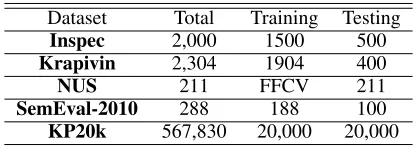
BesidesKP20k, we also adopt other four widely-used sci-entific datasets for comprehensive testing, including In-spec(Hulth 2003),Krapivin(Krapivin, Autaeu, and March-ese 2009), NUS (Nguyen and Kan 2007), and SemEval-2010 (Kim et al. 2010). Table 2 summarizes the statistics of each testing dataset.
Dataset Total Training Testing
Inspec 2,000 1500 500
Krapivin 2,304 1904 400
NUS 211 FFCV 211
SemEval-2010 288 188 100 KP20k 567,830 20,000 20,000
Table 2: The statistics of testing datasets. The “Training” means the training part for the traditional supervised extrac-tive baseline. The “FFCV” represents five-fold cross valida-tion. The “Testing” means the testing part for all models.
Implementation Details
For all datasets, the main body is the abstract, and the con-text is the concatenation of the title and the abstract. During preprocessing, various operations are performed including lowercasing, tokenizing by CoreNLP (Manning et al. 2014), and replacing all the digits with the symbolhdigiti. We de-fine the vocabularyVas the 50,000 most frequent words.
We set the embedding dimensionde to 100, the hidden
size d to 256, and λto 0.5. All the initial states of GRU cells are set as zero vectors except thath0 is initialized as [−→mLx;←m−1]. We share the embedding matrix among the con-text words, the title words, and the target keyphrase words. All the trainable variables including the embedding matrix
are initialized randomly with uniform distribution in [-0.1, 0.1]. The model is optimized by Adam (Kingma and Ba 2015) with batch size = 64, initial learning rate = 0.001, gra-dient clipping = 1, and dropout rate = 0.1. We decay the learning rate into the half when the evaluation perplexity stops dropping. Early stopping is applied when the valida-tion perplexity stops dropping for three continuous evalua-tions. During testing, we set the maximum depth of beam search as 6 and the beam size as 200. We repeat the experi-ments of our model three times using different random seeds and report the averaged results.
We do not remove any predicted single-word phrase in the post-processing forKP20kduring testing, which is dif-ferent from Meng et al. (2017), since our model is trained on this dataset and it can effectively learn the distribution of the single-word keyphrases. But for other testing datasets, we only keep the first predicted single-word phrase following Meng et al. (2017).
Baseline Models and Evaluation Metric
For present keyphrase predicting experiment, we use two unsupervised models including TF-IDF and Tex-tRank (Mihalcea and Tarau 2004), and one supervised model Maui (Medelyan, Frank, and Witten 2009) as our tradi-tional extraction baselines. Besides, we also select Copy-RNN (Meng et al. 2017) and CopyCNN (Zhang, Fang, and Weidong 2017), the two state-of-the-art encoder-decoder models with copy mechanism (Gu et al. 2016), as the base-lines for present keyphrase prediction task. As for absent keyphrase prediction, since traditional extraction baselines cannot generate such keyphrases, we only choose CopyRNN and CopyCNN as the baseline models. For all baselines, we use the same setups as Meng et al. (2017) and Zhang, Fang, and Weidong (2017).
TherecallandF-measure(F1) are employed as our met-rics for evaluating these algorithms. Recall is the number of correctly predicted keyphrases over the total number of target kayphrases. F1 score is computed based on the Re-call and thePrecision, whereinPrecisionis defined as the number of correctly predicted keyphrases over the total pre-dicted keyphrase number. Following Meng et al. (2017) and Zhang, Fang, and Weidong (2017), we also employ Porter Stemmer for preprocessing when determining whether two keyphrases are matched.
Results and Analysis
Present Keyphrase Predicting
In this section, we compare present keyphrase prediction ability of these models on the five real-world benchmark datasets. The F-measures at top 5 and top 10 predictions of each model are shown in Table 3.
RNN-Model Inspec Krapivin NUS SemEval KP20k F1@5 F1@10 F1@5 F1@10 F1@5 F1@10 F1@5 F1@10 F1@5 F1@10 TF-IDF 0.221 0.313 0.129 0.160 0.136 0.184 0.128 0.194 0.102 0.162 TextRank 0.223 0.281 0.189 0.162 0.195 0.196 0.176 0.187 0.175 0.147 Maui 0.040 0.042 0.249 0.216 0.249 0.268 0.044 0.039 0.270 0.230 CopyRNN 0.278 0.342 0.311 0.266 0.334 0.326 0.293 0.304 0.333 0.262 CopyCNN 0.285 0.346 0.314 0.272 0.342 0.330 0.295 0.308 0.351 0.288 TG-Net 0.315 0.381 0.349 0.295 0.406 0.370 0.318 0.322 0.372 0.315 % gain 10.5% 10.1% 11.1% 8.5% 18.7% 12.1% 7.8% 4.5% 6.0% 9.4%
Table 3: Present keyphrase predicting results on all test datasets. “% gain” is the improvement gain over CopyCNN.
Model Inspec Krapivin NUS SemEval KP20k
R@10 R@50 R@10 R@50 R@10 R@50 R@10 R@50 R@10 R@50
CopyRNN 0.047 0.100 0.113 0.202 0.058 0.116 0.043 0.067 0.125 0.211 CopyCNN 0.050 0.107 0.119 0.205 0.062 0.120 0.044 0.074 0.147 0.225 TG-Net 0.063 0.115 0.146 0.253 0.075 0.137 0.045 0.076 0.156 0.268 % gain 26.0% 7.5% 22.7% 23.4% 21.0% 14.2% 2.3% 2.7% 6.1% 19.1%
Table 4: Absent keyphrase predicting results on all test datasets. “% gain” is the improvement gain over CopyCNN.
based framework, our model improves about 20.2%. The re-sults show that our model obtains much stronger keyphrase extraction ability than CopyRNN and CopyCNN.
Absent Keyphrase Predicting
In this setting, we consider the absent keyphrase predict-ing ability which requires the understandpredict-ing of the semantic meaning of the context. Only the absent target keyphrases and the absent predictions are preserved for this evaluation. Generally, recalls at top 10 and top 50 predictions are en-gaged as the metrics to evaluate how many absent target keyphrases are correctly predicted.
The performance of all models is listed in Table 4. It is ob-served that our TG-Net model consistently outperforms the previous sequence-to-sequence models on all the datasets. For instance, our model exceeds 19.1% (R@50 score) on KP20kthan the state-of-the-art model CopyCNN. Overall, the results indicate that our model is able to capture the un-derlying semantic meaning of the context content much bet-ter than these baselines, as we have anticipated.
Keyphrase Predicting on Various Title Length
Ratios
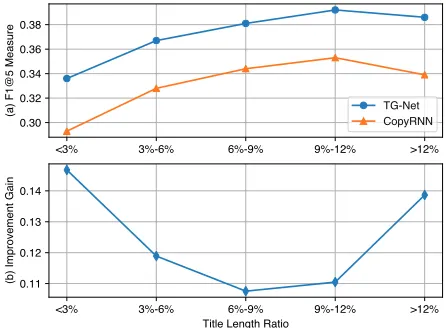
To find out how our title incorporation influences the pre-diction ability, we compare the keyphrase predicting abil-ity of two RNN-based models (i.e., our model and Copy-RNN) on different title length ratios. The title length ratio is defined as the title length over the context length. This analysis is based on theKP20ktesting dataset. In view of the title length ratio, we preprocess the testing set into five groups (i.e.,<3%, 3%-6%, 6%-9%, 9%-12% and>12%). Then, the present keyphrase prediction results (F1@5 mea-sure) and the improvement gain on each group are depicted in Figure 3.
In Figure 3(a), we notice that both CopyRNN and our TG-Net model generally perform better when the title length
ra-<3% 3%-6% 6%-9% 9%-12% >12% 0.30
0.32 0.34 0.36 0.38
(a) F1@5 Measure TG-Net
CopyRNN
<3% 3%-6% 6%-9% 9%-12% >12% Title Length Ratio
0.11 0.12 0.13 0.14
(b) Improvement Gain
Figure 3: Present keyphrase predicting ability (F1@5 mea-sure) on various title length ratios.
tio is higher. One possible explanation is that when the ti-tle is long, it conveys substantial salient information of the abstract. Therefore, the chance for the models to attend to the core information is enhanced, which leads to the ob-served situation. This figure also shows that both TG-Net and CopyRNN get worse performance on>12% group than 9%-12% group. The main reason is that there exist some data with a short abstract in>12% group, which leads to the lack of enough context information for correctly generating all keyphrases.
In Figure 3(b), we find that our TG-Net consistently im-proves the performance with a large margin on five test-ing groups, which again indicates the effectiveness of our model. In a finer perspective, we note that the improvement gain is higher on the lowest (i.e.,<3%) and the highest (i.e.,
Title: Exponential stabilityof switched stochastic delay systems with non-linear uncertainties
Abstract: This article considers the robust exponential stabilityof uncertain switched stochastic systems with time-delay. Both almost sure (sample) stability and stability in mean square are investigated. Based on Lyapunov functional methods and linear matrix inequalitytechniques, new criteria for exponential robust stability of switched stochastic delay systems with non-linear uncertaintiesare derived in terms of linear matrix inequalities andaverage dwell-timeconditions. Numerical examples are also given to illustrate the results.
(a)Present Keyphrases
Target: {stochastic systems; non-linear uncertainties; exponential stability; linear matrix inequality; average dwell-time}
CopyRNN:1. linear matrix inequality, 2. switched stochastic systems, 3. robust stability, 4. exponential stability, 5. average dwell-time TG-Net: 1.exponential stability, 2. switched stochastic systems, 3. average dwell-time, 4.non-linear uncertainties, 5. linear matrix inequality
(b)Absent Keyphrases
Target: {switched systems; time-delay system}
CopyRNN:1. switched systems, 2. switched delay systems, 3. robust control, 4. uncertain systems, 5. switched stochastic stochastic systems TG-Net: 1. almost sure stability, 2. switched systems, 3. time-delay systems, 4. mean square stability, 5. uncertain systems
Figure 4: A prediction example of CopyRNN and TG-Net. The top 5 predictions are compared and the correct predictions are highlighted in bold.
plays a more important role than in other groups, and conse-quently our model benefits more by not only explicitly em-phasizing the title information itself, but also utilizing it to guide the encoding of information in the main body. As for
<3% group, the effect of such a short title is small on the latter part of the context in CopyRNN because of the long distance. However, our model explicitly employs the title to guide the encoding of each context word regardless of the distance, which utilizes the title information much more sufficiently. Consequently, our model achieves much higher improvement in this group. While we only display the re-sults of present keyphrase prediction, the absent keyphrase predicting task gets the similar results.
Ablation Study
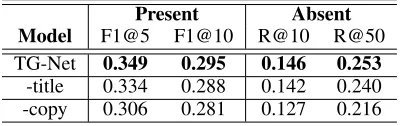
We also perform an ablation study on Krapivin for bet-ter understanding the contributions of the main parts of our model. For a comprehensive comparison, we conduct this study on both present keyphrase prediction and absent keyphrase prediction.
As shown in Table 5, after we remove the title-guided part and only reserve the sequence encoding for the context (i.e., -title), both the present and absent keyphrase predic-tion performance become obviously worse, indicating that our title-guided context encoding is consistently critical for both present and absent keyphrase generation tasks. We also investigate the effect of removing the copy mechanism (i.e., -copy) from our TG-Net. From Table 5, we notice that the scores decrease dramatically on both present and absent keyphrase prediction, which demonstrates the effectiveness of the copy mechanism in finding important parts of the con-text.
Case Study
A keyphrase prediction example for a paper about the expo-nential stability of uncertain switched stochastic delay sys-tems is shown in Figure 4. To be fair, we also only compare the RNN-based models (i.e., TG-Net and CopyRNN). For present keyphrase, we find that a present keyphrase “non-linear uncertainties”, which is a title phrase, is correctly
pre-Present Absent Model F1@5 F1@10 R@10 R@50 TG-Net 0.349 0.295 0.146 0.253
-title 0.334 0.288 0.142 0.240 -copy 0.306 0.281 0.127 0.216
Table 5: Ablation study onKrapivindataset.
dicted by our TG-Net, while CopyRNN fails to do so. As for absent keyphrase, we note that CopyRNN fails to predict the absent keyphrase “time-delay systems”. But our TG-Net can effectively utilize the title information “stochastic delay sys-tems” to locate the important abstract information “stochas-tic systems with time-delay” and then successfully generate this absent keyphrase. These results exhibit that our model is capable of capturing the title-related core information more effectively and achieving better results in predicting present and absent keyphrases.
Conclusion
Acknowledgments
The work described in this paper was partially supported by the Research Grants Council of the Hong Kong Special Ad-ministrative Region, China (No. CUHK 14208815 and No. CUHK 14210717 of the General Research Fund), and Mi-crosoft Research Asia (2018 MiMi-crosoft Research Asia Col-laborative Research Award). We would like to thank Jingjing Li, Hou Pong Chan, Piji Li and Lidong Bing for their com-ments.
References
Bahdanau, D.; Cho, K.; and Bengio, Y. 2015. Neural machine translation by jointly learning to align and translate. InICLR. Berend, G. 2011. Opinion expression mining by exploiting keyphrase extraction. InIJCNLP, 1162–1170.
Cho, K.; van Merrienboer, B.; Gulcehre, C.; Bahdanau, D.; Bougares, F.; Schwenk, H.; and Bengio, Y. 2014. Learning phrase representations using rnn encoder–decoder for statistical machine translation. InEMNLP, 1724–1734.
Dauphin, Y. N.; Fan, A.; Auli, M.; and Grangier, D. 2017. Lan-guage modeling with gated convolutional networks. InICML, 933– 941.
Florescu, C., and Caragea, C. 2017. A position-biased pagerank algorithm for keyphrase extraction. InAAAI Student Abstracts, 4923–4924.
Florescu, C., and Jin, W. 2018. Learning feature representations for keyphrase extraction. InAAAI Student Abstracts.
Gao, Y.; Bing, L.; Li, P.; King, I.; and Lyu, M. R. 2018. Gen-erating distractors for reading comprehension questions from real examinations.arXiv preprint arXiv:1809.02768.
Gehring, J.; Auli, M.; Grangier, D.; Yarats, D.; and Dauphin, Y. N. 2017. Convolutional sequence to sequence learning. InICML, 1243–1252.
Gollapalli, S. D.; Li, X.; and Yang, P. 2017. Incorporating expert knowledge into keyphrase extraction. InAAAI, 3180–3187. Gu, J.; Lu, Z.; Li, H.; and Li, V. O. 2016. Incorporating copying mechanism in sequence-to-sequence learning. InACL, volume 1, 1631–1640.
Hai, Y., and Lu, W. 2018. Semi-supervised learning for neural keyphrase generation.arXiv preprint arXiv:1808.06773.
Hulth, A., and Megyesi, B. B. 2006. A study on automatically extracted keywords in text categorization. InCOLING and ACL, 537–544.
Hulth, A. 2003. Improved automatic keyword extraction given more linguistic knowledge. InEMNLP, 216–223.
Jones, S., and Staveley, M. S. 1999. Phrasier: a system for interac-tive document retrieval using keyphrases. InSIGIR, 160–167. Jun, C.; Xiaoming, Z.; Yu, W.; Zhao, Y.; and Zhoujun, L. 2018. Keyphrase generation with correlation constraints. arXiv preprint arXiv:1808.07185.
Kim, S. N.; Medelyan, O.; Kan, M.-Y.; and Baldwin, T. 2010. Semeval-2010 task 5 : Automatic keyphrase extraction from scien-tific articles. InProceedings of the 5th International Workshop on Semantic Evaluation, 21–26.
Kingma, D. P., and Ba, J. 2015. Adam: A method for stochastic optimization. InICLR.
Klein, G.; Kim, Y.; Deng, Y.; Senellart, J.; and Rush, A. 2017. Opennmt: Open-source toolkit for neural machine translation. In ACL System Demonstrations, 67–72.
Krapivin, M.; Autaeu, A.; and Marchese, M. 2009. Large dataset for keyphrases extraction. Technical report, University of Trento. Li, D.; Li, S.; Li, W.; Wang, W.; and Qu, W. 2010. A semi-supervised key phrase extraction approach: Learning from title phrases through a document semantic network. InACL Short, 296– 300.
Liu, Z.; Chen, X.; Zheng, Y.; and Sun, M. 2011. Automatic keyphrase extraction by bridging vocabulary gap. InCoNLL, 135– 144.
Luan, Y.; Ostendorf, M.; and Hajishirzi, H. 2017. Scientific infor-mation extraction with semi-supervised neural tagging. InEMNLP, 2641–2651.
Luong, T.; Pham, H.; and Manning, C. D. 2015. Effective ap-proaches to attention-based neural machine translation. InEMNLP, 1412–1421.
Manning, C.; Surdeanu, M.; Bauer, J.; Finkel, J.; Bethard, S.; and McClosky, D. 2014. The stanford corenlp natural language pro-cessing toolkit. InACL System Demonstrations, 55–60.
Medelyan, O.; Frank, E.; and Witten, I. H. 2009. Human-competitive tagging using automatic keyphrase extraction. In EMNLP, 1318–1327.
Meng, R.; Zhao, S.; Han, S.; He, D.; Brusilovsky, P.; and Chi, Y. 2017. Deep keyphrase generation. InACL, volume 1, 582–592. Mihalcea, R., and Tarau, P. 2004. Textrank: Bringing order into text. InEMNLP.
Nema, P.; Khapra, M. M.; Laha, A.; and Ravindran, B. 2017. Di-versity driven attention model for query-based abstractive summa-rization. InACL, volume 1, 1063–1072.
Nguyen, T. D., and Kan, M.-Y. 2007. Keyphrase extraction in scientific publications. InICADL, 317–326.
Nguyen, T. D., and Luong, M.-T. 2010. Wingnus: Keyphrase ex-traction utilizing document logical structure. InProceedings of the 5th International Workshop on Semantic Evaluation, 166–169. Paszke, A.; Gross, S.; Chintala, S.; Chanan, G.; Yang, E.; DeVito, Z.; Lin, Z.; Desmaison, A.; Antiga, L.; and Lerer, A. 2017. Auto-matic differentiation in pytorch. InNIPS-W.
See, A.; Liu, P. J.; and Manning, C. D. 2017. Get to the point: Sum-marization with pointer-generator networks. In ACL, volume 1, 1073–1083.
Song, L.; Wang, Z.; and Hamza, W. 2017. A unified query-based generative model for question generation and question answering. arXiv preprint arXiv:1709.01058.
Sutskever, I.; Vinyals, O.; and Le, Q. V. 2014. Sequence to se-quence learning with neural networks. InNIPS, 3104–3112. Wan, X., and Xiao, J. 2008. Single document keyphrase extraction using neighborhood knowledge. InAAAI, 855–860.
Wang, W.; Yang, N.; Wei, F.; Chang, B.; and Zhou, M. 2017. Gated self-matching networks for reading comprehension and question answering. InACL, volume 1, 189–198.
Witten, I. H.; Paynter, G. W.; Frank, E.; Gutwin, C.; and Nevill-Manning, C. G. 1999. Kea: Practical automatic keyphrase ex-traction. InProceedings of the fourth ACM conference on Digital libraries, 254–255.
Zhang, Q.; Wang, Y.; Gong, Y.; and Huang, X. 2016. Keyphrase extraction using deep recurrent neural networks on twitter. In EMNLP, 836–845.