The Journal of Social Sciences Research
ISSN(e): 2411-9458, ISSN(p): 2413-6670
Vol. 5, Issue. 1, pp: 94-100, 2019
URL: https://arpgweb.com/journal/journal/7 DOI: https://doi.org/10.32861/jssr.51.94.100
Academic Research Publishing Group
Original Research Open Access
The Influence of Self Care on Mindful Consumption Behaviour
Syahrul Hezrin Mahmud
Faculty of Business and Management1 Universiti Teknologi MARA, Terengganu, Terengganu, Malaysia
Marhana Mohamed Anuar
*School of Maritime Business and Management Universiti Malaysia Terengganu, Terengganu, Malaysia Institute of Oceanography and Environment Universiti Malaysia Terengganu, Terengganu, Malaysia
Muhammad Abi Sofian Abdul Halim
School of Maritime Business and Management Universiti Malaysia Terengganu, Terengganu, Malaysia
Azizul Yadi Yaakop
School of Maritime Business and Management Universiti Malaysia Terengganu, Terengganu, Malaysia
Abstract
The progress and the developmental changes in consumer behavior have been obvious for eras. The major transformation in the new consumer behavior because of the current economic and financial situation has become the major concern with sustainable consumption as its prime focus. This paper discusses the empirical finding from the preliminary study based on the research of Mindful Consumption (MC). The study is expected to explore the mindful consumption behavior (MCB) among working people. The role of mindful mindset, specifically self care in influencing MCB in Malaysia, will be the main subject of this study. The data was collected by using questionnaires that were converted into the Google Form prior the study. Forty-five responses were secured from an online survey which was conducted for a month and those responses were automatically being stored in Google Form platform. SPSS version 23 was used to retrieve the data from the online storage and to analyze relevant statistical measurement. The result of Pearson Correlation analysis has indicated the positive influence of self care on MCB. Keywords: Mindful consumption behaviour; Mindful mindset; Consumer behaviour; Self care; Sustainable consumption.
CC BY: Creative Commons Attribution License 4.0
1. Introduction
The study on Mindful Consumption (MC) is important in addressing consumption sustainability. MC is a new concept that deserved further theoretical refinement and it is prefaced on awareness in pondering outcomes of consumption. The dynamic progress of consumer behavior areas has brought the development and the seeds of progress have been obvious for eras. The major transformation in the new consumer behavior, due to the current economic and financial situation will be stressed with the focus on the angle of sustainable consumption. Basically, this study is expected to explore the mindful consumption behavior (MCB) among the government and private employees in Malaysia. The role of mindful mindset specifically on self care in influencing MCB in Malaysia will be the main subject of the study. Thus, it is also important to know the contribution level of supporting variables such as the elements of mindful mindset, namely self care, on MCB itself.
As the number of people who live in debts in Malaysia as well as around the world is alarming, the practice of MC among consumers is important. However, the research on MC remains scarce and has begun to gain interest
only in 2011 as stated in Sheth et al. (2011). Yet, the influencing factors of MC are to be identified. Therefore, an
investigation in determining these factors is crucial.
The concept of self care is about mindful mindset that concern on individual. It is focusing on individual's well-being and concern. In advance, the main aspects of self care are eudemonic, which means blissing or thriving, and
another is concerning on the financial aspects (Sheth et al., 2011). Furthermore, self care is something concerning
with a personal aspect in which it manages how one intra-relates with oneself as to the significance, reason and values in life (Gomez and Fisher, 2003).
As reported by AKPK (Credit Counselling and Debt Management Agency, established by Bank Negara Malaysia) (2014), almost 300 thousand individuals have attended its counseling services with more than 30% of them have enrolled in a program named Debt Management Program. Those individuals were from different kinds of backgrounds. Throughout the program, it was found that the elements which lead to their over-obligation and powerlessness to reimburse their obligations are the poor money related arranging, numbness and absence of budgetary train to live within their means. Hence, the identification and understanding of mindful mindset factors involving self care that influenced MCB is necessary especially in dealing with the consumerism issues.
MCB. The statistical findings on these factors are infrequent and needs to be explored further. Nevertheless, a study
conducted by Ndubisi (2012) that examined the existing exploration on mindfulness as a rule, inferred that
mindfulness has been considered by specialists crosswise over various disciplines and subjects. The study also revealed that only a few researches were conducted regarding the mindfulness itself in addressing the consumption sustainability.
Therefore, this study on self care and the relationship with MCB will contribute on hypothetical refinements and further advancement as a construct. It is expected to recognize components that will give impact to the feeling of
mindful mindset and behavioral temperance (Sheth et al., 2011). They have argued that the “nature of (the)
relationship between a caring mindset and temperate consumption behavior …needs to be investigated”. However, Phipps et al. (2013) has stated that the question stays on how to consider the relationship amongst behavior and the wide assortment of individual variables identified with behavior.
2. Literature Review
2.1. Mindful Consumption
The concept of mindful consumption is derived from the related concept of sustainability consumption, ethical consumption, green consumption and many other consumption theories. Since the development of MC is considered quite new, the limitation of the study regarding MC itself has so far unable to put appropriate standard benchmarking to the previous studies conducted on MC by the previous researchers.
However, the similarity of MC with other areas of consumption has allowed the researches to conduct the study
through the adaptation and the customization of a model with the reference to the study conducted by Chowdhury
and Fernando (2013) about the influences of spiritual well-being on ethical consumption.
The understanding of mindful aspects is related with care includes capacity to reason about new sorts of jolts, capacity to look at, differentiation and make judgments about likenesses and contrasts, familiarity with the attributes of specific circumstances and changes in such circumstances, seeing things from various perspectives and focusing on the prompt circumstance (Sternberg, 2000).
2.2. Mindful Consumption Behavior
In order to change behavior, the focal topic in MC is moderation. Moderation or temperance does not infer to a dismissal of consumption as such, but rather it is gone for contributing ideal consumption for consumer's prosperity and reliable with their qualities. Moderation or temperance has to be practiced in a few types of behaviors, namely accumulative, repetitive, and aspirational, that are most often associated with overconsumption. These behavioral affinities have been proven, now and again, to cover and additionally to give common support to the moderation or
the temperance itself (Sheth et al., 2011). Mansoor (2011); on the other hand, noted that, the temperance is
reflected with the statements that even rich individuals make a saving, in spite of the fact that this is not priorities to do as such. This is one way the consumers demonstrate their disappointment on excessive consumption. They started to reuse and to show their children conventional qualities.
Intemperate or excessive consumption causes the consumer needs to raise known as over-utilization and
deficient promoting causes the consumer should be ignored called as under-utilization (Malhotra et al., 2005). These
outcomes confirm the view that the impacts of mindfulness are vigorous and that they can't be subsumed by propensity, a conclusion that is in accordance with propensity hypothesis and with the hypothetical meaning of mindfulness (Brown and Ryan, 2003).
2.3. Self Care
Self care is a part of mindful mindset where the center value of MC is depending on the consumers' mindset itself to administer it to themselves. It changes the conduct into hardening their self-vanquishing surpluses related
with acquisitive, repetitive, and aspirational consumption (Sheth et al., 2011). According to Fisher (2011); self care
is alluding to the certification of life in connection to oneself. At the end of the day, high individual prosperity reflects reason and significance in life. It is communicated through self-esteem and self-worth.
The focus on mindful mindset as studied by Subrahmanyan and Gould (2013) consists a few aspects such as
balance in consumption since less, consumption in view of requirements as opposed to propensity or societal weight, consumption that considers consequences for other individuals and additionally nature, sharing one assets, diminishing eagerness and narrow minded consumption. The concept of mindful mindset is related to spiritual well-being that was introduced by Fisher (1999) and Gomez and Fisher (2003). One of the focused area in this research is the personal well-being (self care), and others are community care and environmental well-being (nature care).
Self care is about mindful mindset that stresses on individual’s care and does not reflects one’s narrow minded or egotistic, It is rather focusing on individual's well-being. The two main aspects aspects are eudemonic which
mean bliss or thriving, furthermore financial (Sheth et al., 2011). Self care is something to do with the personal
domain where it manages how one intra-relates with oneself as to significance, reason and values in life. Gomez and Fisher (2003).
of arrangements and control counter deliberate contemplations that regularly degrade individuals from following up on their aims.
Figure-1.Theoretical Framework
Based on Figure 1, the framework helps the researcher to find out the influences of independent variable on the MCB. Further, the influences will be examined to determine whether they affected the components of mindful consumptions such mindsets and behavior. This proposed model is expected to be a guide for an organization and its consumer towards the sustainability.
3. Materials and Methods
Convenience sampling was used in this study. The method of sampling was implemented to ensure the accuracy and validity of data in line with the subject of the study. It also allowed the respondents to join the discussion whenever they felt convenience to do so. It was also suitable with the online data collection method that will be used
in this study. As stressed by Hulland et al. (2018); this type of sampling is appropriate when the aim of the research
is to test the veracity of some proposed theoretical effects. For this study, the researcher focused on the employees in two sectors, public and private. So the respondents were selected from both of these sectors.
Measurement instrument for this study is a questionnaire using the Likert Scale. According to Zikmund et al.
(2010); Likert Scale is a measurement of attitudes designed to allow respondents to rate how strongly they agree or disagree with carefully constructed statements, ranging from very positive to very negative attitudes toward some object. In measuring the dependent and independent variables, the researcher has adapted a measurement items from
the previous study conducted by Chowdhury and Fernando (2013) which stresses on the measurement item of
mindful mindset: self care, while the measurement items for MCB were adapted from Pepper et al. (2009).
As indicated above, the measurement items for the questionnaire used in this study were adapted or adopted from previous studies. The items for each construct and their scale of measurements are described in Table1 below.
Table-1.Measurement Items Used in the Survey Questionnaire
Variable/Authors Items
Mindful consumption behaviour: acquisitive consumption
Adapted from Pepper et al. (2009)
Three items
Five-point Likert scale
1. I buy things when I need them.
2. I buy only the things I need.
3. I don’t purchase something on impulse when out shopping.
Mindful consumption behaviour: repetitive consumption
Adapted from Pepper et al. (2009)
Two items
Five-point Likert scale
1. I replace my clothes when they are worn out.
2. I make the things I buy last as long as possible.
Mindful consumption behaviour: aspirational consumption
Adapted from Pepper et al. (2009)
Three items
Five-point Likert scale
1. I don’t admire people who own expensive homes, cars and clothes.
2. The thing I own don’t say a lot about how well I am doing in life.
3. I don’t like to own things that impress people.
Mindful mindset: Self-care
Adapted from Chowdhury and
Fernando (2013) Five items
Five-point Likert scale
1. I am concerned about developing a sense of identity.
2. I am concerned about developing self-awareness.
3. I am concerned about developing joy in life.
4. I am concerned about developing inner peace.
5. I am concerned about developing meaning in life.
To ensure the reliability of the research methodology, a pretest was conducted among 10 respondents from the government sectors and the other 10 respondents were from private sectors in Terengganu. The participants were interviewed and guided by the researcher to answer the questionnaire. Based on the feedback from the pretest, a few amendments were made in order to increase the accuracy and relevancy of the questionnaires.
The online survey was conducted among respondents from both public and private sector staffs in Malaysia.
information. The time between arranging a study and reporting its discoveries is diminished in light of the fact that many respondents can get to an information online and present their information at any given time. Moreover, there is no trying site or arrangement/outreach planning, and information section is eliminated. Unquestionably, making an overview is required; nonetheless, cheap and easy to use programming exist that can encourage the procedure.
In this preliminary study, the data was collected by using questionnaires which was converted into the Google Form. Then this online questionnaire was distributed and available via online for a month by using social apps such as Facebook and WhatsApp started from 24 March 2016 to 24 April 2016.
It was expected that more than thousand sharing of this questionnaires circulated through Facebook groups and individuals WhatsApp via a link http://goo.gl/forms/6J6KonW9GC. The exact number of circulated questionnaire is unknown due to the nature of this online survey. Forty five responses were secured from the one-month-online survey, in which the responses were automatically stored in Google form. The SPSS version 23 was used in order to retrieve data from the online storage and also to analyze relevant statistical measurement.
4. Results
The summary of demographic profile is presented in Table 2. There were more male respondents (53.5%) participated in this study compared to female respondents (46.7%). The respondents were all over 20 years of age, which qualified them as a representative of working people, in this review. A large portion of the respondents were in the middle age group, aged in the vicinity of 40 and 49 years of age. Most of them also were in professional occupation with majority of them have an income between RM 4001-RM6000 and well educated by bachelor degree and above. Based on race, the Malay responded most (88.9%) and Muslim (93.3%). The majority of the respondents (62.2%) were public or government sectors employee.
Table-2. Demographic profile
Demography Category Percentage
Gender Female 46.7
Male 53.3
Age
20-29 8.9
30-39 20
40-49 55.6
50-59 8.9
60 and above 2.2
Below than 20 4.4
Marital status
Married 33.3
Married with children 44.4
Married without children 4.4
Single 17.8
Occupation
Lower management 6.7
Middle management 20
Others, please specify 6.7
Professional 53.3
Supporting staff 2.2
Top management 11.1
Occupation Sector Private 37.8
Public / government 62.2
Income level (RM)
Below RM2000 4.4
RM10,001 and above 13.3
RM2001-RM4000 17.8
RM4001-RM6000 37.8
RM6001-RM8000 20
RM8001-RM10,000 6.7
Education level
Bachelor degree 37.8
Certificate/Diploma 13.3
Master degree 35.6
PhD 13.3
Race
Chinese 6.7
India 2.2
Malay 88.9
Sabah / Sarawak Bumiputera 2.2
Religion
Hinduism 2.2
Buddhism 2.2
Christian 2.2
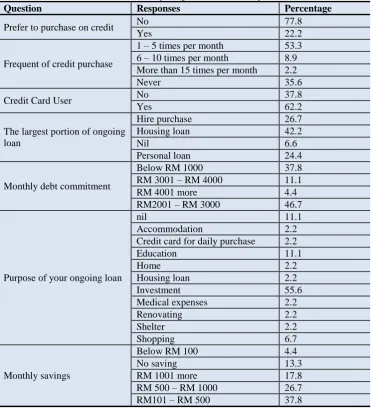
Table 3 indicated that most of the respondents (77.8%) did not prefer to purchase on credit but surprisingly half of them (53.3%) were found to use the credit purchase for about one to five times monthly. Additionally, the majority of the respondents (62.2%) used credit card and it was found that the housing loan contributed the largest portion of respondents’ ongoing loan. Almost half of the respondents had monthly debt commitment between RM2001 to RM4000 (46.7%). The most reason given by the respondents for their ongoing loan, is mostly for investments (55.6%). There were 13.3% of the respondents with no saving and majority of them (37.8%) with RM101 to RM 500 savings monthly.
Table-3. Debt & Spending Related Profile of Respondents
Question Responses Percentage
Prefer to purchase on credit No 77.8
Yes 22.2
Frequent of credit purchase
1 – 5 times per month 53.3
6 – 10 times per month 8.9
More than 15 times per month 2.2
Never 35.6
Credit Card User No 37.8
Yes 62.2
The largest portion of ongoing loan
Hire purchase 26.7
Housing loan 42.2
Nil 6.6
Personal loan 24.4
Monthly debt commitment
Below RM 1000 37.8
RM 3001 – RM 4000 11.1
RM 4001 more 4.4
RM2001 – RM 3000 46.7
Purpose of your ongoing loan
nil 11.1
Accommodation 2.2
Credit card for daily purchase 2.2
Education 11.1
Home 2.2
Housing loan 2.2
Investment 55.6
Medical expenses 2.2
Renovating 2.2
Shelter 2.2
Shopping 6.7
Monthly savings
Below RM 100 4.4
No saving 13.3
RM 1001 more 17.8
RM 500 – RM 1000 26.7
RM101 – RM 500 37.8
Table 4 shows the test of the variables indicating Cronbach’s alpha coefficients score for the variables. The scores indicated that the Cronbach’s alpha for mindful consumption behavior is (0.860) whereas mindful mindset :
self care is (0.854). Based on the suggestion by Nunnally (1978); all the variables are considered to have adequate
reliability since the minimum acceptable alpha for scale reliability is 0.70.
Table-4. Mean, standard deviation and reliability value of variables
ID Variable items No. of
items
Mean Standard Deviation
Cronbach’s alpha
MCB Mindful Consumption Behavior 10 3.48 0.52 .860
MMSC Mindful Mindset : Self Care 10 3.87 0.52 .854
Table-5. Pearson Correlation Test Result
Variable Mindful Mindset : Self Care
Mindful Consumption Behavior Pearson Correlation .501*
Sig. (2 tailed) .000
N 45
* Correlation is significant at the 0.01 level (2-tailed)
To conduct hypotheses testing, the relationship between mindful consumption behavior and mindful mindset is statistically tested by Pearson Correlation test. Based on Table 5, the result concluded that there was significant relationship between the variables. This hypothesis does find a support and it is possibly indicated that self-care leads toward influencing mindful consumption behavior.
Pearson Correlation was used to determine the relationship among variables. It shows clearly the independent variables are statistically significant with the p-value of 0.000 at 0.01 significant levels. The result implies relatedness on the strength of association between self care and MCB. The correlation analysis was conducted in order to examine the association between self care and MCB. As indicated by the correlation result, the variables have a positive correlation. A one-tailed test showed that the independent variable was significant (p < 0.01) as indicated by the result of 0.501.
From the finding, empirically, it indicates that all the two variables have positive correlation respectively relating to the strength of association. The Pearson Correlation analysis suggested that there is significant relationship between independent variables namely self-care with MCB.
5. Discussion
The study on MC and the relationship between self care with MCB which suggested by the researchers will contribute to the hypothetical establishments and advance improvement in the area of study. Research is expected to
distinguish components that impact the sense of caring in mindset and temperance in behavior (Sheth et al., 2011).
Once more, Sheth et al. (2011) who examine on the "idea of (the) connection between a minding outlook and
temperate consumption conduct … should be explored", yet as concerned by Phipps et al. (2013) the inquiry
remains as how to consider the relationship among behavior and the wide collection of individual parts related to behavior. Advance, all the while tending to environmental (e.g., physical and socio cultural), personal, and behavioral factors is critical.
The finding indicated that the positive relationship between self care towards mindful consumption behavior is
in line with Sheth et al. (2011) who proposed that caring to oneself is not about being narrow minded or conceited,
but rather it is about paying regard to one's financial prosperity. It is additionally supported by Malek et al. (2016)
who stated that caring to self is practiced by respondents in which they are arranging their monetary or budgetary position in a superior position. Each of the respondents offers a reasonable picture where they are focusing on their monetary prosperity by taking an interest in an investment. In this context, making a very self-concerned or self-care investment can be considered as manifestation of MCB.
A possible explanation for this finding might be that respondents are very cautious about their spending especially concerning to the individual or personal aspects. Further research may be undertaken in future to study the underlying motives. The self care element is one of the consideration in order to practice mindful consumption behavior where it leads toward the temperance in consumption and further more striving toward consumption sustainability.
The study has indicated an understanding of the MC specifically towards the element of self care and mindful consumption behavior. The finding of this review will have a few ramifications which would without a doubt be useful to a few parties, for example, clients, marketers, government and others. Developing business sector signals recommend that an attention on MC can be profitable in making an arrangement between consumer self-enthusiasm for liberating oneself from an unrewarding and unsustainable example of consumption, and business self-enthusiasm for satisfying its maintainability commitments to meet the desires of many key partners. Indeed, even as the message frame researchers merit consideration from business, what is important most for managers and marketers is the
behavior and mindset of the customer (Sheth et al., 2011).
6. Conclusions
In that regard, the indication of "new normal" in consumption is unmistakable: Malaysian consumers in expanding numbers are swinging to frugality, and a larger part of them are probably not going to swing back to overconsumption. The finding of this research is one of the small signal that indicated the changes of consumer mindset and behavior on the optimal, temperance and sustain consumption.
From the consumerism and environmental point of view, MC is an unpreventable need. MC is profoundly alluring for individual and societal prosperity, and fits well with the new frugality grasped by the consumer. It will likewise relieve some conceivably genuine business dangers, including prosecution and unwelcome new administrative weights. The ways in which consumer makes a spending are also important consideration since this factor will contribute to the mindful consumption behaviour. Thus, education on the aspects of the ethical consumerism plays a significant role in creating mindful consumption towards sustainability consumption
living, uncontrolled debt and quality of life. Future study on the relationship of mindful consumption and sustainability consumption is highly recommended. Meanwhile, exploring various factors contributing toward mindful consumption is also a vital consideration.
Conflicts of Interest
The authors declare that there is no conflicts of interest.
References
Brown, K. W. and Ryan, R. M. (2003). The benefits of being present: mindfulness and its role in psychological
well-being. Journal of personality and social psychology, 84(4): 822.
Chowdhury, R. M. and Fernando, M. (2013). The role of spiritual well-being and materialism in determining
consumers’ ethical beliefs: An empirical study with Australian consumers. Journal of Business Ethics,
113(1): 61-79.
Fisher, J. W., 1999. "Developing a spiritual health and life orientation measure for secondary school students." In In
Proceedings of the University of Ballarat annual research conference. pp. 57–63.
Fisher, J. W. (2011). The four domains model: Connecting spirituality. health and well-being. Religions, 2(1): 17–
28.
Gomez, R. and Fisher, J. W. (2003). Domains of spiritual well-being and development and validation of the spiritual
well-being questionnaire. Personality and Individual Differences, 35: 1975–91.
Hulland, J., Baumgartner, H. and Smith, K. M. (2018). Marketing survey research best practices: evidence and
recommendations from a review of JAMS articles. Journal of the Academy of Marketing Science, 46(1):
92-108.
Malek, A. B. A., Osman, I., Alwi, S. F. S., Muda, R. and Mohamad, S. (2016). Impact of Mindful Consumption
(MC) on Investment Decision: A Study Within Malaysian Individual Investors. In Proceedings of the 1st
AAGBS International Conference on Business Management 2014 (AiCoBM 2014). Springer: Singapore.
269-81.
Malhotra, N. K., Allvine, D. C. and Wu, L. (2005). Does marketing need reform? The case of excessive
consumption”, in Sheth, J. and Sisodia, R. (Eds), Does Marketing Need Reform? : M.E. Sharpe: Armonk,
NY.
Mansoor, D. (2011). the global business crisis and consumer behavior: Kingdom of bahrain as a case study.
International Journal of Business and Management, 6(1): 104-15.
Ndubisi, N. O. (2012). Mindfulness, quality and reliability in small and large firms. International Journal of Quality
& Reliability Management, 29(6): 600-06.
Nunnally, J. (1978). Psychometric theory.
Pepper, M., Jackson, T. and Uzzell, D. (2009). An examination of the values that motivate socially conscious and
frugal consumer behaviours. International Journal of Consumer Studies, 33(2): 126-36.
Phipps, M., Ozanne, L. K., Luchs, M. G., Subrahmanyan, S., Kapitan, S., Catlin, J. R. and Weaver, T. (2013).
Understanding the inherent complexity of sustainable consumption: A social cognitive framework. Journal
of Business Research, 66(8): 1227-34.
Rhodes, S. D., Bowie, D. A. and Hergenrather, K. C. (2003). Collecting behavioural data using the world wide web:
considerations for researchers. Journal of Epidemiology and Community Health, 57(1): 68-73.
Sheth, J. N., Sethia, N. K. and Srinivas, S. (2011). Mindful consumption: a customer-centric approach to
sustainability. Journal of the Academy of Marketing Science, 39(1): 21-39.
Sternberg, R. J. (2000). Images of mindfulness. Journal of Social Issues, 56(1): 11-26.
Subrahmanyan, S. and Gould, S. (2013). Achieving sustainable consumption through spiritual practices.
Purushartha. A Journal of Management Ethics and Spirituality, 5(2).