326
Volume-4, Issue-4, August-2014,
ISSN No.: 2250-0758
International Journal of Engineering and Management Research
Available at:
www.ijemr.net
Page Number: 326-331
Changing Trends in Indian Life Insurance Industry
Dr. Yograj Singh1 Deepak Dhariyal2
1Research Supervisor, Shri Venkateshwara University, Gajraula, INDIA 2
Research Scholar, Shri Venkateshwara University, Gajraula, INDIA
I.
ABSTRACT & INTRODUCTION
The rapid growth of the sector over the last decade, insurance in India remains at an early stage of development. At the end of 2003, the Indian insurance market (in terms of premium volume) was the 19th largest in the world, only slightly bigger than that of Denmark and comparable to that of Ireland.2 This was despite India being the second most populous country in the world as well as the 12th largest economy. Yet, there are strong arguments in favor of sustained rapid insurance business growth in the coming years, including India‟s robust economic growth prospects and the nation‟s high savings rates. Insurance industry contributes to the financial sector of an economy and also provides an important social security net in developing countries. The growth of the insurance sector in India has been phenomenal. The insurance industry has undergone a massive change over the last few years and the metamorphosis has been noteworthy. There are numerous private and government insurance companies in India that have become synonymous with the term insurance over the years. Offering a diversified product portfolio and excellent services the many insurance companies in India have managed to make their way into almost every Indian household. With an annual growth rate of 15-20% and the largest number of life insurance policies in force, the potential of the Indian insurance industry is huge. According to government sources, the insurance and banking services‟ contribution to the country's gross domestic product (GDP) is 7% out of which the gross premium collection forms a significant part. The funds available with the state-owned Life Insurance Corporation (LIC) for investments are 8% of GDP. By nature of its business, insurance is closely related to saving and investing. Life insurance, funded pension systems and (to a lesser extent) non-life insurance, will accumulate huge amounts of capital over time which can be invested productively in the economy. In developed countries (re)insurers often own more than 25% of the capital
markets. The mutual dependence of insurance and capital markets can play a powerful role in channeling funds and investment expertise to support the development of the Indian economy.
II.
A HISTORICAL REVIEW OF
INDIAN INSURANCE
INDUSTRY
327
Table 1III.
INSURANCE DEVELOPMENT
AND POTENTIAL
Notwithstanding the rapid growth of the sector over the last decade, insurance in India remains at an early stage of development. At the end of 2003, the Indian insurance market (in terms of premium volume) was the 19th largest in the world, only slightly bigger than that of Denmark and comparable to that of Ireland.2 This was despite India being the second most populous country in the world as well as the 12th largest economy. Yet, there are strong arguments in favor of sustained rapid insurance business growth in the coming years, including India‟s robust economic growth prospects and the nation‟s high savings rates. The dynamic growth of insurance buying is partly affected by the (changing) income elasticity of insurance demand. It has been shown that insurance penetration and per capita income have a strong non-linear relationship.4 Based on this relation and other considerations, it can be postulated that by 2014 the penetration of life insurance in India will increase to 4.4% and that of non-life insurance to 0.9%. With the opening of insurance sector in India, the share of private insurer was very less. total share of private insurer was just 2% in 2001-02. It was because of any reason which includes credibility on private players.
Table-2: Market Share Of Public And Private Insurance Companies
IV.
INDIA IN THE
INTERNATIONAL CONTEXT
The Indian insurance market is the 19th largest globally and ranks 5th in Asia, after Japan, South Korea, China and Taiwan. In 2003, total gross premiums collected amount to USD 17.3 billion, representing just under 0.6% of world premiums. Similar to the pattern observed in other regional markets, and reflecting the country‟s high savings rate, life insurance business accounted for 78.5% of total gross premiums collected in the year, against 21.5% for non-life insurance business. Insurance penetration (premiums as a percentage of GDP) has remained stable at a relatively low level in the early 1990s. Total insurance penetration in India was 1.5% in 1990 and was not much higher by the middle of the decade. By 2003, total penetration had risen to 2.88%, comprising 2.26% life insurance business and 0.62% non-life insurance business.
In the context of international comparison, insurance penetration in India is low but commensurate with its level of per capita income. In 2003, India had the 11th highest insurance penetration in Asia and ranked 54th worldwide.
V.
CHANGING TRENDS IN LIFE
INSURANCE POLICY
328
objectives is saving and investment. Traditional lifeinsurance policies like endowment were becoming unattractive and not meeting the aspirations of the policyholders as the policyholder found that the sum assured guaranteed on maturity had really depreciated in real value because of the depreciation in the value of money. The investor was no longer content with the so called security of capital provided under a policy of life insurance and started showing a preference for higher rate of return on his investments as also for capital appreciation. It was, therefore found necessary for the insurance companies to think of a method whereby the expectation of the policyholders could be satisfied. The objective of providing a hedge against the inflation through a contract of insurance pushed insurer to link the insurance policy with market and thus the industry observed the beginning of Unit linked insurance policy (ULIP).
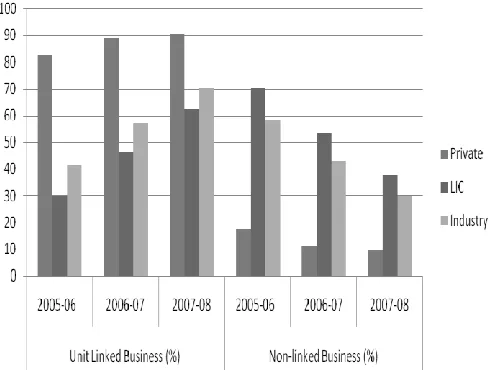
The flexibility, transparency, liquidity and fund options available with ULIPs made it the preferred choice of customers and gradually it changed the trend of insurance policy.
The share of ULIPs increased from 82.3 % in 2005-06 to 90.33% in 2007-08 as far as private insurers are concern. LIC too showed a tactical shift towards promoting linked products and soon the share of ULIPs rose from just 29.76% in 2005-06 to 62.37% in 2007-08.
Table 3: Ulips Plan Comparison Chart Compiled From The Annual Reports Of IRDA
VI.
DISTRIBUTION
The LIC has traditionally sold life business using tied agents (in-house sales forces are not a traditional feature of the Indian life market). All life insurers have tied agents working on a commission basis only, and the majority of private-sector insurers have followed this approach in distributing life products. Nevertheless, as banks are now
able to sell insurance products, bancassurance has made a major impact in life sales. Almost all private sector insurers have formed alliances with banks, with a few of the insurers using bancassurance as their major source of new business.
TIED AGENTS
Tied agents have traditionally been the primary channels for insurance distribution in the Indian market. The LIC has branches in almost all parts of the country and has attracted local people to become their agents. The agents come from various segments within society, collectively covering the entire spectrum of society. Traditionally, a person who has lived in a locality for many years sells the products of the insurance company with a local branch nearby. While these agents may not have been sufficiently knowledgeable about the different products offered and may not have sold the best possible product to customers, the customers trusted the company and the agents as locals. While tied agents continue to be the prime channel for insurance distribution in India, they are increasingly being supplemented by other channels in the face of tougher competition.
BROKERS
The Insurance Regulatory and Development Authority (Insurance Brokers) Regulations of 2002 set out the requirements for the licensing and operation of insurance brokers in India. The Regulations stipulate a minimum capital requirement of INR 5 million for direct brokers, and at the same time a 26% cap on foreign equity shares. As of November 2003, there were 70 registered direct insurance brokers in India. While there are no official statistics on premiums generated by brokers, their short span of operation and the market‟s reliance on other channels suggest their contribution to be relatively limited so far.
E-COMMERCE
The Internet has not been a major source of distribution for insurers. Of the population of over one billion in India, around 9.5 million people were estimated to be Internet users by 2001.29 Some of the life insurers have a website, where the services provided are mainly confined to accessing product information and rate quotes etc. Nevertheless, premium payments can now be made via credit card, the Internet, e-transfer, direct debit and bankers‟ draft, and this should allow insurers to better develop an e-strategy.
DIRECT MARKETING
329
insurers has also grown significantly as insurers attempt togain attention from the public on a wide range of products and services, as well as educating them on the benefits of life insurance, and in particular, protection-type products. BANCASSURANCE
Bancassurance is emerging as an important new avenue of distribution of insurance in India.
Some insurance companies like SBI Life are heavily devoting their resources to and successfully implementing bancassurance. According to the Reserve Bank of India (RBI), banks with at least INR 5 billion net worth and a three-year profit record may set up insurance companies subject to a 50% shareholding limit. A higher shareholding may be permitted by the RBI subject to the regulations set out in the Insurance Regulatory and Development Authority Act, 1999, where Indian promoters must gradually reduce shareholdings to 26% after the insurer has been in operation for ten years. In the 2001 “Report on Currency and Finance”, the RBI laid down its views on bancassurance in more concrete terms. “The Reserve Bank, in recognition of the symbiotic relationship between banking and the insurance industries, has identified three routes of banks‟ participation in the insurance business, viz., (i) providing fee-based insurance services without risk participation, (ii) investing in an insurance company for providing infrastructure and services support and (iii) setting-up of a separate joint venture insurance company with risk participation. The third route, due to its risk aspects, involves compliance to stringent entry norms. Further, the bank has to maintain an “arms length” relationship between its banking business and its insurance outfit. For banks entering into insurance business with risk participation, the prescribed entity (viz., separate joint-venture company) also enables to avoid possible regulatory overlaps between the Reserve Bank and the Government/IRDA. The joint venture insurance company would be subjected entirely to the IRDA/Government regulations.
VII.
TREND ANALYSIS :
METHODOLOGY
Today, trend analysis often refers to the science of studying changes in social patterns, including fashion, technology, and consumer behavior. Trend Analysis is the practice of collecting information and attempting to spot a pattern, or trend, in some fields of study, the term "trend analysis". The trend analysis is used for comparing one year with other year. In the below table we have taken 11 years to compare, how it can increase or decrease in trend percentages. This method is suitable to compare at a time with different years. And also it is easy to understand and easy to calculate. In below table I have taken 2002 as the base year to calculate trend percentages. The reason to take 2002 is as base year is as in this year, few companies have
entered into General insurance and also some companies started Life insurance.
Formula for trend percentages: PRESENT YEAR *100 / BASE YEAR
TOTAL INSURANCE PREMIUM
Table 4: Trend Analysis Of Life And Non-Life Insurance Premium (Corers)
INTERPRETATION
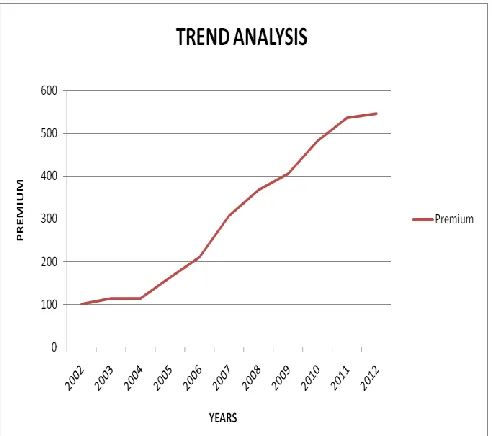
In the above table we can observe how the insurance premium is increasing year to year. In 2002 there were only few companies in the Insurance market, before 1999 the LIC was only insurance company and it‟s the regulatory body in India.
The trend percentages from 2002 to 2012 it almost increases 5 times, it indicates the good growth rate. The improvement of premium is indicating how many people were insure, impact of this leads to improvement in the economy growth rate which is most important for developing countries like India.
In India first Life insurance started so the life insurance premium is more than Non-Life insurance. The Life insurance premium is improved from 2002 to 2012 near to 6 times. It‟s good revelation in this deceit.
Private Non-Life insurance is started after IRDA is incorporated in 2000. Now in India 24 general insurance companies are in the Indian market. In 2002 to 2012 it‟s improved 5times.
330
Table 5: Graphical Presentation Of Insurance PremiumVIII. ROLE OF INSURANCE IN INDIA'S
FUTURE
Insurance would assist business to operate with less volatility and risk of failure and provide for greater financial and societal stability from the growth pangs of an estimated growth rate over 8% in GDP.
Government has arranged for disaster management and for funds. NGO‟s and public institution assists with fund raising and relief assistance. Beside government provides for social security programs. There is considerable impact upon government in these respects. Insurance substantially steps in to provide these services. The effect would be to reduce the strain on the tax payers and assist in efficient allocation of societal resources.
Facilitates track, business and commerce by flexible adaptation to changing risk needs particularly of the burgeoning services sector.
Like any other financial institution insurance companies generate saving from the insurance sector. Within the economy and make available the same in well directed areas of the economy deserving investment, a sector with potential for business as is the case with Indian insurance provides incentive to develop it all the more faster.
It enable risk to be managed more efficiently through risk pricing and risk transfer and this is an area which provides unlimited opportunities in the Indian context for consulting, broking and education in the post privatization phase with newer employment opportunities.
The insurance industry on its own accord is interested in loss minimization. It‟s expertise in understanding losses assists it to share the experience across the economy thus enabling better loss control and preservation of national assets.
In its risk pricing and investment decisions the insurance industry sets the tone for investment by others in the economy. Informed assessment by the insurance companies thus, signals allocation of resources by others contributing to efficiency in allocation. In India visibility of L.I.C. and G.I.C. has been dwarfed by government‟s actions and other high profile institutions like I.C.I.C.I., I.D.B.I., and U.T.I. Of late A.I.G. is visible in the media and its investment announcements are being followed keenly by institutional investors in India. I.N.G. saving trust and Zurich are active in asset management and are being keenly followed by retail investors.
IX.
CONCLUSION
Where almost all the industries in the world trying hard for survival due to the major economic meltdown, Indian life insurance industry is one of the sectors that is still observing good growth. It is the changing trends of Indian insurance industry only that has made it to cope with the changing economic environment. Indian insurance industry has modified itself with the passage of time by introducing customized products based on customers‟ need, through innovative distribution channels, Indian life insurance industry searched its path to grow. Changing government policy and guideline of the regulatory authority, IRDA have also played a very vital role in the growth of the sector. Move from non-linked to unit liked insurance policies is one of the major positive changes in Indian life insurance sector. Similarly, opening on the sector for private insurer broke the monopoly of LIC and bring in a tough competition among the players. This completion resulted into innovations in products, pricing, distribution channels, and marketing in the industry. Though the sector is growing fast, the industry has not yet insured even 50% of insurable population of India. Thus the sector has a great potential to grow. To achieve this objective, this sector requires more improvement in the insurance density and insurance penetration. Development of products including special group policies to cater to different categories should be a priority, especially in rural areas. The life insurers should conduct more extensive market research before introducing insurance products targeted at specific segments of the population so that insurance can become more meaningful and affordable. By adopting appropriate strategy along with proper government support and able guidance of IRDA, India will certainly become the new insurance giant in near future.
331
it density percentages year to year. So let us hope betterthat India can also improve in insurance sector.
REFERENCE
[1] Sharada Kumara Swamy, V Kumara Swamy, CORPORATE INSURANCE Tata Mc-Graw Hill New Delhi -2005
[2] Annual report of IRDA, 2003-04, 2004-05, 2005-06, 2006-07, 2007-08.
[3] Annual report of LIC, 2003-04, 2004-05, 2005-06, 2006-07, 2007-08.
[4] Article, „An Analysis of the Evolution of Insurance in India‟ by Tapen Sinha, ING Chair Professor.
[5] Insurance bill-2000, Govt. of India, October 2000.p.26 [6] N JANARDHAN RAO, “INDIA An emerging superpower house,” published by ICFAI Press.
[7] www.irdaindia.org
[8] www.bimadeals.com/life-insurance-india [9] www.insuringindia.com
[10] www.nasscom.in
[11] www.economictimes.com [12] www.indiatoday.com