An Efficient Tree-based Frequent Temporal Inter-object
Pattern Mining Approach in Time Series Databases
Nguyen Thanh Vu, Vo Thi Ngoc Chau
*Ho Chi Minh City University of Technology, Ho Chi Minh City, Vietnam
Abstract
In order to make the most of time series present in many various application domains such as finance, medicine, geology, meteorology, etc., mining time series is performed for useful information and hidden knowledge. Discovered knowledge is very significant to help users such as data analysts and managers get fascinating insights into important temporal relationships of objects/phenomena along time. Unfortunately, two main challenges exist with frequent pattern mining in time series databases. The first challenge is the combinatorial explosion of too many possible combinations for frequent patterns with their detailed descriptions, and the second one is to determine frequent patterns truly meaningful and relevant to the users. In this paper, we propose a tree-based frequent temporal inter-object pattern mining algorithm to cope with these two challenges in a level-wise bottom-up approach. In comparison with the existing works, our proposed algorithm is more effective and efficient for frequent temporal inter-object patterns which are more informative with explicit and exact temporal information automatically discovered from a time series database. As shown in the experiments on real financial time series, our work has reduced many invalid combinations for frequent patterns and also avoided many irrelevant frequent patterns returned to the users.
© 2015 Published by VNU Journal of Science.
Manuscript communication: received 15 December 2013, revised 06 December 2014, accepted 19 January 2015 Corresponding author: Vo Thi Ngoc Chau, [email protected]
Keywords: Frequent Temporal Inter-Object Pattern, Temporal Pattern Tree, Temporal Pattern Mining, Support
Count, Time Series Mining, Time Series Rule Mining.
1. Introduction
An increasing popularity of time series nowadays exists in many domains such as finance, medicine, geology, meteorology, etc. The resulting time series databases possess knowledge that might be useful and valuable for users to get more understanding about behavioral activities and changes of the objects and phenomena of interest. Thus, time series mining is an important task. Indeed, it is the
At present, we are aware of many existing works related to the frequent temporal pattern mining task on time series. Some that can be listed are [3, 4, 5, 9, 14, 15, 16, 18, 19, 20, 26, 27, 29]. Firstly in an overall view about these related works, it is realized that patterns are often different from work to work and discovered from many various time series datasets. In a few works, the sizes and shapes of patterns are fixed, and time gaps in patterns are pre-specified by users. In contrast, our work would like to discover patterns of interest that can be of any shapes with any sizes and with any time gaps able to be automatically derived from time series. Secondly, there is neither data benchmarking nor standardized definition of the frequent temporal pattern mining problem on time series. Indeed, whenever we get a mention of frequent pattern mining, market basket analysis appears to be a marvelous example of the traditional association rule mining problem. Such an example is not available in the time series mining research area for frequent temporal patterns. Thirdly, two main challenges that need to be resolved for frequent pattern mining in time series databases include the problem of combinatorial explosion of too many possible combinations for frequent patterns with their detailed descriptions and the problem of discovering frequent patterns truly meaningful and relevant to the users.
Based on the aforementioned motivations, we propose a tree-based frequent temporal inter-object pattern mining algorithm in a level-wise bottom-up approach as an extended version of the tree-based algorithm in [20]. The first extension is a generalized frequent temporal pattern mining process on time series databases with an adapted frequent temporal pattern template. As a result, a frequent temporal pattern in our work is semantics-based temporal pattern that occurs as often as or more often than expectation from users determined
by a minimum support count value. These semantics-based temporal patterns are semantically abstracted from one or many different time series, each of which corresponds to a time-ordered sequence of some repeating behavioral activities of some objects or phenomena of interest whose characteristic has been observed and recorded over the time in its respective time series. It is also necessary to distinguish our so-called frequent temporal patterns from motifs which are repeating continuous subsequences in an individual time series. In contrast, a frequent temporal pattern being considered might contain various repeating meaningful continuous subsequences with many different temporal relationships automatically discovered from one or many different time series in the time series database. As for the second extension, we have reconsidered our tree-based algorithm employing appropriate data structures such as tree and hash table. The modified version of this algorithm is defined with a keen sense of reducing the number of invalid combinations generated and checked for frequent temporal patterns. It is also capable of removing many irrelevant frequent patterns for the users.
As shown in the experiments on real financial time series, our proposed algorithm is more efficient to deal with the combinatorial explosion problem. In comparison with the existing works, our work is useful for frequent temporal inter-object patterns more informative with explicit and exact temporal information which is automatically discovered from a time series database.
section IV, we propose an efficient tree-based frequent temporal inter-object pattern mining algorithm and its evaluation with many experiments is presented and discussed in section V. Finally, section VI concludes our work and states several future works.
2. Related Works
In this section, some related works [3-7, 9, 14-22, 24, 26-29] are examined in comparison with our work. Among these related works, [3-5, 7, 9, 14-16, 18-20, 22, 26, 27] are proposed for frequent temporal pattern mining in time series, [21, 24, 29] for frequent sequential pattern mining in sequential databases, and [6, 17, 28] for frequent temporal pattern mining in temporal databases.
In the most basic form, motifs can be considered as primitive patterns in time series mining. There exist many approaches to find motifs in time series named a few as [9, 15, 16, 19, 26, 27]. Our work is different from those because the scope of our algorithms does not include the phase of finding primitive patterns that might be concerned with a motif discovery algorithm. We suppose that those primitive patterns are available to our proposed algorithm. As for more complex patterns, [4] has introduced a notion of perception-based pattern in time series mining with a so-called methodology of computing with words and perceptions. [4] reviewed in details such descriptions using sign of derivatives, scaling of trends and shapes, linguistic interpretation of patterns from clustering, a pattern generation grammar, and temporal relationships between patterns. Also towards perception-based time series mining, [14] presented a duration-based linguistic trend summarization of time series using a few features such as the slope of the line, the fairness of the approximation of the original data points by line segments and the
corresponding to relevant patterns (i.e. behaviors or properties) detected in their time courses. These temporal abstractions can be combined together to form more complex temporal abstractions also using Allen’s temporal relationships BEFORE, MEETS, OVERLAPS, FINISHED BY, EQUALS, and STARTS. It is realized that temporal abstractions discovered from [22] are temporal patterns rather similar to our frequent temporal inter-object patterns. However, our work supports richer trend-based patterns and also provides a new efficient pattern mining algorithm as compared to [22]. For another form of patterns, [7] aimed to capture the similarities among stock market time series such that their sequence-subsequence relationships are preserved. In particular, [7] identified patterns representing collections of contiguous subsequences which shared the same shape for specific time intervals. Their patterns show pairwise similarities among sequences, called timing patterns using temporal relationships such as begin earlier, end later, and are longer. [7] also defined Support Count and Confidence measures for a relationship but these measures were not employed in any algorithms of their work. As compared to [7], our work supports more temporal relationships with explicit time. More recently, [5] has paid attention to linguistic association rules in time series which are based on fuzzy itemsets stemming from continuous subsequences in time series. Each frequent itemset in [5] can be considered as a frequent pattern discovered in time series. However, there is no consideration for temporal knowledge in their frequent fuzzy itemsets. As for [20], our work is based on their proposed work with several extensions to the process and tree-based algorithm in order to discover frequent temporal inter-object patterns in a time series database more efficiently.
In sequential database mining, [21, 24, 29] are among many existing works on frequent sequential pattern mining. [24] introduced GSP algorithm to discover generalized sequential patterns in a sequential database using Apriori antimonotonic constraint. Later, [21] proposed PrefixSpan algorithm to avoid the weakness of [24] in scanning the database many times unnecessarily. Indeed, [21] can find frequent sequential patterns without generating any candidate for them. For a comparison, those frequent sequential patterns are not as rich as ours in temporal aspects hidden in time series which include interval-based relationships and their associated time. As for [29], so-called inter-sequence patterns are discovered with two proposed algorithms which are M-Apriori and EISP-Miner. The first algorithm is Apriori-like and not as efficient as the second one which is based on a tree data structure, named ISP-tree. Nevertheless, the capability of both algorithms is limited to a user-specified parameter which is maximum span, called maxspan. It is believed that it is not easy for users to provide a suitable value for this parameter as soon as their sequential database is mined. This might lead to many trial-and-error experiments for maxspan.
To the best of our knowledge, the type of frequent temporal inter-object patterns defined in our work has not yet been taken into consideration in the existing works. The proposed temporal frequent inter-object pattern mining algorithm on a set of various time series is designed to be a more efficient version of the tree-based algorithm in [20].
3. A Generalized Frequent Temporal Inter-object Pattern Mining Process
In this section, a generalized frequent temporal inter-object pattern mining process on a time series database is figured out to elaborate our solution to discovering so-called frequent temporal inter-object patterns from a given set of different time series. This process is mainly based on the one in [20]. Each time series is considered an object of interest which can be some phenomena or some physical objects in our real life. We refer to a notion of temporal inter-object pattern as temporal relationship among objects being considered. This notion of object” is somewhat similar to “inter-transaction” in [17, 28] and “inter-sequence” in [29]. However, our work aims to capture more temporal aspects of their relationships so that discovered patterns can be more informative and applicable to decision making support. In addition, interestingness of discovered patterns is measured by means of the degree to which they are frequent in the lifespan of these objects in regard to a user-specified minimum threshold called min_sup. This is because we use Support Count as an objective measure with the meaning intact in [12].
Depicted in Figure 1, the detail about the pattern mining process will be mentioned clearly as follows. Our process includes three phases mainly based on the well-accepted general knowledge discovery process [12]. Phase 1 is responsible for preprocessing to prepare for semantics-based time series, phase 2 for the first step to obtain a set of repeating trend-based subsequences, and phase 3 for the primary step to fully discover frequent temporal inter-object patterns. As compared to the process in [20], our generalized process is not specific for the input of the proposed algorithm by relaxing the use of trend-based time series. Instead, so-called semantics-based symbolic time series are used so that users can have more freedom to express the meaning of each component in a resulting frequent pattern via the semantic symbols used for time series transformation in phase 1.
3.1. Phase 1 for Semantics-based Symbolic Time Series
The input of this phase is also the one of our work, which consists of a set of raw time series of the same length for simplicity. Formally, each time series TS is defined as TS = (v1, v2, …, vn). TS is a so-called univariate time series in an n-dimension space. The length of TS is n. v1, v2, …, and vn are time-ordered real numbers. Indices 1, 2, …, n correspond to points in time in our real world on a regular basis. Regarding semantics, time series is understood as the recording of a quantitative characteristic of an object or phenomenon of interest observed regularly over the time.
Figure 1. A generalized frequent temporal inter-object pattern mining process on a time series database.
As previously mentioned, we have generalized the pattern mining process introduced in [20] for more semantics in resulting frequent patterns. Thus, in this paper, we do not restrict the meaning of individual components in discovered frequent patterns to behavioral changes of objects and the degree to which they change. Instead, we enable so-called semantics-based symbolic time series by means of any transformation technique on time series. For instance, each time series can be transformed into a trend-based time series using short-term and long-term moving averages in [31] or into a symbolic time series using SAX technique in [16].
The output of this phase is a set of semantics-based time series each of which is formally defined as (s1, s2, …, sn) where si∈Σ for i = 1..n where Σ is a discrete set of semantic symbols derived by a corresponding transformation technique. For the technique in [31], Σ = {A, B, C, D, E, F} where A represents the time series in a weak increasing trend; B in a strong increasing trend; C starting a strong increasing trend; D starting a weak increasing trend; E in a strong decreasing trend; and F in a weak decreasing trend. For the technique in [16], Σ is the word book. If two breakpoints are used, Σ = {a, b, c} where a represents subsequences with high values, b with average values, and c with low values.
3.2. Phase 2 for Repeating Subsequences
3.3. Phase 3 for Frequent Temporal Inter-object Patterns
Similar to phase 2, phase 3 has the input which is the output of the previous phase, a set of repeating subsequences. In addition, phase 3 also needs a minimum support count threshold, min_sup, from users to evaluate the output returned to users. As compared to [29], min_sup is a single parameter whose value is provided by the users along with the input set of time series in our process. Using min_sup and the input, phase 3 first obtains a set of primitive patterns, named L1, which includes only repeating subsequences with the counts equal or greater than min_sup. All elements in L1 are called frequent temporal inter-object patterns at level 1. At this level, there is just one object involved in each frequent pattern. Differently, level is used to refer to the number of components in a pattern which will be detailed below, not to the number of objects involved in a pattern. Secondly, phase 3 proceeds with a frequent temporal inter-object pattern mining algorithm to discover and return to users a full set of frequent temporal inter-object patterns in a set of various time series. The rest of this subsection will define a notion of frequent temporal inter-object pattern and in section 4, we will propose an extended version of the tree-based frequent temporal inter-object pattern mining algorithm that makes the frequent temporal inter-object pattern mining process more effective and efficient.
In general, we formally define a frequent temporal inter-object pattern at level k for k>1 in the following form: m1-m1.ID<operator
type1: delta time1> m2-m2.ID….mk-1-mk-1.ID<
operator typek-1 : delta timek-1> mk-mk.ID.
In this form, m1, m2, …, mk-1, and mk are primitive patterns in L1 which might come from different objects whose identifiers are m1.ID,
m2.ID, …, mk-1.ID, and mk.ID, respectively. Regarding relationships between the components of a pattern at level k, operator type1, …, operator typek-1 are Allen’s temporal operators. There are thirteen Allen’s temporal operators in [1] well-known to express interval-based relationships along the time, including precedes (p), meets (m), overlaps (o), Finished by (F), contains (D), starts (s), equals (e), Started (S), during (d), finishes (f), overlapped by (O), met by (M), preceded by (P). For their converse relationships, our work used seven Allen’s temporal operators (p, m, o, F, D, s, e) to capture temporal associations between subsequences from different objects in phase 3. That is, operator type1, …, operator typek-1 are in {p, m, o, F, D, s, e}. Moreover, we use delta time1, …, delta timek-1 to keep time information of the corresponding relationships. Regarding semantics, intuitively speaking, a frequent temporal inter-object pattern at level k for k>1 fully presents the relationships between the frequent parts of different objects of interest over the time. Hence, we believe that unlike some other related works [7, 11, 17, 18], our patterns are in a richer and more understandable form and in addition, our pattern mining algorithm is enabled to automatically discover all such frequent temporal inter-object patterns with no limitation on their relationship types and time information.
Figure 2. Illustration of a frequent temporal pattern on a single object NY.
Figure 3. Illustration of a frequent temporal inter-object pattern on two objects: NY and SH.
Example 2: Let us consider a frequent temporal inter-object pattern on two objects NY and SH also using the transformation technique in [31]: AA-NY<e:2>AA-SH {0, 10}. This pattern, whose illustration is presented in Figure 3, involves two objects NY and SH and presents their temporal relationship along the time. In particular, we can state about NY and SH that NY has a two-day weak increasing trend and in the same duration of time, SH does too. This fact occurs twice at positions 0 and 10 in their lifetime. It is also worth noting that we absolutely do not know whether or not NY influences SH or vice versa in real life unless their relationships are analyzed in some depth. Nonetheless, such patterns provide us with objective data-driven evidence on the relationships among objects of interest so that we can make other further thorough investigations into these objects and their surrounding environment.
4. The Proposed Tree-based Frequent
Temporal Inter-object Pattern Mining
Algorithm on Time Series Databases
As noted in [20], the type of knowledge we aim to discover from time series has not yet been considered. Hence, in [20], two mining
algorithms were defined: brute-force and tree-based. The brute-force algorithm provides a baseline for correctness checking and the tree-based one helps speeding up the pattern mining process in the spirit of FP-Growth algorithm [13]. The two algorithms followed the level-wise bottom-up approach.
Based on [20], we extend the tree-based algorithm to a new version that enables us to deal with the combinatorial explosion problem by using an additional hash table for a detection and elimination of irrelevant frequent patterns. In particular, the modified tree-based algorithm is capable of removing the instances of potential candidates pertaining to one single pattern with overlapping parts. In the following subsections, the tree-based algorithm is detailed.
4.1. A Temporal Pattern Tree
In this paper, we remain a so-called temporal pattern tree in [20]. Nevertheless, for being self-contained, the description of a temporal pattern tree is presented as follows.
Figure 4. The structure of a node in the temporal pattern tree.
A temporal pattern tree (TP-tree) is a tree that has n nodes of the same structure as shown in Figure 4.
A node structure of a node being considered in TP-tree is composed of the following fields:
- ParentNode: a pointer that points to a parent node of the current node.
and its parent node where p stands for precedes, m for meets, e for equal, s for starts, F for finished by, D for contains, and o for overlaps.
- DeltaTime: an exact time interval associated with the temporal relationship in OperatorType field.
- Pat.Length: a length of the corresponding pattern counting up to the current node.
- Info: information about the corresponding pattern that the current node represents.
- ID: an object identifier of the object which the current node stems from.
- k: a level of the current node.
- List of Instances: a list of all instances corresponding to all positions of the pattern that the current node represents.
- List of ChildNodes: a hash table that contains pointers pointing to all children nodes of the current node at level (k+1). Key information of an element in the hash table is: [OperatorType associated with a child node + DeltaTime + Info of a child node + ID of a child node].
Each node corresponds to a component of some frequent temporal inter-object pattern. In particular, the root of TP-tree is at level 0, all primitive patterns at level 1 are handled by all nodes at level 1 of TP-tree, the second components of all frequent patterns at level 2 are associated with all nodes at level 2 of TP-tree, and so on. All nodes at level k are created and added into TP-tree from all possible valid combinations of all nodes at level (k-1). This mechanism comes from the idea such that candidates for frequent patterns at level k are generated just from frequent patterns at level (k-1). In addition, only nodes associated with support counts satisfying the minimum support count are inserted into TP-tree.
4.2. Building a Temporal Pattern Tree
Using the node structure defined above, a temporal pattern tree is built in a level-wise approach from level 0 up to level k corresponding to the way we discover frequent patterns at level (k-1) first and then use them to discover frequent patterns at level k. It is realized that a pattern at level k is only generated from all nodes at level (k-1) which belong to the same parent node. This feature helps us much avoid traversing the entire tree built so far to discover and create frequent patterns at higher levels and expand the rest of the tree. A subprocess of building TP-tree is shown step by step.
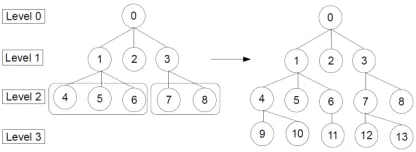
Step 1 - Initialize TP-tree: Create the root of TP-tree labeled 0 at level 0.
Step 2 - Handle L1: From the input L1
which contains m motifs from different trend-based time series with a support count satisfying the minimum support count min_sup, create m nodes and insert them into TP-tree at level 1. Distances between these nodes to the root are 0 and Allen’s OperatorType of each of these nodes is empty. The resulting TP-tree after steps 1 and 2 is displayed in Figure 5 when L1 has 3 frequent patterns corresponding to nodes 1, 2, and 3.
Step 3 - Handle L2 from L1: Generate all
possible combinations between the nodes at level 1 as all nodes at level 1 belong to the same parent node which is the root. This step is performed with seven Allen’s temporal operators as follows.
Let m and n be two instances in L1. With no loss of generality, these two instances are considered for a valid combination if m.StartPosition ≤ n.StartPosition where
has a satisfied support count, it is a frequent pattern at level 2 and added into L2.
Figure 5. The resulting TP-tree after steps 1 and 2.
Figure 6. The resulting TP-tree after step 3.
If m and n belong to the same object, m must precede n. A combination is in the form of: m-m.ID<p:delta>n-n.ID where p stands for Allen’s operator precedes, delta (delta > 0) for an interval of time between m and n, m.ID and n.ID are object identifiers corresponding to their time series. In this case, m.ID = n.ID.
Example 3: Using the transformation technique in [31], consider m-m.ID = EEB-ACB starting at 0 and n-n.ID = ABB-EEB-ACB starting at 7. A valid combination of m and n is EEB-ACB<p:4>ABB-ACB starting at 0.
If m and n come from two different objects, ie. m-m.ID ≠ n-n.ID, a combination might be generated for the additional six Allen’s operators: meets (m), overlaps (o), Finished by (F), contains (D), starts (s), and equal (e). Valid combinations of m and n for these operators are formed below where d is a common time interval in m and n.
- Meets: m-m.ID<m:0>n-n.ID
- Overlaps: m-m.ID<o:d>n-n.ID
- Finished by: m-m.ID<F:d>n-n.ID
- Contains: m-m.ID<D:d>n-n.ID
- Starts: m-m.ID<s:d>n-n.ID
- Equal: m-m.ID<e:d>n-n.ID
It is noted that a combination in the tree-based algorithm is associated with nodes in TP-tree that help us to early detect if a pattern is frequent. Thus, if a combination corresponding to an instance of a node that is currently available in TP-tree, we simply update the position of the instance in List of Instances field of that node and further ascertain that the combination is associated with a frequent pattern. If a combination corresponds to a new node not in TP-tree, using a hash table, we easily have the support count of its associated pattern to check if it satisfies min_sup. If yes, the new node is inserted into TP-tree by connecting to its parent node. The resulting TP-tree after step 3 is given in Figure 6 where nodes {4, 5, 6, 7, 8} are nodes inserted into TP-tree at level 2 to represent 5 frequent patterns at level 2.
Figure 7. The resulting TP-tree after step 4.
Step 4 - Handle L3 from L2: Using
1, 6}} and {{0, 3, 7}, {0, 3, 8}}. It is ensured that no combination is generated from patterns corresponding to paths not sharing the same prefix, for example: {0, 1, 4} and {0, 3, 7}, {0, 1, 4} and {0, 3, 8}, etc. Besides, the tree-based algorithm easily checks if all subpatterns at level (k-1) of a candidate at level k are also frequent by making use of the hash table in a node to find a path between a node and its children nodes in all necessary subpatterns at level (k-1). If a path exists in TP-tree, a corresponding subpattern at level (k-1) is frequent and handled in TP-tree so that we can know if the constraint is enforced. The resulting TP-tree after this step is given in Figure 7 where nodes {9, 10, 11, 12, 13} are nodes inserted into TP-tree at level 3 to represent 5 different frequent patterns at level 3.
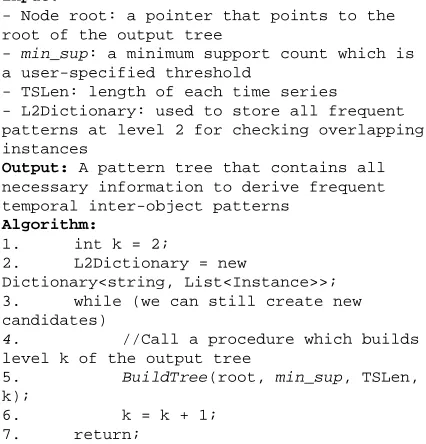
Input:
- Node root: a pointer that points to the root of the output tree
- min_sup: a minimum support count which is a user-specified threshold
- TSLen: length of each time series
- L2Dictionary: used to store all frequent patterns at level 2 for checking overlapping instances
Output: A pattern tree that contains all
necessary information to derive frequent temporal inter-object patterns
Algorithm:
1. int k = 2;
2. L2Dictionary = new
Dictionary<string, List<Instance>>;
3. while (we can still create new
candidates)
4. //Call a procedure which builds
level k of the output tree
5. BuildTree(root, min_sup, TSLen,
k);
6. k = k + 1;
7. return;
Figure 8. The pseudo-code of CreateTree function.
Step 5 - Handle Lk from Lk-1 where k>=2:
Step 5 is similar to step 4. Once TP-tree has been expanded up to level (k-1), we generate nodes at level k if all nodes at level (k-1) at the end of the branches sharing the same prefix path can be combined with a satisfied support count. These new nodes are inserted into TP-tree at level k representing frequent patterns in
Lk. The routine keeps repeating till no more level is created for TP-tree. As compared to FP-tree [13], TP-FP-tree in our work has no header table. Instead, we use a hash table at each level to keep track of the support count of each combination which is the most potential candidate for a frequent pattern.
Input:
- Node node: a pointer that points to the
current node of the output tree
- min_sup: a minimum support count which is a user-specified threshold
- TSLen: length of each time series
- level: the level of the pattern tree going to be constructed
Output: Construct level k of the pattern
tree corresponding to Lk
Algorithm:
1. if (root == node &&
root.ChildNodes.Count == 1 && level == 2)
2.
CombineChildNodes(node.ChildNodes, level, min_sup, TSLen);
3. return;
4. if (node.ChildNodes.Count < 2 &&
node != root)
5. return;
6. if (node.k == (level – 2))
7.
CombineChildNodes(node.ChildNodes, level, min_sup, TSLen);
8. return;
9. for (int i = 0; i <
node.ChildNodes.Count; i++)
10. BuildTree(level,
node.ChildNodes.ElementAt(i).Value, min_sup, TSLen);
Figure 9. The pseudo-code of BuildTree procedure.
Input:
- ChildNodes: a list of nodes that need checking for valid combinations
- min_sup: a minimum support count which is a user-specified threshold
- TSLen: length of each time series
- level: the level of the pattern tree going to be constructed
Output: Create combinations of nodes at
level k
Algorithm:
1. for i = 0 to ChildNodes.Count
2. for j = i to ChildNodes.Count
3. CombineNode(ChildNodes[i],
ChildNodes[j], min_sup, TSLen, level);
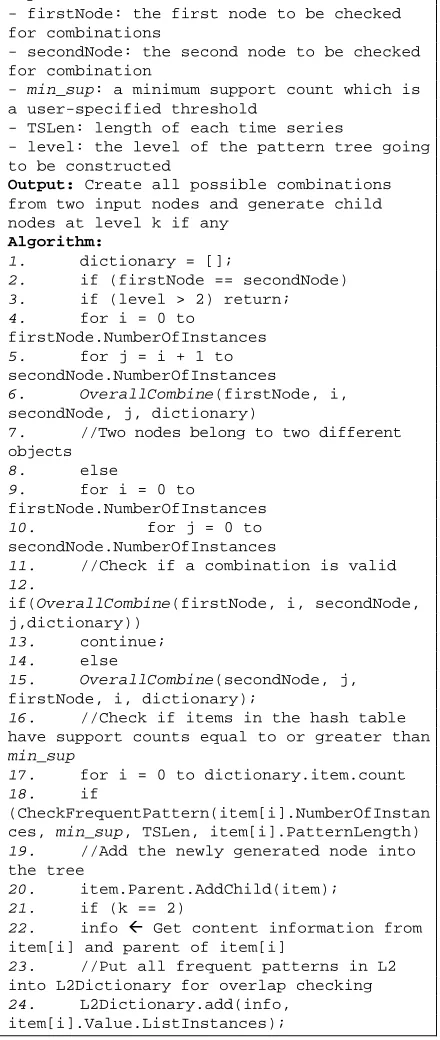
Input:
- firstNode: the first node to be checked for combinations
- secondNode: the second node to be checked for combination
- min_sup: a minimum support count which is a user-specified threshold
- TSLen: length of each time series
- level: the level of the pattern tree going to be constructed
Output: Create all possible combinations
from two input nodes and generate child nodes at level k if any
Algorithm:
1. dictionary = [];
2. if (firstNode == secondNode)
3. if (level > 2) return;
4. for i = 0 to
firstNode.NumberOfInstances
5. for j = i + 1 to
secondNode.NumberOfInstances
6. OverallCombine(firstNode, i,
secondNode, j, dictionary)
7. //Two nodes belong to two different
objects
8. else
9. for i = 0 to
firstNode.NumberOfInstances
10. for j = 0 to
secondNode.NumberOfInstances
11. //Check if a combination is valid
12.
if(OverallCombine(firstNode, i, secondNode, j,dictionary))
13. continue;
14. else
15. OverallCombine(secondNode, j,
firstNode, i, dictionary);
16. //Check if items in the hash table
have support counts equal to or greater than
min_sup
17. for i = 0 to dictionary.item.count
18. if
(CheckFrequentPattern(item[i].NumberOfInstan ces, min_sup, TSLen, item[i].PatternLength)
19. //Add the newly generated node into
the tree
20. item.Parent.AddChild(item);
21. if (k == 2)
22. info Get content information from
item[i] and parent of item[i]
23. //Put all frequent patterns in L2
into L2Dictionary for overlap checking
24. L2Dictionary.add(info,
item[i].Value.ListInstances);
Figure 11. The pseudo-code of CombineNode procedure.
Input:
- firstNode: the first node to be checked
for combination
- firstInstancePosition: the position of
an instance of firstNode
- secondNode: the second node to be
checked for combination
- secondInstancePosition: the position of
an instance of secondNode
- dictionary: a hash table to keep nodes
which have been generated
Output: true if two input instances are able
to combine with each other; otherwise, false. If a combination is valid, a corresponding node will be added into the hash table.
Algorithm:
1.firstInstance
firstNode.GetInstanceAt(firstInstancePosition);
2.secondInstance secondNode.
GetInstanceAt(secondInstancePosition);
3.if (firstInstace.ParentPosition !=
secondInstance.ParentPosition)
4. return false;
5.if (secondInstance.StartPosition <
firstInstance.StartPosition)
6.return false;
7.Key Get information for a combination
between firstInstance and secondInstance
8.if (!dictionary.ContainsKey(Key))
9.Node node = CombineInstances(firstNode,
i,secondNode, j);
10.if (node is not null)
11.if (firstNode.k >= 2)
12.if (!CheckFrequentSubSequence(firstNode,
node))
13.return false;
14.node.ParentNode = firstNode;
15.dictionary.Add(Key, node);
16.else return false;
17.Else
18.Node n = dictionary[Key];
19.Instance instance = new Instance();
20.instance Get information from
firstNode and secondNode
21.//Check overlap if k = 2
22.if (n.k == 2)
23.//if not overlap
24.if (IsOverlap(n.listInstances, instance)
== false)
25.n.add(instance);
26.//Check overlap if k > 2
27.else if (n.k > 2)
28.//Get information from n and n.Parent
(this is also the two last parts from new instance)
29.string info = GetInfo(n, n.Parent);
30.//Check overlap based on information and
position of the parent of new instance
31.//if not overlap
32.if (IsOverlap(L2Dictionary, info,
instance.ParentPosition) == false)
33.n.add(instance);
34.return true;
Figure12. The pseudo ode of OverallCombine
function.
additional hash table L2Dictionary is initialized and BuildTree procedure is invoked to construct nodes at level k corresponding to the process of generating frequent patterns in Lk. Its pseudo-code is presented in Figure 9. It then calls CombineChildNodes procedure in Figure 10 to make combinations between child nodes of a current node where child nodes are located at level k. For a specific combination between two nodes, CombineChildNodes procedure will pass control of the tree building process to CombineNode procedure whose pseudo-code is given in Figure 11. CombineNode procedure is responsible for creating all valid combinations and inserting them into TP-tree if their support counts satisfy min_sup. For checking the validity of a combination as earlier explained in steps 3-5, it then invokes OverallCombine function whose pseudo-code is described in Figure 12.
As for the extension of the tree-based algorithm, we have modified CreateTree function at line 2 in Figure 8, the entire BuildTree procedure in Figure 9, CombineNode procedure at lines 21-24 in Figure 11, and OverallCombine function at lines 21-33 in Figure 12. The modifications help us to early check and remove instances of each pattern that have some parts overlapping the others because such overlapping parts will lead to self-similarity and thus, irrelevant frequent patterns.
4.3. Finding all Frequent Temporal Inter-object Patterns from A Temporal Pattern Tree
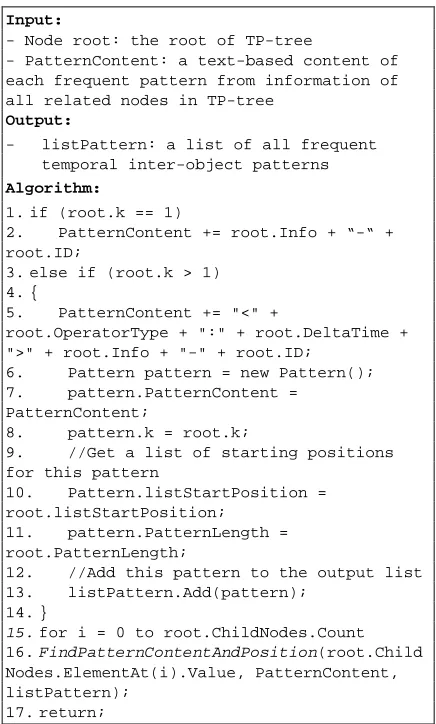
As soon as TP-tree is completely constructed, we can traverse TP-tree from the root to derive all frequent temporal inter-object patterns from level 1 to level k by invoking FindPatternContentAndPosition function presented in Figure 13. This subprocess recursively forms a frequent pattern represented by each node except the root node in TP-tree with no more checks. Thus, TP-tree is nicely
and conveniently used to discover and manage all frequent patterns.
Input:
- Node root: the root of TP-tree
- PatternContent: a text-based content of each frequent pattern from information of all related nodes in TP-tree
Output:
- listPattern: a list of all frequent
temporal inter-object patterns
Algorithm:
1.if (root.k == 1)
2. PatternContent += root.Info + “-“ +
root.ID;
3.else if (root.k > 1)
4.{
5. PatternContent += "<" +
root.OperatorType + ":" + root.DeltaTime + ">" + root.Info + "-" + root.ID;
6. Pattern pattern = new Pattern();
7. pattern.PatternContent =
PatternContent;
8. pattern.k = root.k;
9. //Get a list of starting positions
for this pattern
10. Pattern.listStartPosition =
root.listStartPosition;
11. pattern.PatternLength =
root.PatternLength;
12. //Add this pattern to the output list
13. listPattern.Add(pattern);
14.}
15.for i = 0 to root.ChildNodes.Count
16.FindPatternContentAndPosition(root.Child
Nodes.ElementAt(i).Value, PatternContent, listPattern);
17.return;
Figure 13. The pseudo-code of
FindPatternContentAndPosition function.
4.4. An Overall Evaluation on the Proposed Algorithm
In this subsection, we discuss an overall evaluation on the proposed algorithm in comparison with the existing works about the reason for not using maxspan constraint and other kinds of tree in pattern mining.
4.4.1 Why our algorithm does not use maxspan
span in each frequent pattern and/or association rule. Using maxspan might help us narrow down the space where potential candidates for frequent patterns exist; leading to less processing time. However, in our paper, we do not use maxspan as previously introduced, we want to discover all the patterns hidden in a time series database which can be formed from many primitive patterns from any possible number of objects with any time spans and any time gaps in their temporal relationships.
4.4.2. A comparison between TP-tree and other kinds of tree in frequent pattern mining
Defining and using a tree data structure seems to be one of best practices in frequent pattern mining. One of the most popular trees is FP-tree proposed with FP-Growth algorithm in [13]. Other kinds of tree were discussed in [23].
Firstly, we give an explanation about the differences between our TP-tree approach and the FP-tree approach. Our TP-tree is not similar to FP-tree in the following points. (1). The purpose of TP-tree is not to compress the time series unlike the purpose of FP-tree which is to compact the transactional database to reduce the number of database scans. Instead, TP-tree is used for handling the candidates of frequent patterns and the real frequent patterns so that the tree-based algorithm can save processing time on generating and checking combinations of candidates and time on forming frequent patterns from their components in TP-tree. (2). TP-tree does not have any header table so that TP-tree is accessed directly from its root while FP-tree has a header table and access to FP-tree is made via the entries in its header table. (3). The level-wise approach in Apriori is embedded in TP-tree while FP-tree does not have this feature. This is because a node at level k in TP-tree always contributes to a frequent k-pattern while a node at level k in FP-tree might not contribute to a frequent k-pattern if its support
count does not satisfy the minimum support count. For space saving in our final version, such comparisons are not included. (4). When using the traditional FP-Growth algorithm, we must create and traverse many projected conditional FP-trees along with their header tables to get all frequent patterns. With our tree-based algorithm, after completely built, TP-tree is traversed recursively from the root to get all frequent temporal patterns. Therefore, we do not need further complex computation when traversing our TP-tree.
a satisfying support count and inserted into TP-tree if truly a frequent pattern. Thus, manipulation on TP-tree is minimized.
5. Experiments
In order to further evaluate our proposed tree-based frequent temporal inter-object pattern mining algorithm, we present several experiments and provide discussions about their results in this section. The experiments were prepared using C# programming language and carried out on a 3.0 GHz Intel Core i5 PC with 4.00 GB RAM.
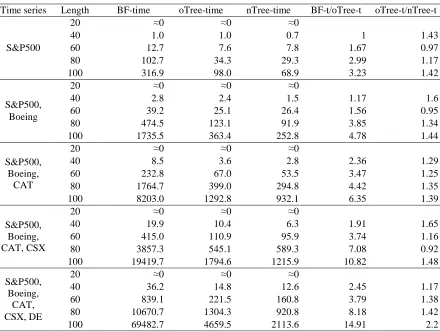
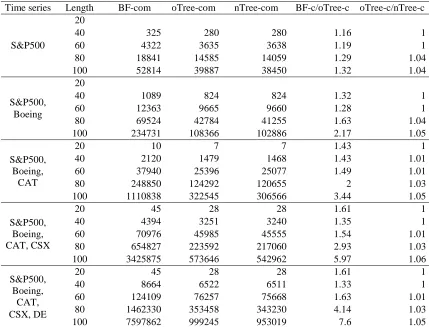
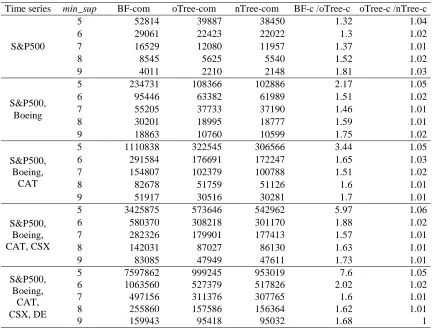
There are two groups for examining the efficiency of the proposed algorithm and how much improvement has been made between the modified version and the previous one together with the brute-force one in [20]. The first group was done by varying the time series length and the second one by varying the minimum support count. Each experiment of every algorithm was carried out and its processing time in millisecond was reported. In Tables I and III, we recorded the processing time of the brute-force algorithm represented by BF-time, the time of the old tree-based one by oTree-time, the time of the new tree-based one by nTree-time, the ratio of BF-time to oTree-time by BF-t/oTree-t, the ratio of oTree-time to nTree-time by oTree-t/nTree-t for comparison. In addition to processing time, we captured the number of combinations generated and checked by each algorithm. In the resulting tables II and IV, BF-com is used to denote the number of combinations in the brute-force algorithm, oTree-com the number of combinations in the old tree-based one, nTree-com the number of combinations in the new tree-based one, BF-c/oTree-c the ratio of BF-com to oTree-com, and oTree-c/nTree-c the ratio of oTree-com to nTree-com.
In the experiments, we used five real-life stock datasets of the daily closing stock prices available at [8]: S&P 500, BA from Boeing company, CSX from CSX Corp., DE from Deere & Company, and CAT from Caterpillar Inc. Each of them started at 01/04/1982 with variable lengths of 20, 40, 60, 80, and 100 days. All of the time series in the experiments have been unintentionally collected. In each group, using the transformation technique in [31], we mined a single time series, two different time series, …, up to all five time series to obtain frequent temporal inter-object patterns if these time series really associated with each other during a few periods of time, that is their changes have influenced each other.
In the rest of this section, 4 resulting tables are provided and discussed. For the first group of experiments, Table I contains the results of time processed on financial time series with a fixed minimum support count = 5 and various lengths from 20 to 100 with a gap of 20. Table II going with Table I is used to show the number of generated combinations of each algorithm and a comparison between them. For the second group, Table III displays the experimental results for time processed with a fixed length = 100 and various minimum support counts min_sup from 5 to 9. Similar to Table II, Table IV goes with Table III to present the number of generated combinations of each algorithm and a comparison between them.
the efficiency of the new version is better than the old one or the same as the old one.
Table 1. Time processed on financial time series with various lengths
Time series Length BF-time oTree-time nTree-time BF-t/oTree-t oTree-t/nTree-t
S&P500
20 ≈0 ≈0 ≈0
40 1.0 1.0 0.7 1 1.43
60 12.7 7.6 7.8 1.67 0.97
80 102.7 34.3 29.3 2.99 1.17
100 316.9 98.0 68.9 3.23 1.42
S&P500, Boeing
20 ≈0 ≈0 ≈0
40 2.8 2.4 1.5 1.17 1.6
60 39.2 25.1 26.4 1.56 0.95
80 474.5 123.1 91.9 3.85 1.34
100 1735.5 363.4 252.8 4.78 1.44
S&P500, Boeing,
CAT
20 ≈0 ≈0 ≈0
40 8.5 3.6 2.8 2.36 1.29
60 232.8 67.0 53.5 3.47 1.25
80 1764.7 399.0 294.8 4.42 1.35
100 8203.0 1292.8 932.1 6.35 1.39
S&P500, Boeing, CAT, CSX
20 ≈0 ≈0 ≈0
40 19.9 10.4 6.3 1.91 1.65
60 415.0 110.9 95.9 3.74 1.16
80 3857.3 545.1 589.3 7.08 0.92
100 19419.7 1794.6 1215.9 10.82 1.48
S&P500, Boeing,
CAT, CSX, DE
20 ≈0 ≈0 ≈0
40 36.2 14.8 12.6 2.45 1.17
60 839.1 221.5 160.8 3.79 1.38
80 10670.7 1304.3 920.8 8.18 1.42
100 69482.7 4659.5 2113.6 14.91 2.2
For the number of combinations generated for candidates and then for frequent patterns in Table II, the brute-force algorithm always produces the highest number of such combinations, leading to its highest processing time as compared to the two versions of the tree-based algorithm. Particularly, its number of combinations is up to about 8 times higher than one of the tree-based algorithm. Especially, the tree-based algorithm can early abandon a few up to a few million non-potential combinations in comparison with the brute-force algorithm. Besides, the two versions of the tree-based algorithm have a
difference of a few percent in the number of combinations. In many cases, the new version often generates and checks the smaller number of combinations.
In Table III, the results let us know that the tree-based algorithm can improve at least 3 up to 15 times the processing time of the brute-force algorithm. Besides, the larger minimum support count, the fewer number of candidates need to be checked for frequent temporal patterns. Thus, the less processing time is required by each algorithm. Once min_sup is high, a pattern is required to be more frequent; that is, a pattern needs to repeat more during
Time series Length BF-com oTree-com nTree-com BF-c/oTree-c oTree-c/nTree-c
S&P500
20
40 325 280 280 1.16 1
60 4322 3635 3638 1.19 1
80 18841 14585 14059 1.29 1.04
100 52814 39887 38450 1.32 1.04
S&P500, Boeing
20
40 1089 824 824 1.32 1
60 12363 9665 9660 1.28 1
80 69524 42784 41255 1.63 1.04
100 234731 108366 102886 2.17 1.05
S&P500, Boeing,
CAT
20 10 7 7 1.43 1
40 2120 1479 1468 1.43 1.01
60 37940 25396 25077 1.49 1.01
80 248850 124292 120655 2 1.03
100 1110838 322545 306566 3.44 1.05
S&P500, Boeing, CAT, CSX
20 45 28 28 1.61 1
40 4394 3251 3240 1.35 1
60 70976 45985 45555 1.54 1.01
80 654827 223592 217060 2.93 1.03
100 3425875 573646 542962 5.97 1.06
S&P500, Boeing,
CAT, CSX, DE
20 45 28 28 1.61 1
40 8664 6522 6511 1.33 1
60 124109 76257 75668 1.63 1.01
80 1462330 353458 343230 4.14 1.03
100 7597862 999245 953019 7.6 1.05
the length of time series which is in fact the life span of each corresponding object. This leads to fewer patterns returned to users. Once min_sup is small, many frequent patterns might exist in time series and thus, the number of candidates might be very high. In such a situation, the two versions of the tree-based algorithm are very useful to filter out candidates in advance and save much more processing time than the brute-force one.
Table IV provides evidence on the findings from Table III. Particularly, the number of combinations handled by the brute-force algorithm is also up to about 8 times higher than the one by the two versions of the
tree-based algorithm. In general, the tree-tree-based algorithm can efficiently remove a few thousand up to a few million non-potential combinations from checking and inserting patterns into TP-tree while the brute-force algorithm takes them all into consideration. Different from the previous cases in Table II, in Table IV, the new version of the tree-based algorithm works much better than the old one because of not generating and checking a few ten to a few ten thousand non-potential combinations. This tells us how efficient the newly proposed tree-based algorithm is for discovering relevant frequent temporal patterns in a time series database.
Time series min_sup BF-time oTree-time nTree-time BF-t /oTree-t oTree-t /nTree-t
S&P500
5 319.8 97.1 78.6 3.29 1.24
6 169.9 54.9 40.4 3.09 1.36
7 80.2 28.5 28.9 2.81 0.99
8 39.5 14.6 14.5 2.71 1.01
9 14.9 6.5 5.2 2.29 1.25
S&P500, Boeing
5 1732.2 382.4 215.7 4.53 1.77
6 698.2 196.3 142.4 3.56 1.38
7 367.1 109.7 76.1 3.35 1.44
8 175.3 56.8 53.9 3.09 1.05
9 95.0 34.6 24.5 2.75 1.41
S&P500, Boeing,
CAT
5 8248.6 1303.4 919.4 6.33 1.42
6 2222.7 574.2 410.2 3.87 1.4
7 1073.7 294.1 223.4 3.65 1.32
8 530.3 152.4 111.7 3.48 1.36
9 294.0 93.6 68.0 3.14 1.38
S&P500, Boeing, CAT, CSX
5 19482.2 1976.2 1213.0 9.86 1.63
6 4628.6 1080.7 746.4 4.28 1.45
7 2075.9 546.6 396.0 3.8 1.38
8 972.4 270.7 193.8 3.59 1.4
9 519.9 145.9 129.0 3.56 1.13
S&P500, Boeing,
CAT, CSX, DE
5 69068.7 4600.9 2155.4 15.01 2.13
6 8985.9 1685.1 1309.8 5.33 1.29
7 3713.1 880.8 686.4 4.22 1.28
8 1751.0 437.8 348.4 4 1.26
9 983.7 256.2 210.2 3.84 1.22
In almost all the cases, no doubt the tree-based algorithms consistently outperformed the brute-force algorithm. Especially, when the number of objects of interest increases, the complexity does too. As a result, the brute-force algorithm requires more processing time while the two versions of the tree-based algorithm also need more processing time but much less than the brute-force time. This fact helps us confirm our suitable design of data structures and processing mechanism in the tree-based algorithm to speed up our frequent temporal inter-object pattern mining process on a time series database.
6. Conclusion
confirmed with the experiments on real financial time series.
In the future, we would like to examine the scalability of the proposed algorithm with respect to a very large amount of time series in a much higher dimensional space. More investigation will also be done for semantics-related post-processing so that the effect of the surrounding environment on objects or
influence of objects on each other can be analyzed in great detail. In addition, strong association rules and correlation rules from the resulting frequent temporal inter-object patterns are going to be considered and then, decision makers can make the most of discovered knowledge in terms of both patterns and rules from their time series.
Table 4. Number of combinations generated from financial time series with various values for min_sup
Time series min_sup BF-com oTree-com nTree-com BF-c /oTree-c oTree-c /nTree-c
S&P500
5 52814 39887 38450 1.32 1.04
6 29061 22423 22022 1.3 1.02
7 16529 12080 11957 1.37 1.01
8 8545 5625 5540 1.52 1.02
9 4011 2210 2148 1.81 1.03
S&P500, Boeing
5 234731 108366 102886 2.17 1.05
6 95446 63382 61989 1.51 1.02
7 55205 37733 37190 1.46 1.01
8 30201 18995 18777 1.59 1.01
9 18863 10760 10599 1.75 1.02
S&P500, Boeing,
CAT
5 1110838 322545 306566 3.44 1.05
6 291584 176691 172247 1.65 1.03
7 154807 102379 100788 1.51 1.02
8 82678 51759 51126 1.6 1.01
9 51917 30516 30281 1.7 1.01
S&P500, Boeing, CAT, CSX
5 3425875 573646 542962 5.97 1.06
6 580370 308218 301170 1.88 1.02
7 282326 179901 177413 1.57 1.01
8 142031 87027 86130 1.63 1.01
9 83085 47949 47611 1.73 1.01
S&P500, Boeing,
CAT, CSX, DE
5 7597862 999245 953019 7.6 1.05
6 1063560 527379 517826 2.02 1.02
7 497156 311376 307765 1.6 1.01
8 255860 157586 156364 1.62 1.01
9 159943 95418 95032 1.68 1
G
References
[1] J. F. Allen, “Maintaining knowledge about temporal intervals”, Communications of the ACM, vol. 26 (1983) 832.
[2] R. Agrawal and R. Srikant, “Fast algorithms for mining association rules,” Int. Conf. on VLDB, 1994.
[3] I. Batal, D. Fradkin, J. Harrison, F. Mörchen, and M. Hauskrecht, “Mining recent temporal
patterns for event detection in multivariate time series data,” Int. Conf. on KDD, 2012.
[4] I. Batyrshin, L. Sheremetov, and R. Herrera-Avelar, “Perception based patterns in time series data mining”, Studies in Computational Intelligence, vol. 36 (2007) 85.
[5] C-H. Chen, T-P. Hong, and V. S. Tseng, “Fuzzy
[6] C. W. Cho, Y. H. Wu, J. Liu, and A. L. P. Chen, “A graph-based approach to mining inter-transaction association rules,” Int. Conf. on ICS, 2002.
[7] D. H. Dorr and A. M. Denton, “Establishing relationships among patterns in stock market data”, Data & Knowledge Engineering, vol. 68 (2009) 318.
[8] Financial time series, http://finance.yahoo.com/, Historical Prices tab, 05/2013.
[9] P. G. Ferreira, P. J. Azevedo, C. G. Silva, and R. Brito, “Mining approximate motifs in time series,” Int. Conf. on DS, 2006.
[10] T. Fu, “A review on time series data mining”,
Engineering Applications of Artificial
Intelligence, vol. 24 (2011) 164.
[11] A. Hafez, “Association mining of dependency between time series,” Int. Conf. on SPIE, 2001. [12] J. Han, M. Kamber, and J. Pei. Data mining:
concepts and techniques. Morgan Kaufmann, 3rd Edition, 2012.
[13] J. Han, J. Pei, and Y. Yin, “Mining frequent patterns without candidate generation,” Int. Conf. on SIGMOD, 2000.
[14] J. Kacprzyk, A. Wilbik, and S. Zadrożny, “On linguistic summarization of numerical time series using fuzzy logic with linguistic
quantifiers”, Studies in Computational
Intelligence, vol. 109 (2008) 169.
[15] J. Lin, E. Keogh, S. Lonardi, and P. Patel, “Finding motifs in time series,” Int. Conf. on Temporal Data Mining, 2002.
[16] J. Lin, E. Keogh, S. Lonardi, and P. Patel, “Mining motifs in massive time series databases,” IEEE Int. Conf. on Data Mining, 2002.
[17] H. Lu, J. Han, and L. Feng, “Stock movement prediction and n-dimensional inter-transaction association rules,” ACM SIGMOD Workshop on Research Issues on Data Mining and Knowledge Discovery, 1998.
[18] F. Mörchen and A. Ultsch, “Efficient mining of understandable patterns from multivariate interval time series”, Data Min Knowl Disc, vol. 15 (2007) 181.
[19] A. Mueen, E. Keogh, Q. Zhu, S. S. Cash, M. B. Westover, and N. Bigdely-Shamlo, “A
disk-aware algorithm for time series motif
discovery”, Data Min Knowl Disc, vol. 22 (2011) 73.
[20] V.T. Nguyen and C.T.N. Vo, “Frequent
temporal inter-object pattern mining in time series,” Int. Conf. on KSE, 2013.
[21] J. Pei, J. Han, B. Mortazavi-Asl, J. Wang, H. Pinto, Q. Chen, U. Dayal, and M. Hsu, “Mining sequential patterns by Pattern-Growth: the PrefixSpan approach”, IEEE Transactions on Knowledge and Data Engineering, vol. 16, no. 10 (2004) 1.
[22] L. Sacchi, C. Larizza, C. Combi, and R.
Bellazzi, “Data mining with temporal
abstractions: learning rules from time series”, Data Mining and Knowledge Discovery, vol. 15 (2007) 217.
[23] T. Schlüter and S. Conrad, “Mining several kinds of temporal association rules enhanced by tree structures,” Int. Conf. on eKNOW, 2010. [24] R. Srikant and R. Agrawal, “Mining sequential
patterns: generalizations and performance improvements,” Int. Conf. on EDBT, 1996. [25] Z. R. Struzik, “Time series rule discovery:
tough, not meaningless,” Int. Symp. on Methodologies for Intelligent Systems, 2003.
[26] Y. Tanaka, K. Iwamoto, and K. Uehara,
“Discovery of time series motif from multi-dimensional data based on MDL principle”, Machine Learning, vol. 58 (2005) 269.
[27] H. Tang and S. S. Liao, “Discovering original motifs with different lengths from time series”, Knowledge-Based Systems, vol. 21 (2008) 666. [28] J. Ting, T. Fu, and F. Chung, “Mining of stock
data: intra- and inter-stock pattern associative classification,” Int. Conf. on Data Mining, 2006.
[29] C-S. Wang and A. J.T. Lee, “Mining inter-sequence patterns”, Expert Systems with Applications, vol. 36 (2009) 8649.
[30] Q. Yang and X. Wu, “10 challenging problems
in data mining research”, International Journal of Information Technology & Decision Making, vol. 5, no. 4 (2006) 597.
[31] J. P. Yoon, Y. Luo, and J. Nam, “A bitmap approach to trend clustering for prediction in time-series databases,” Int. Conf. on Data Mining and Knowledge Discovery: Theory,