IJPAR |Vol.7 | Issue 3 | Journal Home page: www.ijpar.com
Research article Open Access
Isolation of active components derived from tuberous root of
Ipomoea
digitata.
G.Alagumanivasagam
Assistant Professor of Pharmacy, Department of Pharmacy, Annamalai University, Annamalai
Nagar-608 002, Tamil Nadu
*Corresponding Author: G.Alagumanivasagam Email: [email protected]
ABSTRACT
The objective of the present investigation was to isolate the active components present in whole plant of Ipomoea digitata. . The plant were extracted with various solvents (pet. ether, ethyl acetate and methanol), methanol was found to be more active among them. The preliminary phytochemical results revealed that flavonoids and amino acids as active constituents in methanolic extract of Ipomoea digitata.Themethanolic extract of Ipomoea digitata. was undergone column chromatography with different solvent fractions. Hence, two compounds were isolated from methanolic extract of Ipomoea digitata. with the compound 1 designated as compound 1 (110 mg)the solvent system(hexane :ethyl acetate80:20), and fractions 42 -50 (eluted with ethyl acetate: Methanol 75:25) gave a solid designated as compound 2 (135mg) compound 2 Rf value was 0.19 using to solvent system (ethyl acetate: Methanol 90:10). The structures of the two isolated compounds were characterized by using FT-IR, NMR and Mass spectrophotometric methods. Thus, the compound 1 was characterized as 3, 4, 5 – Trihydroxy – 6 – (c methoxy carbonyl methyl) – tetrahydro – 2H – Pyran – 2 Carboxylic acid and its molecular formula is C8H14 O8., and compound 2 was characterized as Tetrahydro 4,
5-dimethoxy-6 (Methoxy methyl)-3 (tetrahydro – 3 – 4, 5, - trimethoxy – 6 – methyl – 2H – Pyran 2 – 2 – y loxy) – Pyran-2 Carboxylic acid and its molecular formula C19 H34 O11. Therefore, further biological
investigations need to be carried out isolated compounds present in this plant.
Keywords: Ipomoea digitata ,
Column chromatography, FT-IR,.MASS, NMRINTRODUCTION
The tuberous root of Ipomoea digitata. (linn) is belongs to the convolvolaceae family. The root large ovoid or elongated tuber ous roots. The root
is regarded as a diuretic, leprosy, burning sensation,vomiting, disease of blood, anthelmintic, syphilis and spleen disease [1]. The plant used as Aphrodisiac activity [2] and anti microbial activity [3]. Resin glycoside was isolated from leaves and
stems of Ipomoea digitata. [4]. Therefore, the objective of the present investigation was to isolation of active components derived from whole plant of Ipomoea digitata. by using FT-IR, NMR and mass spectrophotometric methods
MATERIALS AND METHODS
Plant material
The tuberous root of Ipomoea digitata. (Linn), were collected from Kilikulam, Tirunelveli District of Tamil Nadu, India. Taxonomic identification was made from Botanical Survey of Medical Plants Unit Siddha, Government of India. Palayamkottai. The tuberous root of Ipomoea digitata. (Linn)were dried under shade, segregated, pulverized by a mechanical grinder and passed through a 40 mesh sieve.
PREPARATION OF EXTRACTS
The above powdered materials were successively extracted with methanol (60-800C) by hot continuous percolation method in Soxhletapparatus [5] for 24 hrs. The extracts were concentrated by using a rotary evaporator and subjected to freeze drying in a lyophilizer till dry powder was obtained. The methanolic extract was stored in screwcap vial at 40C until further use.
Preliminary phytochemical screening
The extract was subjected to preliminary phytochemical screening for the detection of various plant constituents present. The various extracts of Ipomoea digitata. was subjected to the following chemical tests such as tests for Alkaloids [6], test for Carbohydrates[6], tests of Glycosides ,testsforPhytosterol[7], test for Coumarins, test for Flavonoids[8,9] test for Tannins and Phenolic compounds[10], tests for Proteinsand Amino Acids6, test for Saponins, testfor Fixed Oils[6]
TLC characterization of methanolic extract
of
Ipomoea digitata.
The chromatography principle of separation is either partition or adsorption. The constituent which is having more affinity for mobile phase moves with it, while the constituent which is having more affinity for stationary phase gets adsorbed on it. This way various compounds
appear as a band on the TLC plate, having different Rf values. The methanolicextract of Ipomoea digitata. were subjected to thin layer chromatographic studies for the separation and identification of their components.
Preparation of plates
100g of silica gel G was weighed and made into a homogenous suspension with 200 ml of distilled water to form slurry. The slurry was poured into a TLC applicator, which was adjusted to 0.25 mm thickness on flat glass plate of different dimensions (10X2, 10X5, 30X5, 20X10 cm etc,). The coated plates were allowed to dry in air, followed by heating at 100-105°C for 1 hour, cooled and protected from moisture. Before using, the plates were activated at 110°C for 10 minutes.
Separation of components
The methanolic extracts of Ipomoea digitata. was dissolved in methanol separately and spotted using a capillary tube on TLC plates 2 cm above from the bottom of the plate. The selection of solvent systems was based on increasing the order of polarity. The different spots developed in each system were detected by means of iodine staining.
Isolation of methanolic extract of
Ipomoea
digitata.
by using Column Chromatography
The column chromatographic separation of the compounds is based adsorption at the solid liquid interface. For successful separation of the compounds, a mixture must show different degrees of affinity for the solid support. The interactions between adsorbent and compound must be reversible. As the adsorbent is washed with fresh solvent, the various components will therefore move down the adsorbent, than with high affinity for the adsorbent (Harborne, 1998).
mixtures with increasing order of polarity. All the column fractions were collected separately and concentrated under reduced pressure. Finally the column was washed with ethyl acetate and methanol.
Characterization of isolated Compounds
Spectral analysis of the compounds using
FT-IR
IR spectra of the compounds isolated from the methanolic extracts of Ipomoea digitata. and were recorded using a Nicolet 170SX. The spectral resolution for the Nicolet 170SX was 0.25cm-1, and the spectral data were stored in the database at intervals of 0.5 cm-1 at 4000-2000 cm-1, and of 0.25 cm-1 at 2000-400 cm-1. Liquid samples were measured with liquid film method, and solid samples were measured by using KBr disc methods.
Spectral analysis of the compounds using
1
HNMR
[1]HNMR spectra of the compounds isolated from the methanolic extracts of Ipomoea digitata. was recorded using a JEOL AL-400 (399.65 MHz). The measuring conditions for the most of the spectra were as follows: flip angle of 22.5-30.0 degrees, pulse repetition time of 30s. The long pulse repetition time and small flip angle is used to ensure precise relative intensities. The 1H NMR chemical shifts were referred to TMS in organic solvents and TSP in D2O.
Spectral analysis of the compounds using
13
CNMR
[13]CNMR spectra of the compounds isolated from the methanolic extracts Ipomoea digitata. was recorded with a Bruker AC-200 (50.323 MHz). The measuring conditions for the most of the spectra were as follows: a pulse flips angle of 22.45-45 degrees, a pulse repetition time of 4-7 seconds, and a resolution of 0.025-0.045 ppm. The spectra whose spectral codes started with “CDS” were reconstructed from peak positions intensities, and line widths by assuming all resonance peaks were Lorenz lines. The chemical shift was referred to a TMS for all solvents.
Spectral analysis of the compounds using
Mass Spectrum
Mass spectra of the compounds isolated from the methanolic extracts of Ipomoea digitata. was recorded with JEOL JMS-700 by the electron impact method where an electron is accelerating voltage 75eV and an ion accelerating voltage of 8-10nV. The reservoir inlet systems were used. The dynamic range for the peak intensities were 3 digits and the accuracy of the mass number was 0.5.
Preliminary phytochemical screening
The methanolic extract of Ipomoea digitata. was screened for its phytochemical constituents. The phytochemical screening results are shown Table 1.
# Name of Test Ipomoea digitata.
1. Test for Alkaloids +
2. Test of Carbohydrates +
3. Test for Glycosides +
4. Test for Phytosterol _ 5. Test for fixed oils and fats +
6. Test for saponins _
7. Test for tannins and phenolic compounds + 8. Test for Proteins and Free Amino
Acids
_
9. Test for Flavonoids +
10. Test for Liginin _
11. Test for Terpenes _
TLC Chromatographic Profiles
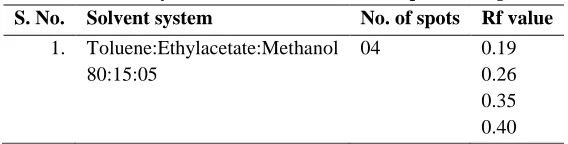
The methanolic extract of Ipomoea digitata. was dissolved in the mother solvent and spotted on plates 2 c.m above its bottom. Most of the sample for application were between 0.1-1%. The applied spots were spots were of equal size as far as
possible and diameter ranging from 2-3m.m. The mobile phase (solvent system) for TLC was developed by trial and error using solvents which were differing in polarities as given below in Table 2.
Table. TLC analysis of methanolic extract of Ipomoea digitata. S. No. Solvent system No. of spots Rf value
1. Toluene:Ethylacetate:Methanol 80:15:05
04 0.19
0.26 0.35 0.40
Isolation
of
compounds
by
column
chromatography separation:
The methanolic extract of Ipomoea digitata. was subjected to column chromatographic separation using normal phase silica gel column. The brown solid (15 g methanolic extract ofIpomoeadigitata) was adsorbed on silica gel (15 g) and transferred to a column of silica gel (200g equilibrated with Hexane). Elution was performed with Hexane (100%), Hexane: ethyl acetate (80:20), Hexane: ethyl acetate (60:40), Hexane: ethyl acetate (40:60), Hexane: ethyl acetate (20:80), ethyl acetate (100), ethyl acetate: methanol (95:5), ethyl acetate: methanol (90:10) ethyl acetate: methanol (85:15) , ethyl acetate: methanol (80:20), ethyl acetate: methanol (75:25), ethyl acetate: methanol (70:30), ethyl acetate: methanol (60:40)and methanol(100). Fractions of 100ml were collected every time, distilled off the solvent and the homogeneity of the resulting residues was examined on TLC by using different solvent systems and similar fractions, identified by their TLC behaviour were mixed together.
Fractions 9-12 (eluted hexane with ethyl acetate20:80), fractions 42-50 (eluted with ethyl acetate: Methanol 75:25). Fractions 9-12 (eluted hexane with ethyl acetate20:80), gave a solid designated as compound 1 (110 mg)the solvent system(hexane :ethyl acetate80:20), and fractions 42-50 (eluted with ethyl acetate: Methanol 75:25) gave a solid designated as compound 2 (135mg)
compound 2 Rf value was 0.19 using to solvent system (ethyl acetate: Methanol 90:10)
Structure elucidation of isolated compounds
The isolated compounds were analyzed by FT-TR, 1HNMR &13CNMR and Mass Spectrum. As per the spectral analysis the structure of compound-1 is proposed as 3, 4, 5 – Trihydroxy – 6 – (c methoxy carbonyl methyl) – tetrahydro – 2H – Pyran – 2 Carboxylic acid and its molecular formula is deduced as C8H14 O8.
Structure of compound 2 is proposed as Tetrahydro 4, 5-dimethoxy-6 (Methoxy methyl)-3 (tetrahydro – 3 – 4, 5, - trimethoxy – 6 – methyl – 2H – Pyran 2 – 2 – y loxy) – Pyran-2 Carboxylic acid and its molecular formula deduced as C19 H34 O11.
COMPOUND 1
IR (KBr) 3419 (O-H Str.), 2958 (C-H+aliphatic), 1725 (C=0 (COOH aliphatic), 1283 (C-aC ether/ ester) cm-1. 1HNMR : 8.2 (, 1H, C2-COOH),
5.10-5.08 (d, 1H, C2-H), 4.93-4.88 (dd, 1H, C6-H),
4.84-4.83 (dd, 1H, C3-H),4.42 (m, 1H, C5-H), 4.21-4.19 (t,
1H, C4-H),4.14-4.12 (d, 1H, C3-OH), 4.00-3.99 (d,
1H, C4-OH), 3.73-3.70 (m, 1H, C5-OH), 3.75 (S, 3H,
C6-CH2OCH3) and 2.44-2.43 (m, 2H, C6-CH2
-) ppm. 13
Structure of compound-1 proposed 3, 4, 5 – Trihydroxy – 6 – (c methoxy carbonyl methyl) – tetrahydro – 2H – Pyran – 2 Carboxylic acid.
COMPOUNDII
IR (KBr)3379 (-OH), 2927 (C-H aliphatic), 1649 (C=0) and 1066 (C-O) cm-1.1HNMR: (DMSO-d6,400 MHZ: 8.2 (, 1H, C2-COOH), 5.15 (, 1H,
C2-H), 5.08 (, 1H, C2-H), 4.94 (d, 1H, C3-H), 4.90
(6, 1H, C3-H), 4.89 (d, 1H, C5-H), 4.88 (d, 1H, C6-H)
4.84-4.83 (d, 1H, C4-H), 4.42-4.43 (d, 1H, C4
-H)4.36-4.30 (m, 1H, C5-H), 4.28-4.12 (m, 1H, C5-H)
3.75 (, 3H, C3-OCH3), 3.73 (d, 3H, C4-OCH3)3.70
(d, 3H, C4-OCH3), 3.57 (, 3H, C6-CH2OCH3 ),3.50-3.49 (d, 3H, C5-OCH3), 3.46-3.42 (d, 3H,C5-OCH3)
and 2.81-2.79 (d, 3H, C6-CH3). 13CNMR assignment to the carbon is given in the structure of the compound as given below
Compound 2 was proposed Tetrahydro-4,5- dimethoxy-6-(methoxymethyl)- 3-(tetrahydro -3,4,5- trimethoxy -6- methyl -2H- pyran -2-yloxy)-2H- pyran -2-carboxylic acid
CONCLUSION
Tetrahydro 4, 5-dimethoxy-6 (Methoxy methyl)-3 (tetrahydro – 3 – 4, 5, - trimethoxy – 6 – methyl – 2H – Pyran 2 – 2 – y loxy) – Pyran-2 Carboxylic
acid (C19 H34 O11). in this plant. Furthermore,
biological investigations are required for these isolated compounds.
REFERENCES
[1]. Kirtikar K.R. and Basu B.D. Indian Medicinal Plants. First Edition, 1918, 877.
[2]. Sreedhar M, Srinivasan KK, and Shanbhan T; Aphrodisiac activity of Ipomoea digitata. . 1993.
[3]. Locher CP, Burch MT, Mower HF, Beretecky J, Davis H, Van poel B, Lasure A, VandenBerghe DA and Vlietinck AJ. Anti- microbial activity and anti-complement activity of extracts obtained from selected Hawaiian medicinal plants. J Ethnopharmacol. 49(1), 1995, 23-32.
[4]. Ono M, Fukuda H, Muraya H, Miyahara K. Resin glycosides from the leaves and stems of Ipomoea digitata. Nat med (Tokyo). Aor; 63(2), 2009, 176-80.
[5]. Harborne JB. Phytochemical methods 11th Edn. In Chapman &, Hall.New York, 1984, 4-5.
[6]. Evans WC An index of medicinal plants. A Text book of Pharmacognosy. 14th ed. 7(5), 1997, 12-14. [7]. Finar G. Plants of economic importance. Medicinal Plants and Medicine in Africa. Spectrum Books Ltd.
Ibadan. 78,1986, 150-153.
[8]. Dey PM and Harborne JB. Methods in Plant Biochemistry: Academic Press; London 1987. [9]. Evans WC. Pharmacognosy, 13th Ed, Balliere-Tindall; London 1989.