Development of an Android-based
Transcutaneous Electrical Nerve Stimulator Chair
Ronnie M. Dysangco
College of Engineering and Information Sciences, Trinity University of Asia, Quezon City, Philippines Email: [email protected]
Abstract—The Transcutaneous Electrical Nerve Stimulation (TENS) is one of the popular pain treatment modality however, there is no such documentation on its effectiveness in chronic pain management. This research study the researcher will show the update of the basic microcontroller-based transcutaneous electrical nerve stimulator chair that had been developed as a medical treatment and defined as a drug-free non-invasive pain relief method which uses electrical impulses to stimulate the nerve endings pain on its near site. This research study also highlights data acquisitions on how the developed prototype would be controlled by a mobile device through a wireless and Bluetooth technology using an android device. Also in this research, the researcher also shows that Transcutaneous Electrical Nerve Stimulator (TENS) can be an advance pain reducing and rehabilitation technology than can be used for clinical treatment. The researcher also used an alternative electrode component rather than a conductive gel that is normally applied over the years that electronic experts and medical professionals are using towards its development.
Index Terms—analog digital conversion, embedded systems, microcontroller, simulator, Transcutaneous Electrical Nerve Stimulator (TENS), Android-based
I. INTRODUCTION
Transcutaneous Electrical Nerve Stimulator (TENS) is a non-invasive analgesic technique that is used to relieve nociceptive, neuropathic, and musculoskeletal pain. [1] TENS is used extensively in health care because it is inexpensive, safe, and can be administered by patient themselves. Success depends on appropriate application. Systematic reviews have been compromised by poor quality randomized controlled trials (RCT). Better quality trials are needed to determine differences in the effectiveness of different types of TENS. [2] Transcutaneous Electrical Nerve Stimulator (TENS) also deals with the application of body nerves electrical stimulus for pain theraphy. [3]
TENS (Transcutaneous Electrical Nerve Stimulator) is a therapeutic device used to deliver electric current through one’s skin. As a device is used on human body, safety concern becomes a matter that needs special attention. The test is done in the interval of the simulator
Manuscript received October 24, 2018; revised February 16, 2019.
pulse. This option is used to protect users by electrical shock that can be caused from this device. [4]
However, this research would present how to improve the performance of Transcutaneous Electrical Nerve Stimulator (TENS) through Arduino Uno microcontroller. In which the embedded C-Language code would do its full functionality as therapeutic chair controlled by Android application software [5].
II. OBJECTIVES
The main objective of this project is to design a Transcutaneous Electrical Stimulator Chair controlled by an android-based application in accordance with engineering standards, and design trade-offs application.
A. Specific Objectives
a. To design an electrodes stimulator chair that would produce electro pulse signal that would stimulate the human body back portion in accordance to Engineering Trade-Offs based on economic, functionality and manufacturability constraints.
b. To develop an android application that will control the prototype movement and stimulator capabilities.
c. To test and evaluate the prototype based on the acccuracy and user acceptability.
III. MATERIALS AND METHODS
There has been mixed methodologies used in this research to further results evaluation. These include hardware and software design methodologies. Together with resource management in accordance with code of engineering and standards with constraints and trade-offs considerations.
The research came up with an idea of designing a Transcutaneous Electrical Nerve Stimulator (TENS) Chair controlled by an android application. To make functional the researcher developed an android application system that was applicable to the prototype full functionalities.
A. Design Development
1) Requirements
In this phase researcher conducted research about TENS application in the country. This type of device is available in the local market but it is very expensive. This scenario inspired the researcher to develop an engineering solution. The researcher also considered the following: (a)
Pulse Amplitude: 0 to 80 mA each channel, adjustable, (500 ohm load); (b) Pulse Rate: 1 to 200 Hz, adjustable; (c) Pulse Width: 40 to 260 microseconds, adjustable [4]
2) Analysis
In this phase, the researcher reviewed the effectiveness of TENS in pain treatment. Wherein, Table I shows the different pain condition and related study done by other researchers.
TABLE I. TENSEFFECTIVENESS REVIEW IN PAIN TREATMENT [5]
Condition Existing
Reviews
Researchers
Acute Pain 7/14 Reeve, Menon and Corabian (1996) Chronic Pain 9/20 Reeve, Menon and
Corabian (1996) Post-Operative
Pain 2/17 Carroll et al (1997a) Labour Pain 3/8 Carroll et al (1997a)
The researcher in this stage would consider the said research study towards to the prototype improvement and manufacturability and usability.
3) Design and coding
The researcher made a strategic plan about the problem. Brainstorming with experts in the field of medicine who knows TENS technology application. The researcher at this phase listed down all the possible solutions based on the expert recommendation to satisfy the research objective. The researcher also consider the design standard on microcontroller calibration on signal generation. [6]
4) Testing
The researcher tested the prototype to know if the design was working accurately based from the standards and constraints. Evaluation form was given to ten respondents during the next phase of this research study to evaluate the prototype based on its reliability while the accuracy testing on controlling the prototype using an Android application will be done in accordance to technical standards and procedures. [7]
B. Design Constraint Inputs
The consideration of multiple constraints was applied in the process designing the project. These constraints served as the aspects that determined the feasibility of the design. There were different types of constraints applicable for the design, but the researchers have selected only those that greatly affect the entire development process.
1) Economic
The total cost of the designs of the project was affected by the price of the major components used in each circuit design. The researchers considered the price of the major components to show practicality without effect in/or the functionality of each on its expected output. There were
different types of major components used in each circuit design and the researchers considered the most advisable TENS pad and other components in order to achieve the objectives of the project. However, the researcher considered the protype development in terms of design ergonomics that would be limitted to the following aspects: body size, frame, level of fat content, nature of pain, pain tolerance level and the user perception that would affect the cost of the whole prototype design.
2) Functionality
The functionality of the Transcutaneous Electrical Nerve Stimulator (TENS) was considered through the operating properties of the sensors used in the design. The voltage sensitivity greatly affects the function of the design because the higher voltage sensitivity has, the higher the changes in input voltage to output voltage of the TENS Pads. [8] Wherein, the researcher also consider the users safety that motivates the researcher to limit the prototype used on adult that is experiencing pain and not applicable for children.
3) Manufacturability
The researcher would like to develop a prototype that all parts are locally available and in the case that the research is in need for a component replacement it will be replace easily in a short span of time.
C. Design Standards Inputs
The design of this project conforms to the following studies, codes, and standards:
D. Standards
1) Fundamentals and requirements of peripheral electric nerve stimulation. A contribution to the improvement of safety standards in regional anaesthesia [9]
The use of a nerve stimulator allows an injection cannula to be located without the cooperation of the patient. Regional anaesthesia thus becomes safer because the basic condition "no paraesthesia, no anaesthesia" becomes irrelevant. In accordance with the basic electrophysiological conditions, a stimulator should have the following properties: (1) adjustable constant current at resistances of 0.5-10 kOhm; (2) monophasic square-wave initial impulse; (3) impulse duration selectable (0.1 ms + 1 ms, and exactly adjustable; (4) impulse amplitude (0-5 mA) exactly adjusted, unequivocal scale graduation or current indicator, in particular in the range of 0.05-1.0 mA; (5) impulse frequency 1-2 (-3) Hz; (6) alarm at high impedance and check on electrical circuit; (7) battery test (indication of battery voltage); (8) unequivocal assignment of load end; (9) high-quality connecting cable and plug; and availability of (10) instructions for use with relevant parameters (tolerated variations, steady-state characteristic curves, etc.).
2) The function of peripheral nerve stimulators in the implementation of nerve and plexus blocks [10]
reference to a spectrum of characteristics that appear desirable in theoretical and practical terms. Measurements at Ohm's resistance showed that in the clinically relevant range of impulse amplitudes (0.1-1.0 mA) the quality of adjustment of the instruments varied widely. Four instruments did not generate a monophasic square-wave signal despite assertions to the contrary in the instructions for use, and one instrument did generate such a signal although a "special biphasic asymmetrical" impulse is described by the manufacturer. Impulse-like overshooting at the beginning of the signal, oscillations into the positive range at the end of the signal and fall in current during the course of the signal were the form variants indicating technically inadequate design in the other instruments. Resistance to the square-wave current impulse engendered by the complex body resistance (impedance), a good approximation to the mathematical e-function to be expected, could be demonstrated for the rising signal flank, whereas the signal curve in the lower part of the descending flank was flatter than expected owing to polarization effects in the body tissue. [8]
E. Illustrative Diagram
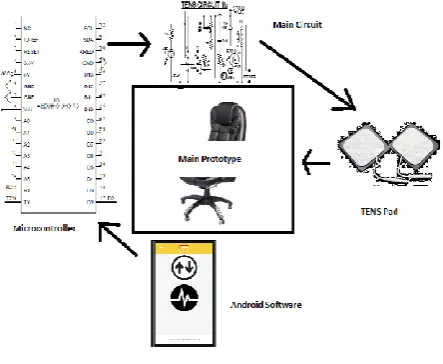
The researchers used three different sensors that detect vibrations from the construction materials. These sensors were categorized in three hardware design of the project. As shown in Fig. 1, the illustrative diagram shows the components of the design prototype. These components is conforming the engineering studies, codes, and standards that govern it. As shown in Fig. 1.
Figure 1. Illustrative diagram
The embedded microcontroller accepts the input signal coming from the android device via Bluetooth technology application. The researcher developed an algorithm that was embedded in a microcontroller memory. This input signal controls the prototype main embedded circuit. At the time that microcontroller identified which signals correspond with the embedded algorithm it will produce an output (TENS Pad pulse or movement). The whole system work as follows:
a. Command selection such as the TENS pad movement (UP/DOWN) and pulse rate.
b. If the user selects the TENS pad movement the user may control the TENS pad towards UP/DOWN settings. While if the user selects the TENS pad pulse the user may adjust the intensity from level 1 up to 5.
F. Voltage Sensitivity Formula
The researcher determined the voltage sensitivity of the TENS pad stated in the datasheets. The voltage sensitivity as shown in Eq. (1) was considered in the functionality constraint of the design and used for trade-offs. With deep research, the researcher found a related study and the following computation was for the voltage sensitivity of the TENS pads [11]:
𝑠𝑣=𝐺33×ℎ×𝑀×𝑎
𝐴 (1)
wherein:
𝑆𝑣 - Voltage sensitivity
𝐺33 - Material voltage constant for PZT ℎ - Height of the PZT material 𝑀 - Mass of the prototype (Kg) 𝑎 - Acceleration constant (9.8𝑚/𝑠2) 𝐴 - Area of the PZT material
IV. TRADE-OFFS
This research used three different design categories in obtaining the final prototype design. Using Otto and Antonsons' model on trade-off strategies in engineering design, each criterion was given a value of 0 to 5, depending on its importance. The researchers calculated the ability to satisfy each criterion based on certain properties of the device, using the equations: Computation of ranking for the ability to satisfy criterion of each mechanism: [12] as shown in Eq. (2) and (3).
%𝑑𝑖𝑓𝑓. = (𝐻𝑖𝑔ℎ𝑒𝑟 𝑉𝑎𝑙𝑢𝑒−𝐿𝑜𝑤𝑒𝑟 𝑉𝑎𝑙𝑢𝑒) 𝐻𝑖𝑔ℎ𝑒𝑟 𝑉𝑎𝑙𝑢𝑒 (2)
𝑆𝑅 = 𝐺𝑅 − (%𝑑𝑖𝑓𝑓) × 10 (3)
wherein:
SR- Subordinate Rank GR – Governing Rank
V. CONCEPTUAL FRAMEWORK
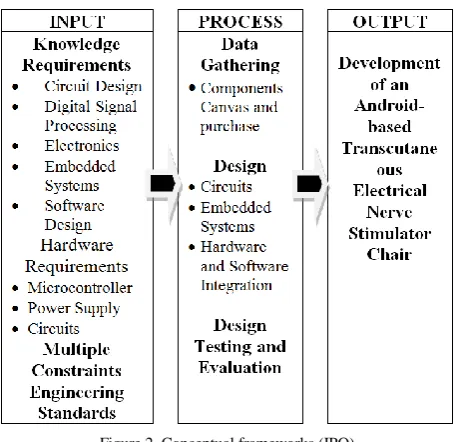
The conceptual framework shown in Fig. 2 is the researcher conceptualization based on engineering standards and different constraints consideration. The microcontroller was embedded with a program that controlled the prototype functionality. It also compromises other electronic component that affects the prototype functionalities.
Figure 2. Conceptual frameworks (IPO)
VI. RESULTS AND DISCUSSION
A. Design Raw Ranking
The Table II shows the indicated constraints which are the economic, functionality, and manufacturability and the ranking based Eq. (2). The researcher ranked the criterion’s importance from zero (0) to five (5) and the ability to satisfy the criterion is rated from negative five (-5) to positive five ((-5). It also shows the summary results of the Researchers’ raw ranking based on economic, functionality, and manufacturability constraints. [14]
TABLEII. DESIGN RAW RANKING Decision Criteria
Ability to satisfy the criterion (on scale from -5 to 5)
Design 1 Design 2 Design 3
Cost 5 4 1 Functionality 3 5 2 Availability 4 1 5 Rank 49 43 28
There are three (3) designs that the researcher considered on the prototype development such as in design 1 the researcher would expend around Php 13,000 because of the materials needed for the prototype development. However, in functionality criteria design 2 shows the accurate calibration of the TENS pad pulse because the researcher would purchase a Class B materials spare from the previous project. Design 3 are much more on the improvise design because the researcher used a material that came from the scrap but not applicable on the design standards. Table II shows that among the Three (3) designs the researchers prove that even the design 1 cost a lot still it would produce a functional prototype.
B. Android Application
The researcher developed an android application that will control the prototype TENS pad movement and also its stimulator functionality. The researcher connects prototype and Android application using Bluetooth technology. The researcher considers the accurate output
at the time that the user used the prototype controlled by the Android application. Fig. 3 shows that there are two menus that the user should choose. First, is the up and down menu that would focus on the movement of the embedded TENS pad. Second, the signal symbol is for the TENS intensity pulse that would be based on the level of pulse (1-5). The researcher also design the application with connect and disconnect feature to makes sure that the prototype and mobile device are directly connected to each other.
Figure 3. Android application
C. Prototype Accuracy Testing
The Android application output from the mobile phone controller was tested based on its accuracy. The connectivity of the designed prototype and the android device is very important in this research because in the case that the signal transmission failed the prototype output would be affected. The researcher conduct two series of test such as the prototype TENS pad movement and the pulse rate adjustment. The researcher gave a questionnaire to ten different people who used the prototype based on installation, hardware compatibility and control.
VII. CONCLUSIONS
that Arduino microcontroller produced each time the user pressed the application. The prototype is 90% accurate based on the results gathered by the researcher on the series users evaluation that compares the output on another electronic measuring material to determine the stimulator required range. For the timing accuracy the stimulator functionality was divided into 6 minutes functional time (1 minute to 6 minute of stimulation).
This prototype shows a 90% accuracy based on the series of tests and trials made by the random selected users with knowledge in electronics and electrical charge production. A 5mA current output supplies the back portion of the body for stimulation shows the significant effect of the stimulator based on the given standards where measured and tested by the selected users.
VIII. RECOMMENDATIONS
The researcher recommends that instead of using a power window motor, use a step up motor for it could have exact direction and the power supply requirement that will be much lesser. In order to enhance the performance of the system, additional motor should be use for it to be able to move left and right directions. Installation of a solar panel is also recommended for power saving purposes. Exploration of different microcontroller is also applicable together with other free software application to improve this research study. The researcher would also like to recommend an alternative configuration of the stimulator circuit which does not make use of a different supply for lessen the wiring connection of each component. Patient monitoring improvement also highly recommended by the researcher for the future study. The researchers would also recommend the efficiency validation and software upgrade for the future research and prototype improvement. Lastly, the researcher would also recommend using a nerve scanner installation device for much efficient result of the stimulator.
ACKNOWLEDGEMENT
The researcher would like to extent gratitude To Dr. Jesusa N. Padilla (Dean of College of Engineering and Architecture) Technological Institute of the Philippines my research adviser. Trinity University of Asia University President Dr. Wilfred Tiu, Vice-President for Academic Affair Dr. Luna, Research and Development Center Headed by Dr. Capili. College of Engineering and Information Sciences Dean, Faculty Members and Staff. Hytech Power Inc. for their support on this research.
REFERENCES
[1] Medexsupply.com. (26 February 2018). [Online]. Available: https://www.medexsupply.com/orthopedic-therapy-electrotherapy- fluidotherapy-tens-ems-units-stimulators-promed-prom-500-electrical-muscle-stimulator-x_pid-50655.html
[2] J. M., “Transcutaneous electrical nerve stimulation: Review of effectiveness,”Nurs Stand., pp. 44-53, 2014.
[3] I. Jones, “Transcutaneous electrical nerve stimulation,” BJA
Education, vol. 9, no. 4, pp. 130-135, 2009.
[4] J. J. Rodrigues, Emerging Communication Technologies for
E-Health and Medicine, USA: IGI Global, 2012.
[5] S. Balaji, “Mobile phone based transcutaneous electrical NErve stimulation,”IJISET- International Journal of Innovation Science,
Engineering and Technology, vol. 1, no. 2, pp. 266-270, 2014.
[6] D. M. HArding, “Patient.info.com,” TENS Machines, 23 June 2015.
[7] S. Balaji, “Mobile phone based transcutaneous electrical nerve stimulation,” International Journal of Innovative Science,
Engineering and Technology, vol. 1, no. 2, pp. 266-270, 2014.
[8] D. M. Hedau, “Application of microcontroller in transmitter section of wireless systems,” International Journal of
Computational Engineering Research, vol. 4, no. 10, pp.
2250-3005, 2014.
[9] Q. S. Software. (2018). [Online]. Available: https://www.questionpro.com/survey-templates/software-evaluation
[10] J. M. D. Santana, “Effectiveness of transcutaneous electrical nerve stimulation for treatment of hyperalgesia and pain,”US National
Library of Medicine, vol. 1, no. 6, pp. 492-499, 2009.
[11] W. P. Instruments. (2013). Laboratory Equipment for the Life Science 2013. [Online]. Available: [email protected] [12] B. C. Tsui, Altas of Ultrasound and Nerve Stimulation-Guided
Regional Aneshesia, 2017.
[13] R. Jamalzadeh, “An approximate method for voltage sensitivity calculation in unbalanced distribution systems,” in Proc. IEEE/PES Transmission and Distribution Conference and
Exposition, 2016.
[14] K. N. Otto, “Trade-off strategies in engineering design,”Research
in Engineering Design, vol. 3, no. 2, pp. 87-103, 1991.
Engr. Ronnie M. Dysangco is an Assistant Professor at Trinity University of Asia. He finished his Bachelor’s Degree in the field of Computer Engineering at La Fortuna College (2002) and earned his Master’s Degree in Engineering with Specialization in Computer Engineering at Pamantasan ng Lungsod ng Maynila (2013). Currently, he earned units in Doctor of Engineering at the Technological Institute of the Philippines.
He also serves as an Instructor at Rizal Technological University form 2011-2017. Assistant Professor at Technological Institute of the Philippines from 2011-2017. Currently, He is a part time professor at Far Eastern University Institute of Technology. His area of research focuses on the following field namely Renewable Energy, Biomedical Innovation and Information Technology.
![TABLE I. TENS EFFECTIVENESS REVIEW IN PAIN TREATMENT [5]](https://thumb-us.123doks.com/thumbv2/123dok_us/9943940.1981974/2.595.63.284.273.362/table-i-tens-effectiveness-review-pain-treatment.webp)