PhD Dissertation
International Doctorate School in Information and
Communication Technologies
DISI - University of Trento
Assisted Reuse of Pattern-Based Composition
Knowledge for Mashup Development
Soudip Roy Chowdhury
Advisor:
Prof. Fabio Casati and Dr. Florian Daniel
Universit`
a degli Studi di Trento
Abstract
First generation of the World Wide Web (WWW) enabled users to have instantaneous
access to a large diversity of knowledge. Second generation of the WWW (Web 2.0)
brought a fundamental change in the way people interact with and through the World Wide
Web. Web 2.0 has made the World Wide Web a platform not only for communication
and sharing information but also for software development (e.g., web service composition).
Web mashup or mashup development is a Web2.0 development approach in which users
are expected to create applications by combining multiple data sources, application logic
and UI components from the web to cater for their situational application needs. However,
in reality creating an even simple mashup application is a
complex task
that can only be
managed by skilled developers.
Examples of ready mashup models are one of the main sources of help for users who
don’t know how to design a mashup, provided that suitable examples can be found
(exam-ples that have an analogy with the modeling situation faced by the user). But also tutorials,
expert colleagues or friends, and, of course, Google are typical means to find help.
How-ever, searching for help does not always lead to a success, and retrieved information is
only seldom immediately usable as it is, since the retrieved pieces of information are not
contextual, i.e., immediately applicable to the given modeling problem.
Motivated by the development challenges faced by a naive user of existing mashup tools,
in this thesis we propose to aid such users by enabling assisted reuse of pattern-based
composition knowledge. In this thesis we show how it is possible to effectively assist these
users in their development task with contextual, interactive recommendations of
composi-tion knowledge in the form of mashup model patterns. We study a set of recommendacomposi-tion
algorithms with different levels of performance and describe a flexible pattern weaving
ap-proach for the one-click reuse of patterns. We prove the generality of our algorithms and
approach by implementing two prototype tools for two different mashup platforms. Finally,
we validate the usefulness of our assisted development approach by performing thorough
empirical tests and two user studies with our prototype tools.
Preface
This thesis is structured as a collection of articles that we published during this work
and those, thus, have been reviewed and accepted by peers in the scientific community.
Chapter 1 presents an executive summary of our research work, providing an overview of
the main problems, research challenges and solutions and the references to our articles
describing in details various parts of the work. Chapter 1 is structured as follows: first,
we provide motivations (in subsection 1.1) for this thesis. Then, we define problems
we identified in the context of the motivating example, research challenges (in section
1.3) associated with the identified problem statement, the research methodology that we
follow (in section1.4) during this research exploration. Section 1.5 summarizes the main
contributions of this thesis. Finally, Section 1.7 discusses the key lessons we learned during
this research work, limitations of this work and future work that we are planning to do
next. All the articles composing this work (cited in Figure 1.13) are included as appendix
at the end of this dissertation.
Acknowledgements
Quitting an esteemed research lab job for pursuing Ph.D. study was a tough call for
me back in 2009, however, the great guidances, which I had received from my mentors
and colleagues at IBM Research Lab helped me and motivated me to explore the tough
path of Ph.D. Now, when I analyze my so far journey in research before and during Ph.D.,
I can confidently say that my decision to take up this hard path was justified and I am
deeply grateful to my research mentor Dr. C. Mohan and other great managers from IBM
Dr. Manish Gupta, Dr. Shivkumar Kalyanraman, Dr. Sambit Sahu who had greatly
motivated me to take up the challenge for doing Ph.D.
I wish to convey my sincere gratitude to my advisor Prof. Fabio Casati for giving me
the opportunity to carry out my research in the University of Trento. I would also like to
express my sincere thanks to my co-advisor Dr. Florian Daniel for his advice during my
doctoral research endeavor. As my supervisor, he has constantly motivated me to remain
focused on achieving my goals. His observations and comments helped me to strive for
perfection and to move forward with research in depth.
Besides my advisors, I would like to thank my thesis committee : Prof. Boualem
Benatallah, Prof. Ihab Francis Ilyas and Prof. Cinzia Cappiello, for their encouragement,
insightful comments and feedback.
I would also like to thank Dr. Carlos Castillo, Dr. Patrick Meier for hosting me and
offering me an internship opportunity in Qatar Computing Research Institute that led
me to work on diverse exciting projects in social computing. This work experience has
certainly broaden my perspective as a researcher. I also wish to convey my sincere thanks
to all my colleagues and friends at Qatar Computing Research for providing a friendly
research environment.
I also thank Dr. Sihem Amer Yahia and Prof. Gautam Das for guiding and helping at
times during my Ph.D. journey with their insightful guidance and help. I wish to thank
OMELETTE EU FP7 project and COMPAS EU FP7 project for funding my research.
I also wish to convey my sincere thanks to my research collaborators who have worked
with me in these projects and who have co-authored with me for various publications. I
also thank my colleague and friends at DISI.
Last but not the least, I am deeply thankful to my family for their love and support.
I dedicate this thesis to my mother, who has been the continuous source of motivation in
my life. This last word of acknowledgment I have saved for my dear wife, who has been
with me in all the ups and downs of life. Her sacrifice, unlimited patience, understanding
and continuous encouragements through out my Ph.D journey has made this day possible.
(Soudip Roy Chowdhury)
Contents
1 Thesis Summary
1
1.1
Motivating scenario and problem statement
. . . .
1
1.2
State of the art . . . .
3
1.3
Research challenges . . . .
5
1.4
Research steps followed . . . .
5
1.5
Contributions . . . .
6
1.5.1
Theoretical foundation for the assisted re-use of pattern based
com-position knowledge . . . .
6
1.5.2
Efficient, Interactive recommendation of composition patterns . . .
9
1.5.3
Filtering of recommended patterns by user preferences
. . . .
10
1.5.4
Automated weaving of composition patterns . . . .
14
1.5.5
System design for our assisted mashup development platform . . . .
15
1.5.6
User studies and validation . . . .
17
1.6
Structure of the thesis . . . .
18
1.7
Conclusion . . . .
20
1.7.1
Dissemination . . . .
20
1.7.2
Limitations and future work . . . .
20
Bibliography
25
Appendix A Wisdom-Aware Computing: On the Interactive
Recommen-dation of Composition Knowledge
27
Appendix B End-user requirements for wisdom-aware EUD
41
Appendix C Composition Patterns in Data Flow Based Mashups
59
Appendix D Efficient, Interactive Recommendation of Mashup
Composi-tion Knowledge
71
Appendix E Discovery and Reuse of Composition Knowledge for Assisted
Mashup Development
87
Appendix F Baya: Assisted Mashup Development as a Service
91
Appendix G Assisting End-User Development in Browser-Based Mashup
Tools
97
Appendix H Assisted Mashup Development: On the Discovery and
Rec-ommendation of Mashup Composition Knowledge
101
Appendix I
Complementary Assistance Mechanisms for End User Mashup
Composition
127
Appendix J Interactive Recommendation and Weaving of Mashup Model
Patterns for Assisted Mashup Development
133
Chapter 1
Thesis Summary
All knowledge that the world has ever received comes from the mind; the infinite library of the universe is in our own mind.
Swami Vivekananda
Despite several efforts for simplifying the composition process, the learning process
for using existing mashup editors remains rather difficult. Due to this difficult learning
process, the development of mashup applications is only achievable by expert developers.
In this thesis, we describe how this barrier can be lowered by means of an assisted
devel-opment approach that enables the reuse of existing composition knowledge. We further
demonstrate and verify how with the help of our efficient interactive pattern
recommen-dation technique, less-skilled user can successfully build mashup applications.
1.1
Motivating scenario and problem statement
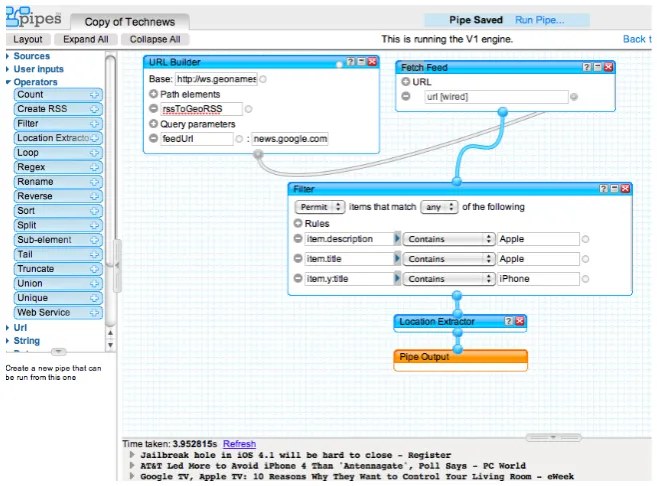
In order to better understand the problem that we address in this thesis, let’s have a
look at how a mashup is, for instance, composed in Yahoo! Pipes
http://pipes.yahoo.
com/pipes/, one of the most well-known and used mashup platforms as of today. Let us
assume we want to develop a simple pipe that fetches a set of news feeds from Google
News website, filters them according to a predefined condition (in our case, we want to
search for news on products and services by a given vendor), and locates them on a Yahoo!
Map based upon the geo-location associated with each news item.
com-2
Thesis Summary
ponent: Base=http://ws.geonames.org, Path elements=
rssToGeoRSS
, and Query
pa-rameters=
FeedUrl
:news.google.com/news?topic=t&output=rss&ned=us. The so
cre-ated URL is fed into the
Fetch Feed
component, which fetches the geo-enriched news feed
from the Google News site. In order to filter out the news items we are really interested in,
we need to use the
Filter
component, which requires the setting of proper filter conditions
via the
Rules
input field. Feeding the filtered feed into the
Location Extractor
component
causes the plot of the news items on a Yahoo! Map. Finally, the
Pipe Output
component
specifies the end of the pipe.
If we analyze the development steps above, we can easily understand that developing
even such a simple composition is out of reach for people without sufficient programming
knowledge, it is even difficult for a less-skilled developer. As pointed out in the Figure
1.1, the
URL Builder
, for example, requires the correct setting of it’s configuration
pa-rameter. Then, components need to be correctly connected in order to define a consistent
data-flow logic i.e., the output parameter of a component must be mapped correctly to
the input parameter/s of other component/s. But more importantly, plotting news onto a
map requires knowing that this can be done by first enriching a feed with geo-coordinates,
then by fetching the actual feed, and then by plotting the fetched items on a map.
Under-standing all these programming concepts is
neither trivial nor intuitive
for a less-skilled
developer.
State of the art
3
The non-trivial programming concepts (e.g., data flow, control flow, components,
con-nectors, configuration settings etc.) of mashup development, as explained in Figure 1.1,
make the design of a suitable recommendation system more complex and challenging.
Being motivated by this challenge, in this thesis, we address the following problem
statement (PS): How can we assist less-skilled developers in their mashup designs by
providing them necessary support to reuse the existing composition knowledge?
choosing the right component
filling the correct config. parameter value
connecting components together
defining the correct data mappings
Figure 1.1: Screenshot of the Yahoo! Pipes mashup environment showing typical composition
steps
1.2
State of the art
au-4
Thesis Summary
tocomplete the partial mashup. The limitation of these approaches is that they partly
overestimate the skills of less skilled developers, as they either still require advanced
mod-eling skills (which users don’t have), or they expect the user to specify complex rules for
defining goals (which they are not able to), or they expect domain experts to specify and
maintain complex semantic networks describing modeling constructs (which they don’t
do).
The business process management community more specifically focuses on patterns as
a means for knowledge reuse. Among the related works for applying or weaving
recom-mended patterns, the automated pattern application approach [5] uses structural
prop-erties of the current composition model to tell the user which pattern (simple merge,
exclusive choice, parallel branch, and similar) among the workflow patterns introduced
by Van Der Aalst et al. [22] are applicable in the current modeling context. The
struc-tural properties of the workflow patterns are verified against the current process model
structure to check their applicability. These control flow patterns are not able to capture
domain knowledge of the underlying mashup applications, and hence are not contextual.
The syntax-based assistance approach proposed in [8] recommends the user a set of
workflow patterns based on his current process model, and, once a user selects one of the
recommended patterns, weaves the pattern by considering the structural compatibility
among modeling constructs (e.g., a gateway must be followed by an activity in the current
composition). However, this approach is limited to only block-structured models, and also
the instance level information of a composition model (e.g., an activity of type A must
be followed by an activity of type B, and so on) is not captured in the recommended
patterns.
Research challenges
5
1.3
Research challenges
To find a solution to the problem statement
PS
and to address the gap identified in the
existing state-of-the-art approaches, the specific research challenges (RC) that we address
in this research are:
•
RC1: How to design a conceptual model for the interactive development
recom-mendation system that supports the reuse of existing composition knowledge for
developing mashups in a step-by-step manner.
•
RC2: How to represent the composition knowledge that captures the typical
mod-eling steps in mashup designs.
•
RC3: How to design a set of algorithms that support interactive and contextual
retrieval of composition knowledge at runtime.
•
RC4: How to design a set of algorithms that automate the application (weaving) of
the modeling edits (addition or deletion of components, connectors etc.), captured
in a composition knowledge, to the current composition context.
•
RC5: How to implement a system that can help us to integrate the solutions for
RC1, RC2, RC3 and RC4 and that also helps us to evaluate the usefulness of our
interactive recommendation approach.
•
RC6: How to assess the usability and the accuracy of our recommendation
algo-rithms and our system via user studies and empirical tests.
1.4
Research steps followed
The summary of how we proceeded in our research exploration and the research
method-ology that we followed for the execution of this research are described below:
•
The foundation of this thesis is based upon a set of hypotheses that emphasize the
benefit of the assisted reuse of existing composition knowledge in end user
develop-ment.
6
Thesis Summary
•
By analyzing the existing state of the art related to assistance mechanism across
mul-tiple domains, we found a set of novel research challenges that are not yet addressed
in the existing body of research and that we addressed in this research work.
•
Based upon the elicited requirements, we defined the theoretical foundation
(con-ceptual model of interactive pattern recommendation, pattern representation) of our
assisted mashup platform, and then we proposed a set of novel interactive
recom-mendation and an automated weaving algorithm that could satisfy the requirements
elicited before and the theoretical foundation defined before.
•
To validate the benefit of our proposed algorithms, we developed a prototype system
(Baya) that help us in collecting the necessary data for measuring the viability and
usability of our approach among the target user groups.
•
We further elicited requirements for the improvements (e.g., incorporating user
pref-erence aspects for filtering the recommendations) of our algorithms by performing
thorough empirical test of our algorithms.
•
We performed user studies with the target user groups to validate and fine tune the
initial hypotheses underlying our approach.
•
Finally by disseminating the results of this thesis across several mashup platforms
(Yahoo! Pipes, Apache Rave
http://rave.apache.org/, MyCocktail
http://www.
ict-romulus.eu/web/mycocktail), we proved the generality as well as the
suitabil-ity of our approach in end user development paradigm in general, mashup
develop-ment in particular.
1.5
Contributions
The contributions of this thesis span across theoretical and algorithmic aspects of
interac-tive, contextual development assistance that address all related research challenges listed
in Section 1.3.
1.5.1
Theoretical foundation for the assisted re-use of pattern based
compo-sition knowledge
Contributions
7
(developer knowledge), best modeling practices (domain expert knowledge), or recurrent
model fragments in a given repository of mashup models (community knowledge [13]).
The structure and types of composition patterns that capture the typical design steps in
a mashup environment are the core knowledge behind our step-by-step recommendation
approach.
Composition pattern types. Composition patterns capture the typical modeling
steps performed by a developer (e.g., filling input fields, connecting components etc. as
shown in Figure 1.1) in a Pipes-like mashup tool. By analyzing the model of existing
mashups [14], we specifically identified following five types of composition patterns.
•
Parameter value pattern.
The parameter value pattern represents a set of value
assignments for the input parameters of a component. This pattern helps filling
input parameters of a component that require explicit user input.
•
Connector pattern.
The connector pattern represents a connector between a pair of
components, along with the data mapping of the target component. This pattern
helps connecting a newly placed component to the partial mashup model in the
canvas.
•
Component co-occurrence pattern.
The component co-occurrence pattern captures
pairs of components that occur together. It comes with two associated components
as well as with their connector, parameter values, and data mapping logic. This
pattern helps developing mashups incrementally in a connected fashion.
•
Component embedding pattern.
The component embedding pattern captures which
component is typically embedded into which other component, both being preceded
by another component. This pattern helps, for instance, modeling
loops
, a task that
is usually not trivial to non-experts.
•
Multi-component pattern.
The multi-component pattern represents model fragments
that are composed of one or more of the patterns as described before.
This list of pattern types is not exhaustive, but it contains the most representative
steps in mashup designs. These patterns help in understanding the domain knowledge
and the best practices as well as keeping agreed-upon modeling conventions. To read
more about the basic intuitions behind coming up with this set of composition patterns,
one can refer to our earlier work [14].
8
Thesis Summary
Modeling Action
Select
Drag&Drop
Connect
Fill
Delete
Embed Object
Composition
Fragment Connector Component
Parameter Field Partial
Composition 1 1..N
Object-action-recommendation rule
Recommendation
1..N
1
triggers
part of
1..N
1..N
applies to
1
0..N
1 0..N
1 0..N
Composition pattern
provides
Complete
Substitute
Highlight
Connector Component embedding Multi-component Parameter value co-occurenceComponent
--- Context for interactive recommendations
--- Interactive recommendation preliminaries
Figure 1.2: Conceptual model of interactive pattern recommendation approach
Contributions
9
1..N DataMapping ID SourceOutputAttribute TargetParameter Usage Date Connectors ID SourceComponent SourceOutputPort SourceOutput TargetComponent TargetInputPort Usage Date 0..1 ParameterValues ID Component Parameter Value Usage Date MultiComponent ID C DF DF' Usage Date ComponentCooccur ID SourceComponent TargetComponent TargetOutput Usage Date Embedding ID SourceComponent EmbeddingComponent EmbeddedComponent Usage Date 0..1 1..N 0..1 1..N 1..N 1..N 0..1 0..1 1..N 1..N 0..1 0..1Figure 1.3: KB schema for composition patterns
in order to help them to proceed with the development steps. For more details about the
conceptual model and the theoretical foundations of this thesis, we refer the reader to
[13], [15].
1.5.2
Efficient, Interactive recommendation of composition patterns
The algorithmic contributions for the pattern recommender consist of a pattern knowledge
base (KB) that is structured to support fast retrieval of composition patterns at runtime,
an exact and an approximate search algorithm that are designed for the efficient retrieval
of graph-like pattern structures and a novel user-preference based filtering and ranking
algorithm that improves the accuracy of our pattern retrieval algorithm.
Pattern KB. The core of the interactive recommender is the KB that stores
composi-tion patterns, but decomposed into their constituent parts, so as to enable the incremental
recommendation approach.
10
Thesis Summary
be retrieved in the current composition context. The
object
of an action is used as a query
for searching of suitable patterns from the KB. We develop a similarity based algorithm
to retrieve suitable patterns for the given composition context. As for the retrieval of
similar patterns
, our goal was to
help modelers, not to disorient them
. This led us to
the following principles for the identification of “similar” patterns: preference should
be given to exact matches of components and connectors in
object
, candidate patterns
may differ for the insertion, deletion, or substitution of
at the most one
component in
a given path in
object
, and among the non-matching components preference should be
given to functionally similar components (e.g., it may be reasonable to allow a Yahoo!
Map instead of a Google Map). For the fast execution of similarity based algorithm
we pre-process the graph structure of the original patterns, and the query object to an
intermediate representation. This pre-processing step saves us from the costly
graph-traversal steps at runtime. For each retrieved pattern, we compute a rank based on the
pattern description (e.g., containing
usage
and
date
), the computed similarity, and the
current partial mashup context. We then sort the patterns based upon their rank value
and group the recommendations by their type, and filter out the top
k
patterns for each
recommendation type. Details of our pattern recommendation algorithm are described in
[15].
Performance evaluation of our recommendation algorithm. To prove the
ef-ficiency of our recommendation algorithm we wished to verify its performance under
different stress conditions.
To perform such stress tests, we generate a realistic
test
data set
, containing 130 parameter values, 650 component co-occurrence and, 3250
data-mapping, and 1000 multi-component patterns. In the
worst-case scenario
(KB of 1000
multi-component patterns, approximate similarity matching of patterns), the
recommen-dation engine retrieves relevant patterns within 608 milliseconds (cf. Figure 1.4). Details
of the performance evaluation tests are described in our previous work [15].
1.5.3
Filtering of recommended patterns by user preferences
Contributions
11
10.098& 20.987&
61.556&
165.784&
586.038&
0& 100& 200& 300& 400& 500& 600& 700&
10& 100& 1000&
Re
tr
ie
va
l)*
m
e)
[m
s]
)
Number)of)pa5erns)in)KB)
Connector&
Par&value&
Co9occurrence&
Mul;9component&
Total& Recommendation types and times in response to an
addition of a new component to the canvas
Figure 1.4: Performance evaluation for the client-side pattern recommender
for users’ development histories. As shown in the figure, we first crawled all pipes in a
given application domain e.g., news related pipes, then for each of the crawled pipes we
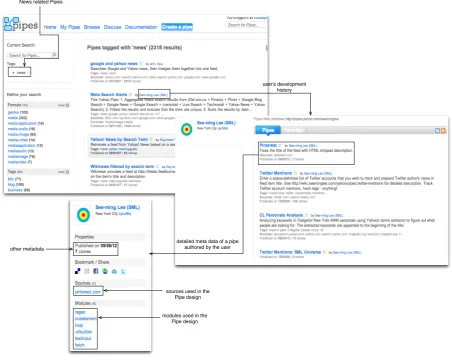
extracted the author’s preference information i.e., number of modules/components and
data sources they have used in their pipes by crawling their development profile page
containing information about pipes they have developed. Totally, we collected
develop-ment profiles information for
441
unique Yahoo! Pipes users. The development profile for
each user contains two matrices, one of which captures the association between the users
(#441) and the modules (#51) and the other matrix contains the association between the
users (#441) and the data-sources (#4781). From these association metrics we derived
an implicit rating matrix for the users-modules and the users-data-sources. We identified
a high sparsity in the rating matrices; a user only uses a few of the modules/data-sources
available in the platform in all his/her pipes and that results in high sparsity in the
user-module/data-sources rating matrix. This phenomenon motivated us to implement the
alternating least square (ALS) algorithm [7], a well known matrix factorization technique
that efficiently handles implicit rating dataset with high sparsity. We then incorporated
the user preference based ranking of modules and data-sources as a filtering criteria for
finding top-
k
patterns from the retrieved result of our similarity based pattern retrieval
algorithm.
12
Thesis Summary
News related Pipes
user's development history
details of a Pipe authored by the user
modules used in the Pipe design
detailed meta data of a pipe authored by the user other metadata
sources used in the Pipe design
Figure 1.5: Screenshot depicting the development profile information for a user in Yahoo! Pipes
negative
metrics for our test results. If the expected modules were found in the top-
k
list as returned by the recommendation engine then we marked the result as
true
pos-itive
(TP), if the expected module was not found in the recommended top-
k
list then
we marked the result as
false positive
(FP), and if the algorithm was not able to return
any recommendation for a step then we marked the result as
false negative
(FN). The
precision, recall and the
F
1measures were calculated by using the standard formula as
described below.
precision =
T P
T P
+
F P
recall =
T P
T P
+
F N
F1 =
2*precision*recall
precision + recall
Contributions
13
Original mashup model in Yahoo! Pipes
subgraphs with varying size A C AC E CE D ED
A C AC
A C AC CE E AC A C CE E D ED (1) (2) (3) A C
query Object recommendationexpected
A C
query Object recommendationexpected
retrieved patterns Top K (cp.C) = {B,C,F,G} TP=1
FP=0 FN=0
E
retrieved patterns Top K (cp.C) = {M,N,F,G} TP=0
FP=1 FN=0
A C
query Object recommendationexpected
E D
retrieved patterns Top K (cp.C) = {} TP=0
FP=0 FN=1
Decomposed into subgraphs
Step 1. for |obj.C|=1 Step 2. for |obj.C|=2 Step 3. for |obj.C|=3 C CE E
E ED D
CE
C E ED D
Figure 1.6: Evaluation strategy for calculating the accuracy of our recommendation algorithms
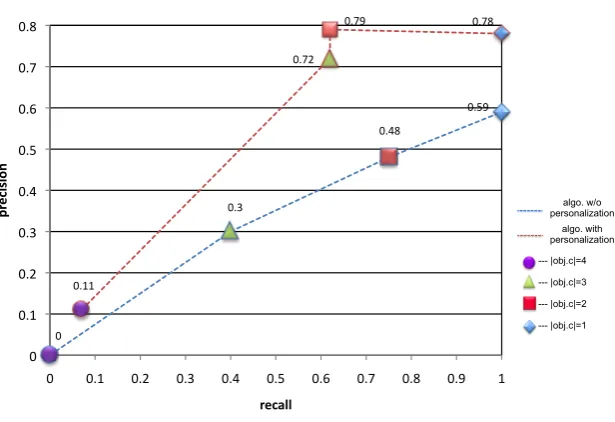
--- |obj.c|=4 --- |obj.c|=3 --- |obj.c|=2 --- |obj.c|=1 algo. w/o personalization algo. with personalization
Recall precision graph for the two variants of our recommendation algorithm (k=10)
0.59% 0.48% 0.3% 0% 0.78% 0.79% 0.72% 0.11% 0% 0.1% 0.2% 0.3% 0.4% 0.5% 0.6% 0.7% 0.8%
0% 0.1% 0.2% 0.3% 0.4% 0.5% 0.6% 0.7% 0.8% 0.9% 1%
pr
ec
ision)
recall)
Figure 1.7: Accuracy measures for the top-10 recommendations by our algorithms
The details of the user preference based filtering algorithm and the empirical evaluation
tests are explained in the paper [19].
14
Thesis Summary
sure that we didn’t consider those pipes that were included for the pattern KB creation.
Based upon the retrieved results we calculated the precision, recall and
F
1measures for
our algorithms. We used the same evaluation strategy for both of our recommendation
algorithms, with and without preference based filtering algorithm and the results of the
evaluations are shown in Figure 1.7. In all of our tests, the recommendation algorithm
variant that includes user preference based filtering approach
outperformed
the naive
version without personalization. This verified our claim that incorporating personalization
in the recommendation algorithm can improve accuracy of the overall system. The details
of this test setup and detailed evaluation results can be found in the paper [19].
1.5.4
Automated weaving of composition patterns
We don’t limit our system functionality to only recommending patterns that can be
applied to the current composition context, but we also help users in progressing their
development task by applying a selected pattern in the current model on behalf of the
user. We call this functionality automated
weaving
of composition patterns. Weaving
a given composition pattern into a partial mashup model is not straightforward and
requires a thorough analysis of the structure and context for both the pattern and the
partial mashup, in order to understand how to connect the pattern to the constructs
already present in the current composition model. In essence, weaving a pattern means
emulating developer interactions inside the modeling canvas, so as to connect a pattern
to the partial mashup.
We approached the problem of pattern weaving by first defining a
basic weaving
strat-egy
that consists of steps (mashup operations) required for weaving a composition pattern
type. For example weaving a parameter value pattern requires a mashup operation
(as-signing a parameter value to a parameter field of a component) to be performed. The
Basic weaving strategy is agnostic regarding the current composition context.
Contributions
15
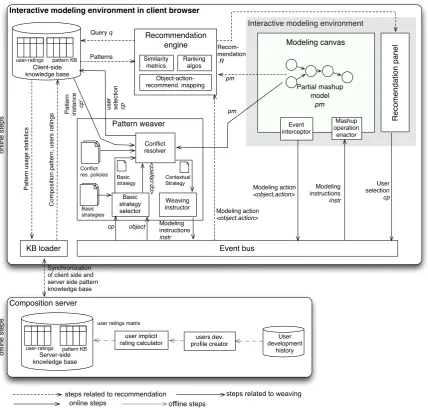
Interactive modeling environment in client browser
Event bus KB loader cp Recom-mendation R Query q
Patterns C o mp o si tio n p a tt e rn , u se rs ra tin g s Pa tt e rn u sa g e st a tist ics User selection cp Modeling instructions instr Object-action-recommend. mapping Similarity metrics Ranking algos pm Modeling action <object,action> pm Modeling action <object,action> Modeling instructions instr object
Interactive modeling environment
Modeling canvas R e co me n d a ti o n p a n e l Partial mashup model pm Event interceptor Mashup operation enactor Client-side knowledge base Conflict resolver Weaving instructor Basic strategy selector Basic strategies Conflict res. policies Basic
strategy Contextual Strategy <cp ,o b je ct > Synchronization of client side and server side pattern knowledge base Pattern weaver Pa tt e rn in st a n ce cp ' u se r se le ct io n cp Recommendation engine pattern KB user-ratings Composition server
steps related to recommendation steps related to weaving
on lin e st ep s
online steps offline steps
User development history users dev. profile creator user implicit rating calculator pattern KB user-ratings
user ratings matrix
Server-side knowledge base of fli ne st ep s
Figure 1.8: Functional architecture of the interactive pattern recommendation and automated
weaving approach
1.5.5
System design for our assisted mashup development platform
16
Thesis Summary
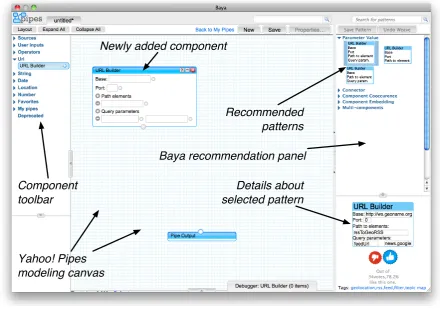
Yahoo! Pipes
modeling canvas
Newly added component
Baya recommendation panel
Recommended
patterns
Details about
selected pattern
Component
toolbar
Figure 1.9: Screenshot of Baya: an assisted mashup platform as a service
distinguish between online and offline steps involved in our system.
Baya: Assisted mashup development as a service. To realize our interactive,
contextual pattern recommendation and automated weaving algorithms, we developed a
prototype tool named Baya [17]. Baya aims to seamlessly extend existing mashup or
composition instruments with advanced knowledge reuse capabilities. It targets both
ex-pert developers and beginners and aims to speed up the former and to enable the latter.
The
design goals
behind Baya can be summarized as follows: We didn’t want to develop
yet another
mashup environment; so we opted for an extension of existing and working
solutions (e.g., Yahoo! Pipes, Apache Rave etc.). Baya is implemented as Mozilla
Fire-fox (http://mozilla.com/fireFire-fox) extension for Yahoo! Pipes, adding an interactive
recommendation panel to the modeling canvas. Figure 1.9 shows a screenshot of Baya in
action, to view a working demonstration of Baya’s assisted mashup development approach
one can refer to this screencast at
http://www.youtube.com/watch?v=AL0i4ONCUmQ.
Contributions
17
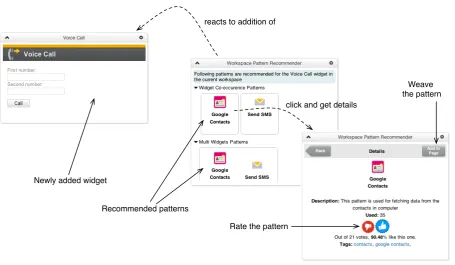
Newly added widget
Recommended patterns
Rate the pattern
Weave the pattern reacts to addition of
click and get details
Figure 1.10: Screen shot showing of Baya extension a.k.a workspace pattern recommender widget
in action
extending Baya’s recommendation and weaving algorithms for other mashup tools. In
the context of an European union project OMELETTE (http://www.ict-omelette.
eu/home), we implemented a pattern recommender widget (an extension of Baya) to
support W3C widget based mashup development in an open-source mashup platform
Apache Rave (http://rave.apache.org/). The pattern recommender (cf. Figure 1.10)
aids users of Apache Rave in building their mashups by reusing existing composition
knowledge. To understand better how we extended Baya’s pattern recommendation and
weaving algorithm in the pattern recommender widget implementation, we refer the reader
to [10] (page 26-31) and [18].
1.5.6
User studies and validation
sam-18
Thesis Summary
500 1000 1500 2000 2500 100 200 300 400 500 600 3 4 5 6 7 8Control Group Test Group
D eve lo pme nt ti me in se co nd s N umb er of u se r in te ra ct io ns
Control Group Test Group Control Group Test Group
T hi nki ng ti me (d ev . t ime / nu mb er of in te ra ct io ns) in se co nd s
(a) Mean development time in
designing a pipe without and with Baya (b) Mean number of user interactions in designing a pipe without and with Baya (c) Mean thinking time for designing a pipe without and with Baya 500 1000 1500 2000 2500 100 200 300 400 500 600 3 4 5 6 7 8
Figure 1.11: Results for Baya’s usability validation test executed on the mechanical turk
crowd-sourcing platform with 30 participants split into a control and a test group
ple sizes and unequal variance on the evaluation results data (cf. Figure1.11) and that
could statistically confirm the viability of the first two hypotheses. In response to the
questionnaire that we asked users to fill in with feedbacks, the majority of the users (73%
of control group and the 80% of test group) confirm the benefits of such an interactive
recommendation utility in the end user development.
To cross-validate the result of our first user study another follow-up study was
con-ducted with our protype system by T-Systems
http://www.t-systems-mms.com/
and
Huwaei
http://www.huawei.com/en/
in the context of OMELETTE project. The aim
of that study was again to evaluate the usefulness of our assisted development approach in
an end-user mashup design scenario. The study was conducted in China and in Germany
and totally 22 participants took part in that study. The study result as shown in the
Figure 1.12 re-confirms the validity of our earlier assumption that Baya
speeds up
the
development (mean development time of 57 sec for the test group against 137 sec for the
control group). 67% of all users agreed that this feature was important or even essential
for a mashup environment. Few users also reported that Baya’s assistance helped them to
learn the usage of new widgets, which they were unaware of. These study results not only
backs our claims about the usefulness of Baya in end-user development paradigm, but
they also reveal the didactic value of our interactive step-by-step assistance mechanism.
Details of the study and the test results is explained in [18].
1.6
Structure of the thesis
Structure of the thesis
19
50
100
150
200
0
50
100
150
D
eve
lo
pme
nt
ti
me
in
se
co
nd
s
Control Group Test Group
50
100
150
200
Mean development time in extending a workspace without and with pattern
recommender
(a) Results of user study conducted in China
D
eve
lo
pme
nt
ti
me
in
se
co
nd
s
50
100
150
Control Group Test Group Mean development time in extending a
workspace without and with pattern recommender
(b) Results of user study conducted in Germany
Figure 1.12: Results for usability validation test executed in China and in Germany to evaluate
the benefit of pattern recommender tool
20
Thesis Summary
approach.
How to read this thesis
Depending on the reader’s interest in details, we suggest three different ways of reading
these papers:
•
The complete picture of the work done in this thesis and its evolution from the first
ideas to the final test of the algorithms, the lesson learned and the conclusion are
summarized in Chapter 1 and are described in all details in the papers attached as
appendices (A-J).
•
The core contributions of the work are best described in publications [11; 15; 19].
•
Implementation details for tools, which demonstrate the realization of the our
inter-active pattern recommendation algorithm and the automated weaving approach are
described in [10; 16].
1.7
Conclusion
1.7.1
Dissemination
During the course of this research we disseminated the interim results and the knowledge
gathered in several reputed international conferences and journals (cf. appendices A-J).
In terms of applications, we developed an open source tool
Baya
, as a Firefox extension
for Yahoo! Pipes. The datasets that we have collected for our experimentations (both the
pattern KB and the developer profiles in Yahoo! Pipes) is made available for the benefit of
larger research communities. In the context of an European Union project OMELETTE
(http://www.ict-omelette.eu/home), we used the results of our interactive pattern
based recommendation and automated weaving algorithms by implementing assistance
plugin tools for two actively
open-source
mashup platforms Apache Rave and MyCocktail.
This thesis also produces one bachelor thesis and one international recognition (winner for
Graduate Category in ACM Student Research Competition 2012
http://src.acm.org/
winners.html) for the work entitled “Assisting Mashup Development in Browser Based
Modeling Tool” [12].
1.7.2
Limitations and future work
Conclusion
21
experimental study, while others are intrinsic in the design of our models and techniques,
and may be addressed by adopting different approaches and/or technical tools.
Some of the limitations that we have identified and are working toward addressing
them in our future works are listed below:
•
Coverage of the pattern KB. As reported in Figure 1.7, the accuracy of our
recommendation algorithm falls down sharply once we go beyond the query object
size of 3. This is due to the low coverage of our pattern KB for patterns with size
more than 4. This is partly because while building the knowledge base for the initial
prototype system, we only considered a subset of pipes (tagged as
“most popular”
pipes) as an input for the pattern mining algorithm, that we considered as the source
for the composition pattern. The high support value required for identifying
multi-component patterns with many multi-components (more than 4) by the pattern mining
algorithm also contribute to this low coverage problem.
To address the pattern KB’s coverage issue, in our future work we are planning to
crawl the
entire mashup repository
of Yahoo! Pipes, which has several thousands
of pipes models available. We also wish to explore other sources for composition
pattern knowledge (e.g., knowledge contributed by domain experts) in the future
design of our system. As a step towards that, we are working towards defining
algorithms for finding expert users in a development platform like Yahoo! Pipes. By
analyzing these expert users’ mashup designs we can further identify knowledge for
our recommendation algorithm. This process is not straight-forward and has it’s own
research challenges. In our future work we are going to address them one-by-one.
We also want to cross-verify the effect of different sources of composition knowledge
(e.g., knowledge from the expert users vs knowledge mined from the repository) on
the quality of recommendations.
•
Usability issues for the consumption of recommendations.
Accepting/reject-ing a recommendation as suggested by any recommendation system requires users to
understand the recommended pattern (details of what is recommended and why it
is recommended). In our tool we show users the details of a recommended patterns
in the form of a preview of a pattern and the associated meta data (e.g., how many
users used a pattern or liked a pattern). However, we believe, that to enhance the
usability and transparency of our recommendation approach, more work is required
in terms of representation of recommendations in the UI.
22
Thesis Summary
mashup environments. In addition to this, we are also working on improving the
usability of our recommendation system by providing more
explanations
(why a
pattern is suggested, and what would a pattern do in the current context) about
the suggested recommendations. We believe that an explanation along with each
recommended steps will increase the transparency of our recommendation system to
users.
•
Limiting the novelty of recommendations. Personalization or preference-based
filtering of recommendations certainly increases the relevance of recommendations
to a user, but it also limits the novelty of recommendations (only preferred
mod-ules/data sources always appear in the top-
k
recommended list). This may limit the
usefulness and the didactic aspects of a recommendation system.
To address this issue, we are working on techniques to introduce
diversity
into
rec-ommendations. We hypothesize that a right balance of novelty and personalization
in recommendations can make our recommendation system more valuable to users.
•
Scalability of the personalized recommendation algorithm. New users (for
whom the system doesn’t have the development preference information) of our
as-sisted development platform poses challenges to the personalized recommendation
algorithm. Since the system has no knowledge about the ratings for modules and
data-sources for such users, it can’t calculate the preference metrics for them. In
order to get their development preference information, the system is required to
re-execute the implicit-rating matrices calculation for all users. Re-doing this matrix
factorization step for a large dataset is an expensive process, and may hinder the
overall performance of our recommendation system.
To address the scalability issue of our personalized recommendation algorithm, in
our future work we will explore the applicability of incremental singular value
decom-position algorithm [20] and other state-of-the-art collaborative filtering techniques
in the context of our recommendation algorithm.
recom-Conclusion
23
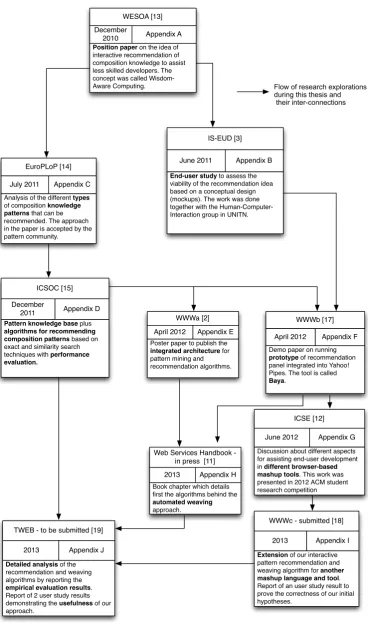
WESOA [13]
December
2010 Appendix A
Position paper on the idea of interactive recommendation of composition knowledge to assist less skilled developers. The concept was called Wisdom-Aware Computing.
EuroPLoP [14]
July 2011 Appendix C
Analysis of the different types of composition knowledge patterns that can be recommended. The approach in the paper is accepted by the pattern community.
IS-EUD [3]
June 2011 Appendix B
End-user study to assess the viability of the recommendation idea based on a conceptual design (mockups). The work was done together with the Human-Computer- Interaction group in UNITN.
ICSOC [15]
December
2011 Appendix D
Pattern knowledge base plus algorithms for recommending composition patterns based on exact and similarity search techniques with performance evaluation.
WWWa [2]
April 2012 Appendix E
Poster paper to publish the integrated architecture for pattern mining and recommendation algorithms.
WWWb [17]
April 2012 Appendix F
Demo paper on running prototype of recommendation panel integrated into Yahoo! Pipes. The tool is called Baya.
Web Services Handbook - in press [11]
2013 Appendix H
Book chapter which details first the algorithms behind the automated weaving approach.
TWEB - to be submitted [19]
2013 Appendix J
Detailed analysis of the recommendation and weaving algorithms by reporting the empirical evaluation results. Report of 2 user study results demonstrating the usefulness of our approach.
ICSE [12]
June 2012 Appendix G
WWWc - submitted [18]
2013 Appendix I
Extension of our interactive pattern recommendation and weaving algorithm for another mashup language and tool. Report of an user study result to prove the correctness of our initial hypotheses.
Flow of research explorations during this thesis and their inter-connections
Discussion about different aspects for assisting end-user development in different browser-based mashup tools. This work was presented in 2012 ACM student research competition
Bibliography
[1] Cypher, Allen; Halbert, Daniel C.; Kurlander, David; Lieberman, Henry; Maulsby, David; Myers, Brad A.,
and Turransky, Alan, editors. Watch what I do: programming by demonstration. MIT Press, Cambridge,
MA, USA, 1993. ISBN 0-262-03213-9.
[2] Daniel, Florian; Rodriguez, Carlos; Roy Chowdhury, Soudip; Motahari Nezhad, Hamid R., and Casati,
Fabio. Discovery and reuse of composition knowledge for assisted mashup development. In Proceedings
of the 21st international conference companion on World Wide Web, WWW ’12 Companion, pages 493– 494, New York, NY, USA, 2012. ACM. ISBN 978-1-4503-1230-1. doi: 10.1145/2187980.2188093. URL
http://doi.acm.org/10.1145/2187980.2188093.
[3] De Angeli, Antonella; Battocchi, Alberto; Roy Chowdhury, Soudip; Rodr´ıguez, Carlos; Daniel, Florian, and
Casati, Fabio. End-User Requirements for Wisdom-Aware EUD. InIS-EUD’11, pages 245–250, 2011.
[4] Deutch, Daniel; Greenshpan, Ohad, and Milo, Tova. Navigating in complex mashed-up applications. Proc.
VLDB Endow., 3(1-2):320–329, September 2010. ISSN 2150-8097. URLhttp://dl.acm.org/citation.cfm?
id=1920841.1920885.
[5] Gschwind, Thomas; Koehler, Jana, and Wong, Janette. Applying patterns during business process
mod-eling. In BPM’08, pages 4–19. Springer, 2008. ISBN 978-3-540-85757-0. doi: http://dx.doi.org/10.1007/
978-3-540-85758-7 4. URLhttp://dx.doi.org/10.1007/978-3-540-85758-7_4.
[6] Henneberger, Matthias; Heinrich, Bernd; Lautenbacher, Florian, and Bauer, Bernhard. Semantic-Based
Planning of Process Models. InMultikonferenz Wirtschaftsinformatik’08, 2008.
[7] Koren, Yehuda; Bell, Robert, and Volinsky, Chris. Matrix factorization techniques for recommender systems.
Computer, 42(8):30–37, August 2009. ISSN 0018-9162. doi: 10.1109/MC.2009.263. URLhttp://dx.doi.
org/10.1109/MC.2009.263.
[8] Mazanek, Steffen and Minas, Mark. Business Process Models as a Showcase for Syntax-Based Assistance in
Diagram Editors. InMODELS ’09, pages 322–336, 2009.
[9] Ngu, A.H.H.; Carlson, M.P.; Sheng, Q.Z., and young Paik, Hye. Semantic-based mashup of composite
applications. IEEE TSC, 3(1):2 –15, 2010. ISSN 1939-1374. doi: 10.1109/TSC.2010.8.
[10] OMELETTE Consortium, . D3.4 Interim MDP Prototype Implementation. Technical report,
http://www.ict-omelette.eu/c/document_library/get_file?p_l_id=48742&folderId=139741&name=
DLFE-10845.pdf, 2012.
[11] Rodr´ıguez, Carlos; Roy Chowdhury, Soudip; Daniel, Florian; R. Motahari Nezhad, Hamid, and Casati, Fabio.
26
Bibliography
[12] Roy Chowdhury, Soudip. Assisting end-user development in browser-based mashup tools. In ICSE, pages
1625–1627, 2012.
[13] Roy Chowdhury, Soudip; Rodr´ıguez, Carlos; Daniel, Florian, and Casati, Fabio. Wisdom-aware computing:
On the interactive recommendation of composition knowledge. In WESOA’10, pages 144–155. Springer,
2010.
[14] Roy Chowdhury, Soudip; Birukou, Aliaksandr; Daniel, Florian, and Casati, Fabio. Composition patterns in
data flow based mashups. InProceedings of EuroPLoP 2011, pages 27–28, 2011.
[15] Roy Chowdhury, Soudip; Daniel, Florian, and Casati, Fabio. Efficient, Interactive Recommendation of
Mashup Composition Knowledge. InICSOC’11, pages 374–388, 2011.
[16] Roy Chowdhury, Soudip; Rodr´ıguez, Carlos; Daniel, Florian, and Casati, Fabio. Baya: Assisted Mashup
Development as a Service. InWWW’12, 2012.
[17] Roy Chowdhury, Soudip; Rodr´ıguez, Carlos; Daniel, Florian, and Casati, Fabio. Baya: assisted mashup
development as a service. In Proceedings of the 21st international conference companion on World Wide
Web, WWW ’12 Companion, pages 409–412, New York, NY, USA, 2012. ACM. ISBN 978-1-4503-1230-1.
doi: 10.1145/2187980.2188061. URLhttp://doi.acm.org/10.1145/2187980.2188061.
[18] Roy Chowdhury, Soudip; Chudnovskyy, Olexiy; Niederhausen, Matthias; Pietschmann, Stefan; Sharples, Paul; Daniel, Florian, and Gaedke, Martin. Complementary assistance mechanisms for end user mashup
composition– submitted. InWWW ’ 13, 2013.
[19] Roy Chowdhury, Soudip; Daniel, Florian, and Casati, Fabio. Interactive recommendation and weaving of
mashup model patterns for assisted mashup development– to be submitted. In ACM Transactions on the
Web, 2013.
[20] Sarwar, Badrul; Karypis, George; Konstan, Joseph, and Riedl, John. Incremental singular value
decompo-sition algorithms for highly scalable recommender systems. InFifth International Conference on Computer
and Information Science, pages 27–28, 2002.
[21] Shani, Guy and Gunawardana, Asela. Evaluating recommendation systems. In Recommender Systems
Handbook, pages 257–297. 2011.
[22] Van Der Aalst, W. M. P.; Ter Hofstede, A. H. M.; Kiepuszewski, B., and Barros, A. P. Workflow patterns.
Distrib. Parallel Databases, 14:5–51, July 2003. ISSN 0926-8782.
[23] Wong, Jeffrey and Hong, Jason I. Making mashups with marmite: towards end-user programming for the web. InCHI’07, pages 1435–1444. ISBN 978-1-59593-593-9. doi: http://doi.acm.org/10.1145/1240624.1240842.
Appendix A
Wisdom-Aware Computing: On the
Interactive Recommendation of
Composition Knowledge
Wisdom-Aware Computing: On the Interactive
Recommendation of Composition Knowledge
Soudip Roy Chowdhury, Carlos Rodríguez, Florian Daniel and Fabio Casati
University of Trento, Via Sommarive 14, 38123 Povo (TN), Italy
{rchowdhury,crodriguez,daniel,casati}@disi.unitn.it
Abstract. We propose to enable and facilitate the development of service-based development by exploiting community compositionknowledge, i.e., knowledge that can be harvested from existing, successful mashups or service composi-tions defined by other and possibly more skilled developers (the community or
crowd) in a same domain. Such knowledge can be used to assist less skilled de-velopers in defining a composition they need, allowing them to go beyond their individual capabilities. The assistance comes in the form of interactive advice, as we aim at supporting developers while they are defining their composition logic, and it adjusts to the skill level of the developer. In this paper we specifi-cally focus on the case of process-oriented, mashup-like applications, yet the proposed concepts and approach can be generalized and also applied to generic algorithms and procedures.
1
Introduction
Although each of us develops and executes various procedures in our daily life (ex-amples range from cooking recipes to low-level programming code), today very little is done to support others, possibly less skilled developers (or, in the extreme case, even end users) in developing their own. Basically, there are two main approaches to
enable less skilled people to “develop”: either development is eased by simplifying it
(e.g., by limiting the expressive power of a development language) or it is facilitated by reusing knowledge (e.g., by copying and pasting from existing algorithms).
As for what regards capturing and reusing knowledge, in IT reuse typically comes in the form of program libraries, services, or program templates (such as gener-ics in Java or process templates in workflows). In essence, what is done today is either providing building blocks that can be composed to achieve a goal, or providing the entire composition (the algorithm – possibly made generic if templates are used), which may or may not suit a developer’s needs. In the nineties and early 2000s, AI planning [1] and automated, goal-oriented compositions (e.g., as in [2]) became popu-lar in research. A typical goal there is to derive a service composition from a given goal and a set of components and composition rules. Despite the large body of inter-esting research, this thread failed to produce widely applicable results, likely because the goal is very ambitious and because assumptions on the semantic richness and consistency of component descriptions are rarely met in practice. Other attempts to extract knowledge are, for example, oriented at identifying social networks of people [3] or at providing rankings and recommendations of objects, from web pages (Goo-gle’s Pagerank) to goods (Amazon’s recommendations). An alternative approach is followed by expert recommender systems [4], which, instead of identifying knowl-edge, aim at identifying knowledge holders (the experts), based on their code produc-tion and social involvement.
In this paper, we describe WIRE, a WIsdom-awaRE development environment we are currently developing in order to enable less skilled developers to perform also complex development tasks. We particularly target process-oriented, mashup-like applications, whose development and execution can be provided as a service via the Web and whose internals are characterized by relatively simple composition logic and relatively complex tasks or components. This class of programs seems to provide both the benefit of (relative) simplicity and a sufficient information base (thanks to the reuse of components) to learn and reuse programming/service composition knowl-edge. The idea is to learn from existing compositions (or, in general, computations) and to provide the learned knowledge in form of interactive advice to developers while they are composing their own application in a visual editor. The aim is both to allow developers to go beyond their own development capabilities and to speed up the overall development process, joining the benefits of both simplification and reuse.
Next, we discuss a state of the art composition scenario and we show that it is eve-rything but trivial. In Section 3, we discuss the state of the art in assisted composition. In Section 4 and 5, we investigate the idea of composition advices and provide our first implementation ideas, respectively. Then we conclude the paper and outline our future work.
2
Example Scenario and Research Challenges
Figure 1 Implementation of the example scenario in Yahoo! Pipes
The pipe that implements the required feature is illustrated in Figure 1. It is com-posed of five components: The URL Builder is needed to set up the remote Geo Names service, which takes a news RSS feed as an input, analyzes its content, and inserts geo-coordinates, i.e., longitude and latitude, into each news item (where possi-ble). Doing so requires setting some parameters: Base=http://ws.geonames.org, Path
elements=rssToGeoRSS, and Query parameters=FeedUrl:news.google.com/news?
topic=t&output=rss&ned=us. The so created URL is fed into the Fetch Feed compo-nent, which loads the geo-enriched news feed. In order to filter out the news items we are really interested in, we need to use the Filter component, which requires the set-ting of proper filter conditions via the Rules input field. Feeding the filtered feed into the Location Extractor component causes Pipes to plot the news items on a Yahoo! Map. Finally, the Pipe Output component specifies the end of the pipe.
If we analyze the development steps above, we can easily understand that develop-ing even such a simple composition is out of the reach of people without program-ming knowledge. Understanding which components are needed and how they are used is neither trivial nor intuitive. The URL Builder, for example, requires the setting of some complex parameters. Then, components need to be suitably connected, in order to support the data flow from one component to another, and output parameters must be mapped to input parameters. But more importantly, plotting news onto a map requires knowing that this can be done by first enriching a feed with geo-coordinates, then fetching the actual feed, and only then the map is ready to plot the items.
an assisted development environment. We want to obtain the knowledge to provide advices by extracting, abstracting, and reusing compositional knowledge from exist-ing compositions (in the scenario above, pipes) that contain community knowledge, best practices, and proven patterns. That is, in WIRE we aim at bringing the wisdom of the crowd (possibly even a small crowd if we are reusing knowledge within a com-pany) in defining compositions when they are both defined by an individual (where the crowd supports an individual) or by a community (where the crowd supports so-cial computing, i.e., itself in defining its own algorithms). The final goal is to move towards a new frontier of knowledge reuse, i.e., reuse of computational knowledge.
Doing so requires approaching a set of challenges that are non-trivial:
1. First of all, identifying the types of advicesthat can be given and the right times when they can be given: depending on the complexity and expressive power of the composition language, there can be a huge variety of possible advices. Un-derstanding which of them are useful is crucial to limit complexity.
2. Discovering computational knowledge: how do we harvest development knowledge from the crowd, that is, from a set of existing compositions? Knowledge may come in a variety of different forms: component or service compatibilities, data mappings, co-occurrence of components, design patterns, evolution operations, and so on.
3. Representing and storing knowledge: once identified, how do we represent and store knowledge in a way that allows easy querying and retrieval for reuse? 4. Searching and retrieving knowledge: given a partial program specification
un-der development, how do we enable the querying of the knowledge space and the identification of the most suitable and useful advice to provide to the devel-oper, in order to really assist him?
5. Reusing knowledge: given an advice for development, how do we (re)use the identified knowledge in the program under development? We need to be able to “weave” it into the partial specification in a way that is correct and executable, so as to provide concrete benefits to the developer.
In this paper, we specifically focus on the first challenge and we provide our first ideas on the second challenge and on the assisted development environment.
3
State of the Art
In literature, there are approaches that aim at similar goals as WIRE, yet they mainly
and supports the search for functionally equivalent or matching components; reuse is supported by a semantics-aided, automated connection of components. Also the ap-proach in [10] is based on a simple, semantic description of information sources (name, formal inputs [allowed ones], actual inputs [outputs consumed from other sources], outputs) and mashups (compositions of information sources), which can be queried with a partial mashup specification in order identify goals based on their likelihood to appear in the final mashup; goals are fed to a semantic matcher and an AI planner, which complete the partial mashup. This last approach is the only one that also automatically discovers some form of knowledge in terms of popularity of out-puts in existing mashup specifications (used to compute the likelihoods of goals).
In the context of business process modeling, there are also some works with similar goals as ours. For instance, in [7], the authors more specifically focus on business processes represented as Petri nets with textual descriptions, which are processed (also leveraging WordNet) to derive a set of descriptive tags that can be used for search of processes or parts thereof; reuse is supported via copy and paste of results into the modeling canvas. The work presented in [13] proposes an approach for sup-porting process modeling through object-sensitive action patterns, where these pat-terns are derived from a repository of process models using techniques from associa-tion rule learning, taking into consideraassocia-tion not only acassocia-tions (tasks), but also the busi-ness objects to which these actions are related. Finally, [14] presents a model for the reuse data mining processes by extending the CRISP-DM process [15]. The proposed model aims at including data mining process patterns into CRISP-DM and to guide the specialization and application of such patterns to concrete processes, rather than actually exploiting the community knowledge.
In general, the discovery of community composition knowledge is not ap-proached by the works above (or they do it in a limited way, e.g., by deriving only behavioral patterns from process definitions). Typically, they start from an annotated representation of mashups and components and query them for functional compatibil-ities and data mappings, improving the quality of search results via semantics, which are explicit and predefined. WIRE, instead, specifically focuses on the elicitation and collection of crowd wisdom, i.e., composition knowledge that derives from the ways other people have solved similar composition problems in the past and that has a significant support in terms of number of times it has been adopted. This means that in order to create knowledge for WIRE, we do not need any expert developer or do-main specialist that writes and do-maintains explicit composition rules or logics; knowl-edge is instead harvested from how people compose their very own applications, without requiring them to provide additional meta-data or descriptions (which typi-cally doesn’t work in practice).
4
Wisdom-Aware Development: Concepts and Principles
4.1 Expressiveness of the Composition Language
Let us consider again Yahoo! Pipes. The platform has a very advanced and pleasant user interface for drag-and-drop development of data mashups and supports the com-position of also relatively complex processing logics. Yet, the strong point of Pipes is its data flow based composition paradigm, which is very effective and requires only a limited set of modeling constructs. As already explained in the introduction, con-straining the expressive power of composition languages is one of the techniques to simplify development, and Pipes shares this characteristic with most of today’s mashup platforms.
Figure 2 A meta-model for Yahoo! Pipes’ composition language
In order to better understand the expressiveness of Yahoo! Pipes, in Figure 2 we derived a meta-model for its composition language. A Pipe is composed of compo-nents and connectors. Components have a name and a description and may be grouped into categories (e.g., source components, user input components, etc.). Each pipe contains always one Pipe Output component, i.e., a special component that de-notes the end of data flow logic or the end of the application. A component may be embedded into another component; for example components (except user inputs and operators) can be embedded inside a Loop Operator component. Components may also have a set of parameters. A Parameter has a name, a type, and may have a value assigned to it. There are basically three types of parameters: input parameters (accept data flows attributes), output parameters (produce data flow attributes), and configu-ration parameters (are manually set by the developer). For instance, in our example