Effective Task Scheduling in Cloud Computing Based on
Improved Social Learning Optimization Algorithm
https://doi.org/10.3991/ijoe.v13i06.6695
Zhizhong Liu
School of Henan Polytechnic University, Jiaozuo, China [email protected]
Jingxuan Qin
School of Henan Polytechnic University, Jiaozuo, China [email protected]
Weiping Peng
School of Henan Polytechnic University, Jiaozuo, China [email protected]
Hao Chao
School of Henan Polytechnic University, Jiaozuo, China [email protected]
Abstract—For the typical optimal problem of task scheduling in cloud computing, this paper proposes a novel resource scheduling algorithm based on Social Learning Optimization Algorithm (SLO). SLO is a new swarm intelli-gence algorithm which is proposed by simulating the evolution process of hu-man intelligence and has better optimization mechanism and optimization per-formance. This paper proposes two learning operators for task scheduling in cloud computing after analyzing the characteristics of the problem of task scheduling; then, by introducing the Small Position Value (SPV) method, the two learning operators with continuous nature essence are enabled to solve the problem of task scheduling, and then the improved SLO is employed to solve the problem of cloud resource optimal scheduling. Finally, the performance of improved SLO is compared with existing research work on the CloudSim plat-form. Experimental results show that the approach proposed in this paper has better global optimization ability and convergence speed.
Keywords—Cloud Computing, Task Scheduling, Social Learning Optimizati- on Algorithm, Service of Quality
1
Introduction
and delivers the resources by means of virtualization technologies [2]. The goal of cloud computing is to provide on-demand computing service with high reliability, scalability, and availability [3].
As the emerging trend in distributed computing recently, cloud computing provid-ed many advantage to end-users, such as data ubiquity, flexibility of access, high availability of resources, and flexibility. The task scheduling problem is a key prob-lem which influences the quality of Cloud computing, and it is an NP-hard probprob-lem [5]. Recently, some research work focuses on this problem and propose several meth-ods, most of these methods are designed based on evolutionary algorithms, as this kind of algorithm has strong heuristic algorithm optimization ability. Some evolution-ary algorithms (such as genetic algorithm [6-9], particle swarm algorithm [10-12], ant colony algorithm [13, 14], bee colony [15], and cuckoo algorithm [4, 16]) has been used to solve the problem of task scheduling in cloud computing. However, above evolutionary algorithms still have some shortcomings, such as slow convergence speed, easy to fall into local optimum, etc. These shortcomings reduce the efficiency of task scheduling problem solving.
To solve the task scheduling problem efficiently, this paper proposes a new ap-proach based on improved Social Learning Optimization Algorithm (SLO) [17]. SLO is a new evolutionary algorithm which is proposed by simulating the evolution pro-cess of human intelligence, it consists of three co-evolution spaces: micro-space, learning space and belief space. These three spaces construct a closed co-evolution process which has better evolution mechanism. SLO provides a heuristic optimization algorithm model for solving optimization problems, and evolution process in each space could be realized by designing corresponding optimization operators.
For solving task scheduling problem efficiently, this work designs some optimiza-tion operators (such as crossover operaoptimiza-tion, mutaoptimiza-tion operaoptimiza-tion, observaoptimiza-tional learn-ing, imitation learning operation, accept operation and influence operation) for differ-ent spaces of SLO, moreover, Small Position Value (SPV) method is used to discrete the individuals of improved SLO, so as to enable the improved SLO could solve the discrete task scheduling problem. Finally, the performance of improved SLO is com-pared with other methods on the CloudSim platform. Experimental results show that improved SLO has better performance than that of other evolutionary algorithms. The main contribution of this work is presented as follows.
• It proposes optimization operators of the three spaces in SLO and substantiate the SLO for solving the task scheduling problem;
• SPV method is used to discrete the individuals of improved SLO, so as to enable the improved SLO could solve the discrete task scheduling problem.
2
Related works
Task scheduling is one of the most important and critical problems in cloud com-puting, moreover, task scheduling is also an NP-complete problem [18]. Nowadays such problems are often addressed by using heuristic methods. Many researchers have even more proven that heuristic algorithms can better to find the optimal solution for task scheduling in cloud environment.
Most of these works are focused on minimize the makespan or save the execution cost in cloud computing. For example, Nima et al. [4] have proposed a task schedul-ing evolutionary algorithm in cloud computschedul-ing based on Cuckoo Search Algorithm (CSA), which used obligate brood parasitic behavior of some cuckoo species in com-bination with the Lévy flight behavior of some birds and fruit flies, and improves the coverage speed. Similarly, Kim et al.[19] have developed biogeography-based opti-mization (BBO) for task scheduling, this algorithm in large size problems is performs satisfactorily than other optimization problems such as genetic algorithm (GA), parti-cle swarm optimization (PSO) and simulated annealing (SA). Solmaz Abdi et al. [11] have proposed a modified PSO algorithm to allocate tasks in cloud computing envi-ronment which combine with shortest job to fastest processor algorithm (SJFP) to initializes particles minimize the makespan. Nidhi Bansala et al. [20] have introduced the cost parameter to the QoS-driven scheduling algorithm minimizing the total allo-cation cost.
However, there are some other parameters which influence the scheduling of tasks and utilization of resources. So some scholars have carried out the related research about multi-dimensional optimization for cloud task scheduling problem. Jacob et al. [21] have proposed a task scheduling algorithm based on bacterial foraging optimiza-tion algorithm. The algorithm considered the QoS parameters such as cost, reliability and makespan together which is able to meet the needs of the users. Sun et al. [22] have presented a heuristic cloud resource scheduling algorithm with application pref-erence which based on the immune clonal algorithm of rapid multi-objective optimi-zation. According to the preference priority of non-dominated antibodies, the algo-rithm can improve the convergence ability efficiently. He et al. [23] have proposed a PSO-based adaptive multi-objective task scheduling strategy which considers four objectives includes optimal resource utilization, task completion time, average cost and average energy consumption. In order to maintain the particle diversity, the method adopt acceleration coefficient to adjust parameters adaptively and improve population diversity.
learning operator and imitation learning operator in SLO are designed for improving the convergence speed and the quality of task scheduling services.
3
Task scheduling Problem
The quaternion of task scheduling model M =( , , , )S V F! is made up of n tasks and
m virtual resources, where S is a set of n tasks, V is a set of m resources, F stand for the objective function of resource scheduling and ! is the resource scheduling optimi-zation algorithm. In this paper we make the following assumptions about cloud task scheduling model [24]:
(1) The performance of the virtual machine meets the requirements of any task; (2) Each task can only be performed by one virtual machine;
(3) The effect of task transmission time on model optimization is not considered. This paper only considers the situation with one user (multiple users can cycle exe-cution), the characteristics of scheduling model are described as follows:
(1)The task setS={ , , , }s s1 2! sn submitted by the user, which are indivisible and
independent between n tasks. SLi represent the length of i-th task that always deter-mines by the user.
(2)The virtual resources setV={ , , , , , }v v1 2! vi! vm , where each virtual resource vi
has multiple attributes, such as computing power, memory and bandwidth, etc.In this paper, we mainly consider the computing power of virtual machine
1 2
{ , , , ,i m}
VC= vc vc ! vc ! vc where vci represent the computing power of the virtual machine i.
(3) Task execution time matrix,Time=
{
time iij}
(
=1,2,! n j; =1,2,! m)
where timeij is the execution time of task i on a virtual machine j, the timeij is calculated by formula (1):ij i j
time =SL vc (1)
(4) Distribution matrix
11 12 1
21 22 2
1 2
m
m
n n nm
x x x
x x x
X
x x x
=
! ! " " " "
!
, where 1, if a task of s will be run on v
0, otherwise
i j
ij x =!"
# !!!
We use the matrix to represent whether the task i is assigned to the virtual ma-chine j. Where xij = 1 indicates that the task i is allocated to the virtual resource j, otherwise not.
Factor 1: TIME express the task completion time. In cloud computing environ-ments, RETj indicates the execution time of virtual resource j which can be calculated
by a function
1
n
j ij ij
i
RET x time
=
=
"
! . Because the virtual resources are run in parallel, thecompletion time of all tasks is obtained according to (3):
1
maxjm j
TIME RET
=
= (3)
Factor 2: C means the cost in task scheduling. For illustrate the superiority of the algorithm better in task scheduling, we assume that the tasks are mutually independ-ent. Matrix RC j j{ }( =1,2, , )! m is used to express the cost of virtual resource j per time unit. The total execution cost for all cloud tasks can be calculated according to formula (4):
( )
1m j j
C RET RC j
=
=
"
! (4)Factor 3: The energy consumption used matrix E e i={ }( 1,2, , ;ij = ! n j=1,2, , )! m to express. Where eij represents the energy consumption when task i runs on resource
j. The total energy consumption EC for finish all tasks are calculated by (5);
1 1
*
n m
ij ij
i j
EC x e
= =
=
!!
(5)Factor 4: RU represents the resource utilization in cloud computing task sched-uling problem. When resource utilization in cloud computing is higher, the less ener-gy consumption. Therefore, improving the utilization efficiency of cloud resources can effectively reduce the cost of cloud service providers. The resource utilization [26] is according to the formula (6):
(
)
(
)
1
1 m j *
j
RU Total RET m Total
=
= !
"
! (6)Above all, we need to find the most reasonable scheduling scheme and deter-mine the final decision matrix. The goal of task scheduling in this paper is minimize the task completion time, cost, energy consumption and resource utilization. The resource utilization is proportional to the execution time; therefore we only need to consider three main factors: task completion time, cost and energy consumption. The objective function of the problem of task scheduling is defined as (7):
( )
1 2 3 CWhere !1, !2, !3 respectively represent the weights of the task completion time, the cost and the energy consumption in the objective function, and !1+!2+!3=1, !1"0,
!2"0, !3"0.
4
Task scheduling Problem
As we know, in all groups of organisms, the intelligence of humans is the high-est among all of the animal groups. Humans always enhance their intelligence by learning from others’ behavior; this is the key reason why human intelligence is high-er than that of othhigh-er animals. In human society, through obshigh-ervation and the imitation of others’ behaviors, humans can improve their intelligence quickly; this behavior has been called imitation learning or social learning.
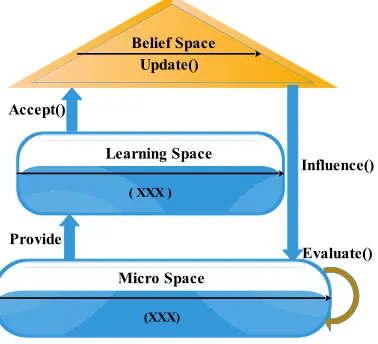
Social learning optimization algorithm Paradigm (SLO) [17] is a swarm intelli-gence algorithm which inspired by the evolution process of human intelliintelli-gence. The framework of SLO is constructed based on the framework and key functions of the culture algorithm (CA) [25]. On the basis of the framework of CA, a new micro-space is added to the bottom of the CA framework to simulate individual genetic evolution. The population space of CA is taken as the learning space of SLO, while the top layer of the CA framework is taken as the belief space. The framework of SLO is presented in Fig. 1.
Fig. 1. Framework of SLO
SLO consists of three co-evolution spaces: the bottom is the micro-space, where individuals’ genetic evolution takes places; the middle layer is the learning space, where individuals enhance their intelligence through learning and where better knowledge is extracted and delivered to the top layer; the top layer is the belief space, where culture is formed through knowledge accumulation and is used to guide indi-viduals’ evolution regularly in the macro-space. The general algorithmic structure of the SLO is described in Alg_1.
Learning Space
( XXX )
Belief Space Update()
Provide Accept()
Influence()
Evaluate() Micro Space
Alg_1. Algorithmic structure of SLO Step1: Initialization
Generate individuals in the micro-space; REPEAT
Step2: Individual Genetic Evolution Phase
Carry out individual genetic evolution in the micro-space and provide individuals to the learning space;
Step3: Individual Learning Phase
For each individual, carry out the imitation learning and observational learning; Step4: Culture Influence Phase
Establishes the culture; apply culture to regularly influence the individual genetic evolution in the micro- space;
Memorize the best solution achieved so far; UNTIL (the termination condition is satisfied);
5
Task Scheduling Based on improved SLO
SLO is an optimization model, when using it to solve optimization problems, it needs to design concrete operators in each spaces. For solving the task scheduling problem efficiently, this work designs several operators for each spaces of SLO.
5.1 Operators in there space of SLO
Operators in the Micro-space: The evolution process in micro-space is mainly based on genetic algorithm, which is used to imitate human intelligence evolution, and this process is divided into three operations: selection, crossover and mutation.
Initialization operation: Initial population in the Micro-space are randomly gener-ated, the value of each dimension is obtained according to formula (8):
min ( max min)*
ij
POP POP= + POP !POP rand (8)
where POPij represents the j-th dimension of the individuals POPi, i =1,2,…,popsize; j=1,2,…,n, in which popsize indicates the individual quantity, n is the number of tasks and rand is a random number between 0 and 1.
POP
max=
5
,min
0.5
POP
=
!
.Individuals generated by formula (8) is a continuous variable, but the task sched-uling in cloud computing is a discrete problem, so this paper introduce the small posi-tion value (SPV) rule [27] to convert the continuous individual
[
1, 2, ,]
i i i in
POP= pop pop ! pop to discrete individual !i=
[
! !i1, , ,i2! !in]
.Formula (9) is used to change the discrete individual !i=
[
! !i1, , ,i2! !in]
to amod 1
ij ij
R =
!
m+ (9)Here m represents the amount of resource.An example to illustrate the conversion process for 10 tasks and 4 resources is illustrated in Table 1.
Table 1. Convert POPi to Riby using SPV rule
Dimensionj
Variable 1 2 3 4 5
i
POP 2.16 -0.42 -0.28 1.48 4.13
i
! 6 1 3 5 9
i
R 2 2 4 1 5
Variable 6 7 8 9 10
i
pop 3.12 1.08 -0.34 4.41 3.70
i
! 7 4 2 10 8
i
R 3 5 3 1 4
Selection Operation: In this paper, the roulette wheel is used to select excellent individual from the population. Assume that the population size is P, for an individual POPi whose fitness value is fi and its selection probability Selectican be calculated by
(10). After obtained the selection probability of each individual, then, the selection operation can carry out based on these probabilities.
1 / popsize
i i j j
Select = f
!
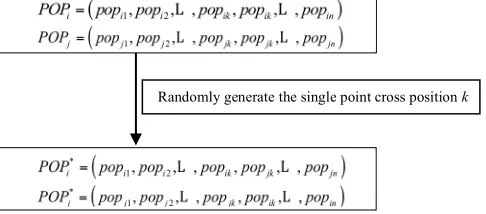
= f (10)Crossover Operation: For the crossover operation, assume that two different indi-viduals which are randomly selected from the population arePOPi andPOPj, through
crossover operation, two new different individuals are generated, this process can be illustrated as Fig. 2.
Fig. 2. schematic diagram of crossover operator
After the crossover operation, carry out the greedy operation that is to keep up two better individuals among the four individuals.
Mutation Operation: In this work, the single point mutation method is adopted, that is, randomly generate a new gene in the range of [POPmin,POPmax] and to replace the randomly selected gene point in the individual. Then, evaluate the new individual and old individual, carry out the greedy operation and keep the better one.
Operators in the Learning-space: In the learning space, social learning optimiza-tion algorithm is simulating the learning process about human society and promoting population evolution by learning from the best individuals. The learning operators of the learning-space include observation learning and imitation learning.
Observation learning: In society, individuals will retain a portion of their knowledge when they observing and learning from elite individuals. Inspired by this phenomenon, this work introduces the inertia coefficient to observation learning oper-ator, so as to avoid jumping into the local optimum, enhance the searching ability and convergence speed of SLO.
Let POPi=(pop popi1, i2, ,! popik, ,! popin) indicates any individual in a population, 1 2
( , , , , , )
cg cg cg cg cg
j n
POP = pop pop ! pop ! pop represents the current global optimal solution,
min max
, cg [ , ]
i j
pop pop !POP POP and * * * * *
1 2
( , , , , , )
i i i ik in
POP = pop pop ! pop ! pop indicate the new
indi-vidual produced by the observation learning. Observation learning operations are defined as (11)
* cg (1 sin( ))
ik ik k
pop =
!
#pop +pop # $"
(11)Where *
ik
pop represents the k-th dimension of new individuals *
i
POP ; !
indi-cates the learning inertia weight and!"(0,1), this work set !=0.5; sin( )! denotes the learning disturbance factor and!#[2, ]" ;
! "
x
ik indicates the self-retaining part of an individual in the observation learning; cg (1 sin( ))ik
x " #
!
denotes the part that anindi-vidual through learning obtaining from the current global optimal indiindi-vidual. When the value of *
ik
pop out of the range
[
POP POPmin, max]
, we modify the val-ue of the dimension variable by formula (12):max max
*
min min
ik ik
ik
POP if pop POP
pop
POP if pop POP
> !
= " <
# (12)
1 2
* ( cg ( ))
ik ik k r k r k
pop =pop +F pop! + pop "pop (13)
Where *
ik
pop is the k-th dimension of new produced individual after imitation learning; F![0,1] represents scaling factor; r1 and r2 are random number between
[1, ]n and
r r
1!
2; popr k1 is the k-th dimension of random individualPOPr1; popr k2 is the k-th dimension of random individualPOPr2; cgk
pop is the k-th dimension of the current best individual cg
k
pop ;
1 2
(popr k!popr k) indicates the dynamic learning step which is automatic change with the increase of the number of iterations.
If the new individual’s k-th dimension out of the range
[
POP POPmin, max]
, we should reset the value of the variable according to the formula (12). After carrying out the imitation learning operation, the greedy operation is performed, and the individuals with better fitness are retained.Operation in the Belief Space: There are two operators in the belief space, they are Update operator and Influence operator. Update operator is used to update the knowledge in the belief space; the Influence operator is used to guide the evolution of the micro space with the knowledge in the belief space when the algorithm iterating every # times. These two operators are defined as follows.
Update (): Replace the poor individuals in the belief space with the new better in-dividuals who were selected from the learning space.
Influence (): Use individuals in the belief space to substitute the poor individuals in the micro-space and randomly generate some individuals to replace some original individuals.
5.2 Applying the styles to an existing paper
Alg_2 Task scheduling based on SLO
Input: population size popsize; mutation probability PM,crossover probability PC; F!"h!"!!
Output: the optimal result; Step1: Initialization
Generate individuals in the micro-space; Step2: Discretization with SPV
For(i=1 to popsize)
Convert the continuous individual
POP
i to the discrete individual !i ac-cording to the SPV rule; Then, transform the !i to processor's vector Ri according to formula (9). Last, calculating each individual’s fitness value by using formula (7);}EndFor REPEAT
Step3: Individual Genetic Evolution Phase Carry out the roulette selection operation;
For(i=1 to popsize) // popsize is the scale of the individuals Carry out the crossover operation and keep the better individual; EndFor
For(i=1 to popsize)
Carry out the mutation operation and keep the better individual; EndFor
Repet step2,carry out the best fitness by using formula(7); Step4: Individual Learning Phase
For(i=1 to popsize)
Carry out the observational learning according to formula (10) and keep the better individual;
EndFor
For(i=1 to popsize)
Carry out the imitation learning according to formula (12) and keep the better individual;
EndFor
Step5: Culture Influence Phase If(the generation time == k1)
Carry out the Influence() function; EndIf
If(the generation time == k2)
Generate q new individuals and replace q old individuals randomly; EndIf
6
Experiment performance analyses
In order to verify the efficiency of the approach proposed in this work, CloudSim platform is adopted to simulate the task scheduling experiment. The experimental environment is PC with the following configurations, OS: Windows 7; CPU: Inter 4, 3.20GHZ; Memory:4G. The simulation experiment is conducted by extending the DataCenterBroker class in the CloudSim platform. This work take the particle swarm optimization algorithm(PSO)[23] and genetic algorithm(GA)[28] as the compared object and analyze the performance of improved SLO on the four factors involved in the fitness function, such as task completion time, cost, energy consumption and re-source utilization.
6.1 Values of parameters
Under the same experimental conditions, the parameters of three algorithms are set as follows: population size P=10, task length SL, virtual machine execution capability
VC, energy consumption matrix E, and cost matrix RC unified randomly generated by MATLAB. The random range of SL is
[
10000 ,50000MI MI]
, the range of VC value is[
200,1000]
, the value range of E is[
1,10]
, the range of value of RC is[ ]
1,5. And the weight of each factor in the objective function !1=0.5!!2=0.2!!3= 0.3; Crossover rate PC=0.6 and mutation rate PM=0.08 in SLO and GA; C1=C2 =2 in PSO.6.2 Experiment results and analyses
To verify the effectiveness of improved SLO algorithm in solving cloud task scheduling, we adopted two contrastive experiment. Each algorithm runs 10 times to eliminate the interference of random factors to the experimental results and the aver-age value is taken as the comparison.
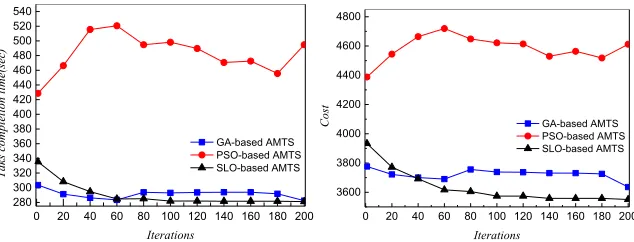
(1)Experiment 1: Compare the performance of three algorithm on a smaller scale In this experiment, set 20 tasks and 5 virtual computing resources in the clouding computing environment. Then according to the objective function formula (7), calcu-late the task completion time, cost, energy consumption and the fitness of the optimal solution of the three algorithms. The experimental results are shown in Fig.3—Fig.6, the x-axis represents the iteration number, and the vertical axis represents the perfor-mance comparison
0 20 40 60 80 100 120 140 160 180 200 280 300 320 340 360 380 400 420 440 460 480 500 520 540 Taks complet ion ti me(sec) Iterations GA-based AMTS PSO-based AMTS SLO-based AMTS
0 20 40 60 80 100 120 140 160 180 200 3600 3800 4000 4200 4400 4600 4800 Cost Iterations GA-based AMTS PSO-based AMTS SLO-based AMTS
Fig.3 The task completion time for 20 tasks, 5 resource Fig.4 The cost for 20 tasks, 5 resource
0 20 40 60 80 100 120 140 160 180 200 94 96 98 100 102 104 106 En er gy consu mp tion Iterations GA-based AMTS PSO-based AMTS SLO-based AMTS
0 20 40 60 80 100 120 140 160 180 200 880 900 920 940 960 980 Fitness Iterations GA-based AMTS PSO-based AMTS SLO-based AMTS
Fig.5 The energy consumption for 20 tasks, 5 resource Fig.6 The fitness for 20 tasks, 5 resource
Fig. 5 shows the energy consumption of three algorithms. As the fitness function consists of three parts with different weights, includes task completion time, cost and energy consumption and the proportion of energy consumption is smaller when algo-rithm tends to the optimal fitness leads to the fluctuation of energy consumption.
In this experiment, fitness value represents the evaluation value of resource sched-uling scheme of each algorithm. Experimental results in Fig. 6 proves that SLO has a faster convergence rate, and can obtain better solutions for task scheduling problem. (2)Experiment 2: Compare the performance of three algorithm on a large scale
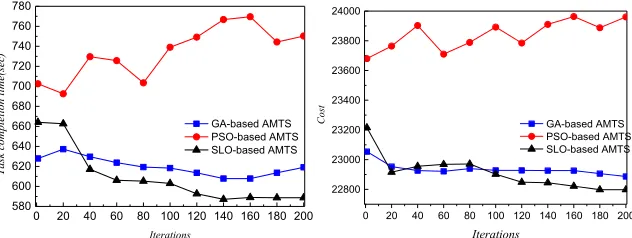
Different from experiment 1!this experiment sets 150 tasks and 20 virtual
0 20 40 60 80 100 120 140 160 180 200 580 600 620 640 660 680 700 720 740 760 780 Task complet ion t ime(s ec) Iterations GA-based AMTS PSO-based AMTS SLO-based AMTS
0 20 40 60 80 100 120 140 160 180 200 22800 23000 23200 23400 23600 23800 24000 Cos t Iterations GA-based AMTS PSO-based AMTS SLO-based AMTS
Fig.7 The task completion time for 150 tasks, 20 resource Fig.8 The cost for 150 tasks, 20 resource
0 20 40 60 80 100 120 140 160 180 200
805 810 815 820 825 830 835 840 Energ y con sump tion Iterations GA-based AMTS PSO-based AMTS SLO-based AMTS
0 20 40 60 80 100 120 140 160 180 200 5100 5120 5140 5160 5180 5200 5220 Fitness Iterations GA-based AMTS PSO-based AMTS SLO-based AMTS
Fig.9 The energy consumption for 150 tasks, 20 resource Fig.10 The fitness for 150 tasks, 20 resource
Fig.7 shows the comparison results of task completion time of the three algorithms. Compared with other algorithms, Fig.7 illustrates SLO can get the better solution with shorter task completion time. From the comparison results in Fig. 8, we can find that when the task size is larger, compared with other algorithms, the improved SLO is still able to get better implementation cost.
In addition, although the cost curve of SLO has some fluctuated with the increase of iteration times, SLO is converge to the less cost gradually. Based on the experi-mental results in Fig. 7 and Fig. 8, it can find that the improved SLO has the better performance in balancing the execution cost and task completion time.
Fig. 9 illustrates the comparison results of energy consumption and proves the same conclusion as experiment 1. Fig.10 represents the fitness value of task schedul-ing scheme searched by three algorithms. From Fig. 10, it can be found that, SLO has better optimizations performance and get the better results in task scheduling problem when compared with GA and PSO.
Table 2. Research results comparison under the smaller task scale
Algorithm
Runtimes GA fitness PSO fitness SLO fitness
10ms 910.3903 919.7856 918.7804
20ms 887.3571 899.8473 899.5892
30ms 883.1139 888.4389 890.5927
40ms 879.7424 881.0896 886.1017
50ms 875.5693 877.7031 877.7914
60ms 874.5732 877.2812 874.4622
70ms 871.984 877.2812 867.798
120ms 865.2132 877.2812 862.7844
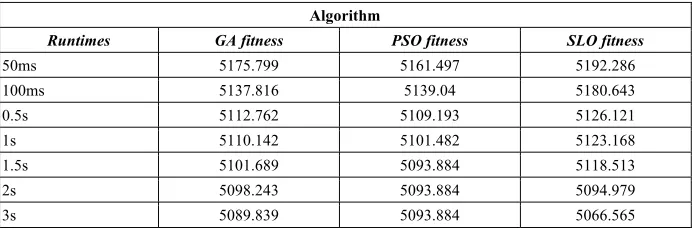
Table 3. Research results comparison under the larger task scale
Algorithm
Runtimes GA fitness PSO fitness SLO fitness
50ms 5175.799 5161.497 5192.286
100ms 5137.816 5139.04 5180.643
0.5s 5112.762 5109.193 5126.121
1s 5110.142 5101.482 5123.168
1.5s 5101.689 5093.884 5118.513
2s 5098.243 5093.884 5094.979
3s 5089.839 5093.884 5066.565
From table 2 we can find that the difference of search results is smaller between three algorithms when the running time is less than 50ms. With the increase of run-ning time, PSO gets into a local optimum. However the genetic algorithm and the improved SLO algorithm are well convergent until the best global optimum solution is found, and the convergence rate of SLO is the fastest, at the same time, the optimal solution found by the improved SLO is better than the optimal solutions found by the other two algorithms.
With the increase of tasks and virtual resources, table 3 shows the fitness value ob-tained by the three algorithms were slowly decreased when the running time is less than 1s. PSO get into local optimum after 1.5s, but SLO can skip the local optimum, finally gets the optimal scheduling scheme. It means that the computational efficiency of SLO is higher than PSO and GA. Experimental results in table 2 and 3 prove that the improved SLO has better convergence speed and search ability in solving the task scheduling problem, meanwhile it also can balance the task completion time and the cost well .
the proposed method still has good convergence ability and optimization ability. At the same time, the experimental results also verify that the improved SLO algorithm proposed in this paper has strong ability to skip the local optimum and faster conver-gence speed.
7
Conclusions
In order to efficiently solve the task scheduling problem in cloud computing, this paper proposes a novel task scheduling algorithm based on the improved SLO. We designs some optimization operators (such as crossover operation, mutation operation, observational learning, imitation learning operation, accept operation and influence operation) for different spaces of SLO, moreover, Small Position Value (SPV) meth-od is used to discrete the individuals of improved SLO, so as to enable the improved SLO could solve the discrete task scheduling problem. Finally, the performance of improved SLO is compared with other methods on the CloudSim platform. Experi-mental results show that improved SLO has better performance than that of other evolutionary algorithms.Moreover, the improved SLO algorithm can also be used to solve other optimization problems.
8
Acknowledgment
This work is supported by: The National Natural Science Foundation Fund China (No.61300124; No.61472106; No.61403128); Major projects of science and technol-ogy in Shandong Province (2015ZDXX0201B02); Basis and frontier of Henan Prov-ince (152300410212); Soft science research project of Henan ProvProv-ince (152400410513); Zhengzhou leading talent project (131PLJRC645); The authors would like to thank the anonymous reviewers for their valuable feedback on this work.
9
References
[1]Jula A, Sundararajan E, Othman Z. Cloud computing service composition: A systematic literature review [J]. Expert Systems with Applications, 2014, 41(8):3809-3824. https://doi.org/10.1016/j.eswa.2013.12.017
[2]Li X, Xu J, Yang Y. A Chaotic Particle Swarm Optimization-Based Heuristic for Market-Oriented Task-Level Scheduling in Cloud Workflow Systems [J]. Computational Intelli-gence & Neuroscience, 2015, 2015:718689.
[3]Zhan Z H, Liu X F, Gong Y J, et al. Cloud Computing Resource Scheduling and a Survey of Its Evolutionary Approaches [J]. Acm Computing Surveys, 2015, 47(4):1-33. https://doi.org/10.1145/2788397
[5]Ullman J D. NP -complete scheduling problems[J]. Journal of Computer & System Sci-ences, 1975, 10(3):384-393. https://doi.org/10.1016/S0022-0000(75)80008-0
[6]Liu C Y, Zou C M, Wu P. A Task Scheduling Algorithm Based on Genetic Algorithm and Ant Colony Optimization in Cloud Computing[C]// International Symposium on Distribut-ed Computing and Applications To Business, Engineering and Science. 2014:68-72. [7]Tao F, Feng Y, Zhang L, et al. CLPS-GA: A case library and Pareto solution-based hybrid
genetic algorithm for energy-aware cloud service scheduling [J]. Applied Soft Computing, 2014, 19(6):264–279. https://doi.org/10.1016/j.asoc.2014.01.036
[8]Zhang M, Yang Y, Mi Z, et al. An Improved Genetic-Based Approach to Task Scheduling in Inter-cloud Environment[C]//Ubiquitous Intelligence and Computing and 2015 IEEE 12th Intl Conf on Autonomic and Trusted Computing and 2015 IEEE 15th Intl Conf on Scalable Computing and Communications and Its Associated Workshops (UIC-ATC-ScalCom), 2015 IEEE 12th Intl Conf on. IEEE, 2015: 997-1003.
[9]Keshanchi B, Souri A, Navimipour N J. An improved genetic algorithm for task schedul-ing in the cloud environments usschedul-ing the priority queues: Formal verification, simulation, and statistical testing [J]. Journal of Systems and Software, 2017, 124: 1-21. https://doi.org/10.1016/j.jss.2016.07.006
[10]Abdi S A M S. Task Scheduling using Modified PSO Algorithm in Cloud Computing En-vironment [M]. 2014.
[11]Tareghian S, Bornaee Z. Algorithm to improve job scheduling problem in cloud compu-ting environment[C]//2015 2nd International Conference on Knowledge-Based Engineer-ing and Innovation (KBEI). IEEE, 2015: 684-688.
[12]Jena R K. Multi Objective Task Scheduling in Cloud Environment Using Nested PSO Framework [J]. Procedia Computer Science, 2015, 57:1219-1227. https://doi.org/10.1016/ j.procs.2015.07.419
[13]Zhang Z, Zhang N, Feng Z. Multi-satellite control resource scheduling based on ant colony optimization [J]. Expert Systems with Applications, 2014, 41(6):2816-2823. https://doi.org/10.1016/j.eswa.2013.10.014
[14]Hua X Y, Zheng J, Wen-Xin H U. Ant colony optimization algorithm for computing re-source allocation based on cloud computing environment [J]. Journal of East China Nor-mal University, 2010, 61(1):127-134.
[15]Kansal N J, Chana I. Artificial bee colony based energy-aware resource utilization tech-nique for cloud computing [J]. Concurrency and Computation: Practice and Experience, 2015, 27(5):1207-1225. https://doi.org/10.1002/cpe.3295
[16]Zhao L. Cloud computing resource scheduling based on modified cuckoo search algorithm [J]. Journal of Nanjing University of Science and Technology, 2016(04):472-476.
[17]Liu Z, Chu D, Song C, et al. Social learning optimization (SLO) algorithm paradigm and its application in QoS-aware cloud service composition [J]. Information Sciences, 2016, 326:315-333. https://doi.org/10.1016/j.ins.2015.08.004
[18]Bo XU, Chao Z, Zhu Y J, et al. Virtual Machine Resource Scheduling Multi-objective Op-timization in Cloud Computing [J]. Journal of System Simulation, 2014, 45(2):493-495. [19]S. Kim, J. Byeon, H. Yu and H. Liu, “Biogeography-Based Optimization for Optimal Job
Scheduling in Cloud Computing”, Applied Mathematics and Computation, Elsevier, Vol. 247, pp. 266-280, 2014. https://doi.org/10.1016/j.amc.2014.09.008
[21]Jacob L, Jeyakrishanan V, Sengottuvelan P. Resource Scheduling in Cloud using Bacterial Foraging Optimization Algorithm[J]. International Journal of Computer Applications, 2014, 92(1):281-289. https://doi.org/10.5120/15972-4857
[22]Sun D W, Chang G R, Feng-Yun L I, et al. Optimizing Multi-Dimensional QoS Cloud Re-source Scheduling by Immune Clonal with Preference [J]. Tien Tzu Hsueh Pao/acta Elec-tronica Sinica, 2011, 39(8):1824-1831.
[23]He H, Xu G, Pang S, et al. AMTS: Adaptive multi-objective task scheduling strategy in cloud computing [J]. Wireless Communication Over Zigbee for Automotive Inclination Measurement China Communications, 2016, 13(4):162-171. https://doi.org/10.1109/ cc.2016.7464133
[24]Liu W, Jin H, Liu B. Cloud computing resource scheduling based on improved quantum genetic algorithm [J]. Journal of Computer Applications, 2013, 33(8):2151-2153. https://doi.org/10.3724/SP.J.1087.2013.02151
[25]Peng B. Knowledge and population swarms in cultural algorithms for dynamic environ-ments [M]. Wayne State University, 2005.
[26]Yan-Fang L I, Jiang X F. Grid Resources Scheduling Algorithm Based on Discrete Particle Swarm and Tabu Search [J]. Computer & Modernization, 2011.
[27]Fatih Tasgetiren M, Liang Y, Sevkli M, et al. Particle swarm optimization and differential evolution for the single machine total weighted tardiness problem [J]. 2006, 44(22):4737-4754.
[28]Srinivas M A P L. Genetic Algorithms: A Survey [J]. Computer, 1994, 6(27):17-26. https://doi.org/10.1109/2.294849
10
Authors
Zhizhong Liu was born in Shangshui county, Zhoukou City, in 1981. received the PhD degree in computer science from the HoHai University, Nan jing, China, in 2011. He is currently an lecturer in the Henan Polytechnic University and Post doc-toral in Harbin Institute Of Technology. His main research interests are in Swarm intelligence algorithm, Web service computing and Cloud Computing.
Jingxuan Qin was born in Linfen city, Shanxi province!in 1991. Currently, she is a graduate student with the School of Computer science and technology in the Henan Polytechnic University. Her current main research interests include Swarm intelli-gence algorithm and Cloud Computing.
Weiping Peng was born in TianMen City, Hubei Province in 1979. He received the Ph.D. degree in Signal and Information Processing from the Beijing University of Posts and Telecommunications, Beijing, China, in 2011. He is currently an associate professor at the School of Computer Science and Technology in Henan Polytechnic University. His main research interests include information security, data leakage prevention and security and application of IOT.
Chao Hao was born in XuChang City, Henan Province in 1981. He is currently an lecturer in the Henan Polytechnic University, Jiao zuo, 45400, P.R. China. His main research interests are in information security.