Indicators of Students’ Intention to Use
Massive Open Online Courses for
Academic Purposes
Mukaramatu Tahiru [1], Rosemaliza Kamaludeen [2] http://dx.doi.org/10.17220/mojet.2018.03.004
[1] International Islamic University Malaysia
[1] International Islamic University Malaysia
ABSTRACT
Massive Open Online Courses (MOOCs) have a considerable potential impact on teaching, learning, and traditional higher educational structures, according to many types of research. Several higher education institutions either through the specific development of MOOCs or the integration of existing MOOCs into their curriculum are swiftly implementing them on their campuses. To examine the MOOCs phenomenon more closely, this study explored the significant difference between MOOCs users and non-users in their intention to use MOOCs for academic purposes. It again explored the influence of awareness knowledge, how-to knowledge, perceived usefulness, actual usage, and attitude on intention to use MOOCs for academic purposes. The sample consisted of 190 postgraduate students. The analysis procedure made use of independent sample t-test and multiple regression analysis. The findings reveal a significant difference between users and non-users of MOOCs in their intentions to use MOOCs for academic purposes. It again indicated that all predictor variables significantly contribute to the prediction of intention to use MOOCs for academic purposes except how-to knowledge and actual usage. It also reveals that students’ intention to use MOOCs for academic purposes is raised by the perceived usefulness which reflects in their attitude. Awareness knowledge, in turn, incline the perceived usefulness of MOOCs to students signifying that a substantial amount of knowledge of MOOCs is a precursor to a higher level of intention to use..
Keywords: Indicators, MOOCs, Awareness Knowledge, How-to Knowledge, Perceived Usefulness, Attitude, Actual Usage, Intention to Use for Academic Purposes.
INTRODUCTION
The accessibility of higher education has been improved due to increased technology and globalisation. The concept of online learning in recent years has greatly expanded to include an increasing number of Massive Open Online Courses (MOOCs) as well as many higher education courses open for internet users to enrol at no cost. In the field of online learning, MOOCs are current trend that are free and open online courses encouraged by several prestigious universities such as Harvard, Massachusetts Institute of Technology (MIT), Stanford and University of California. MOOCs emerged from Open Educational Resources (OER) movements, coined by Dave Cornier and Bryan Alexander in 2008. Majority of MOOCs comprise relatively short video lectures and related contents whereas feedback on assignments and tests are given either through peer-review and group collaboration or by computerized system (Holdaway & Hawtin, 2013). Among the characteristics of MOOCs is Massive, which means MOOCs easily accommodate large numbers of students. Openness, which involves several key concepts: software, registration, curriculum and assessment, communication including interaction, collaboration, sharing and learning environments. Connectivism, which
www.mojet.net
offer an emerging online learning theory inspired by a connectivist viewpoint (Rodriguez, 2012). Coursera, Udacity, edX and Udemy are the most popular websites that offer several MOOCs. Coursera is one of the fastest growing MOOCs providers registering about 15.3 million participants with over 127 universities and over 1,300 courses.
Similarly, in Malaysia the acceptance and usefulness of Open Educational Resources and Open Course Ware have led to another buzz concept, Massive Open Online Course (MOOCs). Since its inception in 2008, MOOCs becomes an alternative platform for online learning rapidly. This can be seen in many instances where tertiary education providers started to inaugurate their MOOCs initiatives. For example, in 2013, Taylor’s University, Malaysia began to offer courses through MOOCs. Recently, another university, Universiti Putra Malaysia has also launched its MOOCs initiative called PutraMOOC in April 2014 (Juhary, 2014). Subsequently, twenty (20) public universities in Malaysia upload the e-content of their courses to a local MOOCs platform known as ‘OpenLearning.com’. The emergence of MOOCs in Malaysia has encouraged higher education institutions to admit that traditional teaching and learning methods require a revision and rejuvenation to catch up with the fast-paced, connected, technologically-driven atmosphere of the 21st century (Fadzil et al., 2016).
Several studies have been carried out on the set of factors that enhance individuals’ adoption of online learning. Perceived usefulness plays an important role in students’ acceptance of online learning (Amer, Ahmad & Smedley, 2013). The acceptance and perceived usefulness of OER and OCW have led to the perceived usefulness of MOOCs (Juhary, 2014). Again, perceived usefulness had a significant influence on attitude towards using Learning Management System [LMS] (Juhary, 2014). Some studies have related knowledge, perceived usefulness, attitude, intention to actual usage of online technologies (Al- Adwan et al., 2013; Cheong & Park, 2005; Brennan et al., 2010; Peres, Correia & Moital, 2011; Bolks, 2014).
Online education via Open Learning in Malaysia keeps growing and both public and private institutions are encouraged to provide MOOCs aligned with the Malaysian Education Blueprint 2015 to 2025 (Amrang, 2016). International Islamic University Malaysia is one of the public institutions that offer several MOOCs on OpenLearning.com. Yet, majority of the students do not use them (Amrang, 2016; Mat-jizat et al., 2014). Similarly, little literature exists that explore the set of factors affecting the students’ intention to use MOOCs for academic purposes among postgraduate students in Malaysia and IIUM specifically. This study therefore, explores the set of factors (awareness knowledge, how-to knowledge of MOOCs, perceived usefulness, attitude, actual usage) that determines postgraduate students’ intention to use MOOCs for academic purposes.
RESEARCH OBJECTIVES
This research sets to explore the significant difference between MOOCs users and non-users in their intention to use MOOCs for academic purposes. It also explores the influence of awareness knowledge, how-to knowledge, perceived usefulness, actual usage and attitude on intention how-to use MOOCs for academic purposes.
RESEARCH QUESTIONS
1. Is there a significant difference between MOOCs users and non-users in their intention to use MOOCs for academic purposes?
2. Do awareness knowledge, how-to knowledge, perceived usefulness, actual usage and attitude influence intention to use MOOCs for academic purposes?
www.mojet.net
HYPOTHESIS
H0: There is no significant difference between MOOCs users and non-users in their intention to use MOOCs for academic purposes.
HA: There is significant difference between MOOCs users and non-users in their intention to use MOOCs for academic purposes.
METHODOLOGY
Design: The research employed the ex-post facto design. The method employed in the study was the survey method using a 5-Likert scale questionnaire as the primary means of data collection. Since the data was in the form of numbers, the study was thus quantitative in nature. An exploratory, cross-sectional survey was employed to capture the extent of IIUM postgraduate students’ awareness knowledge, how-to knowledge, perceived usefulness, attitude, actual usage and intention to use MOOCs for academic purposes. Sample: The sample comprised 190 postgraduate students selected from six kulliyyahs using stratified sampling. Since the sample size was expected to be drawn from students in IIUM whereby they may be in the same level, a simple random sampling technique was employed.
Instrument: Thorough review of literatures has been made to determine the most suitable instrument to be used in addressing the research questions of this study. As a result, the questionnaire items were adapted from four structured questionnaires from Davis (1989), Chen et al. (2008), Venkatesh (2000), Hu and Chau (2001), Lin and Overbaugh (2009), Taylor and Todd (1995), and included new items which were self-developed based on the literatures. The instrument in all contains 32 items measuring awareness knowledge, how-to knowledge, perceived usefulness, attitude, actual usage and intention to use MOOCs for academic purposes. The respondents gave their degree of agreement and disagreement on 5-Likert scale with response category (strongly disagree 1, disagree 2, neutral 3, agree 4, and strongly agree 5).
Data Collection Procedure: The data collection procedure was done through self-administered questionnaires during lecture hours after a permission is granted by the lecturer. Students were also invited to respond to the questionnaires after their classes at the various lecture halls in their respective Kulliyyahs, at the hostels, library, and cafeterias.
Data Analysis Procedure: The statistical analysis was conducted with the aim of answering the research questions. The Statistical Package for the Social Sciences (SPSS) version 17 software was fully utilised in analysing the data. The analysis procedure made use of descriptive statistics to analyse the demographic characteristics of the respondents. Again, independent sample t-test was run to explore and measure the significant difference between users and non-users of MOOCs in their intentions to use MOOCs for academic purposes for the first research question. Multiple Regression Analysis was used for the second research question to identify the significant predictors of respondents’ intention to use MOOCs for academic purposes.
RESULTS
The analysis and findings set out in the research methodology is presented in this chapter. This study aimed at investigating indicators of students’ intention to use Massive Open Online Courses (MOOCs) for their academic purposes. The findings attempt to answer the research questions of this study. The analysis of the data collected from the respondents of this study was done using correlation and independent sample t-test of Statistical Package for the Social Sciences (SPSS) software, version 17. The first research question was answered using independent sample t-test while the second one was answered using bivariate
www.mojet.net
correlation.
Demographic Characteristics of The Respondents
The majority of the respondents are females accounting for 58.9% (n = 112), whereas 41.1% of the respondents (n = 78) represents their male counterparts. In terms of age, the majority of the respondents (44.7%, n = 85) are within the age group of 25-29. In terms of nationality, majority of those who responded to the survey are local students constituting 53.7% (n = 102), while the international students comprise 46.3% (n = 88). Masters students are revealed to be the majority of the respondents accounting for 72.1% (n = 137), whereas 27.9% (n = 53) represents PhD students. In terms of year of study, the majority of the respondents are in their 1st year making 42.1% (n = 80), followed by respondents in their 2nd year with 38.4% (n = 73). The least number of respondents are in their 4th year and above making 4.7% and 2.1% (n = 9, n = 4) respectively.
Research Question 1: The Difference Between Users and Non-Users of MOOCs In Their Intention to Use MOOCs for Academic Purposes
The Independent Sample T-Test Analysis was conducted to check whether significance difference exist between users and non- users of MOOCs among the respondents. The result of their differences is presented in Table 1.
Table 1: Contrast Between Users and Non- users of MOOCs in their Intention to it for Academic Purposes
Variable N M SD t df p
Intention to use for academic purposes
MOOCs Users
Non-MOOCs Users
41
149
4.0691
3.9295
.9775
.6918
-.857 51.523 .042
The result of Table 4.4 on Independent Sample T-Test discloses that there is a significant difference between users and users of MOOCs in the scores; MOOCs users (M = 4.0691, SD = .9775) and non-MOOCs users (M = 3.9295, SD = .6918) where the 2-tailed significant p<.05; t (51.523) = -.857, p = .042.
Evaluated against a level of significance of α=.05, the p-value (.042) is lesser than the level of significance.
Therefore, null hypothesis that there is no significant difference between MOOCs users and non-users in their intention to use MOOCs for academic purposes is rejected. Overall, the result suggests that users and non- users of MOOCs have different propensity to use MOOCs for their academic purposes.
However, considering the results, it is clear that the number of non-users of MOOCs (n = 149) far outweighs that of the users (n = 41). This is beyond the researcher’s control as these numbers were derived from the feedback of the respondents. Nonetheless, the researcher does not believe this to be much of an issue as the study is not an experimental research. Additionally, the mean and standard deviation of users of MOOCs are also bigger than that of the non-users, hence, equal variance is not assumed.
Research Question 2: The Predictors of Respondents’ Intention to Use MOOCs for Academic Purposes
Multiple Regression Analysis has been carried out in order to address the research question on the influence of awareness knowledge, how-to knowledge, perceived usefulness, actual usage, and attitude on
www.mojet.net
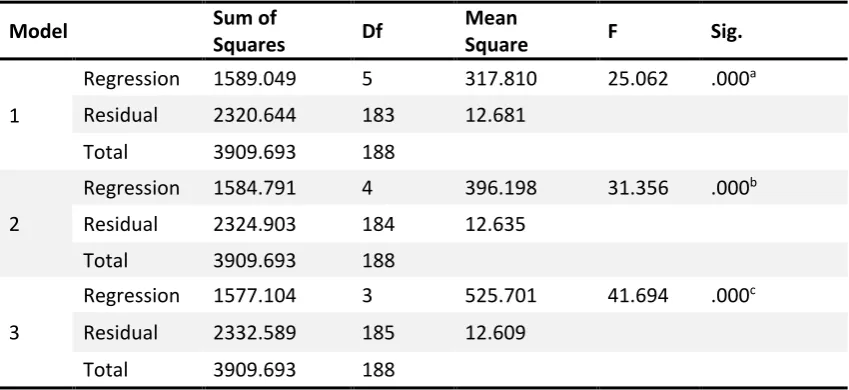
students’ intention to use MOOCs for academic purposes. This method presents only the best summary of the model because it drops out the least predictive variables. The model is accounted by the predictive variables; Attitude, Awareness Knowledge, Perceived Usefulness, Actual Usage, How-to Knowledge (F=25.062, df=5,183, p=.000; p<.005). All the three models are significant at p<.05. The models’ ANOVA results are presented in Table 2.
Table 2: Model’s ANOVA Results
Model Sum of Squares Df Mean Square F Sig.
1
Regression 1589.049 5 317.810 25.062 .000a
Residual 2320.644 183 12.681
Total 3909.693 188
2
Regression 1584.791 4 396.198 31.356 .000b
Residual 2324.903 184 12.635
Total 3909.693 188
3
Regression 1577.104 3 525.701 41.694 .000c
Residual 2332.589 185 12.609
Total 3909.693 188
a. Predictors: (Constant), Attitude, Awareness Knowledge, Perceived Usefulness, Actual Usage, How-to Knowledge
b. Predictors: (Constant), Attitude, Awareness Knowledge, Perceived Usefulness, Actual Usage c. Predictors: (Constant), Attitude, Awareness Knowledge, Perceived Usefulness
d. Dependent Variable: Intention
The comparison of the model based on predictive variables are presented in Table 4.6. Model 1 in Table 4.6 offers the best explanation of variance where 40.6% of the model is affected by the predictors (R2 = .406). The variance for model 2 shows that 40.5% of the model is affected by the predictors (R2 = .405). In model 3, 40.3% of the model is affected by the predictors (R2 = .403). Similarly, the model is accounted by the predictive variables; Attitude, Awareness Knowledge, Perceived Usefulness, Actual Usage, How-to Knowledge (F=25.062, df=5,183, p=.000; p<.005) as shown in Table 3.
www.mojet.net
Table 3: Model Summary of Backward Linear Regression
Model R R Squar e
Adjusted R Square
Std. Error of the Estimate
Change Statistics R Square
Change F Change df1 df2 Sig. F Change
1 .638a .406 .390 3.56106 .406 25.062 5 183 .000
2 .637b .405 .392 3.55462 -.001 .336 1 183 .563
3 .635c .403 .394 3.55086 -.002 .608 1 184 .436
a. Predictors: (Constant), Attitude, Awareness Knowledge, Perceived Usefulness, Act. Usage, How-to Knowledge
b. Predictors: (Constant), Attitude, Awareness Knowledge, Perceived Usefulness, Act. Usage c. Predictors: (Constant), Attitude, Awareness Knowledge, Perceived Usefulness
d. Dependent Variable: Intention
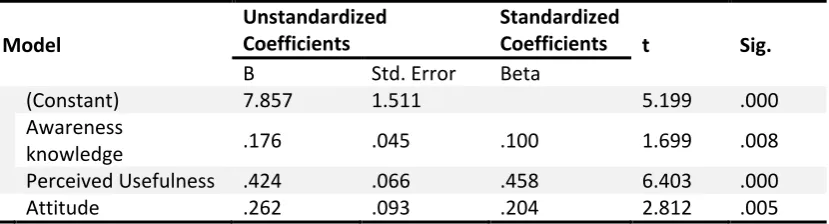
The beta and statistical significance in Table 4 have shown that all predictor variables significantly contribute to the prediction of intention to use MOOCs for academic purposes except how-to knowledge and actual usage. Predictor variables influence intention to use MOOCs for academic purposes by awareness
knowledge β=.100 (p=008; p<005); perceived usefulness at β=.458 (p=000; p<005); and attitude at β=.204
(p=005; p<.005). It can be concluded that the relative strength of the beta weights indicate that perceived usefulness is the most statically significant predictor of intention to use MOOCs for academic purposes.
Table 4: Model Summary of Coefficients
Model Unstandardized Coefficients Standardized Coefficients t Sig.
B Std. Error Beta
(Constant) 7.857 1.511 5.199 .000
Awareness
knowledge .176 .045 .100 1.699 .008
Perceived Usefulness .424 .066 .458 6.403 .000
Attitude .262 .093 .204 2.812 .005
Dependent Variable: Intention to use MOOC for academic purposes; R2 =.406, F=25.062, df=5,183, p=.000; p<.05
General explanation of the model prediction is explained by the intention to use MOOC for academic purposes = .176 awareness knowledge +.424 perceived usefulness +.262 attitude. The relative impact reveals that
i. For every unit of .176 of students’ awareness knowledge increases the intention to use MOOC for
academic purposes (β=.176; t=1.699, p=.008).
ii. For every unit of .424 perceived usefulness increases the intention to use MOOC for academic
purposes (β=.424; t=6.403, p=.000).
iii. For every unit of .262 attitude increases the intention to use MOOC for academic purposes (β=.262;
t=2.812, p=.005).
www.mojet.net
www.mojet.net
DISCUSSION
One of the objectives of this study is to find the difference between users and non-users of MOOCs in their intention to use MOOCs for academic purposes. Using independent sample t-test to determine the difference between users and non-users of MOOCs, the findings revealed that there is a statistical significant difference between the two groups. This may be attributed to the respondents’ prior knowledge of MOOCs and their strong desire to use the technology because of its perceived usefulness to them (Soheila, 2014). The result again suggests that, students who had experienced with MOOCs and consequently were more familiar with the ability of the technology to help them in their academic pursuit had positive perception of it and are willing to use it specifically for their program of study. This idea is similar to those students who have no experience with MOOCs due to the fact that they were briefed on what MOOCs actually is, as such, they anticipated its ability to assist them in pursuit of their program of study.
These findings are consistent with that of (Bagarukayo, 2015) who found a difference in using eLearning among universities in South Africa. In addition, there was statistical significant difference between users and non-users of eLearning materials on medicine (Chui, Abdullah, Wong & Taib, 2015). Again, in similar study, Sheila (2014) found statistically significant difference between users and non-users of GeoGebra in their perceived usefulness, ease of use, current competences, and their intention to use it. The predictors of students’ intention to use MOOCs for academic purposes were extracted from the data using multiple linear regression model with awareness knowledge, how-to knowledge, perceived usefulness, and attitude as independent variables and intention to use MOOCs for academic purposes as dependent variable. The result of the multiple linear regression analysis indicated that all predictor variables significantly contribute to the prediction of intention to use MOOCs for academic purposes except how-to knowledge and actual usage. It shows that when students become aware of MOOCs and perceived it to be useful, they develop a positive attitude towards it thereby develop the intention to use it for academic purposes in the near future.
The result of the Multiple Regression Analysis (MRA) again illustrated that the most significant predictor of perception towards the intention to use MOOCs for academic purposes was its perceived usefulness. This was in line with several empirical studies which found perceived usefulness to be a strong determinant of user intentions (Teo, 2008; Venkatesh & Davis, 2000). These findings again support that of Mamma (2016) who found awareness knowledge and how-to knowledge as significant predictors of students’ intention to use BookMyne. This also agrees with the results of Stols and Kriek (2011) research who reported perceived usefulness as the most significant predictor of attitude towards the use of dynamic geometry software. It is also consistent with the study of Sheila (2014) who discovered that teachers’ perceived usefulness and teachers perceived current competencies statistically significantly predict their intention to use GeoGebra in teaching mathematics in the classroom. Similarly, Multiple Regression Analysis was used in the works of Ploger (2011) to determine the factors concerning superintendent longevity and continuity relative to students’ achievement. Berland and Thornton (2013) also used Multiple Regression Analysis to determine the effect of communication technology distraction on students’ performance.
CONCLUSION AND RECOMMENDATIONS
One of the most important activities students do is to explore learning materials with the available technology, and use the essential information derived from them. This greatly goes to shape their learning experiences. Comparable to many other areas of educational sector, teaching and learning are reshaped by current technological development. MOOCs have attracted so much attention that they are seen as having the potential for helping with important higher education challenges. By making high quality educational content from some of the world’s top universities freely available to anyone with Internet access, MOOCs appear to hold potential for improved access to education. As MOOCs begin to achieve recognition with higher education some universities offer some. This study therefore explored the significant difference between MOOCs users and non-users in their intention to use MOOCs for academic purposes. It also explored the influence of awareness knowledge, how-to knowledge, perceived usefulness, actual usage, and attitude on intention to use MOOCs for academic purposes. Using independent sample and multiple regression
www.mojet.net
analysis, the results showed that the results again showed a significant difference between users and non-users of MOOCs in their intentions to use MOOCs for academic purposes. It also indicated that awareness knowledge, perceived usefulness and attitude are significant predictors of intention to use MOOCs for academic purposes.
It again reveals that students’ intention to use MOOCs for academic purposes was raised by the perceived usefulness which reflected in their attitude. Awareness knowledge in turn inclined the perceived usefulness of MOOCs to students. Additionally, there was a significant pathway between awareness knowledge and students’ intention to use MOOCs for academic purposes, signifying that a substantial amount of knowledge of MOOCs is a precursor to higher level of usage of the technology. This indicated that adoption begins with knowledge which subsequently create perception (usefulness) of the technology or product thereby contributing to the greater intention to use. Nonetheless, despite the evidence suggesting the importance of knowledge in the usage of MOOCs, not all the respondents of this study who have the awareness and how-to knowledge of MOOCs use it. Thus, it is not a guarantee that knowledge of any services or technology is a precursor to positive attitude towards that technology, it is rather the perceived usefulness.
It is therefore, important for the university authority to intensify the creation of awareness of the technology by means of booklets, posters, fliers, through students iTaleem accounts, student portals, MOOCs clubs, briefing newly admitted students about MOOCs during each Kulliyyah briefing and the likes of these. Again, university authorities should improve the IT infrastructure of all Kulliyyahs and hostels so students can find it easy to participate in MOOCs and in any other online activities related to their program of study. Finally, university management should liaise with the popular MOOCs Providers such as Coursera, Udacity, edX and Udemy to provide courses on their websites. This will then further project the image of the university globally.
REFERENCES
Al-Alawi AI, Al-Amer M.A. (2006). Young generation attitudes and awareness towards the implementation of smart card in Bahrain:an exploratory study. Journal of Computer Science 2006, 2(5), 441-446.
Amer, A., Ahmad, A. & Smedley, J. (2013). Exploring students’ acceptance of eLearning using Technology Acceptance Model in Jordanian universities Amer Al- Adwan Applied Science University, Jordan Ahmad Al- Adwan Cardiff Metropolitan University, UK Jo Smedley, 9(2), 4–18.
Amrang, N. A. H. (2016). Massive open online courses a means of free higher education. Retrieved from MalaysiaKini: http://www.malaysiakini.com/letters/358738
Bagarukayo, E. (2015). Evaluation of elearning usage in South African universities: A critical review Billy Kalema, 11(2), 168–183.
Belanger, Y. & Thornton, J. (2013). Bioelectricity: A quantitative approach. Retrieved on May 7 from http://dukespace.lib.duke.edu/dspace/bitstream/handle/10161/6216/Duke_Bioelectricity_MOOC_F all2012.pdf.
Bolks, D. (2014). Awareness, Knowledge and Acceptance of the Artificial Pancreas by Patients.
Brennan, R., Canning, L. & McDowell, R. (2010). Business-to-business Marketing: Sage.
www.mojet.net
Chen, G. & Chiu, M.M. (2008). Online discussion processes: Effects of earlier messages’ evaluations, knowledge content, social cues and personal information on later messages. Computers & Education, 50, 678–692. doi: 10.1016/j.compedu.2006.07.007
Cheong, J. & Park, M. (2005) Mobile internet acceptance in Korea, Internet Research. Electronic Networking Applications and Policy, 15, 125 – 140.
Chui, P. L., Abdullah, K. L., Wong, L. P. & Taib, N. A. (2015). Quality of life in CAM and Non-CAM users among breast cancer patients during chemotherapy in Malaysia. PLoS ONE, 10(10), 1–18.
Davis, F. D. (1989). Perceived usefulness, perceived ease of use, and user acceptance of information technology. MIS Quarterly, 13(3), 319-340.
Fadzil, M., Abdol, L., Tengku, L. & Munira, A. (2016). MOOCs in malaysia: a preliminary case study. E-ASEM Forum: Renewing the Lifelong Learning Agenda for the Future., 1–17.
Holdaway, X. & Hawtin, N. (2013). Major players in the MOOC Universe. Retrieved from: Peres, R. Correia, A. & Moital, M., (2011). The indicators of intention to adopt mobile electronic tourist guides. http://doi.org/10.1108/17579881111154236
Hu, P. J., Chau, P. Y. K., Liu Sheng, O. R. & Kar Yan, T. (1999). Examining the Technology Acceptance Model Using Physician Acceptance of Telemedicine Technology. Journal of Management Information Systems, 16(2), 91-112.
Lin, S.Y. & Overbaugh, R.C. (2009). Computer-mediated discussion, self-efficiency and gender. In British Journal of Educational Technology, 40(6), 999-1013. doi:10.1111/j.1467-8535.2008. 00889.x
Mat-jizat, J. E., Samsudin, N., Yahaya, R., Pendidikan, U. & Idris, S. (2014). Higher education institutions (hei) students take on mooc: case of malaysia, (CELDA), 2011–2014.
Mamman, B. (2016). Awareness and procedural knowledge as predictors of iium undergraduate students’ intention to use bookmyne: an exploratory study. (Unpublished master’s thesis, International Islamic University).
Ploger, D., & Hecht, S. (2009). Enhancing children's conceptual understanding of mathematics through Chartworld software. Journal of Research in Childhood Education, 23(3), 267-277.
Rodriguez, C. O. (2012). MOOCs and the AI-Stanford like courses: Two successful and distinct course formats for massive open online courses. European Journal of Open, Distance and E-Learning. Retrieved from http://www.eric.ed.gov/PDFS/EJ982976.pdf
Soheila, A. (2014). Malaysian teachers’ intention to use GeoGebra in teaching mathematics in the classrooms based on their perceived usefulness, ease of use, and current competencies of using GeoGebra (Unpublished master’s thesis, International Islamic University).
Stols, G., & Kriek, J. (2011). Why don't all maths teachers use dynamic geometry software in their classrooms? Australasian Journal of Educational Technology, 27(1), 137-151.
www.mojet.net
Taylor, S. & Todd, P. A. (1995). Understanding information technology usage: A test of competing models. Information Systems Research, 6(2), 144–176.
Teo, T. (2008). Pre-service teachers’ attitudes towards computer use: A Singapore survey.
Australasian Journal of Educational Technology, 24(4), 413-424.
Venkatesh, V. & Davis, F. D. (2000). A theoretical extension of the Technology Acceptance Model: Four longitudinal field studies. Management Science, 46(2), 186–204.
www.mojet.net