A New Approximate Maximal Margin Classification
Algorithm
Claudio Gentile [email protected]
Dipartimento di Scienze dell’Informazione Universita’ di Milano
Via Comelico 39, 20135 Milano, Italy
Editors:Nello Cristianini, John Shawe-Taylor and Bob Williamson
Abstract
A new incremental learning algorithm is described which approximates the maximal margin hyperplane w.r.t. normp≥2 for a set of linearly separable data. Our algorithm, called almap (Approximate Large Margin algorithm w.r.t. normp), takesO
(p−1)
α2γ2
corrections to separate the data with p-norm margin larger than (1−α)γ, whereγ is the (normal-ized)p-norm margin ofthe data. almap avoids quadratic (or higher-order) programming methods. It is very easy to implement and is as fast as on-line algorithms, such as Rosen-blatt’s Perceptron algorithm. We performed extensive experiments on both real-world and artificial datasets. We compared alma2 (i.e., almap with p = 2) to standard Support vector Machines (SVM) and to two incremental algorithms: the Perceptron algorithm and Li and Long’s ROMMA. The accuracy levels achieved by alma2 are superior to those achieved by the Perceptron algorithm and ROMMA, but slightly inferior to SVM’s. On the other hand,alma2is quite faster and easier to implement than standard SVM training algorithms. When learning sparse target vectors, almap with p >2 largely outperforms Perceptron-like algorithms, such asalma2.
Keywords: Binary Classification, Large Margin, Support Vector Machines, On-line Learning
1. Introduction
Vapnik’s Support Vector Machines (SVM) are a statistical model ofdata that simultaneously minimizes model complexity and data fitting error (Vapnik, 1998). SVM have attracted a lot ofinterest and have spurred voluminous work in Machine Learning, both theoretical and experimental. The remarkable generalization ability exhibited by SVM can be explained through margin-based VC theory (e.g., Shawe-Taylor et al., 1998; Anthony and Bartlett, 1999; Vapnik, 1998; Cristianini and Shawe-Taylor, 2000, and references therein).
Ifan arbitrary norm p is used then such a task turns to a more general mathematical programming problem (e.g., Mangasarian, 1997; Nachbar et al., 1993) to be solved by general purpose (and computationally intensive) optimization methods. This more general task naturally arises in feature selection problems when the target to be learned is sparse (i.e., when the target has many irrelevant features). This is often the case in a number of natural language processing problems (e.g., Golding and Roth, 1996; Dagan et al., 1997).
A fair amount of recent work on SVM centers on finding simple and efficient methods to solve maximal margin hyperplane problems (e.g., Osuna et al., 1997; Joachims, 1998; Friess et al., 1998; Platt, 1998; Kowalczyk, 1999; Keerthi et al., 1999; Li and Long, 1999). This paper follows that trend, giving two main contributions. The first contribution is a new efficient algorithm which approximates the maximal margin hyperplane w.r.t. norm p to any given accuracy. We call this algorithm almap (Approximate Large Margin algorithm
w.r.t. norm p). almap is naturally viewed as an on-line algorithm, i.e., as an algorithm
which processes the examples one at a time. A distinguishing feature ofalmap is that its
relevant parameters (such as the learning rate) are dynamically adjusted over time. In this sense, almap is a refinement ofthe on-line algorithms recently introduced by Auer et al.
(2001).
On-line algorithms are useful when the examples become available to the learning al-gorithm one at a time, but also when the training set is too large to consider all examples at once. alma2 (i.e., almap with p = 2) is a perceptron-like algorithm; the operations it
performs can be expressed as dot products, so that we can replace them by kernel functions (Aizerman et al., 1964). alma2 approximately solves the SVM training problem,
avoid-ing quadratic programmavoid-ing. Unlike previous approaches (Cortes and Vapnik, 1995; Osuna et al., 1997; Joachims, 1998; Friess et al., 1998; Platt, 1998), our algorithm operates di-rectly on (an approximation to) the primal maximal margin problem, instead ofits (Wolfe) dual. almap is more similar to algorithms such as Li and Long’s ROMMA (Li and Long,
1999) and the one analyzed by Kowalczyk (1999) and Keerthi et al. (1999). However, it seems those algorithms have been specifically designed for euclidean norm. Unlike those algorithms, almap remains computationally efficient when measuring the margin through
a generic norm p.
As far as theoretical performance is concerned, alma2 achieves essentially the same
bound on the number ofcorrections as the one obtained by a version ofLi and Long’s ROMMA. In the case whenpis logarithmic in the dimension ofthe instance space (Gentile and Littlestone, 1999) almap yields results similar to multiplicative algorithms, such as
Littlestone’s Winnow (Littlestone, 1988) and the Weighted Majority algorithm (Littlestone and Warmuth, 1994; Grove et al., 2001). The associated margin-dependent generalization bounds are very close to those obtained by estimators based on linear programming (e.g., Mangasarian, 1968; Anthony and Bartlett, 1999, Chap. 14).
The second contribution ofthis paper is an experimental investigation ofalmap on
both real-world and artificial datasets. In our experiments we emphasized the accuracy performance achieved by almap as a fully on-line algorithm, i.e., after just one sweep
through the training examples. Following Freund and Schapire (1999), the hypotheses produced by almap during training are combined via Helmbold and Warmuth’s (1995)
leave-one out scheme to make a voted hypothesis. We ran alma2 with kernels on the
real-world datasets are well-known Optical Character Recognition (OCR) benchmarks. On these datasets we followed the experimental setting described by Cortes and Vapnik (1995), Freund and Schapire (1999), Li and Long (1999) and Platt et al. (1999). We compared our algorithm to standard SVM, to the Perceptron algorithm and to ROMMA. We found thatalma2 generalizes quite better than both ROMMA and the Perceptron algorithm, but
slightly worse than SVM. On the other hand,alma2 is as fast and easy to implement as the
other Perceptron-like algorithms. Hence, compared to standard algorithms, training SVM withalma2 saves a considerable amount oftime.
In the experiments with the artificial datasets we have been mainly interested in com-paring the accuracy ofPerceptron-like algorithms, such as alma2, to the accuracy
ofnon-Perceptron-like algorithms, such asalmap withp >2. When learning sparse target vectors
withalmap, the performance gap betweenp= 2 andp > 2 is big. This is mainly due to the
different convergence speed ofthe two kinds ofalgorithms (see also the paper by Kivinen et al., 1997).
The next section defines our major notation and recalls some basic preliminaries. In Section 3 we describe almap and claim its theoretical properties. Section 4 describes our
experiments. Concluding remarks and open problems are given in the last section.
2. Preliminaries and notation
This section defines our major notation and recalls some basic preliminaries.
An example is a pair (x, y), where x is aninstance belonging to a giveninstance space
X ⊆ Rn and y ∈ {−1,+1} is the binary label associated with x. A weight vector w =
(w1, ..., wn) ∈ Rn represents an n-dimensional hyperplane passing through the origin. It
is natural to associate with w a linear threshold classifier with threshold zero: w : x → sign(w·x) = 1 ifw·x≥0 and =−1 otherwise. Whenp≥1 we denote by||w||p thep-norm ofw, i.e.,||w||p = (ni=1|wi|p)1/p(also,||w||∞= limp→∞(
n
i=1|wi|p)1/p= maxi|wi|). We
say thatqisdualtopif 1p+1q = 1 holds. For instance, the 1-norm is dual to the∞-norm and the 2-norm is self-dual. In this paper we assume that pand q are some pair ofdual values, with p ≥ 2. We use p-norms for instances and q-norms for weight vectors. For the sake ofsimplifying notation throughout this paper we use normalized instances ˆx = x/||x||p,
where the norm p will be clear from the surrounding context. The (normalized) p-norm margin (or just the margin, ifpis clear from the context) of a hyperplanewwith||w||q ≤1 on example (x, y) is defined as yw·xˆ. Ifthis margin is positive1 then w classifies (x, y) correctly. Notice that from H¨older’s inequality we have|w·x| ≤ ||w||ˆ q||x||ˆ p ≤1. Hence
yw·xˆ ∈[−1,1].
Our goal is to approximate the maximalp-norm margin hyperplane for a set of examples (the training set). For this purpose, we use terminology and analytical tools from the on-line learning literature. We focus on an on-line learning model introduced by Littlestone (1988) and Angluin (1988). An on-line learning algorithm processes the examples one at a time intrials. In each trial, the algorithm observes an instancex and is required to predict the label y associated with x. We denote the prediction by ˆy. The prediction ˆy combines the current instance x with the current internal state ofthe algorithm. In our case this state
is essentially a weight vector w, representing the algorithm’s current hypothesis about the maximal margin hyperplane. After the prediction is made, the true value of y is revealed and the algorithm suffers aloss, measuring the “distance” between the prediction ˆyand the label y. Then the algorithm updates its internal state.
In this paper the prediction ˆy can be seen as the linear function ˆy=w·xand the loss is a margin-based 0-1 Loss: the loss of w on example (x, y) is 1 if yw·xˆ ≤(1−α)γ and 0 otherwise, for suitably chosen α, γ ∈[0,1]. Therefore, if ||w||q ≤1 the algorithm incurs positive loss ifand only ifwclassifies (x, y) with (p-norm) margin not larger than (1−α)γ. The on-line algorithms are typically loss driven, i.e., they do update their internal state only in those trials where they suffer a positive loss. We call acorrectiona trial where this happens. In the special case whenα = 1 a correction is a mistaken trial and a loss driven algorithm turns to amistake driven (Littlestone, 1988) algorithm.
Throughout the paper we use the subscript t for x and y to denote the instance and the label processed in trial t. We use the subscript k for those variables, such as the algorithm’s weight vector w, which are updated only within a correction. In particular, wk denotes the algorithm’s weight vector afterk−1 corrections (so that w1 is the initial
weight vector). The goal ofthe on-line algorithm is to bound the cumulative loss (i.e., the total number ofcorrections or mistakes) it suffers on an arbitrary sequence ofexamples
S = ((x1, y1), ...,(xT, yT)). Consider the special case when S is linearly separable with
marginγ. Ifwe pickα <1 then a bounded loss clearly implies convergence in a finite number ofsteps to (an approximation of) the maximal margin hyperplane forS. When a training set is linearly separable with margin γ and hyperplane w is such that yw·xˆ ≥(1−α)γ
for any (x, y) in the training set we sometimes say that w is an α-approximation to the maximal margin hyperplane (for that training set).
Remark 1 Our definition of margin is restricted to zero-threshold linear classifiers, i.e., to hyperplanes passing through the origin. The usual definition of margin in SVM literature (Cortes and Vapnik, 1995) actuallyconsiders the more general non-zero threshold linear classifiers. The threshold of an SVM maximal margin hyperplane is sometimes called the
bias term of the SVM. Restricting margin analyses to zero-threshold hyperplanes loses only a constant factor (e.g., Cristianini and Shawe-Taylor, 2000). Nonetheless, in practical applications such a constant factor might make a significant difference.
3. The approximate large margin algorithm almap
almap is a large margin variant ofthep-norm Perceptron algorithm2 (Grove et al., 2001;
Gentile and Littlestone, 1999), and is similar in spirit to the variable learning rate algorithms introduced by Auer et al. (2001). We analyzealmapby giving upper bounds on the number
ofcorrections. We do not resort to the prooftechniques developed by (Auer et al., 2001), as they seem to give rise to suboptimal results when applied to the algorithm described here. The theoretical contribution ofthis paper is Theorem 3 below. This theorem has two parts. Part 1 bounds the number ofcorrections in the linearly separable case. In the special case whenp= 2 this bound is very similar to the one proven by Li and Long for a version of
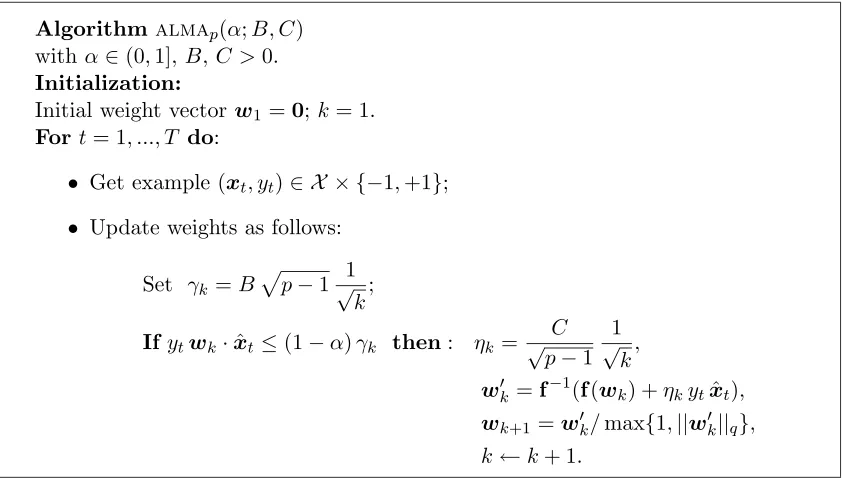
Algorithmalmap(α;B, C)
withα∈(0,1],B,C >0.
Initialization:
Initial weight vector w1=0;k= 1. For t= 1, ..., T do:
• Get example (xt, yt)∈ X × {−1,+1}; • Update weights as follows:
Set γk=B
p−1√1
k;
Ifytwk·xˆt≤(1−α)γk then: ηk= √C
p−1 1 √
k,
wk=f−1(f(wk) +ηkytxˆt), wk+1=wk/max{1,||wk||q},
k←k+ 1.
Figure 1: The approximate large margin algorithmalmap.
ROMMA (called aggressive ROMMA). Part 2 holds for an arbitrary sequence of examples. A bound which is very close to the one proven by Grove et al. (2001) and Gentile and Littlestone (1999) for the (constant learning rate)p-norm Perceptron algorithm is obtained as a special case.
In order to define our algorithm, we need to recall the following mappingf (Gentile and Littlestone, 1999) (ap-indexing for f is understood): f : Rn→ Rn,f = (f1, ..., fn), where
fi(w) =
sign(wi)|wi|q−1 ||w||q−2
q
, w= (w1, ..., wn)∈ Rn.
Observe thatp=q= 2 yields the identify function. The (unique) inversef−1off is (Gentile and Littlestone, 1999)f−1 : Rn→ Rn,f−1 = (f1−1, ..., fn−1), where
fi−1(θ) = sign(θi)|θi|
p−1
||θ||p−2 p
, θ= (θ1, ..., θn)∈ Rn,
namely,f−1is obtained fromfby replacingqwithp. It is easy to check thatf is the gradient ofthe scalar function 12|| · ||2q, whilef−1 is the gradient ofthe (dual) function 12|| · ||2p. The following simple property of f will be useful.
Lemma 2 (Gentile and Littlestone, 1999) The function f maps vectors with a given q -norm to vectors with the same p-norm, i.e., for any w ∈ Rn we have ||f(w)||
p = ||w||q.
almap is described in Figure 1. The algorithm is parameterized by α ∈(0,1], B > 0
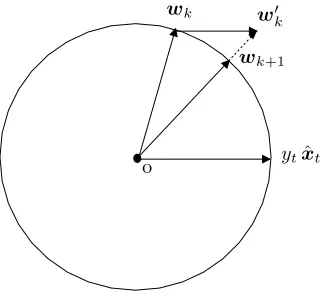
wk wk
wk+1
ytxˆt
o
Figure 2: The update rule of almap when p=q = 2. The circle is a two-dimensionalW.
hyperplane, while B and C might be considered as tuning parameters. Their use will be made clear in Theorem 3. LetW be theq-norm unit ball, i.e.,W ={w∈ Rn:||w||q ≤1}.
almap maintains a vector wk of n weights in W. It starts from w1 = 0. At time t the
algorithm processes example (xt, yt). Ifthe current weight vector wkclassifies (xt, yt) with
(normalized) margin not larger than (1−α)γkthen a correction occurs. Hereγkis intended
as the current approximation to the unknown maximal margin (denoted byγ∗ in Theorem 3) on the data. The update rule3 has two main steps. The first step gives w
k through the
classical update ofa (p-norm) perceptron-like algorithm (notice, however, that the learning rateηkscales withk, the number ofcorrections occurred so far). The second step giveswk+1
by projecting4 w
k onto W: wk+1 = wk/||wk||q if ||wk||q >1 and wk+1 = wk otherwise.
The projection step makes the new weight vector wk+1 belong to W. Figure 2 gives a
graphical representation ofthe update rule.
It is worth discussing at this point howalmap is qualitatively different from previous
on-line algorithms, such as the (p-norm) Perceptron algorithm and ROMMA. First, we notice thatalmap maintains bounded weight vectors, but it uses a decaying learning rate. This is
actually qualitatively similar to the standard (p-norm) Perceptron algorithm, where weight vectors are unbounded but the learning rate is kept constant. In fact, in both cases later updating instances have less influence on the direction ofthe current weight vector than earlier instances. On the other hand, unlike the (p-norm) Perceptron algorithm,almap is
sensitive to margins, i.e., the current weight vector gets updated even ifthe current margin is positive but smaller than desired. Compared to aggressive ROMMA,almap requires the
accuracy parameter α be fixed ahead oftime; ifα is not close to zero, this tends to make
almap’s corrections less frequent than aggressive ROMMA’s (see Section 4.2).
3. In the degenerate case thatxt=0no update takes place.
4. From the proof of Theorem 3 the reader can see that the only way we exploit this projection step is through the condition ||wk||q ≤ 1 for all k. Therefore if we replaced the update rule wk+1 =
w
We now claim the theoretical properties of almap. The following theorem has two
parts. In part 1 we treat the separable case. Here we prove that a special choice of parametersB and C gives rise to an algorithm which computes anα-approximation to the maximal margin hyperplane, for any given accuraryα. In part 2 we show that ifa suitable relationship betweenB andCis satisfied then a bound on the number ofcorrections can be proven in the general (nonseparable) case. The bound ofpart 2 is in terms ofthe margin-based quantity Dγ(u; (x, y)) = max{0, γ −yu·x}ˆ , γ > 0. (Here a p-indexing for Dγ is understood). Dγ is calleddeviationby Freund and Schapire (1999) andlinear hinge lossby Gentile and Warmuth (2001).
Notice that B and C in part 1 do not meet the requirements given in part 2. On the other hand, in the separable case B and C chosen in part 2 do not yield, for any small α, an α-approximation to the maximal margin hyperplane.
Theorem 3 Let X = Rn, W = {w ∈ Rn : ||w||q ≤ 1}, S = ((x1, y1), ..., (xT, yT)) ∈
(X × {−1,+1})T, and M be the set of corrections of almap(α;B, C) running on S (i.e.,
the set of trials t such that ytwk·xˆt≤(1−α)γk).
1. Let γ∗ = maxw∈Wmint=1,...,T ytw·xˆt>0. Thenalmap(α; √
8/α,√2)achieves the following bound5 on|M|:
|M| ≤ 2 (p−1) (γ∗)2
2
α −1
2
+ 8
α −4 =O
p−1
α2(γ∗)2
. (1)
Furthermore, throughout the run of almap(α;√8/α,√2) we have γk ≥ γ∗. Hence (1) is
also an upper bound on the number of trials tsuch that ytwk·xˆt≤(1−α)γ∗.
2. Let the parameters B and C in Figure 1 satisfythe equation6
C2+ 2 (1−α)B C= 1.
Then for anyu∈ W,almap(α;B, C) achieves the following bound on|M|, holding for any
γ >0, where ρ2 = p−1
C2γ2:
|M| ≤ 1
γ
t∈M
Dγ(u; (xt, yt)) + ρ 2
2 +
ρ4
4 +
ρ2
γ
t∈M
Dγ(u; (xt, yt)) +ρ2.
Observe that when α= 1 the above inequalityturns to a bound on the number of mistaken trials. In such a case the value ofγk (in particular, the value of B) is immaterial, while C
is forced to be 1.
Proof. We assume throughout this proofthat thek-th correction occurs on example (xt, yt).
We use the following shorthand notation: θk = f(wk), θk = f(wk) = θk +ηkytxˆt and
Nk+1 = max{1,||wk||q}. We now consider the two parts separately. 5. We did not optimize the constants here.
1. Letγk∗=ytu·xˆt, whereu is the maximal margin hyperplane for the whole sequence
S. We study how fast the quantityu·θk increases from correction to correction. From the update rule ofFigure 1 we have
u·θk+1= u·θk
+ηkytu·xˆt
Nk+1
= u·θk+ηkγ
∗ k
Nk+1 .
(2)
Observe thatu·θk≥0 for any k, since the data are linearly separable.
We need to find an upper bound on the normalization factor Nk+1. To this end, we
focus on the squareNk2+1. By virtue ofLemma 2 we can write
Nk2+1= max{1,||wk||2q}
= max{1,||θk||2p}
= max{1,||θk+ηkytxˆt||2p}.
Furthermore,
||θk+ηkytxˆt||p2 ≤ ||θk||2p+ηk2(p−1) + 2ηkytf−1(θk)·xˆt
=||wk||2q+η2k(p−1) + 2ηkytwk·xˆt ≤1 +η2k(p−1) + 2 (1−α)ηkγk
= 1 + 2A/k,
where the first inequality is essentially proven by Grove et al. (2001) (see also Lemma 2 in the paper by Gentile and Littlestone, 1999), the first equality is again an application of Lemma 2, the second inequality derives from Figure 1, and the last equality derives from Figure 1 by setting A= 4/α−3. Thus we conclude that
Nk+1≤
1 + 2A/k.
Now, we set for brevity m =|M|,ρk = √
p−1
γk∗ and ρ = √
p−1
γ∗ . Sinceγ∗k and γ∗ are p-norm
margins with γ∗ ≤ γk we have ρk ≥ ρ ≥ 1. We plug the bound on Nk+1 back into (2),
unwrap the resulting recurrence and take into account thatw1 =θ1=0. We yield
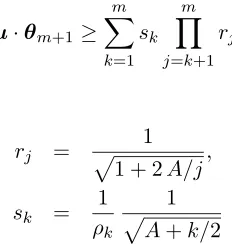
u·θm+1 ≥ m
k=1
sk m
j=k+1
rj,
where
rj =
1
1 + 2A/j,
sk =
1
ρk
1
A+k/2
and the product mj=k+1rj is assumed to be 1 if k = m. From H¨older’s inequality and
Lemma 2 it follows that
Therefore we have obtained: 1≥ m k=1 sk m
j=k+1
rj. (3)
We use this inequality to compute an upper bound on the number ofcorrections m. We proceed by lower bounding the RHS of(3), as a function ofm.
We first lower bound sk by 1ρ √A+1m/2.Next, considering the product
m
j=k+1rj, we can
write
−ln
m
j=k+1
rj =
1 2
m
j=k+1
ln
1 +2A
j ≤ 1 2 m
j=k+1
2A j ≤ A m k 1
jd j
= A lnm
k.
This is equivalent to mj=k+1rj ≥
k
m
A
.Therefore (3) implies
ρ ≥
m
k=1
(k/m)A
A+m/2
≥
m
k=0
(k/m)A
A+m/2dk
= 1
A+ 1
m
A+m/2.
Solving for m gives
m ≤ ρ
2(A+ 1)2
4 +
ρ4(A+ 1)4
16 +ρ
2(A+ 1)2A
≤ ρ2(A+ 1)2
4 +ρ(A+ 1)
3/2
ρ2(A+ 1)
16 + 1
≤ ρ2(A+ 1)2
4 +ρ(A+ 1)
3/2
ρ2(A+ 1)
4 +
2
ρ2(A+ 1)
= ρ
2(A+ 1)2
2 + 2 (A+ 1) (4)
= 2ρ2
2
α−1
2
+ 8
α −4
= 2 (p−1) (γ∗)2
2
α −1
2
+ 8
where the third inequality uses√x+ 1≤√x+2√1
x, f orx >0. This proves that the number
ofcorrections m made by the algorithm is upper bounded as in (1). In order to show that this is also an upper bound on the number oftrials t such that ytwk·xˆt ≤(1−α)γ∗, it
suffices to prove thatγk≥γ∗ fork= 1, ..., m. Recalling Figure 1, we see that
γk =
√ 8ρkγ∗k
α√k
≥ √
8ρ γ∗
α√m
≥
√ 8ρ γ∗
α
ρ2 (A+1)2
2 + 2 (A+ 1)
≥ γ∗
α
(A+1)2 16 + A
+1 4
= γ
∗
1−α42 ≥ γ∗,
where the second inequality is (4), the third inequality follows from ρ ≥ 1 and the last equality follows from the definition ofA. This concludes the proofofpart 1.
2. The proofproceeds along the same lines as the proofofpart 1. Thus we only sketch the main steps. Let ube an arbitrary vector inW. We can write
Nk+1u·θk+1 =u·θk+ηkytu·xt, (5)
where
Nk2+1 = max{1,||θk+ηkytxˆt||2p}
≤ max{1,||θk||2p+η2k(p−1) + 2 (1−α)ηkγk ≤ max{1,1 +ηk2(p−1) + 2 (1−α)ηkγk}
= 1 + C
2+ 2 (1−α)B C
k
= 1 + 1
k.
From (5) and the value ofηk we obtain
√
k+ 1u·θk+1 ≥
√
ku·θk+ √pC−1ytu·xˆt.
Unwrapping, using the two inequalitiesu·θm+1≤1 andytu·xˆt≥γ−Dγ(u; (xt, yt)), and
rearraning yields
√
m+ 1
√
p−1
C +
t∈M
holding for any γ > 0 and any u ∈ W. Solving for m gives the desired inequality. This concludes the proof.
Some remarks are in order at this point.
Remark 4 It is worth emphasizing that the difference between parts 1 and 2 in Theorem 3 is mainlytheoretical. For instance, the condition C2 + 2 (1−α)B C = 1 in Part 2 is satisfied even by B = 2√1
α and C = √
α, for any α ∈ (0,1]. It is not hard to see that in
the separable case this setting yields the bounds |M| ≤ 1+
√ 5 2 p−
1
(γ∗)2α and γk ≥γ∗/3 for all
k (independent of α). Hence, if we set α = 1/2 we obtain a hyperplane whose margin on the data is at least γ∗/6 after no more than (1 +√5)(p−γ∗)12 corrections. This degree of data
fitting could be enough for manypractical purposes. In fact, one should not heavilyrelyon Theorem 3 to choose the “best” tuning for B and C in almap(α;B, C), since manyof the
constants occurring in the statement of that theorem are just an artifact of our analysis.
Remark 5 When p= 2 the computations performed byalmap essentiallyinvolve onlydot
products (recall that p = 2 yields q = 2 and f =f−1 = identity). Thus the generalization of alma2 to the kernel case is quite standard (we just replace everydot product between
instances bya kernel dot product). In fact, the linear combinationwk+1·xcan be computed
recursively, since
wk+1·x= wk·x
+ηkytxˆt·x
Nk+1 .
Here the denominatorNk+1 equals max{1,||wk||2}and the norm ||wk||2 is again computed
recursivelyby
||w
k||22=||wk−1||22/Nk2+ 2ηkytwk·xˆt+η2k,
where the dot product wk·xˆt is taken from the k-th correction (the trial where the k-th weight update did occur), and the normalization of instances xˆ =x/||x||2 is computed as
ˆ
x=x/√x·x.
Remark 6 almap with p > 2 is useful when learning sparse hyperplanes, namely those
hyperplanes having only a few relevant components. Gentile and Littlestone (1999) ob-serve that setting p = 2 lnn makes a p-norm algorithm similar to a purelymultiplica-tive algorithm such as Winnow and the Weighted Majorityalgorithm (Littlestone, 1988; Littlestone and Warmuth, 1994). The performance of such algorithms is ruled bya lim-iting pair of dual norms, i.e., the infinitynorm of instances and the 1-norm of weight vectors. Likewise, almap with p = 2 lnn becomes a multiplicative approximate
maxi-mal margin classification algorithm, where the margin is meant to be an ∞-norm margin. To see this, observe that ||x||p ≤ n1/p||x||∞ for any x ∈ Rn. Hence p = 2 lnn yields ||x||(2 lnn)≤
√
e||x||∞. Also, ||w||1≤1implies ||w||q ≤1for any q >1. Thus if ||w||1 ≤1
the (2 lnn)-norm margin ||xy||w·x
(2 lnn) is actuallybounded from below bythe ∞-norm margin yw·x
||x||∞ divided by √
e. The bound in part 1 of Theorem 3 becomes|M|=O
lnn α2(γ∗)2
, where
γ∗ = maxw:||w||1≤1mint=1,...,T y||txtw||·xt∞. The associated margin-based generalization bounds
Remark 7 almap and its analysis could be modified to handle the case when the margin
is not normalized, i.e., when the margin of hyperplanew on example (x, y) is defined to be justyw·x. We onlyneed to introduce a new variable, call itXk, which stores the maximal
norm of the instances seen in past corrections, and then normalize the new instance xt in the update rule by Xk. The resulting algorithm and the corresponding analysis would
be slightlymore complicated than the one we gave in Theorem 3. As a matter of fact, our initial experiments with almap-like algorithms were performed with the unnormalized
margin version. Such experiments, which are not reported in this paper, show that the unnormalized margin version ofalmap is fairlysensitive to example ordering (in particular,
the algorithm is quite sensitive to the position of outliers in the stream of examples). This is one of the reasons whyin this paper we onlytreat the normalized margin version.
4. Experimental results
To see how our algorithm works in practice, we tested it on a number ofclassification datasets, both real-world and artificial. We used alma2 with kernels on the real datasets
andalmap withp= 2, 6, 10 withoutkernels on the artificial ones. The real-world datasets
are well-known OCR benchmarks: the USPS dataset (e.g., Le Cun et al., 1995), the MNIST dataset7, and the UCI Letter dataset (Blake et al., 1998). The artificial datasets consist ofexamples generated by some random process according to the rules described in Section 4.4.
For the sake ofcomparison, we tended to follow previous experimental setups, such as those described by Cortes and Vapnik (1995), Freund and Schapire (1999), Friess et al. (1998), Li and Long (1999) and Platt et al. (1999). We reduced an N-class problem to a set of N binary problems, according to the so-called one-versus-rest scheme. That is, we trained the algorithms once for each of the N classes. When training on the i-th class all the examples with label i are considered positive (labelled +1) and all other examples are negative (labelled −1). Classification is made according to the maximum output of the N binary classifiers. There are many other ways ofcombining binary classifiers into a multiclass classifier. We refer the reader to the work by Dietterich and Bakiri (1995), Platt et al. (1999), Allwein et al. (2000) and to references therein. Yet another method for facing multiclass classification (which does not explicitly reduce to binary) is mentioned in Section 5.
Our experimental results are summarized in Tables 1 through 6 and in Figures 3, 4 and 5. Following Freund and Schapire (1999), the output ofa binary classifier is based on either thelasthypothesis produced by the algorithms (denoted by “last” throughout this section) or Helmbold and Warmuth’s (1995) leave-one-out voted hypothesis (denoted by “voted”). In our experiments we actually used the variant called average by Freund and Schapire (1999). We denote it by “average” or “avg”, for brevity. This variant gave rise to slight accuracy improvements compared to “voted”.8 When using “last”, the output ofthe i-th 7. It can be downloaded from Y. LeCun’s home page: http://www.research.att.com/∼yann/ocr/mnist/. 8. Freund and Schapire (1999) seem to use the average variant without any theoretical justification. When
using margin sensitive classification algorithms, such asalmapwithα <1, one can prove a bound on
binary classifier on a new instance xis
outputi(x) =w(i)
m(i)+1·x,
where w(i)
m(i)+1 is the last weight vector produced during training by the i-th classification
algorithm (namely, after m(i) corrections); when using “voted” or “avg” we need to store the sequence ofprediction vectors w(1i), w2(i), ..., w(i)
m(i)+1, as well as the number oftrials
the corresponding prediction vector survives until it gets updated. Let us denote by c(ki)
the number oftrials the k-th weight vector ofthe i-th classifier survives. Then ifwe use “voted” the output ofthe i-th classifier on instance xis
outputi(x) =
m(i)+1 k=1
c(ki)sign(w(ki)·x);
ifwe use “avg” the output ofthei-th classifier on instance xis
outputi(x) = m
(i)+1
k=1
c(ki)w(ki) ·x.
In all cases the predicted label ˆy associated withxis
ˆ
y= argmaxi=1...N outputi(x).
We trained the algorithms by cycling up to 3 times (“epochs”) over the training set. All the results shown in Tables 1–6 and in Figures 3–5 are averaged over 10 random permuta-tions ofthe training sequences.
In Tables 1–6 the columns marked “TestErr” give the fraction of misclassified examples in the test set. The columns marked “Correct” (or “Corr”, for brevity) give the total number ofcorrections occurred in the training phase for the N labels (recall that for Perceptron and almap withα= 1 a correction is the same as a mistaken trial).
In Figures 3–5 we plotted a number of margin distribution graphs (Schapire et al., 1998) yielded when runningalmap on various datasets. For binary classification tasks the
margin distribution ofa (binary) classifier w with ||w||q ≤ 1 is the fraction of examples (x, y)∈ X × {−1,+1} in the training set whose margin yw·xˆ is at mosts, as a function ofs∈[−1,+1]. For anN-class problem solved via the one-versus-rest scheme, it is natural to define the margin as the difference between the output ofthe classifier associated with the correct label and the maximal output ofany other classifier. This value lies in [−1,+1] once weight vectors and instances are properly normalized. Also, the margin is positive if and only ifthe example is correctly classified.
In our experiments no special attention has been paid to tune scaling factors and/or noise-control parameters. As far as parametersB and C is concerned, we have set C=√2 (as in Theorem 3, part 1) andB = α1, whereαis chosen in the set{1.0, 0.95, 0.9, 0.8, 0.5}. Notice that with this parameterization the weight update condition ytwk·xˆt≤(1−α)γk
in Figure 1 actually becomes ytwk·xˆt ≤β √
p−1 √
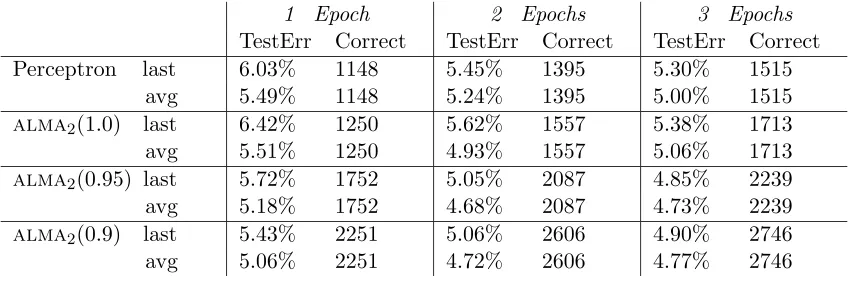
1 Epoch 2 Epochs 3 Epochs
TestErr Correct TestErr Correct TestErr Correct Perceptron last 6.03% 1148 5.45% 1395 5.30% 1515
avg 5.49% 1148 5.24% 1395 5.00% 1515
alma2(1.0) last 6.42% 1250 5.62% 1557 5.38% 1713
avg 5.51% 1250 4.93% 1557 5.06% 1713
alma2(0.95) last 5.72% 1752 5.05% 2087 4.85% 2239
avg 5.18% 1752 4.68% 2087 4.73% 2239
alma2(0.9) last 5.43% 2251 5.06% 2606 4.90% 2746
avg 5.06% 2251 4.72% 2606 4.77% 2746
Table 1: Experimental results on USPS database. We used Gaussian kernels with width
σ = 3.5. “TestErr” denotes the fraction of misclassified patterns in the test set, while “Correct” denotes the total number oftraining corrections for the 10 labels. alma2(α) is
shorthand foralma2(α;1
α, √
2). Recall that averaging takes place during the testing phase. Thus the number ofcorrections of“last” is the same as the number ofcorrections of“avg”.
Below we are using the shorthandalmap(α) to denotealmap(α;1
α, √
2). Thus, for example,
almap(1.0) denotesalmap(1; 1,√2).
We made no preprocessing on the data (beyond the implicit preprocessing performed by the kernels). All our experiments have been run on a PC with a single PentiumIII MMX processor running at 447 Mhz. The running times we will be mentioning are measured on this machine.
The rest ofthis section describes the experiments in some detail.
4.1 Experiments with USPS dataset
The USPS (US Postal Service) dataset has 7291 training patterns and 2007 test patterns. Each pattern is a 16×16 vector representing a digitalized image ofa handwritten digit, along with a {0,1,...,9}-valued label. The components ofsuch vectors lie in [−1,+1].
This is a well-known SVM benchmark. The accuracy results achieved by SVM range from 4.2% (obtained by Cortes and Vapnik, 1995, after suitable data smoothing) to 4.4% (reported by Sch¨olkopfet al., 1999) to 4.7% (reported by Platt et al., 1999, with no data preprocessing). The best accuracy results we are aware ofare those obtained by Simard, et al. (1993). They yield a test error of2.7% by using a notion ofdistance between patterns that encodes specific prior knowledge about OCR problems, such as invariance to translation and rotation.
We ran both the Perceptron algorithm and alma2. Following Sch¨olkopfet al. (1997,
1999), Platt et al. (1999) and Friess et al. (1998), we used the Gaussian kernel
K(x,y) = exp
−||x−y||22 2σ2
. To choose the best width σ, we ran the Perceptron algo-rithm and alma2(1.0) for one epoch. We used 5-fold cross validation on the training set
across the range [0.5,10.0] with step 0.5. The best σ for both algorithms turned out to be
digit 0 1 2 3 4 5 6 7 8 9
alma2(1.0)
1 Epoch Corr 99 46 129 147 142 156 101 102 169 159
SV 99 46 129 147 142 156 101 102 169 159
2 Epochs Corr 121 58 164 183 174 195 127 128 206 201
SV 121 55 159 182 168 193 126 124 202 195
3 Epochs Corr 138 67 174 204 193 208 145 137 228 219
SV 138 61 173 197 184 205 142 132 224 210
alma2(0.95)
1 Epoch Corr 149 79 192 203 190 214 148 144 226 207
SV 149 79 192 203 190 214 148 144 226 207
2 Epochs Corr 176 94 226 242 226 255 174 168 277 249
SV 175 89 224 238 221 253 173 163 272 243
3 Epochs Corr 186 105 235 256 243 273 188 184 297 272
SV 185 94 233 250 234 268 184 173 288 254
alma2(0.9)
1 Epoch Corr 200 110 246 255 243 279 193 182 287 256 SV 200 110 246 255 243 279 193 182 287 256
2 Epochs Corr 224 128 284 294 286 320 224 209 331 306 SV 223 123 282 290 280 314 220 201 323 294
3 Epochs Corr 230 137 294 312 300 334 235 226 349 329 SV 229 126 288 305 289 328 227 214 337 309
SVM (SV) 219 91 316 309 288 340 213 206 304 250
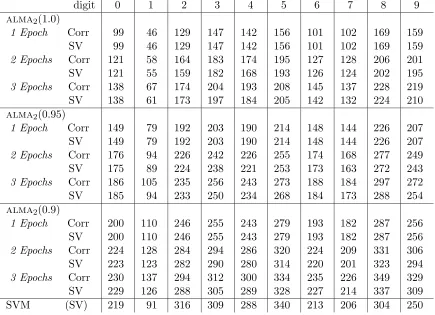
Table 2: Experimental results on USPS database. “Corr” denotes the total number of training corrections for the 10 labels, while “SV” denotes the number of “support vectors” for the 10 labels. alma2(α) is shorthand foralma2(α;1
α, √
using a Gaussian kernel makes the normalization ofinstances ˆx=x/||x||2 immaterial, since
K(x,x) = 1 for any x.
Table 1 gives test error and number ofcorrections for the Perceptron algorithm and
alma2 with different values of α. Table 2 gives statistics for alma2 on the ten digits.
Here “Corr” denotes the number ofcorrections while “SV” denotes the number of“support vectors”, i.e., the number ofexamples that are actually involved in computing the prediction function for each of the ten classes. For the sake of comparison, we also give the number ofsupport vectors yielded by SVM, as reported by Sch¨olkopfet al. (1999). The standard deviations related to our averages are reasonably small; those concerning test errors are about 0.12%.
On this dataset alma2(1.0) and the Perceptron algorithm perform comparably. The
accuracy of alma2(α) improves significantly when we shrink the value of α, whereas the
computed solution gets less and less sparse.
As in the experiments performed by Freund and Schapire (1999) and Li and Long (1999), the accuracy ofthe classifiers tends to get better as we increase the number of training epochs. However, training alma2 “avg” for more than two epochs seems to hurt
performance somewhat. This might be due to the fast convergence of this algorithm (notice that the accuracy obtained by SVM is quite close).
We found the accuracy of 5.06% for alma2(0.9) “avg” fairly remarkable, considering
that it has been obtained by sweeping through the examples just once for each of the ten classes. Indeed, the algorithm is quite fast: training for one epoch the ten binary classifiers of alma2(0.9) takes on average only 6.5 minutes.
The reader might want to compare this performance to the similar accuracy of 5.00% achieved by the “average” Perceptron algorithm run for three epochs. Despite Perceptron’s solution is sparser than alma2(0.9)’s, it is worth saying that running Perceptron for three
epochs takes about twice as long as training alma2(0.9) for one epoch.
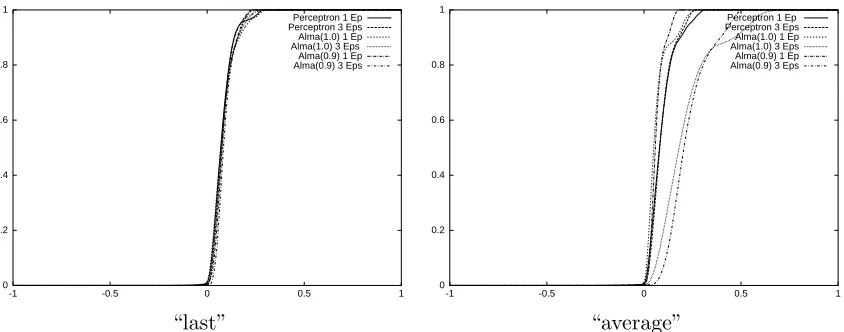
We plot in Figure 3 some ofthe margin distribution graphs obtained. The value ofthe curves at a given point s∈[−1,+1] gives the fraction of patterns in the training set whose margin (after training) is at mosts. alma2(0.9) tends to increase the number ofexamples
with a strictly positive margin. This is actually more evident with the “average” variant (plots on the right) than with the “last” variant (plots on the left).
4.2Experiments with the MNIST dataset
Each example in MNIST dataset is a 28×28 matrix, along with a {0,1,...,9}-valued label. Each entry in this matrix is a value in{0,1,...,255}, representing a grey level. The database has 60000 training examples and 10000 test examples.
The best accuracy results for this dataset are those obtained by Le Cun et al. (1995) through boosting on top ofthe neural net LeNet4. They reported a test error rate of0.7%. A soft margin SVM achieved an error rate of 1.1% (Cortes and Vapnik, 1995).
0 0.2 0.4 0.6 0.8 1
-1 -0.5 0 0.5 1
Perceptron 1 Ep Perceptron 3 Eps Alma(1.0) 1 Ep Alma(1.0) 3 Eps Alma(0.9) 1 Ep Alma(0.9) 3 Eps
0 0.2 0.4 0.6 0.8 1
-1 -0.5 0 0.5 1
Perceptron 1 Ep Perceptron 3 Eps Alma(1.0) 1 Ep Alma(1.0) 3 Eps Alma(0.9) 1 Ep Alma(0.9) 3 Eps
“last” “average”
Figure 3: Some ofthe margin distribution functions yielded by the Perceptron algorithm and byalma2, run for 1 and 3 epochs on USPS dataset.
the kernel to 4. According to Freund and Schapire (1999) this choice was best. The same choice was made by Cortes and Vapnik (1995) and Li and Long (1999). Later on we found that significant improvements could be obtained by a largerd.
We give results for alma2 withd= 4,5,6. We have not investigated any careful tuning
of scaling factors. In particular, we have not determined the best instance scaling factors
for our algorithm (this corresponds to using the kernel K(x,y) = (1 +x·y/s)d). In our experiments we sets= 255. This was actually the best choice made by Li and Long (1999) for the Perceptron algorithm.
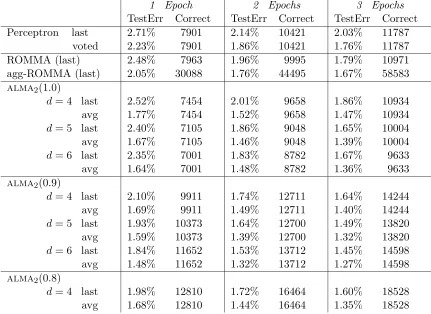
The experimental results are given in Tables 3 and 4. Table 3 gives test error and number ofcorrections for the Perceptron algorithm, ROMMA andalma2(α) withα= 1.0, 0.9, 0.8.
The first four rows ofTable 1 summarize some ofthe results obtained by Freund and Schapire (1999), Li and Long (1999) and Li (2000). The first two rows refer to the Percep-tron algorithm, while the third and the fourth rows refer to the original ROMMA9 and the best noise-controlled version ofROMMA, called “aggressive ROMMA”. Both the Percep-tron algorithm and ROMMA have been run with a degree 4 polynomial kernel. Our own experimental results are given in the subsequent rows.
Table 4 is analogous to Table 2 and refers to alma2 with a degree 4 polynomial kernel.
In the last row ofTable 4 we give the number ofsupport vectors yielded by the soft-margin SVM employed by Cortes and Vapnik (1995). Again, the standard deviations about the averages we report in these tables are not large. Those concerning test errors range in (0.03%, 0.09%).
Among these Perceptron-like algorithms, alma2 “avg” seems to be the most accurate.
Again, we would like to emphasize the good accuracy performance yielded byalma2on the
first epoch. Notice that if d= 6 alma2(0.9) “avg” gets 1.48%.
1 Epoch 2 Epochs 3 Epochs
TestErr Correct TestErr Correct TestErr Correct Perceptron last 2.71% 7901 2.14% 10421 2.03% 11787
voted 2.23% 7901 1.86% 10421 1.76% 11787
ROMMA (last) 2.48% 7963 1.96% 9995 1.79% 10971
agg-ROMMA (last) 2.05% 30088 1.76% 44495 1.67% 58583
alma2(1.0)
d= 4 last 2.52% 7454 2.01% 9658 1.86% 10934
avg 1.77% 7454 1.52% 9658 1.47% 10934
d= 5 last 2.40% 7105 1.86% 9048 1.65% 10004
avg 1.67% 7105 1.46% 9048 1.39% 10004
d= 6 last 2.35% 7001 1.83% 8782 1.67% 9633
avg 1.64% 7001 1.48% 8782 1.36% 9633
alma2(0.9)
d= 4 last 2.10% 9911 1.74% 12711 1.64% 14244
avg 1.69% 9911 1.49% 12711 1.40% 14244
d= 5 last 1.93% 10373 1.64% 12700 1.49% 13820 avg 1.59% 10373 1.39% 12700 1.32% 13820
d= 6 last 1.84% 11652 1.53% 13712 1.45% 14598 avg 1.48% 11652 1.32% 13712 1.27% 14598
alma2(0.8)
d= 4 last 1.98% 12810 1.72% 16464 1.60% 18528 avg 1.68% 12810 1.44% 16464 1.35% 18528
Table 3: Experimental results on MNIST database. The results have been obtained through the polynomial kernelK(x,y) = (1 +x·y/255)d. The Perceptron algorithm and ROMMA use d = 4, while alma2 uses d = 4,5,6. “TestErr” denotes the fraction of misclassified
patterns in the test set, while “Correct” denotes the total number oftraining corrections for the 10 labels.
alma2 is quite fast. Training for one epoch the ten binary classifiers ofalma2(1.0) with d= 4 takes on average 2.3 hours and the corresponding testing time is on average about 40 minutes; training for one epoch the ten binary classifiers ofalma2(0.9) withd= 6 takes on
average 4.3 hours, while testing takes on average 1.2 hours.
There seems to be no big difference in accuracy between alma2(0.9) and alma2(0.8)
when d = 4. This suggested us not to run alma2(0.8) with d > 4. Also, we have not
run alma2 for more than 3 epochs. But it seems reasonable to expect the accuracy of alma2(0.9) “avg” and alma2(0.8) “avg” to get closer and closer to the one achieved by
SVM.
4.3 Experiments with UCI Letter dataset
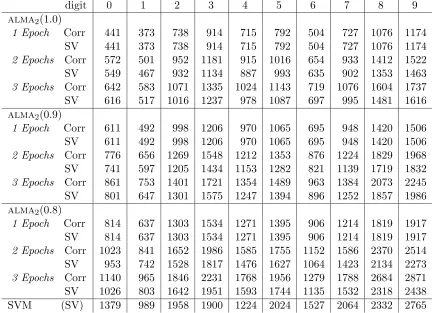
digit 0 1 2 3 4 5 6 7 8 9
alma2(1.0)
1 Epoch Corr 441 373 738 914 715 792 504 727 1076 1174 SV 441 373 738 914 715 792 504 727 1076 1174
2 Epochs Corr 572 501 952 1181 915 1016 654 933 1412 1522 SV 549 467 932 1134 887 993 635 902 1353 1463
3 Epochs Corr 642 583 1071 1335 1024 1143 719 1076 1604 1737 SV 616 517 1016 1237 978 1087 697 995 1481 1616
alma2(0.9)
1 Epoch Corr 611 492 998 1206 970 1065 695 948 1420 1506 SV 611 492 998 1206 970 1065 695 948 1420 1506
2 Epochs Corr 776 656 1269 1548 1212 1353 876 1224 1829 1968 SV 741 597 1205 1434 1153 1282 821 1139 1719 1832
3 Epochs Corr 861 753 1401 1721 1354 1489 963 1384 2073 2245 SV 801 647 1301 1575 1247 1394 896 1252 1857 1986
alma2(0.8)
1 Epoch Corr 814 637 1303 1534 1271 1395 906 1214 1819 1917 SV 814 637 1303 1534 1271 1395 906 1214 1819 1917
2 Epochs Corr 1023 841 1652 1986 1585 1755 1152 1586 2370 2514 SV 953 742 1528 1817 1476 1627 1064 1423 2134 2273
3 Epochs Corr 1140 965 1846 2231 1768 1956 1279 1788 2684 2871 SV 1026 803 1642 1951 1593 1744 1135 1532 2318 2438 SVM (SV) 1379 989 1958 1900 1224 2024 1527 2064 2332 2765
1 Epoch 2 Epochs 3 Epochs
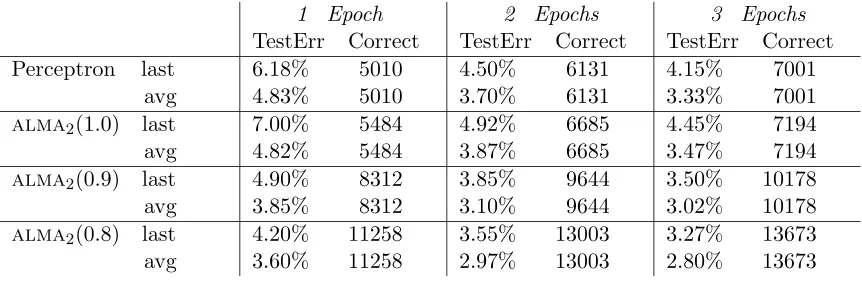
TestErr Correct TestErr Correct TestErr Correct Perceptron last 6.18% 5010 4.50% 6131 4.15% 7001
avg 4.83% 5010 3.70% 6131 3.33% 7001
alma2(1.0) last 7.00% 5484 4.92% 6685 4.45% 7194
avg 4.82% 5484 3.87% 6685 3.47% 7194
alma2(0.9) last 4.90% 8312 3.85% 9644 3.50% 10178
avg 3.85% 8312 3.10% 9644 3.02% 10178
alma2(0.8) last 4.20% 11258 3.55% 13003 3.27% 13673
avg 3.60% 11258 2.97% 13003 2.80% 13673
Table 5: Experimental results on UCI Letter database. We used a “poly-Gaussian” kernel (see main text). “TestErr” denotes the fraction of misclassified patterns in the test set, while “Correct” denotes the total number oftraining corrections for the 26 labels.
extracted from raster scan images ofmachine printed letters of20 different fonts. The attributes have values in {0, 1, ..., 15}. A standard split is to consider the first 16000 patterns as training set and the remaining 4000 patterns as test set.
The best accuracy results we are aware ofare those obtained by Schwenk and Bengio (2000) by boosting suitable neural network architectures. They reported an error rate of 1.5%. According to Platt et al. (1999), a Gaussian kernel SVM achieves 2.2%. This accuracy difference might actually be due to different preprocessing.
This is a dataset where Perceptron-like algorithms such asalma2did not work as well as
we would have liked. We ran both the Perceptron algorithm andalma2. Both algorithms
exhibited a somewhat slow convergence. Besides, they both failed to converge to SVM’s accuracy level. We tried to speed up convergence by using a “poly-Gaussian” kernel ofthe
form K(x,y) =
1 + exp
−||x−y||22 2σ2
d
. This kernel corresponds to a linear combination of dGaussian kernels with different width parametersσ. We set d= 5 to make the kernel flexible enough. Again, in order to determine the best σ, we ran the Perceptron algorithm and alma2(1.0) for one epoch, using 4-fold cross-validation on the training set across the
range [0.5, 10.0], with step 0.5. The best σ for Perceptron was 4.0, while the best σ for
alma2 turned out to be 3.0. The experiments are summarized in Table 5, where only the
best results are shown.
The conclusions we can draw from this table are similar to those for Table 1 and Table 3. The main difference is that the test error achieved by alma2 after one epoch (alma2(0.8)
“avg” achieves 3.60%) is significantly worse than SVM’s (2.2%). The accuracy of alma2
tends to improve after the first epoch (it reaches 2.80% after three epochs), but it stabilizes around 2.7%, no matter how many epochs one trains the algorithm for. We observed a similar behavior with the Perceptron algorithm (with an even slower convergence). This phenomenon might be due to the lack ofSVM’s bias term.
As far as running time is concerned, training alma2(1.0) for one epoch takes about 2.5
4.4 Experiments with almap on artificial datasets
We tested almap, p≥2, without kernels on medium-size artificial datasets. The datasets
are about binary classification tasks and have been generated at random according to the following rules. We first generated a target vector u ∈ {−1,0,+1}300, where the first s
components are selected independently at random in{−1,+1} and the remaining 300−s
components are 0. The valuesis intended as a measure ofthe sparsityoftarget vectoru. In our experiments we set s = 3, 10, 100, 300. We also added labelling noise with rate
(. In our experiments (= 0.0, 0.05, 0.10, 0.15. For a given target vector u and a given noise rate(, we randomly generated 10000 training examples and 10000 test examples. The instance vectors xt have 300 components with values chosen in [−1,+1]. The training set is generated as follows. We pickedxt∈[−1,+1]300 at random. Ifu·xt≥1 then a +1 label is associated with xt. If u·xt ≤ −1 then a −1 label is associated with xt. The labels so obtained are then flipped with probability (. If |u·xt|<1 then xt is rejected and a new vectorxtis drawn. The test set instancesxtare again chosen at random in [−1,+1]300, the corresponding labels equal10 sign(u·xt). We did not force a large margin on the test set.
On each ofthese 4×4 = 16 datasets we ran almap(α) (both “last” and “avg”) for one
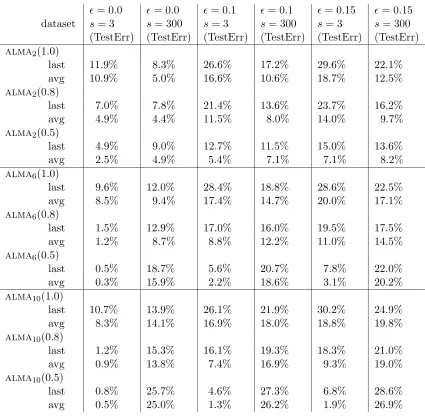
epoch, with p = 2, 6, 10 and α = 1.0, 0.9, 0.8, 0.5. The accuracy results (test errors) are shown in Table 6. These experiments had the purpose ofinvestigating the behavior of
almap on extreme scenarios. The differences in performance are big and sometimes even
huge. In Table 6 we report what we believe are some ofthe most interesting results. We picked 6 out ofthe 16 datasets. The columns are marked according to the values of( and
s.
On sparse target datasets (s = 3 in Table 6) alma6 and alma10 largely outperform alma2. On these datasets the accuracy ofall algorithms improves as α is made smaller.
Correspondingly, the number ofcorrections (not shown in Table 6) increases. Like in the experiments ofthe previous subsections, there is a natural trade-off between the number of corrections the algorithms make and the accuracy ofthe resulting hypotheses. To give an idea ofthis trade-off, we report three results: on the “(= 0.0, s= 3” dataset alma2(1.0)
makes on average 142 corrections, while alma2(0.5) makes 2720 corrections; on the same
dataset, alma10(1.0) makes on average only 14 corrections, whereas alma10(0.5) makes
1050; on the “( = 0.15, s = 3” dataset alma10(1.0) makes on average 2656 corrections
while alma10(0.5) makes on average 3594 corrections. The reader might want to compare
the accuracy results for these three cases. For any given value of α, there is essentially no difference between alma10(α) and alma6(α) (the test errors shown in Table 6 are
meaningful up to about 1%).
On dense target datasets (s = 300) almap(α) with p = 2 is best. Again, accuracy
improves by shrinkingα, but it degrades as we increasep.
In Figure 4 we plot the margin distribution graphs obtained on 4 ofthe 16 datasets generated. In these plots we put emphasis on the comparison between the two extreme cases α = 1.0 and α = 0.5. The performance gap between alma2(α) and alma6(α) on
the two “s = 3” datasets (plots on the left) is clearly reflected by the different behavior ofthe corresponding margin distribution functions. The plots on the right, on the other
(= 0.0 (= 0.0 (= 0.1 (= 0.1 (= 0.15 (= 0.15 dataset s= 3 s= 300 s= 3 s= 300 s= 3 s= 300
(TestErr) (TestErr) (TestErr) (TestErr) (TestErr) (TestErr)
alma2(1.0)
last 11.9% 8.3% 26.6% 17.2% 29.6% 22.1%
avg 10.9% 5.0% 16.6% 10.6% 18.7% 12.5%
alma2(0.8)
last 7.0% 7.8% 21.4% 13.6% 23.7% 16.2%
avg 4.9% 4.4% 11.5% 8.0% 14.0% 9.7%
alma2(0.5)
last 4.9% 9.0% 12.7% 11.5% 15.0% 13.6%
avg 2.5% 4.9% 5.4% 7.1% 7.1% 8.2%
alma6(1.0)
last 9.6% 12.0% 28.4% 18.8% 28.6% 22.5%
avg 8.5% 9.4% 17.4% 14.7% 20.0% 17.1%
alma6(0.8)
last 1.5% 12.9% 17.0% 16.0% 19.5% 17.5%
avg 1.2% 8.7% 8.8% 12.2% 11.0% 14.5%
alma6(0.5)
last 0.5% 18.7% 5.6% 20.7% 7.8% 22.0%
avg 0.3% 15.9% 2.2% 18.6% 3.1% 20.2%
alma10(1.0)
last 10.7% 13.9% 26.1% 21.9% 30.2% 24.9%
avg 8.3% 14.1% 16.9% 18.0% 18.8% 19.8%
alma10(0.8)
last 1.2% 15.3% 16.1% 19.3% 18.3% 21.0%
avg 0.9% 13.8% 7.4% 16.9% 9.3% 19.0%
alma10(0.5)
last 0.8% 25.7% 4.6% 27.3% 6.8% 28.6%
avg 0.5% 25.0% 1.3% 26.2% 1.9% 26.9%
Table 6: Results ofexperiments on artificially generated datasets. Recall that(denotes the amount oflabelling noise, whilesis the number ofnonzero components oftarget vectoru.
hand, are somewhat less informative. When learning a dense (“s = 300”) target, a single training epoch is probably not sufficient to differentiate algorithms’ performance through their margin properties.
0 0.2 0.4 0.6 0.8 1
-1 -0.5 0 0.5 1
p = 2, alpha = 1.0 p = 2, alpha = 0.5 p = 6, alpha = 1.0 p = 6, alpha = 0.5
0 0.2 0.4 0.6 0.8 1
-1 -0.5 0 0.5 1
p = 2, alpha = 1.0 p = 2, alpha = 0.5 p = 6, alpha = 1.0 p = 6, alpha = 0.5
Noise rate(= 0.0, sparsitys= 3. Noise rate(= 0.0, sparsity s= 300.
0 0.2 0.4 0.6 0.8 1
-1 -0.5 0 0.5 1
p = 2, alpha = 1.0 p = 2, alpha = 0.5 p = 6, alpha = 1.0 p = 6, alpha = 0.5
0 0.2 0.4 0.6 0.8 1
-1 -0.5 0 0.5 1
p = 2, alpha = 1.0 p = 2, alpha = 0.5 p = 6, alpha = 1.0 p = 6, alpha = 0.5
Noise rate(= 0.1, sparsity s= 3. Noise rate(= 0.1, sparsity s= 300.
Figure 4: Margin distributions yielded by almap(α) “avg” with p = 2,6 and α= 1.0,0.5,
0 0.2 0.4 0.6 0.8 1
-1 -0.5 0 0.5 1
p = 2, alpha = 0.5, "last" p = 2, alpha = 0.5, "avg "
0 0.2 0.4 0.6 0.8 1
-1 -0.5 0 0.5 1
p = 6, alpha = 1.0, "last" p = 6, alpha = 1.0, "avg "
Sparsitys= 3, noise rate(= 0.0. Sparsitys= 3, noise rate(= 0.0.
0 0.2 0.4 0.6 0.8 1
-1 -0.5 0 0.5 1
p = 2, alpha = 0.5, "last" p = 2, alpha = 0.5, "avg "
0 0.2 0.4 0.6 0.8 1
-1 -0.5 0 0.5 1
p = 6, alpha = 0.5, "last" p = 6, alpha = 0.5, "avg "
Sparsitys= 300, noise rate(= 0.0. Sparsitys= 300, noise rate(= 0.0.
0 0.2 0.4 0.6 0.8 1
-1 -0.5 0 0.5 1
p = 6, alpha = 1.0, "last" p = 6, alpha = 1.0, "avg "
0 0.2 0.4 0.6 0.8 1
-1 -0.5 0 0.5 1
p = 6, alpha = 0.5, "last" p = 6, alpha = 0.5, "avg "
Sparsitys= 3, noise rate(= 0.1. Sparsitys= 3, noise rate(= 0.1.
0 0.2 0.4 0.6 0.8 1
-1 -0.5 0 0.5 1
p = 2, alpha = 0.5, "last" p = 2, alpha = 0.5, "avg "
0 0.2 0.4 0.6 0.8 1
-1 -0.5 0 0.5 1
p = 6, alpha = 0.5, "last" p = 6, alpha = 0.5, "avg "
Sparsity s= 300, noise rate(= 0.1. Sparsitys= 300, noise rate(= 0.1.
Figure 5: Margin distributions yielded byalmap(α) withp= 2,6 andα= 1.0,0.5, run for