www.adv-radio-sci.net/13/181/2015/ doi:10.5194/ars-13-181-2015
© Author(s) 2015. CC Attribution 3.0 License.
Coexistence issues for a 2.4 GHz wireless audio streaming in
presence of bluetooth paging and WLAN
F. Pfeiffer1, M. Rashwana, E. Biebl2, and B. Napholz3
1perisens GmbH, Munich, Germany
2Fachgebiet Höchstfrequenztechnik, Technische Universität München, Munich, Germany 3Daimler AG, Sindelfingen, Germany
aformerly at: Daimler AG, Sindelfingen, Germany
Correspondence to: F. Pfeiffer ([email protected])
Received: 14 December 2014 – Revised: 5 March 2015 – Accepted: 10 March 2015 – Published: 3 November 2015
Abstract. Nowadays, customers expect to integrate their mo-bile electronic devices (smartphones and laptops) in a vehicle to form a wireless network. Typically, IEEE 802.11 is used to provide a high-speed wireless local area network (WLAN) and Bluetooth is used for cable replacement applications in a wireless personal area network (PAN). In addition, Daimler uses KLEER as third wireless technology in the unlicensed (UL) 2.4 GHz-ISM-band to transmit full CD-quality digital audio. As Bluetooth, IEEE 802.11 and KLEER are operat-ing in the same frequency band, it has to be ensured that all three technologies can be used simultaneously without inter-ference. In this paper, we focus on the impact of Bluetooth and IEEE 802.11 as interferer in presence of a KLEER audio transmission.
1 Introduction
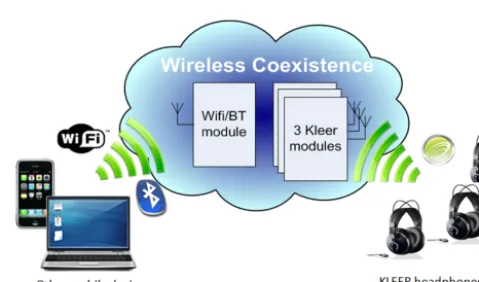
This paper addresses the impact of an IEEE 802.11b/g and a Bluetooth system on a KLEER audio transmission. The considered wireless architecture includes a WiFi (IEEE 802.11b/g) combo module and three independent KLEER sources which allow three independent audio streams (see Fig. 1).
KLEER from SMSC is a short-range radio interface in the 2.4 GHz frequency band that is designed for lossless 44.1 kHz-sampled 16 bit stereo audio transmission in full CD quality (see SMSC, 2007a, b; Devries et al., 2009; Mason et al., 2009). A lossless audio compression is used to reduce the required net data rate of 1.4112 Mb s−1to approximately 1 Mb s−1 on average. But the short term compression ratio
Figure 1. Considered wireless architecture.
depends on characteristics of the audio signal. Therefore the full data rate of 1.4112 Mb s−1has to be supported to achieve lossless full CD quality audio streaming. KLEER is using 16 equally spaced RF channels from 2.403 to 2.478 GHz (hav-ing a frequency spac(hav-ing of 5 MHz) and each channel oc-cupies an RF bandwidth of 3 MHz. For independent audio streams, each stream requires its own RF channel. Thereby KLEER is offering a gross data rate of 2.37 Mb s−1. The
0 1 2 3 4 5 6 7 8 9 10 11 12 13 14 15 16 17 18 19 20 21 22 23 24 25 26 27 28 29 30 31 32 33 34 35 36 37 38
39 40 41 42 43 44 45 46 47 48 49 50 51 52 53 54 55 56 57 58 59 60 61 62 63 64 65 66 67 68 69 70 71 72 73 74 75 76 77 78
0 1 2 3 4 5 6 7
8 9 10 11 12 13 14 15
1 1
2
3
4
5
6
7
9 8 7 6 5
10
11
12
14 (Japan) 13 IEEE
802.11b/ g Bluetooth
Kleer
Bluetooth
IEEE 802.11b/ g
Kleer
8
2.402 2.410 2.420 2.430 2.440 f / GHz
2.450 2.460 2.470 2.480f / GHz
Figure 2. Bluetooth, IEEE 802.11b/g and KLEER channels in the 2.4 GHz-ISM-band.
Table 1. Comparison of wireless technologies.
KLEER Bluetooth IEEE 802.11b IEEE 802.11g
Gross data rate [Mbit s−1] 2.37 1/2/3 1/2/5.5/11 6/9/12/18/24/
36/48/54
Max. transmit power [dBm] 1.5 – 20 (class 1) 17 17
– 4 (class 2) – 0 (class 3)
20 dB-bandwidth [MHz] 3 1 16 17
Channels 16 (non-overlapping) 79 (non-overlapping) 13 (partly overlapping) 13 (partly overlapping)
Modulation MSK GFSK/DQPSK DBPSK/DQPSK BPSK/QPSK/
8DPSK 16-QAM/64-QAM
Miscellaneous None Frequency Hopping Spreading/Code Keying OFDM
current channel if it is experiencing bad channel conditions. A channel change has to be initiated if the retransmission bandwidth is not able to cope with the packet loss rate over a defined period of time. At the audio sink side (at the wire-less headphones), Kleer uses antenna diversity by switching two orthogonal polarized antennas which provides additional interference mitigation in small scale fading for in-vehicular communication. In Table 1 all important details on KLEER are shown and compared to Bluetooth and IEEE 802.11b/g. Figure 2 shows the channel distributions of Bluetooth, IEEE 802.11 and KLEER in the ISM-band.
In the first section, the impact of an IEEE 802.11b/g in-terferer is discussed and measurement results are presented. The next section analyzes the impact of a Bluetooth interferer in connected and connecting state using an analytical packet error model. Typical Bluetooth states are classified
accord-ing to their impact on a KLEER transmission. It turns out that Bluetooth page state is very critical regarding interfer-ence. The following section gives details about the packet timing and the hopping sequence during page state. Further-more, the characteristic behavior of a page hopping sequence is discussed. In the last section, a statistical analysis is done to carry out a relevance analysis concerning the impact of Bluetooth page state on KLEER.
2 Impact of IEEE 802.11b/g on KLEER
over-lap completely and one partly with a single IEEE 802.11 b/g channel. This assumes an IEEE 802.11 bandwidth of 22 MHz according to a more conservative bandwidth definition which is often used in literature. We used KLEER evaluation boards to analyze the impact of an IEEE 802.11 b/g interferer on a KLEER audio streaming. This allows disabling KLEER’s dynamic channel switching. By applying an IEEE 802.11 b/g signal on a KLEER transmission we could evaluate the sig-nal to interferer ratio (SIR) at which audio dropouts occurs. For a SIR region of 1 to−20 dB, audio dropouts occurred in up to four KLEER channels (out of 16) in presence of IEEE 802.11b/g traffic. The exact number of disturbed channels (channels where audio dropouts occur) depends on the inter-ferer signal (either IEEE 802.11b or g) and the overlapping spectral power density of the interfering signal in a KLEER channel. Regarding the SIR values, it is important to note that IEEE 802.11b/g is transmitting with a maximum power of 20 dBm compared to KLEER with 1.5 dBm. Therefore a SIR of−20 dB represents almost equal path loss conditions between KLEER victim receiver and KLEER transmitter and IEEE 802b/g transmitter, respectively. Under more unfavor-able path loss conditions even more than four KLEER chan-nels can be disturbed. For SIR values between −20 and
−30 dB, IEEE 802.11b disturbs five KLEER channels. On the opposite side, KLEER is not affected at all by IEEE 802.11b/g for SIR values higher than 1 dB. Considering the difference in transmitting power between IEEE 802.11 and KLEER, interference is likely in an in-vehicular environ-ment. Therefore KLEER has to avoid IEEE 802.11b/g sig-nals. But if only a limited number of the total 16 channels are affected by IEEE 802.11 signals, KLEER’s dynamic chan-nel switching (DSC) is an effective method to avoid the dis-turbed channels. Our measurements showed that DSC en-ables KLEER to dynamically change the affected channels during an IEEE 802.11 disturbance with an SIR of−30 dB without audio quality degradation.
3 Impact of Bluetooth on KLEER
KLEER needs a minimum SIR of about 13 dB to prevent au-dio dropouts in presence of a constantly transmitting Blue-tooth GFSK-signal. The SIR difference compared to IEEE 802.11 signals can be explained by the lower spectral band-width of Bluetooth. In contrast to IEEE 802.11, Bluetooth communication standard uses Frequency Hopping Spread Spectrum (FHSS) which combines TDMA (Time Division Multiple Access) and FDMA (Frequency Time Division Multiple Access). The TDMA divides the channel in 625 µs slots resulting in 1600 slots s−1. For the connecting state (in-quiry or paging) also half slots of 312.5 µs are used. The FDMA is dividing the ISM band in 79 channels of 1 MHz width starting at 2.402 and ending at 2.480 GHz. Each packet is transmitted in a different channel than the previous packet following a pseudo-random hopping sequence. In Bluetooth
specification version 1.2, Bluetooth Special Interest Group (SIG) introduced Adaptive Frequency-hopping (AFH) as ad-ditional coexistence mechanism for connected devices (Blue-tooth SIG, 2004). When AFH is in use, channels which are classified as “bad” are removed from the hopping sequence. The Bluetooth core specifies a minimum number of 20 RF channels. In presence of an interfering FHSS communication system – like Bluetooth – with uniformly distributed chan-nels over the whole band, a channel switch is unnecessary and even bares risks: a channel change always implies a data overhead and reduces the net data rate. Moreover, the Blue-tooth channel classification is influenced negatively by a con-stantly switching system. In best case, Bluetooth will classify the channels inside the current KLEER channel as “bad” and stop using these channels. Therefore, the interference is only temporary during the Bluetooth AFH-adaptation time. Nev-ertheless, KLEER’s retransmission bandwidth has to be able to compensate the packet loss during an occurring Bluetooth interference to provide overall coexistence. To calculate the resulting packet loss, the packet distribution in time and fre-quency has to be known. As Bluetooth supports multiple ap-plications in different profiles, the paper focuses on typical in-vehicle scenarios:
– paging/inquiry,
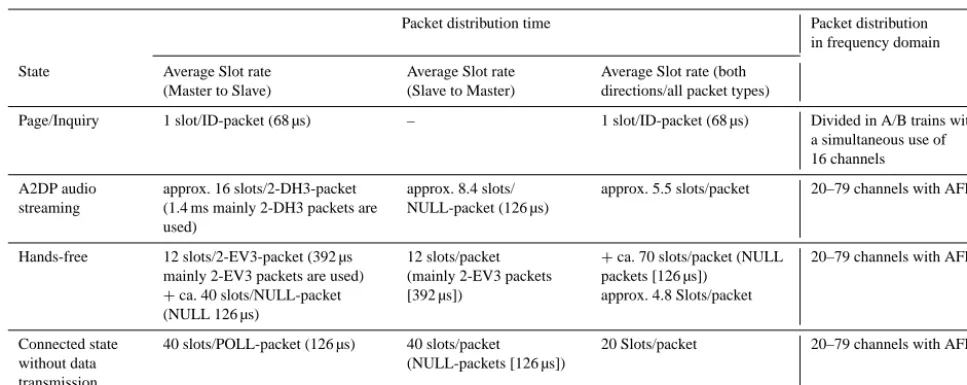
– A2DP audio streaming (ACL connection type), – hands-free telephony (SCO connection type), – and connected state without any data transmission. The measurements were conducted with evaluation boards using an Ellisys Bluetooth sniffer. In Table 2 the average packet distribution in time and frequency is shown.
Comparing the slot rates for both directions as worst-case interference scenario, it shows that paging/inquiry achieves by far the highest slot rate, however, with very short pack-ets of only 68 µs length. In order to make a statement of the interference impact, it is necessary to calculate the resulting packet error rate. According to Golmie (2006), an analytical approach is used to model the occurring interference. Fig-ure 3 shows the timing of the desired packets with respect to the interfering packets seen at the victim’s receiver. The model assumes that the desired and interfering packets are sent periodically in a fixed time period ofTsigandTint. This
simplifies the calculation, but is only valid in case of pag-ing/inquiry and SCO connection. But nevertheless, it also gives a reasonable estimation for the other cases. The packet length is denoted withtsigandtint.
The variable1t defines the time offset between a desired and an interfering packet. Assuming that1tis uniformly dis-tributed, the average number that an interfering packet hits a desired packet in time can be calculated, as follows:
hi=
tsig+tint,i Tint,i
Table 2. Average packet distribution in time and frequency for different Bluetooth states; data derived from an exemplary measurement using
Ellisys Bluetooth sniffer.
Packet distribution time Packet distribution
in frequency domain
State Average Slot rate
(Master to Slave)
Average Slot rate (Slave to Master)
Average Slot rate (both directions/all packet types)
Page/Inquiry 1 slot/ID-packet (68 µs) – 1 slot/ID-packet (68 µs) Divided in A/B trains with
a simultaneous use of 16 channels A2DP audio
streaming
approx. 16 slots/2-DH3-packet (1.4 ms mainly 2-DH3 packets are used)
approx. 8.4 slots/ NULL-packet (126 µs)
approx. 5.5 slots/packet 20–79 channels with AFH
Hands-free 12 slots/2-EV3-packet (392 µs mainly 2-EV3 packets are used)
+ca. 40 slots/NULL-packet (NULL 126 µs)
12 slots/packet (mainly 2-EV3 packets [392 µs])
+ca. 70 slots/packet (NULL packets [126 µs])
approx. 4.8 Slots/packet
20–79 channels with AFH
Connected state without data transmission
40 slots/POLL-packet (126 µs) 40 slots/packet (NULL-packets [126 µs])
20 Slots/packet 20–79 channels with AFH
Desired Packet Δt
Tsig
Interfering Packets
Tint tsig
tint
t
Figure 3. Collisions at the victim’s receiver.
Considering different interfering packetsi=1,2,3, .., M the total number is a sum of the individual numbers.
h=
M
X
i=1
tsig+tint,i Tint,i
(2)
Assuming that every collision in time and frequency causes a packet error, the packet error rate is:
PER=
h· nint
ntotal
if h≤ ntotal
nint
1 if h > ntotal nint
, (3)
wherentotalis the total number andnintthe number of
chan-nels overlapping with the desired signal. The channel dis-tribution is assumed to be uniformly distributed. The above mentioned formula assumes that the collision in time and fre-quency are independent. Even if not all assumptions of the packet error model are completely valid, it gives a sufficient well estimation of the interference. Using the derived model and assuming a KLEER packet length of 1.3 ms an average
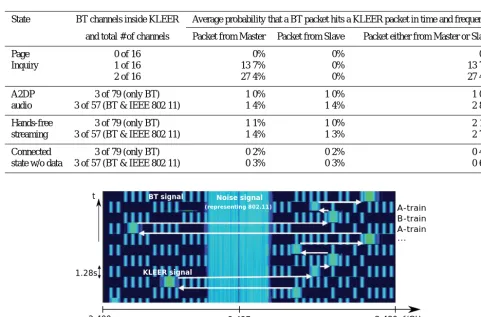
packet error rate can be calculated. For A2DP, Hands-free and no data transmission two different interfering scenar-ios shall be regarded: in both scenarscenar-ios, three BT channels are overlapping with a KLEER channel. But one scenario assumes BT to use all 79 channels and the other only 59 channels. The latter represents a situation where AFH avoids 20 channels due to additional IEEE 802.11 interference. In both cases, only co-channel interference with three BT chan-nels inside one KLEER channel is considered. For Bluetooth paging/inquiry 16 channels are used simultaneously in one interval of 10 ms. A characteristic of the paging/inquiry se-quence is that the adjacent channels always remain unused. More details about the characteristics of Bluetooth page state are given in the next section. Considering co-channel inter-ference using KLEER’s channel bandwidth of 3 MHz three cases have to be distinguished: no interference occurs and one or two channels out 16 are disturbed. The resulting prob-abilities that a BT packet hits a KLEER packet are shown in Table 3.
Table 3. Average probability that a Bluetooth packet hits a 1.3 ms long KLEER packet in frequency and time for different Bluetooth states.
State BT channels inside KLEER Average probability that a BT packet hits a KLEER packet in time and frequency
and total # of channels Packet from Master Packet from Slave Packet either from Master or Slave
Page 0 of 16 0% 0% 0%
Inquiry 1 of 16 13.7% 0% 13.7%
2 of 16 27.4% 0% 27.4%
A2DP 3 of 79 (only BT) 1.0% 1.0% 1.0%
audio 3 of 57 (BT & IEEE 802.11) 1.4% 1.4% 2.8%
Hands-free 3 of 79 (only BT) 1.1% 1.0% 2.1%
streaming 3 of 57 (BT & IEEE 802.11) 1.4% 1.3% 2.7%
Connected 3 of 79 (only BT) 0.2% 0.2% 0.4%
state w/o data 3 of 57 (BT & IEEE 802.11) 0.3% 0.3% 0.6%
1.28s
A-train B-train A-train ... BT signal
KLEER signal
Noise signal (representing 802.11)
2.400 2.437 2.480 f/GHz
t
Figure 4. Constant channel switch of a single KLEER transmission in presence of BT paging and IEEE 802.11b/g – measurement done with
signal generator and cable setup.
a free channel fast enough without audio degradation. To an-alyze the coexistence capabilities of KLEER in presence of BT paging/inquiry we generated a BT page state sequence using a vector signal generator. The sequence was generated with a periodic interval of 1.28 s long A and B trains. As BT paging always leaves a region of 16 MHz free, we added a noise signal to fill this gap. This bad case interference sce-nario was applied to a KLEER transmission. The power ra-tios are chosen in such a manner that a collision in frequency and time leads very likely to a packet loss. To manage this bad case scenario KLEER has to be able to constantly switch in a free channel. The Fig. 4 shows the measured power den-sity of the described scenario against frequency and time in a waterfall plot.
As shown in Fig. 4, KLEER initiates a channel switch if the Bluetooth page sequence changes from A to B train and vice versa. After every train change, KLEER is able to find an undisturbed channel without any audio degradation. Under these difficult conditions, KLEER’s channel switching algo-rithm is working well.
4 Statistical interference analysis of page (inquiry) sub state
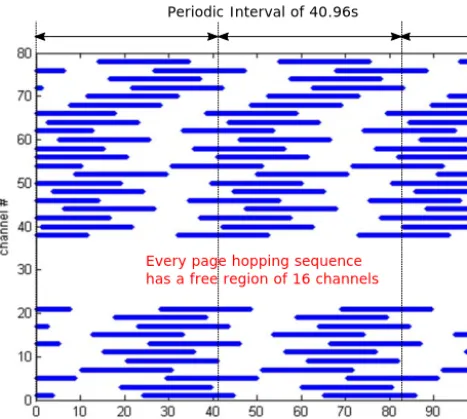
Every page hopping sequence has a free region of 16 channels
Periodic Interval of 40.96s
Figure 5. Exemplary Hopping sequence in page state for
ULAP=0x8B6949.
train. Figure 5 shows the used channels of an exemplary page hopping sequence.
The figure illustrates the characteristics of a page (inquiry) hopping sequence:
– The sequence always leaves a region of 16 channels free.
– There is a gap of at least one frequency between two used channels.
– The page/inquiry hopping sequence repeats every 40.96 s.
– Every 1.28 s one (out of 16) frequencies changes. Be-tween 20.48 s (=16×1.28 s – phase difference between A and B train) two different sets of 16 channels are used. As described before, every page hopping sequence uses 16 channels per train and has a free region of 16 frequen-cies. The spectral location of the free region depends on the Bluetooth device address and is uniformly distributed (for random device addresses). Furthermore, we know that an IEEE 802.11b/g signal is able to disturb up to 5 KLEER channels – assuming only co-channel interference. Assum-ing a bad case scenario, an IEEE 802.11b/g signal lies into the free region of the page hopping sequence. In an absolute worst-case scenario, the 16 frequencies of A or B train are disturbing the remaining 11 KLEER channels outside IEEE 802.11. In this case, all 16 KLEER channels are disturbed either with the IEEE 802.11b/g signal or the paging signal. KLEER would constantly initiate channel switches without the chance to find a free channel – at least during a single page train of 1.28 or 2.56 s. It is important to know the prob-ability of occurrence for this worst case scenario to evaluate
Figure 6. Number of disturbed channel by a Bluetooth page state
with probability of concurrency calculated with 10 000 different Bluetooth device addresses.
the relevancy. Based on 10 000 calculated page hopping se-quences with random ULAP addresses a statistical analysis was performed. For every ULAP address 32 sequences of 16 frequencies were calculated to cover all possibilities over time. In total 320 000 page hopping sequences were calcu-lated and statistically evaluated. Figure 6 shows the proba-bility of occurrence for the number of interfered channels. In the upper figure the probability is given for the maximum number (considering the 32 possible sequences over time for one ULAP address). The lower figure shows average number of interfered channels.
As result it can be stated that the above mentioned worst-case situation is possible: the statistical probability that IEEE 802.11b/g and Bluetooth page state overlap with all 16 KLEER channels is about 0.02 %. In other words, two out of 10 000 randomly generated ULAP addresses are manifesting this behavior. In such a case, the interference on all channels occurs during 1.28 of 40.96 s. It should be emphasized that this worst-case situation only occurs if several factors come together:
– Bluetooth is enabled at the vehicle’s head unit (HU) without any connected device.
– IEEE 802.11b/g packet load is high and the SIR is low enough to disturb five KLEER channels.
– The critical sequence is appearing while paging is ac-tive.
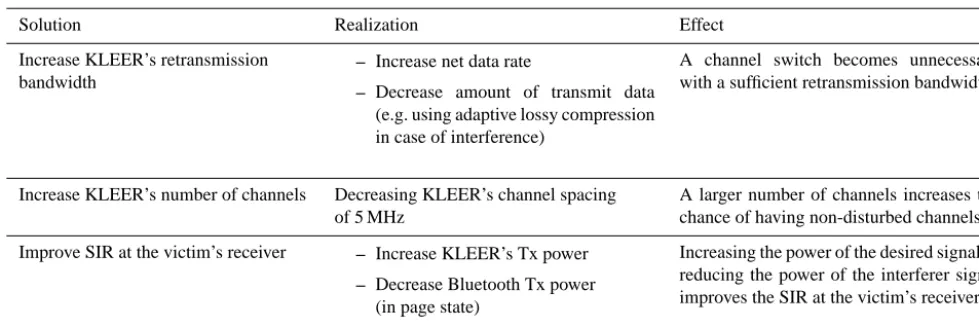
Table 4. Possible solutions for paging interference
Solution Realization Effect
Increase KLEER’s retransmission bandwidth
– Increase net data rate
– Decrease amount of transmit data
(e.g. using adaptive lossy compression in case of interference)
A channel switch becomes unnecessary with a sufficient retransmission bandwidth
Increase KLEER’s number of channels Decreasing KLEER’s channel spacing of 5 MHz
A larger number of channels increases the chance of having non-disturbed channels
Improve SIR at the victim’s receiver – Increase KLEER’s Tx power – Decrease Bluetooth Tx power
(in page state)
Increasing the power of the desired signal or reducing the power of the interferer signal improves the SIR at the victim’s receiver
From a customer view, a page state interference is incom-prehensible as Bluetooth is switched off at the mobile device and only IEEE 802.11 as single system is used simultane-ously with KLEER. In such a situation the customer cannot understand why he is experiencing audio dropouts. If there is more than one KLEER connection active, of course more than one free channel is needed. At maximum three inde-pendent streams (on three channels) are possible. The prob-ability that three or more channels are disturbed during a page state is already 12.4 %. Thus is it certainly necessary to take steps to minimize the interference in such a critical state. Table 4 gives an overview of possible measures for in-terference reduction: beside of the pure technical aspects, it was important for Daimler to avoid time-consuming costly firmware and hardware changes. Considering the cost and interference aspects, the following two measures were taken: the audio level was lowered digitally on the transmitter’s side to improve the audio compression rate. A smaller amount of transmit data increases the retransmission bandwidth. By ad-justing the channel switch algorithm to the new retransmis-sion bandwidth, a channel change become more unlikely dur-ing page state even if one Bluetooth channel lies inside the KLEER channel. It must be taken into account that an audio level reduction implies an increase of the audio quantization noise. Additionally to the reduction of the audio level, the Bluetooth transmit power was reduced during page/inquiry state to avoid packet loss in case of packet collision. In an in-vehicle situation the distances to the mobile device are very short (typically below 3 m) which usually allows a certain power reduction. First antenna based measurements on ran-dom positions inside a vehicle cabin showed that a power reduction of up to 20 dB does not affect the connect ability of Bluetooth devices.
5 Conclusions
needed to avoid interference from other devices sharing the same band – but as second coexistence objective the interference on other devices should be minimized as well. During a single page sequence of 1.28 s (2.56 s) Bluetooth master device sends 2048 (4096) identical 68 bit-packets in a very high rate containing a high amount of redundant information. On the slave’s side, this is favorable as the scan time can be minimized and thus energy saved. But for other systems, this could cause serious interference as shown in this paper. An approach to minimize the interference without changing the connecting procedure, is to adaptively reduce the transmit power during the connection state. It has however be assured that the devices are close enough to each other that a reduction in transmit power will not affect the ability to connect devices.
Edited by: F. Gronwald
Reviewed by: M. Koch and one anonymous referee
References
Bluetooth SIG: Specification of the Bluetooth System, Core, Ver-sion 2.1, available at: http://www.bluetooth.com (last access: 24 March 2015), 2004.
Golmie, N.: Coexistence in Wireless Networks, Cambridge Univer-sity Press, Cambridge, UK, 2006.
Devries, C. A., Mason, R. D., and Beards, R. D.: RF-to-baseband re-ceiver architecture, US Patent no. 7,539,476, available at: https: //www.google.com/patents/US7539476 (last access: 20 March 2015), 2009.
Mason, R. D., Li, R., and DeCruyenaere, J. P. R.: Wireless com-munications systems and channel-switching method, US Patent App. 12/106,098, available at: https://www.google.com/patents/ US20090262709 (last access: 20 March 2015), 2009.
SMSC: ISM Band Coexistence, Document Number KLR0000-WP2-1.2, available at: http://ww1.microchip.com/downloads/en/ DeviceDoc/Kleer_ISM_Coexistence.pdf (last access: 24 March 2015), 2007a.