www.adv-radio-sci.net/5/347/2007/ © Author(s) 2007. This work is licensed under a Creative Commons License.
Radio Science
Energy modelling in sensor networks
D. Schmidt1, M. Kr¨amer2, T. Kuhn2, and N. Wehn1
1Microelectronic System Design Research Group, University of Kaiserslautern, Germany 2Networked Systems Group, University of Kaiserslautern, Germany
Abstract. Wireless sensor networks are one of the key
en-abling technologies for the vision of ambient intelligence. Energy resources for sensor nodes are very scarce. A key challenge is the design of energy efficient communication protocols. Models of the energy consumption are needed to accurately simulate the efficiency of a protocol or application design, and can also be used for automatic energy optimiza-tions in a model driven design process. We propose a novel methodology to create models for sensor nodes based on few simple measurements. In a case study the methodology was used to create models for MICAz nodes. The models were integrated in a simulation environment as well as in a SDL runtime framework of a model driven design process. Mea-surements on a test application that was created automati-cally from an SDL specification showed an 80% reduction in energy consumption compared to an implementation without power saving strategies.
1 Introduction
In the vision of a world of ambient intelligence in which peo-ple are constantly interacting with an adaptive, proactive, and user friendly environment, wireless sensor networks are a vi-tal component, because of their inherent redundancy, their robustness, and their transparency to the user. As the nodes in AmI sensor networks have very limited energy resources and computing power, a key challenge is the development of energy efficient application specific communication proto-cols. In this paper, we present a component based modelling methodology for energy modelling of sensor nodes for these kinds of networks. The proposed approach is applicable for a wide range of wireless sensor nodes and applications. The models serve two purposes:
– At design time the models are used to estimate or
simu-late the energy consumption of the designed application and communication protocols.
Correspondence to: D. Schmidt
– As the models are very lightweight they can be used to
estimate the energy consumption at runtime. This way the node can estimate the remaining lifetime of its en-ergy source and adjust its quality of service accordingly. We show how the models can be integrated into a sim-ulation environment that is capable of simulating complete networks of nodes accurately regarding their behavior and energy consumption. This allows for optimization of net-work behavior and netnet-work lifetime rather than single node lifetime.
As a side-effect of the modelling methodology, the model’s semantics can be adapted to reflect basic energy-optimal strategies, without having to add energy optimization strategies explicitly to the model. This is done in the model runtime environment as well as in the code patterns that are used for transforming the model into code. Using this ap-proach, the code for the hardware nodes can be generated automatically and validated using the integrated simulation framework.
The remaining parts of this paper is structured as follow-ing: Sect. 2 provides an overview over different energy elling approaches and introduces our proposed energy mod-elling methodology. The simulation environment and the un-derlying integration methodology is presented in Sect. 3. An examplary energy model for the MICAz (MICAz, 2006), a state-of-the-art sensor node, that was obtained using the pro-posed energy modelling methodology is shown in Sect. 4 before Sect. 5 shows in a case study how these models can be used in a MDD process for energy aware communication protocols. Section 6 summarizes our conclusions and points out areas of future research.
2 Energy modelling methodology
Sensor/Peripherals
μ-Controller RAMflash
RF-Frontend
Environment
Fig. 1. Architecture of a typical sensor node.
etc., it is very tedious to create the models, as a detailed in-depth knowledge of the hardware is mandatory. Also, sim-ulation on circuit level is very time consuming and is not suitable to simulate whole networks with a large number of individual nodes.
Hence, for many microprocessors energy models that sim-ulate the hardware on the instruction level have been created. This is usually done by measurement of synthetic bench-marks (Senger et al., 2005). These contain loops that ex-ecute only one kind of instruction, so that the energy con-sumption of every single instruction can be calculated from the measurements. Even more measurements have to be done to model inter-instruction dependencies or the impact of operands on energy consumption. These models still al-low for relatively accurate energy simulations but require a lot less knowledge of the hardware circuit. Another benefit over circuit simulation is the improved simulation runtime. However, the cost of model creation is relatively high and the resulting model is still too complex to be used at runtime, as sensor nodes typically have very limited computational power.
To overcome the mentioned problems we propose a com-ponent based high level modelling approach. A typical sen-sor node’s architecture is depicted in Fig. 1. It is made up of several components like a microcontroller, a transceiver chip, sensor electronics, and various other devices like LEDs, flash RAMs, etc. Each of these components can be oper-ated in different states, e.g. power down, idle, transmitting, and receiving in case of a transceiver chip. Based on the as-sumption that instruction level effects are negligible for the components used on today’s sensor nodes we consider the energy consumption in each state to be constant. Thus, we can model the energy consumption of each individual com-ponent using a finite state machine (FSM) in the following way:
– Every operational state of a component is modeled as
one state in the FSM.
– Every possible change from one operational state to
an-other is modeled as a state transition in the FSM.
Task: Send Frame
active, no RF
active, tx
active, tx
active, no RF t_activate
t_bit* #bits
t_deactivate
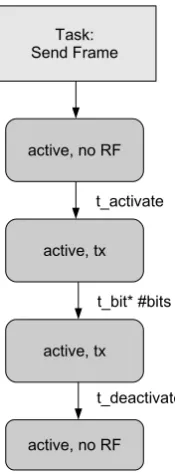
Fig. 2. Parametric flowchart for frame transmission.
– Every state in the FSM is associated with an energy
con-sumed per time.
– Every transition in the FSM is associated with a time
needed to switch between two operational states.
– The FSM has a well-defined initial state that
corre-sponds to the stable state a component reaches after power up.
All the times and energy consumptions associated with states and state transitions can be obtained by relatively simple measurements or from data sheets.
Once every component of a sensor node has been mod-eled as a FSM a similar model for the whole sensor node can be constructed. Basically it is the product automaton of all component models. As usually only the microcontroller can trigger state changes the product automaton can be greatly re-duced, because only in states with an active microcontroller other components can change their states.
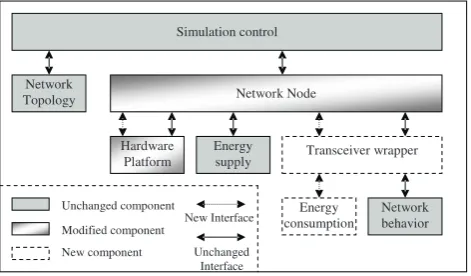
Fig. 3. Structure of the simulator integration framework.
are part of the runtime environment. The complete dynamic behavior of a node can be formalized as a set of communi-cating state machines. This holds for the SDL model, which is based on state machines, as well as the runtime environ-ment that executes the SDL model. These state machines have common actions with the state machine describing the nodes hardware. An example for a part of a nodes dynamic behavior is given in Fig. 2. It represents the task of sending one frame of a given number of data via the wireless inter-face to a distant node. It starts in the state where the micro-controller is the only active component of the sensor node. It then triggers the transceiver to transmit one frame. The number of data bytes to be transmitted is the parameter in this case and determines the amount of time spent in trans-mit mode. After transmission the transceiver is deactivated again to save energy and the initial state is reached again.
From these flowcharts it is very easy to calculate the en-ergy consumed by the specified task, conforming to Eq. (1). HerePstateis the power consumed in the state “state”,tstateis the time spent in this state.Ptransandttransare the power and time for the transitions between to states.
E=X state
Pstate·tstate+
X
trans
Ptrans·ttrans (1)
This analytic model can be integrated in a simulator, of-fering the possibility to perform simulations that predict the energy consumption of a system very accurately.
3 Simulator integration methodology
To simulate the energy consumption of an array of sensor nodes accurately, it is necessary to capture all relevant sim-ulation artifacts that affect the behavior of the sensor node array, i.e. platform resources, network resources, and energy resources. This is due to the fact that one simulated artifact can significantly affect all of the other simulated artifacts, and therefore change the outcome of the simulation. For ex-ample, the energy consumption of a sensor node participating
51-pin expansion connector μ-Controller ATMega 128L
flash RAM AT45DB041B
RF-Frontend Chipcon CC2420
3 LEDs serial-number
chip
2 page buffer UART
Fig. 4. Architecture of MICAz.
in a large sensor network is significantly affected by its wire-less transceiver chip. The transceiver chip is used for com-municating with other network nodes. Due to network col-lisions and bandwidth limitations, it is possible that a large number of transmission errors occur, changing the commu-nication pattern of every network node, and thus affecting the energy consumption. Furthermore, platform limitations like inaccurate timers can make this effect worse by intro-ducing jitter into time-synchronized networks. To capture all of these effects, a number of highly specialized simulators are necessary (SAM, 2006).
In (SAM, 2006), it has been shown that simulators for simulating network behavior are already available, that these specialized simulators can be turned into simulation compo-nents, and that they can be interconnected using a message based interface to form a system simulator. To integrate the simulation of energy consumption, two steps must be per-formed: The state machines describing a nodes energy con-sumption must be integrated, and the message based inter-faces for coupling simulation of energy consumption with the remaining parts must be integrated into the system simu-lator. Therefore, two methodologies are supported:
– Integration of energy consumption into already existing
simulators is feasible in the case, that a simulation of the energy consumption of a hardware component is al-ready included in a simulation component. In this case, only an interface must be implemented into the simula-tion component. The Avrora simulator (Avrora, 2005) includes already the simulation of energy consumption.
– Integration of energy consumption as new simulation
Transceiver (CC2420)
Microcontroller (ATMega 128L)
Power Down VReg off 0.001 mA
Send [8.5..17.4]mA Idle
0.426mA
Receive 18.8mA
Power Down 0.02mA Operating−Mode Clock−Cycle−Divider
Divider off Divide[2..129]Divider on
Idle 4mA
Active / 8mA
ADC−MODE
1mA Ext. Standby0.16mA Power Save0.009mA Standby*1mA PowerDown*0.3µA on/8
off/8
idle/4c adc/4c
estdby/4c
save/4c act/16000c
act/10c act/10c
act/4c
VReg on/600µs
idle/1000µs
receive/192µs send/192µs
send/192µs
ready/192µs pd/0
idle/0
interrupt/10c
stdby/4c interrupt /16000c
pd/4c
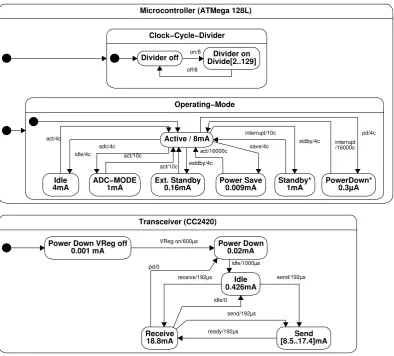
Fig. 5. Energy model of MICAz (only microcontroller and transceiver).
Both methodologies can easily be integrated into the sim-ulator framework. Figure 3 shows the integration of both methodologies for the simulated hardware platform, and for the simulated network. It is shown, that the central compo-nent “Network Node”, which is part of the simulator frame-work needs to be changed to integrate the energy consump-tion into the simulaconsump-tion. This is necessary, because this com-ponent controls all simulators that simulate one node. For the simulated hardware, it was feasible to integrate the en-ergy consumption into the already available simulator. For the simulation of the wireless network, a new component implementing the energy model was created, and the simula-tion component for the network behavior was replaced with a wrapper, distributing simulator messages among the original simulation component for network behavior and the added component that tracks the energy consumption.
4 Energy model for MICAz
The MICAz from Crossbow Technology is a typical wire-less sensor node. It features an 8-bit Atmel microcontroller
with RISC architecture, clocked at 7.3728 MHz, with 4 kB of internal SRAM and 4 kB data EEPROM as well as 128 kB of internal flash memory. The ZigBee-compliant wireless transceiver chip operates at data rates up to 250 kbit/s. A 512 kB flash memory can be accessed via two SRAM page buffers of 264 bytes each. Three LEDs can be used to show the operational status of the device and each node is equipped with a serial-number chip that gives a node its unique ID. The MICAz has a 51-pin expansion connector as an interface to arbitrary sensors. Figure 4 shows the overall architecture.
As the MICAz operates at a constant input voltage of 3 V, the energy consumption for every state is given in mA. For the transceiver send state, however, there is not a single value given, but a range of energy consumption. The actual con-sumption in this state depends on the chosen output power of the transceiver chip. It is remarkable that even at the highest output power the energy consumption is lower than in receive mode.
5 Energy-optimization using energy-models
Energy optimization can be performed on several levels. It can be optimal for the node, for a few nodes or for a whole network. With the simulators described above it is possi-ble to analyze and optimize the consumed energy on each level. For the optimization of a network, special protocols like MacZ (MacZ, 2006), which is currently under develop-ment, are needed. The first attempt is the reduction of con-sumed energy for a single node. For this task accurate mod-els for the used hardware are needed. With our modmod-els of the MICAz we have extended the scheduler of the specification language SDL to optimize energy. SDL is a reactive lan-guage with additional timers. This enables the lanlan-guage to react on external events, like interrupts or even after a spec-ified time period. SDL expects a continuous timebase and therefore the microcontroller has to wake up in regular in-tervals to increase the timebase. If no timer is expired and no external signal has arrived the microcontroller can enter a lower energy state. The entered energy state is chosen from the model and is based on the active components. In some cases the operating mode with the lowest consumption can-not be entered, e.g. due to an active transfer via the serial (UART) interface or because the wake up-time is longer than to the next scheduled timer.
To verify the results of the simulator and test the sched-uler, a small example application was specified. The appli-cation gets temperature measurements every 10 s via serial communication link and send an average value every minute to another station of the same kind.
The measurement of the consumed energy for a time of 10 min shows that the consumption using the scheduler is re-duced from 16.2 J to 3.09 J. Using the scheduler for this ex-ample application saves 80% energy. This consumption can be reduced in a future version if the precision of the timers is not so important. In the current implementation of the sched-uler the precision of the timebase is set to 163841 s, which is the same as without the new scheduler. Since the microcon-troller has to wake up at least every 7 ms, it is planned to reduce this precision, if energy is more important.
6 Conclusions and future work
In this paper we presented a simple yet effective method-ology to create energy models for wireless sensor nodes.
These models consist of two parts: a FSM modelling en-ergy consumption in the different states a node can be in, and flowcharts that represent power saving best-practice-strategies for the dynamic behavior of the node in typical scenarios. We have shown how the energy models can be integrated in platform simulators to simulate a complete net-work of sensor nodes taking platform resources, netnet-work re-sources, and energy resources into account.
In a case study, we have used the proposed methodology to obtain an energy model for a MICAz sensor node and have used the modified SDL scheduler for an automated genera-tion process for energy optimized code. This way we could show that a MDD process can generate energy optimized code directly from an SDL specification. Compared to an implementation that does not facilitate power saving strate-gies we measured an improvement in energy consumption of 80%.
Future work will focus on the modelling of energy sources enabling the nodes to estimate their remaining run time. Quality of service degradation or changing roles in a network can benefit from this.
Acknowledgements. This work was financed in context of the BelAmI-Project (BelAmI, 2006).
References
Avrora: Avrora Simulator, http://compilers.cs.ucla.edu/avrora, 2005.
BelAmI: Bilateral German-Hungarian Collaboration Project on Ambient Intelligence Systems, http://www.belami-project.org, 2006.
International Telecommunications Union: Specification and De-scriptionLanguage (SDL), ITU-T Recommendation Z.100, Au-gust 2002.
Kuhn, T.: MacZ – a QoS MAC Layer for Ambient Intelligence Sys-tems, in: Advances in Pervasive Computing 2006, edited by: Pfeifer, T., Schmidt, A., Woo, W., et. al., Adjunct Proceedings of the 4th International Conference on Pervasive Computing, [email protected], Vol. 207, Austrian Computer Society (OCG): Vi-enna, 244 pp., ISBN 3-85403-207-2, 2006.
MICAz: MICAz ZigBee Series (MPR2400), http://www.xbow. com/Products/productsdetails.aspx?sid=101, 2006.
SAM06: Kuhn, T. and Becker, P.: A Simulator Interconnection Framework for the Accurate Performance Simulation of SDL Models, Springer LNCS 4320, ISBN 3-540-68371-2, 2006. Senger, R., Marsman, E., and Brown, R.: Methodology for
Instruction Level Power Estimation in Pipelined Microsys-tems, https://domino.research.ibm.com/acas/w3www acas.nsf/ images/conf05/$FILE/senger.pdf, 2005.