Malaya Journal of Biosciences 2015, 2(1):91-95 ISSN 2348 6236 print / 2348 3075 online
REVIEW ARTICLE
Open Access Full Text Article
Phytochemical
and
pharmacological
review
of
Andrographis echiodies
D. Mathivanan and S. R. Suseem
*Pharmaceutical Chemistry Division, School of Advanced Sciences,VIT University, Vellore - 632014, Tamil Nadu, India. *For correspondence: [email protected]
Article Info: Received 02 May 2015; Revised: 12 June 2015; Accepted 18 June 2015
ABSTRACT
Andrographis echiodies belongs to Acanthaceae family, used for various medicinal purposes in South Asia particularly India and China. This medicinal plant was extracted by different solvents and its medicinal properties were identified by various technique. Based on the literature, this plant possess pharmacological properties include antimicrobial activity, anti-inflammatory, diuretic, anthelmintic, analgesic, antipyretic, hepato-protective activities and antioxidant effect. It contains plenty of phytochemical constituents such as flavonoids, flavones, steroids, tannins, carbohydrate, glycosides and alkaloids.
Keywords: Andrographis echiodies, Acanthaceae, Medicinal properties, phytochemical Analysis
1. INTRODUCTION
Plants are containing more number of medicinal properties and it should be used to treat many diseases in humans. It contains plenty of medicinally bio-active compounds which are used to cure many diseases across the world. India is one of the countries contains more than 45,000 plant species, out of that 15,000-20,000 plants are showing good medicinal properties, but currently 7,000-7500 plants only used for medicinal purposes [1]. Herbal drug companies are growing very fast in international market because modern medicine causes some health
hazards problem [2]. Andrographis echiodies plant is
located in dry land of south Asian countries. The leaf
juice of A. echiodies is used to cure fevers. Genus of
Andrographis family plants are used to cure various diseases like goiter, liver diseases, fertility problems, bacterial, malarial and fungal disorders [3,4].
Andrographis echiodies boiled with coconut oil is used to decrease the falling and graying of hair [5].
Taxonomical Classification
Kingdom : Plantae, Plants
Subkingdom : Tracheobionta - Vascular plants
Superdivision : Spermatophyta - Seed plants
Division : Magnoliophyta - Flowering plants
Class : Magnoliopsida - Dicotyledons
Subclass : Asteridae
Order : Scrophulariales
Family : Acanthaceae - Acanthus family
Genus : Andrographis Wall. ex Nees -
false water willow
Species : Andrographis echioides (L.)
Nees - false waterwillow [6].
Malaya
Journal of
Biosciences
Vernacular names
Common name : False Waterwillow Tamil : Gopuram tangi Gujarati : Kalukariyatum Malayalam : Pitumba Marathi : Ranchimani
Oriya : Lavalata
Habitat
Andrographis echiodies is an herbaceous plant widely located indry area of southern Asain countries
[7]. The flowering season of Andrographis echiodies
is March-June and October-December [8].
Morphology
Andrographis echiodies plant contains more number of branchlets to 50 cm long. Leaves are elongated form with approximately parallel sides to broad rounded apex and a tapering base and are sub-sessile with glandular hairs on both abaxial and adaxial surface. The stem is slightly quadrangular with hairs on its surface. The plant shows Raceme type of inflorescence not exceeding the leaves and is scarcely branched. The calyx of the flower is with sub equal lobes, lanceolate with glandular hairs. Corolla is white with brown tinge. It is tubular, showing the 2+3 lipped condition, which are unequal. Stamens-2, exserted and straight, style slender, with capitate stigma. The capsules are ovoid, sparsely hairy, pointed above and narrowed below. The average number of the capsule per plant is 38, seed are yellow in colour and ovoid. Four seeds per capsule, 1.5mm across and glabarous. By The free hand sections, the anatomical characters of root stem and leaf were observed [9].
LEAF: The transverse section of leaf shows the
upper and lower epidermis with glandular hairs. The mesophyll, in between the epidermis is made of palisade cells and spongy cells. The palisade parenchyma cells compactly arranged without any intercellular spaces. The spongy cells are loosely arranged with intercellular space and air cavities for gaseous exchange. In the midrib region the stele is
surrounded a layer of compactly arranged
parechymatous cells. The stele is limited by the boarded parenchyma cells. The xylem is facing the upper epidermis where the phloem is towards the lower epidermis [9].
STEM: T.S of the stem shows the well-defined
epidermis with epidermal hairs. It is followed by the hypodermis and the chlorenchymatous cortex.
The xylem elements are spherical in shape. The xylem is endarch. The phloem is encircling the xylem. Prominent pith is present in the centre. The pith cells are polygonal and are compactly arranged [9].
ROOT: The outermost covering of the root is the
epidermis which is composed of single layer of barrel shaped epidermal cells. It lacks stomata and cuticle. The epidermis is followed by the compactly arranged parenchymatous cortex. Secondary growth is present. The phloem is towards the epidermis and the xylem are at the centre [9].
Part used from Andrographis echiodies
Whole plant, leaves and stem.
Chemical constituents from Andrographis echiodies
From the leaves extract of A.echiodies, various
chemical constituents were isolated
dihydroechioidinin , skullcap avone 1 2'-methyl ether, echioidinin, echioidin, skullcap avone 1 and 2'-O-b-D-glucopyranoside [10]. Some of the other chemical
constituents present in the A. echiodies are more than
17 compounds such as borneol (2.6%), cyclohexanol 2,4 dimethyl phenol (1.89%), 3,4 altroson (3.5%), n-deconoicacid (15.29%), Squalene (22.57%), vitamin
E (7.40%), Methoprene (1.53%), 2-nonenlol
Oxirane,octyl-, 2, 2-cyclopentene-1-undecanoic acid, ketone, 1,5-methylbicyclo [2.1.0] pent-5-ylmethyl (10.61%) and 2,cyclohexadiene-1,4- dione, 2, 5-dihydroxy-3-methyl -6- (1-methylethyl) bicycle heptan -3- one, 2,6,6-trimethyl (1à,2á,5à) (1.60%), (-)-3-á-Acetoxy-5-etienic acid(3.0%). The medicinal propities of these compounds needs further research which can pave way to further applications and utility of A. echioides in pharmaceutical field [11].
Pharmacological Activity of Andrographis echiodies
Diuretic Activity
Diuretic activity of petroleum ether and chloroform
extract of Andrographis echiodies leaves was studied
by Raama Murthy et al (2012). Chloroform extract of
A.echiodies exhibited significant diuretic activity as evidenced by increased total urine volume and the
urine concentration of Na+, K+ and Cl-. The result of
Mathivanan and Suseem., 2015 / Malaya Journal of Biosciences 2015, 2(1):91-95
Antimicrobial Activity
Petroleum ether, chloroform, acetone and methanol
extract of A. echioides leaves and stems were
screened for its preliminary phytochemical analysis. The antimicrobial activity of the crude extract was
evaluated by Sermakkani et al., (2011) against
Candida albicans [13].
Anthelmintic Activity
Padma et al., (2012) evaluated the anthelmintic
activity of ethyl acetate, methanol and aqueous
extract of whole plant of Andrographis echioides
against Pheretima posthuma. The results revealed
that the test extracts of A. echioides exhibited
significant anthelmintic activity at concentration of
50 mg/ml. The use of A. echioides as an anthelmintic
has been confirmed and further studies are suggested to isolate the active principles responsible for the promising activity [14].
Hepatoprotective and antioxidant effect
In this study the methanolic extract of A. echioides
was investigated for its hepato protective and antioxidant effects against acetaminophen induced hepatotoxicity in wistar albino rats was studied by
Basu et al., (2009) [15].
Anti-inflammatory, analgesic and antipyretic
activity
Basu et al., (2009) evaluated the anti-inflammatory,
analgesic and antipyretic activity of ether,
chloroform, and ethyl acetate extract of Andrographis
echioides in rats and mice. The results suggest that
different extracts of A.echioides produce
antinociceptive, anti-inflammatory and anti-pyretic activities that could be due to the effect of one or a combination of the bio-active components in each extract [16].
Anti-ulcer activity
Anti-ulcer activity of ethanol extract of Andrographis
echioides was evaluated by Ramasubramania Raja et
al., (2014). The extracts have shown potential
anti-ulcer activity in all tested models [17].
Synergistic effect
Sankaran Rajkumar et al., (2012) studied the
synergistic effect of leaves of Andrographis
echioides. It is subjected to Soxhlet extraction using ethanol as solvent. The plant alcoholic extract was
examined against 4th instar larvae of A. aegypti with
gradually increasing concentration from 50 to 250mg/L using WHO protocol. From the results it
can be concluded that synergistic effect of A.
echioides as a more powerful arsenal for control of A. aegypti [18].
Phytochemical Analysis of Andrographis echiodies
The whole plant of Andrographis echiodies contains
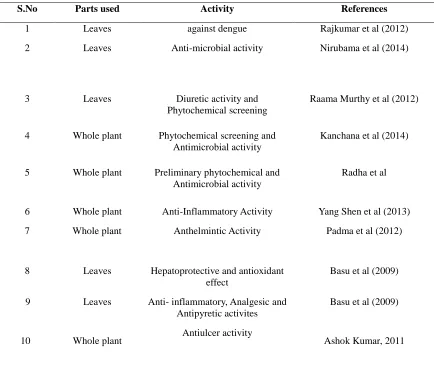
more number of phyto-constituents that are extracted using various solvents depending upon the polarity of these compounds. The isolated compounds are listed below in Table.1.
Kanchana et al., (2014) reported that petroleum ether,
chloroform, ethyl acetate and hydro-alcoholic extracts contains flavonoids, saponins, tannins,
phenols, terpenoids and steroid [5]. Raama Murthy et
al., (2012) reported the presence of glycosides,
flavanoids, flavones, steroids, tannins, carbohydrate,
glycosides, alkaloids, proteins, amino acids
andsaponins in petroleum ether and chloroform
extract [12]. Sermakkani et al., (2011) reported that
petroleum ether, chloroform, acetone and methanol extract contains alkaloids, flavonoids, glycosides, steroids, phenols, tannins and saponins [13]. Padma
et al., (2012) reported that ethyl acetate, methanol and water extract contains alkaloids, flavonoids, glycosides, phenols, phytosterols, proteins, saponins, tannins and triterpenoids [14]. Ramasubramania Rajaet al., (2014) reported the presence of alkaloids, flavonoids, terpenoids, tannins, volatile-oils, amino acid, cardiac glycosides, gums and phytosteroids in ethanol extract [17].
Conclusion
Review on Andrographis echioides showed that it
contains enormous amount of phytochemical
Table 1. Works reported on Andrographis echiodies
References
1. Ankita Kataky and Handique. (2010) A
Brief overview on Andrographis Paniculata
(Burm. f) Nees, A High valued medicinal
plant: Boon over synthetic drugs. Asian
Journal of Science and Technology, 6: 113-118
2. Alok Sharma, Shanker, Lalit Kumar Tyagi,
Mahendra Singh and Ch.V.Ra. (2008) Herbal Medicine for Market Potential in
India: An Overview. Academic Journal of
Plant Sciences, 1(2): 26-36.
3. Kirtikar et al (1975) In Indian medicinal
plants, 3. NewDelhi: Periodical Experts.
4. Zulfkar Latief Qadrie, Beena Jacob,
Anandan, Rajkapoor and Mohammed
Rahamath Ulla. (2009) Antibacterial activity
of ethanol extracts of Indoneesiella
echioides evaluated by the filter paper disc
method. Pakistan Journal of
Pharmaceutical Sciences; 22:123-125.
5. Kanchana Nirubama, Rubalakshmi. (2014)
Phytochemical Screening and Antimicrobial
Activity of Andrographis Echioides (L.)
Nees – An indigenous medicinal plant.
World Journal of Pharmacy and Pharmaceutical Sciences; 3(5):702-710.
6. Pandi Kumar. (2007) Medicinal plants used
by Malasar tribes of Coimbatore district,
Tamil Nadu. Indian Journal of Traditional
Knowledge; 6:579-82.
7. John T Kartesz. (1964).
Andrographisechioides (L.) Nees false water willow natural resources conservation
S.No Parts used Activity References
1 Leaves against dengue Rajkumar et al (2012)
2 Leaves Anti-microbial activity Nirubama et al (2014)
3 Leaves Diuretic activity and
Phytochemical screening
Raama Murthy et al (2012)
4 Whole plant Phytochemical screening and
Antimicrobial activity
Kanchana et al (2014)
5 Whole plant Preliminary phytochemical and
Antimicrobial activity
Radha et al
6 Whole plant Anti-Inflammatory Activity Yang Shen et al (2013)
7 Whole plant
Anthelmintic Activity Padma et al (2012)
8 Leaves Hepatoprotective and antioxidant
effect
Basu et al (2009)
9
10
Leaves
Whole plant
Anti- inflammatory, Analgesic and Antipyretic activites
Antiulcer activity
Basu et al (2009)
Mathivanan and Suseem., 2015 / Malaya Journal of Biosciences 2015, 2(1):91-95
service united state department of
Agriculture.
8. Nandkarni (1976). Indian material medical
popular book depot: Bombay; 101-102
9. Anandanayaki and Uma (2014).
Pharmacognostical and Phytochemical
Studies on Andrographis Echioides (L) Nees
International Journal of Advances in Pharmacy, Biology and Chemistry IJAPBC; 3(3) 77-88.
10. Jayaprakasam Damua, Gunasekara, Blond,
Bodo (1999). Dihydroechioidinin, a avanone
from Andrographis echioides.
Phytochemistry,; 1(3): 92-97.
11. Nirubama, Kanchana and Rubalakshmi
(2014). Bioactive Compounds in
Andrographis echioides (L.) Nees. Leaves
by GC-MS Analysis Int. J. Curr. Res. Biosci.
Plant Biol,; 1(3):92-97
12. Raama Murthy Rajaraman and Meera.
Phytochemical Constituents and Diuretic
Activity of Leaf Extracts of Andrographis
echioides-L-Nees IJPCS 2012; 1(4):1315-1321
13. Sermakkani Radha and Thangapandian
(2011) Evaluation of preliminary
Phytochemical and antimicrobial activity of
Andrographis echioides (L) Nees Pharma Science Monitor,; 2 (2): 92-101
14. Padma Sarojini, Devi, Manjunatha, Philip
and Venkata Raju Preliminary (2012). Phytochemical Screening and Anthelmintic
Activity of Andrographis echioides Nees
Journal of Pharmacy Research, 5(9): 4801-4803.
15. Basu, Rupeshkumar and Kavitha (2009)
Hepatoprotective and antioxidant effect of
Andrographis echioides N against
acetaminophen induced Hepatotoxicity in
Rats journal of biological sciences,;
9(4):351-356.
16. Basu, Rupeshkumar and Kavitha (2009)
studies on the anti-inflammatory, Analgestic
and antipyretic properties of Andrographis
echioides nees. International Journal of pharmacology,; 5(4):251-256.
17. Ramasubramania Raja (2014)
Pharmacognostical phytochemical and
anti-ulcer activity of Andrographis echioides
(Acanthaceae) Journal of Pharmacognosy
and phytochemistry 3 (3): 39-49.
18. Sankaran Rajkumar Arulsamy Jebanesan,
Rajarathinavelu Nagarajan (2012).
Synergistic effect of Andrographis echioides
and Cadaba trifoliate leaf extracts against
larvae of dengue mosquito Aedes aegypti