R E S E A R C H A R T I C L E
Open Access
Circulating serotonin levels in COPD
patients: a pilot study
Pietro Pirina
1,2*, Elisabetta Zinellu
1, Panagiotis Paliogiannis
3, Alessandro G. Fois
2, Viviana Marras
2,
Salvatore Sotgia
3, Ciriaco Carru
3and Angelo Zinellu
3Abstract
Background:Chronic obstructive pulmonary disease (COPD) is a major and increasing global health problem. Serotonin is a neurotransmitter that participates in several pulmonary functions and it has been involved in oxidative stress, which plays essential roles in the pathogenesis of COPD. The current study aimed at establishing the levels of circulating serotonin in COPD, and investigating eventual relations between serotonin and oxidative stress markers.
Methods:Whole blood serotonin was assessed in 43 consecutive patients with stable COPD and in 43 age and sex-matched healthy controls.
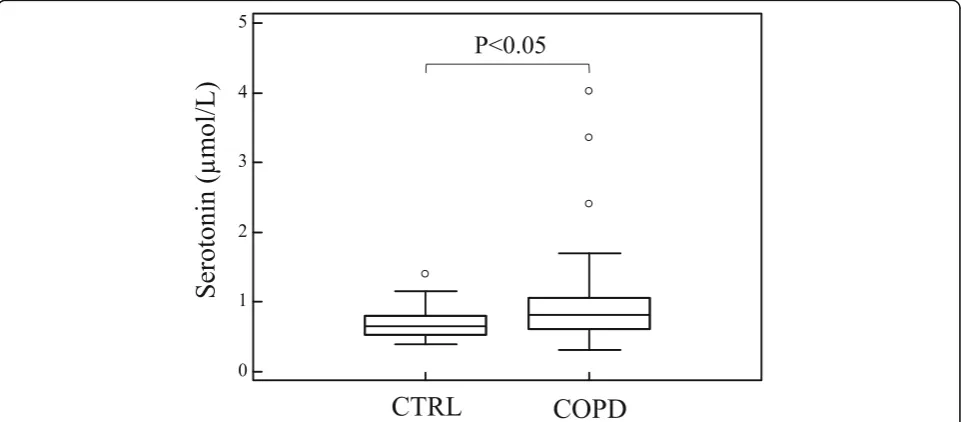
Results:Serotonin blood levels were significantly higher in COPD patients than in controls (median 0.81 μmol/L, IQR: 0.61–4.02 vs 0.65 μmol/L, IQR: 0.53–1.39, p= 0.02). The univariate logistic regression analysis evidenced that serotonin levels are independently associated with presence of COPD (crude OR = 7.29, 95% CI: 1.296–41.05, p= 0.003) and such an association was confirmed also after adjusting for several confounders (OR 21.92, 95% CI 2.02–237.83; p= 0.011).
Conclusions: Our study showed higher levels of circulating serotonin in COPD and an inverse correlation with the worsening of airway obstruction. Future studies are necessary to investigate the clinical utility of this finding.
Keywords:COPD, Oxidative stress, Serotonin, Markers
Background
COPD is an increasing global health problem that now-adays represents the third leading cause of death in the world [1, 2]. It is a chronic progressive disease charac-terized by a not fully reversible airflow limitation, asso-ciated with a chronic inflammation of the lungs and small airways [3, 4]. Although cigarette smoking repre-sents the most known risk factor, in-door and out-door pollution, second-hand smoking and genetic condi-tions, such as α1 antitrypsin deficiency, are considered
important additional risk factors [5–7]. The noxious compounds present in cigarette smoke and in environ-mental pollution, trigger the inflammatory response of the airways and the lungs in susceptible subjects,
causing epithelial injury with subsequent production of
reactive oxygen species (ROS) [8, 9]. The increased
amount of oxidants together with the depletion of anti-oxidant defenses, results in oxidative stress. It is now recognized that oxidative stress is involved in the pathogenesis of COPD [9, 10] and, in this regard, sev-eral biomarkers have been evaluated [11].
Serotonin (5-hydroxytyptamine, 5-HT) is a ubiqui-tous neurotransmitter that plays important roles in pulmonary functions, being involved in the modula-tion of respiratory rhythm and in pulmonary
vasocon-striction [12, 13]. Furthermore, serotonin has been
implicated in the pathogenesis of some of the main
comorbidities of COPD, like depression [14, 15]
des-pite the relation between serotonin, COPD and de-pression is still to be verified.
Moreover, serotonin has been reported to induce oxi-dative stress via monoamine oxidase-dependent
path-way in human heart valves [16] and in mesenchymal
* Correspondence:[email protected] 1
Department of Respiratory Diseases, University Hospital Sassari (AOU), Sassari, Italy
2Department of Clinical and Experimental Medicine, University of Sassari,
Sassari, Italy
Full list of author information is available at the end of the article
stem cells [17] indicating that serotonin metabolism may be involved in oxidative stress. Its role in the gen-esis and maintenance of oxidative stress in COPD pa-tients is not well-established. In this pilot study we focused on the assessment of blood serotonin levels in COPD patients compared to healthy controls and in relation to airway obstruction severity; we have also evaluated potential associations between serotonin and oxidative stress markers, like thiobarbituric acid react-ive substances (TBARS) and protein sulfhydryl groups (PSH), which have been demonstrated in previous stud-ies to be altered in patients with COPD [18,19].
Methods Subjects
This case–control pilot study involved 43 consecutive
patients with stable COPD (mean age 74.8 ± 5.9 years, range 52–85 years), treated at the Respiratory Unit of the University of Sassari.
The diagnosis of COPD was made in accordance with the Global Initiative for Chronic Obstructive Lung Disease criteria [20]. The patients enrolled did not have a previous diagnosis of COPD and they were not under
treatment with long- or short-acting β-agonists, or
long-acting muscarinic antagonists, as well as with in-haled corticosteroids at least within 4 weeks prior to enrollment. Each patient performed respiratory func-tion tests and underwent physical examinafunc-tion, blood tests and chest radiographs. The functional diagnosis of COPD was based on the presence of not fully reversible airflow limitation, defined by a post-bronchodilator ra-tio of forced expiratory volume in 1 s to forced vital capacity (FEV1/FVC) < 70% of the predicted value [4]. In order to collect demographic and clinical data, including smoking history and information about occu-pational and/or in-door and out-door pollutants expos-ure, a structured questionnaire was administered. In particular, patients who were never smokers, had been exposed to other COPD risk factors: half of them were women exposed to second-hand smoke, three of them had worked as miners and therefore exposed to silica powders and two of them had been exposed to indoor pollutants (biomass heating, etc).
A group of 43 age- and sex-matched healthy controls, with no medical history, was also included. Subjects with severe concomitant diseases, such as heart diseases, kid-ney and liver diseases, systemic inflammatory diseases, patients with severe COPD and patients with a history of asthma and atopic diseases, were excluded from the study. The study was approved by the Institutional Local Ethics Committee (Azienda Sanitaria Locale n°1 di Sassari (Italy) (prot. 2175/CE del 21/04/2015). The subjects who decided to participate, signed a written in-formed consent before enrollment.
Biochemical analysis
The levels of serotonin in whole blood of COPD sub-jects and healthy controls were determined according to a method previously described [21]. The inter-assay CV was < 8%. The oxidative stress indices TBARS and
PSH were measured as previously reported [22, 23].
TBARS assay was employed to measure malondialde-hyde (MDA) and other aldemalondialde-hydes produced by lipid peroxidation induced by reactive oxygen species. TBARS were determined by measuring the absorbance at 535 nm after reaction with thiobarbituric acid. A calibration curve was obtained using MDA as reference standard. Plasma PSH determination was performed by
spectrophotometry with 5,5′-dithiobis-2-nitrobenzoic
acid (DTNB) as titrating agent by measuring the ab-sorbance of conjugate at 405 nm. Concentration in samples was determined from a GSH standard curve. ROS can oxidize protein SH to disulfide or sulfenic acid, leading to a reduction in–SH groups.
Statistical analysis
The results are expressed as mean (mean ± SD) or me-dian values (meme-dian and IQR). The distribution of vari-ables was evaluated by means of Shapiro-Wilk test. The statistical comparisons between groups were assessed by
means of unpaired Student’s t-test or Mann-Whitney
rank sum test, as appropriate. Correlations between
variables were estimated using Spearman’s or
Pearson’s correlation, as appropriate. In order to
verify the presence of association between variables potentially implicated in disease development, logistic regression analysis was performed. Receiver operating characteristics (ROC) curve analysis was used to test the ability of serotonin to predict COPD, alone and in combination with TBARS and PSH. ROC curves were obtained with calculation of the area under the curve (AUC). Optimal cut-off maximizing sensitivity and specificity was selected according to the Youden Index.
Statistical analyses were performed using MedCalc for Windows, version 15.4 64 bit (MedCalc Software, Ostend, Belgium) and SPSS for Windows, version 14.0 32 bit (IBM Corporation; Armonk, NY, USA).
Results
Table1reports the demographic and clinical characteris-tics in controls and COPD patients. As expected, COPD
patients showed a reduced FEV1 and FEV1/FVC ratio.
There were no between-group differences in smoking status or BMI. Serotonin blood levels were significantly
higher in COPD patients (median 0.81 μmol/L, IQR:
concentrations significantly decreased, according to
COPD presence [18]. However, no significant
correla-tions were observed between serotonin blood levels
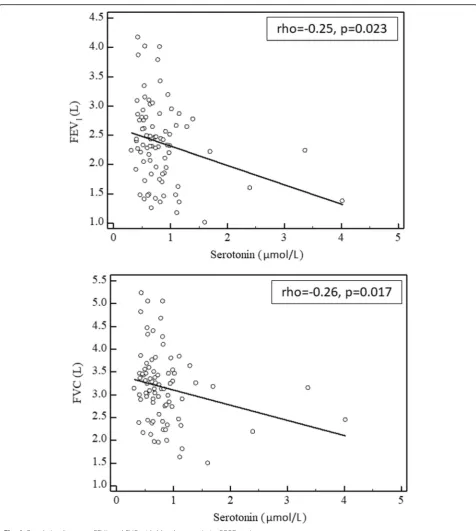
and oxidative stress indices. As reported in Fig. 2,
Spearman’s correlations in the whole study population
indicated that serotonin blood values are inversely
as-sociated with FEV1 (rho =−0.25, p= 0.023) and FVC
(rho =−0.26, p= 0.017). Table 2 summarizes the
re-sults of the univariate logistic regression analysis, which evidenced that serotonin levels were independ-ently associated with presence of COPD (crude OR = 7.29, 95% CI: 1.296–41.05, p= 0.003). This association remained significant also after adjusting for age, gen-der, BMI, smoking status, and oxidative stress indices
(OR 21.92, 95% CI 2.02–237.83; p= 0.011).
ROC curve analysis was performed to evaluate the sensitivity, specificity, and diagnostic accuracy of serum serotonin levels alone, or in combination with PSH and TBARS, in distinguishing COPD from healthy subjects (Fig. 3 and Table 3). Serotonin alone, with a cut-off of
0.78 μmol/L discriminated COPD from controls with
53.5% sensitivity and 74.4% specificity (AUC = 0.647,
95% CI 0.537–0.747, p= 0.014). Serotonin in
combin-ation with PSH and TBARS produced the best result, with an AUC of 0.830 (95% CI 0.733–0.902,p< 0.0001), sensitivity 76.7% and specificity 74.4%. Pairwise compari-son of ROC curves indicated that the combination of serotonin, PSH and TBARS yield a significant increase
in AUC (+ 0.183,p= 0.0035) compared to AUC obtained
with serotonin alone.
Discussion
Serotonin is a biogenic amine known for its role as a neurotransmitter. It is synthesized from L-tryptophan within the central nervous system (CNS), where it is stored in the presynaptic neurons. Serotonin synthesis outside the CNS is limited to enterochromaffin cells, while platelets take up serotonin from plasma repre-senting a further major storing site for serotonin [24]. The main metabolic pathway of serotonin is the Table 1Clinical and functional parameters of healthy subjects
and COPD patients
Controls (n= 43)
COPD (n= 43) Age (years) 73 ± 7 75 ± 6 Gender (F/M) 9/34 9/34 BMI (kg/m2) 26 ± 4 27 ± 4 Never smoked 14 (33%) 10 (23%) Current smokers 3 (7%) 3 (7%) Ex smokers 26 (60) 30 (70%) FEV1 (L) 2.8 ± 0.6 2.0 ± 0.6** FEV1 (% predicted) 112 ± 14 80 ± 18** FVC (L) 3.4 ± 0.7 2.9 ± 0.8* FVC (% predicted) 108 ± 15 88 ± 15** FEV1/FVC 80.4 ± 3.9 66.6 ± 4.8** RV (L) 2.0 ± 0.5 3.4 ± 0.9** RV (% predicted) 105 ± 12 137 ± 32** TLC (L) 6.0 ± 1.1 6.4 ± 1.1 TLC (% predicted) 107 ± 10 108 ± 14 RV/TLC (%) 32 ± 3 53 ± 9**
FEV1Forced Expiratory Volume in the 1st second,FVCForced Vital Capacity,
FEV1/FVCTiffeneau index (calculated as LLN) *p< 0.01, **p< 0.001 obtained by Student’s t-test
metabolism by monoamine oxidase (MAO) that cataly-ses the oxidative deamination of the amine substrate, with production of its aldehyde intermediate and hydrogen peroxide as a by-product. The aldehyde inter-mediate is then rapidly oxidized by aldehyde dehydro-genase to 5-hydroxyindoleacetic acid [24,25].
It is known that lung represent an important site in which removal and metabolism of serotonin take
place [26]. The ability of the endothelial cells of the lungs to metabolise amines may be reduced in disease states, and this could explain their increased levels in the circulation. Elevated circulating levels of serotonin have been reported in respiratory diseases such as
asthma [27] and lung cancer [28]. COPD has also
been associated with a variation of a transporter gene
involved in serotonin re-uptake [29] and metabolites
of the serotonin pathway have been associated with adverse outcome in exacerbated COPD [30]. Furthermore, it is now recognized that oxidative stress is involved in the
pathogen-esis of COPD [9, 10] and it has been reported that
serotonin induces oxidative stress via MAO-dependent
pathway in human heart valves [16] and in mesenchymal
stem cells [17]. Moreover, it has been described that
cigarette smoke, a major COPD risk factor, inhibit MAO in different species in vitro [31]. Such evidences suggest that serotonin may play relevant roles in the pathogenesis of COPD.
Our study has evidenced a significant increase in serotonin levels in COPD patients compared to
con-trols. Spearman’s correlations indicated that blood
serotonin values are inversely associated with FEV1 and FVC, to confirm an association of serotonin levels not only with the presence of COPD, but also with the severity of airway obstruction. The univariate logistic regression analysis has shown that serotonin levels were independently associated with presence of COPD also after adjusting for age, gender, BMI, smoking status, and oxidative stress indices.
Table 2Predicting factors for chronic obstructive pulmonary disease
Factor Univariate analysis Multivariate analysis
Crude OR 95%CI p-value OR 95%CI p-value Age 1.035 0.967–1.109 0.749 0.998 0.917–1.088 0.978 Gender 1.000 0.368–2.720 0.061 1.567 0.341–7.203 0.563 BMI 1.076 0.953–1.216 0.692 1.108 0.942–1.303 0.217 Smoking status 1.404 0.551–3.581 1.000 0.516 0.144–1.854 0.319 PSH 0.427 0.258–0.705 0.0001 0.289 0.144–0.580 0.0005 TBARS 1.816 1.053–3.131 0.02 2.947 1.322–6.570 0.008 Serotonin 7.294 1.296–41.05 0.003 21.92 2.02–237.83 0.011
BMIbody mass index,PSHprotein sulfhydryl groups,TBARSthiobarbituric acid reactive substances,ORodds ratio,CIconfidence interval
Lau et al. [32], investigated the role of serotonin in the pathogenesis of COPD and found higher levels of circulating serotonin in patients compared to healthy controls. Unlike us, they examined only male COPD subjects who were significantly older than controls, and found a positive correlation between serotonin levels and age in pathological subjects. Moreover, in their analysis they prevalently included moderate to very severe COPD cases, finding no differences in serotonin levels according to disease progression. In our study, we confirmed the presence of higher blood serotonin levels in COPD compared to age- and sex-matched controls. As opposed to the study of Lau et al., our patients had a mild-moderate degree of airway obstruction (FEV1 > 50%). From this point of view these patients can be considered in the early phase of the disease. In fact, they were all newly diag-nosed patients who had not yet started a treatment. These data support the hypothesis that serotonin could be a predictive marker of the onset of COPD. Moreover, the inverse correlation that we found be-tween serotonin levels and FEV1 and FVC, suggests a relation of this molecule with the worsening of airway obstruction.
The ROC curve analysis for serotonin significantly dis-criminate patients with COPD from those without COPD and showed that the diagnostic accuracy is higher when serotonin is combined with TBARS and PSH. In particular, the triple combination of serotonin, TBARS and PSH increased significantly the AUC of the ROC curve. Although it is an interesting result, its clinical validity and usefulness needs to be further investigated. Moreover, Spearman’s correlation analysis failed to find a relationship between serotonin and oxidative stress biomarkers. This could be due to the low number of subjects involved, in particular to the absence of severe COPD subjects. The small number of cases, and the lack of advanced stage COPD patients represent the main limitations of our work. On the other hand, our study is the first to investigate blood serotonin levels in a cohort of early COPD cases and has several strengths, like its prospective case-match design, the accurate statistical analysis, and the research of associations with other well-established biomarkers of oxidative stress.
Conclusions
Our study confirms literature data showing an involve-ment of serotonin in the pathogenesis of COPD, demon-strating a statistically significant increase of circulating serotonin levels in an early phase of the disease, and a re-lation with the worsening of the airway obstruction. Given the need of biomarkers useful to detect and monitor COPD and its response to treatments, this seems to be a promising result that need to be further investigated.
Abbreviations
5-HT:Serotonin; AUC: Area under the curve; BMI: Body mass index; CNS: Central nervous system; COPD: Chronic obstructive pulmonary disease; FEV1: Forced expiratory volume in the 1st second; FVC: Forced vital capacity; MAO: Monoamine oxidase; MDA: Malondialdehyde; PSH: Protein sulfhydryl groups; ROC: Receiver operating characteristics; TBARS: Thiobarbituric acid reactive substances
Acknowledgements
Not applicable.
Funding
This research did not receive any specific grant from funding agencies in the public, commercial, or not-for-profit sectors.
Availability of data and materials
The datasets generated and analysed during the current study are not publicly available.
Authors’contributions
PP1 participated in the design of the study and drafted the manuscript. EZ helped to draft the manuscript and contributed to the biochemical analysis. PP2 and AGF helped to draft the manuscript. VM and SS contributed to the biochemical analysis. CC contributed to the statistical analysis. AZ conceived and designed the study, was responsible for data extraction and performed statistical analysis. All authors have critically revised the manuscript and have approved the final version.
Ethics approval and consent to participate
The study was approved by the Institutional Local Ethics Committee (Azienda Sanitaria Locale n°1 di Sassari (Italy) (prot. 2175/CE del 21/04/2015), and was in accordance with the principles of Declaration of Helsinki. All subjects provided written informed consent.
Consent for publication
Not applicable.
Competing interests
The author Pietro Pirina is currently acting as an Associate Editor for BMC Pulmonary Medicine. All other authors declare that they have no competing interests.
Publisher’s Note
Springer Nature remains neutral with regard to jurisdictional claims in published maps and institutional affiliations.
Author details 1
Department of Respiratory Diseases, University Hospital Sassari (AOU), Sassari, Italy.2Department of Clinical and Experimental Medicine, University
of Sassari, Sassari, Italy.3Department of Biomedical Sciences, University of Sassari, Sassari, Italy.
Received: 16 November 2017 Accepted: 25 October 2018
References
1. López-Campos JL, Tan W, Soriano JB. Global burden of COPD. Respirology. 2016;21(1):14–23.
Table 3Prognostic accuracy of serotonin alone or in combination with TBARS and MDA
Marker AUC 95%CI pvalue Cut-off Sensib Specif Serotonin 0.647 0.537–0.747 0.014 > 0.780 53.5% 74.4% Ser-TBARS 0.741 0.635–0.829 < 0.0001 > 0.543 53.5% 88.4% Ser-PSH 0.764 0.660–0.849 < 0.0001 > 0.569 60.5% 86.1% Ser-PSH-TBARS 0.830 0.733–0.902 < 0.0001 > 0.460 76.7% 74.4%
PSHprotein sulfhydryl groups,TBARSthiobarbituric acid reactive substances,
2. Lozano R, Naghavi M, Foreman K, Lim S, Shibuya K, Aboyans V, Abraham J, Adair T, Aggarwal R, Ahn SY, Alvarado M, Anderson HR, Anderson LM, Andrews KG, Atkinson C, et al. Global and regional mortality from 235 causes of death for 20 age groups in 1990 and 2010: a systematic analysis for the Global Burden of Disease Study 2010. Lancet. 2012;380(9859):2095–128. 3. Decramer M, Janssens W, Miravitlles M. Chronic obstructive pulmonary
disease. Lancet. 2012;379:1341–51.
4. Vogelmeier CF, Criner GJ, Martinez FJ, Anzueto A, Barnes PJ, Bourbeau J, Celli BR, Chen R, Decramer M, Fabbri LM, Frith P, Halpin DM, López Varela MV, Nishimura M, Roche N, Rodriguez-Roisin R, Sin DD, Singh D, Stockley R, Vestbo J, Wedzicha JA, Agusti A. Global Strategy for the Diagnosis, Management, and Prevention of Chronic Obstructive Lung Disease 2017 Report: GOLD Executive Summary. Eur Respir J. 2017;49(3).https://doi.org/ 10.1183/13993003.00214-2017.
5. Mannino DM, Buist AS. Global burden of COPD: risk factors, prevalence, and future trends. Lancet. 2007;370:765–73.
6. Eisner MD, Anthonisen N, Coultas D, Kuenzli N, Perez-Padilla R, Postma D, Romieu I, Silverman EK, Balmes JR, Committee on Nonsmoking COPD, Environmental and Occupational Health Assembly. An official American Thoracic Society public policy statement: novel risk factors and the global burden of chronic obstructive pulmonary disease. Am J Respir Crit Care Med. 2010;182:693–718.
7. Gooptu B, Ekeowa UI, Lomas DA. Mechanisms of emphysema in alpha1-antitrypsin deficiency: molecular and cellular insights. Eur Respir J. 2009;34:475–88. 8. Larsson K. Aspects on pathophysiological mechanisms in COPD. J Intern
Med. 2007;262(3):311–40.
9. Kirkham PA, Barnes PJ. Oxidative stress in COPD. Chest. 2013;144(1):266–73. 10. Santus P, Corsico A, Solidoro P, Braido F, Di Marco F, Scichilone N. Oxidative
stress and respiratory system: pharmacological and clinical reappraisal of N-acetylcysteine. COPD. 2014;11(6):705–17.
11. Zinellu E, Zinellu A, Fois AG, Carru C, Pirina P. Circulating biomarkers of oxidative stress in chronic obstructive pulmonary disease: a systematic review. Respir Res. 2016;17(1):150.
12. Hilaire G, Voituron N, Menuet C, Ichiyama RM, Subramanian HH, Dutschmann M. The role of serotonin in respiratory function and dysfunction. Respir Physiol Neurobiol. 2010;174(1–2):76–88.
13. Morecroft I, Loughlin L, Nilsen M, Colston J, Dempsie Y, Sheward J, Harmar A, MacLean MR. Functional interactions between 5-hydroxytryptamine receptors and the serotonin transporter in pulmonary arteries. J Pharmacol Exp Ther. 2005;313(2):539–48.
14. Blier P, El Mansari M. Serotonin and beyond: therapeutics for major depression. Philos Trans R Soc Lond Ser B Biol Sci. 2013;368(1615):20120536. 15. Yohannes AM, Alexopoulos GS. Depression and anxiety in patients with
COPD. Eur Respir Rev. 2014;23(133):345–9.
16. Peña-Silva RA, Miller JD, Chu Y, Heistad DD. Serotonin produces
monoamine oxidase-dependent oxidative stress in human heart valves. Am J Physiol Heart Circ Physiol. 2009;297(4):H1354–60.
17. Trouche E, Mias C, Seguelas MH, Ordener C, Cussac D, Parini A.
Characterization of monoamine oxidases in mesenchymal stem cells: role in hydrogen peroxide generation and serotonin-dependent apoptosis. Stem Cells Dev. 2010;19(10):1571–8.
18. Zinellu A, Fois AG, Sotgia S, Sotgiu E, Zinellu E, Bifulco F, Mangoni AA, Pirina P, Carru C. Arginines plasma concentration and oxidative stress in mild to moderate COPD. PLoS One. 2016;11(8):e0160237.
19. Zinellu A, Fois AG, Sotgia S, Zinellu E, Bifulco F, Pintus G, Mangoni AA, Carru C, Pirina P. Plasma protein thiols: an early marker of oxidative stress in asthma and chronic obstructive pulmonary disease. Eur J Clin Investig. 2016; 46(2):181–8.
20. Global Strategy for the Diagnosis, Management, and Prevention of Chronic Obstructive Lung Disease 2017 Report. GOLD Executive Summary. Am J Respir Crit Care Med. 2017;195(5):557–82.
21. Zinellu A, Sotgia S, Deiana L, Carru C. Reverse injection capillary electrophoresis UV detection for serotonin quantification in human whole blood. J Chromatogr B Anal Technol Biomed Life Sci. 2012;895–896:182–5. 22. Esterbauer H, Cheeseman KH. Determination of aldehydic lipid peroxidation
products: malonaldehyde and 4-hydroxynonenal. Methods Enzymol. 1990; 186:407–21.
23. Ellman GL. Tissue sulfhydryl groups. Arch Biochem Biophys. 1959;82(1):70–7. 24. Mohammad-Zadeh LF, Moses L, Gwaltney-Brant SM. Serotonin: a review.
J Vet Pharmacol Ther. 2008;31(3):187–99.
25. Lewis A, Miller JH, Lea RA. Monoamine oxidase and tobacco dependence. Neurotoxicology. 2007;28(1):182–95.
26. Block ER, Stalcup SA. Metabolic functions of the lung. Of what clinical relevance? Chest. 1982;81(2):215–23.
27. Lechin F, van der Dijs B, Orozco B, Lechin M, Lechin AE. Increased levels of free serotonin in plasma of symptomatic asthmatic patients. Ann Allergy Asthma Immunol. 1996;77(3):245–53.
28. Takahashi C, Goto E, Taira S, Kataoka N, Nishihara M, Katsumata T, Goto I, Takiuchi H. Serotonin syndrome in a patient with small cell lung cancer. Gan To Kagaku Ryoho. 2013;40(8):1059–61.
29. Ishii T, Wakabayashi R, Kurosaki H, Gemma A, Kida K. Association of serotonin transporter gene variation with smoking, chronic obstructive pulmonary disease, and its depressive symptoms. J Hum Genet. 2011;56(1):41–6. 30. Meier MA, Ottiger M, Vögeli A, Steuer C, Bernasconi L, Thomann R,
Christ-Crain M, Henzen C, Hoess C, Zimmerli W, Huber A, Mueller B, Schuetz P. Activation of the serotonin pathway is associated with poor outcome in COPD exacerbation: results of a long-term cohort study. Lung. 2017;195(3): 303–11.
31. Khalil AA, Davies B, Castagnoli N Jr. Isolation and characterization of a monoamine oxidase B selective inhibitor from tobacco smoke. Bioorg Med Chem. 2006;14:3392–8.