_____________________________________________________________________________________________________
Shared Space Creation from Intersubjective
Temporality
Aynaz Lotfata
1*1
Mississippi State University, USA.
Author’s contribution
The sole author designed, analysed, interpreted and prepared the manuscript.
Article Information
DOI: 10.9734/ACRI/2019/46599
Editor(s):
(1)Dr. Faisal, Lecturer,Institute of Business Studies and leadership, Abdul Wali Khan University, Mardan, KP, Pakistan.
Reviewers:
(1)Buket Özdemir Işik, Avrasya University, Turkey. (2)Romer C. Castillo, Batangas State University, Philippines. (3)Gül Sayan Atanur, Landscape Architecture, Bursa Technical University, Turkey. Complete Peer review History:http://www.sdiarticle3.com/review-history/46599
Received 27 October 2018 Accepted 10 January 2019 Published 22 January 2019
ABSTRACT
The study underlines that time is a socially practiced phenomenon and is a product of the interaction of socioeconomic and spatial practices in society. This study discusses an urban space where the process of globalization has intersected with the inter-subjective time to shape people daily life. The dialectical relationship between global and contextual temporalities defines the idea of planning and designing in the urban space. This study criticizes how local temporalities with those that are globally produced shape the shared space. The development of the embodied cognitions defines space, in which all members of a society find a way to culturally practice reality and experience time.
Keywords: Inter-subjective time; shared space; creation.
1. INTRODUCTION
Contemporary cities contain many examples of revolutionary temporality, injustice and uneven temporality. Global capital sets the scene for the
competitive world of economic productivity [1], leading to a time-lag (temporal gap) in certain urban spaces that struggle keep pace with the socio-temporal changes witnessed around the world.
The study examines three dimensions of time that structure shared space: instrumental (physical structure), existential (memories, emotions and myths), and experimental (every day and short-term social interactions and practices) temporalities [2]. Urban spaces are constituted through various short and long-term performative practices by diverse users. The study broadly underlines how inter-subjective time helps shape common understandings of spaces.
1.1 Importance of Study
Shared space is often theorized in terms of culture, ethnicity and gender, but seldom in terms of time. This study reveals that the change in social activities as long as their connections with the contextual past contributes to inter-subjectively experience and sense of time [3]. The acceleration and multiplication of temporality in city make life more creative, but it is the right to the city life to sustain multiple timeframes (long and short-term events) [4 and 5]. The relational spatial temporality contributes to respect different tastes, beliefs, senses and perceptions. This study contributes to the studies of urban diversity, inclusive space [6,7] and [8] and intersubjective space [9,10,11] and [12]. It proposes that it is the interactions of the inter-subjective time that shape the shared space.
The present study is also a descriptive criticism of the existing practice of urban design. An urban design approach must relate to the needs and interest of all the actors in the urban development process. Urban design must be conceptualized as a variety of temporalities that are involved in the creation of space. This study provides a contribution to urban design theory. It links the temporal dimension of urban spaces with aspects of spatial experiences. The multiple temporalities need to be considered in the processes of both analyses and design. Urban design needs to move away from the superficial aesthetics and visual forms aspects of cities [13 and 14].
1.2 Inter-subjective Time
Time does not exist without the actions of individuals. Individual is in the sequence of actions identifies own progression and existence in time. The concerning time is not independent of the time experienced by users. Accordingly, there is no time in the absence of action. The connecting subjects’ actions inscribe inter-subjective-time in people mentality. Time
relationally constructed reality includes the temporality of differences [15].
Culturally experienced time is practiced through cognitive development. People use a trial-error approach to explore a reality that is a result of a chain of cognitive acts. Getting into action, the inter-subjective embodied time-consciousness has been led to new time-consciousness. The socio-economic and physical structures of space allow the development of an inter-subjective sphere, while the financial system introduces a passive system of existence that is not founded based on the temporal traces of the inter-subjective mind [16 and 17]. To illustrate, if people are used to passing time in a neighborhood, a newly shaped space should allow for the continuity of the embodied inter-subjective consciousness. The inter-inter-subjectively constructed space opens doors to creativity and production through the increasing social interactions [18].
Inter-subjective time offers spaces that are made up of ‘sharing time islands’. A place that brings people together for different reasons brings also a path-breaking creativity to a place. The more sharing time improve the social consciousness [19]. Human-based designs are encouraged to preserve places that are situated in the minds of individuals, in that those places witness inter-subjective being [20 and 21]. Time fragmentation occurs when the time experienced in urban places is overlooked. Individual cognition should get into action to the temporal solidarity, otherwise individuals while become overwhelmed at the massive temporal knowledge that has no root in the human genesis, and also at the fact that knowledge never get into action, since it is rootless [22]. Additionally, that knowledge easily excludes the disables, uneducated and lower classes of a society, those who did not educate to use space under influence of the increasingly globalized system products. Since inter-subjective time occurs by way of the cognitive development of individuals in a time process, it allows different users to benefit from common urban resources [23 and 24].
against human biology, and this disables people to the active participation and show their strengths and potentials in the creation of space [25 and 26]. Additionally, technological advances have brought up the idea of compressed commodities, such as shopping malls, though for the fuzzy mind, time identifies with the multiple visible and invisible dynamics that connect one other. Indeed, time itself is a complex phenomenon that is shaped spontaneously through the interaction of the multiple temporalities [27,28 and 29].
The inter-subjective nature of time-space does not mean people share the same experiences at the same moment, but rather that the shared experiences in different historical periods are inherently the same action. The sharing of the temporal structure of actions creates the common space. To illustrate, a person describes a neighborhood according to its intimate neighborhood relationships, while another person describes a neighborhood in terms of its dynamic nightlife. Although a neighborhood may witness socio-economic and physical changes, its dynamic life never disappeared. Both of them develop a cognitive experience of space based on a common entity that connects the temporal structure of actions that happened at different times.
Interpersonal relationship attributes are based on the sharing of time and space, although the preferences are different. Is space designed and planned based on the sharing of time? Traces of an embodied temporality in the minds of people or in the culture of a place should find its equivalent in the contemporary era, otherwise gaps will develop among people. This prevents the pursuant development of individual cognitions, and indeed the uneducated, disabled and older segments of society are excluded from living in the public area [30 and 31]. When do individuals start sharing the “now”?, in that inter-subjective time occurs in the interaction between two subjects, two actors who are able to engage into dialogue. People experience time culturally in different ways; they share time within a system of values that respect the embodied experiences of the place [32].
2. DISCUSSION
While the modern consciousness of time restructures the local spatial temporality under the rapid changes in the financial system, public space in the structure of cities witnesses a complex timetable of space that embraces a
diversity of users [33]. Both daily practices and collective activities have contributed to the socioeconomic and spatial development of the public space, and it has come to be identified with a broad range of activities, from small stores to brand cafés and restaurants. Indeed, the public space has witnessed cultural celebrations, inviting low-priced stores to the luxurious structure of space. The formal everyday lives of local people have been deconstructed to create an inclusive and dynamic place for the sharing of time.
The public space celebrations support both the top-down powers and also the bottom-up grassroots, and the temporality of these two systems in relation to each other needs to be investigated. How do the temporalities of the two systems affect each other and shape the socio-spatial profile of urban space? Since public space has in its history witnessed the co-existence of differences and diversities, the bourgeoisie residents of the shared space easily adopt strangers. The residents’ cognitions have fitted historically into the culture of differences and diversities; and in this regard, the urban space time-table brings together the diversity of actions [34]. Moreover, inter-subjective activities narrate the sequential changes in the socio-economic and physical structure of the street. The shared urban space has witnessed two major turning points that reversed the habitual life of the shared space, but despite the abrupt changes in the timetable of space, the cognitions of local people were not thoroughly reversed. In this regard, people’s cognition can be said to develop based upon the inherent inclination to change in the individual mind. Change is not the external reality to impose on people and place.
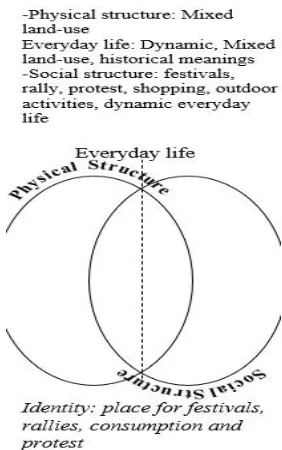
people to use space equally but does demand that no one be reduced to any characterization of his or her identity for the sake of global products. Intersubjectivity-literally “between subjects”-is arguably the organic structure of human cognition [35,36,37 and 38]. The participants’ shared activities contribute the cognitive development. Public space is a shared platform which connects past to present for generations and cultures. Urban space coordinates sociocultural and economic dynamics to construct moments of interaction between individuals. Urban space, the collaborative field of action composes the intersubjective space in which the individuals operate, from passing time on the café to political protests. Public space, identifies with everyday rhythms and sociopolitical uncertainties which create the common ground (Fig. 1). The common ground provides a basis for subjects to coordinate their joint activities. Cognitive development happens when the set of background beliefs and the current set of activities practice by subjects.
Fig. 1. A set of activities identifies public space structure
3. CONCLUSION
This descriptive study which examined the creation of public space showed that sense of time is socially constructed. When people’s cognitions and perceptions vary from day to day, just as the individual consciousness is re-shaped
and modified over time, individuals live in the multiple timeframes. This process allows the active participation and interaction of individuals in the public space. The time of space is indeed inert-subjective time, in that people do not apprehend the temporality that arises out of their spatial experiences and actions. The human mind understands and apprehends the culturally practiced realities. Otherwise, the manipulated time is far of their imagination brings about the exclusion of the groups who might not access the serving resources [39 and 40].
The created space, based on inter-subjective time, provides a sphere in which multiple intelligences have the chance to develop and progress. Individuals with different minds and of different socioeconomic statuses draw different lines of existence, revealing the existing common justice. Residents of contemporary globalized societies suffer from disenfranchisement, in that the practiced space does not allow them to act, participate or exist in social life [41].
Broadly speaking, cognitive analysis focuses on how users recognize, and experience time and space is required to let public existence of differences. Accordingly, the development of the embodied cognitions creates the productive space, in which all members of a society find a way to culturally practice reality and experience time. Cognitive development is not only the foundation, but also an integral part of urban life development. Accordingly, the idea of development should be planned based upon the continuity of the embodied experiences of the residents.
The study presented a new type of a shared space where the multiple actors of a society from local people to political-economic decision makers work together in creation of the socio-spatial and economic life of a place under the continuity of traditional contextual strategies, habits and practices. Indeed, the finding of this study provide a clue to investigate ‘a right to city life’ based on the embodied inter-subjective temporality. Additionally, the present study puts also forward suggestion for a new research path. further research may use similar methods to reveal individuals’ cognitions related to urban transformations, either in different parts of the city, in a comparison of different geographies and contexts [44 and 45].
COMPETING INTERESTS
Author has declared that no competing interests exist.
REFERENCES
1. Lotfata A, Sadeghi MJ. The creative city, reflecting new planning tendencies for cities. 5th Symposium on Advances in Science and Technology, Mashhad, Iran; 2009.
2. Madanipour A. Cities in time, temporary Urbanism and the future of the city, UK: Bloomsbury Academic Press; 2017. 3. Orange DM, Atwood EG, Stolorow RD.
Working Intersubjectively- Contextualism in Psychoanalytic practice. Hillsdale, NJ: The Analytic Press; 1997.
4. Lefebvre H. The Production of space. (Translated by Donald Nicholson-Smith). Oxford: Blackwell; 1991.
5. Laguerre MS. Urban multiculturalism and globalization in New York City: An analysis of diasporic temporalities. Palgrave Macmillan, New York; 2003. 6. Lotfata A. Effect of environmental factors
on behaviors and learning, in educational spaces (Especially Elementary Schools). Modiriyat Shahri. 2008;21.
7. Amin A. Ethnicity and the multicultural city. Environment and Planning A. 2002;34(6): 959-980.
8. Bautman B. Imagination as appropriation. Space and Culture. 2003;6(3):261-275. 9. Schutz A. Walsh G, Lehnert F. The
phenomenology of the social world, Evansto, IL: Northwestern University Press; 1967.
10. Blumer H. Symbolic Interactionism: Perspective and method. Berkeley: University of California Press; 1969. 11. Merleau-Ponty M. Phenomenology of
Perception, New York: Humanities Press; 1962.
12. Ricoeur P. Hermeneutics and the human sciences. In J.B. Thompson (Ed), Cambridge, UK: Cambridge University Press; 1981.
13. Lynch K. Good city form Cambridge. MA, MIT Press; 1981.
14. Jacobs J. The death and life of great American cities. New York, Random House; 1961.
15. Kahneman D. Thinking, fast and slow. New York: Farrar, straus and Giroux; 2011. 16. Giddens A. The Constitution of Society.
Berkeley, CA: University of California Press; 1997.
17. Lotfata Y, Lotfata A. Effect of physical changes on the spatial structure of historical area, the Historical District of Urmia city as a case study. Journal of Ustainable Development. 2018a;11(4). 18. Heidegger M. Being and time. Translated
by J. Macquarrie and E. Robinson. New York: Harper and Row; 1962.
19. Mead GH. The mechanism of social consciousness. Journal of Philosophy. 1912;9:401-406.
20. Baars BJ. A cognitive theory of
consciousness, Cambridge, UK:
Cambridge University Press; 1988.
21. Bosselman P. Representation of places: Reality and realism in city design. Berkeley and London: University of California Press; 1998.
22. Kaplan S, Kaplan R. Cognition and environment: Coping in an uncertain world. New York: Praeger; 1982.
23. Heidegger M. Being and Time. Translated by J. Macquarrie and E. Robinson. New York: Harper and Row; 1962.
24. Donald M. A mind so rare: The evolution of human consciousness. 1st Ed. New York: Norton. 2001;xiv:371.
25. Ambinakudige S, Parisi D, Cappello GC, Lotfata A. Diversity or segregation? A multi-decadal spatial analysis of demographics of atlanta neighborhoods, spatial demography; 2017.
26. Flaherty M. A watched pot: How we experience time. New York: New York University Press; 1998.
temporal processing. Neuroscience. 2001; 4:317–323.
28. Livesey AC, Wall MB, Smith AT. Timeperception: Manipulation of task difficulty dissociates clock functions
from other cognitive demands.
Neuropsychologia. 2007;45:321–331. 29. Taatgen NA, van Rijn H, Anderson JR. An
integrated theory of prospective time interval estimation: The role of cognition, attention and learning. Psychological Review. 2007;114: 577–598.
30. Lotfata A. Urban diversity in the Middle East: A case study of Tehran. International Journal of Culture and History. 2015;2:1. 31. Isaacs R. The subjective duration of time in
the experience of urban places. Journal of Urban Design. 2001;6:109–127.
32. Lotfata Y, Lotfata A. Street as common space. International Journal of Culture and History. 2018c;5(2).
Available:https://doi.org/10.5296/ijch.v5i2.1 347
33. Lotfata A. Socio-spatial resilience strategic planning through understanding strategic perspectives on Tehran and Bath. World Academy of Science, Engineering and Technology. 2012;6(11).
34. Riggio M. Culture in action the traditional experience. New York: Routledge; 2004. 35. Clark H. Using language, Cambridg, UK:
Cambridge University Press; 1996.
36. Hutchins E. Cognition in the wild, Cambridg, MA: MIT Press; 1995a.
37. Vygotsky LS. Mind in society: The development of higher psychological processes, Cambridge, MA: Harvard University Press; 1978.
38. Schutz A. Walsh G, Lehnert F. The phenomenology of the social world,
Evansto, IL: Northwestern University Press; 1967.
39. Lotfata A. The role of socio cultural practices in the transformation of socio cultural practices in the transformation and re-structuring of streets: A case study of bagdat street in Istanbul. Middle East Technical University, Ankara, Turkey; 2014.
40. Lotfata A, Ambinakudige S. Natural disaster and vulnerability: An analysis of the 2016 flooding in Louisiana, Southeastern Geographer. 2019;59(2). 41. Lotfata Y, Lotfata A. Resiliency of open
public space (Streets) through transferring memory Graffiti and Wall Arts in the Tehran streets. International Journal of History and Scientific Studies. 2018b;1(3). 42. Lotfata A. The role of socio cultural
practices in the transformation of socio cultural practices in the transformation and re-structuring of streets: A case study of Bagdat Street in Istanbul. Middle East Technical University, Ankara, Turkey; 2014.
43. Lotfata A. Socio-spatial resilience strategic planning through understanding strategic perspectives on Tehran and Bath. World Academy of Science, Engineering and Technology. 2012;6(11).
44. Lotfata A. Transformation of Urban spaces through time-space politics towards ethical developing Urban spaces in Turkey Context. Global Journal of Human Social Science Political Science. 2013;13:4. 45. Lotfata A. Epistemological differences in
tactical and strategic spatial planning. Global Journal of Computer Science and Technology Neural & Artificial Intelligence. 2013;13:1.
2019 Lotfata; This is an Open Access article distributed under the terms of the Creative Commons Attribution License
(http://creativecommons.org/licenses/by/4.0), which permits unrestricted use, distribution, and reproduction in any medium,
provided the original work is properly cited.
Peer-review history: